


After sheet or bar stock is cut, where do the usable remnants go? They may sit on a shop floor rack with no searchable dimensions or material grade, so the next job draws new stock. Or a remnant with uncertain grade or lot is used and the product history can no longer be traced. Implementing a remnant material management system takes more than photographing offcuts. It means linking the moment a potentially reusable piece is created to conditional storage, reservation, recutting, and eventual disposal in one transaction history. This article is primarily for metalworking and sheet metal factories in Thailand. It sets out requirements, RFP questions, acceptance tests, and a way to think about costs. Numerical examples are design assumptions, not market averages or guaranteed results.
Define the Scope of Remnant Management First
“Leftover material” is too broad to define a system. If unused, unprocessed components are returned from a production order to the warehouse, restoring their quantity and ownership to the original inventory is a matter of surplus material return control. Material rejected during processing and no longer reusable, or approved for disposal, belongs in scrap management. Here, a remnant is a physical piece left by cutting or punching that can potentially be used on another production order if its dimensions, material, and quality meet the requirements.
Examples include a sheet left after laser cutting, a length left from standard bar stock, and the remaining length of an extrusion. Potential usability alone should not make a remnant “good inventory.” A simple area measurement for an irregular sheet cannot prove that the next part will actually fit. Conversely, classifying every remnant as scrap forfeits opportunities to save purchasing, storage, and cutting effort. Define explicit states such as candidate, verified, reserved, in use, quality hold, and approved for disposal. Assign a responsible person and evidence to each transition.
Autodesk’s official explanation describes a remnant in nesting as material left after cutting that is tracked for reuse in future jobs. Its product documentation describes criteria such as minimum remnant length and disposal of used portions. These are design references for deciding which remnants to keep, not an endorsement of a product. TRUMPF’s Storage Module also covers inventory management for sheet metal and remnants. Linking remnant inventory to process planning and storage equipment is an implementable option, but do not assume that an ERP system alone can manage the geometry.
Start with Unique Identification and Units of Measure
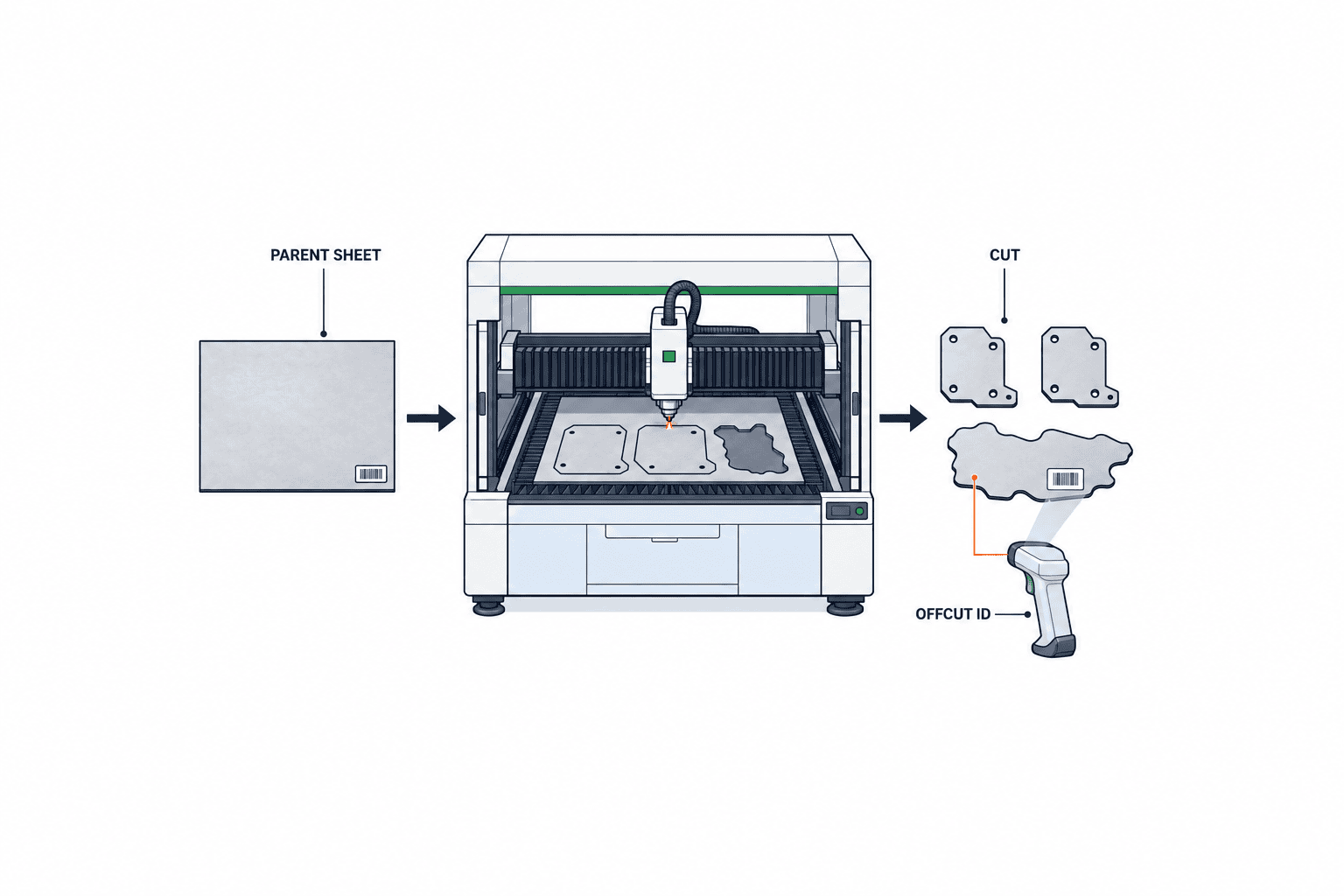
When a remnant is created, record its parent material ID, cutting job, machine, time, operator, material specification, sheet thickness or diameter, lot, owner, original dimensions, remaining dimensions, and storage location. If drawings or nesting data exist, link the geometry file and contour revision. Required attributes depend on the product. Material with a directional appearance may require rolling direction, surface finish, and face orientation. Where a job requires a heat number or material certificate, carry the parent material’s certificate ID into the remnant record. “2.0 mm steel sheet, about half left” is insufficient to decide whether it can be used.
Do not force weight, area, length, and piece count into one unit. Purchasing may work in kilograms, nesting in millimetre bounding dimensions, the warehouse in pieces, and accounting in monetary value. Specify the base and display units, and version the basis for conversion. For an irregular sheet, its contour, holes, and missing areas that define the usable region matter more than the area of a simple length-by-width rectangle. A barcode scan should display a geometry preview and use restrictions as well as numbers.
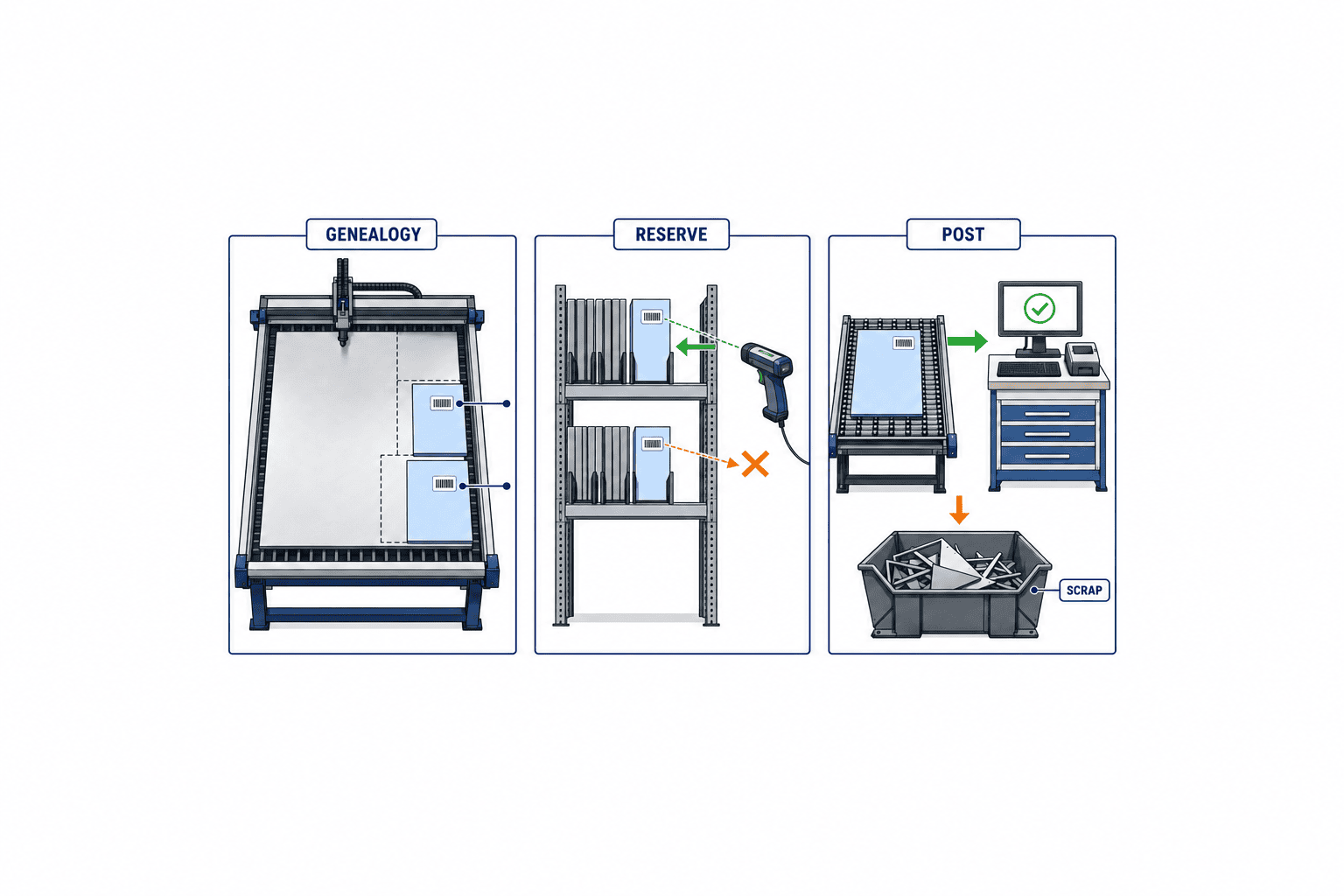
If one parent sheet produces several remnants, give each a unique ID and preserve the parent-child relationship. Do the same when recutting a remnant produces another remnant. To avoid counting the original and its children as duplicate inventory, mark the original as consumed or split when creating the children. Microsoft’s manufacturing traceability material describes linking material and component batch or serial numbers to finished goods. Remnant management must additionally retain the “parent material → remnant → product using the remnant” lineage. That extra lineage is a design requirement proposed here.
Master Data Versus Transaction Data
Manage material specifications, permitted thicknesses, surface conditions, minimum usable dimensions, and customer-specific bans on reuse in master data. A remnant’s measured dimensions, shape, lot, rack, damage, reservation, and latest inspection time belong to the individual item and its transactions. If the distinction is unclear, a later master-data change can appear to rewrite the basis for an earlier decision. Keep the criteria revision and measurements used at the time. Decide whether a master-data change applies automatically to existing remnants or puts them in a queue for reinspection.
Print the ID and minimum identifying details on the remnant label and show the fuller record in the system. Pieces too small for a label can be identified by a container or bundle, provided its contents do not mix grades or lots. The RFP should specify that a lost label is replaced only after physical verification and approval to restore the same ID, never by guessing.
Matching Material Grade Alone Does Not Establish Reusability
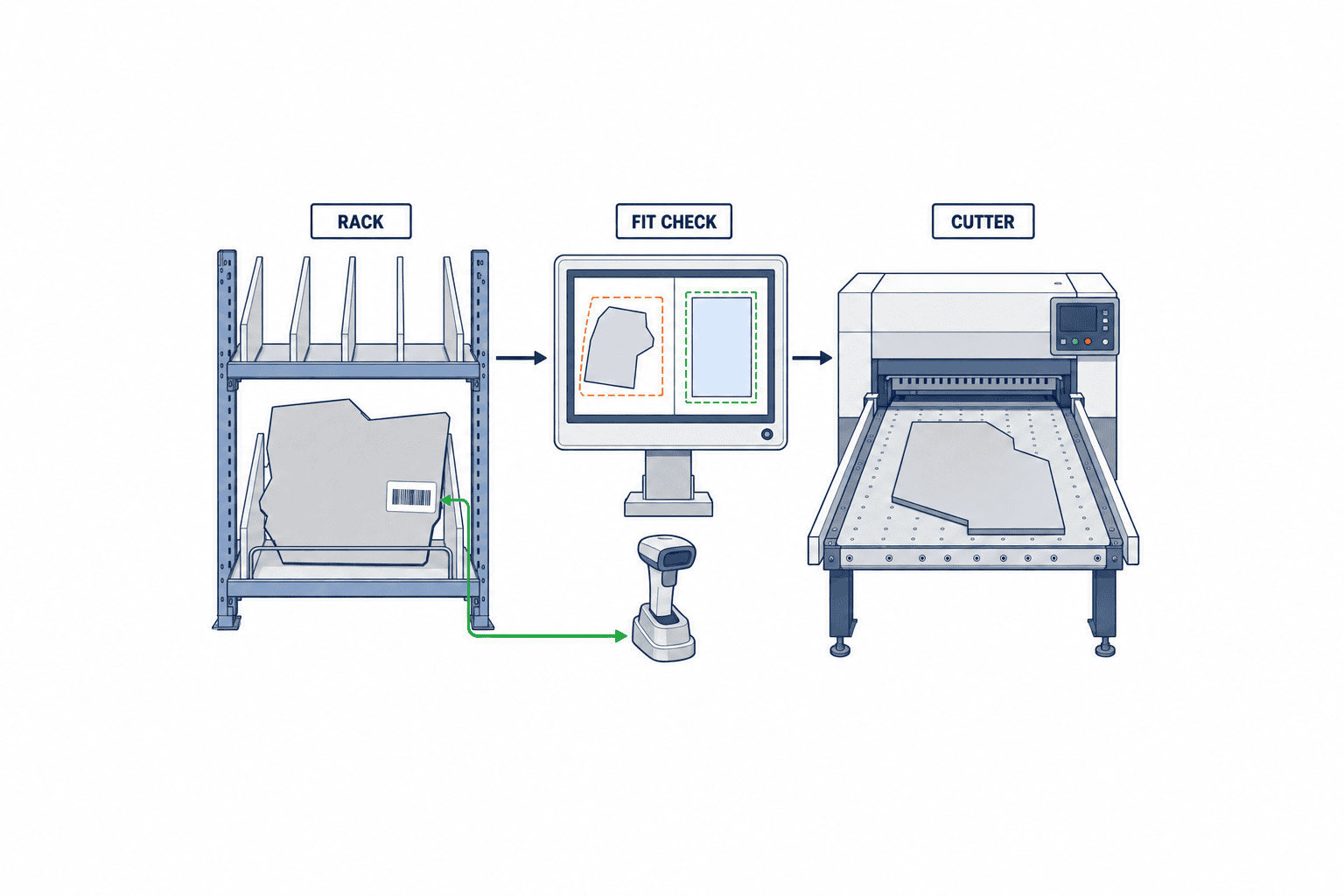
A candidate search should combine grade, thickness, length and width, orientation, quality status, customer restrictions, location, and due date. Even where the ERP item number matches, the production order may impose different limits. For jobs requiring material certification, verify that the certificate link is still available. Customer-supplied material may not be used for another customer’s job even if it has the same specification. A remnant past its permitted storage period or rust-prevention treatment date should not be selectable before reinspection.
A “usable shape” depends on the part. A part may fit inside the remnant’s bounding rectangle yet fail nesting because of existing holes, cut edges, clamp zones, or grain direction. A reservation should therefore retain the remnant ID, current geometry revision, planned part, required quantity, and a reference to the nesting result. A CAM specialist or process owner should approve the final decision; an automated candidate result should not become an unconditional issue authorization. Autodesk’s remnant documentation says saved remnants can be nested manually or automatically, but each factory still needs to decide who verifies its clamp, quality, and customer constraints.
Concurrent reservations by two production orders are another risk. Visibility in search does not mean a remnant is available for use. Make the reservation operation atomic so that only the successful order changes the state to reserved. Release an expired reservation automatically, with warehouse confirmation if the piece has already moved from its rack. For offline devices that upload later, make duplicate scans idempotent using one transaction ID. An old reservation uploaded after network recovery must not overwrite a newer one.
Standard Flow from Creation to Reuse
- At completion of a cutting job, confirm the parent material ID and planned nesting revision, then register the resulting remnants as candidates.
- An operator checks actual dimensions and surface condition, updating the photo or contour where needed. Put a piece on quality hold if its material specification or lot cannot be read.
- A warehouse or process owner verifies the reuse criteria and changes the status to verified. Send pieces below the minimum dimensions to a scrap request.
- Scan the shelf, rack, or container on put-away to link the remnant ID to its location. Record a transfer history when only the storage location changes.
- For a new production order, search candidates, check shape, material, and quality constraints, then reserve a piece. Fix the intended order at reservation.
- Issue and move the physical piece to the cutting machine. At the machine, match its ID against the approved nest. Record the actual piece and quantity used and any new remnants created from it.
- For a piece deemed unusable, record the reason, measurements, and approver before handing it to scrap management. Follow the responsible department’s approval process for accounting write-downs and BOI-related disposal decisions.
This is an example flow. It does not replace existing factory quality approvals or accounting entries. In the RFP, define event by event which actions increase or decrease ERP inventory. Ambiguity over whether a remnant enters accounting inventory when registered or only after warehouse acceptance can cause double counting. Choosing between a separate lot of an existing item and a dedicated remnant item also requires considering tax, costing, and stocktaking effects.
System Boundaries: CAM, MES, WMS, and ERP
CAM and nesting determine which parts can be placed in a shape. MES records cutting jobs, actual material inputs and outputs, and machine results. WMS or an inventory application manages the physical remnant, location, reservations, and movements. ERP handles parent material valuation, issues, production costs, remnant valuation, and transfer to scrap. One product need not do everything. Use the remnant ID and transaction ID as common keys, and designate the system of record for each fact.
For example, an MES creation event creates a candidate in WMS, and WMS acceptance sends an inventory transaction to ERP. WMS finalizes the status after the ERP response. If communication fails, preserve a visible “accepted, pending ERP posting” state so an operator does not manually register the same receipt twice. Updating geometry in CAM changes its revision and triggers a review of reservations based on the older revision. Include retries, cancellations, and reversal entries in business testing.
“Displays remnants in an inventory list” is an inadequate software selection criterion. Check contour-data input formats, ID schemes across systems, hold and disposal transitions, offline device behavior, Thai and English interfaces, label reissue permissions, and history export. Functions in TRUMPF and Autodesk products are reference examples. A fair comparison asks each vendor to process the same test remnant and production order in its demo.
Include Exceptions and Pass Criteria in the RFP
Do more than write one normal scenario. Include at least multiple parent-material lots, an irregular sheet, a damaged remnant, customer-supplied material, a missing label, competing reservations, a new remnant after recutting, a rack transfer, failed ERP integration, and final scrap approval. For each case, specify inputs, expected status, inventory quantity, approval authority, audit log, and recovery method. Ask vendors to demonstrate evidence in a demo or configuration screen rather than merely ticking a feature box.
Minimum data fields are remnant ID, parent material ID, originating order, grade, specification, thickness, dimensions, geometry, original lot, certificate, owner, quality status, location, reserved order, lifecycle status, event times, operators, and criteria revision. Too many fields will stop shop floor entry. Separate values inherited automatically, values obtained from equipment or CAM, and measurements that people must take, minimizing manual input. A photo helps verify shape but cannot replace measurements or a material certificate.
Give operational burden substantial weight in the selection scorecard alongside features. Candidate criteria include agreement between physical stock and records, prevention of incorrect reuse decisions, ERP/WMS/CAM integration, time spent on shop floor devices, history and permissions, and explainability of implementation and maintenance. The factory must set its own weights; no vendor ranking works everywhere. For a requirement that standard functions do not cover, state whether a process change, configuration, or custom development will close the gap. If development is needed, include upgrade impact and maintenance ownership in the estimate.
Cost and Investment: Compare Like-for-Like Units
Initial costs include requirements work, labels and devices, geometry-data integration, ERP/WMS/MES/CAM interfaces, master-data cleanup, shop floor training, and testing. Ongoing costs include subscription or licence fees, support, device replacement, label consumables, cloud storage, geometry-data upkeep, and stocktaking labour. Compare quotes using the same assumptions for number of remnant IDs, sites, devices, interfaces, and years of data retention. There is no defensible single market price for this scope, so no price is asserted here.
Benefits should include more than reduced material purchases. Track time to find pieces, rack occupancy, recutting setup, wrong-material and nonconformance risk, disposal handling, and inventory discrepancies. An overly aggressive reuse target can encourage hoarding of low-value pieces. Set a retention threshold using expected reuse value less storage, search, recutting, and quality-inspection costs. For example, as a purely hypothetical calculation, expected material savings of THB 1,000 less THB 700 to find, move, recut, and inspect the piece and THB 200 in storage cost leave THB 100 net value. These are not prevailing prices in Thailand. If the net value is negative, sending the piece for a scrap decision may be more rational than storing it.
Track remnant reuse counts and weight together with time from candidate search to issue, physical mismatch rate, reservation cancellation rate, storage days, rack occupancy, reasons for transfer to scrap, and success rate of original-lot tracing. Keep denominators consistent. Decide whether the denominator is remnants that met the retention criteria or all cutoffs, then segment by grade, thickness, and process. Autodesk’s official article also treats material utilization, scrap rate, and remnant reuse as separate measures. Do not apply a sales brochure’s single reduction percentage to your factory as a forecast.
Ten Acceptance Conditions for FAT and SAT
Use FAT to reproduce configuration, integration, and failure cases in the vendor environment. Use SAT to verify them on the actual equipment, racks, network, and with the operators. The following are starting points for pass or fail criteria.
- Cut one parent piece into two remnants and retain the parent-child IDs, original lot, and certificate for both.
- Do not reserve an irregular sheet incorrectly from rectangular dimensions alone; refer to its approved geometry revision.
- Exclude a remnant with a different customer owner or surface condition even if its material grade matches.
- Allow a piece on quality hold to appear in candidate search if useful, but prevent issue and machine start.
- When two orders reserve the same piece concurrently, exactly one succeeds.
- When replacing a missing label, record physical verification, authorized approval, and invalidation of the old label.
- A scan at the old rack after a transfer must not create a duplicate receipt; the current location remains unique.
- After an ERP response stalls, retry using the transaction ID without double counting inventory or accounting entries.
- When recutting produces a new remnant, consume the original and create lineage for the new child.
- After disposal approval, prevent further reservation and pass the reason and valuation information to scrap management.
Attach transaction logs, before-and-after inventory quantities, ERP documents, and scan histories as evidence, not screenshots alone. Measure any operation-time requirement with the actual gloves, lighting, devices, and network conditions. Agree acceptable waits and the treatment of matching errors before contracting so “pass” does not depend solely on an individual’s judgment. Set numeric thresholds after measuring the factory’s baseline; do not import unsupported universal values.
Assign Operational Responsibility in a Thai Factory
If a Japanese headquarters sets material standards, the Thai factory measures and stores remnants, and local purchasing decides on replenishment, identify who approves each remnant status. Permission to substitute a material and permission to reuse a remnant are separate decisions. Confirm ownership boundaries for customer-supplied material. Japanese-only screens and reports cannot support local decisions. Check Thai and English terms for statuses and error reasons, not only translations of material names, as well as procedures for each role. Thai tax and BOI disposal requirements depend on each company’s permissions and circumstances. Refer applicability decisions to tax and legal staff, while designing the system to retain required approvals and evidence before disposal.
If sites share a remnant ID scheme, check that parent and remnant lineage survives interfactory transfer. Transporting a piece may, however, cost more in freight, packaging, duties, and inspection than reusing it locally saves. Begin candidate searches within one factory, and expand across sites after evaluating economics and applicable rules.
Four Implementation Stages in the Right Order
Stage 1: Investigate the physical flow. Rather than loading every sheet and bar item at once, select one material and machine with meaningful cutoff volume and reuse potential. Follow recent cutting jobs from parent-material receipt, nest preparation, and actual cutting through storage, subsequent use, and scrap decisions. Record who captures which information. Ask where undocumented decisions such as “this scratch is acceptable” or “this customer cannot use it” are made. A specification that erases such shop floor judgment is unsafe even if it has many input fields.
Stage 2: Establish IDs and states. Assign remnant IDs and first test whether the parent material, lot, physical piece, and rack agree. Automatic geometry integration can follow. Decide who corrects a mismatch between the label and on-screen dimensions and who puts the piece on hold. Provide temporary records and reconciliation for periods when scanning is unavailable or equipment is down, so a later batch entry does not create fictitious stock. If the causes of inventory discrepancies are invisible at this stage, adding interfaces only spreads them faster.
Stage 3: Connect reservations and nesting. Search verified remnants only, then connect order reservations, CAM geometry checks, and physical identification at the cutting machine in sequence. Test exceptions such as a successful reservation with no piece on the rack or a physical piece whose geometry revision is stale. Update the recorded location immediately when an operator temporarily removes a remnant from a rack. If two orders compete for it, design either first-come allocation or reassignment to a higher-priority order together with the shop floor approval process.
Stage 4: Integrate accounting and roll out factory-wide. Connect ERP quantities, valuation, and journal entries. At month-end, verify how candidate, verified, held, and pending-disposal pieces appear on inventory reports. Do not expand to more sites while geometry or lot data is missing. After rollout, measure entry delays and physical mismatches as well as creation counts, reuse rate, and search time. If operators stop registering unusable pieces to improve reported results, the denominator becomes invalid. Keep registration and measurement criteria stable so before-and-after results remain comparable.
Three Data Migration Risks
First, an existing Excel ledger or machine notes may call the same material “SUS304,” “304,” and “stainless steel 304.” Verify the mapping between material specifications and purchased items before consolidating; do not bulk-convert on a guess. Second, a rack address on paper may differ from its physical sign. Count physical locations and assign temporary remnant IDs for reconciliation before importing records. Third, avoid migrating old pieces with unknown original lots as unrestricted good inventory. Restrict them from uses requiring certification and decide whether other uses are allowed or the pieces should be disposed of. Even a small migration can require agreement among quality, warehouse, and accounting staff.
Design Input Around Shop Floor Work
An operator at a cutting machine will not sustainably enter a dozen fields for every remnant. Auto-display values inherited from the parent stock and cutting job, and ask the operator for facts only the physical piece reveals: measured size, scratches or deformation, and location. Even when geometry comes from CAM, request confirmation if the planned nest differs from actual cutting. Photos are useful evidence, but taking them may require removing gloves or transferring substantial data. During SAT, measure entry time and check device placement, label surfaces, power, and network conditions to establish a safe operator workflow.
The most important exception in remnant reuse is that pieces which look identical may have different conditions for use. Even with the same nominal thickness and material grade, the presence of a material certificate, heat treatment, surface treatment, or damage and corrosion during storage can change the permitted applications. Instead of merely marking a candidate “usable,” show the product, customer, and process for which it was approved, together with the criteria revision. If the physical piece conflicts with its record, suspend issue until quality staff reassess it. Even when a production priority justifies an exception, record who approved what based on which evidence and how long the approval remains valid. This keeps an approval for one urgent order from being mistaken for unrestricted permission on future orders.
When measuring a remnant, distinguish its overall bounding dimensions from the area that can actually be used. A rectangular sheet with a hole near an edge cannot accommodate a part in that region. For bar stock, a damaged cut face, bend, or required gripping allowance means the nominal remaining length is not the usable length. Standardize the measurement method and retain both the geometry revision and measurement time. Define a camera position and lighting that do not compromise quality, and include a scale reference when images support an assessment. Make clear to operators that a photograph alone does not establish dimensions.
The storage layout is also part of the data model. Grouping long stock, thin sheet, heavy material, and customer-supplied material under one rack number may look unambiguous on screen but leave pieces difficult to find. Identify the rack, level, and container, and define the sequence for retrieving physical stock. Where corrosion or deformation is a risk, set a maximum storage period and reinspection conditions. Distinguishing held and usable pieces by colour alone invites mistakes when labels are dirty or lighting is poor. Display the state in text as well and physically separate held pieces from usable-stock racks. Tidying the device screen without recording put-away and retrieval will not improve inventory accuracy.
At month-end stocktaking, verify more than the system balance: check each remnant ID against its physical location, material, usability status, and original lot. Immediately reclassifying a missing piece as scrap can confuse an unrecorded move with disposal. Classify discrepancies by cause, such as unrecorded reuse, an incorrect rack transfer, a damaged label, a corrected measurement, or a child remnant not registered after cutting. Provide a correcting transaction for each cause instead of overwriting historical entries and erasing the trail. Separating authority to adjust the ledger balance from responsibility for physical verification makes monthly reconciliation easier to explain.
If several remnants are used on one production order, retain the actual quantity used from each. Reporting them together as “one sheet” obscures both original-lot traceability and the remaining reusable area. Conversely, if one remnant is used on several occasions, connect its first issue and each cutting result through parent-child IDs. Test whether material lineage reaches the product by working backward from a hypothetical customer inquiry about a specific lot, not only by tracing a normal job forward. Records that take days to retrieve do not provide adequate operational traceability merely because they exist.
If offcut reuse is judged only by the number of pieces used, sound disposal decisions may look like poor performance. Do not increase the reuse count by skipping the time needed for quality checks. In improvement reviews, look together at the material value recovered, labor spent on verification, failed reprocessing, and reasons why held pieces were finally scrapped. Record cases where not reusing an offcut was the rational choice and revise the retention threshold accordingly. The purpose of an offcut control system is neither to eliminate every remnant from the warehouse nor to maximize the reuse rate. It is to prevent mistaken identity, make suitable material safely findable when needed, and dispose of unsuitable material with a documented reason. With that objective shared, operators do not need to force a questionable remnant back into production merely to improve a dashboard figure.
Frequently Asked Questions
Can a general inventory management system handle remnants?
An inventory-system extension may suffice if the task is limited to remnant IDs, dimensions, original lots, and locations. If it must handle irregular contours, nesting, child remnants created by recutting, customer-specific restrictions, and matching at machine issue, the design needs CAM/MES integration. Start with a small representative process and identify decisions that the current system cannot make.
When should a cutting remnant be recognized as inventory?
There is no universal point. Choose creation, post-measurement, or warehouse acceptance as the accounting and quantity recognition event in line with costing and stocktaking policy. Avoid counting a candidate on the shop floor in ERP inventory while also leaving it in the parent stock balance. Agree on the system of record and reversal procedure with accounting.
When does a remnant become scrap?
Consider more than minimum size: unknown grade or lot, damage or corrosion, storage life, future demand, and the cost of finding, moving, and inspecting it. Send pieces below retention criteria to a scrap request, and finalize status and accounting treatment after authorized approval. “Remnant” and “scrap” are not interchangeable labels fixed at creation.
Should we use barcodes or RFID?
Test against remnant shape, rack density, attachment to metal, reading position, contamination, and cost. Establish unique IDs and operating rules first; barcodes are a practical starting point if scanning pieces individually is sufficient. If bulk RFID reads are needed, test missed and false reads in the metal environment. Changing the identification medium alone will not define geometry, quality, or reservation rules.
Conclusion
Reusable remnant inventory requires a unique ID, lineage to the parent material, measured geometry and material properties, quality and ownership restrictions, exclusive reservation and issue, and consistent transactions with ERP. Set an economic threshold for retaining pieces and make states explicit from candidate through verification and reuse to scrap. Start with one cutting process and representative material. Use FAT and SAT to confirm that the physical pieces, CAM data, warehouse records, and accounting quantities agree.
If you are deciding where to begin with remnant stocktaking, nesting, or ERP integration, contact TOMAS TECH. We can review your material flow and existing systems with you and define the smallest safe scope for managing reuse candidates.


