


“Can AI eliminate the scramble for records the night before an audit?” For a manufacturing process audit, the first deliverable should be an evidence package, not an automatically written report. It must connect the requirement effective when work was done to the actual product, process, equipment setting and execution record, and let an auditor open each original. This guide is for manufacturing plants in Thailand planning the data links, sampling rules, exception workflow, RFP and FAT/SAT acceptance tests for process audit AI.
Define the process audit AI job precisely
A process audit asks whether work was performed according to the instructions effective for that product, station and moment. That is different from using AI to classify inspection images or measuring whether a corrective action prevented recurrence. A useful process audit tool maps audit questions to evidence, checks document and setting revisions, selects auditable samples, and flags missing or conflicting records. A qualified auditor retains the final conformity judgment under the applicable customer and plant requirements.
For “Was the operator using the current torque setting?”, an AI answer of “yes” is inadequate. The evidence should show the serial or lot, operation time, station, work instruction revision, tightening program revision and measured result, operator authorization, change approval and original source links. A missing record should say “evidence unavailable”; a revision conflict should say “review required.” The fluent wording of a summary matters less than whether another auditor can reproduce its basis.
ISO 19011:2026 is guidance on audit principles, programs and execution. Its public preview defines audit evidence as verifiable information relevant to audit criteria. A search summary by itself is therefore insufficient: the source, applicable time, criterion and means of verification must be visible. ISO 19011 does not require an organization to purchase an AI system.
Build an evidence package from four connected layers
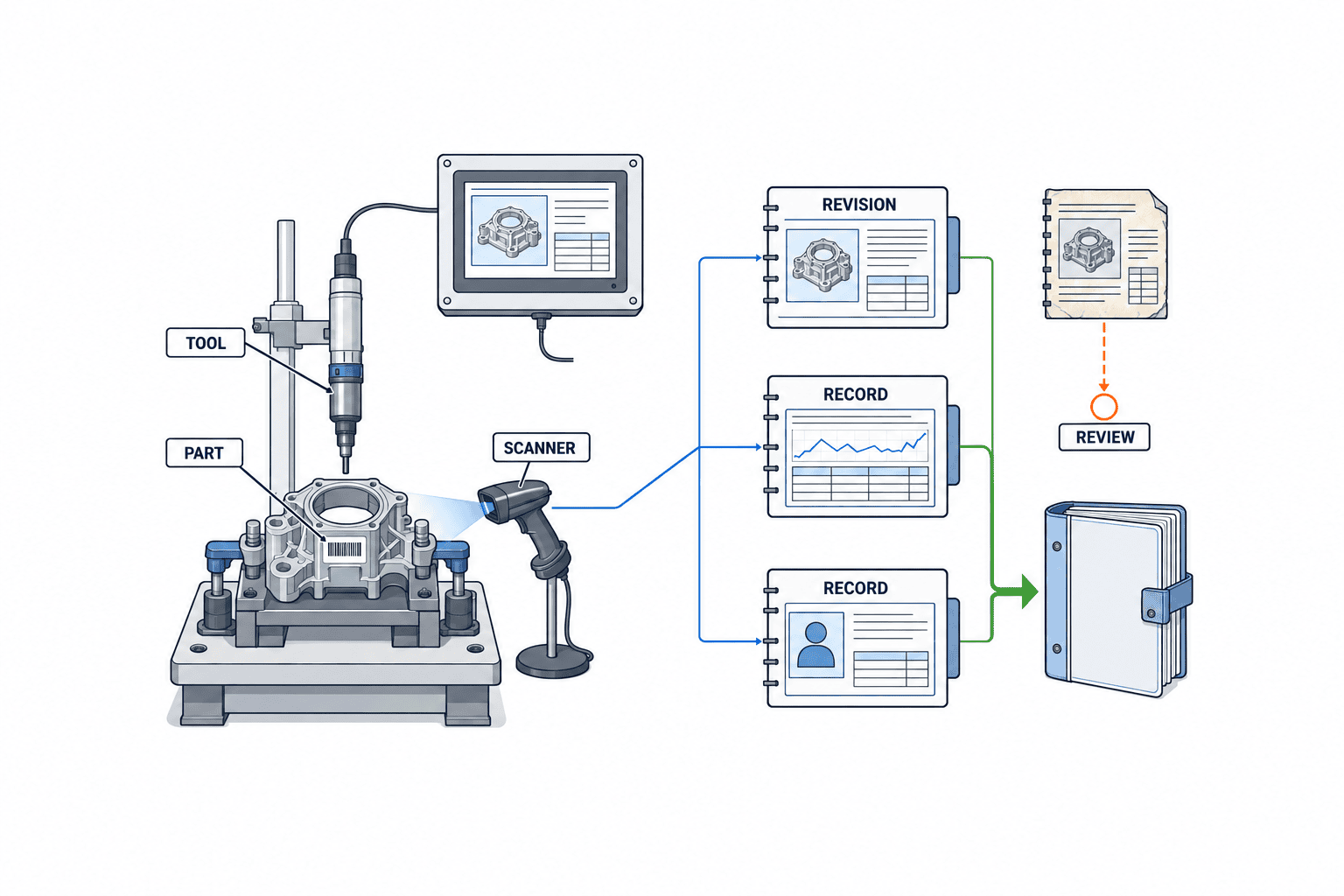
Divide an audit question into requirements, subject, execution and judgment. Requirements include customer specifications, control plans, work instructions, machine parameter sheets and approved process changes. The subject is the item or lot, operation, equipment, fixture and shift. Execution includes timestamps, measured values, alarms, checks, material and operator history. Judgment records the auditor’s observation, interview, classification, additional checks and approval trail.
All four layers must refer to the same product and production time. Pairing the latest instruction with a lot made last month does not show which revision applied last month. Store effective and expiry times, applicable product and line, and temporary instructions. Approval of a revision also does not prove that it reached the shop-floor terminal or that an operator used it.
| Evidence | Minimum join keys | Audit question |
|---|---|---|
| Requirement document | Requirement ID, revision, effective time, scope | Was this the criterion at the time? |
| Production execution | Lot/serial, operation, equipment, start/end time | Where did this item actually pass? |
| Machine or measurement | Asset ID, cycle ID, program revision, timestamp | Does it belong to the item’s process window? |
| People and material | Operator ID, authorization revision, material lot, use time | Was another lot or shift mixed in? |
| Audit finding | Question ID, sample ID, auditor, decision time | Who decided what, and on which originals? |
Agree on the meaning of each key before connecting systems. An ERP “lot” might identify incoming material while an MES “lot” identifies finished output and a spreadsheet “lot” means a packing unit. Joining identical column names would produce a false evidence chain. Preserve splits, merges, rework and retests as explicit events. If a join cannot be established, show that limitation and request investigation instead of asking AI to guess.
Our guide to customer-audit traceability and record retrieval covers the adjacent task of finding records quickly. Here the focus is turning the retrieved records into verifiable evidence for a specific process audit question.
Use the revision effective at production time
Loading only the current work instruction into an AI assistant can make it judge an older lot against a newer rule. Give each controlled document its effective period and applicable scope, then join it to the production event by time. If a document is approved at one moment and deployed to a line terminal later, retain both timestamps. The audit may need to examine that gap.
ISO 9001 addresses documented information and control of processes within a quality management system. ISO’s guidance on documented information explains the purpose of maintaining information to support operations and retaining information to provide confidence that work occurred as planned. It does not mandate a particular electronic form. In an RFP, specify retrieval of approval, effective revision, deployment and execution rather than a vague claim of “ISO compliance.”
Test the boundary of a change. Suppose a new revision takes effect at 10:00, reaches the terminal at 10:05, and a lot starts at 10:03 and ends at 11:00. Which rule applies is an operational decision based on customer requirements and the plant’s change-control procedure. Store the version of that decision rule. The system must also show “criterion unknown” or “criteria conflict” rather than silently selecting a convenient revision.
Map checklist questions to verifiable records
Scanning a checklist PDF and making its text searchable is only a starting point. Each question needs a process, requirement ID, evidence types, sampling unit and required human check. “Was first-piece approval performed?” may require a setup or change trigger, first-piece result, approval time relative to production start and an authorized approver. OCR may read a signature, but authorization must be verified separately.
The AI output should distinguish candidate evidence, gaps, conflicts and sources. Search and image recognition can gather candidates, while an auditor opens originals, inspects the station where needed, and records a decision. If generative AI paraphrases a requirement, keep the source text and revision beside the paraphrase so that a change in meaning can be spotted.
Select an initial proof of concept around one high-risk question with scattered evidence and one question with relatively clean records. This tests both value and implementation difficulty. Limit the scope to a process, product family and audit program, while defining join keys that can extend later. Converting every form to OCR first will not fix ambiguous product and revision links.
Make sampling reproducible
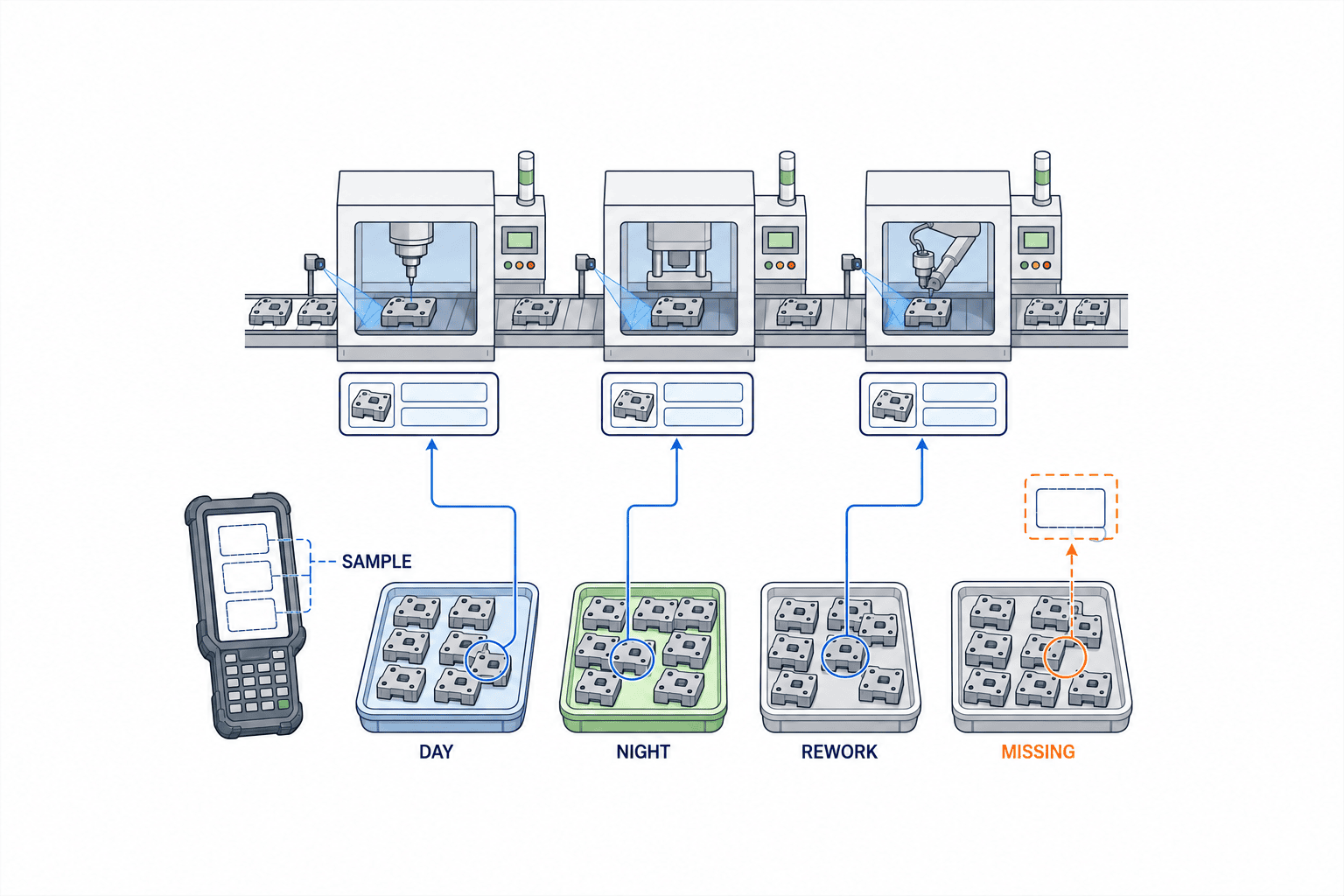
Auditors cannot inspect every transaction. AI can help by making sample selection transparent: retain the population, period, exclusions, method, random seed, selected IDs and reasons for replacement. Then another auditor can recreate the same selection. “Ten items most likely to have a problem” is ambiguous unless the risk-based selection rule is documented.
Different goals call for different methods. A process immediately after a major change might merit targeted selection; a stable process might combine random samples with strata for night shifts, machines, materials and reworked parts. Do not represent any one sample size as a universal standard. The audit owner should approve the method under the applicable customer requirement, audit program and process risk.
The official IATF 16949 FAQ explains that manufacturing process audit frequency depends on risk where a customer has not specified it, and that all processes fall within a three-year cycle in that IATF context. This is not a blanket interval for every industry. Tag each AI sampling rule with its audit program and customer requirement.
Do not replace a sample just because its record is missing. The absence itself may matter. If replacement is necessary, preserve the original sample, reason and approval. Monitor whether particular shifts or assets are systematically excluded. AI should keep the selection trail; it should not determine the audit finding.
Separate anomaly detection from an audit finding
An AI tool can detect an out-of-range value, revision mismatch, expired authorization or reversed timestamps. None automatically proves nonconformity. A clock fault, temporary approval, gauge replacement or rework path may explain the signal. The auditor checks originals and site facts against the applicable criterion. Keep distinct states for “review needed,” “verified deviation,” “conforming” and “decision deferred,” including reviewer and time.
Be particularly careful when AI infers joins. A similar operator name and nearby shift do not establish who made a part. Display time resolution, time zone, missing-data rate and delayed manual entry. Separate confirmed links from possible links; never silently fill missing audit evidence.
The NIST AI RMF Core calls for documenting intended tasks, limits and human oversight and for evaluating AI before and during operation. The NIST Generative AI Profile discusses automation bias and information integrity. In a plant audit, this means no automatic copying of a confident AI statement into a finding: the auditor opens the evidence and records a reason. NIST’s framework is voluntary guidance, not Thai factory legislation.
After a finding is confirmed, root-cause analysis and effectiveness monitoring move to a separate workflow. Our article on AI for corrective-action effectiveness covers that later stage. The audit tool’s job is to hand over the original evidence and the human decision intact.
Handle Thai, English and Japanese records without replacing the source
A Thai plant may receive English customer specifications, Japanese headquarters standards and Thai work instructions or interviews. Decide which language version is authoritative for each requirement before adding translation. Translation can aid search, but must not overwrite the controlled original. Display the requirement ID, source text, approved translation, revision and applicable operation together. Mark unapproved translations and use a glossary for plant-specific terms.
Before sending pictures or interview records to a cloud AI service, check customer confidentiality, the plant’s data classification, hosting location and access controls. Show only the personnel information needed for an audit and restrict it by role. Design against the site’s contracts and policies rather than assuming one universal legal rule. Compare sending full documents to an external model with sending only selected passages retrieved internally.
If a terminal stores records while offline, preserve capture and synchronization times and every correction. Decide by process risk whether an old instruction displayed during an outage should stop work or trigger supervisor review. The system must not overwrite the old audit trail quietly when the connection returns.
Measure three evidence-link rates before model accuracy
Model accuracy alone hides poor source data. Measure separately: evidence availability, meaning whether the required original exists; subject match, meaning it can be uniquely connected to the right item, operation and time; and revision match, meaning the effective criterion at production time can be identified. Use audit-question/sample pairs as the denominator. Set target values with the customer and plant risk owner; the article does not prescribe industry thresholds.
A form can exist but lack a lot ID; a machine log can exist but use an unsynchronized clock. Availability may look high while subject match is poor. In that case, add lot identification or synchronize clocks before optimizing AI. If the links are sound but opening originals takes too long, improve the search interface and permissions instead.
Have auditors and process owners construct a reference set from real historical lots and deliberately difficult cases. Include revision cutovers, night shifts, rework, missing records, duplicate names and clock drift. Count false conformity claims and false deviation alerts separately. If only the AI vendor chooses convenient forms for evaluation, a high headline score may say little about shop-floor risk.
Put inputs, outputs and responsibility in the RFP
An RFP should describe the operation from audit question to original record. Inputs are the audit program, controlled criteria and revisions, product/lot/process identifiers and MES, QMS, ERP and machine records. Outputs are selected samples, effective document revision, source links, gaps and conflicts, the auditor’s judgment and approval trail, and an exportable report. Specify retention, role-based access, logs, recovery, APIs and the export format if the service ends.
| RFP test | Demonstration required | Acceptance evidence |
|---|---|---|
| Historical revision | Revise an instruction across a production date | Document ID, revision, effective time, reason for selection |
| Subject linkage | Trace split, merged and reworked lots | Parent/child links and originals |
| Sampling | Rerun a fixed population and method | Same sample IDs and replacement trail |
| Missing basis | Omit a machine log or approval | Gap shown, no unwarranted conclusion |
| Human judgment | Auditor accepts or rejects a candidate | Reviewer, time, reason and change log |
| Access and export | Separate customer evidence by role | Permission test, masking and audit log |
The supplier is responsible for reliable candidate links, visible limitations and an action log for specified inputs. The plant owns authoritative criteria, identifiers, exception rules, designated decision makers and retention policy. Final conformity decisions remain with the auditor under the applicable audit arrangement. If an RFP says only “AI decides pass/fail,” acceptance cannot be objectively defined.
Include regression evaluation after model, OCR or search-index updates. Candidate ranking and summaries can shift even if source documents stay fixed. Test sampling, revisions and source links against a stable reference set and define rollback, approval and record retention for unacceptable changes.
Challenge the system at FAT and SAT
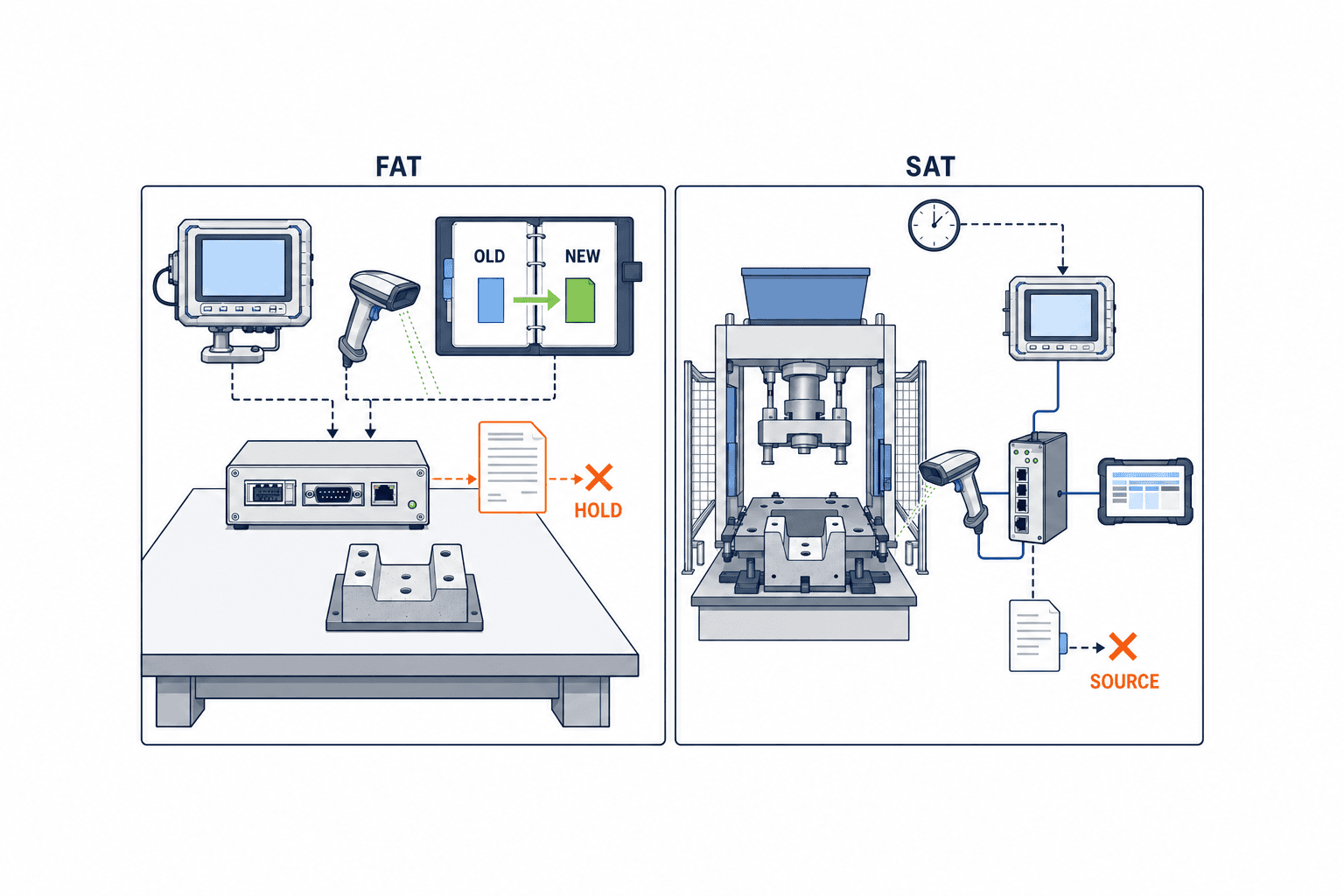
FAT uses representative copies of criteria and production history before the system connects to the real plant. SAT repeats the tests with live interfaces, local Thai forms, machine clocks, network behavior, permissions and auditor operation. Passing clean demo data at FAT does not prove that messy live data will work at SAT. Keep separate acceptance records.
Include lots produced immediately before and after a revision, two machines making the same part, a missing approval, a drifting clock, a reworked item passing twice, a customer file outside the user’s permission, and an auditor rejecting an AI candidate. Specify the expected original, displayed revision, reason to hold a decision and person allowed to decide. The examples are test design suggestions, not standard-mandated quantities.
Do not accept on average response time alone. Measure time to open an original, whether absent evidence triggers a false conformity claim, whether unauthorized material is cited, and whether the evidence basis remains reproducible after an update. Treat false conformity as a particularly serious failure. Agree thresholds in the contract and retain the test data and results.
Compare integration cost before AI licensing cost
The model subscription is only one line of the budget. Controlled revisions, paper capture, MES/QMS/ERP connectors, synchronized machine clocks, lot genealogy, permissions, auditor interface and support can dominate. When identifiers are already consistent, start small. When each operation uses different paper and spreadsheets, data preparation is substantial. Separate setup and operating costs, and compare bids against a fixed scope of operations and evidence types. Do not put unsupported claims of percentage labor savings into a business case.
For outcomes, track preparation time, the share of evidence not found, revision corrections, time spent opening originals and repeat audits. Compare equivalent audit questions, sample counts and permissions before and after the pilot. AI changes where an auditor spends investigation time; it does not remove expert judgment.
Deploy in stages, starting with evidence integrity in one process
First inventory audit questions and the location of their records. Make requirement ID, revision, product, operation and event time part of a shared data contract. Next, assemble an evidence package manually for historical lots in one process; this exposes missing identifiers before software development. Implement document and record retrieval, historical revision matching, sample-selection history and source display on that limited scope. Auditors and process owners should approve the reference answer set and exception rules before AI starts proposing evidence. Complete FAT/SAT, then move change control and periodic evaluation into routine operation.
Set stop conditions before procurement. If the original cannot be opened, the effective revision cannot be determined, timestamp reliability cannot be explained, or the output cites information outside a user’s permissions, an AI recommendation must not enter an audit finding automatically. Repair the data or require additional human verification. Test these stops explicitly instead of judging a demonstration by how fluent its prose sounds.
Preserve an evidence export that remains readable later
The screen used on audit day may not exist six months later. Documents, models, user rights and system interfaces change. Export the question ID, criterion ID and revision, sample list, original record identifiers, retrieval time, auditor decision and change history with the report. Either archive the original under controlled access or retain a durable, integrity-checked reference to it. A report full of AI prose whose source links expire is weak evidence.
An export should distinguish a fact written in a record from AI inference. If it says “temperature in range,” show the actual value, unit, time and limits effective for that part. A reader can then spot a limit accidentally retrieved from another product. The exported summary should remain understandable on its own while retaining a path back to each original; a PDF containing only AI prose is insufficient.
Configure retention by customer contract, product, applicable law and plant policy; do not hard-code one period for every record. The RFP should require configurable retention, deletion of data after its period with an auditable deletion log, and customer-specific export permissions. Whether originals are stored in the cloud, on site or in an existing QMS, preserve the links between the effective revision and source record.
Monitor plausible-looking mistakes in operation
Count not only queries served but candidate rejections, incorrect revision matches, wrong-lot joins and cases where a missing source was summarized as conformity. Auditors and system owners should review patterns at a frequency they set. Frequent rejection of a question may point to naming, master-data, clock or form-entry faults rather than a need for model retraining.
Require opening originals for material findings and let auditors correct a candidate after observing a different reality on the line. A click alone does not prove careful review; the process should capture why the auditor accepted or rejected the evidence. Send source-data faults discovered during observation or interviews back to the quality owner so the record-creation process can be repaired.
In an operational review, diagnose whether each error arose in the AI answer, the retrieval index, the original record or the business rule. An obsolete revision in search calls for an index-update fix; a wrong lot on the original calls for better record capture; an ambiguous exception calls for an audit-owner decision. Changing only the prompt can improve wording while leaving the same wrong join. Rerun the same hard cases before and after a change, checking both false conformity claims and whether valid evidence was dropped.
Before extending to another process, compare its record structure and rebuild the evaluation set. Keep the common relationship between question, evidence, subject, time, revision and decision, but define new process-specific data contracts and join rules. A molding shot and cavity are not the same unit as an assembly tightening cycle; forcing both into the same form can turn a useful pilot into a search demo that fails elsewhere.
Frequently asked questions about process audit AI
Can process audit AI replace the auditor’s conformity decision?
It can retrieve evidence, match historical revisions, record sample selection and flag conflicts. A conformity decision may also require observation, interviews, customer-specific requirements and approval of exceptions. Keep the auditor’s original check and reasoning in the record.
Can checklist AI start with paper forms?
Yes, but legible OCR is not proof that a form belongs to the audited lot. Test the form revision, entry time, item and operation ID, approver and source image together. If staff must manually reconstruct most links, improve the form or capture process first.
Should AI choose the audit sample count?
It can prepare the population and risk context. The audit owner should approve count, frequency and coverage under the applicable program and customer requirements. Preserve the selection and replacement rules so the same sample can be reproduced.
Which systems should a plant connect first?
That depends on the audit question. Work-instruction adherence needs document control and production execution; machine parameters need MES and equipment logs; material mix-up needs ERP and consumption records. Trace one question to its originals before attempting to connect everything.
What matters most in an RFP and FAT/SAT?
Prioritize the revision effective when the product was made, safe handling of missing or conflicting records, reproducible sampling, original links and access controls. Put boundary cases into FAT, then repeat with site-specific forms, clocks and communications at SAT.
Summary
Manufacturing process audit AI is most useful when it links an audit criterion to the same product and moment as the execution record. Controlled revisions, selected samples, exception originals and human findings form one traceable chain. Start with one process, measure evidence availability, subject match and revision match, and prove at FAT/SAT that the system stops short of an unsupported conclusion.
If your Thai plant is still mapping forms, revisions and MES, machine or QMS connections, contact TOMAS TECH. We can start with a single audit question and identify where its evidence chain breaks.
Sources
- ISO 19011:2026 and its public preview, audit principles and evidence definitions.
- ISO 9001 and ISO/TC 176 documented-information guidance. The latter addresses the 2015 edition.
- IATF 16949 official FAQ, manufacturing process audit frequency in the automotive context.
- NIST AI RMF Core and NIST AI 600-1 Generative AI Profile, AI oversight, evaluation and information integrity.
*The data fields, tests and metrics in this guide are implementation proposals, not universal numeric or software requirements of the cited standards.*


