


The purpose of implementing AI for manufacturing corrective action effectiveness is to verify that an approved action was carried out, that defects fell under comparable production conditions, and that the improvement lasted long enough to justify closure. AI can join action logs to product, lot, equipment and inspection records; highlight changes in conditions; and alert a quality team to recurrence. It cannot itself approve the causal claim or close the case. This guide explains the workflow from root cause verification through action execution, effectiveness assessment, RFP, FAT and SAT for factories in Thailand and elsewhere.
Effectiveness assessment comes after detection, cause investigation and report drafting
Visual inspection AI can flag a scratch. Anomaly detection can report unusual equipment signals. Neither establishes why the scratch occurred. Root cause analysis (RCA) examines the possible mechanisms, using evidence from materials, equipment, methods, measurement and the shop floor. Once people verify the cause and authorize an action, a different question begins: did that action actually prevent the same defect from returning?
For the upstream task of joining inspection and process data, see our yield improvement AI guide. For drafting an 8D or corrective action document, see the AI corrective action report guide. This article focuses on the evidence for effectiveness and the authority to approve it. ASQ’s problem-solving framework includes defining the problem, diagnosing its cause, implementing a solution and sustaining results. ISO’s process approach guidance likewise includes evaluating the effectiveness of corrective action as part of improvement. Completing a work order is the start of that evaluation, not proof of success.
Keep immediate correction separate from corrective action. Sorting or quarantining the affected lot limits today’s impact; changing the process condition that produced the defect is intended to prevent recurrence. Some plants call the latter a corrective measure. Whatever term the local form uses, record both activities separately, because their completion criteria differ.
What AI should assess: changed outcomes, not merely a completed task
A maintenance log stating that a worn fixture was replaced does not show that defects fell. Record the equipment ID, replacement and restart times, part numbers, work confirmation, and approving person. Then link subsequent production and inspection records on the same timeline. AI can assemble the before-and-after cohort, show missing data and concurrent changes, and notify a reviewer when a pre-agreed limit is exceeded. A quality owner decides whether the evidence supports effective, ineffective, or continued observation.
Write the assessment plan *before* implementing the action. Otherwise it is easy to choose a convenient period with unusually few defects after seeing the data. Define the defect and its denominator, eligible product and equipment, pre- and post-action windows, minimum number of lots or units to observe, treatment of missing records, reviewer and reassessment date. There is no universal number of days: a rare defect or a weekly production run needs a different observation period from a defect occurring on every shift. ASQ’s discussion of effectiveness evaluation emphasizes choosing sound measures and a meaningful observation period.
Consider a purely illustrative example, not a reported factory outcome. Before a fixture change, 100 of 10,000 inspected parts fail; afterwards, 40 of 10,000 fail. The observed rate moves from 1.0% to 0.4%. If the later run also used a new material grade and halved inspection frequency, the fixture change cannot be credited from those numbers alone. A useful AI screen must show the changed material and inspection conditions, lot lists, denominators and limits of comparison. It should offer “assessment pending” when evidence is not comparable, instead of announcing a 60% improvement as a verified causal effect.
If an appropriate control is available, compare the same part, material and inspection method on a line or period without the action. Never leave a dangerous defect unaddressed just to manufacture a control group. Where parallel controls are inappropriate, use a stable baseline, adequate post-action exposure and a documented list of concurrent changes. Statistical significance alone is insufficient: ask whether the effect makes process sense and whether the action was carried out faithfully.
Five decisions to make before buying effectiveness-monitoring AI
1. Define the defect and its source record
Counts alone are not enough. Store the defect class, acceptance rule, inspection station and time, product or lot, quantity, method and measurement unit. If one department records “scuff” and another records “surface NG,” create a controlled classification dictionary. Retain original and revised judgments rather than overwriting one with the other. An AI system trained on inconsistent labels may learn differences in recording practice rather than differences in the manufacturing process.
2. Choose a traceability unit
A part, production lot, batch, molding shot and pallet support different questions. If inspection is per part but material use is only recorded per lot, material effects cannot be established more finely than the lot. If machine settings change per shot but only a daily value is stored, a later defect cannot be uniquely paired with its setting. Select a specific defect first, then match recording granularity to the time scale on which the process changes. Collecting every signal at the fastest possible frequency is rarely the right starting requirement.
3. Distinguish a candidate cause from a verified cause
AI may rank machine B, material lot M and a temperature change. Those are leads, based on association, timing or similarity to prior cases. To confirm a cause, the team checks a plausible mechanism, competing explanations, measurement error and shop-floor changes. Machine B might merely produce the hardest part numbers. Display “associated with machine B; compare within part number” rather than “machine B caused the defect.”
4. Define where automation ends
Early deployments can automate data retrieval, missing-data checks, comparison assembly and alerting. Decisions on containment, equipment setting changes, customer communication and closure of a corrective action case require authorized people. A high AI rank must never directly change a safety-critical process parameter. Approval rights and audit history belong in the RFP alongside analytical requirements.
5. Separate “implemented” from “effective”
“Implemented” means the approved action was applied to the intended equipment and product scope, with execution evidence checked by an owner. “Effective” means the pre-agreed observation time and production exposure were met, comparable data show sustained improvement without unacceptable side effects or recurrence, and the quality owner approved that conclusion. Put observation and decision-pending states between them; never advance automatically. Track unique evidence linkage, implementation fidelity, comparable before-and-after cohorts, recurrence, time to decision and staff input effort. Model accuracy is only a supporting measure.
Join process and inspection data for a valid comparison

The first integration task is to show that an inspection result and a process history refer to the same manufactured item or lot. Connect product or lot ID, operation, equipment, start and finish times, material lot and inspection event. Add parent-child lot and in/out events for split lots, rework and outsourced processes. A join on calendar date alone can combine items from different lines.
Sensor samples, materials and inspections have different granularity. State the join rules explicitly: for example, map pressure samples within a molding-shot interval to parts from that shot, and map a material lot from one changeover event to the next. Check clock source, time zone, synchronization error and delayed data entry across PLC, MES and inspection terminals. Preserve source system, record ID, retrieval time and transformation version so a later reviewer can reproduce what the AI saw.
Measure the proportion of selected defect events for which all required product, material, equipment and time links are unique. We call this the *matchable rate* as an operational measure for this project, not a universal standard metric. Inferred or ambiguous joins go in a separate category. If this rate is low, repair scanner placement, changeover records or clock synchronization before tuning the model. Siemens describes Opcenter Intelligence as contextualizing MOM, IoT and OT data for quality and operational analysis. That is a product description, not a performance guarantee for a particular plant.
Workflow from cause verification to effectiveness approval
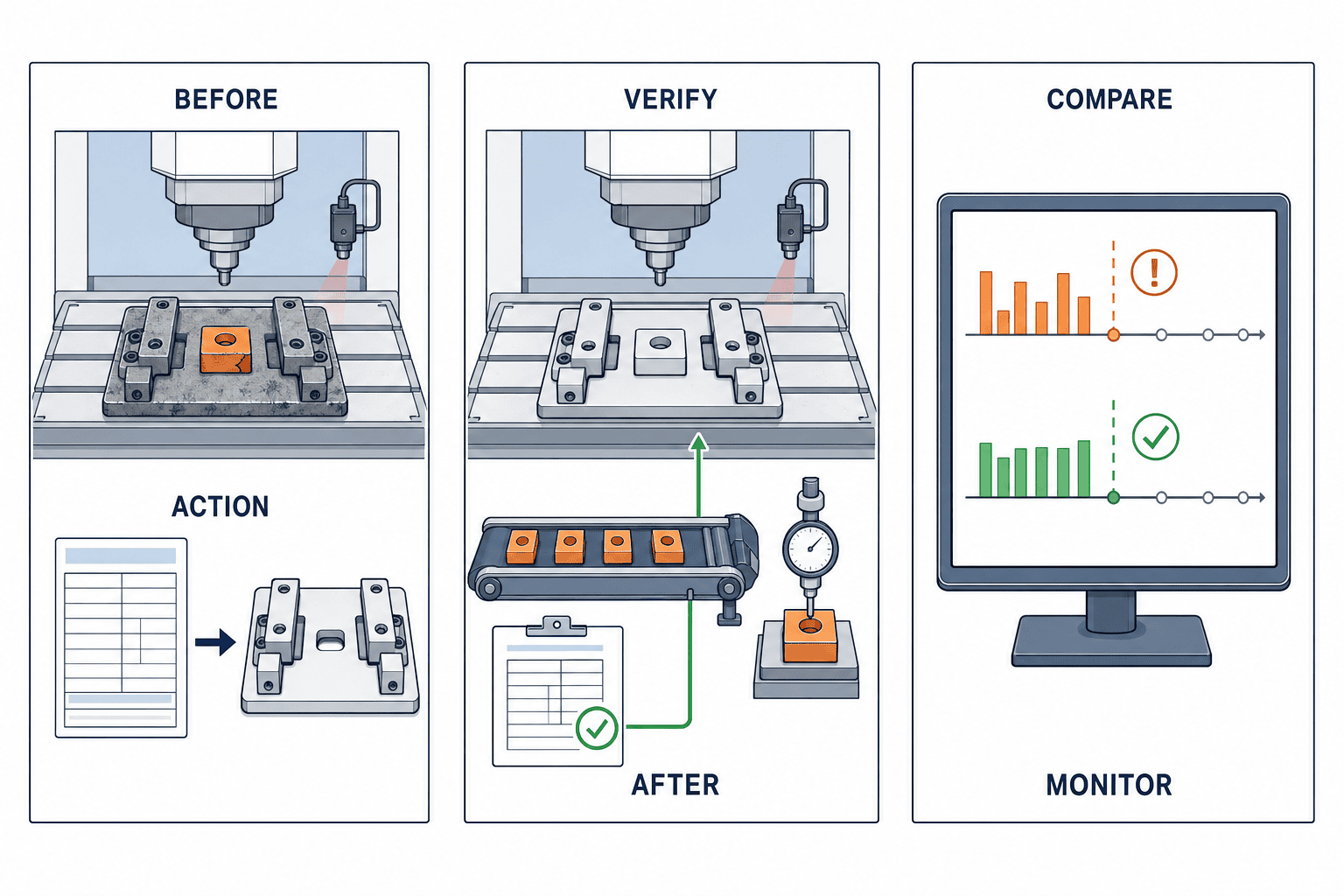
Start with a narrow problem statement: what defect, on which product and process, where and when, with what inspected denominator? Record whether the inspection criterion changed. Use a fishbone diagram to keep possible material, machine, method, measurement, people and environmental factors in view, including factors absent from digital logs. ASQ describes fishbone diagrams as a way to organize possible causes, not as proof that a written branch is the root cause.
AI can rank leads only with supporting evidence: period, good and bad unit counts, stratification by product and equipment, missingness, model version and links to source records. A comparison for material lot M should show other machines using M, machine runs using other materials, and coincident setting changes. A feature-importance score ranks investigation; it does not prove causality.
Quality staff check the measurement and inspection method. Production checks the physical process and changeover. Maintenance checks calibration, equipment alarms and replacement logs. Where safe and appropriate, compare good and bad units or repeat a controlled trial. Record rejected hypotheses and reasons, not only the adopted explanation. ASQ notes that a complex case can have multiple root causes.
Once the cause is verified, approve a corrective action with an owner, due date and explicit effectiveness plan. “Replace fixture,” “update inspection threshold,” and “revise preventive maintenance interval” may be distinct actions in the same case. Immediate sorting should remain a separate containment record. After execution, have a person verify that the intended equipment and product scope actually changed. Only then begin the observation clock.
From implementation records to effectiveness decisions
The case should move through states such as cause verified → action plan approved → in progress → implementation verified → observing effectiveness → awaiting quality decision → effective, ineffective, or extend observation. This is a proposed design, not a mandated industry state model. Each transition records owner, timestamp, evidence and approver. Prevent a direct jump from “implemented” to “effective.” If material, equipment or inspection criteria change during observation, attach the change and ask whether the comparison must restart.
If AI extracts a completion date from an email or maintenance document, a person must verify the equipment ID and actual work time against the source record. In multilingual plants, keep local-language text alongside stable codes for equipment and defect categories; do not join records by a translated phrase alone. The quality approval screen should show whether the action happened, whether minimum exposure was met, whether the outcome met the planned target, whether the defect recurred and whether side effects appeared.
Avoid mistaking correlation for an action effect
Production conditions move together: part number, shift, machine, supplier and ambient temperature may change at once. An apparent night-shift effect may really reflect a material lot used only at night. Before-and-after results should be stratified or adjusted for the main differences, and unresolved differences should be visible. Compare good units under the same product, process and inspection rule where possible. Time comparisons help, but identify simultaneous changes.
Avoid data leakage. A “rework reason” entered after final inspection cannot be treated as a predictor available before the decision. Splitting parts from one lot across training and evaluation sets puts near-identical conditions on both sides and overstates performance. FAT should assess unseen lots and time periods, and freeze the point in time at which each variable was actually available.
No statistical result replaces process evidence. Verify the physical mechanism with wear, calibration, material composition or controlled change where appropriate. Protect customer product and follow safety procedures during trials. In a case with no defensible control group, record that limitation and extend observation rather than claiming proof the data cannot provide.
A small PoC and a useful business case
Choose one defect class, one product family and one main operation. Gather inspection, material, setting, equipment alarm and action execution records. Map the process and find where IDs disappear. Revisit several historic cases with their original investigators, including cases with missing data. Define acceptance before the trial: unique linkage, traceable source evidence, time to assemble a cohort, time to reject a false lead and whether the planned decision could be made. These are proposed metrics, not reported results.
Base the business case on the plant’s own defect counts, investigation hours, scrap, rework, sorting and customer-response costs. Include equipment connections, time synchronization, master data, training, maintenance, model updates and audit support—not just model development. A published reduction at another company is not the expected ROI at yours. Analysis reduces loss only if the organization can implement a useful change and verify that it holds.
What the RFP should specify
State the eligible defects, product and equipment scope, traceability unit and source systems. Specify how missing IDs, clock mismatches, lot splits, rework, replaced equipment and revised inspections are handled. Require links from each comparison and alert to original records. Make “candidate,” “verified cause,” “implemented action” and “effective action” distinct states with role-based transitions. Require a quality owner to approve the assessment plan and final decision. Describe how the result returns to the existing QMS or corrective action case ID.
Ask suppliers to demonstrate a joining diagram, data-quality measures, a before-and-after view with denominators, concurrent-condition warnings, an exception queue, an approval trail and a recurrence monitor. The data schedule should identify owner, retrieval method, update interval, retention, personal-data treatment and permissions. One daily CSV is insufficient for a process that changes by the second; millisecond collection everywhere may be wasteful for a lot-level defect. Fit granularity to the causal question.
An RFP sentence might read: “For the designated dimensional defect, link the inspection event to product, production lot, material lot, equipment, operation and process time. Display unmatchable or ambiguous records without inventing a join. Record the corrective action’s execution time and scope. Compare the predefined before and after cohorts, show concurrent changes and source records, monitor recurrence and require an authorized quality owner to approve effectiveness.” Adapt this example to the product’s safety and regulatory requirements.
Quality owns the defect definition, assessment plan and closure. Production owns process events and execution. Maintenance owns equipment and calibration records. IT/OT owns connections and access. Procurement confirms contractual data rights. Specify who supplies, checks and signs each item before the FAT; otherwise a requirement discovered in FAT may still fail in SAT.
FAT and SAT acceptance tests
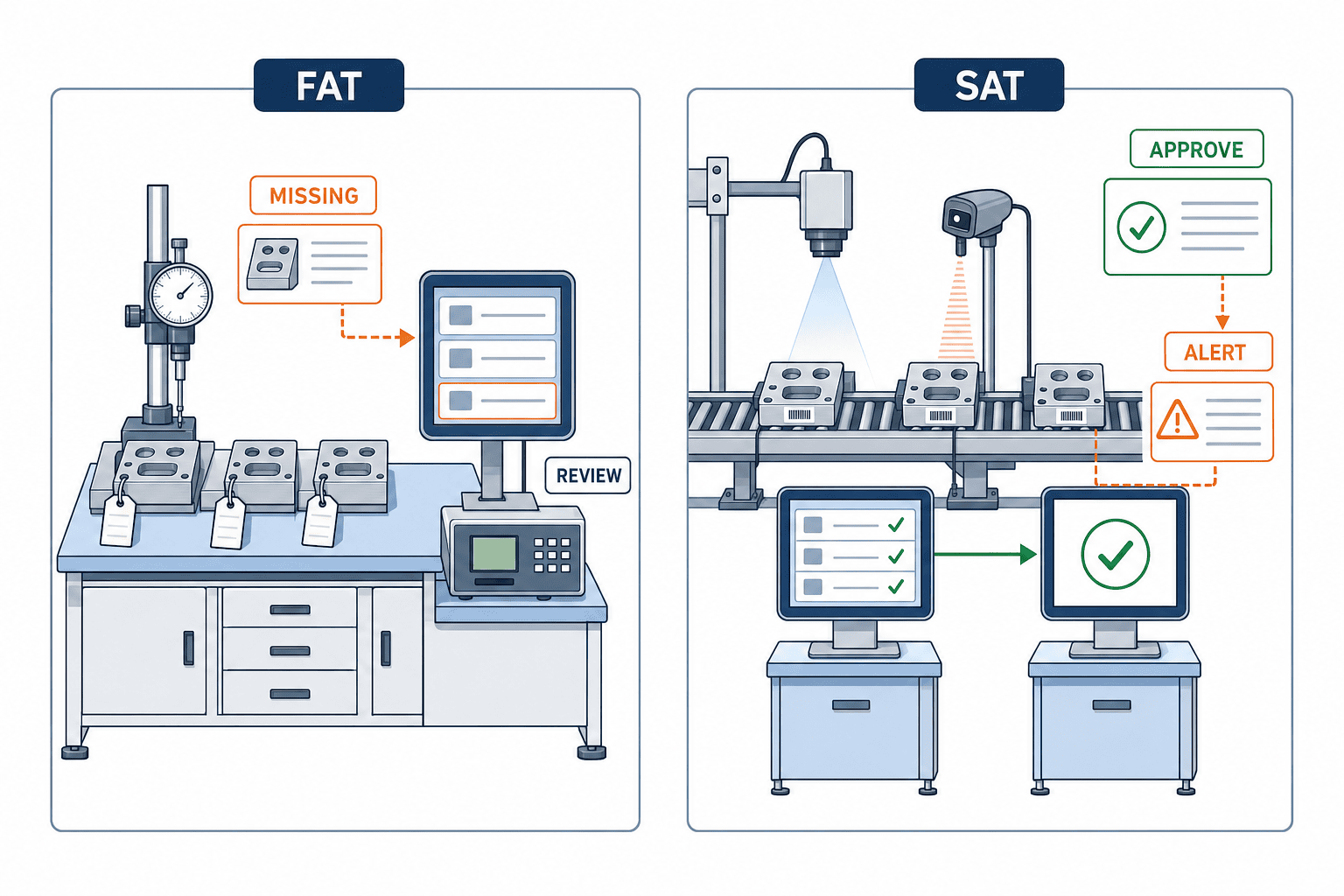
FAT tests configuration and behavior in the supplier environment; SAT tests the real equipment, communications, people and permissions on site. In FAT, include a material lot change inside a run, revised inspection, identical part numbers on two lines, missing action timestamps and a small post-action sample. Ambiguous joins should be marked pending, not silently completed. Test that a non-authorized user cannot approve the effectiveness decision. Select evaluation cases from lots and periods the supplier has not used to tune the system.
In SAT, register a defect at the real terminal and follow the record through MES, ERP, QMS and equipment logs. Test night-shift operation, connection loss, clock changes, master-data updates and a revised work order. Have quality staff reject a candidate, request more observation and sign a final decision. Verify that the source and the person’s reasoning can later be audited. Agree numeric acceptance thresholds for each plant rather than writing only “95% accurate,” which leaves the definition of ground truth, multiple causes and case mix unspecified.
Include process changes when monitoring recurrence after closure
Review defect counts together with production denominator, product mix, utilization, material source and measuring-device state. The NIST/SEMATECH Engineering Statistics Handbook covers statistical process and product monitoring. If control charts are used, document the baseline and reconsider it after process change rather than applying old limits mechanically. An AI anomaly alert begins an investigation; it does not itself prove recurrence.
If the original defect falls but another defect or cycle time rises, examine the side effect before calling the action effective. Reassess the scope when a part number, fixture or substitute material changes. An action verified for one product family is not automatically verified for all others. At weekly or monthly quality meetings, review cases awaiting evidence, unresolved mismatches, time to approval and related recurrences. Retain model, data-transformation and process versions on each case.
Do not automatically train on every human-approved label as if it were permanent truth. A conclusion may later be overturned. Keep “unconfirmed” as an allowed state and use verified outcomes, including later recurrence, when evaluating the next model. If results miss the target, separately investigate implementation failure, a poorly chosen action and an incorrect cause hypothesis. ASQ’s problem-solving cycle ends with sustaining results because an implemented action that does not hold has not solved the problem.
Frequently asked questions
Can AI approve corrective action effectiveness automatically?
No. It can assemble data and flag departures from the assessment plan. A designated quality owner must evaluate comparison conditions, exposure, recurrence and side effects, then record the reason for approval, extension or reopening.
How long should an effectiveness observation last?
Choose the period before implementation based on production frequency and how often the defect is expected. A fixed number of calendar days may include too little production. Define minimum units or lots as well as time, and extend observation when data are inadequate.
What if the defect rate falls but material or inspection method changes?
The action’s effect is not established by the raw before-and-after rate. Show the concurrent change, use a valid comparison if available, or keep the case open for more evidence. Do not describe association as proof of causality.
What belongs in the cost estimate?
Include data integration, time synchronization, master data, audit trail, training, ongoing monitoring, model updates and the quality team’s review effort. Estimate benefits using the plant’s own defect and investigation costs, not an external headline percentage.
Summary
AI can support manufacturing corrective action effectiveness by connecting verified causes and approved actions to execution logs, comparable process conditions and subsequent inspection results. The decision must distinguish “implemented” from “effective,” specify an observation period and control strategy in advance, and leave final approval to the quality owner. RFP, FAT and SAT should test ambiguous data, permissions and real shop-floor operation as carefully as model output.
Even if you are still organizing action tickets and before-and-after records, you can contact TOMAS TECH to scope a PoC, RFP and acceptance tests around a specific defect and your available data.
References
- ISO: The process approach in ISO 9001:2015.
- ASQ: Essential Evaluation.
- ASQ: Problem Solving.
- ASQ: Fishbone Diagram.
- ASQ: Root Cause Analysis.
- NIST/SEMATECH: Engineering Statistics Handbook, Process or Product Monitoring.
- AIAG: 8D Problem Solving.
- Siemens: Opcenter Intelligence — product description of contextualized manufacturing data and quality analysis.


