


When a factory introduces a minimum order quantity (MOQ) control system, entering “minimum 100 pieces” in an item master is only the beginning. If net demand is 63 pieces, the supplier MOQ is 100, and cartons contain 24, what quantity should the MRP purchasing proposal show? Who approves the excess? What changes if a lower unit price begins at a larger quantity? Unless these questions are answered together, a new screen merely moves the buyer’s spreadsheet calculation into a different workflow. This guide sets out the data, decision rules and implementation tests for manufacturers in Thailand and elsewhere in ASEAN.
MOQ, order multiples and reorder points answer different questions
A reorder point helps determine when replenishment should begin. MOQ sets the minimum quantity a supplier will accept in one order. An order multiple defines the increments allowed above a threshold or across the entire order. A carton multiple describes the physical pack that can be shipped without repacking. Those four concepts may produce different answers for the same material. A reorder point can be correct while an MRP suggestion still falls below supplier MOQ.
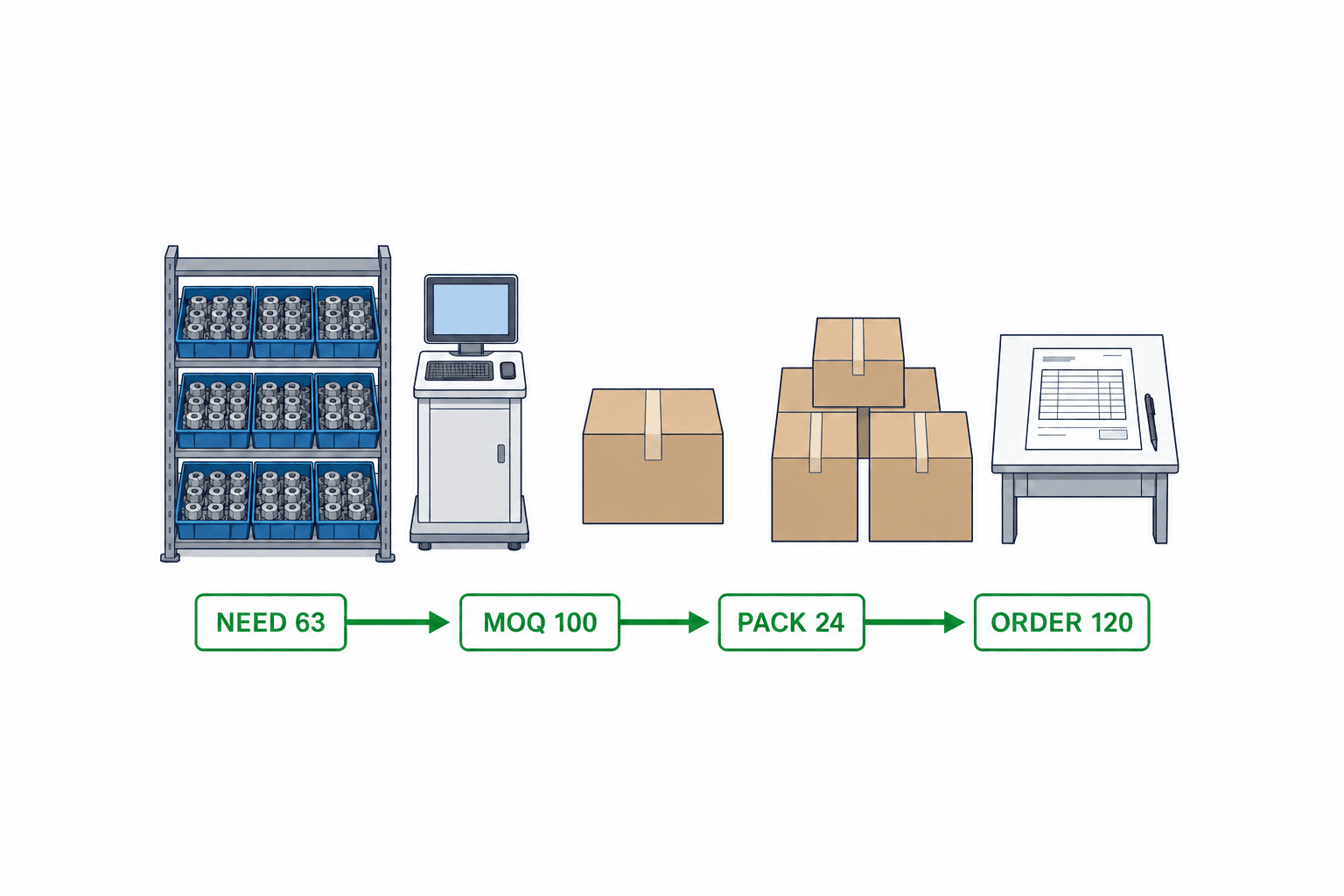
Consider a requirement of 63 pieces, MOQ of 100, order multiple of 20 and carton size of 24. If the contract says that all orders must be at least 100 and whole cartons, the smallest feasible order is 120. If the contract says “100 plus increments of 20” and cartons are a separately negotiable shipping preference, 100 or 120 might be valid depending on the written terms. Do not hard-code one interpretation before asking the supplier. The numbers here are illustrative, not an industry benchmark.
Oracle’s Supply Planning documentation separately describes Minimum Order Quantity and Fixed Lot Multiplier; Microsoft’s default order settings separately identify minimum, maximum and multiple quantities. These product examples support a general requirements lesson: model each constraint explicitly, including its unit and valid dates, instead of storing a single “lot size” value. See Oracle’s item attributes and order modifiers and Microsoft’s default order settings.
| Data element | Question | Example | Typical owner |
|---|---|---|---|
| Net requirement | How many pieces are actually short after available stock and open orders? | 63 pcs | Production control |
| Supplier MOQ | What is the minimum per order? | 100 pcs | Purchasing |
| Order multiple | In what increments can the quantity grow? | 20 pcs | Purchasing |
| Pack multiple | How many pieces are in a full carton? | 24 pcs | Purchasing and warehouse |
| Maximum | Is there an upper limit for one order? | 500 pcs | Purchasing |
| Validity | Which dated contract terms govern? | Start and end dates | Purchasing |
Put the constraint on the right supplier and purchase path
The same component may be available from a local supplier in batches of 100 and from an importer in batches of 1,000. A material-only MOQ cannot represent both. Supplier, plant, purchasing organisation, shipping origin, contract, currency, purchase unit and validity date may all matter. The precedence among general item settings and supplier-specific terms must be defined and tested.
Microsoft’s multisource planning documentation describes minimum quantities by supplier and item, and explains that a relevant supplier minimum is considered alongside the default order setting. It also explicitly limits those supplier-specific rules to planned purchase orders created by the relevant master-planning policy; they do not apply to manually entered purchase orders. That is a product-specific behaviour, but it illustrates a critical acceptance test for any system: find out exactly which transaction paths enforce the rule. The source is Microsoft’s multiple-vendor sourcing guide.
How should MRP convert net demand into an MOQ-compliant proposal?
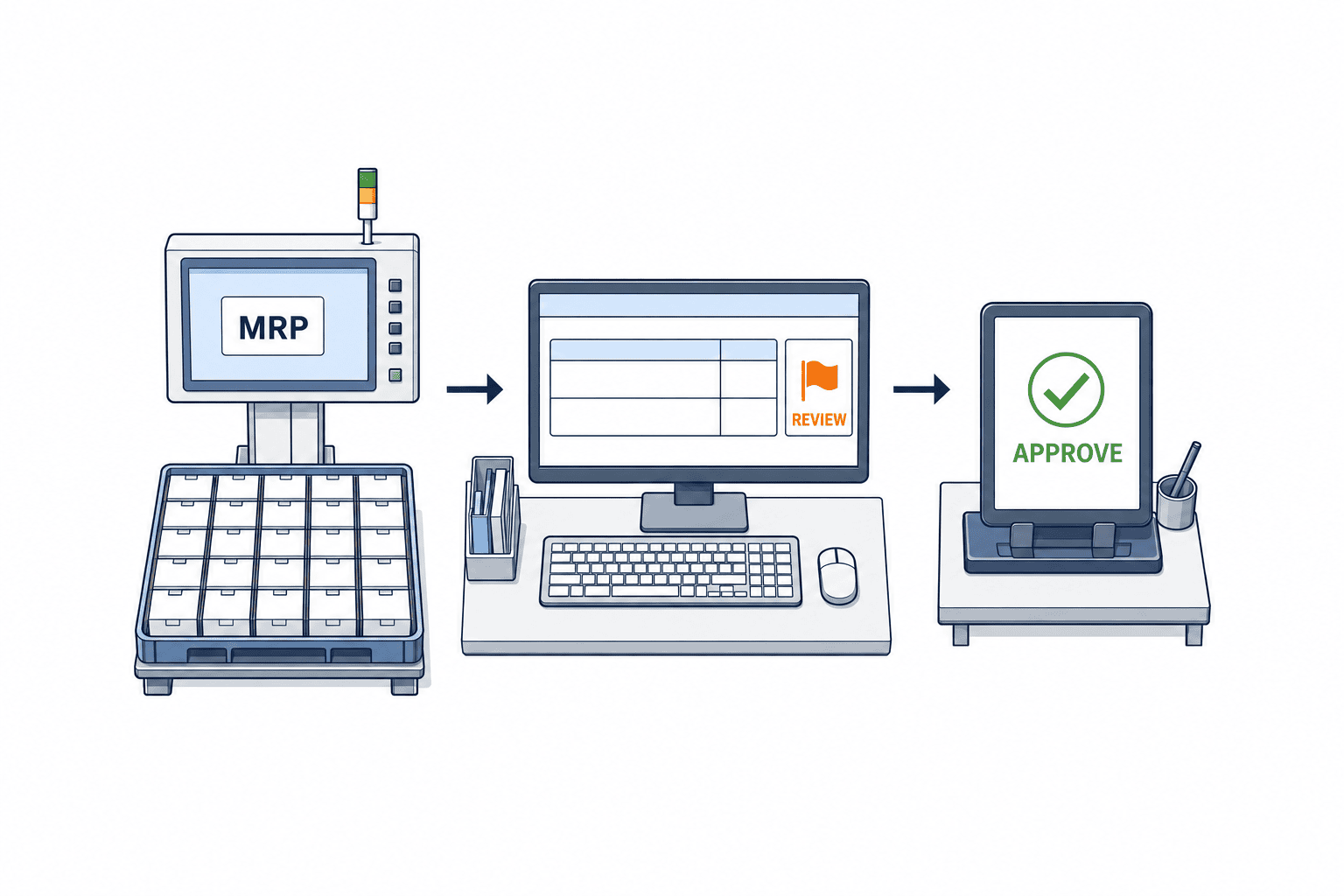
Make each stage of the quantity decision visible. First derive net requirement from the production plan, bill of materials, usable stock and open purchase orders. Next select or compare viable suppliers. Apply that supplier’s MOQ, order multiple, pack multiple and maximum. Then check dates, prices and contract terms. Finally display the gap between required and proposed quantity as an exception that a buyer can understand and approve. Supplier selection needs to precede supplier-specific rounding; otherwise an item-wide rule can distort the alternatives.
For a 63-piece requirement, a proposed order of 100 creates 37 excess pieces, while 120 creates 57. Neither amount is automatically good or bad. The buyer needs to see whether confirmed future orders will absorb the excess, whether the part may become obsolete after an engineering change, and whether storage or shelf life adds cost. An MRP suggestion that only displays “order 120” hides the very trade-off that purchasing must decide.
Show a trace such as “need 63 → supplier MOQ 100 → carton multiple 24 → proposal 120”. If purchase units are cartons and inventory units are pieces, show “5 cartons × 24 pieces = 120 pieces”. SAP documents a rounding profile for procurement quantities that must match deliverable or transportable amounts. Microsoft also distinguishes warehouse unit sequences from default purchase-order quantities and warns that conversions must be available. A missing unit conversion should stop automatic approval, with a clear data-fix message. See SAP’s rounding profile and Microsoft’s unit guidance.
Compare feasible quantities, not just the smallest one
A buyer may compare a special 63-piece order, the normal 120-piece MOQ order, a 240-piece price tier and another supplier. Remove any option that the supplier cannot actually accept. For the rest, compare total spend, freight, expected holding cost, delivery reliability and future demand on a common basis. A unit-price discount alone is not a sufficient decision rule.
For example, assume 120 pieces at THB 40 each and 240 pieces at THB 38 each. The purchase amounts are THB 4,800 and THB 9,120. The lower unit price requires THB 4,320 more cash and increases excess above the 63-piece need from 57 to 177 pieces. If 177 pieces are committed to next month’s production, buying 240 may still be sensible; without that evidence, “cheaper per piece” is an incomplete argument. These are arithmetic examples, not actual quotations or promised savings.

Link supplier price tiers to exception approval
Record each price tier with its supplier quotation or contract version, quantity range, currency, tax treatment, freight basis, purchase unit and validity. Two apparent prices cannot be compared if one is per carton and the other per piece, or one includes delivery and the other does not. Microsoft documents purchase agreements that connect quantity or value commitments with agreed prices and discounts and track fulfilment against purchase orders. The general lesson is to keep the price evidence beside the quantity rule and the resulting decision. See Microsoft’s purchase agreement documentation.
An approval rule that says “approve every order above MOQ” will generate noise, because MOQ itself often forces a larger order. Distinguish exceptions by excess value or rate, expiry or obsolescence risk, out-of-contract price, late supply, switching supplier, and manual changes to an MRP proposal. Route them to the person who can judge the actual risk: purchasing, production planning, inventory control, finance or quality. A high-value part that will be consumed by a firm order may warrant a different response from a low-value chemical with a short shelf life.
| Exception | Evidence displayed | First reviewer | Outcome to retain |
|---|---|---|---|
| MOQ-driven excess | Need, proposed quantity, excess, future firm demand | Planning and purchasing | Order, defer or alternative |
| Pack mismatch | Purchase unit, carton count, conversion | Purchasing and warehouse | Fix conversion or confirm supplier |
| Price tier choice | Total spend and holding cost for each tier | Purchasing and finance | Selected quantity and reason |
| Urgent or off-contract buy | Needed date, feasible date, incremental cost | Purchasing manager | Approver and timestamp |
| Manual quantity change | Original proposal and revised quantity | Line manager | Reason and audit trail |
Check manual orders as well as MRP proposals
Do not assume the same restriction applies to manual entry, CSV import, EDI and API orders. Test each path, plus an order split into two lines. Whether MOQ applies per line, per purchase order or per shipment must reflect the supplier’s written agreement. Emergency buying may be permitted, but the exception should be visible and approved. The broader division between purchase-order handling, procurement and MRP is covered in our order and purchasing management guide; here the focus is turning that division into precise quantity controls.
Requirements to put in an MOQ system RFP
“Supports MOQ” is too vague to compare vendors. Give each bidder the same sample material, supplier, pack, demand, price and lead time, then ask them to demonstrate the resulting proposal and approval history. At minimum, require independent fields for MOQ, order multiple, pack multiple and maximum; effective-date and supplier specificity; a display of the calculation before and after rounding; a view of excess units and value; price-tier comparison; approval, rejection and return states; and an audit trail that survives later contract changes. Specify how each import and order-entry route behaves.
Use difficult acceptance cases: demand below MOQ, MOQ conflicting with carton size, a residual quantity between increments, a price-tier boundary, quotations in different purchase units, a contract expiring at month-end, and an alternate supplier with a smaller MOQ. Grade the explanation and approval path as well as the numeric answer. Until the supplier’s contract is clear, neither “100” nor “120” can be marked correct.
Score normal and exception paths separately. In the normal path, check whether demand and stock reproduce the net requirement, switching supplier also switches MOQ and price, and the proposal quantity remains consistent through to the purchase order. For exceptions, test a missing unit conversion, expired terms, deputy approval when the manager is absent, cancellation of an approval and a repeated import of the same data. Ask the vendor to show which master-data version and calculation order produced “120”, what changes after an issued order when MOQ is revised, and whether an auditor can retrieve the earlier approval. If custom development is needed, include maintenance and upgrade effects in the quotation.
Use a period of parallel operation as the production go-live gate. Classify each difference from a buyer’s decision as a justified human choice, a master-data defect or an ambiguous contract term. Do not widen automatic purchasing while contract ambiguity remains. If buyers historically ordered extra “just in case”, record the underlying demand or safety-stock reason instead of teaching the system to imitate an unexplained amount. Measure approval time separately from quantity accuracy: a correct proposal that waits too long for sign-off can still delay supply.
Inventory accuracy is a prerequisite
Correct rounding cannot repair incorrect net requirements. If physical stock is 50 pieces while the ledger says 80, the shortage is understated before MOQ is applied. If an overdue purchase order is counted as on-time supply, the new order may be delayed. Review receipt posting time, stock holds, cycle-count differences, work in progress and open-order dates alongside quantity rules. Our factory inventory-system comparison helps define which stock data must be reliable before buying more software.
ASEAN plants need explicit units, currencies and contract dates
An imported part may be quoted in USD, incur local costs in THB, be stocked as pieces and ordered as cartons. “MOQ 100” is ambiguous until the unit is recorded. Keep dated conversion factors and their evidence. State whether comparisons include freight, duty and taxes, and which exchange-rate date is used. For materials with lot tracking or specific import controls, a nominally excess quantity may not be transferable to another project. These are system-design checks, not a determination of individual tax or customs treatment.
Also distinguish MOQ per purchase order from minimum quantity per shipment. A single 120-piece order delivered in three 40-piece shipments may be acceptable under one contract and prohibited under another. If a monthly agreement is in place, its overall quantity commitment is a separate constraint from each release. A change notice received by email needs both a receipt date and an effective date. Decide whether only unapproved proposals are recalculated and how issued purchase orders retain their original basis. Without versioned terms, an automatic recalculation can make the internal plan disagree with the supplier’s accepted order.
Cost and performance measures for implementation
Price the project by work streams rather than screen count: supplier-term cleansing, MRP or ERP integration, migration of quotations and contracts, approval design, user training and ongoing exception review. An existing ERP may already have much of the logic. Conversely, if supplier rules are scattered through emails and spreadsheets, data preparation may dominate the effort. Use the same test cases when obtaining quotations, and compare scope as well as price.
Measure the rate and time of manual proposal changes, supplier rejections caused by quantity errors, excess inventory value and age, expedited freight from stockouts, and price-term mistakes. A larger single order can raise immediate purchase value while reducing order-processing work; a single “spend reduction” metric would conceal this. For illustration, if buyers revise 60 of 300 monthly proposal lines and each revision takes 12 minutes, they spend 12 hours on those checks. Halving the revisions does not automatically save six hours if approval delays rise. Separate causes such as MOQ, units, lead time and stock errors before attributing an improvement to the new rule engine. These figures are hypothetical, not TOMAS TECH customer results.
A practical 90-day implementation sequence
Phase 1: Define the supplier terms
Choose materials with frequent manual changes rather than cleaning every item at once. Ask suppliers whether MOQ is per line, order or shipment, how the increment starts, whether split delivery is allowed, and where price breaks begin. Tie each answer to a contract or quotation version. Align purchasing, planning and warehouse definitions.
Phase 2: Replay historical orders
Run the chosen items through the proposed logic using the stock, demand and contracts that applied at the time. Explain each difference between the calculated and actual purchase order. A historic buyer decision is not automatically correct, so do not tune the system merely to maximise agreement. Test supplier changes, month-end contract transitions and delivery dates across weekends.
Phase 3: Run alongside buyers
Begin with visible proposals and limited approval, before enabling automatic transmission of purchase orders. Retain explicit reviews for materials with high excess risk or tight delivery dates. If exception volume is high, investigate missing unit conversions and outdated supplier data before simply loosening approval thresholds.
Phase 4: Maintain the conditions
Supplier processes, packaging, prices and product lifecycles change. Trigger review at contract renewal, supplier or pack change, and engineering change. Do not silently continue using expired terms. Preserve the rule version used by each issued order and define a deputy approval path so that a single absent manager does not stop procurement.
Frequently asked questions about MOQ control
Are MOQ and order multiple the same thing?
No. MOQ is a floor for one order; an order multiple defines permitted increments. The increment may start at MOQ or at zero, depending on the supplier agreement. Pack and pallet sizes can add further constraints.
What if MOQ creates surplus inventory?
Show the excess, firm future demand and storage or obsolescence risk. Compare buying now, deferring, using another supplier, combining demand across sites and negotiating a special quantity. Automatically purchasing the MOQ is not inventory optimisation.
Do we need a separate system if we already have MRP?
Maybe not. If the existing MRP or ERP can manage supplier-specific MOQ, multiples, prices, exceptions and history across the actual order paths, configuration and integration may suffice. Test manual orders as well as planned ones.
How much does an MOQ control implementation cost?
There is no responsible universal figure. Cost varies greatly between configuring an existing ERP and building supplier-master cleansing, integration and approvals. Ask vendors to quote the same example data and acceptance tests.
Should emergency orders below MOQ be permitted?
Only if the supplier agrees to an exception. Record any premium, freight, approver and reason. If the contract prohibits it, present alternative supply options rather than issuing a non-compliant normal order.
How often should MOQ terms be reviewed?
Use contract renewal, packaging change, supplier change and engineering change as review triggers. Check recurring manual overrides monthly: they may indicate stale master data rather than user carelessness. Warn on expired terms and decide whether high-risk materials should be blocked from automatic ordering until new terms are confirmed.
Conclusion
Manufacturing MOQ control is a decision process, not a single master-data field. Store supplier-specific floors, increments, pack rules, dated price tiers and unit conversions; show how MRP turned a net requirement into an order quantity; and route the resulting excess or contract exception to an accountable person. Start with a narrow set of materials and replay real historical decisions until differences can be explained. That foundation reduces the need for shadow spreadsheets.
TOMAS TECH can help map the connection among production planning, stock and procurement at Thailand and ASEAN manufacturing sites. If you are still cataloguing supplier terms or defining what an approval screen should show, you can discuss that early stage through our contact page.


