


Introducing AI to create manufacturing work instructions is not simply a way to write faster. A fluent draft can hide an invented torque setting, a mismatch between machine models, or a translated version based on obsolete conditions. This guide is for manufacturing engineering, quality, production, EHS and IT teams at Thai factories. It takes an approved source through an AI draft, checks against the equipment, actual part, safety requirements and quality criteria, then covers multilingual review, controlled release, training and retirement of the old revision. It also specifies what to ask for in an RFP and what to test at FAT and SAT.
Define the scope of AI work-instruction authoring first
A work instruction identifies the product and process, equipment and fixture, materials, sequence, control points, acceptance criteria and what to do when something is abnormal. The public ISO 9000 vocabulary defines a work instruction as a detailed description of how to perform tasks. It notes that materials, equipment and acceptance criteria may be included and that descriptions can use text, drawings, images, audio, video and checklists. A writing tool alone cannot supply this whole system. ISO 9000 vocabulary
Start with a bounded process family, one approved source hierarchy and stated languages. Different machine models or modification histories need separate applicability conditions or revisions. Before importing anything, inventory document ID, revision, effective date, product, equipment and line identifiers, and the owner of the master. Exclude documents whose authority cannot be established. The task here is to author and approve a new instruction from controlled sources. For the wider delivery and revision problem see our work-instruction system guide; for extracting know-how from video see AI-assisted work-instruction video.
What AI may propose and what people must decide
AI can assemble candidate steps in a template, point to source passages, list missing fields and suggest translations. People decide whether the source is authoritative, whether the instruction matches the machine and actual part, whether hazards and acceptance criteria are correct, and when a revision can become effective. Do not rely only on a prompt saying “do not guess.” Make a value without an approved source ID ineligible for approval. Mark contradictions as unresolved instead of letting the model choose a plausible answer.
NIST’s AI Risk Management Framework calls for defined human oversight, a documented use case and knowledge limits. Its generative AI profile helps organizations assess risks particular to generated content. For shop-floor documents this means every AI output begins as an unapproved proposal; critical conditions retain traceable sources and named reviewers; a person with release authority signs the final revision. NIST AI RMF Core and NIST Generative AI Profile.
Establish the master record before giving data to AI
The state of the source documents matters more than the model name. Process sheets, equipment manuals, control plans, inspection specifications, hazard assessments, change notices, photographs and interviews do not all have equal authority. If revisions conflict, do not let a model select the best-written file as truth. A document controller and process owner must identify the approved version applicable to each product, line and machine.
| Source | Condition before use | Reviewer | Role |
|---|---|---|---|
| Approved instruction | ID, revision and applicability known | Document controller | Draft baseline |
| Machine manual and fixture specification | Model and modifications match reality | Maintenance and engineering | Equipment check |
| Control plan and inspection standard | Correct part and current revision | Quality | Acceptance check |
| Hazard assessment and EHS material | Matches the task and equipment | EHS owner | Safety check |
| Interview, photograph or video | Date, machine and explanation recorded | Shop-floor leader | Candidate evidence, not master on its own |
A source register should include ID, location, revision, approver, product, machine model, line, language, expiration and access rights. Test OCR output against the scan for decimals, units, part numbers, arrows and table columns. Text extracted from a diagram or image stays unverified until a person checks the original. Practical know-how not yet in an approved source may be logged as a proposal, but does not silently enter a released instruction.
Attach sources to conditions, not only to paragraphs
A citation at the end of a page cannot tell a reviewer which revision supplied a torque limit. Link each critical value to source ID, revision, page or drawing callout, applicable product and machine, extraction time and review outcome. Rephrasing a harmless sentence and changing a number, unit, order or prohibition have different risk. Show critical differences side by side. When two approved-looking documents disagree, the result must be a hold for human resolution, not a majority vote by AI.
Match photographs and the physical asset
An engineering diagram may be current while a guard, fixture or button arrangement has changed on the floor. Check the machine nameplate, cabinet, fixture number and part label. A photograph without its date and asset ID does not establish the current state. Do not merge pictures of two machine variants into one generic instruction when their operating differences matter. Express applicability explicitly.

A concrete review example from source to one process
Consider a process in which an operator places a part in a fixture, presses it in a machine and checks the result with a gauge. The traveler holds process ID and part number; the asset register holds machine ID and modification number; the material sheet holds grade and lot; the control plan holds measuring position and acceptance; the hazard assessment holds the guard-opening rule. Align these records by process ID, machine ID, part and revision before asking AI to summarize. If one key differs, do not join the records automatically. A photo of a similarly named but different control cabinet can produce a perfectly fluent yet wrong location for an operator action.
For each draft step, the review form should show the original sentence, AI proposal, physical check needed, owner and decision. For “place workpiece in fixture,” compare orientation with the drawing and actual part photo, fixture number with the asset label, press-fit result with the control plan and limit sample, and safety condition with the actual guard and interlock. Even “send accepted parts to the next process” remains on hold if it does not state who records acceptance and with which gauge. Good grammar is not evidence that these checks have passed.
Make traceability a release condition. A missing machine ID, truncated part number, changed acceptance unit or moved guard-closing step cannot be accepted because the prose reads better. Changes only to headings or connective words may be reviewed together once it is shown that critical conditions are intact. This directs reviewer time to the physical process rather than line-by-line stylistic differences.
Structure the draft by process step
A request to “write a standard instruction” as free text is difficult to verify. Instead, give each step structured fields: entry condition, part and machine, action, checkpoint, acceptance decision, stop-and-escalate action, source reference and photograph ID. Empty required fields remain “unverified.” Keep language polishing separate from selection of engineering limits.
For example, “insert the connector securely” sounds fluent but cannot be inspected. The operation may need the correct part number, orientation, insertion position, locking indication, visual check and quarantine route for a failure. The real values must come from approved factory specifications, never from this example. AI can identify a missing field; it cannot invent an unmeasured tolerance.
Specify a workflow rather than a clever prompt
Use this sequence: choose approved masters; extract and structure; filter retrieval by revision and access; generate candidate steps; display differences and missing evidence; perform equipment, part, safety and quality reviews; review each language; approve and release; then train affected users and retire old versions. Retain structured records as well as a printable document so the process survives a change of model. Log source versions, generated output, model identifier, edits, reviewers and approval times.
RFPs should define which proprietary drawings may enter a third-party service, retention period, model-training settings, permissions and audit logs. If users can see the generated sentence but not its restricted source, address that review gap. ISO’s public explanation of ISO/IEC 42001 treats AI deployment as a managed matter of accountability, transparency and privacy. Our proposed workflow applies those ideas to shop-floor documents; it does not claim that a particular system is certified. ISO AI management system explanation
Stop dangerous changes at the boundary
Test for altered numbers, swapped units, reversed step order, mixed machine models and deleted prohibitions. Deliberately provide an obsolete revision, a missing page, contradictory values and a photo of the wrong machine. A system that turns them into smooth prose fails the test. The acceptable response is “unknown,” “source conflict” or “wrong equipment,” followed by a release hold. Also distinguish critical alerts from harmless wording differences so reviewers can focus on real risk.
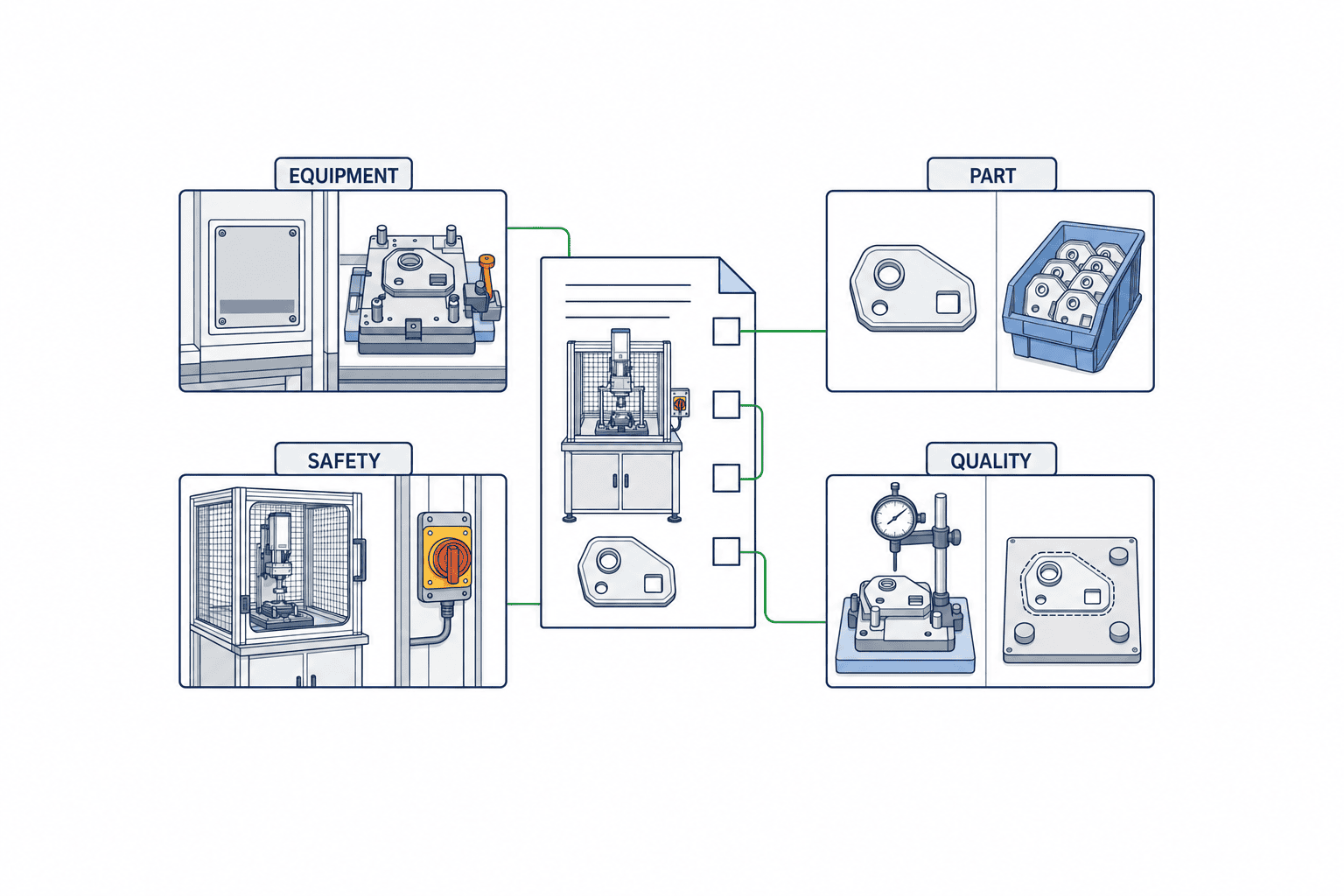
Four review gates: equipment, part, safety and quality
After drafting, keep four separate checks even if some reviewers hold multiple roles. Equipment review asks whether physical controls and fixtures match. Part review checks product, material, lot and applicability. Safety review checks hazards and protection. Quality review checks control points and acceptance. Release should require an outcome for each gate.
| Gate | On-site evidence | Example reason to stop release |
|---|---|---|
| Equipment | Nameplate, HMI, fixture ID, modification record | Old-model button remains in draft |
| Part | Part and material labels, drawing, traveler | Out-of-scope material merged in |
| Safety | Hazard assessment, PPE, isolation procedure, observation | Stop or isolation condition missing |
| Quality | Control plan, gauge, inspection record, limit sample | Unit or sign of limit changed |
Never compress a safety-critical sequence into a vague sentence
Maintenance and cleaning may require a defined sequence for stopping, isolating energy, releasing stored energy, verifying isolation and returning to service. US OSHA guidance describes documenting energy-control procedures and training affected workers. It is cited here as an example of procedure design, not as a claim that US law directly governs a Thai factory; local requirements and customer standards need separate assessment. OSHA procedure documentation and OSHA training guidance.
If AI reduces an isolation sequence to “stop the machine safely,” key actions may disappear. Compare prohibitions, PPE, interlocks, emergency stop, residual pressure, stored electrical energy and authorized-person restrictions against the source one by one. EHS and equipment owners must verify the actual installation. Avoid mixing normal production instructions and maintenance isolation into one ambiguous page.
Quality checks need a method, not just a number
“Within specification” is not actionable without gauge, measurement point, frequency, decision maker and record location. A model must preserve measurement conditions and revision with the limit. If conversion or rounding is necessary, apply an approved rule with boundary test cases and retain the original value. Cross-check the effective lot against the traveler when product and equipment changes overlap.
Review translations as controlled manufacturing documents
A Thai factory may use a Japanese master and Thai and English floor versions. The main risk is not just wording; it is a translation still tied to the previous master. Give each language a parent source ID and revision. A change to the master should identify affected steps in every language. Do not release the new instruction to a language group before its own review and approval are complete.
The glossary should control equipment names, control labels, part names, defects, prohibited expressions, units and abbreviations. An action verb such as press, push fully or tighten may change what an operator does; verify it at the real machine. Compare numbers, units, signs, sequence, branches and warning strength mechanically, then ask a user of the target language to follow the procedure on the floor. If operators work in Thai, an approved English version and “Thai for reference” is not an adequate release arrangement. The Thai version needs an approver, effective condition and training record.
Back-translation can reveal an error, but may also turn an ambiguous instruction back into a fluent sentence. Ask operators to explain what they would do under a given condition in front of the machine. Ask quality to confirm acceptance points and EHS to confirm protective actions. A corrected term should trigger an impact search across other instructions using the same glossary term. For the broader capture of skills see our AI work-instruction video article.
Make approval, release, training and retirement one controlled transaction
Clicking “approved” does not switch the shop floor. The release owner sets revision and effective condition, distributes the current version to terminals and posted locations, invalidates the old one, and records training and understanding for affected workers. ISO’s guidance on ISO 9001 documented information discusses managing information an organization needs and mentions work and test instructions as examples. This does not mean every document format is universally mandatory; the organization determines what it needs to control. ISO 9001 documented-information guidance
Connect master ID, derivative languages, approvers, timestamps, product, machine, line, effective lot or time, training group and old-version retirement in the release record. For offline terminals, define what revision remains visible after disconnection and when production must stop or use a controlled fallback. If printing is required, track controlled copies and confirm collection. Evidence that the new version was distributed is different from evidence that obsolete copies are absent.
Recreate only what a change affects
A change to machine, process condition, control plan, drawing or hazard assessment should select affected instructions. Regenerating everything changes harmless wording and creates unnecessary review. Produce differences at step level and prioritize changed limits, warnings and applicability. Link the engineering change to the instruction revision and do not activate it before the effective lot and training state align. See our 4M change-management article for the wider process.
Decide revisions and training after a 4M change
Not every change requires regeneration of the whole document, but AI must not decide on its own that an old instruction remains valid. Even a material-supplier change that appears to leave work unchanged needs a check of material specification and approval. A fixture replacement calls for checking position and the protected area. A method change directly affects sequence and training; a measurement change affects gauge and acceptance. The authorized change owner decides impact and the document controller issues the instruction revision.
| Change | What to check in instruction | Revision and training response |
|---|---|---|
| Man: operator or qualification | Restricted tasks, handover, language | Update affected training records even if steps are unchanged |
| Machine: equipment or fixture | Model, controls, guard, gauge | New revision and retraining if action or hazard changes |
| Material: material or component | Part, supplier, orientation, incoming criteria | Separate effective lots if applicability or acceptance changes |
| Method: procedure or setting | Order, parameters, abnormal response | Approve differences and train users before use |
This is an impact-assessment design example, not a claim of a universal standard requirement. Keep change origin, affected process and machine IDs, old and new effective lots, target languages and trained personnel in one linked record. If the master is new but Thai is old, do not merely record “translation pending”; decide whether the Thai-speaking floor may begin work under the new condition. If necessary versions and training cannot be ready by the effective date, postpone release or explicitly limit its scope.
What to put in an RFP
“Automatically create work instructions with AI” is not enough. Specify input, boundaries, review, release, logging and test data. Have bidders demonstrate a realistic process with competing revisions, different machine models, languages and photographs, not only a polished sample. Otherwise OCR repair, master cleanup, language review and terminal rollout become surprises after quotation.
| RFP area | Requirement to state | Cost to separate |
|---|---|---|
| Scope | Processes, machine models, parts, languages, documents | Initial and later migration |
| Master control | Approved revisions only, source display, conflict hold | Register and OCR correction |
| Drafting | Template, critical-value protection, missing-field display | Model use and configuration |
| Review | Four distinct evidence gates | Specialist and floor reviews |
| Language | Glossary, parent revision, separate approval | Translation and floor read-through |
| Release | Roles, retirement, training, offline handling | Terminals and operations |
| Operation | Audit, access, retention, model-change retest | Support and usage charges |
Also ask about data ownership, storage location, export on exit and reassessment when the model provider changes. Drafting speed alone is a weak KPI. Measure how many critical conditions are traceable, whether uncertain inputs are held, review time, obsolete copies remaining after release, and language synchronization. Set targets using the plant baseline and risk tolerance, not generic vendor claims.
Initial costs include source inventory, OCR and drawing verification, template and glossary, integration, access design, testing and training. Continuing costs include model usage, revisions, translation review, maintenance, terminals and audit support. Estimate benefits from measured drafting and review effort, rework associated with obsolete versions, training preparation and change latency. This guide does not assert a market price or a universal reduction percentage.
FAT and SAT: test whether dangerous mistakes stop release
FAT checks the configured system with agreed sample data before site acceptance. SAT checks it with the real equipment, part, terminal, permissions and users. A clean sample alone proves little. Add an obsolete master, missing page, contradictory limit, wrong-model image and outdated translation. Define input, expected result, evidence file and adjudicator for each test case.
| Case | FAT | SAT | Expected result |
|---|---|---|---|
| Revision conflict | Supply old and current masters | Leave old copy on terminal | Old revision blocked |
| Wrong machine | Mix another model specification | Check nameplate and HMI | Hold as inapplicable |
| Number and unit | Insert OCR and conversion errors | Compare gauge and standard | Change detected |
| Safety | Omit isolation step | EHS checks actual action | No unapproved release |
| Quality | Reverse limit sign | Compare limit sample | Difference held |
| Language | Mix older master translation | User explains action | Revision mismatch detected |
| Release | Unauthorized approval attempt | Test offline and paper copies | Permission denied; old-version evidence |
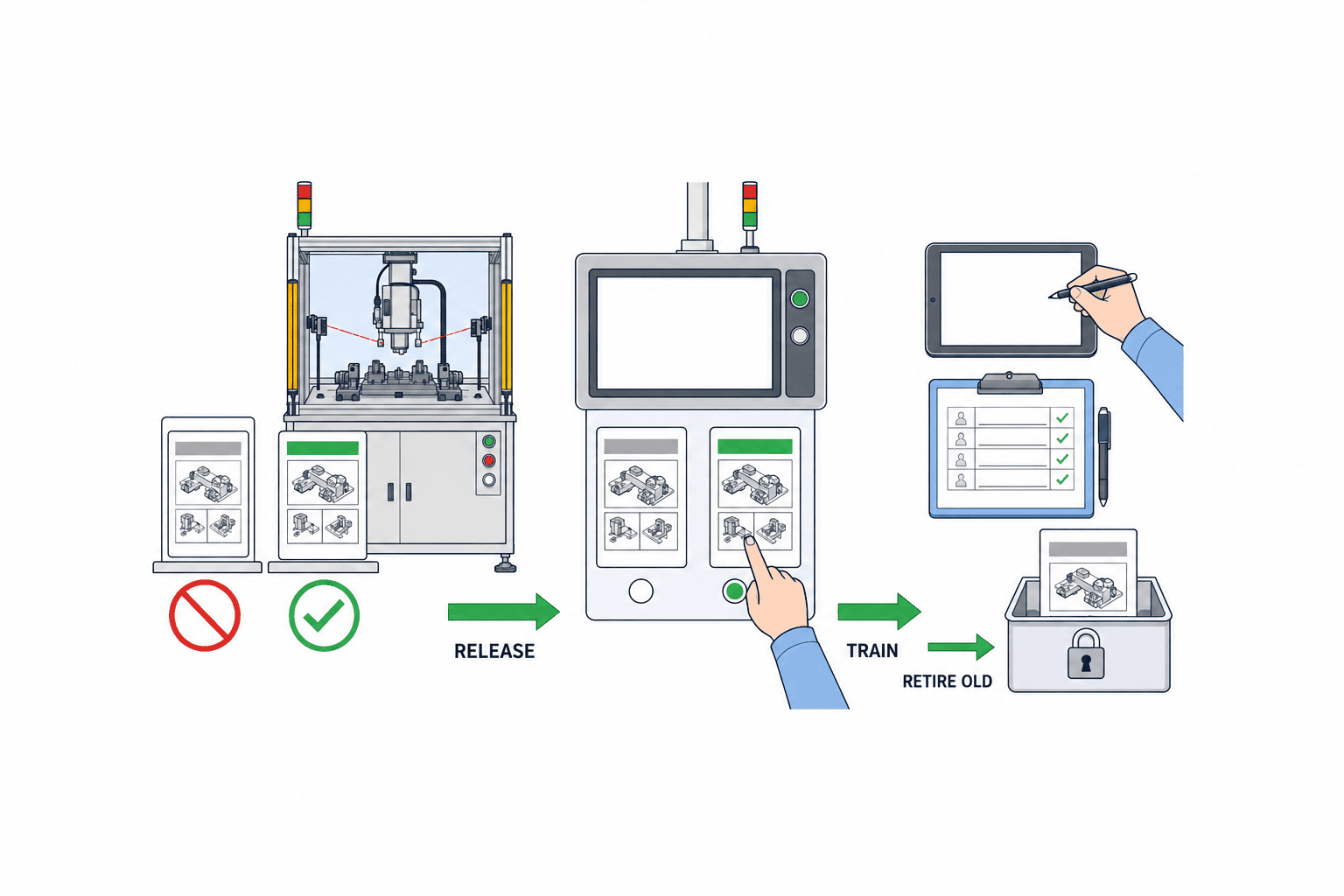
SAT ends at the workstation, not at a document list in a test room. Verify that selecting a product and machine cannot show an inapplicable instruction, that people needing retraining are identified, and that operators can explain stop conditions. Define the behavior when the network is unavailable. If a critical issue remains open, keep the process in a restricted pilot rather than declaring acceptance.
Run negative tests through the real release path
At FAT, leave a PDF with an obsolete limit in retrieval while introducing the new approved value for the same control point. Passing means more than “the model cited the new file”: an old-value draft must not be releasable and both conflicting values and document IDs should appear to a reviewer. Insert an OCR sample with a lost decimal point, a different unit and a value pulled from an adjacent table column. Decide from source comparison logs rather than how convincing the output sounds. For translation testing, insert a weakened warning, reversed sequence and omitted machine model; verify that language review blocks each case.
At SAT, use the actual terminal where an operator selects part and machine. Test an old revision in device cache, an old printed copy on the bench and a disconnected network separately. Observe whether wrong access and use are detected or prevented. After power returns, record which revision the terminal displays. If sync fails, determine whether the process stops or switches to a controlled paper fallback. The point is not merely that software runs, but that the correct revision can be selected at the workplace.
Evidence should include screen photos, terminal and machine IDs, part, tested language, obsolete revision inserted, expected and actual results, adjudicator and retest after correction. A vendor clicking through a successful demo cannot replace tests of the plant’s permissions and network conditions. Document control, quality, EHS and shop-floor leadership each judge their own criteria. Do not turn a failed case into a pass solely by saying operators will be careful; record a temporary control, residual risk, owner and due date.
Assign ownership and start with one meaningful process
The document controller owns the master and revision; manufacturing engineering owns process and equipment fit; quality owns acceptance; EHS owns protective measures; production owns usability; IT owns permissions, logs and integration. Translators support language quality but do not replace technical approvers. Identify one release authority and make approval backlog visible. A supplier may provide a model and workflow, while the factory retains responsibility for its process.
Select a pilot process where a real revision is likely, so the team can test retirement and translation follow-through. Inventory masters, draft one process, run four reviews, translate, release, train and retire the previous revision. Measure actual drafting time, errors found during review, holds and elapsed revision-change time. Use these observations to revise the cost and staffing estimate for the next process rather than promising an arbitrary schedule or percentage benefit.
Frequently asked questions
Can AI create manufacturing work instructions without human review?
It can draft and identify missing fields. It should not approve machine, part, safety or quality facts solely from its own output. Controlled masters, physical checks, specialist review and human release authority are necessary. If no approved master exists, establish it first.
What determines the cost of AI work-instruction implementation?
Revision cleanup, drawings and photographs, number of machine variants and languages, review difficulty, delivery terminals and integration often matter more than document count. Separate initial preparation, usage fees and revision operations in the quotation.
Can the AI-translated Thai version be issued immediately?
No. Verify equipment names, action verbs, warnings, values and branching against the master and glossary. Have Thai-speaking operators demonstrate understanding at the actual machine. Record its parent revision, approver and effective condition.
What is the difference between FAT and SAT?
FAT tests drafting, sources, holds and approval controls using agreed samples, including bad inputs. SAT tests applicability and release at the actual machine with users, devices, offline behavior and printed copies. Both need documented pass criteria.
Conclusion
AI work-instruction authoring is a controlled path from approved source to candidate draft, four evidence checks, multilingual approval, release, training and retirement. Choose a solution for traceability and its ability to hold uncertain or dangerous changes, rather than for fluent text alone. Put inputs and acceptance conditions in the RFP and test both correct and deliberately faulty cases at FAT and SAT.
If you are preparing a source inventory or a one-process pilot, contact TOMAS TECH. We can help define the boundaries, review roles and acceptance tests around your equipment, quality rules, languages and revision process.


