


Forging traceability implementation requires more than collecting press-load data. When a customer reports a defect, the plant must be able to show which material heat and billet became the part, when it passed through which furnace, which press and die formed it, and which heat-treatment, inspection and shipment lots followed. Identity is especially easy to lose during hot transfer, billet splitting, reheating and mixed loading into heat-treatment baskets. This guide explains how to connect physical parts to event records, choose lot or individual-part granularity, specify an RFP and test acceptance in FAT/SAT.
This is a practical guide to system design and procurement, not a certification assessment. Product drawings, customer contracts and the applicable editions of relevant standards determine the actual requirements. No equipment performance, compliance outcome or return on investment is guaranteed.
Define the purpose of forging traceability in both directions
Define two queries before choosing software. A backward trace starts with a shipped part, box or lot and finds its material heat and certificate, received stock, cut billet, heating batch, forging lot, press, die revision, heat-treatment batch and NDT or hardness result. A forward trace starts with a suspect heat, furnace excursion, damaged die or mixed heat-treatment basket and identifies every affected part, box and destination. A one-way search cannot establish which shipments can safely be excluded.
Take one historical quality issue and trace it in both directions using the paper records, spreadsheets, part marks and equipment logs you already have. Record more than the search time: note where the candidate population grows, who puts the physical parts on hold and which records disagree. A manually entered lot number may be present without proving that the labelled stock was actually used. This exercise becomes the baseline for deciding what the investment must fix.
The GS1 Global Traceability Standard frames traceability as critical tracking events and the key data elements that describe them. In a forge, receiving, cutting, heating, forming, heat treatment, inspection, packing and shipping can be modelled as events recording what happened, where and when, who was involved and why. This does not impose GS1 identifiers on every internal item. First define the keys shared with customers and the keys that must remain unique within the plant, then preserve every input-to-output link.
Model splits and merges from material heat to billet and forged part
A material heat identifies a melt source, but a heat, purchased lot, bundle, bar and internal receipt lot are not necessarily one-to-one. Link the supplier certificate and stock marking to the plant receipt label, then carry that relationship into each split bar and cut billet. Reconcile quantities and weights as the material moves. Keeping a certificate PDF alone does not provide traceability unless a key connects that certificate to each shipped forging.
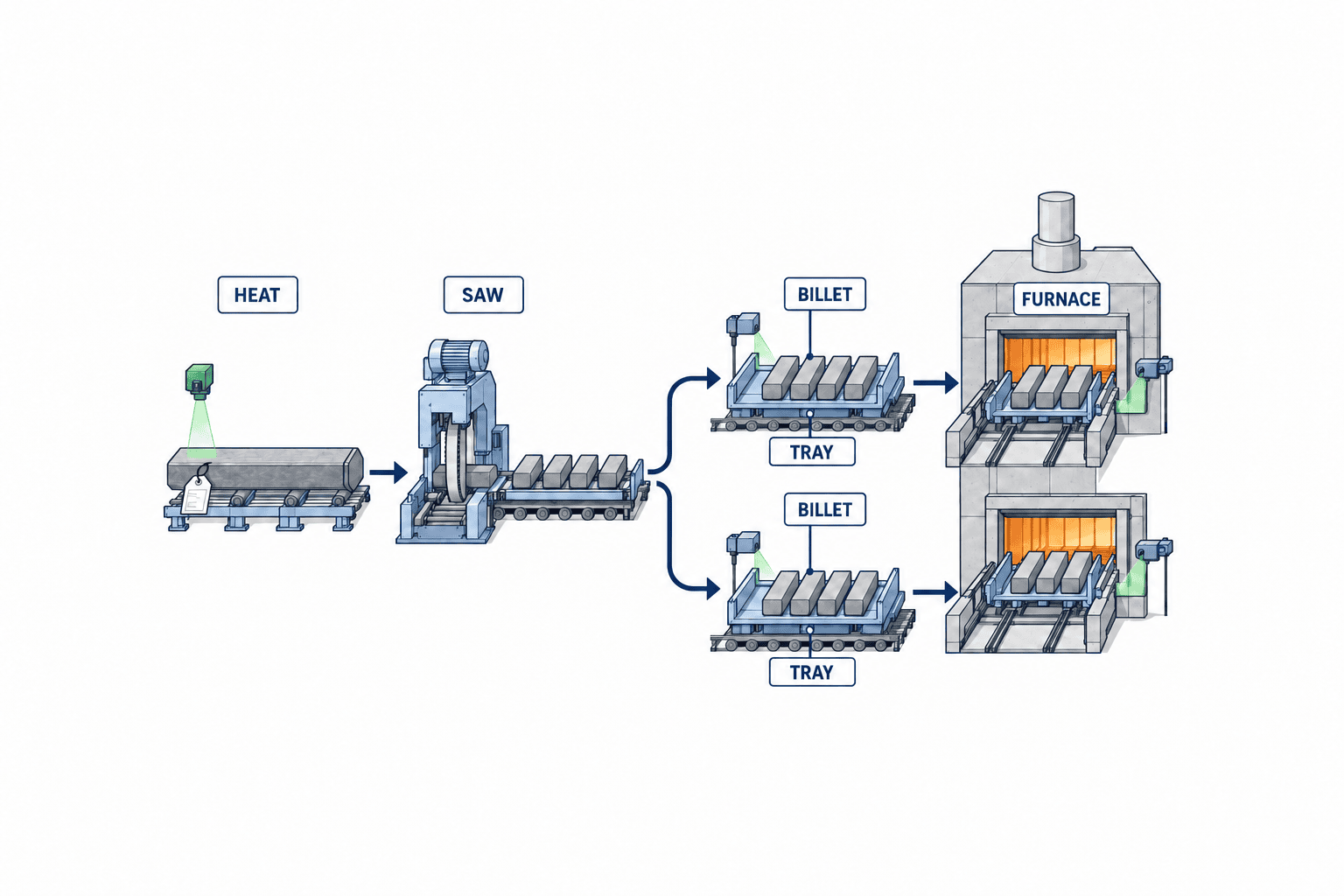
One bar can produce many billets. Record the cutting sequence, machine, billet dimensions or weight, and the disposition of offcuts and mix-ups. If individual billets cannot be marked, label and physically segregate the bundle, container or transfer tray. Every removal, addition or transfer between containers must update the relationship. Choosing heat, bar, billet or container as the tracking unit determines how narrowly a later quality issue can be contained.
The data model must support one-to-many and many-to-one relationships. One heat may feed several forging lots; several forging lots may share a heat-treatment basket. If mixing is prohibited, segregate the parts physically and verify the restriction in the system. If it is allowed, preserve every parent lot. A database that stores only one “representative” parent can omit affected parts from a forward trace.
Record material reassignment and scrap return
Material may be reassigned to another work order, while offcuts or scrap may be reused or returned to a supplier. Ignoring those events breaks both material balance and genealogy. Record the original order, new destination, approval and time instead of overwriting the earlier record. Distinguish reuse within the plant from return to the material supplier. If material is remelted, link it to a new heat only within the supplier’s documented certification and control scope; do not assume the original heat identity still applies.
Observe the material staging bench and the floor area before the furnace before designing the screens. Decide what happens when a billet tag falls off, an offcut cannot be identified or containers are temporarily mixed: who stops the flow, which population is held and how identity can be re-established. Recording “unknown” and segregating the stock is more useful for a quality decision than forcing an operator to guess a heat number.
Define loading and unloading boundaries for each heating furnace batch
Furnace setpoint, measured furnace temperature, actual billet temperature, position in the furnace and dwell time describe different things. On a continuous furnace, examine entry and exit sequence, lane changes, accumulation and a stop with billets still inside. On a batch furnace, record the input container, position, start and end times, and output quantity. If billets from several heats share one furnace batch, keep the furnace batch ID and each material heat as separate keys.
For every temperature value, define what was measured, where and when. A furnace sensor and a billet-surface pyrometer have different measurement targets and error sources. The Forging Industry Association temperature-measurement tutorial treats this as a distinct quality-control topic. It does not provide a universal threshold for this article. Set the temperature window and measurement method from the product specification, material, furnace, sensor and on-site validation.
Do not turn reheating into a correction of the first heating record. If a billet leaves the furnace, transfer is interrupted and the billet is returned, preserve both loading and unloading cycles and the approval for the second pass. Where the product specification limits furnace-to-press transfer time, synchronized clocks and a trustworthy tracking unit matter. Use physical separation and container or tray scans where cameras and sensors cannot maintain identity continuously.
Connect each forging press event to its die revision and physical part
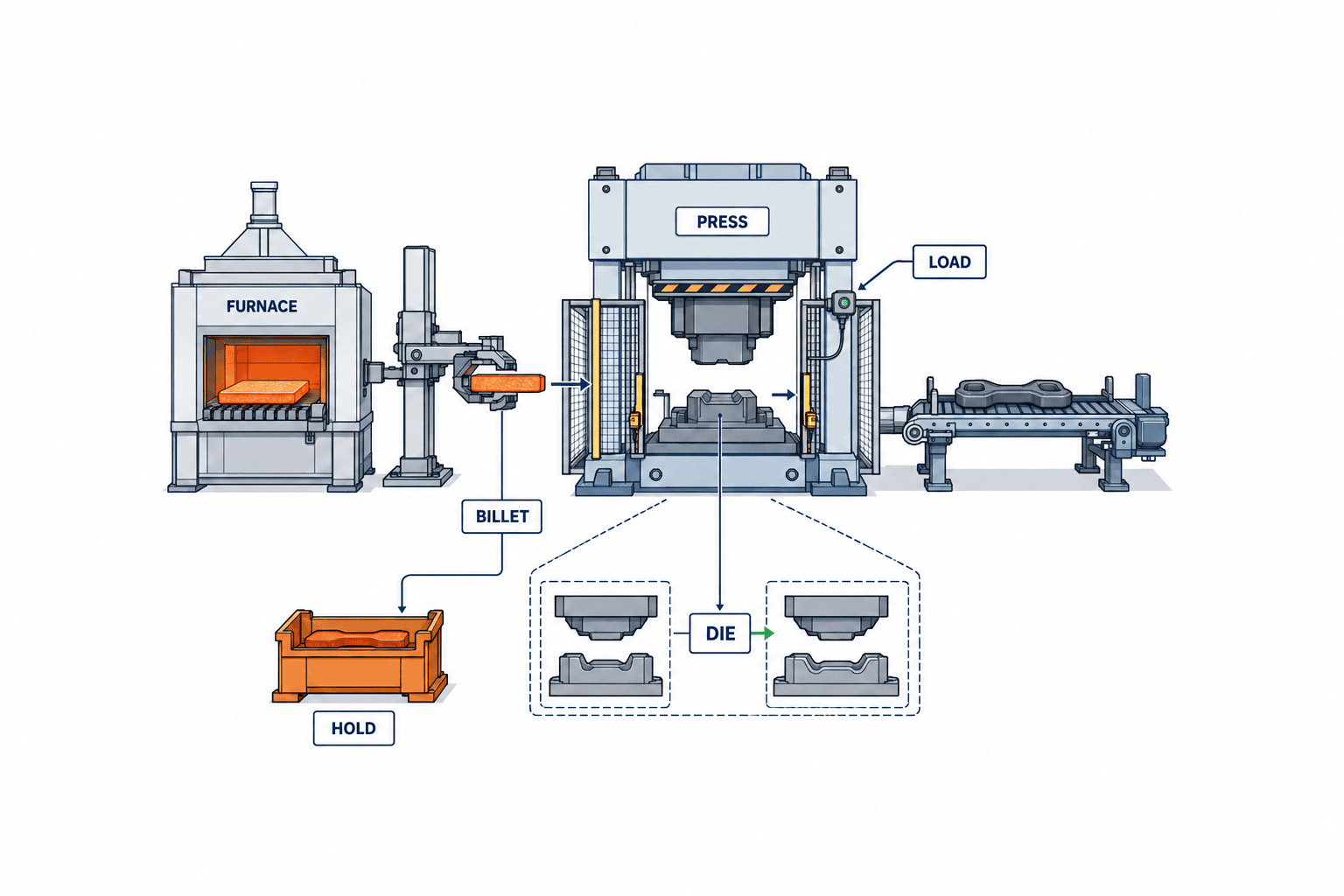
A forging press counts strokes or blows, but its counter is not automatically a part ID. One billet may receive several blows or pass through preforming and finishing; there may also be empty strokes, a part retained in the die, or a counter reset after restart. Link the billet or carrier ID, press ID, operating session, stroke or blow ID, process stage, and resulting part or scrap disposition. In a continuous line, record where position tracking can break.
The die type alone is insufficient. Record the unique die ID, cavity or position, repair and replacement events, effective start and end strokes, and revision. A partial repair must create a distinguishable before-and-after state. Decide which part or operating interval each press-force, energy, stroke-position or temperature value describes. FIA’s tonnage-signature research investigated how workpiece geometry, part temperature and ram misalignment affect the signal. A recorded waveform alone does not prove that a part passed inspection.
A manufacturer example is useful for defining the interface survey. Schuler’s screw-press brochure describes monitoring of impact energy, force, part thickness and temperature, along with documentation and external data connections. Available values still depend on the exact press, controller revision and options. In the RFP, list the required signals, sampling or event timing, timestamps and missing-data behaviour, then verify them on each actual machine.
Distinguish a forging lot from a press stroke
A forging lot is a production and quality-control unit; a stroke or blow is one equipment action. Define whether a lot may contain more than one heat, whether a die change starts a new lot and where setup or start-up parts are separated. Record lot start, close, split, merge, hold and release as events. A press counter alone must not silently define the lot boundary.
A billet-temperature reading is weak evidence if it cannot be tied to the correct press stroke. Watch the transfer robot’s gripping positions, multiple lanes, manual loading and insertion of returned parts. Identify the intervals where order is guaranteed and those where it can change. Add a scan, vision identification or physically segregated carrier at an uncertain point. In the hot zone, where a mark cannot be read, reconcile positions, counts and equipment events before and after; conservatively include any ambiguous parts in the affected population.
Reconnect heat-treatment lots to NDT and hardness results
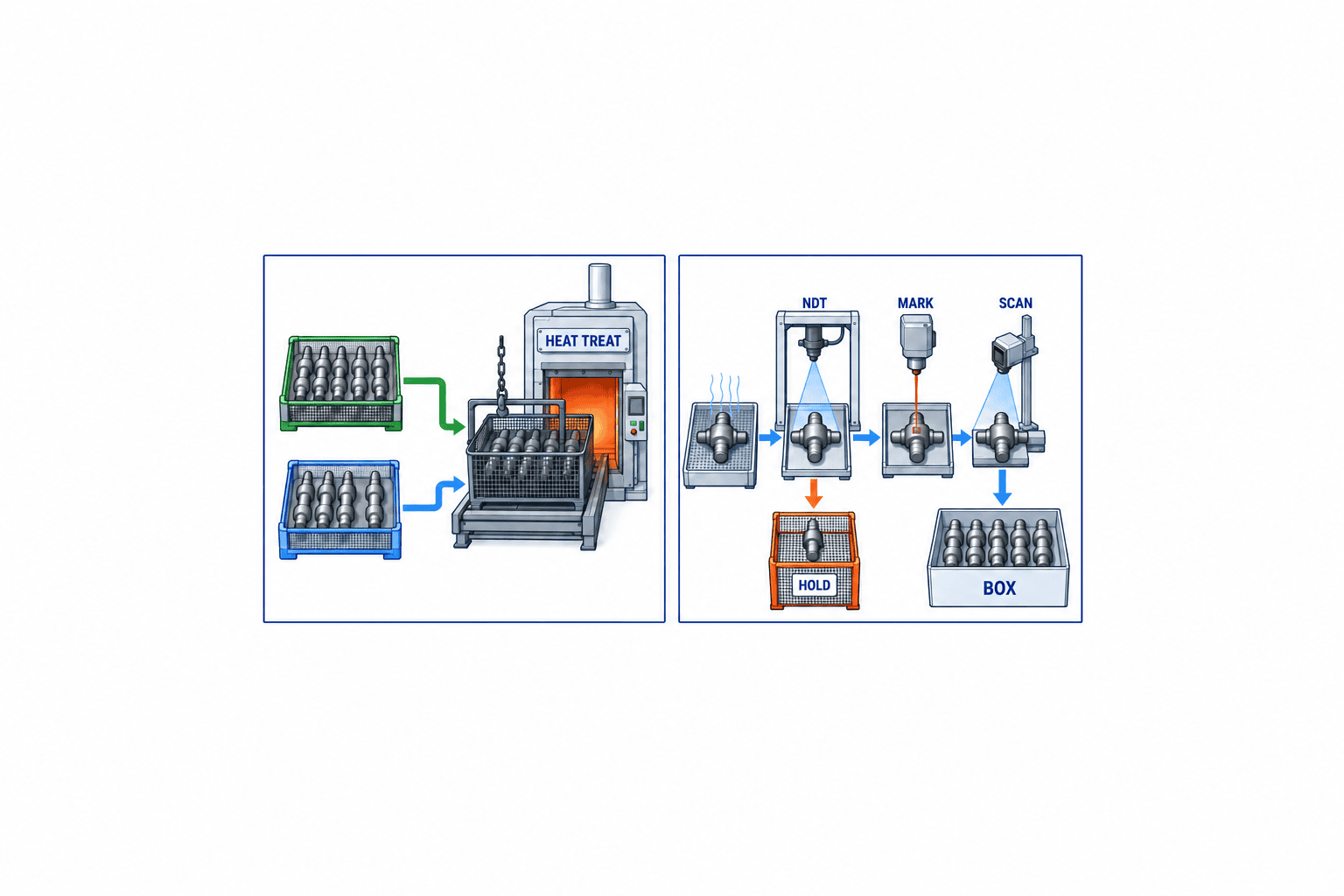
Heat treatment introduces another split-and-merge point. Record the furnace batch, basket, rack position, loading time, recipe, cooling and tempering steps, rework and quantity removed. If several forging lots share a basket, the basket ID must lead back to every source lot. If one forging lot is split across furnace batches, decide whether inspection results and shipment release must also be separated by batch.
Inspection may include visual and dimensional checks, hardness, mechanical tests and NDT; the application and contract determine which are required. The FIA Product Design Guide for Forging discusses material composition, heating, forging, heat treatment and testing where appropriate. The FIA RFQ Checklist lists material grades, heat treatment, destructive or nondestructive tests, drawings, packaging and labels among quotation inputs. These are useful prompts for defining the records required for each part number, not a claim that every test applies to every forging.
For a sample test, state exactly which population the specimen represents. One hardness result must not be assigned automatically to every part produced that day if furnace batches or rework differ. Link each NDT result to a part or lot ID, inspection equipment, program or procedure revision, inspector, any retest and final disposition. A later pass must not erase an initial failure; retain both as a status history. Shipment release should consider the approved disposition and remaining restrictions, not only the latest measurement.
The broader record design for heat treatment is discussed in our process heat-treatment and CQI-9 article. Here the focus is preserving a route back to the original material heat and billet after forging lots are split or mixed in treatment baskets. For automotive audit evidence, see the IATF 16949 traceability guide and verify which customer requirements apply to the actual part.
Map every point where hot handling or mixed loading breaks identity
Walk the shop floor before finalizing the data model. Mixing can occur at the saw discharge box, furnace staging area, furnace outlet lanes, post-press cooling conveyor, shot-blasting container, heat-treatment basket, pre-NDT staging area or packing bench. At each point, document whether different heats or forging lots may be combined, whether a physical divider exists and whether operators can remove or add parts by hand. The neat one-way route on a diagram may differ from what the night shift actually does.
The way to retain identity depends on the part and its temperature. Before heating, a billet or container label may work; through the hot zone, position, travel order, robot grip or a suitable heat-resistant carrier may serve as temporary evidence; after cooling, direct marking or Data Matrix may be possible. The product engineer and customer must assess whether marking is acceptable for the material and end use. A carrier ID is only a proxy: opening the carrier requires a controlled handoff or re-identification. Do not present that proxy as if it were a permanent part ID.
Test a stopped conveyor, two billets close together in one lane, a robot drop and an operator reinserting a returned part at the front. Sensor timestamps alone may imply a false order after a blockage or retrieval. Hold any interval whose count or position no longer reconciles, and define who checks the physical parts and authorizes restart.
Compare lot-level and part-level traceability by product
The simplest option links material heat, forging lot, heat-treatment lot and shipment lot. A middle option also follows cutting containers, furnace batches, press intervals and inspection trays. The most granular option gives a billet or part a unique ID, connects it to the mark applied after cooling and reads it again at inspection and packing. Greater detail adds scanners, marking constraints, operator work, handling for unreadable marks and data retention costs. It does not automatically produce a better result.
Choose several plausible quality concerns and calculate what each tracking option would require you to hold. Suspect chemistry in an entire heat may affect every part from that heat regardless of individual IDs. A deviation confined to one furnace batch or die position may be narrowed by finer links. Estimate benefits from your own history of isolation, sorting, certificate checks and customer reporting, with assumptions stated. Do not invent a universal payback period or fix the frequency and cost of rare failures without evidence.
For individual-part tracking, the crucial handoff is between the billet ID, its temporary position during heating and the permanent mark applied after cooling. If parts are mixed in a treatment basket without another read, the effective granularity falls at that point. With lot tracking, explicitly include uncertain changeover parts and unidentified pieces in the hold policy. Neither method should exclude parts without supporting evidence.
Test ID transitions with a worked example
Consider a worked example. A supplier certificate identifies heat H-A and bar B-A. The bar is cut into billets assigned to containers C-1 and C-2. C-1 enters furnace batch F-1 and C-2 enters F-2; some billets from F-1 are later reheated in F-3 after a stoppage. Press P-1 forges one group with die D-1 before repair and another with a revised D-1 after repair. Both groups enter heat-treatment basket T-1. T-1 must retain two incoming links, not replace them with one parent. The inspection plan also specifies whether hardness specimen S-1 represents all of T-1 or only the pre-repair group.
If a customer asks about abnormal press load immediately after the die repair, start with the affected strokes on P-1 and follow the revised die, downstream transfer, T-1, inspection records and box IDs. Because T-1 also contains pre-repair parts, you can exclude those parts only if their identities remain distinct through packing. If the question instead concerns the chemistry of all H-A material, every route through F-1, F-2 and F-3 is potentially affected. The same records therefore produce different hold populations depending on the cause. In an RFP demonstration, compare the actual query results with the expected populations; an attractive screen is not evidence that the result is correct.
Give each event a unique ID and an explicit set of inputs and outputs. Cutting consumes B-A and produces the billets in C-1 and C-2. Reheating creates a new event that takes identified output from F-1 into F-3; it must not erase the first heat cycle. Tie a press anomaly to the relevant strokes and physical parts, widening the hold population when identity is uncertain. Represent quality as a history of states such as uninspected, held, failed, awaiting retest and finally approved rather than one overwritten “pass” flag.
Make the investment decision with three questions
Ask three questions. First, which failure modes must be contained, and within what time, under the product and customer requirements? Second, at which process points must the physical item or carrier ID be read to prove that containment boundary? Third, how will you compare the costs of reading, marking, machine integration and maintenance with actual isolation, sorting and reporting costs? A furnace-batch concern may justify first securing the basket-to-furnace link. A die-position concern may require position retention or individual marking after the press. An issue that always implicates a whole material heat may yield little added benefit from part-level marks.
Turn the decision into a small shop-floor trial rather than settling it in a meeting. Simulate each quality concern under each candidate method, count the boxes actually held, and observe extra scans, unreadable marks and night-shift exceptions. If the theoretical minimum hold population differs from what operators can actually isolate, find whether the gap comes from the data model or physical handling. Include the equipment, procedures and training needed to close that gap in the quotation and measure the same indicators after go-live.
Specify forging genealogy and exceptions in the RFP
The RFP should describe the part and drawing revision, form in which stock and heat certificates arrive, saws, furnaces, presses and dies, heat treatment, inspection and actual shipping flow. Ask each bidder which ID will be captured at every event, which input-to-output links will be stored and what production or release action occurs when data is missing. The material, heat-treatment, test, packaging and label fields in the FIA Forging RFQ Checklist are useful part-specific inputs to this system specification.
Give bidders the same ten comparison items: (1) physical flow and mixing points; (2) ID scheme and split/merge rules; (3) equipment connection inventory; (4) data dictionary for temperature, load and time; (5) inspection and shipment release; (6) links between stock and certificates; (7) power loss, communication failure and replay; (8) access rights and correction history; (9) expected FAT/SAT results; and (10) training, maintenance and itemized costs. Compare how each proposal covers machines, scan points, extra sensors, master data and migration. For a machine that has not been surveyed, require a site assessment and live connection test rather than accepting “supported” as a proven fact.
Separate software, machine-data acquisition, industrial scanners and marking, network, terminals, quality-system or ERP integration, process changes and maintenance in the cost estimate. Storage changes substantially if every waveform is retained rather than selected values and exception waveforms. Set retention and retrieval needs from the customer contract and use case. Do not state that API 20E/20F or another sector-specific specification applies to every forging; applicability depends on the part, application, customer and contract.
Use FAT/SAT to test splitting, mixed loads and reheating
Use simulated data at FAT to test the event model and screens, then use real machines, material, carriers and operators at SAT to reconcile digital records with physical flow. A successful search for an ordinary box is too weak. Split one material heat into two cutting lots, route them through different furnace batches, reheat one subset, mix material in a heat-treatment basket, retest an NDT subset and repack a box. Agree in writing on the expected parent-child links and hold population before running the test.
| Deliberately introduced event | Evidence required to pass |
|---|---|
| Split one heat across containers and forging lots | Output quantities and parent heat reconcile in both directions |
| Mix billets from another heat before furnace entry | The hold or multiple-parent link follows the agreed permission rule |
| Reheat a subset after a furnace stop | Two distinct heating events identify the affected billets |
| Run an empty stroke, restart the press and insert a returned part | Missing stroke numbers and any change in physical sequence are detected |
| Change or repair a die mid-lot | Effective revision boundaries identify the relevant forged parts |
| Split or mix heat-treatment baskets | Each part or lot leads to its source basket and treatment recipe |
| Retest after NDT and reopen/repack a box | Original decision, correction reason and old-to-new box link remain visible |
During a network interruption or power loss, test when production may continue, how offline records are reconciled and whether replay creates duplicates. If press or furnace records arrive late, retain both the event time and ingestion time. Never substitute zero or “pass” for missing data. Quality, production, maintenance and logistics should each compare the search result with physical evidence and sign off their own SAT criteria alongside IT.
Review unlinked events and held parts every day
Record counts alone can hide a broken genealogy. Review unlinked receipts, material-balance differences, furnace input/output discrepancies, press output after excluding empty strokes, unknown die revisions, undeclared mixed treatment baskets, overdue inspection holds and mismatches between box labels and contents. Set the expected value and allowed resolution time for each indicator from the process and customer requirements. Carry unresolved exceptions into the next shift rather than letting them disappear at handover.
A correction must retain the original event, corrected value, reason, operator, approver and time. Overwriting a heat number after shipment would make the historical release decision and material certificate impossible to reconstruct. Restrict edits by job role and require controlled approval for post-shipment changes. A database backup is insufficient unless a restore test also proves that a shipped box can still be traced backward to its stock.
Press-load and temperature monitoring can help detect process anomalies, but they answer a different question from genealogy. Without a part ID or defensible carrier-to-part link, a signal cannot define which shipments to hold. Conversely, linked IDs alone do not prove quality without reliable measurements and approved criteria. Assign owners for machine signals, physical-part links and quality disposition, then make all three visible from one trace result.
The existing die-casting traceability guide links molten-metal batches, casting shots, dies and castings. Forging requires a different event model: one solid-material heat splits into cut billets, billets move hot from furnace to press, some are reheated, and multiple forging lots can merge in a heat-treatment basket. A shared “lot number” field cannot express those physical relationships by itself. Check the input and output of each event before reusing a system design across processes.
Complete one closed genealogy on one product and line
Choose one representative part number and line that include hot transfer and heat treatment and can be observed closely. Selecting only the easiest press connections may leave the hardest mixing point unresolved; connecting every line at once makes identity errors difficult to diagnose. Walk the physical path, mark mixing points and the first feasible point for permanent marking, define IDs and exception actions, then test machine acquisition on real equipment. Expand only after both material-to-shipment and shipment-to-material searches close for the pilot.
Acceptance also requires routine operation without a vendor standing beside the line. At SAT, have night-shift staff handle a material reassignment, furnace stop, returned part, NDT retest and opened box under the written procedure. Have quality staff approve the resulting affected population. Use the pilot’s unlinked, corrected and held-event history to improve the next line’s RFP. For each new part, recheck marking feasibility, furnace practice and test requirements instead of copying the first configuration unchanged.
FAQ: Forging traceability implementation
Is a heat number alone enough to trace forged parts?
A heat number is the starting point, not necessarily a complete genealogy. One heat can be split across cutting containers, furnace batches, die revisions and heat-treatment lots. Without the links between those steps, you cannot say which process conditions a particular shipment experienced. Preserve the receipt marking and certificate together with cutting, transfer, heating, pressing and downstream input/output events.
How can a hot billet be identified without a permanent mark?
Use a container or tray ID before heating, verified position and sequence in the hot zone, count reconciliation between furnace exit and press, and a permanent mark after cooling where feasible. Add scanning or physical segregation wherever sequence can change. State explicitly when the effective tracking granularity falls back to a lot because individual parts cannot be distinguished; do not show false precision.
Does press stroke data alone prove product quality?
No. Force and stroke are only part of the process evidence. Link them to material, die revision, heating, treatment and inspection results, and establish which measurement source, revision and customer acceptance criterion apply. Verify the machine maker’s data-acquisition behaviour on the actual press.
Should we track by lot or by individual part?
Compare customer requirements, the fault population that must be contained, marking and reading feasibility, and operating cost. Part IDs may not narrow a concern that implicates an entire material heat. They can be valuable when a concern is limited to one furnace batch or die position. Calculate the hold population for representative fault scenarios under both designs.
Are API 20E/20F mandatory for all forging plants?
Not universally. API 20E/20F concern specific applications and supply-chain requirements; verify the part, customer contract and applicable edition before treating either as relevant. This guide describes a general genealogy design and does not determine standards compliance.
Summary
Forging traceability records each split and merge from material heat through cut billets, furnace batches, press and die, heat treatment, inspection and individual part or shipment lot. Its usefulness depends on retaining the physical link through hot transfer, mixed loads, reheating and scrap handling. Select lot or part granularity from the required containment range and total operating cost, and deliberately test exceptions in the RFP and FAT/SAT.
Even if your Thai plant has not yet mapped the physical flow and machine connections from material heat to shipment, you can consult TOMAS TECH. We can start with one part number and one line to define traceability granularity, the RFP and acceptance tests.
Related articles
- IATF 16949 traceability in Thai factories: Automotive identification and audit evidence.
- MES implementation in Thai factories: The boundaries among MES, ERP and equipment.


