


A production material issue control system must do more than record a warehouse withdrawal. For every released production order, it should show which component lot and quantity was reserved, picked, moved to a production input location and actually consumed, and when that consumption affected inventory and cost. Unused material returned to stock is a different transaction from damaged material scrapped at the line. This guide helps teams in Thai factories define the ERP–MES–WMS boundary, scanning workflow, discrepancies, RFP and FAT/SAT.
Our material management system guide covers the broader purchasing and inventory picture. Our manufacturing inventory allocation guide focuses on committing stock to demand. This article starts at the next boundary: moving actual material and recording actual use. An order, reservation, pick, movement and consumption posting are not interchangeable events.
Define the scope and transaction boundaries of a material issue
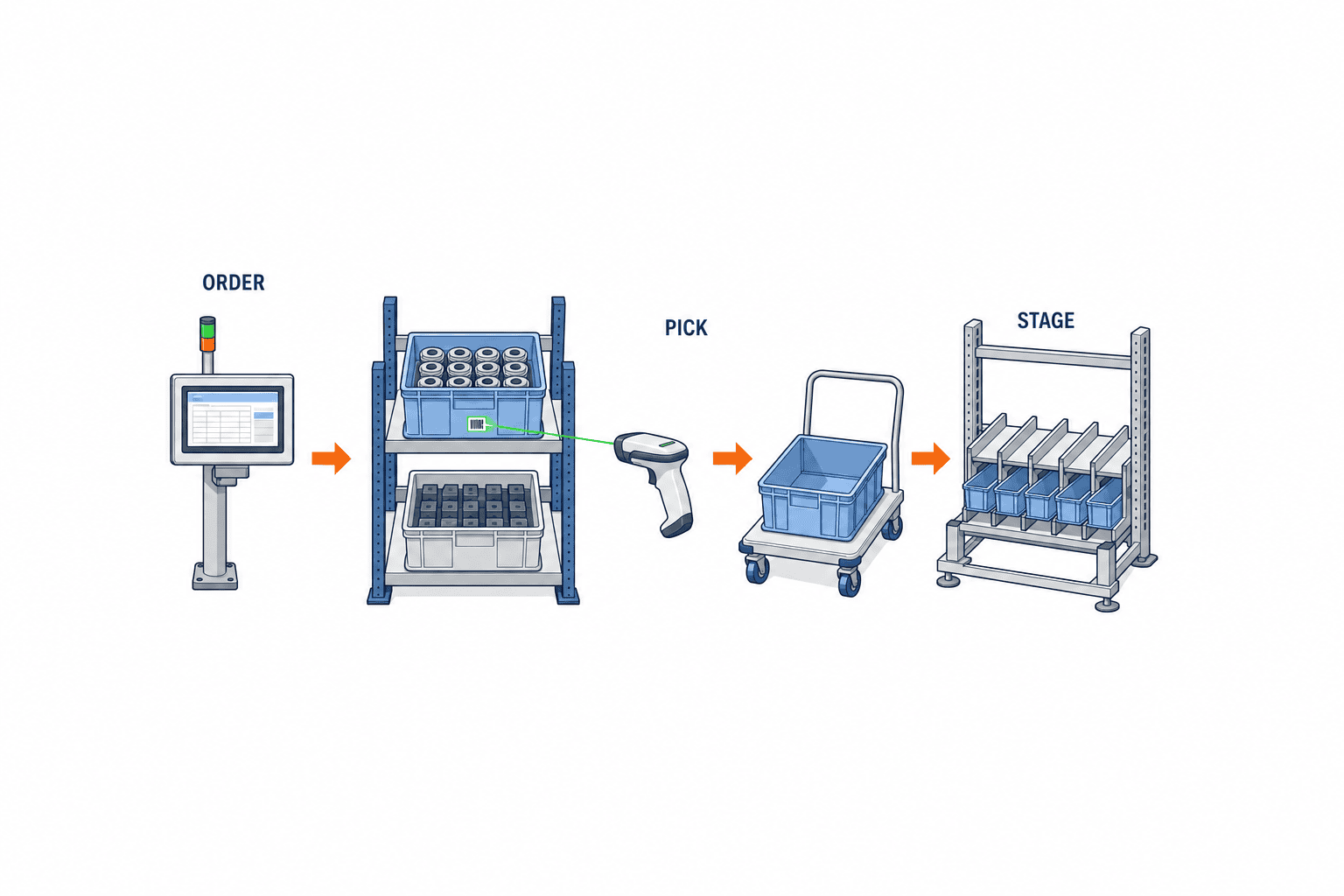
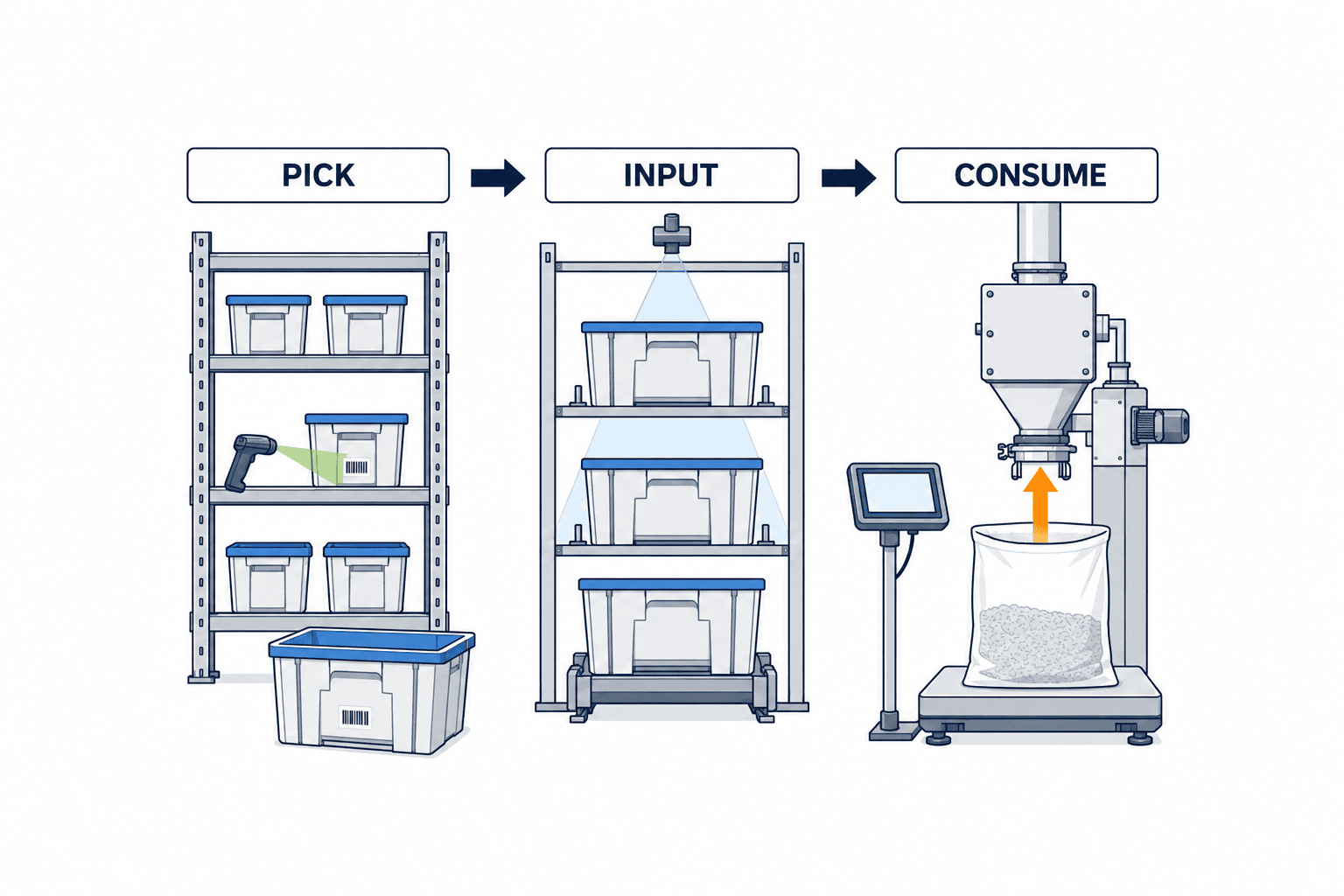
Map eight steps: (1) release the production order; (2) establish requirements from the BOM or formula; (3) reserve inventory; (4) pick from the warehouse; (5) move and receive it at the production input location; (6) register actual consumption; (7) return unused material or scrap damaged material; and (8) approve discrepancies and close the order. Some factories call step 4 “issue”; others mean step 6. Replace that ambiguous word in the RFP with a table showing the effect of each event on location, available stock, cost and ownership.
Microsoft’s official documentation describes a released production order as available for shop floor and warehouse execution. Raw material picking work can be generated for physically reserved material. BOM lines can be released to the warehouse with the order, through a batch job or manually; material already at the production input location may need no warehouse move. These are examples of one product’s configuration, not universal rules. They illustrate why an implementation must separate order state, warehouse work and actual consumption. See production order release and BOM line release.
| Event | Physical or system state | Evidence to capture | Risk if repeated |
|---|---|---|---|
| Reservation | Stock committed to one order | Order, item, required quantity, lot rule | Same stock promised twice |
| Pick | Material removed from storage | Source, container, lot, actual pick quantity | Warehouse balance reduced twice |
| Staging | Material received at production input | Destination, recipient, handling unit | Stock location becomes unknown |
| Consumption | Actual use confirmed | Order, operation, lot, amount, time | WIP and cost double counted |
| Return or scrap | Unused stock and loss separated | Condition, quantity, reason, approval | Good stock and usage misstated |
Decide which system makes consumption final. Microsoft’s production posting documentation explains that posting a production picking list journal creates an issue transaction and deducts on hand stock. A container movement does not necessarily mean every unit in it was consumed. Equally, a scan captured on a device does not guarantee that an ERP journal was posted. Compare the official posting description with the exact settings of your chosen systems.
From order release to pick: what becomes eligible, and when?
Start with the order life cycle. Specify whether issues are allowed while an order is planned, firmed, released, started, completed or cancelled. Releasing too early creates returns after plan changes; releasing too late leaves the warehouse no preparation time. Model changes in order quantity, BOM revision, approved substitute, emergency order and cancellation before choosing a product.
The BOM calculation is a starting point for the pick, not always its final quantity. Yield, fixed consumption, rounding, pack size, operation and actual quantity manufactured may all differ. If the order is for 100 units but the next shift will make 25, a partial release may be appropriate. Microsoft’s BOM release feature can release by operation or proportion of finished goods. An RFP should state whether full, operation, shift and partial quantity releases are allowed, and how remaining requirements are calculated.
A reservation is not yet a usable warehouse instruction where a component spans several lots, bins or containers. A pick task needs an order and BOM line, item, requested amount and unit, permitted lot, source bin, destination, due time and priority. Specify who approves a substitute lot or shortage. A two-point check—scan at source and receipt at the input location—can expose a mix-up during movement.
Some configurations consume automatically when warehouse work is completed. That may be acceptable for stable, fully used components. It is less suitable where material waits at the line, is partially consumed or returned, or must have an exact lot and use time. Microsoft’s manufacturing execution parameters allow automatic BOM consumption at order start, operation completion or report as finished. The documentation warns that inconsistent settings can deduct materials twice or not at all. Specify the consumption trigger by material group and operation, then test it rather than treating “automatic consumption” as one feature. See the parameter guidance.
Barcode confirmation must identify more than the item
A scanner reading a label does not itself validate an issue. An item number alone does not identify the lot, pack quantity or individual container. Decide whether the controlled unit is an item, lot, serial, tote, pallet or weighed portion. Connect it to an order, operation, location, operator, quantity and unit. Avoid forcing every attribute into one code; define scan order and which fields the system can reliably derive.
GS1 General Specifications define Application Identifier (10) for a batch or lot number. A GS1 label still does not inherently identify your factory’s order, operation or measured consumption. Separate supplier label reading from generation of internal container IDs. Split containers of the same lot need unique IDs when their movements differ. Include damaged labels, reprints and restricted manual entry in the work instruction. The GS1 specification is a reference for the encoded data element.
A clear device flow begins with the order or task, then checks bin, container, lot, amount and destination. Scanning a nearby container before selecting an order can assign it to the wrong job. Use distinct verbs and screens for “move to input location” and “consume in operation”. Display a server accepted transaction ID, not just a green animation. The operator needs that ID to resolve a lost network response without making a second issue.
Units are a frequent source of hidden discrepancies: purchasing in kilograms, storing in bags and weighing in grams. Define conversions, rounding, tare and permissible variation in master data and on screen. For a partially used 25 kg bag, identify the scale, who records remaining mass and who approves the return. When exact batch, amount and time matter, capture them at actual use. Microsoft’s mobile consumption example records order, production input location, item, batch and quantity before posting the journal. See the handheld workflow.
Divide ERP, MES and WMS by system of record and transaction ID
The slogan “ERP handles stock, WMS handles warehouse, MES handles the line” leaves the boundary undefined. For orders, BOMs, item and lot masters, locations, balances, tasks and consumption journals, name the system of record, event producer and final posting system. One possible arrangement keeps formal orders and costs in ERP, warehouse picks in WMS and physical use in MES. Your actual architecture depends on product configuration and existing equipment.
An order number alone is an inadequate integration key: the same line may receive repeated partial issues across several operations. Design an event contract with a unique transaction ID, order line, operation, item, lot, container, source and destination, amount and unit, time, origin system, state and any correction reference. Preserve order and BOM revisions so an old pick can be compared with a revised requirement. Define what each receiver updates and precisely what its acknowledgement means.
Test replay deliberately. If Wi-Fi fails after a device sends a scan but before it receives the response, it may resend. The receiver must return “already processed” for the same transaction ID without changing inventory or journals again. Reject the same ID with different content and retain an audit trail. Define what happens if a consumption message arrives before pick completion: hold, retry or escalate. More retries alone will not repair an interface lacking deduplication, monitoring and an exception queue.
Set stop versus offline continuation rules according to material risk. For a traceability critical component, continued use without server validation may be unacceptable. If offline work is permitted, issue a temporary record number, isolate affected containers, reconcile after recovery, prevent double posting and obtain approval. “Enter it later” is not a controlled exception process.
Keep discrepancies, returns and scrap distinct
The difference between required and picked quantity, picked and received quantity, and received and consumed quantity arise at different boundaries. Record each stage’s amount, unit, lot, container, time, operator and approver so the cause can be located. Set approval thresholds by material risk and value; a universal threshold would be misleading. An interface that merely stores a free text “difference” cannot determine whether the warehouse short picked, transport lost a tote or production used extra material.
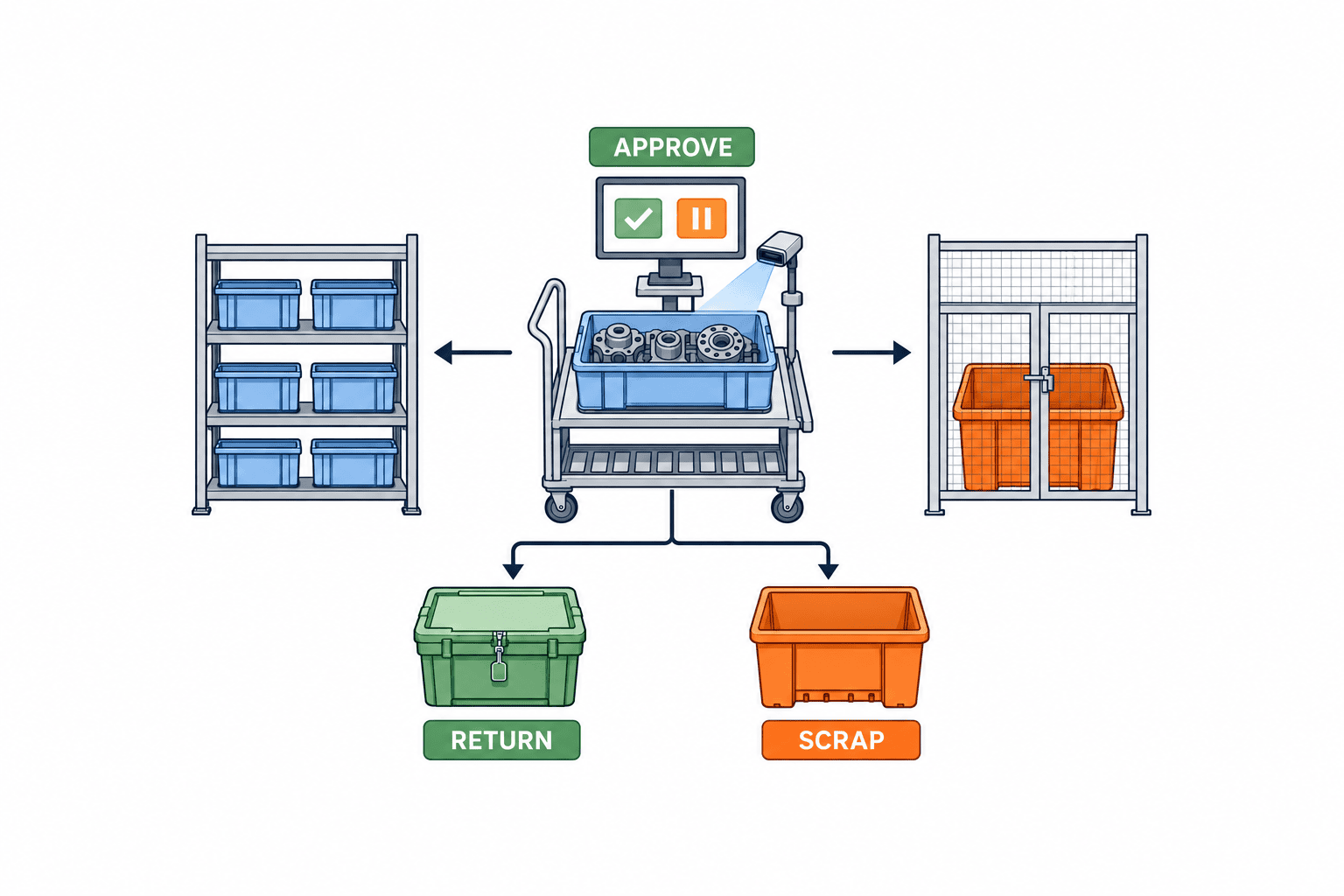
Before returning unused stock, check whether it is sealed, whether storage conditions remained valid and whether its lot label is legible. Used or damaged material must not silently re-enter good inventory. Distinguish quality hold, inspection, repacking and disposal. A reversal needs a reference to the original issue and its order and lot. Erasing an event with an unexplained negative quantity weakens auditability.
Scrap has a different reason and accounting treatment from a return. Pre-use damage, process loss and a failed quality check point to different owners. Microsoft describes configuration choices for allocating error quantity cost to good units or a dedicated scrap account. Apply your company’s accounting policy and obtain finance approval. In the requirement, write where the discrepancy is detected, who approves it, which corrective transaction is made and where it appears on reports.
Put operational ownership and exception approvals on screen
A technically sound interface still leaves open tasks if ownership is unclear. Warehouse staff pick against an order and task; production staff receive the lot at the input location; operators enter actual use; planners communicate order changes; quality decides whether held material can return; finance checks postings. Configure role based queues, substitutes and approval limits for these decisions.
If the warehouse picked 20 units and production received 19, do not complete the receipt by assuming the missing unit is somewhere nearby. Hold one unit as an unresolved in transit discrepancy. Investigate source bin, tote, route and timestamps. Record whether it was a wrong pick, an unscanned receipt or a physical loss, then post an approved correction. A red mark on paper does not clear a system balance.
A cancelled order illustrates why task state and physical stock must be handled separately. Unpicked work may be stopped, but material already at the production input location requires physical confirmation, return or reassignment. A one way ERP cancellation message could erase in progress WMS work or MES evidence. Let receiving systems accept, reject or hold the change and surface holds to an accountable person.
Check master data and cutover before rollout
A new issue system will not repair an incorrect BOM. For representative components, validate substitution rules, standard amounts, operation assignment, unit conversion, lot control, inventory status, source bin and input location. When old and new item codes are ambiguous, staff start bypassing failed barcode matches through manual entry. Identify whether each label contains an ERP item, supplier item or internal container ID.
Cutover requires more than importing balances. Reconcile released orders, reservations, picks in progress, containers already at input locations and unposted consumption journals. Define the timestamp after which the old system stops creating issues, how delayed events are handled, what number the new system returns and who signs the reconciliation. On the first live order, compare physical item, lot and amount with WMS, MES and ERP before closure.
Design operational reports for unpicked tasks, in transit quantities, input location stock, unposted consumption, pending returns and pending approvals. Supervisors should clear exceptions daily rather than accumulate a month end adjustment. Set retention, access and clock synchronization to the company’s contractual and quality needs; confirm an auditor can reconstruct a lot’s path from actual records.
Compare functions, costs and responsibility in the RFP
Attach a current process map and realistic data to the RFP. Give every vendor the same released order, multi-lot component, partial pick, operation change, leftover return, scrap, cancellation and network loss scenarios. Ask whether each step uses standard function, configuration, custom development or another product. Assess the resulting inventory, WIP, cost and genealogy, not merely attractive screens.
| RFP topic | Vendor response required | Demonstration result |
|---|---|---|
| Order and BOM sync | Master, revision, change and cancellation propagation | Handling of a pick made under the old revision |
| Lot and container check | Code format, splits, mixed stock, manual-entry right | Wrong lot rejected |
| Partial issue | Operation and shift, rounding and unit | Correct remaining demand and reservation |
| Consumption trigger | Manual or automatic by item group | No double deduction |
| Return and scrap | Original transaction, quality state, approval | Good stock and costs updated correctly |
| Integration | IDs, replay, out of order events, monitoring | Duplicate and missing message tests |
| Operations | Offline rules, roles, audit, backup | Reconciliation after a failure |
Break the estimate into licenses, devices, scanners, scales, printers, Wi-Fi, master data cleanup, interfaces, migration, training, Thai language screens, support and future operation or SKU changes. Device customization and ERP posting may be separate contracts. Name an owner and first support contact for each boundary. Comparable scenarios reveal more than an unsupported market price claim.
A pilot may start on one operation, but it must include hard production cases: multiple lots and containers, unit conversions, partial use, returns and network failures. A single lot consumed in full will not test discrepancy handling. Record current exception frequency and task time before deployment so the factory can compare results later.
FAT and SAT must prove balances, not just a working screen
FAT reproduces agreed business cases in the vendor environment and checks the transactions. SAT uses the Thai factory’s real bins, input locations, labels, Wi-Fi, scale, devices, configurations and operators. An API that worked at FAT may fail against a damaged label or weak signal. Define evidence and pass conditions in the RFP rather than negotiating a vague “works properly” at handover.
| Test | FAT check | Added at SAT | Passing evidence |
|---|---|---|---|
| Release and partial issue | Order revision, demand, remaining quantity | Real shift and operation change | Order line and task history |
| Wrong lot or over-quantity | Rejection and controlled override | Actual labels, scale, gloves | Screen and audit log |
| Pick → input → consumption | Separate states | Physical bins, transfer, recipient | Stock, WIP and lot history |
| Return and scrap | Reversal references | Opened container and quality hold | Good stock and accounting posting |
| Network loss and repeated tap | One posting per ID | Wi-Fi handover, device restart | Request, acknowledgement and balance |
| Change and cancellation | Hold for already picked stock | Physical tote retrieval | Approval and resolved discrepancy |
Use more than one ideal order. Combine lots, containers, partial quantities, different units, another order, an opened return and a network failure. A repeated tap is a normal device scenario, not a reason to exclude a test. Passing means each system has one consistent transaction and the on hand, reservation, input location, actual consumption, WIP and cost follow the agreed definition.
Record SAT defects with severity, temporary work instruction, owner, due date and repeat test. Do not enter normal operation with unresolved wrong-lot or double-consumption defects. Have actual operators complete the Thai-language order selection, wrong scan recovery, return and post-outage reconciliation. Vendor demonstrator success does not prove the factory can operate the process.
Acceptance scenario: trace a partial issue, return and replay on one order
The following quantities are illustrative assumptions, not industry standards or recommended tolerances. Assume a released order for 100 finished units, with a BOM requiring two units of component A per finished unit. Total demand is 200 components. The next shift will start only 40 finished units, so the warehouse receives a partial issue request for 80 components. Component A is stocked in lots L1 and L2. It picks 60 units from L1 and 20 from L2 in two containers. This example assumes both lots have been approved for this order; actual lot mixing rules depend on the product and process. Set these assumptions in the order, BOM and stock state before beginning the acceptance test.
First, confirm that WMS completes two pick tasks and updates available quantity at the source bins and the remaining reservation correctly. At the production input location, MES or a shop floor device scans each container and receives 60 units of L1 and 20 of L2. The scenario assumes no material has yet entered the process. Input-location balance should therefore be 80 units and actual consumption zero. If ERP has already posted a consumption journal at this point, the operational meaning of “received” may conflict with the accounting meaning of “used”. Compare the observed posting with the trigger agreed for the selected product configuration.
The operator then registers actual use of 50 units from L1 and 18 from L2. Total consumption is 68; unused balance at the input location is 10 from L1 and two from L2. Assume the server accepts the L2 event but Wi-Fi fails before the success response reaches the device. When the device resends the *same transaction ID*, MES actuals and ERP consumption posting must include those 18 units only once, and the receiver should respond that the ID was already processed. If an operator creates a new ID for the same action, evaluate whether the system warns about a suspicious match on order, operation, lot, container and time. Idempotency by ID alone cannot necessarily prevent a mistakenly created second ID.
At the end of the operation, assume the unopened, properly stored ten units of L1 are approved for return to the warehouse. The two opened units of L2 go to quality hold. The returned ten may re-enter good stock, while the held two must not be available for a new reservation. A later quality decision either follows an approved restocking procedure or generates a scrap transaction. Both paths should reference the original issue. Before accepting this partial-issue test scenario, reconcile the 80 units picked as 68 consumed + 10 returned to good stock + two on quality hold. The remaining 120 units of total order demand have not yet been issued; do not treat them as consumption or as a discrepancy.
Passing evidence includes WMS source-bin, pick and return records; MES receipt, lot-specific use and replay logs; ERP inventory and WIP or cost postings; plus quality hold and approval history. Screenshots alone are insufficient: each record must be joinable by order line ID and transaction ID. Repeat the sequence from a second device and compare balances and posting counts before and after replay. If it fails, identify the exact transaction boundary where the amount changed, correct it and retest.
KPIs and change control after go-live
Track more than processing time: rejected wrong-lot scans, pick discrepancies, unreceived transfers, unposted consumption, returns awaiting review, differences at order closure and replay events. Analyze by operation, material, lot and shift. If alerts become noise, review master data and reason codes; do not simply turn validation off.
A revised BOM, new supplier label, different pack size, new lot rule or operation changes the issue process. Maintain a regression checklist covering order and BOM revision, device screens, printed labels, ERP journal, WMS task and MES record. A new scan sequence still needs the transaction ID, deduplication and audit rules. Even an accurate cycle count cannot compensate for a wrong consumption time or lot attribution. Before closing an order, be able to explain reserved, picked, staged, consumed, returned and scrapped quantities.
Frequently asked questions
Are reservation and issue the same?
No. Reservation commits stock to demand. Issue refers to physical pick, transfer or consumption, depending on the system’s terminology. Define the inventory and accounting effect of each event in the RFP.
Does WMS remove the need for MES issue functions?
WMS may handle warehouse picks without recording the precise lot and amount used at an operation. MES or an ERP shop floor screen can capture use; choose one system of record and an ERP posting path.
Is an item code alone sufficient on the barcode?
Not where lots and split containers matter. Identify item, lot and container, and associate the scan with order and operation. Display amount and unit for operator confirmation.
Should we use backflush or a scan at actual use?
It depends on material variability and traceability. Automatic deduction may fit predictable consumption; exact lot, amount and time calls for on-site registration. Test that both triggers cannot deduct the same material twice.
Can a return be a negative consumption entry?
Use a controlled reversal referencing the original transaction and preserving item, lot and quality state. Sealed, opened and damaged material cannot all flow straight back to good stock. Approve the accounting treatment.
How small can the first rollout be?
One operation is enough if it includes partial issues, several lots, residual return and network failure. Test the full chain from released order through consumption and close.
Conclusion
Define released order → reservation → pick → input location → actual consumption → return or scrap as distinct transactions. For each, specify the authoritative system, transaction ID, lot, quantity, unit, approval and accounting effect. Barcode scanning connects physical material to these transactions; replay control and discrepancy workflows keep ERP, MES and WMS consistent. Use real exception cases in the RFP, FAT and SAT.
To map this flow across an existing Thai factory, contact TOMAS TECH. We can turn the current process, transaction boundaries, vendor scenarios and acceptance evidence into a practical selection brief.
Sources
- Microsoft Learn: Release production orders
- Microsoft Learn: Release BOM and formula lines to the warehouse
- Microsoft Learn: Register material consumption using a mobile device
- Microsoft Learn: Production parameters for manufacturing execution
- Microsoft Learn: Production posting
- GS1 General Specifications: AI (10) batch/lot


