


Introducing AI for ergonomic assessment in a factory takes more than installing a camera that recognizes postures. A procurement team must decide which task and posture will be assessed, which method applies, how a qualified person reviews uncertain results, and what changes to tools, fixtures or layout will follow. This guide is for safety, production engineering and IT/OT teams in Thailand. It turns RULA and REBA selection, fixed camera placement, worker privacy, RFP requirements and FAT/SAT into an actionable purchasing plan.
Buy an improvement decision, not a dashboard score
Ergonomics means designing work around human capabilities. NIOSH identifies awkward posture, force, repetition, duration and vibration among the factors relevant to work related musculoskeletal disorders. OSHA recommends combining observation with worker interviews, job analysis and existing reports. Video cannot diagnose pain or disease. Nor can one AI score predict that a particular worker will be injured.
An incentive to count fewer high score events can simply lead to a narrower camera view. Instead, specify the desired improvement: reposition a bin, adjust bench height, suspend a tool, provide a lift assist or change the sequence of work. Compare the same task before and after that intervention. AI should help identify candidate events consistently and track whether the improvement holds. It should not become an individual performance or disciplinary ranking.
Our AI visual inspection procurement guide explains how to specify imaging conditions and acceptance tests for products. Here the subject is worker postural load screening, expert review and engineering changes. For camera based hazard alerts and the distinction between monitoring and a protective safety function, see our factory safety AI RFP guide.
RULA versus REBA: choose a method for the task
RULA, Rapid Upper Limb Assessment, was published by McAtamney and Corlett in 1993. It quickly screens upper limbs, neck, trunk and legs together with muscle use and external load. It is often a useful starting point for assembly or inspection tasks where shoulder, arm and wrist position matter. REBA, Rapid Entire Body Assessment, was described by Hignett and McAtamney in 2000 as a field method that accounts for whole body posture, load, coupling and activity. It is relevant when handling boxes, reaching into low locations or changing stance and trunk posture.
The two scores are not interchangeable scales. Neither score is a medical diagnosis or an individual injury probability. Both are mainly screening assessments of selected postures. Exposure also depends on force, repetition, duration, rest and workers’ experience. For a two handed lifting task, consider whether the Revised NIOSH Lifting Equation is suitable. A qualified ergonomics or occupational health practitioner should select the method for the task, rather than selecting the task to fit a vendor’s menu.
| Example task | Method to consider first | Inputs a camera cannot reliably supply | Check |
|---|---|---|---|
| Fine assembly or overhead fastening | RULA | Tool reaction force, holding time, left/right difference | Can shoulders and wrists be seen? |
| Moving cartons from a low pallet | REBA and possibly a lifting assessment | Mass, grip quality, frequency | Are trunk and legs visible together? |
| Pushing a large component | Task specific assessment | Horizontal force, floor condition, distance | Do not approve work using RULA/REBA alone |
| Long static holding posture | ISO 11226 related assessment | Holding time, breaks, external load | One angle is not a full shift exposure |
ISO 11226:2000 addresses static working postures and considers time as well as body angles. The ISO page listed the 2000 edition as current and under revision when checked in October 2026. State the edition in an RFP and check its status again before contracting. The examples above guide assessment selection; they are not legal limits.
Define the unit of assessment as task, posture and condition
“Worker A is high risk” tells an engineer little about what to change. Define line, station, product, task element, fixture, material location, shift and setup. “Take one component from the upper shelf on the right and place it on the assembly bench” is a unit that can be assessed again after a shelf move. Personal identity is usually unnecessary for this decision. Restrict any exceptional identity access to an agreed investigation process.
Separate two questions: Which postures should an expert inspect, and how often or how long do those postures occur in the defined task? A single worst frame may overstate a rare setup movement. An average frame may hide a short but demanding reach. Decide in advance how normal production, product changeover, infrequent work and physically demanding events enter the sample.
Before and after comparisons need matched conditions. If carton mass, workbench height, product mix, staffing, lighting or camera angle changes at the same time, the reason for a score difference is uncertain. Record what changed and what remained constant. Compare like with like or report why matching was impossible. Do not take the average of every pre change event and compare it with the best post change frame. The observation period should match task variability rather than a universal number.

Fixed cameras: what they capture and what they miss
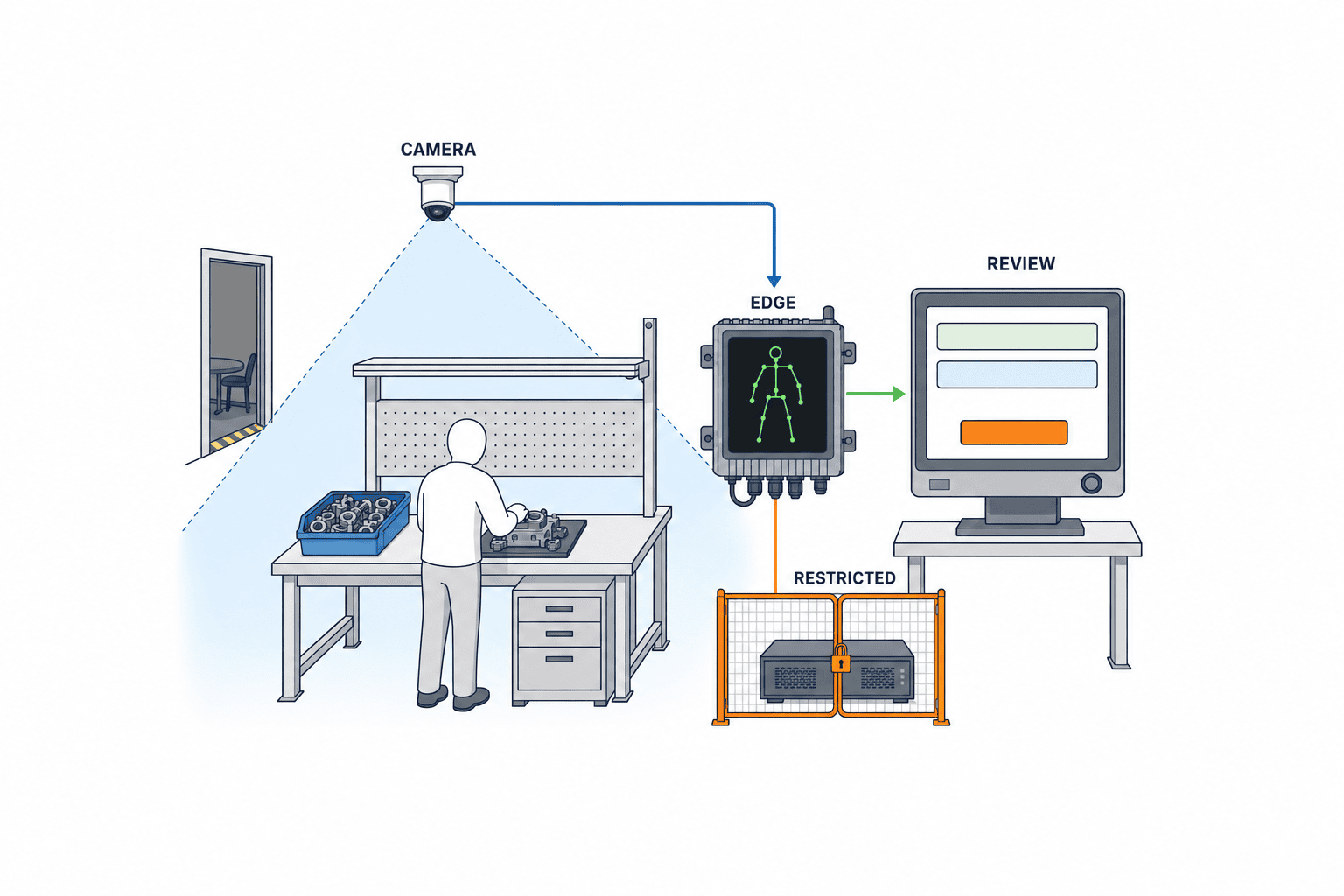
A fixed camera can observe the relationship among bench, shelf, workpiece and worker from a repeatable view. A two dimensional picture does not automatically reveal depth or trunk twisting. An arm can disappear behind a product; gloves and tools can obscure the wrist; people may overlap; reflective metal can confuse keypoint detection. More pixels do not solve physical occlusion.
During a site survey, film representative movements and record which shoulder, elbow, wrist, neck, trunk, knee and foot landmarks remain visible. Choose a frontal or modestly oblique view that does not place a fixture in front of the critical joint. Include safe maintenance access to camera mounts and cabling. Multiple cameras add synchronization, retention and access complexity. Add them only after identifying a specific view that one camera cannot provide.
A shift in mounting height or zoom changes measured image angles even when the worker’s posture has not changed. Align pilot and production conditions. Recheck quality after equipment moves, lens changes, lighting replacement, new fixtures, different uniforms or a model update. Sample day and night shifts where both will be assessed.
NIOSH has investigated computer vision for estimating trunk angles and notes the potential for longer observation periods. That research result is not a warranty for another factory. Measure errors under the plant’s own lighting, occlusion, clothing and task pace. Preserve “unassessable” as an explicit outcome.
Audit posture estimation separately from scoring
Break the pipeline into video quality, person detection, body keypoints, left/right identification, angles, posture classes, RULA/REBA rules, task assignment, summaries and human review. A system should not silently interpolate a hidden wrist and display high confidence. It should show “joint not visible,” “assessment unavailable” or “manual review required.” Missing data must not become a low risk score.
Several scoring inputs are not visible in a video: actual load, tool reaction force, grasp quality, muscle use, frequency and duration. Collect them from measurements, production data and a worker or supervisor interview. Do not infer carton mass from its apparent size, assume grip quality from one image or extrapolate a whole shift from a short clip. Mark missing inputs and withhold a final score or label it explicitly provisional.
Have trained experts score independent video samples as a reference. Compare joint angles, posture categories and final score separately. A matching total can conceal two errors that cancel each other. Examine errors by task, left/right side, occlusion, clothing and body size. An adjacent score difference matters if it changes the intervention priority. If experts disagree, retain that disagreement and adjudicate it; do not force an artificial ground truth.
Design worker privacy before mounting a camera
Even a clip without a visible face may identify someone through station, time and uniform. In Thailand, review applicable PDPA requirements and the employer’s occupational health processes. Thai government agencies publish CCTV privacy notices describing purpose, coverage, handling and rights channels. A factory should develop its own notice and lawful processing basis with legal and DPO review rather than copy another agency’s wording.
Define the purpose as improving ergonomics for specified tasks. Separate it technically and contractually from attendance, discipline, face recognition and general surveillance. Frame only necessary work areas; avoid break rooms and irrelevant walkways. If feasible, process video on an edge device and keep joint points or aggregate task information, retaining raw clips only for justified reviews. Skeleton data is not automatically anonymous: a timestamp and station may reidentify a worker.
Set separate retention periods and access controls for raw video, extracted clips, keypoints and aggregates. Document deletion, vendor access, subcontractors, any international transfer and evidence of deletion at contract end. Keep access logs and an exception path. Explain to workers how they can report a wrong assessment. ISO’s discussion of ISO 45001 emphasizes worker consultation and participation. Share task improvement plans, rather than a leaderboard of people.
A PoC must show that the task can be improved
Select a task where worker feedback, site observations or health and safety records already suggest a problem, and where engineering changes are feasible. Involve workers before selecting the camera view. A photogenic demonstration task may have little to do with the plant’s main ergonomic burden.
For the baseline, capture task elements, posture candidates, actual loads, production conditions and worker feedback. Compare automatic output with independent expert scoring. Classify disagreements as view/occlusion, lighting, identity tracking, keypoint extraction, scoring rules, missing load data or disagreement between experts. Retraining a model will not fix a badly placed camera or undefined task.
Implement one concrete change: raise a parts bin, suspend a torque tool, rotate a fixture or add a lift assist. Reobserve matched work. Check posture, worker experience, product quality and any new burden elsewhere. A lower score with a new wrist problem is not a successful intervention. The expert and the site team make the final improvement judgment.
If a one time manual assessment and bench adjustment solve the issue, a permanent camera network may not be justified. Valid PoC outcomes include expanding, reducing camera scope, continuing manual reviews or changing assessment methods.
Specify functions, data and owners in the RFP
“Supports RULA/REBA” and “AI posture detection” are not sufficient procurement requirements. State what is automated, what remains a human input, when the result becomes unassessable, how the test is performed and who approves changes.
| RFP item | Required definition | Acceptance evidence |
|---|---|---|
| Scope | Line, task element, target posture and shift | Scope drawing and task definition |
| Method | RULA/REBA edition, scoring tables, side, manual inputs | Scoring specification and expert records |
| Imaging | Mount, lens, light, occlusion, maintenance | Installation drawing and plant samples |
| Output | Candidate posture, unavailable result, rationale, task summary | Reproducible cases and logs |
| Privacy | Purpose, notice, access, retention, deletion, vendors | Notice, permissions and deletion evidence |
| Operations | Correction, model change, camera move | Change log and rollback procedure |
| Improvement | Owner, deadline and reassessment | Action sheet and matched comparison |
Check the scoring tables, version, implementation and any licensing questions before signing. If a vendor offers a proprietary “Ergo Score,” label it separately from RULA or REBA and ask for its calculation, validation scope and update history. Also allocate ownership: IT for retention and access; OT for mounts, connectivity and change control; safety for method and prioritization; production engineering for fixtures and layout; workers for actual practice and unintended effects. Scores accumulate without an owner for action.
FAT and SAT: test failures before celebrating accuracy
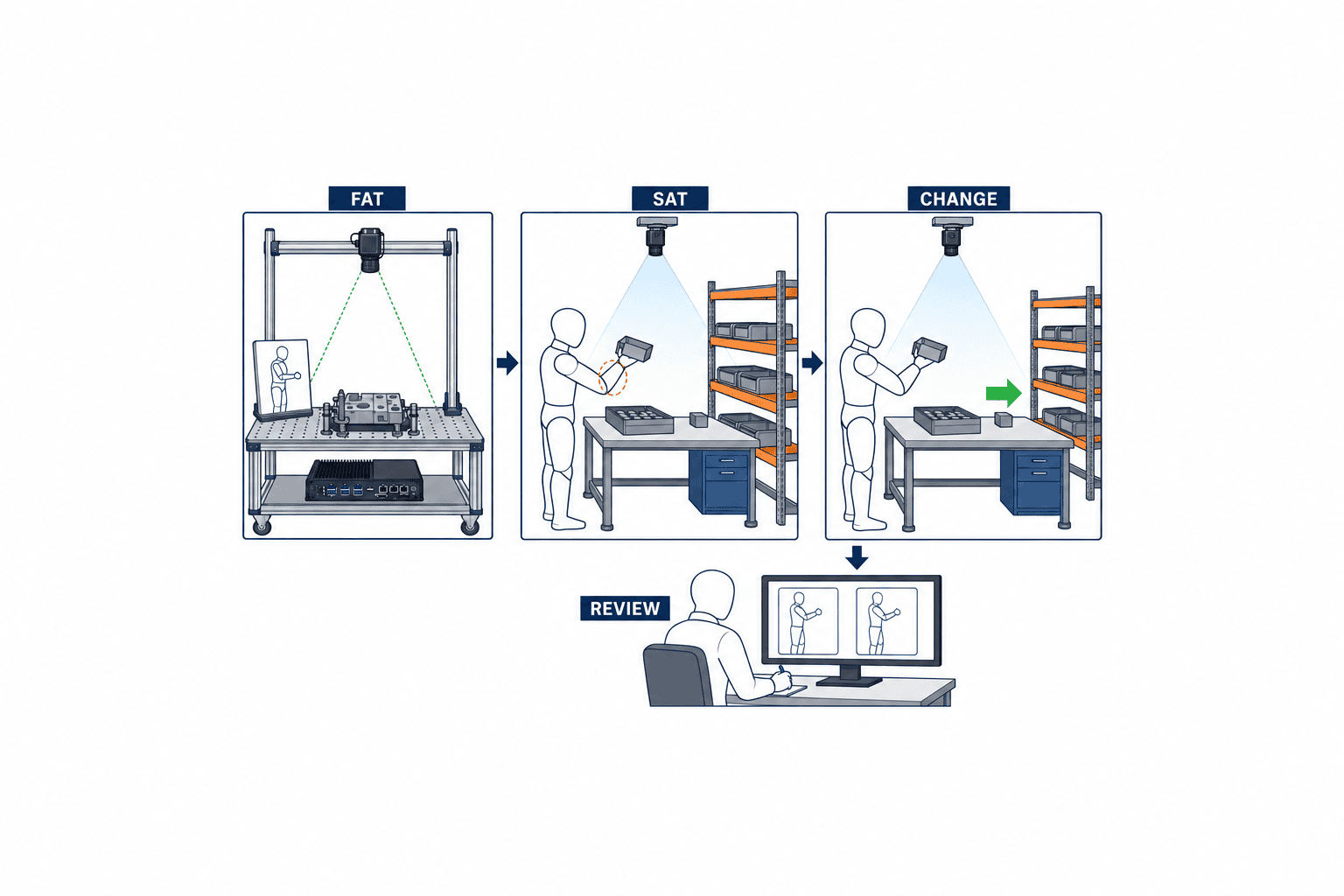
At FAT, test scoring logic, input, logs, access rights, deletion and failures in a vendor environment. Include hidden wrists, crossing people, blocked shoulders, lighting loss, frozen frames and wrong load entries. Expected results might be “unassessable,” “manual review” or “recapture.” An incorrect low score must not be the default error state.
At SAT, use the real plant under day/night lighting, reflections, uniforms, changeovers, bench moves, network interruptions and post maintenance camera shifts. Replaying a clean pilot video is not a site acceptance test. Have experts score fresh plant samples. Review missed important postures, changes in improvement priority and reasons for unavailable results, not only exact total score agreement.
Choose thresholds using a small site sample before the purchase. Measure expert agreement, task variability and the volume of manual review the team can manage. A percentage without a denominator, sample selection, excluded cases and uncertainty interval is not a defensible acceptance criterion. Preserve model version, camera ID, view configuration, method and load source with each assessment. A camera move changes the SAT conditions even if the AI model stays the same.
Budget for validation and engineering changes
Compare more than camera and license prices. Include site survey, power and network, expert scoring, worker communication, privacy design, test case preparation, FAT/SAT, maintenance, updates and the fixture or material handling changes that actually reduce the burden. Longer video retention increases storage cost and privacy management effort.
At PoC stage, measure the time needed to find cases, time to decide an intervention, completed reassessments and worker feedback. Do not claim a percentage reduction in injuries from a short trial. Injury counts may be small and affected by production volume and other changes. State every assumption in a business case. Before adding cameras across lines, verify that the first task’s recommended change was implemented and accepted.
A practical operating sequence
Begin with a task and an improvement owner, not a vendor name. Safety reviews reports and observations; production engineering checks what can be changed; the line leader describes changeovers and exceptional work; workers explain where the task is uncomfortable. An expert then chooses the assessment method. Survey camera views, safe maintenance access and areas that must remain outside the frame. Some tasks are better assessed manually.
When results disagree, check whether expert raters disagree, who entered load values, whether task labels match and whether the camera moved. Correct the cause: a software rule, camera location, input workflow or task definition. In operational reviews, discuss which condition of which task can be altered. Maintain an action sheet with posture, proposal, owner, due date, worker feedback and reassessment date. Recheck after product, bench, PPE, camera or model changes.
For an upper shelf assembly example, define the exact product and reach. Film shoulders and elbows; mark the wrist unassessable if the shelf hides it. An expert scores representative RULA postures and checks whether AI finds the demanding moments. Moving the bin lower may reduce shoulder elevation but increase trunk flexion if it is placed too low. Review both and check for quality or handling side effects.
For a low pallet carton lift, the trunk, legs, stance and grip matter. Obtain carton mass from a reliable record or measurement. A frontal camera may miss depth and trunk rotation. Consider REBA and, where suitable, a lifting equation. After adding a height adjustable trolley, verify the same load and throughput while checking whether pushing or high stacking creates a new burden. Assess the whole job, not one score.
Rare jam clearance, cleaning and maintenance movements should not be averaged into routine production. Follow existing machine isolation and work permit rules first. A supervised simulation or expert observation may be safer and more informative than continuous recording. Success on one line does not validate another with different fixtures and lighting.
Build an acceptance dataset the buyer controls
The buyer should select ordinary work, both sides of the body, different uniforms, occlusion, lighting changes and exceptional tasks. Train independent raters and record why they disagree near posture category boundaries. Keep difficult boundary examples rather than removing them. Test reporting should state how samples were gathered, which conditions were excluded, how many raters participated and how many results were unavailable. A headline “90% accuracy” is an example of a claim to interrogate, not a recommended target: its denominator may consist mostly of easy low risk frames.
Set contractual limits on later data use. Decide whether video or keypoints may train a vendor’s general model, be used on other customers’ projects or be transferred abroad for support. Record storage location, subcontractors and deletion evidence. SAT approval proves the system passed defined tests; it does not itself prove health outcomes. Keep a separate report on the engineering interventions and whether workers experienced an improvement.
Frequently asked questions
Should a factory choose RULA or REBA for AI ergonomic assessment?
Consider RULA first for upper limb focused assembly or inspection, and REBA for changing whole body posture, load and grip. Neither is a universal injury predictor. Choose other task specific methods for lifting, push/pull or long static exposure where appropriate, with a qualified practitioner.
Can one fixed camera automatically produce a valid score?
It depends on the task and view. Trunk rotation, hidden wrists, legs behind a workpiece, load, grip and duration may not be observable. Ask for unavailable states and clearly documented human inputs, then compare with expert ratings on plant footage.
What percentage accuracy is enough?
There is no universal number. Measure joint estimation, posture class, final score and intervention priority separately. Set acceptance limits based on site samples, expert disagreement, consequences of missing a case and review capacity.
Does blurring faces settle Thai PDPA requirements?
No. Station, time, clothing or skeleton traces may still identify someone. Review purpose, lawful basis, notice, access, retention, vendors and rights channels with the appropriate legal and DPO teams. Face blurring is only one technical measure.
Should a high RULA or REBA score stop a machine automatically?
No machine safety circuit should be driven by an ergonomic screening score alone. Respond to immediate hazards under existing procedures. Use posture scores for expert review and engineering priorities. A protective function requires its own system level safety design and validation.
Conclusion: change the work after scoring the posture
AI ergonomic assessment succeeds when the team defines tasks, selects the appropriate method, handles camera blind spots and missing inputs, protects workers, validates against expert judgment and compares matched conditions before and after a physical improvement. Put those steps and evidence into the RFP, FAT and SAT. A live dashboard without an owner and a changed fixture is not the intended outcome.
If your Thailand factory is selecting a task, camera location, RULA/REBA review process or PoC acceptance plan, contact TOMAS TECH. We can start with the actual work conditions and the plant’s existing safety process.
References
- McAtamney & Corlett, RULA, *Applied Ergonomics* (1993): https://doi.org/10.1016/0003-6870(93)90080-S
- Hignett & McAtamney, REBA, *Applied Ergonomics* (2000): https://doi.org/10.1016/S0003-6870(99)00039-3
- NIOSH, Collect Health and Medical Evidence: https://www.cdc.gov/niosh/ergonomics/ergo-programs/gather-evidence.html
- NIOSH, Computer Vision Development for Estimating Trunk Angles: https://www.cdc.gov/niosh/bulletin/2020/computer-vision.html
- NIOSH, Revised NIOSH Lifting Equation: https://www.cdc.gov/niosh/ergonomics/about/rnle.html
- OSHA, Identify Problems: https://www.osha.gov/ergonomics/identify-problems
- ISO 11226:2000: https://www.iso.org/standard/25573.html
- ISO 45001 and worker participation: https://www.iso.org/news/ref2268.html
- Thailand Department of Rail Transport, CCTV Privacy Notice: https://www.drt.go.th/privacynoticecctv


