


During a customer audit, someone asks, “Please show us the furnace conditions for this lot right away.” You then work your way through a stack of chart paper from the recorders, the SD cards from paperless recorders and handwritten daily reports. If you are responsible for heat treatment at a Japanese-affiliated auto parts plant in Thailand, you may well have been in that situation at least once. Introducing a heat treatment process record system is often described as an investment to cut this “searching time.” Yet simply keeping temperatures as electronic data is not enough to fully withstand audits or customer claims.
This article makes one argument. A heat treatment process record becomes a record that can withstand audits and claims only when three conditions are met: “the record comes from a correct measurement system (pyrometry),” “it has not been tampered with and has no gaps (data integrity)” and “you can say unambiguously which product lot it belongs to (linking).” Selecting a system is a design problem: write these three conditions into the RFP as requirements, and then deliberately break them during acceptance testing to confirm they hold.
First, let us clarify one term. The FAT/SAT in the title refers to the acceptance tests of a system implementation project, that is, the Factory Acceptance Test and the Site Acceptance Test. On the other hand, the SAT that appears in the context of CQI-9 and pyrometry refers to the System Accuracy Test, which checks the accuracy of the entire measurement system made up of thermocouples and instruments. The same three letters mean completely different things. To avoid confusion, this article writes the former as “factory acceptance test” and “site acceptance test,” and the latter as “SAT (System Accuracy Test).”
Below, so that quality assurance managers, production engineering managers and plant managers can assemble the material they need for internal decisions, we walk through taking inventory of what to record, what CQI-9 compliance requires, the relationship between pyrometry and records, data integrity, linking to product lots, system architecture, how to think about cost, RFP items, acceptance testing, and issues specific to Thailand. Note that the number of furnaces, hours, amounts and payback periods for the model plant in this article are all provisional numbers set up for this article only. They are not industry averages, survey results or manufacturer prices.
Why Heat Treatment Process Records Are Being Questioned in Thai Plants Now
In the second half of 2026, the factors surrounding auto parts plants in Thailand point in different directions.
Start with production. According to a Reuters report on an announcement by the Federation of Thai Industries (FTI), Thailand’s automobile (four-wheel) production in August 2026 was 124,646 units, up 10.93% year on year (July was up 6.12%). In the same month of August, domestic sales rose 25.59% year on year and exports fell 2.04% year on year. A Trading Economics article from the same day put August domestic sales at 59,808 units. On the other hand, in July FTI had revised its full-year 2026 production forecast downward, from the earlier 3% increase to a 3.33% decrease. The reason given was lower exports due to the situation in the Middle East. A single month may grow while the full-year outlook remains hard to read.
Next, policy. According to the Board of Investment of Thailand (BOI), in Thailand’s new car market for January to July 2026, the share of electrified vehicles (BEV, HEV and PHEV combined) reached a record 55%, surpassing combustion engine vehicles for the first time. At the National EV Policy Committee meeting on September 10, 2026 (chaired by Deputy Prime Minister and Finance Minister Ekniti), an agreement in principle was reached on restructuring the excise tax. The principles of the restructuring include “expanding the use of high-value domestic parts and skilled labor (High Value-Added Local Content)” and “strengthening the domestic supply chain (local supplier development),” with tax rates set in four tiers according to local value added. However, the new tax rates have not yet been finalized. According to press reports, there is also a proposal to raise the excise tax on EVs that do not use domestic parts from 10% to 31 to 39%, but this too is still at the proposal stage.
As for the outlook for the parts industry itself, Krungsri Research forecasts that production in Thailand’s auto parts industry will grow 1.5 to 2.5% per year in 2026 to 2028. Thailand’s auto parts exports in 2025 are also said to have ranked 10th in the world and 1st in ASEAN.
If the tax system moves toward rewarding the value added by domestic parts, parts manufacturers will be asked, more than ever, to show through records that “our parts were made as required.” Heat treatment is a process in which measuring appearance or dimensions afterwards tells you little about whether the conditions were right. That is exactly why the process record itself becomes evidence of quality.
There is movement on the certification side as well. According to a stakeholder communiqué issued by IATF in July 2026 (SC-2026-005), the 2nd edition of IATF 16949 is planned for publication in mid-2027. The schedule is described as provisional and subject to change. The priority themes for the revision include Tier N supply chain management (risk-based management of lower-tier suppliers and cascading of customer requirements). This communiqué makes no direct reference to CQI-9. Even so, for Tier1 suppliers that outsource heat treatment and for Tier2 heat treatment specialists, it is worth taking this as a trend in which “how far you can trace the records of lower-tier processes” will be questioned. In addition, CSRs are updated from time to time: for example, the IATF site posted an update to Ford’s customer-specific requirements (CSR) dated June 30, 2026 (the updated items include “Heat Treat Consolidation Efforts with latest CQI-9 edition”), and updates to Stellantis’s CSR summary documents in August and September. In many cases, CQI-9 requirements reach parts manufacturers through these OEM CSRs.
The general approach to retrieving records quickly in audits is covered in detail in “Customer Audit Traceability | Retrieve Records in 30 Seconds“. This article focuses on heat treatment, one of the most difficult processes in that respect.
What Is a Heat Treatment Process Record System? Taking Inventory of the Parameters to Record
“What to record” is determined by the process and the process tables
A heat treatment process record system is a mechanism that takes process conditions such as furnace temperature, time and atmosphere from the measurement system, stores them in a form that cannot be tampered with, and makes them retrievable linked to product lots. Think of it not as a matter of the recorder alone, but as a single chain that covers measurement, storage, linking and search.
Which conditions to monitor and record in which process is determined by the process-specific process tables in CQI-9. Looking at AIAG’s public description and the announcements for training offered in Thailand, CQI-9 consists of the Heat Treat System Assessment (HTSA) form, pyrometry requirements and process-specific process tables, with tables provided for processes such as carburizing, nitriding, induction hardening and aluminum heat treating. Please check the recording frequencies and tolerances for each item in the original text of the process tables that apply to your plant. This article does not go into the clauses or values of the original; it focuses on how to take inventory.
What to record by process (example candidates for the inventory)
The table below shows example candidates for when you take inventory of what to record in your own plant. It is not a list of mandatory items under CQI-9. The actual mandatory items and frequencies are settled by the applicable process tables and your customers’ requirements.
| Example process | Candidate items to record | What to confirm in the inventory |
|---|---|---|
| Carburizing and quenching (batch furnace) | Furnace temperature, holding time, atmosphere (carbon potential), quench oil temperature and agitation status | Which instrument or sensor value is treated as authoritative, and how the start and end of each charge are recorded |
| Carburizing and quenching (continuous furnace) | Temperature per zone, atmosphere, conveyor speed, quench tank status | How to identify the time window in which parts passed through each zone |
| Tempering | Furnace temperature, holding time | Whether the elapsed time from quenching to tempering needs to be recorded |
| Nitriding | Furnace temperature, time, atmosphere control values | Which instrument the atmosphere control values are taken from |
| Induction hardening | Heating conditions, quenchant status, machining program | Whether to keep the equipment set values or the actual values |
| Aluminum heat treating | Solution treatment and aging temperatures and times, quenching conditions | How to handle the transfer time until quenching |
Summarize the results of the inventory in a “furnace × process × record item” list. This list becomes the foundation of the requirements you will later attach to the RFP. The key is to decide, for each item, “which channel of which instrument is authoritative,” “whether to keep the set value or the actual value” and “what to keep when an alarm occurs.” If you digitize while these points are still vague, the vagueness of the paper records moves straight into the data.
Keep set values, actual values and corrective action records separately
Process records mix three kinds of data with different characteristics.
- Set values (recipes): The conditions that should be used for that part number in that process. You need a history of who changed them and when
- Actual values: The values the measurement system actually measured. Keep them as a time series in a form that cannot be tampered with
- Corrective action records: When an alarm or deviation occurred, who judged what, and how the product was handled
In paper-based operation, chart paper (actual values), work instructions (set values) and nonconformance action forms (corrective action records) are stored in different places, and people match them up for every audit. In a record system, one of the main purposes of the introduction is to make these three retrievable by the same charge number.
What CQI-9 Compliance Requires of a Record System
The current CQI-9 edition and the status of its revision
CQI-9 “Special Process: Heat Treat System Assessment” is a document published by AIAG for organizations handling automotive production and service parts to self-assess their heat treat systems. As of October 9, 2026, the current version is the 4th edition, which AIAG announced as available for sale in June 2020. AIAG’s blog notes that the 4th edition and AMS2750F, the pyrometry standard for aerospace, were both published at the end of June 2020.
Note that a Czech standards sales site states, for the 4th edition, that it is “sold out and will not be reprinted, under revision. The new edition is planned for publication at the end of 2026.” This is a statement by a sales agent, and we could not confirm the publication timing of the next edition on AIAG’s own pages. For now, it is reasonable to understand that “the 4th edition is current, and revision work is under way.” Development of each CQI-9 edition is handled by AIAG’s heat treat work group, which lists as its objectives reducing recalls and warranty claims caused by heat-treated parts, preventing defects in the supply chain, and clarifying the process tables and pyrometry requirements.
Main changes in the 4th edition (within AIAG’s public description)
AIAG lists items such as the following as changes in the 4th edition.
- Clarified qualification requirements for assessors conducting the Heat Treat System Assessment (HTSA)
- Updated pyrometry reporting requirements
- Addition of RTDs (resistance temperature detectors) to the thermocouple section
- Provisions for a grace period in each of the calibration, SAT (System Accuracy Test) and TUS (Temperature Uniformity Survey) sections
- Enhanced guidance for cases where a normal TUS cannot be performed because of the furnace’s construction
- Revised formula for calculating the number of TUS thermocouples required for large-volume furnaces
- Removal of the refractometer calibration requirement
- Improvements to the HTSA form
The fact that many of the changes concern pyrometry and reporting should not be overlooked when designing a record system. This suggests that managing not only furnace temperature records but also the results of calibration, SAT and TUS in a reportable form is an important part of CQI-9 compliance.
What a record system needs, translated into requirements
Leaving the specific values in the CQI-9 clauses to be checked in the original, the requirements for a record system can be summarized in general terms as the following three.
- Backing from the measurement system: You can show, in the same ledger as the records, that the recorded temperatures come from a measurement system that has undergone calibration, SAT and TUS in accordance with the frequencies and tolerances set by CQI-9
- Integrity of the records: The records have not been rewritten afterwards, any missing data is identifiable, and alarms and corrective actions are retained
- Linking to the product: You can say unambiguously which part lot was processed in which charge (or in which time window)
These three correspond directly to the three conditions stated at the beginning.
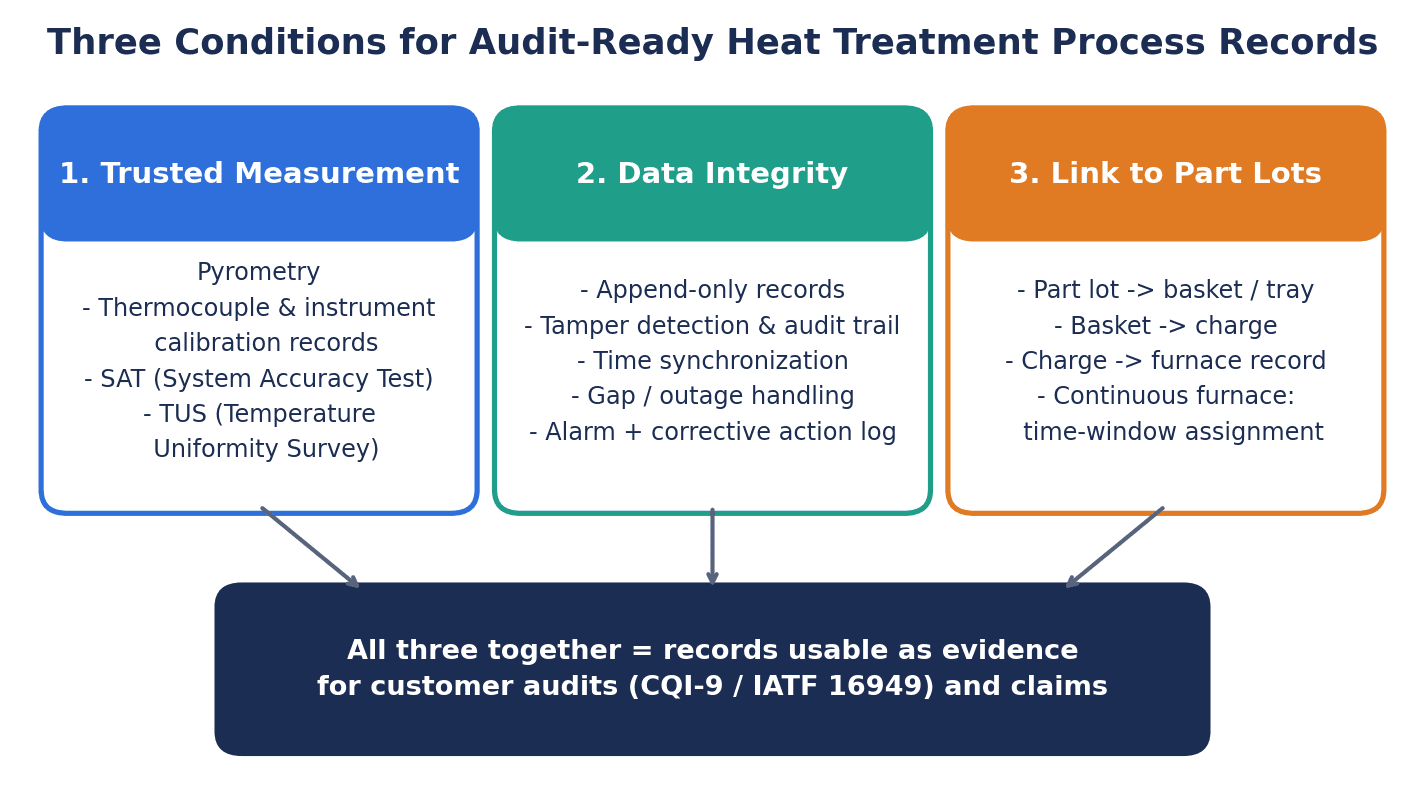
Figure: The three conditions for heat treatment process records that withstand audits and claims. When measurement system reliability (pyrometry), data integrity and linking to product lots are all in place, the record can be used as evidence.
Pyrometry (TUS, SAT and Calibration) and How It Relates to Records
What is pyrometry?
Pyrometry is a set of requirements for keeping temperature measurement in heat treating equipment reliable. The current version of SAE AMS2750, a standard for aerospace, is Revision H (revision date July 15, 2024), and its published scope lists temperature sensors, instruments, thermal processing equipment, correction factors and instrument offsets, SAT (system accuracy tests) and TUS (temperature uniformity surveys). AMS2750 is mainly an aerospace standard and is separate from CQI-9, but CQI-9 also has pyrometry requirements, and the changes in the 4th edition include the calibration, SAT and TUS sections.
For reference, it has been explained that in the earlier AMS2750F, the description of SAT became clearer than in Revision E, and the methods were organized into three: comparison, alternate and waiver. This is part of the history of the 2020 version and should not be read as a provision of the current Revision H or of CQI-9.
Roughly speaking, pyrometry includes the following three checks.
- Calibration: Whether the thermocouples and instruments themselves read correctly
- SAT (System Accuracy Test): Whether the measurement system as a whole, combining thermocouples, wiring and instruments, shows the correct value
- TUS (Temperature Uniformity Survey): Whether the temperature within the furnace’s work zone is uniform within the required range
The frequency and tolerances for each follow what CQI-9 sets. This article does not cover the specific values.
The issue on the record system side: can you retrieve everything from the same ledger?
Pyrometry and process records are often managed by different people in different files. Furnace temperature records are kept by the manufacturing section, calibration records by the quality assurance section, and TUS reports are PDFs prepared by an outside calibration contractor.
What is really asked in audits and claim handling is the question, “Was the furnace temperature correct when this lot was processed?” To answer it, you need to show that at the date and time the charge was processed, that furnace’s measurement system was within the validity period of its calibration and SAT, and that its TUS results were acceptable. The functions you would want from a record system include the following.
- For each furnace and each channel, you can register the date, result and next due date of calibration, SAT and TUS
- When you open a charge record, you can trace it to the calibration, SAT and TUS records that were valid at that time
- If a furnace was used while overdue or after a failed result, you can extract the charges from that period as a list
- The history of instrument replacement (when, from which instrument, to which instrument) is retained
Example instrument vendors
Some instrument manufacturers offer products designed with pyrometry records in mind. For example, on its heat treatment page, Yokogawa Electric explains that its SMARTDAC+ recorders and UTAdvanced controllers meet the requirements of Nadcap/AMS2750 and IATF 16949/CQI-9. It states that measurement data is saved in a proprietary tamper-resistant binary file, that electronic signatures can be added, and that data is made redundant inside the recorder. According to the company, TUS reports can be created on a PC from the recorded files, and SAT (System Accuracy Test) reports can also be created by combining several of its devices. These are the manufacturer’s claims, and in the description of the TUS report software on the same page there are passages that refer to an older version of AMS2750 (Rev. E). If you are considering adopting it, check, against your customers’ requirements and the current version, how much the product can cover and where operations need to fill the gap.
Data Integrity: Paper vs Paperless Recorders vs SCADA/Historian
Four issues when digitizing furnace temperature recording
When digitizing furnace temperature recording, “getting rid of paper” is not the goal in itself. Both paper and data have weaknesses. From the standpoint of data integrity, these are the four points to check.
- Append-only storage and tamper detection: Values, once recorded, cannot be rewritten afterwards, and if they are rewritten, that fact can be detected
- Time consistency: The clocks of recorders, controllers, servers and the MES are aligned. If the times drift, the linking to charges breaks down
- Handling of missing data: When recording is interrupted by a communication outage or power failure, that interval is explicitly marked as “missing” and can be distinguished from values filled in afterwards
- Alarms and corrective actions: Alarms raised when upper or lower limits are exceeded, and who judged what in response, are kept in the same record
Time consistency is an unglamorous issue that breaks down easily. The approach to time synchronization in a factory is summarized in “Factory Time Synchronization: PTP vs NTP and Acceptance Tests in Thailand“.
Comparison of recording methods
| Aspect | Paper recorder charts and handwritten daily reports | Paperless recorder (standalone) | Recorder + server, or SCADA + historian |
|---|---|---|---|
| Resistance to tampering | Traces of writing or replacement may remain, but detection relies on visual checks | Some products offer tamper-resistant file formats and electronic signatures (check each product) | Append-only storage and change history can be built in by design. Depending on the settings, it can also be weak |
| Time consistency | Depends on the writer’s watch and memory | Each device has its own clock. Synchronization needs to be configured | Easier to synchronize centrally on the server side |
| Handling of missing data | Running out of ink or paper is easy to miss | Data is stored in the device, but there is a risk of forgetting to retrieve it or of overwriting | Display of missing intervals and resending from the device buffer can be designed in |
| Ease of search | Leaf through storage locations to find it | Collect and open SD cards or files | Cross-search by charge number, part number and date/time |
| Linking to product lots | Handwritten transcription into daily reports | Basically not available | Achieved in combination with the MES or with linking input |
| Pyrometry ledger | Tends to be managed separately | Some products support creating reports such as TUS | Calibration, SAT and TUS ledgers can be held in the same database |
| Main weakness | Search time and transcription errors | Records are scattered by furnace | The configuration becomes complex, and security and maintenance need attention |
With any method, data integrity is not something you “get by buying a product.” Even if a paperless recorder has tamper-resistance functions, if the file is taken out on a USB stick, edited in spreadsheet software and then submitted to an audit, integrity is broken at that point. It is important to draw the entire path from the moment a record is created until it is submitted to an audit, and to check where rewriting could happen.
Heat Treat Traceability: Linking Charges to Part Lots
Decide the unit of linking
The difficulty of heat treat traceability lies in the fact that the unit in which the furnace records data does not match the unit in which products are managed. On the furnace side, records are kept by “charge” or “time window,” while on the product side, things are managed by “part lot” or “shipping lot.” Deciding the intermediate unit that connects the two is the starting point of linking design.
For a batch furnace, the basic linking hierarchy is as follows.
- Part lot: A group of parts coming from the previous process
- Basket/tray: A container for loading into the furnace. One part lot may be split across several baskets, and several part lots may be mixed in one basket
- Charge: The combination of baskets loaded into the furnace in one treatment run
- Furnace record: The actual values for temperature, atmosphere, time and so on from the start to the end of the charge
In the record system, you attach identifiers (barcodes, RFID and so on) to baskets and trays, and at loading you register by scanning “which part lot went into which basket, and which basket went into which charge.” If the start and end times of the charge are recorded on the same clock as the furnace records, you can trace a single path from the part lot to the furnace conditions.
Continuous furnaces are assigned by “time window”
A continuous furnace has no division called a charge. Parts flow through the furnace on a belt or trays. In this case, you record the time a part lot entered the furnace and the time it left (or the transit time calculated from the conveyor speed), and assign the furnace records within that time window as the process conditions for that lot.
Points to watch in time window assignment include the following.
- At the boundary between lots, there is an interval in which the preceding and following lots are mixed in the furnace during the same time window. Decide how to handle that interval (whether to assign it to both lots)
- If the conveyor speed changes partway, how to correct the transit time calculation
- Because transit times differ by zone, whether to calculate a time window for each zone or to represent it by a time window for the furnace as a whole
- If parts remained in the furnace because of a power failure or conveyor stoppage, how to show that interval and as the record of which lot
The precision of linking determines the “scope of containment”
Why linking matters becomes easier to see if you imagine what happens when an abnormality is found. Suppose that one day it is discovered after the fact that the furnace temperature was temporarily out of range. If linking is only possible by day, you have no choice but to suspect every part processed in that furnace on that day. If linking is possible by charge or by time window, you can narrow the suspect range down to the parts that were actually affected. This difference determines the scope of quarantine, re-inspection and reporting to the customer.
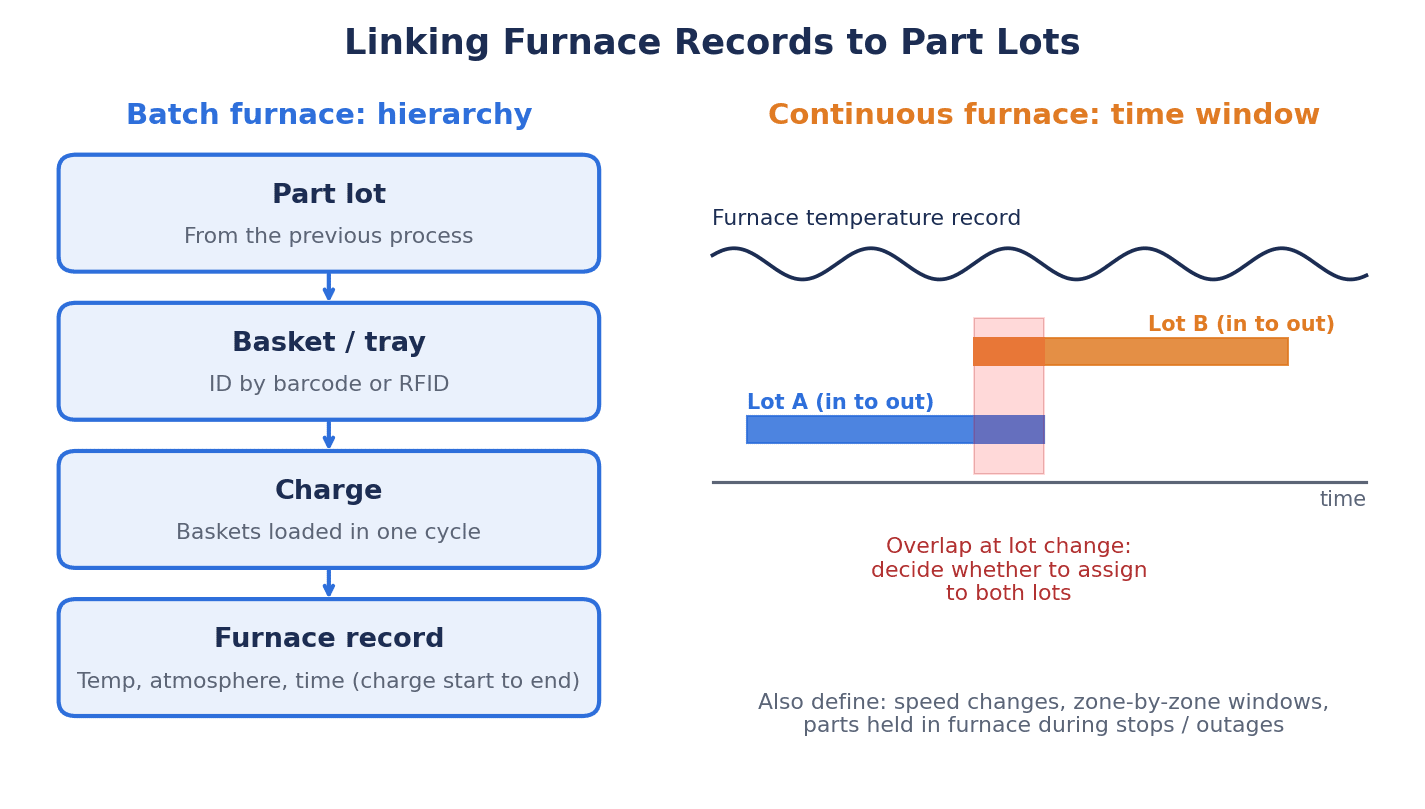
Figure: How linking works for batch furnaces and continuous furnaces. Batch furnaces are connected through the hierarchy of part lot, basket, charge and furnace record, while continuous furnaces assign furnace records by the time window between the load time and the discharge time.
The design of part-level traceability as a whole, including the preceding and following processes, is explained in “Automotive Parts Traceability 2026 — IATF 16949 and Customer Audits“. If you position heat treatment linking as one process within that design, it becomes easier to align lot numbering with the preceding and following processes.
Process Record System Architecture Options and Security
Three architecture patterns
The architecture of a process record system can be broadly divided into three patterns.
| Architecture | Overview | Suited to | Points to note |
|---|---|---|---|
| A: Recorder + collection server | Periodically collect files or data from existing or new paperless recorders onto a server, and give it search and ledger functions | Plants with few furnaces that first want to gather records in one place | Linking requires separate input. A mechanism to detect gaps in file collection is needed |
| B: SCADA + historian | Collect values in real time via communication from controllers and recorders, and store them as time series in a historian | Plants with many furnaces that also want to integrate monitoring screens and alarms | Vulnerability management is needed for communication components (OPC UA, VPN and so on) |
| C: B + MES integration | In addition to B, link with MES work orders, part lots and inspection results | Plants with many part numbers that want to automate lot linking | Data definitions and time consistency with the MES need to be decided first |
With any architecture, decide early whether to keep the original data recorded on the instrument side (the data inside the recorder). Duplicating the server-side data and the instrument-side original helps both in filling gaps during communication outages and in showing the original in audits.
How to choose the historian at the center of architectures B and C is compared in detail in “Industrial Historian Selection: RFP and FAT/SAT in Thailand“.
Do not let the record system become an entry point for attacks
Connecting furnace controllers and recorders to a network makes recording more convenient, but it also creates a path to the control system. NIST SP 800-82 Rev. 3 “Guide to Operational Technology (OT) Security” (published September 2023) in the United States is guidance for protecting OT while taking into account the performance, reliability and safety requirements specific to OT. It is not specific to heat treatment, but it is also useful in designing record systems.
Vulnerability information on the components used in record systems also continues to appear. For example, a WaterISAC summary dated September 3, 2026 reported that 8 CISA ICS advisories were published on September 1 and 10 on September 3, and these included historian products, SCADA platforms, OPC UA-related components, VPN clients for remote connection and FA engineering software. In this summary, we could not find any advisories naming controllers or paperless recorders for heat treatment furnaces. Even so, since the historians and communication components that make up a record system can be affected, build basics such as the following into the design.
- Separate the furnace and instrument network from the office network
- Decide clearly whether to allow the record system to write to controllers (change set values), and if not, make the communication read-only in the configuration
- Open remote maintenance connections only when they are used, and record who connected and when
- Regularly check vulnerability information for the products you use, and decide on a patching policy in advance
Cost and Payback for a Heat Treatment Process Record System (Model Estimate)
From here on is a model estimate. All of the figures below are provisional numbers set up independently for this article; they are not industry averages, survey results or manufacturer prices. When considering this for your own plant, replace them with your own records and quotations.
Assumptions for Model Plant H
- A Japanese-affiliated auto parts plant in Thailand with an in-house heat treatment line. 8 furnaces (a mix of batch carburizing furnaces, tempering furnaces and continuous furnaces)
- Current records are a mix of recorder chart paper, paperless recorder files and handwritten daily reports
- Quality assurance staff check charts and files every day and transcribe them into daily reports
- Customer inquiries and audits generate work to find and submit the furnace conditions for specific lots
Initial cost and operating cost (provisional)
| Cost item | Content | Amount (provisional) |
|---|---|---|
| Measurement and collection | Recorder upgrades or added communication for each furnace. 8 furnaces × THB 120,000 | THB 960,000 |
| Server and network | Collection server, historian, OT network separation | THB 640,000 |
| Lot linking | Scanning terminals at loading, basket identifiers, MES integration | THB 480,000 |
| Ledger, acceptance and training | Setup of calibration, SAT and TUS ledgers, factory and site acceptance tests, training | THB 320,000 |
| Total initial cost | – | THB 2,400,000 |
The total initial cost is 960,000 + 640,000 + 480,000 + 320,000 = THB 2,400,000. Operating costs (maintenance, licenses, server upkeep) are assumed to be THB 180,000 per year.
How to set the benefits: compare against only one world
Benefits count only the difference compared with “the same plant without the record system.” The comparison (the counterfactual) is a single world in which production volume and staffing are the same as now and records remain a mix of paper and files. The benefits are split into three non-overlapping tasks and events.
- (1) Daily transcription work: Assume the work of checking charts and files and transcribing them into daily reports is reduced by 2 hours per day. 2 hours × 300 days = 600 hours per year. At THB 200 per hour (provisional), 600 hours × THB 200 = THB 120,000
- (2) Searching for records for inquiries and audits: Assume there are 10 requests per month to find and submit the furnace conditions for a specific lot, and each takes 4 hours less. 10 requests × 12 months = 120 requests per year, and 120 requests × 4 hours = 480 hours per year. Because quality assurance staff handle these, the hourly rate is set higher at THB 300 (provisional): 480 hours × THB 300 = THB 144,000
- (3) Scope of containment in an abnormality: Assume that once a year a deviation in furnace conditions is found after the fact, requiring quarantine and re-inspection of products. With the current linking by day, each event is assumed to cost THB 600,000, and with linking by charge it would be kept to THB 150,000. The difference is 600,000 − 150,000 = THB 450,000
The annual benefit is 120,000 + 144,000 + 450,000 = THB 714,000.
- Net annual benefit after deducting operating costs: 714,000 − 180,000 = THB 534,000
- Simple payback period: 2,400,000 ÷ 534,000 = about 4.5 years
If the number of abnormalities changes
Since (3) is an event that may or may not occur, we also calculate it with different frequencies.
| Case | Annual benefit | Net benefit (after deducting operating cost of THB 180,000) | Simple payback period |
|---|---|---|---|
| 0 abnormalities per year | 120,000 + 144,000 + 0 = THB 264,000 | 264,000 − 180,000 = THB 84,000 | 2,400,000 ÷ 84,000 = about 28.6 years |
| 1 abnormality per year (base) | 120,000 + 144,000 + 450,000 = THB 714,000 | 714,000 − 180,000 = THB 534,000 | 2,400,000 ÷ 534,000 = about 4.5 years |
| 2 abnormalities per year | 120,000 + 144,000 + 900,000 = THB 1,164,000 | 1,164,000 − 180,000 = THB 984,000 | 2,400,000 ÷ 984,000 = about 2.4 years |
In the case of 2 per year, (3) is 450,000 × 2 = THB 900,000.
What this table shows is that the payback of a record system hardly works on reductions in daily work alone, and depends heavily on how far you can narrow the suspect range when an abnormality occurs. In a year with no abnormalities at all, the work reductions alone only slightly exceed the operating costs. Put the other way around, this investment has a strong “insurance” character, and the precision of linking (whether you can narrow it down by charge) determines most of the benefit. If you postpone linking and go ahead with digitizing records first, almost none of the benefit in (3) will materialize.
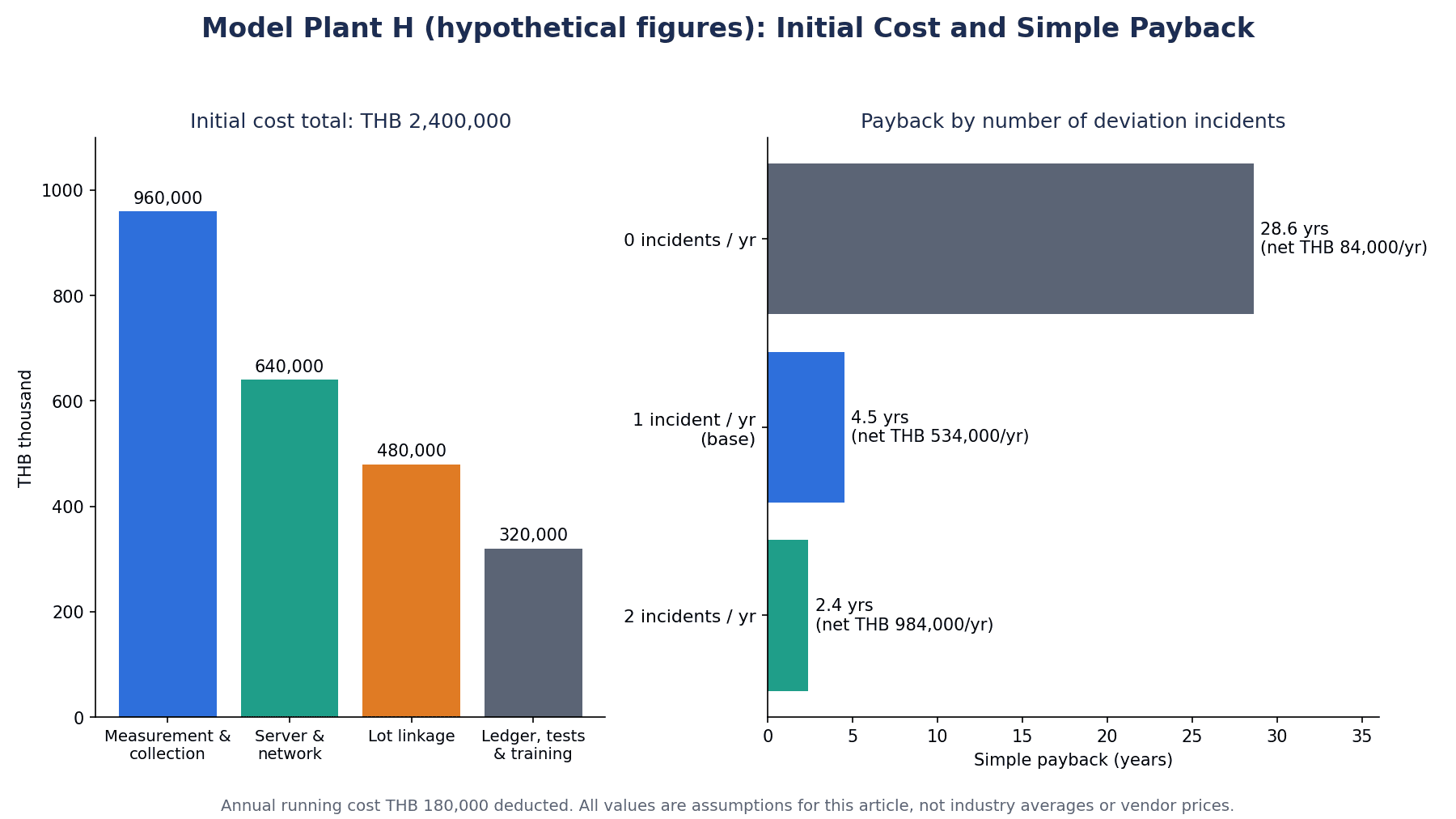
Figure: Estimate for Model Plant H. The breakdown of the initial cost of THB 2,400,000 and a comparison of the simple payback period when abnormalities occur 0 times per year (about 28.6 years), 1 time per year (about 4.5 years) and 2 times per year (about 2.4 years). All figures are provisional values set for this article.
Notes on avoiding double counting
- Do not overlap the hours in (1) and (2): (1) is daily transcription and (2) is searching for inquiries and audits; they are set as separate tasks. When you actually count them, check that the same person’s same hours are not included in both
- Do not add both the containment cost in (3) and the loss from claims or reputation: (3) is set only as the cost of quarantine and re-inspection. If you add customer penalties or the impact on business, include them within (3) and count them only once
- Do not add “passing the audit” as a separate amount: The benefit of audit response is counted as the search time in (2). Monetizing the same effect separately as “passing the audit” would count it twice
- Only one world as the baseline: (1) to (3) are all differences from “the same plant with records still a mix of paper and files.” Benefits that bring in a different premise, such as reduced storage space for paper, are not included this time. If you include them, count them as differences from the same comparison
What to Put in an RFP for a Heat Treatment Process Record System
When requesting quotations from system integrators or instrument manufacturers, including the following 12 items in the RFP makes proposals easier to compare and acceptance easier to carry out.
| No. | Item | Example content |
|---|---|---|
| 1 | Furnace and instrument inventory | Type, process, instrument and controller models, channels and communication ports for all furnaces. Have the bidder write back the results of its own check |
| 2 | List of record items | The “furnace × process × record item” table. The authoritative instrument and channel, and the distinction between set values and actual values |
| 3 | Recording interval and retention period | Recording interval and retention period for each item. The values are specified by the purchaser based on its own process tables and customer requirements |
| 4 | Tamper prevention and change history | Append-only storage, tamper detection, change history and approval for set values (recipes), whether electronic signatures are required |
| 5 | Time synchronization | How the clocks of recorders, controllers, servers and the MES are synchronized, and monitoring of drift |
| 6 | Handling of missing data | Buffering and resending during communication outages and power failures, display of missing intervals, distinction from filled-in values |
| 7 | Alarms and corrective action records | Upper and lower limit settings, alarm notification recipients, input of corrective actions (who judged what, when and how) |
| 8 | Pyrometry ledger | Registration of calibration, SAT (System Accuracy Test) and TUS results and due dates, reference from charges, extraction of overdue items |
| 9 | Linking to product lots | Method for charge-level linking in batch furnaces, method for calculating time windows in continuous furnaces, handling of intervals where lots are mixed |
| 10 | Search and reports | Search by part lot, part number, date/time and furnace. Format of audit reports and a target for the time needed to output them |
| 11 | Network and security | OT network separation, whether writing to controllers is allowed, remote maintenance procedures, policy for responding to vulnerability information |
| 12 | Acceptance test plan | Scope, test items, acceptance criteria and division of responsibilities for factory and site acceptance tests |
If you leave the recording interval and retention period in item 3 to the bidders, each proposal will rest on different assumptions and comparison becomes impossible. As a rule, the purchaser should take responsibility for checking the values required by CQI-9 and its customers in the original documents and writing them into the RFP.
What to Check in FAT/SAT (Factory and Site Acceptance Tests)
The FAT/SAT here are the acceptance tests of a system implementation project. They are different from the SAT (System Accuracy Test) in CQI-9, so writing them as “factory acceptance test” and “site acceptance test” in internal plans as well helps prevent confusion.
As a reference when planning acceptance testing split into factory and site acceptance tests, there is IEC 62381:2024 (3rd edition, published July 30, 2024). Its title is “Automation systems in the process industry – Factory acceptance test (FAT), site acceptance test (SAT), and site integration test (SIT),” and it sets out requirements and checklists for the factory acceptance test, the optional factory integration test (FIT), the site acceptance test and the site integration test (SIT), so that owners, purchasers and vendors can agree on the scope of testing and the division of responsibilities. It is a standard for automation systems in the process industry, not a standard for heat treatment record systems themselves, but its way of dividing tests and assigning responsibilities is a useful reference.
The key to acceptance testing is to confirm the three conditions by “deliberately breaking them.” Seeing that data is recorded correctly under normal conditions is not enough; test whether you can tell that something has broken when it breaks.
Factory acceptance test (before shipment, or in a verification environment)
- Coverage of record items: Are all items in the RFP’s list of record items recorded on the correct channel, in the correct unit and at the correct interval?
- Tampering attempts: When you try to rewrite stored data, is it rejected, or detected as tampering?
- Change history of set values: When a recipe is changed, are the person who changed it, the date and time, the values before and after, and the approval retained?
- Reproducing missing data: When communication is deliberately cut, are the intervals filled by resending from the buffer after recovery, and the intervals displayed as missing, as specified?
- Ledger reference: When you simulate a state in which calibration or TUS is overdue, are the charges from that period extracted?
Site acceptance test (after installation)
- Matching values on the actual furnace: Compare the record system’s values with the furnace instruments’ displayed values at the same time. Do they match?
- Matching times: Check the times of recorders, controllers, servers and the MES side by side. Are they within the allowed drift?
- End-to-end linking test: Run an actual part lot from loading to discharge. Can you trace a single path from the part lot to the charge (or time window), the furnace record, and the valid calibration, SAT (System Accuracy Test) and TUS records?
- Lot boundaries in continuous furnaces: Is the interval where the preceding and following lots are mixed recorded with the handling defined in the specification?
- Power failures and momentary interruptions: When power is cut and restored, do the gap in the records and the recovery behave as specified?
- Audit simulation: Can quality assurance staff produce the furnace conditions for a designated part lot as a report within the target time?
The results of acceptance testing themselves become records showing the validity of the record system. Keep the test procedures, results and the actions taken on failed items, so that you can present them when the reliability of the system is questioned in a customer audit.
Issues Specific to Thailand and ASEAN
1. When heat treatment is outsourced to a supplier
In Thailand, some parts manufacturers outsource heat treatment to outside specialist companies. Considering that Tier N supply chain management is listed as a priority theme for the 2nd edition of IATF 16949, how far you can trace your subcontractors’ heat treatment records may be questioned even more in the future. Even if you ask a subcontractor to introduce a record system, agreeing as a minimum trading condition that “for each shipping lot, they can submit the charge number, the furnace condition records, and the valid calibration, SAT (System Accuracy Test) and TUS records” makes it easier to explain in your own audits.
2. Multilingual shop floors
It is common for furnace operators, quality assurance staff and Japanese managers to use different languages. Decide at the RFP stage whether alarm messages, corrective action input screens and report field names will be displayed in Thai, Japanese or English. If corrective action input is free text only, the number of people who can read it later is limited. One approach is to make common actions selectable and use free text for supplementary notes.
3. Preparing for power failures and momentary interruptions
Power failures and momentary interruptions affect both missing records and the handling of products inside the furnace. In addition to power provisions for the recorders, uninterruptible power for the servers and a resend mechanism after power is restored, decide on a procedure for keeping “the handling of charges that were in the furnace during the power failure” as a corrective action record. Simulating a power failure during the site acceptance test changes how flustered people are when it happens for real.
4. Customer audits and CSRs
CQI-9 requirements often arrive through OEM CSRs. Because CSRs are updated from time to time, decide in advance on the procedure (change request, approval and verification) for changing the record system settings when requirements for record items or retention periods change.
5. CQI-9 training in Thai
As a way of spreading understanding of CQI-9 on the shop floor, training in Thai is also offered in Thailand. For example, LRQA’s Thai-language page announces CQI-9 training covering process tables such as carburizing, nitriding, induction hardening and aluminum heat treating, Job Audit (ongoing product and process audits), and the process approach to IATF 16949 audits. If shop floor staff understand the thinking behind the process tables before a record system is introduced, taking inventory of record items becomes easier.
Frequently Asked Questions
What is CQI-9?
CQI-9 “Special Process: Heat Treat System Assessment” is a document published by AIAG for assessing heat treat systems. Organizations handling automotive production and service parts use it to self-assess how well their heat treatment is controlled. As of October 9, 2026, the current version is the 4th edition (2020), and it is described as under revision (according to a sales agent). It consists of the Heat Treat System Assessment (HTSA) form, pyrometry requirements and process-specific process tables.
How much does a heat treatment process record system cost?
It varies greatly depending on the number of furnaces, whether existing instruments can be reused, how far lot linking is automated and whether the system is integrated with the MES. In this article’s model estimate, we provisionally set the initial cost at THB 2,400,000 and the operating cost at THB 180,000 per year for a plant with 8 furnaces, but these are neither industry averages nor manufacturer prices. The payback period depends heavily on how far the scope of containment can be narrowed in an abnormality, and in the estimate it ranged from about 2.4 years to about 28.6 years. Please recalculate using your own quotations and records.
Is a paperless recorder alone enough?
Paperless recorders can sometimes cover the digitization of records and part of tamper prevention. However, records remain scattered by furnace, linking to product lots is basically not available, and the records cannot be retrieved in the same place as the calibration, SAT and TUS ledgers. For a plant with few furnaces and few audit inquiries, adding a linking ledger to the recorders may be enough. Judge by which of the three conditions is missing.
What is the difference between TUS and SAT?
TUS (Temperature Uniformity Survey) is a measurement that checks whether the temperature within the furnace’s work zone is uniform within the required range. SAT (System Accuracy Test) is a test that checks whether the measurement system as a whole, combining thermocouples, wiring and instruments, shows the correct value. It is easier to tell them apart if you think of the former as looking at “variation in temperature inside the furnace” and the latter as looking at “whether the temperature is measured correctly.” Note that this SAT is different from the SAT (Site Acceptance Test) used in the acceptance of a system implementation.
If we digitize furnace temperature recording, is CQI-9 compliance complete?
No, it is not. Digitization only helps with part of data integrity among the three conditions. You also need the measurement system to have undergone calibration, SAT and TUS in accordance with the frequencies and tolerances set by CQI-9, the records to be linked to product lots, and responses to the other control items required by the CQI-9 assessment. It is realistic to position digitization as the foundation for these.
Where should we start?
Start by taking inventory of the record items for each furnace and each process. Check the applicable CQI-9 process tables and your customers’ requirements in the original documents, and create a “furnace × process × record item” list. Next, a way of proceeding with less rework is to choose one representative furnace, try everything from measurement through linking and search on a small scale, and then expand to all furnaces.
Summary
Simply keeping temperatures as electronic data does not make heat treatment process records evidence that withstands audits and claims. The record comes from a correct measurement system (pyrometry), it has not been tampered with and has no gaps (data integrity), and you can say unambiguously which product lot it belongs to (linking). Only when these three conditions are met can you say, “The furnace conditions for this lot were correct.”
For CQI-9, the 4th edition (2020) is current and is said to be under revision. The 2nd edition of IATF 16949 is also planned for publication in mid-2027, with Tier N supply chain management listed as a priority theme. In Thailand, discussion is advancing toward evaluating the value added by domestic parts through the tax system, and the weight placed on parts manufacturers’ ability to demonstrate quality through records is likely to grow.
Proceed with the introduction in this order: taking inventory of record items, building a ledger for the measurement system, designing data integrity, designing lot linking, and then the RFP and acceptance testing. Because cost-effectiveness depends heavily on how far you can narrow the suspect range in an abnormality, the key point is not to postpone linking. And in acceptance testing, deliberately break the three conditions and confirm, one by one, that you can tell when they have broken.
You are welcome to consult TOMAS TECH even at an early stage, such as taking inventory of record items, checking whether existing recorders and controllers can be reused, or drafting the RFP and acceptance criteria. We will work with you to sort out where to start, in line with the realities of heat treatment shop floors in Thailand where chart paper, files and daily reports are mixed. Please contact us through this form.
References
- AIAG: Announcement that the CQI-9 4th edition is available (June 11, 2020)
- AIAG: Introduction to an expert analysis of the CQI-9 4th edition (2020)
- AIAG: Heat Treat System Assessment work group
- Technické normy: Sales status and planned revision of the CQI-9 4th edition
- LRQA Thailand: CQI-9 Heat Treat System Assessment training
- SAE: AMS2750H Pyrometry (July 15, 2024)
- Thermal Processing: Explanation of SAT in AMS2750F (September 15, 2020)
- Yokogawa Electric: Solutions for heat treatment
- NIST: SP 800-82 Rev. 3 Guide to Operational Technology (OT) Security (September 2023)
- WaterISAC: Summary of CISA ICS advisories (September 3, 2026)
- IATF: Communiqué on the status of the IATF 16949 2nd edition (July 2026)
- IATF: Stakeholder Communiqué SC-2026-005 (PDF, July 2026)
- IATF Global Oversight: News (Ford CSR update June 30, 2026; Stellantis CSR summary updates August 28 and September 11, 2026)
- IEC: IEC 62381:2024 (July 30, 2024)
- Capital.com: Thailand’s August car production and FTI’s full-year forecast (September 28, 2026)
- Trading Economics: Thailand vehicle sales (September 28, 2026)
- BOI: Press release on the National EV Policy Committee and excise tax restructuring (September 10, 2026)
- Nation Thailand: Proposal to raise the excise tax on EVs (September 9, 2026)
- Krungsri Research: Outlook for Thailand’s auto parts industry 2026 to 2028 (May 7, 2026)


