


For a Thai factory implementing AI-OCR for equipment inspection sheets, reading handwriting is only the first step. The workflow succeeds when the right asset, inspection time, measured value and unit, abnormality assessment, and human approval reach the correct maintenance history. This guide defines responsibilities from paper to CMMS, including exceptions, procurement requirements, and FAT/SAT acceptance.
How does OCR for Equipment Inspection Forms Differ from General Document OCR?
AI-OCR used to extract invoice amounts or purchase order numbers shares common technology with AI-OCR that handles equipment inspection forms. However, in the latter case, the recognized numerical values are utilized for determining equipment status. For example, even if an entry of “4.8” is correctly recognized, it cannot be used for maintenance judgment unless it is known whether this represents vibration velocity or pressure, what unit (mm/s or bar) applies, and which measurement point on which pump is involved. If data is sent to CMMS while still linked to a different piece of equipment, incorrect history records will remain.
This article is for sites that digitize measured values, observations, checkmarks, and signatures from paper patrol-inspection sheets after an inspection. For the general rollout process, see our AI-OCR implementation guide; for measurement of recognition performance, see our AI-OCR accuracy guide. Here we focus on the workflow from asset master data and inspection rules through approval and CMMS registration.
If inspectors can enter data directly on a tablet, compare that approach as well. Existing handwritten forms may be embedded in regulatory, customer-audit, equipment-maker, or offline work procedures, so immediate retirement of paper may be impractical. AI-OCR can bridge the transition, but the forms themselves should be improved so their weaknesses do not carry into the digital process.
Responsibility Boundaries to Determine Before Implementation: From Paper to CMMS History
First, we define a single data path: Paper Inspection Form → Scan or Tablet Capture → Original Image Storage → OCR/Field Extraction → Equipment Master Verification → Measurement Value and Unit Validation → Abnormality Candidate Determination → Human Confirmation and Approval → CMMS inspection history or work order. If the intermediate steps are summarized as “AI Automatic Processing,” it remains undetermined who is responsible for correcting misrecognitions, resubmissions, or changes made after approval.

Determine Equipment ID Before Receiving Forms
Free-text equipment names are not unique keys when staff refer to the same pump in Japanese, Thai, abbreviations, or old numbering. Use the asset ID in the CMMS master as the authoritative identifier and preprint that ID or a QR code on the sheet. Because a QR label can detach or be moved to another asset, also compare its location with the equipment nameplate. Never assign an unreadable sheet to an asset solely because its name looks similar.
Equipment inspection locations are insufficient with only an Equipment ID alone. Suction pressure, discharge pressure, bearing temperature, and seal leakage for the same pump represent distinct measurement points. Records must be identified by combining the Equipment ID, Inspection Item Code, Measurement Location, and Form Version. When inspection items change due to modifications or equipment replacement, define the validity period and handling procedures for each version to prevent erroneous evaluation of results obtained using old forms against new standards.
Distinguish Between “Entry,” “Capture,” and “Registration” Times
Inspection time, image capture time, OCR processing time, and CMMS registration time are distinct entities. If a form filled out at 23:00 on the previous day during night shift is collectively captured in the morning of the next day but treated as an inspection conducted on the date of capture, the chronological sequence before and after failure will be reversed. For Thai factories, explicitly specify the timezone upon storage within one unified system to convert local time and UTC consistently. If a form lacks an inspection timestamp, do not silently substitute it with the capture time; instead, mark it as “Inspection Time Unknown” for review.
Mechanisms are also required to prevent duplicate history records when re-scanning the same form. While proposals exist using combinations of Form Number, Equipment ID, Inspection Date, and Original Image Identifier, business operations must define which combination serves as the duplication detection key. Distinguish between resubmission of corrected versions and simple double submissions by retaining correction reasons, old values, new values, corrector, and approver information.
Validate Measurement Values and Units in Separate Fields
Whether to treat “80” as 80°C or 80°F affects the judgment. Print units in column headers and store values and units separately in OCR results. Distinguish between decimals, minus signs, digit separators, handwritten slashes, blank fields, and zeros. If a person transcribes readings from an instrument’s display, determine whether to link the measuring device ID and calibration status to inspection records. For instruments that can automatically acquire measurement values, integration with devices may be more appropriate than manual transcription.
Separate anomaly determination from OCR tasks. OCR extracts written values and check fields; separate logic applies based on equipment, item, revision, and operating conditions for judgment rules. Even if a form states “OK,” hold it as contradictory if the value exceeds an approved upper limit. Conversely, some items cannot be definitively classified as anomalous based solely on numerical data. Thresholds, unit conversions, missing values, and exceptions during equipment stoppages require approval from the maintenance department head.
Approval Cannot Be Replaced by OCR Confidence Levels
OCR confidence levels represent auxiliary information indicating a model’s certainty regarding predicted characters or items; they do not prove that values were correctly transcribed from actual instruments, that measuring devices are calibrated, or that inspections were genuinely performed. Google Cloud Custom Extractor demonstrates the concept of using per-item confidence as triggers for manual review, and Amazon Textract also recommends setting thresholds with human verification based on application importance. However, neither service’s confidence levels can be compared using a common scale, nor is there a universal “passing score.”
If inspectors and approvers differ, record who verified which original images and extracted values. Pre-approval OCR candidates are considered “provisional”; designs that do not automatically finalize CMMS official histories or work instructions ensure safety. Even if corrections occur after approval, avoid erasing traces via simple overwrites; instead, enable tracking of context through revisions or audit logs.
Define Data Contracts for Inspection Form OCR
Before system integration, define the meaning of output records. The following serves as a design starting point and is not mandatory across all sites. Select items based on existing CMMS APIs and actual form conditions.
| Item | Meaning and Verification Points | Handling When Undetermined |
|---|---|---|
| Original Document ID / Image ID | Which paper or image serves as the basis | Retain original image and request re-acquisition |
| Equipment ID / Measurement Point ID | Which equipment/location in the CMMS master data | Do not auto-confirm based on similar names; perform verification match |
| Form Version / Inspection Procedure Version | Which field and judgment criteria were used | Manually verify correspondence with current version |
| Inspection Date/Time / Time Zone | Actual time of inspection performed | Hold for review; do not substitute capture time |
| Original Entry Value / Normalized Value / Unit | Paper text characters and numerical values used in calculations | Distinguish between missing data, zero, and unknown units |
| Check Result / Observation Notes | Source text from selection fields and free-text descriptions | Review for contradictions or unreadable content |
| Judgment Result / Rule Version | Basis upon which abnormality candidates were identified | Mark as undetermined if rule is not registered |
| Inspector / Approver / Timestamp | Who verified and confirmed the data | Hold formal history registration |
| CMMS Link ID / Status | Tracking of Registered, Resent, Failed, Corrected states | Do not hide failures; route to reprocessing queue |
The critical point is the meaning behind “value empty.” Uninspected, unreadable, N/A (not applicable), equipment stopped, and omitted entry are all distinct. Reducing everything to a single null value prevents accurate interpretation when calculating inspection execution rates or abnormality discovery rates later on. Provide explicit options defined in the form side; if OCR cannot distinguish between them, return it for human review.
ID Misalignment Issues to Avoid When Digitizing Equipment Inspection Records
When field equipment numbers differ from internal CMMS keys, apply valid start and end dates to conversion tables. Even when a pump is replaced and the site name is inherited, separate physical machine IDs from installation location IDs as needed to prevent mixing maintenance histories between old and new equipment. Include multi-site facilities with identical names, line number renumbering, and equipment relocation intentionally in samples during PoC (Proof of Concept).
Even if barcode or QR code scanning succeeds, the content combination is incorrect if the form belongs to a different equipment template. Verify consistency between Equipment ID and inspection item set, alignment between inspection date and target work instructions, and presence/absence of required measurement points. If humans reselect equipment, design the system to retain both original OCR candidates and corrected IDs.
Handwritten Inspection Form AI-OCR Exception Design: Thai / Japanese / English
Thai factory tickets coexist with printed English item names, Japanese equipment nicknames, handwritten Thai observations, Arabic numerals, and unit symbols on a single sheet. Even services labeled as “multilingual support” differ in scope regarding handling of printed text, handwriting, table structure extraction, check boxes, and custom field extraction; verify recognition performance separately by model version, target language, and actual ticket samples.
While Microsoft’s Document Intelligence language support table lists Thai under the handwritten character column for specific Read/Layout model versions, this does not guarantee accuracy across all company models, arbitrary document structures, mixed languages, or on-site messy handwriting. Google Form Parser can extract key-value pairs, tables, and check boxes; however, the vendor notes that parsing quality for certain non-Latin language keys may be lower than for Latin-script languages, with limitations also applying to blank field analysis. Amazon Textract recommendations indicate evaluating image quality and confidence scores based on usage conditions. Evaluate candidate products using identical real tickets and record model names and versions in your evaluation table.

Do Not Group All Exceptions Under “Unreadable”
Splitting exception queues facilitates assigning correction responsibilities: assign refocusing tasks for camera shake, shadows, folds, or cuts; route equipment ID mismatches to the equipment master maintainer; direct ambiguous decimals and units back to inspectors; send contradictions between numerical values and “normal” check results to maintenance supervisors; forward missing approver cases to approval workflow handlers; and route CMMS API failures to IT operations. Recording exception causes and processing times reveals when ticket printing changes are more effective than model adjustments.
Do not summarize handwritten free-text entries by replacing the original text with their meaning. For instance, “no abnormal sound” and “abnormal sound present” represent opposite meanings in a single character; using translation or summarization requires separately storing the original image, recognized source text, translated output, and approver records. Do not fill unreadable observations with guesses—instead, query the inspector for clarification. Regarding safety-related records, do not trigger automatic stops or engage safety interlocks based solely on OCR results; instead, prepare a pathway where humans make judgments following existing safety procedures.
Manage Image Quality as Process Conditions
Even with the same engine, results vary depending on camera angle, lighting, paper condition, resolution, writing instrument, and overlap between printed frames and handwritten entries. Display a shooting guide on the terminal to verify in real time that all four corners are captured, there is no reflection, and text remains readable. Determine whether re-shooting is permitted and how originals should be stored after capture. If print forms can be revised, it may sometimes be more effective to explicitly display inspection item codes, expand handwritten fields, fix units, and align check column positions rather than adding new models for additional learning.
Google Form Parser is suited for structured form key-value pairs and simple tables; Custom Extractor offers an option for custom-format items. Microsoft’s Custom Neural supports both structured and semi-structured document fields and tables but requires verification of the target version and field types before use. Do not decide based solely on product name—compare which approach fits best: form parsing, dedicated extraction, or direct data entry, considering factors such as ticket type, batch variation in versions, ratio of handwritten entries, and importance level of inspection records.
CMMS Integration Methods and Recovery from Failures
An OCR-to-CMMS interface is not complete merely because it exports CSV. Define which record becomes the official maintenance history, whether pre-approval values are displayed, when an abnormality candidate opens a work order, and how retries avoid duplicates. If the maintenance workflow is still being organized, first review the equipment register and work-history basics in our maintenance-management-system guide.
Integration options include registering records one by one via API, batch file integration for approved records, or approval-based registration from a CMMS-side import screen. The choice depends on the CMMS capabilities, network environment, and operational responsibilities of designated personnel. For API connections, specify mappings for equipment IDs and item codes, authentication, permissions, communication encryption, re-submission handling, and retention periods during failures. For file integration, define filename conventions, versioning, character encoding, duplicate exclusion keys, receipt acknowledgments, and handling procedures for partial failures.
Test a CMMS outage, one invalid asset ID in a batch, duplicate submission of an approved sheet, a correction after approval, a network failure after CMMS receives a record but before the acknowledgment returns, and a change to the destination’s field definitions. The sender can mark an operation successful only after confirming CMMS receipt and registration. Keep failed records, retry counts, the latest error, notifications, and manual recovery actions.
If automatic work orders are generated in CMMS, inspection history registration and issuance of work orders must be handled under separate permissions and rules. It is critical not to immediately classify an “abnormality candidate” as a confirmed failure. Determinations regarding machine stoppage, repair priority, and parts procurement connect directly with existing procedures and responsible persons within the maintenance department. For further reference on decision-making methods for condition-based maintenance, see the article on Condition-Based Maintenance Systems.
Metrics to Measure in PoC: Character Recognition Rate Alone Is Insufficient
In the Proof of Concept (PoC), we collect samples without bias across form types, equipment, shifts, scribes, languages, image quality, and presence or absence of abnormalities. Rather than merely inflating sample size, our focus is on verifying whether field exceptions exist. If seasonality, inspection frequency, or document revisions impact results, short-term sampling alone lacks representativeness. When external extraction of personal names or equipment information is required, anonymization and permission settings are performed in accordance with internal regulations and contractual agreements.
Ground truth data is created by maintenance personnel reviewing the original forms to verify equipment ID, item details, date/time, numerical values, units, observations, judgments, approval status, etc. Do not repurpose model outputs as ground truth. Key performance indicators include exact match on critical fields, combination matches for numbers and units, incorrect linking of equipment IDs, missed abnormalities, false alarms, review rate per form, time spent verifying each form, CMMS registration success rate, traceability after corrections, and more. Even if overall character recognition rates are high, a single form with an incorrectly identified equipment ID is considered critical.
The evaluation sheet must specify the denominator and exclusion criteria. For example, if defined as “the proportion of target documents where all necessary key items are correct and registered to the proper equipment after approval,” this metric aligns more closely with operational results than a simple OCR score alone. Thresholds should be determined based on site-specific risk tolerance and review capacity, rather than adopting vendor catalog values directly. When abnormal document occurrences are infrequent, definitive claims regarding anomaly detection rates cannot be made. Separate test documents must be prepared to distinguish them from the scope validated using real production data.
Microsoft Custom Neural documentation provides reliability scores for tables, rows, and cells. While this serves as a reference for review sequencing, high-confidence errors or semantic misinterpretations outside the document structure remain undetected by these metrics alone. Google Custom Extractor also demonstrates design patterns that route low-reliability items to human reviewers. In practice, reliance on confidence scores in isolation is insufficient; instead, equipment ID verification, allowable units of measure, measurement ranges, deviations from previous values, mandatory field validation, and contradiction checks must be employed concurrently. Relying solely on proximity to a previous value as an indicator of normality is hazardous; therefore, differences should always be treated as triggers for review.
Input Requirements, Responsibilities, and Deliverables to Include in the RFP
The Request for Proposal (RFP) must specify not only the volume of documents to be processed but also representative source document types, edition counts, languages used, handwritten fields, equipment master data requirements, CMMS interface specifications, retention and deletion policies, approver operational procedures, and factory network constraints. Documents containing confidential information should clearly state their provision conditions, with explanations provided for differences between anonymized versions intended for evaluation and original documents handled in production environments. Vendors must respond using the same format to indicate both supported document types and unsupported conditions or limitations.
| RFP Item | Definition by the Facility | Response Required from Proposer |
|---|---|---|
| Target Forms and Versions | Scope of Equipment, Items, Languages, and Handwritten Input | Model/Version, Coverage Range, Exclusion Criteria |
| Acquisition Method | Scanners, Tablets, Offline Conditions | Capture guidance, reshoots, original image retention |
| Data Contract | ID, Timestamp, Value, Unit, Validation, Approval | Output Specifications, Verification, Master Record Reconciliation |
| Exception Handling | Who Verifies and Corrects What | Review Screen, Permissions, Audit Logs |
| CMMS Integration | API/File Methods, Conditions for Formal Registration | Resubmission, Duplicate Removal, Partial Failure Recovery |
| Security | Storage Location, Access Control, Retention/Deletion Policies | Data Usage, Encryption, Logging, Return upon Exit |
| Acceptance | Target Forms and Personnel Involved in FAT/SAT | Evidence, Pass/Fail Results, Re-testing, Deliverables |
Cost comparison cannot rely solely on per-page rates. Initial form design, item labeling, terminals, networking, CMMS connectivity, review personnel effort hours, model updates, operational support, and data export costs must be accounted for separately. While some manual entry time can be reduced, an increase in exception verification or approvals may result in no net reduction in total effort hours. Please estimate unit rates and processing volumes using the process times measured with internal forms and rework figures. Do not use unsubstantiated blanket claims of “X% reduction” for contract decisions.
In preparation for vendor changes, verify which formats can be returned for original images, recognized text, corrected data, equipment ID mapping, annotation files for training purposes, and audit logs. Even if the model’s internal weights are not provided, portability of operational data and correction history can still be ensured. Contracts should include re-evaluation upon retraining or version updates, contact information during incidents, and migration support at service termination.
FAT: Validate Sample Forms and Integration Anomalies in a Controlled Environment
During FAT, freeze approved form versions and ground truth, then validate the path from capture to a simulated CMMS in the vendor’s or factory’s test environment. Include faint handwriting, mixed Thai and Japanese text, multiple measurement points, wrong units, old asset IDs, blanks, handwritten corrections, and conflicts between checkmarks and values. Keep evaluation sheets separate from model-tuning sheets, and record the version and test date.
The pass/fail of the FAT is insufficient if “values appear on the recognition screen.” We track each item individually through the sequence: original image → OCR candidate → verification → review → approval → CMMS registration result, and retain inputs/outputs and logs for each stage. We verify whether low-confidence items or rule contradictions can be routed to an exception queue, whether values corrected by a person are reflected in the official history, and whether users without approval authority can finalize records. We also test whether resubmission prevents double registration and how remaining items should be handled when an API partially fails.
Acceptance thresholds per form type are determined by the factory in advance. Mislinking of equipment IDs that is critical for safety or quality will not be aggregated with mere variations in notation using the same weight. For languages, equipment types, or shifts not covered during testing, record them as “unverified” and do not represent their performance as proven at delivery time if it has not been demonstrated. If models or form versions are changed after the FAT, re-execute affected tests.
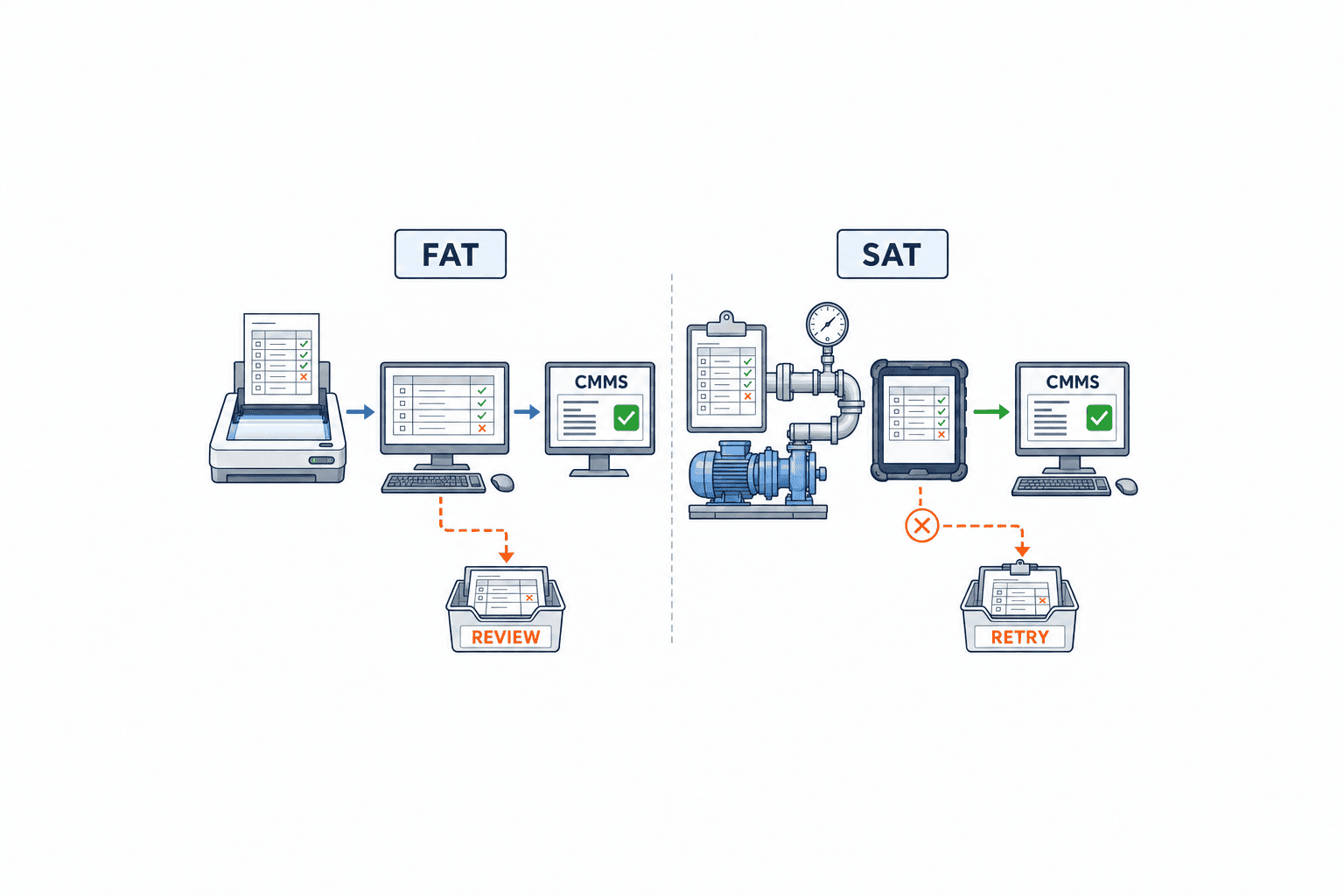
SAT: End-to-End Verification from Inspection to Maintenance Decision on Site
The SAT is conducted using actual scanners or tablets, under factory lighting and communication conditions, with field inspectors as scribes, and utilizing production-like CMMS permissions. We include representative scenarios beyond day shifts such as night shifts, communication outages, equipment relocation or exchange tickets, re-shooting, proxy approval by authorized personnel, and inspections exceeding the deadline. Even if a FAT passes on screens unusable for field inspectors, acceptance of business operations is not complete.
On site, we test the entire sequence from an inspector verifying equipment, measuring values, filling out forms, capturing images, handling exceptions; to an approver reviewing original images and extracted values; to confirming CMMS history and required work instructions. We also verify whether proxies and escalation functions operate correctly when contacts for abnormality candidates are unavailable due to vacations or night shifts. If automation results require changes to existing machine protection paths or emergency stop routes, separate safety design and approval are necessary.
Handover includes form versions, item dictionaries, equipment ID conversion tables, data contracts, exception classifications, permission matrices, guides on interpreting audit logs, resubmission procedures, backup and recovery methods, model versions, scope of evaluation samples, and unverified conditions. After operational launch, we regularly review breakdowns of exceptions, mislinkages, review duration, approval delays, integration failures, form changes, etc. Even if recognition rates improve alone, operations must be corrected if the quality of maintenance history declines.
After Go-Live: Control Form Changes and Model Updates
Inspection forms do not stay fixed forever. New assets, instrument replacement, changes in inspection frequency, and customer audit requirements can alter field placement and names. If a revised form is not communicated to the OCR workflow, a value in an old position may be extracted as a new item. Print a form version and manage the assets, items, units, and decision rules valid for each version. Before switching versions, run regression tests for extraction and integration with representative real forms, and tell the shop floor when the old form expires.
Model updates require the same discipline. If a service provider updates its underlying model, earlier PoC results cannot simply be assumed to hold. Record the model name, version, settings, prompts or extraction schema, and evaluation dataset version; compare critical field accuracy and exception rates. A newer model might improve overall reading while degrading a specific asset ID or handwritten Thai observation. In that case, postponing production rollout may be appropriate. Define rollback and the circumstances under which records processed by the earlier version must be reprocessed.
This approach to version control and defined ownership is consistent with the NIST AI Risk Management Framework Core, which calls for documented roles and responsibilities, ongoing monitoring, and periodic review. The NIST framework does not guarantee OCR accuracy or maintenance decisions at an individual plant; acceptance still depends on tests with the plant’s own forms and operating process.
Operational monitoring should distinguish the number of forms submitted from the number formally registered in CMMS. Classify records waiting for capture, failed OCR, master-data matching, inspector review, approval, or integration. Give each queue an owner and response deadline. Moving paper out of a tray without completing the maintenance history creates invisible missing inspection records. During weekly review, prioritize assets with older backlogs and forms that repeatedly trigger the same exception.
The correction screen should display the original image beside extracted fields and allow a reviewer to enlarge the relevant crop. A screen that forces staff to re-enter every value removes much of the benefit of OCR. Equally, a bulk-approval action that accepts suggestions uncritically can pass serious errors. Make asset ID, values and units, and abnormality candidates easy to distinguish, and allow a reviewer to record the correction reason. Measure both review time and erroneous approvals, then adjust the interface to what the plant can actually use.
Correction logs become material for continuous improvement. If one field is often misread, adjust the space or print density on the form. If an obsolete asset number recurs, clean up the master data. If local Thai abbreviations are misunderstood, build a shop-floor glossary. This sequence may solve problems more cheaply than retraining a model. After any change, retest against the same evaluation set instead of assuming that the result is correct without checking the source forms.
When reporting benefits, look beyond the number of pages read: can maintenance staff find the required history within the required time? Measure the previous time spent entering, filing, searching, and preparing records for audits, then compare it with capture, exception review, approval, and fault recovery after deployment. During high-volume months or weeks when inspection cycles converge, confirm that approval queues do not accumulate. Raising automation rates by removing critical checks may shorten apparent processing time while reducing the quality of maintenance records.
Training must cover what to do when a form cannot be read, not just how to operate a device. Confirm the asset ID before taking a picture, retake an incomplete image, never guess an unclear value, address abnormality candidates, and never share approval credentials. Put these steps into the shop-floor work standard. When Japanese managers, Thai inspectors, and English-language product support are involved, use common exception codes and asset IDs for handovers rather than relying only on translated screens.
FAQ: Introduction to Equipment Inspection Form AI-OCR
Can CMMS automatic registration be performed using only inspection form OCR?
While technically compatible products are available, the conditions for official registration are determined by design elements including equipment ID, measurement point, timestamp, value, unit, judgment, approval, and deduplication. Do not automatically resolve missing or contradictory critical items; instead, prepare a pathway to return exceptions to human review.
Can handwritten Thai always be read?
It cannot be guaranteed with certainty. Microsoft’s official documentation indicates supported languages vary by model version, print/handwritten distinction, and Read/Layout separation. Fix the candidate model name and version, then verify using actual documents that include your company’s scribes, forms, and capture conditions. Free-form text in mixed languages should particularly retain original document verification.
When digitizing equipment inspection records, are paper originals discarded?
The decision to discard depends on internal regulations, contracts, audits, and legal retention requirements. Do not determine original disposal based solely on OCR implementation; instead, document the integrity of source images, approvals, correction history, retention periods, and access rights, then confirm applicable requirements with relevant departments.
What is the passing accuracy threshold for recognition?
There is no universal value. Determine thresholds individually by measuring serious failures such as equipment ID misassignment, missed anomalies, unit errors, etc., alongside whether they can be prevented through review. Specify denominators, sample scope, separation of evaluation sheets and learning datasets, and explicitly state model versions.
How are FAT and SAT distinguished?
FAT (Factory Acceptance Test) uses fixed samples in a controlled environment to reproduce extraction, validation, approval, CMMS integration, and recovery during failures. SAT (Site Acceptance Test) verifies whether operations from the inspector through maintenance judgment function under actual site conditions. Both must record pass/fail results and unverified conditions.
Conclusion
AI-OCR for equipment inspection sheets serves as an entry point to digitize paper text. The success of implementation is determined by cross-referencing equipment IDs and measurement points, interpreting timestamps and units, human confirmation during exceptions, post-approval CMMS registration, and tracking resubmissions/corrections. Include responsibility boundaries and output specifications in your RFP; validate reproducibility via FAT and confirm field operations through SAT.
If you are considering connecting inspection sheets from Thai factories with your CMMS, please consult TOMAS TECH once you have gathered form samples, equipment master data, and current approval procedures. Before finalizing the approach, we can jointly organize which records require human review and where official maintenance history originates.


