



For automated sortation traceability, “barcode read” and “arrived at the correct destination” must be separate records. Between them are routing lookup, the association of an ID with a physical item, a divert command and an observed arrival. This guide helps Thai factories and distribution centres build an event history that WMS and MES can use for missort investigations, audit and recall exercises. The focus is the link between information and physical movement, rather than the choice of sorter mechanism.
Define what the traceability system must prove
“Trackable” is too vague for procurement. Write the questions first: Which shipping units contain manufacturing lot L? When did carton X enter the sorter, what destination was assigned, and at which chute was its arrival observed? Who identified and reinducted a no-read carton? These questions require different levels of detail. Decide whether the traceable object is a product, carton or pallet; do not treat these levels as interchangeable.
GS1’s Global Traceability Standard describes identification, capture and sharing, with critical tracking events and their data elements. Sortation can therefore record which object was handled, when, where and in which business context. Adopting a GS1 symbol alone does not create an auditable trail. The read code must be unique at the chosen level, times and locations must have stable meanings, and the link between a carton and its contents must survive rework.
Prioritise the purpose. Rapid missort detection, lot recall, and customer tracking impose different retention, query and proof requirements. Where law or a customer contract applies, confirm the requirements for the particular industry and jurisdiction. A generic system description is not a compliance certificate.
Keep product, lot, serial and logistics-unit IDs distinct
An item-type code, manufacturing lot, serial number, carton ID and transport-unit ID answer different questions. Two cartons of the same product cannot be distinguished by product type alone. The GS1 Logistic Label Guideline uses the SSCC to identify a logistics unit uniquely and explains why the contents of a mixed unit must be connected through business data. This does not mean every product receives an SSCC. Define where SSCC applies and where a site-specific unique carton or item ID applies.
If three lots are mixed into one carton, preserve “carton ID → product, lot and quantity” from packing. Reading only the carton ID at the sorter cannot reconstruct lost contents. A relabel must retain the old-to-new ID relationship. Repacking, splitting and consolidation require explicit relationship events. Choose the authoritative system for those relationships; avoid divergent versions in MES and WMS.
Consider reader compatibility, label placement, scan direction, print quality and partner requirements when choosing a carrier. GS1 lists barcode types for different applications. A more capable scanner cannot make an item-type-only code identify individual cartons. Choose the identity model before shopping for readers. This article addresses the event chain after a read; symbol print verification is a related but distinct task.
Record a read and an observed arrival as different events
A single “sort completed” event hides where a problem happened. Distinguish induction, identification, route decision, divert instruction, observed discharge and exception handling. Not every internal sensor event must be sent to a business database, but define which internal and external records constitute evidence.
| Event | It establishes | It does not establish |
|---|---|---|
| Induction detection | A physical object crossed the feed point | Identity or destination |
| Code read | A code was observed | Correct link to a particular physical object |
| Route decision | A destination was assigned | Physical movement to that destination |
| Divert command | Controls requested a diversion | Item entered the chute |
| Chute observation | Passage was detected at a location | What happened after manual handling |
| Shipment confirmation | Business shipment was approved | All intermediate exceptions were explained |
BEUMER’s material-flow description covers entry, identification, routing, sorting, discharge and containerisation. Use these boundaries to define your business events. If a divert command is stored as “arrived,” a jam or missed diversion becomes invisible. A chute sensor helps only if its observation can be correlated with the correct item ID and sequence.
Arrival at a chute may not be the last event. Container exchange and transfer to dispatch can require a container ID and shipment confirmation. Diagram where automatic observation ends and human confirmation begins. Show the last observed location honestly instead of marking an unobserved interval as completed.
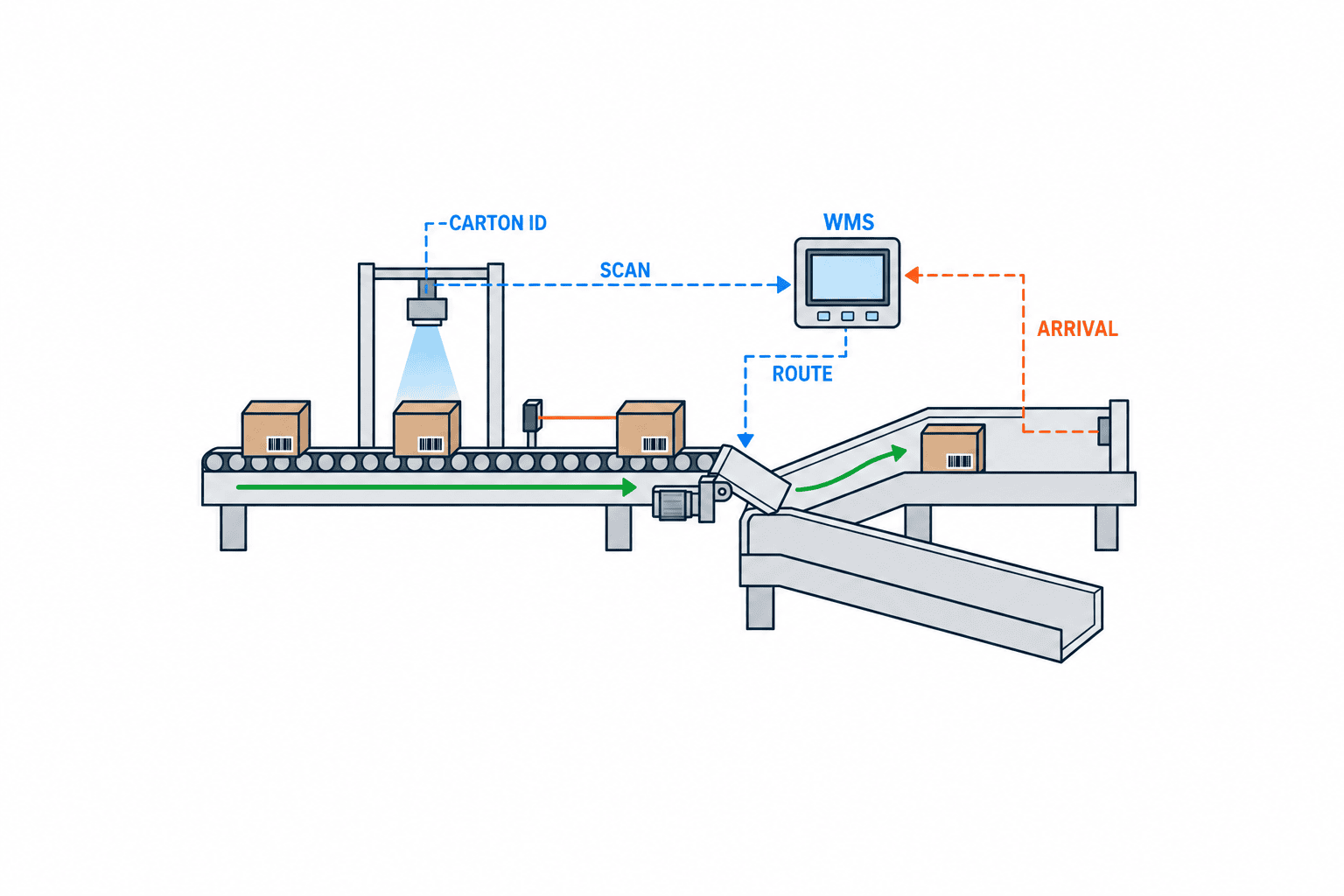
Design the event record before specifying interfaces
An event record may need event ID, object ID, event type, event time, capture time, equipment ID, read point, business location, planned chute, observed chute, outcome, reason code and preceding or succeeding event IDs. Not every field applies to every event; distinguish “unknown,” “not applicable” and “capture failed.” GS1 EPCIS separates the what, when, where and why of events and distinguishes a read point from a business location. A scanner’s physical location should not be silently treated as the place where an item remains afterward.
Event IDs support duplicate-safe retries. After a network outage, resending a buffered event must not create a second business movement. Use a source-assigned unique ID, or a deterministic key based on equipment and sequence. Document replay, out-of-order delivery, missing-sequence detection and buffer retention. “Send after recovery” does not tell an auditor whether some events were lost.
PLCs, sort controllers, WMS and MES may have different clocks. Preserve event time and server capture time separately, with explicit time zones. A Thai local-time display can coexist with a common comparison time. Otherwise the history may show a discharge before its read. Define clock monitoring, permitted offset and behaviour during a sync fault. If the device cannot timestamp at source, retain sequence and mark later inferred times as estimates. Our factory time synchronisation article covers network options.
Preserve the object-to-ID association from feed to discharge
A correct barcode read can still be associated with the wrong carton if two items overlap, gaps collapse or an item slips. Define how object detection, decoded code, carrier ID and position tracking become one association. If one sensor sees two cartons, one carton carries multiple codes, or a carton is lost after reading, send it to a defined exception rather than guessing.
Draw responsibility boundaries. A machine supplier may own scanning through carrier tracking, WMS may own routing lookup, and MES may own the carton-to-lot relation. Agree on ID formats, issuer, uniqueness and reuse rules at every boundary. Build a real sample message chain before ordering. Two interfaces that both call a value “carton number” may still be incompatible.
Reconcile induction count, identified count, routed count, divert count, observed arrivals, rejects and items remaining in the mechanism. If 100 objects entered, 98 were observed at chutes and one was rejected, the last one must be explained as still in the system or missing an event. Closing differences only the next day makes a missort investigation difficult. Reconcile at the end of each shift.
Connect WMS and MES without confusing planned route and observed destination
Choose one authority for routing. In one architecture WMS owns customer destinations and chute assignments, MES owns production lots, and the sorter controller requests a chute from WMS, reports an observed outcome and uses MES links only as needed. Sending every event directly to every system can blur the authoritative update sequence. APIs, message queues and file exchange all need common definitions for event meaning, retry, deduplication and failure recovery.
Route-master versions matter. If customer A uses chute 1 in the morning and chute 2 in the afternoon, retain the assignment version or resolved physical chute at decision time. Recalculating past events from today’s master changes history. If an item is sorted again, link cancellation, new decision and reinduction; do not overwrite the first decision. An audit needs the journey, not merely the final correct status.
A lookup timeout creates a quality-versus-throughput decision: stop, divert to reject, or temporarily use a cached route. Select by the consequences of a missort, recovery target and master-update frequency. A local cache needs expiry, version comparison and reconciliation after recovery. Distinguish items routed before a failure from items entering after it.
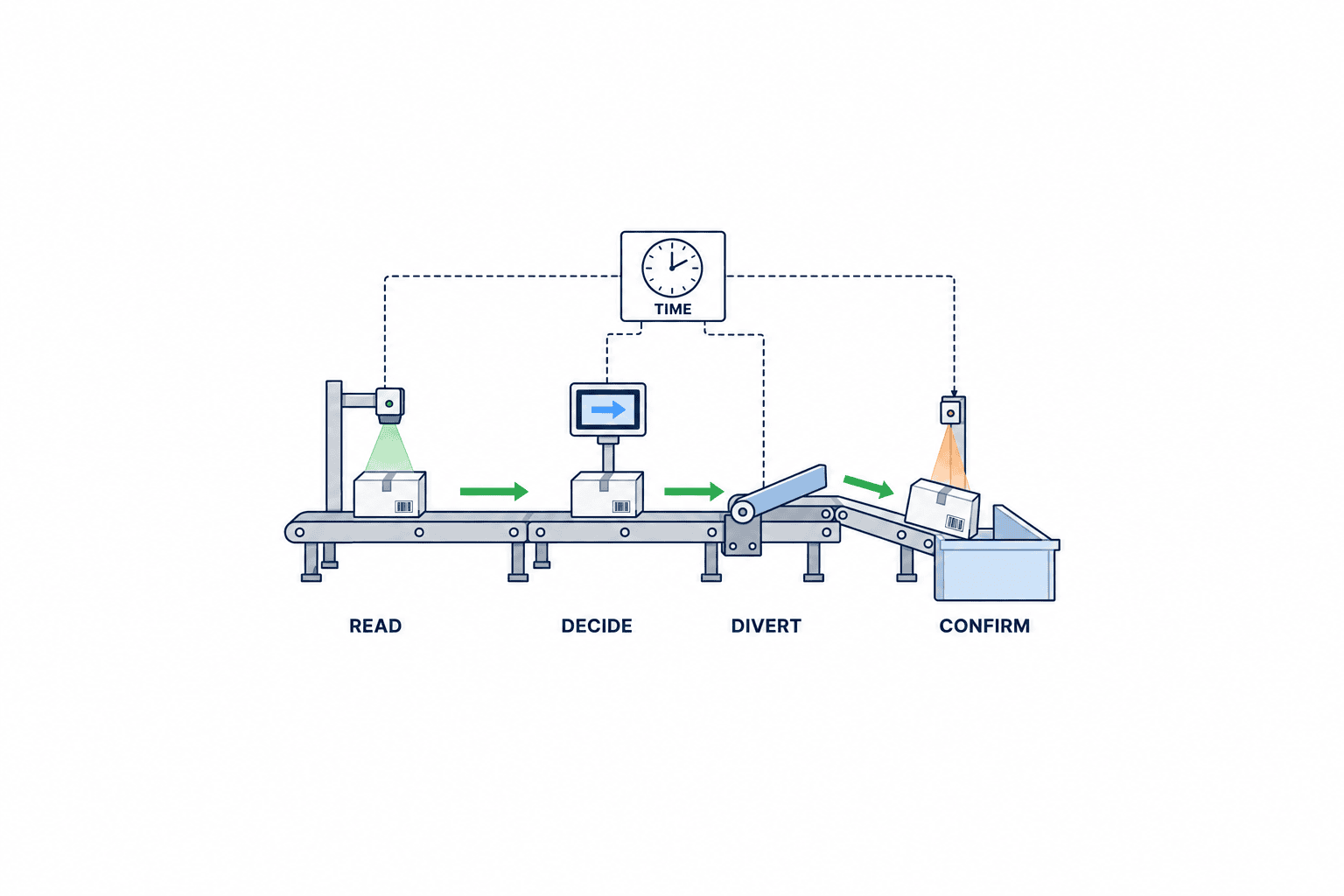
Make no-read, reject and rework part of the main history
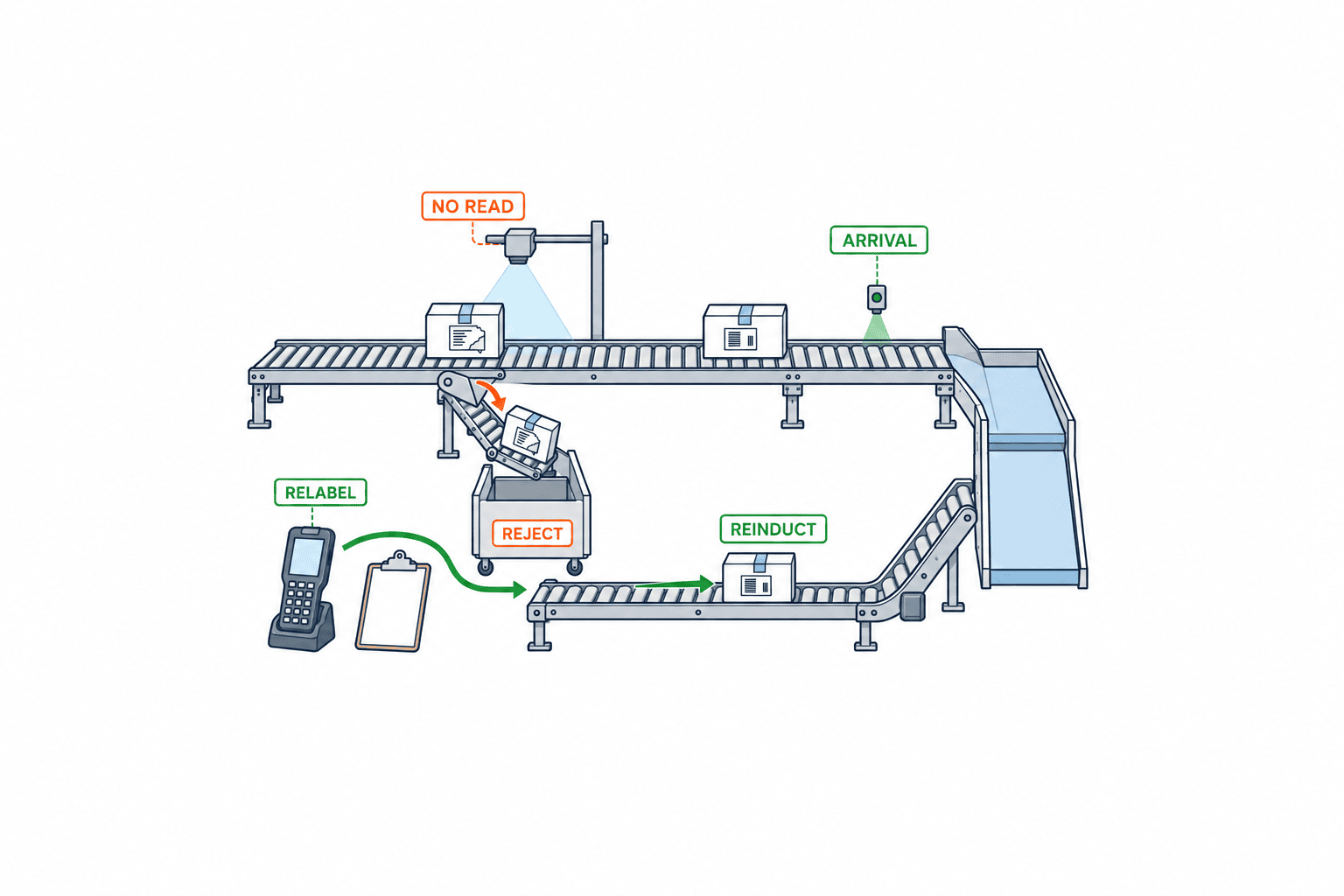
“No-read” may mean no label, weak print, hidden placement, two decoded codes, a decoded code absent from master or a communications failure. A single generic status cannot show who should fix it. Record reason codes, observed movement into the reject area and the person who resolves the item. Fixed codes support analysis; a short free-text note gives context.
When a worker relabels and reinducts a carton, link original ID, replacement ID, worker, time and reason. Registering it as a new unrelated carton erases the first failure. Opening a carton or moving contents to another container changes a parent-child relationship and needs its own event. Define who may authorise rework; an unidentified carton should not be returned to the normal lane by guesswork.
Give the reject container a capacity and owner. Define behaviour when full and how unfinished rejects are handed to the next shift. Analyse reject rates by reason and time. A new film or label material might lower scan performance while the mechanism remains healthy.
Prove recall and audit queries with a rehearsal
Records matter only if staff can retrieve them when needed. Prepare questions such as “list every shipping carton containing lot L,” “show carton X from induction to shipment in order,” and “find cartons handled while chute Y was full.” If data is distributed, provide one entry point and permissions.
Show observed facts separately from inference. A scan point can be the last observed location, but it is not proof of chute arrival without confirmation. Differentiate “not in scope” from “unknown.” Stating the limit of evidence is more useful than claiming perfect completeness without support.
Set retention from shelf life, warranty, contracts, industry obligations and dispute needs. Raw logs, business events and aggregate KPIs can have different periods. Corrections should retain original record, reason, actor and time. A simple overwrite conceals what was known at the time.
In a mock recall, quality staff can prepare a known answer set, then compare retrieved cartons for omissions and extras. Include split cartons, relabels, rework and returns. Check CSV export, saved query criteria, query actor and destination-data permissions. Measure the manual steps needed to answer. Our mock recall test guide covers broader exercise design.
Put event completeness and failure recovery into the RFQ
Supply an event list derived from the business questions: ID issuer, carton-to-lot relationship, routing master authority, read and discharge points, rework permissions, clock sync, retry, deduplication, retention and query requirements. Ask bidders to mark each as available, conditional or unavailable, with cost and physical proof method. “WMS integration supported” does not specify what flows in which direction or when.
Write acceptance around explainable counts, not only machine speed. Under a specified item mix, arrival pattern and destination profile, all inducted items must be accounted for in a final state; a duplicate event must count once; buffered events must return within an agreed recovery window. The thresholds come from your quality requirements, not a copied generic promise.
Include intentionally difficult sequences: two cartons from the same lot, only one relabelled; an item inducted across a chute-map version change; a reject during network outage followed by reinduction. Review the event chain by ID, not just individual screen messages. Decide which system provides the authoritative test extract accessible to buyer and supplier.
Specify log permissions, trade-partner data, export format and handover at contract end. Internal equipment IDs need not be shared with every external partner. Where Thai, English and Japanese interfaces coexist, names may differ but IDs and reason codes must remain the same.
FAT tests transitions; SAT tests physical-to-digital agreement
At the supplier’s site, FAT checks controls and interfaces. In addition to normal routing, simulate duplicate delivery, clock offsets, delayed master responses, no-code cartons, double feeds, assignment changes and full chutes safely. Agree expected state transitions and compare the sorter screen, controller and WMS records at each step.
At the Thai site, SAT includes real labels, item spacing, network, container changes and multiple shifts. After power or network loss, reconcile items still in the machine against buffered events; confirm that no duplicate shipment or missing history results. Check relabel and reinduction, and the alert and retry procedure when the machine says complete but WMS lacks the event.
Test reports should include event ID, object ID, induction order, planned and observed destinations, time, receipt in each system, difference, cause and retest. Assign acceptance ownership and deadlines for conditional acceptance. Use safe energy isolation for maintenance and jam clearance; do not disable guards for a test.
Monitor gaps and differences, not only read rate
Read rate alone cannot prove agreement of data and physical goods. Track ID resolution per induced object, route decision per identified object, observed arrival per divert, closed reject cases, unsent events and system-to-system count differences. Fix denominators and cutoff times. Reconcile mechanism contents, reject contents and downstream containers at shift end.
Classify differences as mechanism fault, scan failure, master mismatch, clock offset, duplicate delivery, communication loss or manual movement. Do not hide all under “system error.” More sensors may not cure a spacing, label or container-exchange issue. For print quality itself, see the barcode verifier guide; here the focus is evidence after a read.
When software versions or destinations change, protect the event definitions. Record the master version and switch time, rather than judging old movements under today’s assignment. Train staff to see the last observed location and next required action, not merely a “scan succeeded” indicator.
Scope and cost a staged rollout in a Thai factory
Cost includes identity design, labels, WMS/MES changes, capturing machine events, storage and search, training, FAT/SAT and outage procedures—not merely scanner count. Compare use of existing logs, creation of business events by a controller, and conversion to a shared format such as EPCIS against the same questions. A standard format is a means, not the result.
A pilot can start with one induction point and a small number of destinations, covering induction through observed arrival, reject and rework. Expand to all chutes, lines and lot reverse lookup later. Even the pilot needs unique IDs and retry/deduplication; omitting these forces a redesign for production. For temporary manual records, keep entry time, worker and basis of confirmation.
Assess benefit from measured time to investigate missorts, identify recall scope, reconcile paper, handle reshipments and prepare audit evidence. Do not invent a percentage reduction in rare major incidents. A concrete capability test—how long it takes to enumerate affected cartons—is more defensible.
Assign data ownership and correction permissions
Automatically captured facts should retain their originals. If a worker moves an item from chute A to B, record the arrival at A and a later manual transfer to B. A status display may show B, while the history explains A-to-B. Overwriting the first event hides the point of failure.
Separate authority to edit routing master from authority to approve shipment or physical rework. Define emergency delegation with reason and actor. Manage the permission table with operating procedures. Share only the necessary event granularity with customers and logistics partners. If partners use different IDs, preserve the mapping and its change history.
Sample a few cartons monthly and compare label, physical goods, controller log, WMS and shipment record. Include a reinducted reject and an item from a route-change day. Across sites, define what “shipment complete” means: chute arrival, container closure or truck loading. Common event names without common trigger conditions cannot support comparable reports.
Frequently asked questions
Is a barcode read sufficient proof of correct sorting?
Usually not. It proves an identifier was observed at a point. Route decision, divert command and physical chute arrival are separate facts. Set observation points for the required scope and show unobserved intervals. A product-type-only code also cannot distinguish individual cartons.
Does every product need an SSCC?
No. SSCC identifies a logistics unit. Choose product, lot, serial, carton and pallet IDs according to the level that must be traced, and preserve their relationships. Check the applicable GS1 guidance if information must be shared with partners.
How should manual handling of a no-read be recorded?
Link original induction, reject reason and observed reject arrival to the worker’s check, relabel relationship and reinduction. Do not create an unrelated “new” carton. Opening and repacking requires a changed parent-child relationship.
Is EPCIS mandatory for traceability?
No. It is a useful standard for sharing visibility events with consistent meaning. First define objects, events, locations, times and queries. Existing systems may already support the required questions. Evaluate EPCIS in the RFQ when cross-organisation exchange calls for it.
What should FAT and SAT accept?
With the agreed item mix, every induction must have an explainable final state, planned routing must remain distinct from physical confirmation, and no-read, replay, outage, full chute, relabel and clock-offset cases must behave as specified. Agree thresholds, duration and query method before testing.
Summary
Automated sortation traceability is more than extra scanning. Define the traceable unit and carton-content links; preserve induction, identification, routing decision, divert command, observed arrival and exception handling as distinct facts. Design clocks, locations, replay, deduplication and corrections, then use FAT and SAT to compare records against physical movement. That makes missort and lot investigations more defensible.
For a Thai plant planning a sorter upgrade or WMS/MES connection, contact TOMAS TECH to map the IDs and events first. A small pilot or preprocurement review is a reasonable starting point.


