


Selecting a vibratory parts feeder by its advertised maximum rate can hide the real constraints: parts may leave in the wrong orientation, changeovers may take too long, or a robot may be unable to pick what the feeder presents. For a Thai assembly plant, the useful question is whether conforming parts reach the next machine in the specified pose and at the required time. This guide compares bowl and flexible feeding, sets out the sample tests to request, and turns the result into an RFP and FAT/SAT acceptance plan.
Define output as parts the downstream process can use
“Parts per minute” is necessary, but the counting point matters. Parts moving around a bowl do not count as accepted output if the assembly machine cannot receive them. Begin with the line takt, part drawing, variation in actual production lots, required orientation, transfer coordinates and downstream handshake. Count conforming parts received at the agreed point, rather than parts circulating inside a feeder.
Suppose an assembly station requires 40 parts per minute and, purely as an illustration, the transfer succeeds 90% of the time. A simple calculation calls for around 45 presented parts per minute. This is an example assumption, not a supplier performance claim. Actual sizing must also include microstops, hopper refills, recipe changes, inspection rejects and any parallel lanes. A catalogue figure of 45 parts per minute is not automatically equivalent to a line output of 40.
Write an acceptance definition that covers front/back orientation, pickup coordinates, spacing from adjacent parts, permissible time waiting at the outlet and damage limits. If machine vision decides whether a part is acceptable, specify the lighting and background conditions too. Bulk input capacity and usable downstream output describe different capabilities.
Bowl feeder versus flexible parts feeder
A vibratory bowl uses a shaped track and mechanical tooling to orient parts while returning unsuitable orientations to the bowl. It can be a strong candidate for a stable part supplied repeatedly over a long period. When the part geometry changes, the track and escapement may need rework. RNA’s bowl feeder information describes part CAD, required exit orientation, sorting track and vibration behaviour as engineering inputs.
A flexible feeder typically spreads parts on a vibrating flat plate, uses vision to find pickable positions and passes coordinates to a robot. Recipe changes can accommodate part families, but the machine is not universal. Two-sided recognition, overlap, reflective surfaces, warped parts, suitable gripping faces, vibration damage and leftovers on the plate all require real-part trials. OMRON’s iPF lineup lists a hopper, frame, plate and cabling in addition to the feeder unit. Comparing only base-unit prices omits important scope.
| Decision point | Bowl feeder | Flexible feeder |
|---|---|---|
| Orientation principle | Shaped track and mechanical rejection | Vibration dispersion, vision and pickup |
| SKU change | May require tooling or track changes | Check recipe coverage with each real SKU |
| Useful measurements | Exit pose, return rate, jams | Recognition, grip success, redistribution cycles |
| Full quotation | Bowl, linear track, escapement, control | Hopper, plate, light, camera, robot interface |
| Common concern | Mechanical rework after geometry change | Crowding, glare and gripper collisions |
This is an initial comparison, not a verdict by technology label. Even a single SKU can change frequently enough to justify flexible feeding. Conversely, several closely related SKUs may share one practical bowl orientation method. Compare actual workpieces and complete delivery scope.

What to check first for a bowl system
Does the part look the same from both sides? Is its centre of mass offset? Can a flange or groove catch the track? Does oil change friction? Thin stamped parts may nest in pairs, plastics may build static charge, and machined parts may carry chips. Measure after the linear track and escapement, at the handover location, not only at the bowl rim. Observe recovery when the outlet empties and how a full downstream buffer stops the supply.
Production parts may sit anywhere within drawing tolerance. Collect samples from multiple lots, including parts near the tolerance limits, minor burrs and surface-finish differences. A trial using only visually perfect samples can postpone jams and excessive rejects until site acceptance. Record sample revisions and lots so trial results can be reproduced.
What to check first for a flexible system
A camera-visible part is not necessarily a robot-pickable part. The gripper may collide with neighbouring parts even when a part is recognized accurately. Time the full cycle: hopper feed, redistribution, image capture, pick, leftovers, further vibration and re-imaging. Ask for sample camera images, handling of failed recognition and the robot’s keep-out regions.
Too many parts on the plate cause overlap; too few cause empty-pick waiting. Asyril’s September 2026 documentation describes a sensor-based amplitude regulation feature for its Asyfill hopper that aims to keep delivery to the Asycube platform consistent. Treat this as an example of an input-control mechanism, not as proof of performance in a different application. In any technology trial, assess how bulk feed is controlled as the plate fills and empties.
A digitally engineered bowl is still a bowl
RNA describes a digital bowl feeder whose sorting track and vibration behaviour are simulated and validated before physical manufacture. This is an engineering and reproducibility approach for a bowl system; it is not the same category as a flat-plate flexible feeder. If a proposal says “AI-ready” or “digital,” ask which input data are used, which physical behaviour is simulated and which claims remain to be checked with real parts. Simulation alone cannot establish the effects of oil, burrs, humidity, local installation and production-lot variation.
Prepare the input data for parts feeding automation
Comparable bids start with a comparable data package. Give each bidder the drawings and CAD model, material and mass, surface treatment, tolerances, acceptable damage, demand by shift, incoming container type, downstream interface and production samples. For multiple SKUs, provide quantities and changeover frequency for each. If parts arrive oily in production, trial oily parts rather than only clean presentation samples.
| Input | What the supplier needs it for | What the buyer checks |
|---|---|---|
| Drawing, CAD, tolerances | Orientation tooling and pickup | Same revision as production parts |
| Physical samples | Jams, nesting, visibility | Multiple lots, limit cases, burrs |
| Required takt | Capacity and buffer sizing | Refills and downtime included |
| Quality rules | Damage, mixed parts, wrong pose | Reject route and evidence |
| Layout | Installation and service access | Existing equipment and safety envelope |
| SKU plan | Recipes and future tooling | Cost and responsibility for changes |
Do not detach a rate such as “100 parts per minute” from its test. Ten minutes after a fresh bulk load and several hours with operator replenishment are different trials. State the measurement duration, accepted output point and treatment of stoppages in the data sheet.
Run three levels of real-part testing
First is feasibility on drawings and samples. Can the required orientation be created without unacceptable damage? Is automated feeding appropriate for the part at all? Keep alternative concepts open: bowl, flat plate, purpose-made tray or a more limited manual loading aid. A small change to the part or its incoming packaging may be more sensible than elaborate tooling, but engineering and quality owners must approve it.
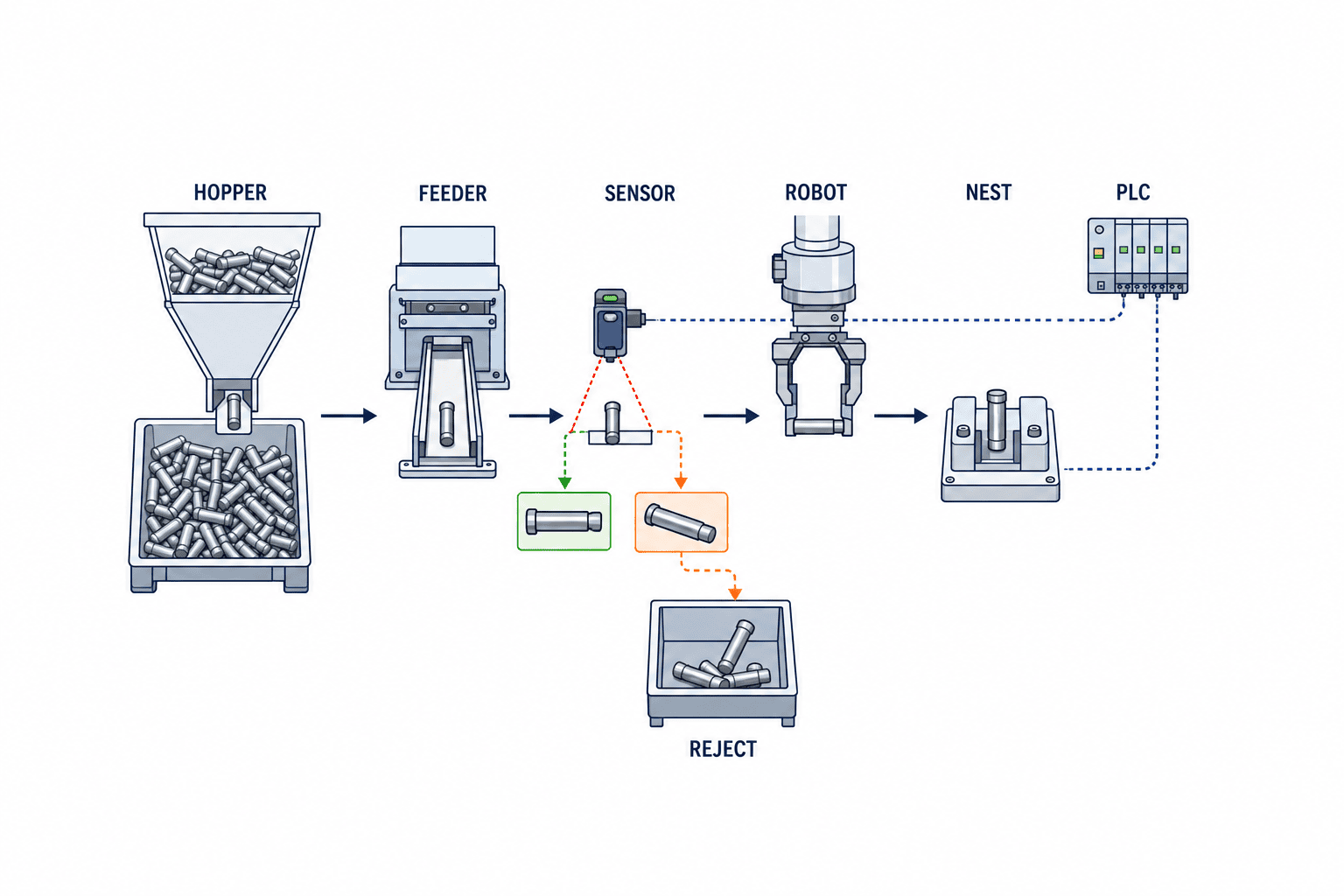
Second is a supplier trial using production-like samples. Measure correct-pose output, effective delivery, jams or redistribution, surface damage, mixed-part detection and leftover parts. A flexible trial must include vision, illumination, gripper and robot path. A bowl trial must include the linear track and escapement. Request timestamped source data and test conditions, not just a short demonstration video.
Third is integration with the assembly station or robot. A standalone feeder may pass while the complete line stalls because of robot standby positions, PLC handshake, safety gates or a poor recovery sequence. Assign one owner for cross-machine signals, approve an I/O list and document abnormal sequences. Our FA system integration buying guide explains how to make those boundaries explicit.
Keep measurements consistent across suppliers
Define effective good-part delivery as conforming parts received in the specified pose divided by the measured operating interval. Also log wrong-pose arrivals, stoppages and recovery time, refill frequency, damage, changeover time and manual interventions. Examine the first part after restart and behaviour when only the last few parts remain. Both are common gaps in a polished short trial.
For illustration only, suppose the line requires 40 good parts per minute. Candidate A presents 50 with an assumed 85% transfer success rate, yielding 42.5 good transfers; candidate B presents 46 with an assumed 95%, yielding 43.7. Neither figure is a measured product specification. The example shows why a higher standalone output does not settle the choice. Real comparisons need the same sample lots, interval and good-part definition, including stoppages.
What a Thai plant’s parts-feeder RFP should contain
An RFP should define an outcome and delivery boundary, not merely name a feeder model. In Thailand, the equipment OEM, local system integrator, robot supplier and the buyer’s Japan-based engineering team may each own part of the line. A low bid can mean that camera, gripper, PLC connection, guarding, transport or local SAT has been left outside the price. Ask bidders to mark included and excluded scope item by item.
Specify confirmed SKUs, drawing revisions, sample quantity, orientation drawing, method for measuring effective capacity, continuous-run conditions, damage rules and mixed-part rejection. Include the I/O list, alarm codes, behaviour when upstream and downstream stop, restart authority and power-recovery procedure. Ask for refill height, cleaning access, consumables, spare parts, local service contact and the promised response arrangement. Targets should come from the plant’s own takt and quality rules, not a generic value copied from a catalogue.
| RFP chapter | Decide explicitly | Result of leaving it vague |
|---|---|---|
| Workpieces | SKUs, revisions, material, incoming state | Trial and production parts differ |
| Outlet | Pose, good-part definition, transfer point | “Fed” and “usable” diverge |
| Capacity | Interval, stops, refill, changeover | Maximum figure determines the purchase |
| Peripherals | Hopper, vision, lighting, gripper, guarding | Quotes have different boundaries |
| Control | PLC/robot interface, rejects, recovery | Responsibility splits on site |
| Acceptance | FAT/SAT samples, logs, signatories | Final acceptance becomes subjective |
| Service | Spares, training, local response | Long recovery after stoppages |
Compare total delivered scope
Add the track or plate, hopper, vision and lighting, gripper, control panel, communication, guarding, transport, installation, commissioning, training and replacement parts to the main unit. Include the labour required for each changeover and foreseeable engineering changes. Cost varies with workpiece, capacity, layout and contract boundary, so this article does not state a market-average price or universal payback period. An RFP with the same scope for every bidder produces a more useful comparison than the claim that either technology is always cheaper.
FAT and SAT answer different questions
At factory acceptance testing, use actual parts and record accepted delivery for each SKU, wrong orientation, damage, stops during continuous running, hopper refill, abnormal-condition recovery and changeovers. If the downstream machine is absent, define the simulation fixture and carry untested points forward on a signed SAT list. Keep sample lot and revision records alongside video and machine logs.
At site acceptance testing in Thailand, check the installed and connected line: power, air, mounting, transferred vibration, actual operator refills, robot and PLC signals, guarding, emergency stop and the support arrangement for every shift. If a unit that passed FAT loses performance at SAT, separate shipping-related adjustment, new part lots, changed illumination, downstream wait signals and restricted refill access. The words “capacity test” may appear at both gates, but the scope is different.
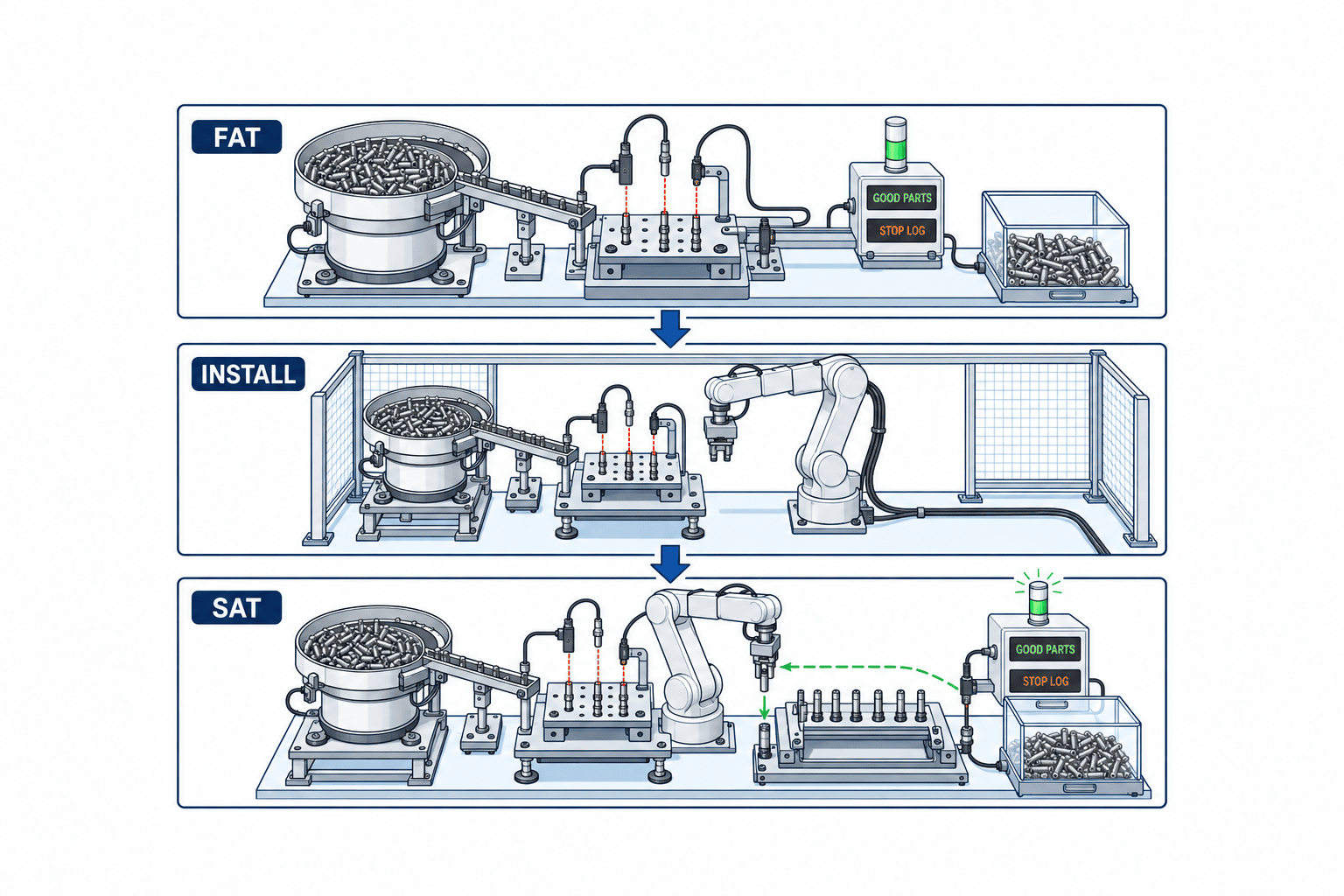
As a hypothetical acceptance-plan example, the team might run three SKUs for 60 minutes each while recording good transfers, stop reasons and damage. The 60 minutes is not a recommended industry threshold. Fill in the actual sample lots, required count, pass level, test operator, log location and retest conditions based on the line. Also specify which tests repeat after a tooling or recipe change.
Never close acceptance using a feeder’s short burst rate alone. Parts feeding supports the downstream cycle. Temporary manual top-ups can mask a weak design during trials and then reappear as routine labour after launch. Count and time each intervention, and include it in the agreed result.
Five boundaries to review in a Thailand rollout
Incoming quality. Locally sourced and imported parts can meet the same drawing while differing in actual finish or oil. Define the lots covered by the equipment guarantee and retain reference samples.
Machine-to-machine ownership. Draw the handover point between bowl or plate, robot gripper, PLC and assembly fixture. State who diagnoses a part that is visible but cannot be picked.
Operating language. A Japanese design dossier alone may not let a Thai shift crew restore service. Review screen messages, alarm lists, cleaning and restart instructions in the language the operating team uses.
Replaceable parts. Confirm how coatings, plates, sensors, camera lights and wear parts are replaced and sourced locally.
Safety and access. Review refill and cleaning actions around moving and vibrating equipment, safety stops, and how residual parts are cleared after a stop.
These boundaries apply regardless of brand. If the plant still needs to determine which process to automate first, our factory automation consulting guide provides an upstream assessment framework. Feeder choice should remain anchored to the complete process and its operators.
Frequently asked questions
How many sample parts are needed to select a bowl feeder?
There is no universal number. The test set must expose relevant drawing tolerances, lot differences, burrs, oil and surface treatment. Ask suppliers for a trial plan, then provide multiple lots including difficult cases. Allow additional parts where testing damages or consumes samples. The final quantity follows what each functional or statistical test must establish.
Is a flexible feeder always preferable for high-mix production?
No. Several related SKUs might share one bowl orientation method. A flexible plate may also struggle with parts that are hard to distinguish from both sides or difficult to grip. Compare effective output, changeover effort, recognition and pick success, damage and maintenance for each SKU under the same conditions.
Can the installed cost be estimated from the base unit price?
No. Bowl projects may need linear tracks and escapements. Flexible projects may need hoppers, plates, vision, lights and grippers. Both need controls, safety, installation, commissioning, spares and training. Require an explicit scope matrix in the RFP.
How should capacity be expressed in a parts-feeder RFP?
State the number of conforming parts accepted downstream in the specified pose, the production lots and SKUs used, the measurement interval and how stops, refills and changeovers are treated. Set pass levels from the process demand. A common FAT/SAT recording template prevents suppliers from reporting incomparable rates.
Does digital bowl design remove the need for a physical trial?
No. Simulation can help investigate track geometry and vibration settings before a build. It does not replace checks of actual surface condition, lot variation, installation and connected downstream control. Ask what data entered the model and what remains outside its scope.
Decisions to settle in the buyer’s internal review
Before requesting a quotation, production, quality, process engineering, maintenance and procurement should share the same definition of success. Production confirms takt and refill practices; quality defines damage and wrong-pose handling; engineering confirms signals to existing equipment; maintenance defines recovery and replacement parts; procurement aligns quotation scope and acceptance. If “good part” means something different to each team, bidders will make different assumptions. Circulate the RFP draft internally, mark open items explicitly and only then issue it.
If multiple concepts remain, do not put only “bowl” and “flexible” on the evaluation sheet. For each concept, record covered SKUs, sample lots, simulated downstream conditions, effective good-part output, changeover duration, manual intervention, service work and untested items. Mark each entry as measured, estimated or not tested. This makes it easier to tell whether a low price reflects a better solution or a narrower validation scope.
Classify downtime by cause. A downstream planned stop that makes the feeder wait normally is different from a feeder fault or time spent on planned changeover. Define reason codes in the PLC and robot logs and use the same categories in FAT and SAT. The valuable feature is a meaningful record of why the line stopped, rather than simply having a sensor installed.
Design a small pilot that can answer a larger question
A plant may pilot one representative part family before automating every SKU. Do not choose only the easiest part. Include high-volume, frequently changed and hard-to-orient examples, then state which findings can be generalized. Success with one part does not prove success with the rest. If a proposal promises future SKU additions, request the expected extra tooling, recipe work, retest scope and cost.
Installation location is part of the pilot. A high hopper adds operator burden at refill; a camera exposed to changing ambient light may give inconsistent recognition. Bowl vibration can propagate to adjacent measurement equipment, so include isolation and mounting in the review. A flexible system needs enough space both for camera view and for plate removal during maintenance. Overlay refill, cleaning, part replacement and fault-recovery movements on the layout, not just the machine outline during normal running.
At handover, request approved drawings, I/O list, software and recipe backups, mechanical settings, consumables, spares, cleaning and inspection instructions, fault-recovery instructions and FAT/SAT records. Define who may change a setting and which tests must repeat afterwards. If adjustment knowledge remains only with one vendor engineer, a night shift or staff change can undermine the installation. Have operators and maintenance staff practice recovery during SAT in the language they actually use.
Workpiece-specific checklist when the choice is unclear
For thin stamped metal parts, test nesting and front/back recognition first. A bowl trial should show whether nested pieces return from the track and whether repeated circulation damages them. A flexible trial should show whether vision detects overlapping parts and whether another vibration cycle separates them. If thickness variation is almost invisible in the image, camera resolution alone may not solve the problem; test lighting direction, background and grip geometry together.
For small plastic parts, assess static electricity and surface damage. A Thai plant’s operating environment may change over the year; specify the actual environmental range in the RFP and test within it, instead of extrapolating from the conditions on one trial day. Colour variants can change reflection and transmission in machine vision. Supply physical samples of each colour and define whether lighting recipes may change.
For metal screws, pins and machined parts, check oil, chips, magnetism and burrs. They can change friction on a bowl track and reflection or sliding on a flexible plate. If the robot inserts a pin into a hole, correct orientation alone is insufficient: the axis must remain suitable after gripping. Assess feeder placement error and robot gripping error as a combined tolerance against the assembly fixture. The standalone feeder specification cannot prove that fit.
For connectors and terminal-bearing parts, watch for entanglement and bent protrusions. Stronger vibration may add damage without separating parts that interlock in bulk. Compare alternatives such as packaging changes, trays or dividers. Logistics, purchasing and the component supplier may need to approve a changed incoming presentation. Ask whether the input condition can be changed before declaring automatic feeding infeasible.
Time changeover from good part to good part
On a high-mix line, a practical interval starts with the last accepted part of product A and ends with the first accepted part of product B. Timing only a recipe selection leaves out clearing leftovers, plate cleaning, camera verification, tooling changes and first-piece approval. For either technology, verify whether one operator can complete the work safely and whether the machine flags a wrong SKU selection. A fast changeover that permits mixed old and new parts is a poor quality outcome.
Break down future SKU introduction too. Track modification, plate exchange, vision threshold or model setup, robot grip teaching, PLC recipe changes and renewed acceptance testing are separate tasks. When a supplier says “just add a recipe,” ask which of these tasks truly disappears. Easier software setup does not remove the need to check part tolerance and downstream integration. Agree on change-work pricing and support ownership before series production.
Keep operating data that supports improvement
After launch, record good transfers by time period, stop reasons, recovery duration, refill events, rejected parts, manual interventions and changeover start/end times. Identify which events live in the feeder controller, PLC or MES and prevent double counting. If a planned downstream stop is coded as a feeder failure, the team may modify a healthy unit unnecessarily.
Use logs to find the next intervention: short supply may point to hopper control or orientation; wrong-pose arrivals to sorting or vision; missed picks to the relationship between gripper and pose. Set contractual handling rules before sharing drawings or camera images containing confidential information with a supplier. Match reason codes to representative images so technicians can diagnose recurring events without hunting through long videos.
Record the assumptions behind the purchase decision: required takt, sample lots, good-part definition, measurement interval, permitted manual help and treatment of stops. If actual performance later diverges, these notes let the team trace why. When bidders test in different conditions, document the difference before ranking the numbers. Distinguish what is verified, what needs another test and what remains an accepted risk.
Conclusion
Selecting a vibratory parts feeder is a process-design decision about delivering usable parts, not simply a comparison of moving mechanisms. Assess mechanical orientation for bowl systems and the combined dispersion, vision and gripping cycle for flexible systems. Test real parts using one definition of good output, make peripherals and ownership explicit in the RFP, and use FAT for the feeder system and SAT for the installed Thai line.
If you are beginning a feeder comparison or drafting an RFP for a Thailand plant, contact TOMAS TECH with your part samples and target takt. We can help frame the interface to existing assembly equipment and the site-acceptance questions while the options are still open.
Sources
- RNA Automation, Vibratory Bowl Feeders product catalogue (2026)
- RNA Automation, Digital Bowl Feeders
- OMRON, iPF Series Flexible Part Feeder lineup
- OMRON Robotics, Industrial Part Feeder
- Asyril, Asyfill smart hopper documentation (2026.09.25)
The calculations and test duration shown above are illustrative assumptions. A maker’s product description is not a performance guarantee for a specific project.


