


When selecting an automatic pallet dispenser for a factory in Thailand, begin with a practical question: can it separate one empty pallet from the actual stacks used on site and pass that pallet safely to the next machine? Nominal magazine capacity alone cannot answer it. Repaired wooden pallets, plastic pallets, warped decks, wet surfaces, inconsistent stacking and imperfect forklift placement change how a dispenser behaves. This guide focuses on empty-pallet separation, replenishment, downstream handoff, safety, procurement and acceptance testing. It is distinct from selecting a palletizing robot, which stacks products on a pallet, or an AGV, which transports pallets.
Define the job and the equipment boundary
An empty-pallet dispenser takes a stack of empty shipping pallets and releases one pallet at a time. Some systems also stack returned pallets. A palletizing robot places cartons or products on the pallet; a depalletizing robot removes a load; a forklift or AGV moves the pallet. The dispenser must supply the correct pallet in the correct orientation when the receiving equipment is ready. A demonstration of the mechanism running on its own is therefore insufficient.
PALOMAT Inline is an example of an inline dispenser integrated with a conveyor. Its manufacturer describes pneumatic and electric versions and a terminal box for external control. A stand-alone magazine is another architectural option, as shown by Q-System. These are examples of available configurations, not evidence that any one device will meet a particular factory’s performance requirement. The purchaser must define both the machine scope and the interfaces around it.
The starting point of the boundary is how and where a stack arrives. The end point is a confirmed single pallet at the receiving machine. Between them sit stack holding, separation, lifting, discharge, presence detection, guarding, access for recovery and safe restart. Name the owner of each interface before requesting quotations. Otherwise the dispenser vendor, conveyor supplier and AGV integrator may each assume another party will manage the critical handoff.
Measure real pallets before comparing models
Do not send a supplier only one perfect sample. Collect the pallets that actually circulate through the site: new, used and repaired units from each source, including those that are warped, chipped, wet or slightly out of alignment. Record which conditions are acceptable for automatic input and which must be rejected before the magazine. Identify each sample so the same population can be used at FAT.
For each pallet type, measure length, width, height, mass, fork openings, deck-board and block positions, bottom contact surfaces and stacking direction. Note protruding nails, splits, loose boards and plastic ribs. Two pallets with the same nominal footprint may present different surfaces to holding fingers or discharge chains. A statement such as “standard pallet compatible” is not a usable acceptance criterion without a measured range and an agreed rejection rule.
| Site evidence | What to record | Why it matters |
|---|---|---|
| Geometry | Measured range and orientation | Guides, holding points and exit path |
| Underside | Blocks, openings and support surfaces | Lifting and conveyor support |
| Condition | Warping, damage, moisture and dirt | Permitted input and reject rules |
| Stack | Minimum and maximum observed stack, lean | Magazine geometry and sensors |
| Logistics | Forklift or AGV type, approach and exit | Opening, docking and signals |
Compare the separation mechanism with those samples
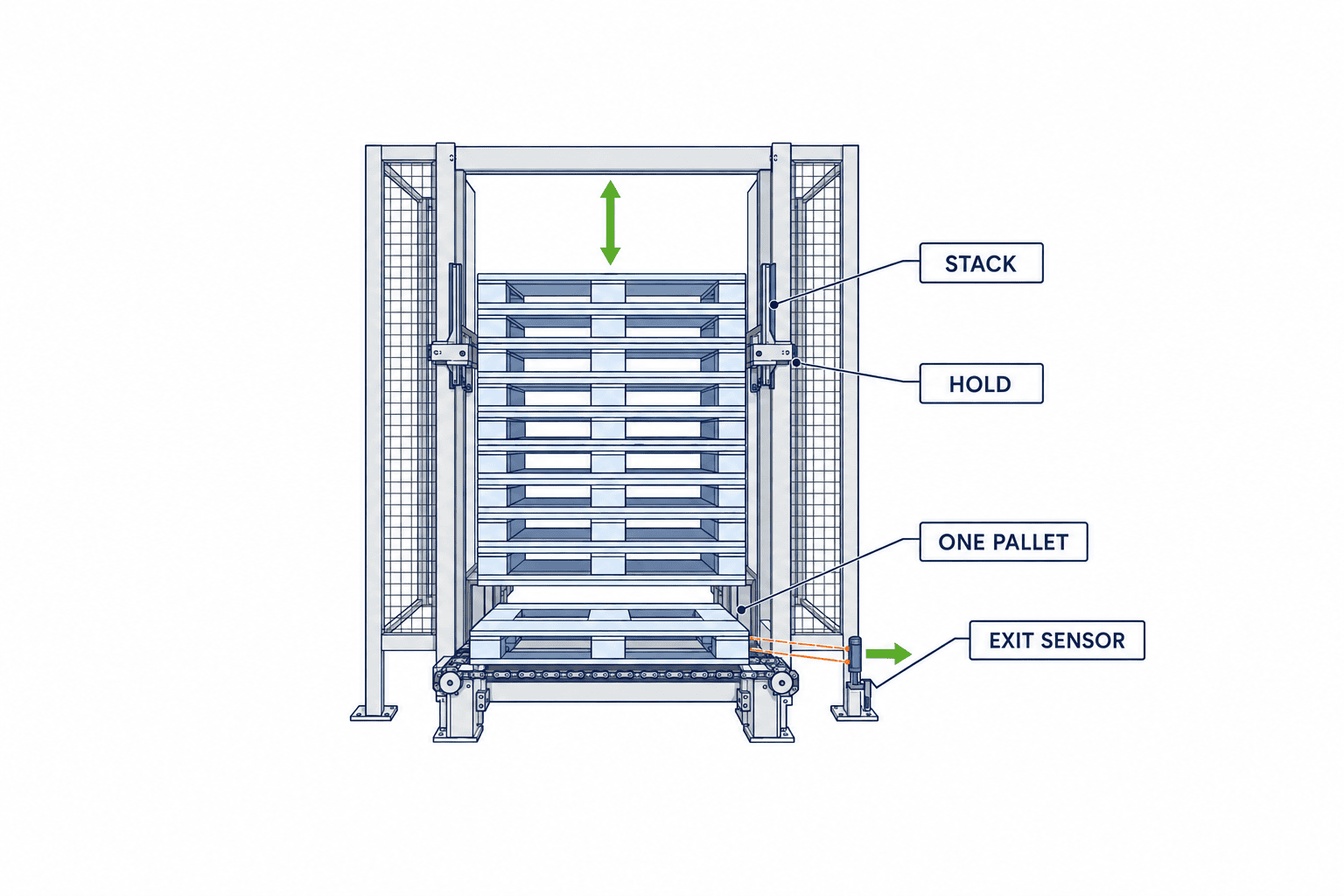
Manufacturers use different mechanical approaches: holding the upper stack while releasing the lowest pallet, lifting the stack to leave one pallet below, or staging pallets with fingers or forks. Columbia/Okura’s integrated-equipment information illustrates that the method itself varies by application. Do not infer reliable separation from a method name. Ask the vendor to show where its machine touches each actual pallet type, how one pallet is identified and what stops the machine if two move together.
If fingers enter a wooden deck opening, board location and damage become critical. If a chain or roller conveyor supports the underside, support spacing and the bottom-board pattern matter. If a clamp holds a slippery plastic pallet, prove the holding action with real samples. A downstream double-pallet sensor is valuable containment, but it does not replace a test of the separation mechanism itself. FAT should distinguish successful one-pallet release from safe rejection of an unacceptable pallet.
An inline machine may feed a palletizer or conveyor directly. A stand-alone magazine may organize empty pallets away from a production line. In either case, the cycle time is more than the lift stroke: include separation, discharge, downstream acceptance, replenishment stops and recovery. A fast mechanism cannot release another pallet while the receiver remains occupied. Compare normal single-pallet cycle and whole-flow availability separately.
Electric versus pneumatic actuation is also a project decision. Check available utilities, maintenance capability, expected duty, positioning needs and safe behavior after power or air loss. Request the vendor’s actual rated conditions and warranty rather than assuming either technology is inherently better. PALOMAT’s product information shows both drive options and external-control integration; it does not establish site-specific durability for your pallet population.
Design forklift and AGV replenishment separately
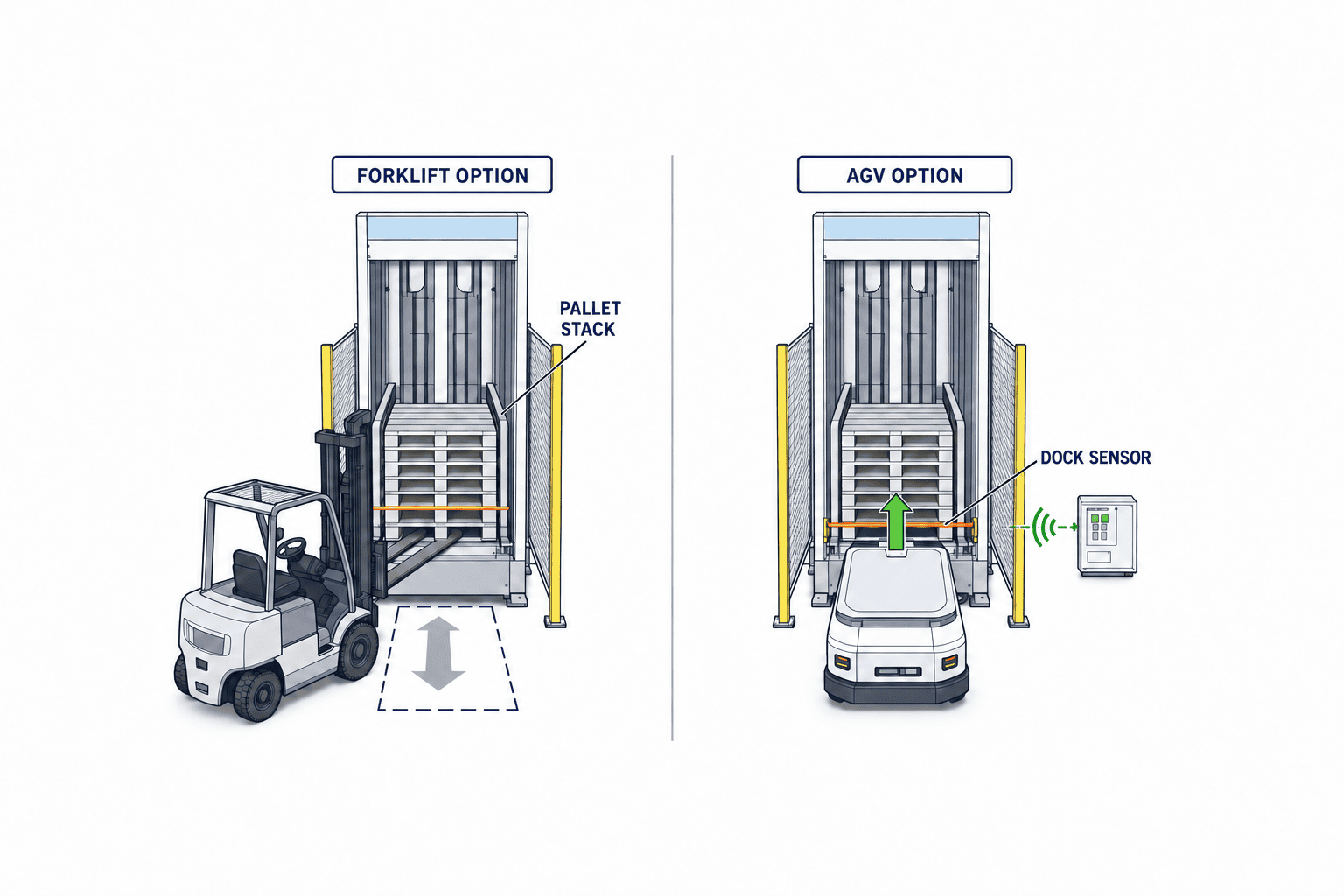
For forklift replenishment, measure entry angle, tine clearance, floor level, overhead pipes, visibility, placement tolerance and the space needed to withdraw the forks. Include collision protection and an unambiguous indication that dispenser motion is inhibited during loading. Requiring a worker to straighten the stack by hand after every placement reduces the value of automation and creates another intervention point.
For AGV or AMR replenishment, an arrival message is not the same as physical docking. The state machine should consider actual stop position, lift height, free magazine capacity, holding-finger state, presence of people and the vehicle’s departure. Define what happens if communication fails, the vehicle leaves early or a second vehicle requests the same station. Do not start machine motion merely because a fleet system reports “arrived”.
ISO 3691-4:2023 covers safety requirements and verification for driverless industrial trucks and their systems, including AGVs and AMRs as examples. The pallet dispenser still needs its own risk assessment. At a shared transfer area, those two assessments must meet. Our AGV layout design guide discusses vehicle routes and waiting areas; the dispenser RFP must add docking tolerance and the precise conditions for a safe transfer.
Specify the downstream handoff as a state transition
The pallet is not delivered just because it has left the magazine. Specify the transfer height, bottom support, conveyor spacing, guide rails, orientation, centering and leading- and trailing-edge detection. If a palletizer is the receiver, include its position and clamp-ready condition. If an AGV receives a single pallet, distinguish a conveyor transfer onto the vehicle from a direct pickup by the vehicle.
Labels such as Ready, Request, Transfer, Received, Fault and Reset are not enough on their own. For every signal, specify who sends it, whether an edge or sustained level is meaningful, its timeout, and the recovery state after a timeout. If an exit sensor sees a pallet but the receiver has not acknowledged it, prohibit a second release and provide a safe way to remove the first pallet. Decide how an occupied sensor is interpreted after a power outage.
Ask for both a PLC I/O list and a state-transition table. The I/O list identifies terminals and signal ownership; the state table explains normal, waiting, fault and recovery behavior. Where separate suppliers provide the dispenser and receiving conveyor, name a lead integrator for the interface test. This avoids spending commissioning time disputing which supplier should generate a missing signal.
Treat safeguarding as part of the operation
The magazine combines a stack, moving fingers, a lift, a conveyor and often a forklift or autonomous vehicle in a small area. Assess crushing, falling material, unexpected start, stored energy during maintenance and vehicle contact for loading, normal running, clearing jams, cleaning and service. ISO 12100:2010 provides the framework for machinery risk assessment and risk reduction. Merely listing it in a proposal does not substitute for a documented site assessment.
ISO 14119:2024 addresses selection and design of interlocking devices for guards. ISO 13849-1:2023 provides methodology for safety-related control systems. Neither source sets one universal required performance level for every pallet dispenser. The safety functions and required performance are derived from the actual hazards and system configuration. Request the assessment, design basis and validation evidence, including the neighboring conveyor or AGV where it can create a hazard at the same opening.
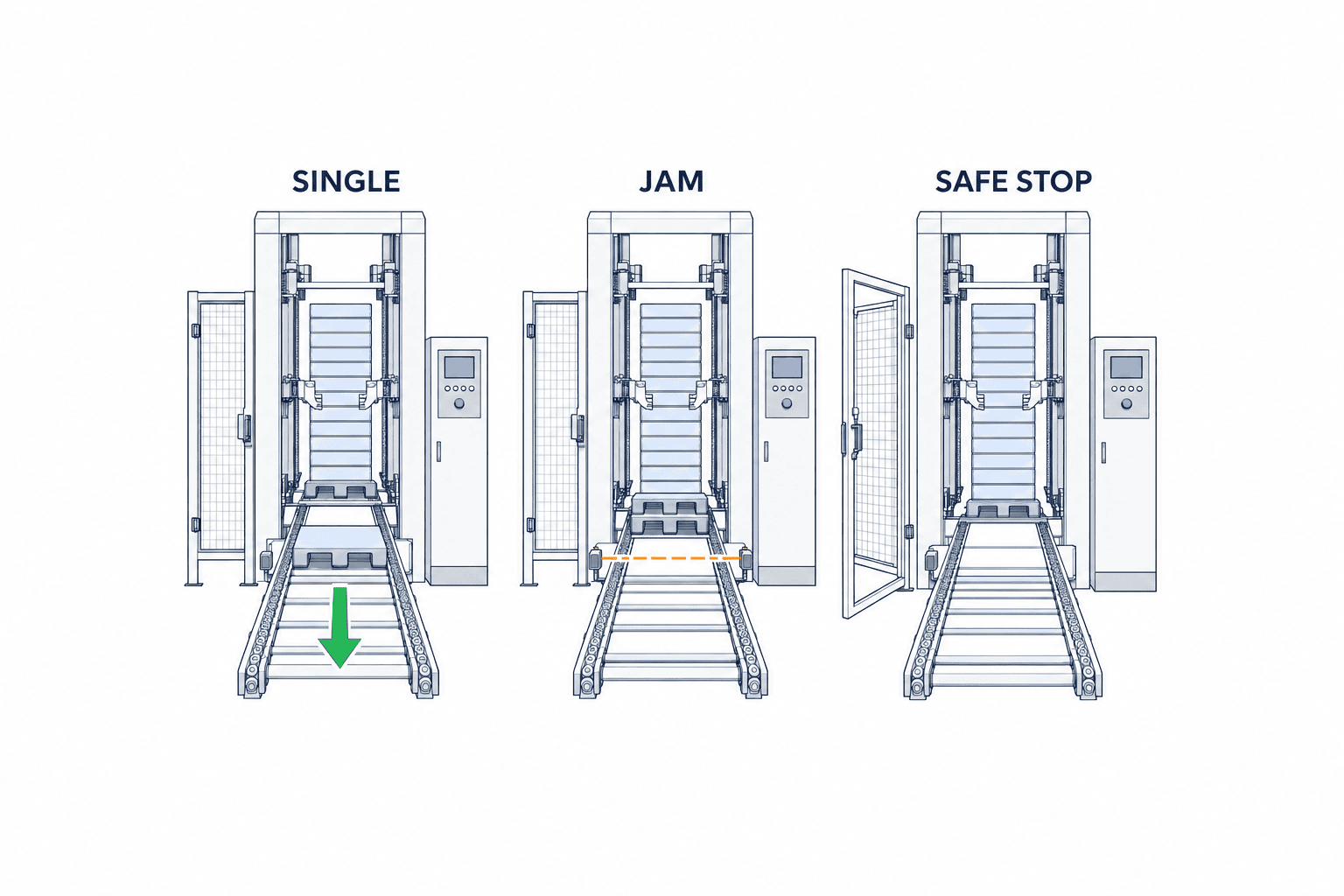
The RFP should explicitly address inhibition of separation while a stack is loaded, safe stop when an access guard opens, isolation before jam removal, restart conditions and fault behavior if a sensor fails. Stopping only the magazine while a neighboring conveyor still moves may leave an exposed hazard. Define the safety boundary and manual-mode controls across the whole transfer cell.
Make the RFP comparable across vendors
Provide the pallet sample register, measured envelopes, layout, material flow, required production demand, utilities, existing PLC and networks, shifts, maintenance arrangements and language requirements. Use a common quotation form. Separate machine, conveyor, guards, sensors, control panel, software integration, installation, commissioning, training, spare parts and support. Avoid broad statements such as “wooden pallets supported” or “AGV-ready”.
| RFP subject | Purchaser supplies | Vendor answers |
|---|---|---|
| Pallet population | Samples, photos, dimensions, good/bad rules | Supported range, contact points, reject conditions |
| Duty | Sequence, demand and stoppages | Measured cycle on samples, fault behavior |
| Replenishment | Forklift/AGV, approach and placement | Docking tolerance, vehicle handshake |
| Exit | Receiver height, orientation, receipt signal | Support, centering and timeout |
| Safety | Site hazards and adjacent equipment | Risk assessment and validation evidence |
| Handover | Local service and language needs | Drawings, backup, training and spares |
Do not compare quotations only by maximum pallets per hour. That number may omit replenishment, jams, receiver blocking and manual corrections. Define separate tests for the normal cycle, sustained running on representative pallets, and safe recovery. Set target values from the site’s demand rather than copying generic values from a brochure. Include a safe manual fallback and space for a reserve stack where interruption of pallet supply would stop a production line.
FAT: prove normal operation and predictable failure
Factory Acceptance Testing should use the sample population agreed before purchase: minimum and maximum accepted geometry, each pallet type, and representative repaired pallets. Unacceptable samples should be rejected safely. Record the sample ID, stack orientation and height, exit position, one-pallet result, fault code and recovery action on each test sheet. Watch for double release, no release, snagging, leaning and misalignment.
Include interface simulations: receiver remains busy, no receipt acknowledgment arrives, the replenishing vehicle withdraws prematurely, stack and sensor counts disagree, network communication is lost, power returns after a stop, an emergency stop is pressed or a guard is opened. Agree safe ways to simulate faults rather than creating dangerous failures on an operating machine. Preserve videos, PLC signal logs, software versions and an open-item register. Do not change pass criteria after seeing the trial.
Build the acceptance matrix around normal, boundary, fault and recovery cases
A test sheet containing only normal operation leaves no contractual basis for deciding what should happen when the machine stops on site. First, take accepted pallets from every approved type and run repeated releases under the same conditions. Record whether exactly one pallet exits each time and whether its final pose lies within the receiving machine’s tolerance. Next, use real pallets close to the agreed size and stack limits; verify that guides and holding fingers remain stable at the boundaries. A deliberately prohibited pallet should test detection, safe stop and removal, not be used to damage the machine.
Test downstream Busy, loss of receipt acknowledgment during discharge, and a sensor count that disagrees with the physical stack as separate cases. A visible alarm alone is not a pass: the machine must prevent a second release, remain stopped until the specified reset, and show operators where the remaining pallet is. Agree a safe method for simulating communication loss instead of casually unplugging a live cable. After reconnection, check that a command is not executed twice.
| Test group | Condition | Acceptance evidence |
|---|---|---|
| Normal | Each approved pallet type in its usual stack | One-pallet release, pose, receipt signal and time |
| Boundary | Real samples near approved geometry and stack limits | Stable hold, position, receiver acceptance |
| Fault | Prohibited sample, receipt delay, detection mismatch | Safe stop, no second release, identifiable alarm |
| Recovery | After power loss, reconnect and jam clearing | Recognition of remaining pallet and restart conditions |
Set continuous-cycle count and time limits from actual line demand and permissible stoppage; do not adjust pass criteria after observing the trial. Keep photos and dimensions of test pallets, their test positions and sensor logs together. If any FAT item is carried to SAT, both parties should sign the reason, temporary measure, cost responsibility and final pass condition.
Test pallet-type changeover separately from mixed stacks
“Handles multiple pallet types after a setting change” differs from “handles mixed types in one stack under one setting.” For changeover, specify who performs it, access rights, operating position, required time and how the first pallet after the change is verified. For a claimed mixed-stack capability, ask whether alternating types in one actual stack are supported or whether stacks must be segregated. If mixed stacks are prohibited, specify identification before loading and safe handling of an incorrect stack.
Orientation matters too. If stacks arrive with fork openings rotated relative to the normal direction, test the holding and exit action in that orientation. If the machine cannot accept it, add floor markings and physical guides rather than relying only on operator memory. Subtract repeated manual changeover and correction time from projected labor savings. Log changes so maintenance can distinguish a mechanical defect from an incorrect recipe.
Score exceptions and scope ownership when comparing bids
Price, peak speed and footprint do not expose operational differences. Start with mandatory gates: proof on the pallet sample population, safety evidence, transfer height, required supply rate and local maintainability. Then score jam recovery, changeover, diagnostics, spare-part access and future AGV integration. Do not award points for the phrase “can support”; require a witnessed sample test, drawing, state table or service instruction.
Normalize quotation boundaries. A proposal that includes guards and the downstream conveyor cannot be compared as a bare-machine price with one that excludes them. Add production shutdown time, modifications to the existing PLC, site interpretation, shipping of test samples and training to the same comparison sheet. Ask which future pallet types can be added by settings and where mechanical modification begins. A low initial price with many “to be discussed” items is not yet a low project cost.
When dispenser, conveyor and AGV come from three suppliers, the same fault may arise from machine position, vehicle docking or receipt-signal timing. Check whether logs share a timestamp, who leads diagnosis and whether suppliers will join an integrated site test. Assign an integration owner and a change-approval route before contract award. The scorecard preserves reasons for the decision; it does not replace a maintenance technician’s observation that a component is inaccessible in the actual layout. Split unresolved items into those due before design approval and those to be fixed through sample testing, with an owner and deadline for each. Arrange which exact FAT samples will be shipped onward for SAT.
SAT: repeat the test with Thai site conditions
Site Acceptance Testing adds the real floor, air and electrical supply, network, dust and humidity, loading routes and receiving machine. Repeat the key FAT cases with the same identified pallet samples, then test the actual forklift or AGV, conveyor and palletizer together. Operators and maintenance staff should demonstrate that they can recognize a fault and recover safely. Define in advance whether a Thai-language HMI and operating instructions are needed, who owns remote access and who provides first-line support.
The maintenance team should also inspect whether a held pallet stack remains stable when a service door opens, whether worn fingers and sensors can be reached safely, and whether parts can be returned to their calibrated position after cleaning. If a replacement needs adjustment, provide the setting tool, method and reference pallet. If maintenance blocks a forklift route, plan the diversion before acceptance. A task printed in a manual is not truly maintainable unless it can be performed in the installed space.
Classify outstanding items by safety and production impact. Record the correction owner and deadline; do not bypass a protective function to run temporarily. As-built drawings, I/O list, parameters, PLC backup, spare-parts list, training records and support contacts are part of acceptance. FAT proves the supplied machine; SAT proves the installed flow.
Plan jam removal and future changes
Jam removal is a foreseeable operation. A 2023 US OSHA investigation reported a partial finger amputation during an attempt to clear jammed pallets from a dispenser. It is a US case, not a statement of Thai law or a site-specific incident rate. It shows why the RFP needs a real, safe recovery procedure. A generic “Jam” alarm is insufficient. The HMI and manual should identify the affected section, whether a stack is being held, which energy sources require isolation, how the stack is supported and where a technician can safely enter.
Do not compensate for poor access by defeating a guard or improvising manual intervention. Improve inspection points, the direction in which a jammed pallet can be removed and access clearance. During SAT, production, maintenance and safety staff should review the recovery path on the actual equipment.
Pallet suppliers and packaging specifications can change. Establish a change-control gate: collect a sample of each new pallet, compare its underside and dimensions with the approved register, repeat the relevant separation and safety tests, and update permitted types, settings and work instructions together. Control who can widen sensor thresholds or change recipes. Record the reason, approver, old value, new value and verification. Keep safety-related settings under a separate approval process.
Evaluate whole-life cost
The business case includes more than time spent lifting empty pallets. Count lost production while a palletizer waits, forklift trips, floor space, damage sorting, maintenance, utilities, guarding, integration and spares. Compare annual cost before and after the project, but do not count the same saved hour both as labor reduction and avoided downtime. Use the factory’s actual shifts and staffing; no universal Thai wage or cycle figure is suitable for a procurement decision. Retain ergonomic and safety improvements as explicit evaluation criteria even where they are difficult to monetize.
Our palletizing robot cost guide addresses the larger robot cell. This article concerns the upstream supply of one empty pallet. Compare quotation boundaries so that conveyors or guards are neither double-counted nor omitted.
Frequently asked questions
Can one dispenser handle both wooden and plastic pallets?
Possibly, but nominal dimensions alone are insufficient. The underside, contact points, friction, weight and stack lean differ. Test both real populations, including normal variation and faults. If changeover requires adjustments, specify who performs them and how long they take.
Can forklift loading later be changed to AGV loading?
It may be possible, but the opening is only part of the issue. Docking accuracy, transfer height, machine inhibit, collision risk and signal ownership change. Reserve space and interface capacity now, and request an estimated future modification scope.
Is a larger magazine always better?
Greater capacity can reduce replenishment frequency, but increases height, floor-load, visibility and jam-recovery considerations. Calculate capacity from peak demand and a safe replenishment interval. There is no universal pallet count.
Does a double-pallet detector remove the need for a separation test?
No. Detection is containment after a fault. FAT must separately prove normal one-pallet separation and safe handling of unacceptable pallets.
Can FAT replace SAT?
No. FAT cannot prove the actual Thai site’s floor, utilities, vehicle docking, downstream acknowledgment or local recovery practice. Agree on both stages and their completion criteria in the purchase contract.
Conclusion
Choose the dispenser as part of a material-flow cell. Fix the real pallet population and pass criteria before purchase, test separation and control at FAT, and verify the forklift or AGV handoff, safety and maintainability at SAT. This makes vendor proposals comparable on operating results rather than catalog claims.
If your Thai factory is still defining how empty pallets should reach a palletizer or conveyor, contact TOMAS TECH with sample photos, measurements and the current replenishment route. We can help frame the requirements and RFP before a machine type is selected.
Primary sources
- PALOMAT Inline product and integration information
- PALOMAT Inline Pneumatic product information
- Q-System stand-alone pallet magazine
- Columbia/Okura integrated equipment
- ISO 12100:2010 machinery risk assessment
- ISO 13849-1:2023 safety-related controls
- ISO 14119:2024 guard interlocking
- ISO 3691-4:2023 driverless industrial trucks
- US OSHA 2023 pallet-dispenser accident release
*Sources checked 4 October 2026. Product pages show available approaches, not guaranteed performance at a specific site. Determine safety functions and acceptance values from the actual risk assessment and contract.*


