


Changing a package barcode to a QR Code does not, by itself, complete a 2027 migration. A checkout may fail to extract the GTIN, a warehouse may lose the lot number, or a phone may open an obsolete product page. Implementing GS1 Digital Link is a coordinated change to identification, printing, scanners, POS and WMS data, web routing, and trading-partner acceptance. This guide turns those boundaries into an RFP, FAT, SAT and change-control plan for manufacturers and retailers operating in Thailand.
For the broader choice among carriers, read our barcode, QR and RFID selection guide. For sharing event history across companies, see EPCIS 2.0 traceability. Here we focus on the Digital Link identifier, URL, physical read points, POS behavior and version control.
Start with a small SKU set and prove three outcomes
Choose a few SKUs with different packages and sales channels. For each, document the identification unit, the GS1 identifiers and attributes to encode, every read point, the fields passed into business systems, information opened on the web, failure handling and evidence. Approve a real package scanned on actual equipment, followed through to the stored transaction. An attractive QR proof alone is not acceptance.
A food retailer may need only the GTIN at checkout but the lot and expiry information at another point. The same symbol need not feed every attribute to every system. Define which application uses and stores each field, then check the trading partner’s specifications. Regulated products require separate review of applicable laws and sector rules; this article is an implementation guide, not proof of legal compliance.
GS1’s Sunrise 2027 is an industry ambition for retail point-of-sale systems to be able to handle 2D barcodes. It is not a universal legal deadline requiring every product to print a particular QR Code. The GS1 retail POS implementation guideline also describes continued support for existing linear retail barcodes. Schedule package changes against partner acceptance, artwork releases, stock depletion and equipment updates.
Separate QR Code, Digital Link URI and resolver
QR Code is a data carrier. GS1 Digital Link is a syntax that expresses GS1 identifiers, such as GTIN, in a web address. Placing an ordinary URL in a QR Code does not automatically create a conformant GS1 Digital Link URI. URI Syntax 1.7.0 separates the primary identification key, key qualifiers and data attributes. AI (01) denotes GTIN, AI (10) lot or batch, and AI (17) expiration date. The current syntax represents a GTIN with 14 digits; shorter GTIN forms are padded with leading zeroes.
An illustrative structure is a domain followed by /01/a-14-digit-GTIN/10/a-lot, with expiry in a query parameter identified by 17. Do not use example identifiers as live product numbers. A GS1-aware parser extracts the structured values; a general smartphone opens the URL. Parsing an identifier and displaying a web page are different actions, even when they start with the same scan.
A resolver can point an identifier toward different information sources, such as a product page, instructions or partner data. GS1-Conformant Resolver 1.2.0 defines that behavior. A syntactically valid Digital Link URI does not necessarily point to a resolver, a distinction the URI standard makes explicit. Test a simple redirect separately from resolver link selection.
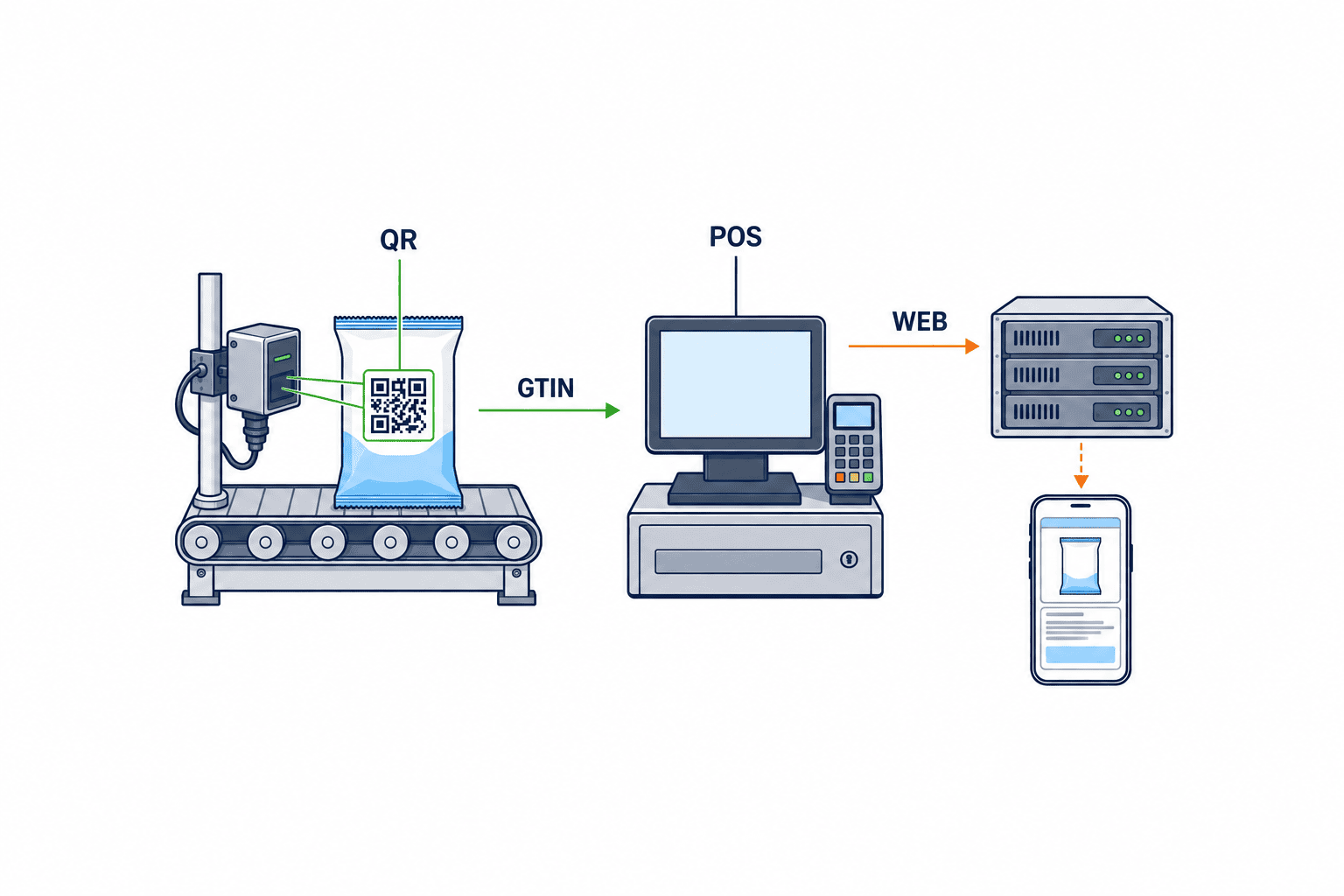
Select GTIN, lot and date from business needs
Distinguish processes that identify only a product type from those that need a lot or date. For receiving and recalls, determine the packaging level on which a lot is managed and where it is captured. Define whether an operational date means best-before or expiration and choose the corresponding GS1 data element with the partner. Do not place sample data into production masters.
| Element | Typical GS1 representation | Check before release |
|---|---|---|
| Product identity | GTIN, AI (01) | Allocation owner, packaging level, 14-digit representation, check digit |
| Lot or batch | AI (10) | Issuing rule, character handling, match with production record |
| Date | Appropriate GS1 AI | Business meaning, format, missing-value handling |
| URL domain | Controlled business domain | Renewal, redirect ownership, monitoring |
| Scan output | GTIN plus required attributes | Consistent interpretation across POS, WMS and MES |
More attributes make a symbol denser and affect size, print material, equipment and reading conditions. Encode the minimum set required by actual processes. The GS1 Barcode Syntax Resource supports syntax recognition, conversion and conformance checks. Syntactic validity does not establish that a retailer’s application or a factory’s process uses the values correctly.
Plan the period with two symbols on one pack
During transition, an existing EAN/UPC and a new 2D symbol may coexist. Test whether a scanner sees both in one pass, which one has priority, whether checkout duplicates an item and whether positioning is practical. The GS1 POS guideline discusses scanner modes and the need to continue reading linear retail barcodes. A global target date alone cannot determine when a particular pack can remove its old symbol.
Read points differ: a line camera, warehouse handheld, store POS, inventory device and consumer phone. Include returns, replenishment, damaged-label reprints and offline operation, not just checkout. For exports, verify the destination retailer and logistics partner’s acceptance requirements before removing an established symbol.
Common failures are mismatched GTINs between symbols, an artwork revision that updates only one symbol, and a camera that checks presence but not data. Generate both from controlled master data and compare their decoded GTINs. Repeat sample checks at artwork approval, first production, material change and printer maintenance.
Write the RFP around four responsibilities
“GS1 QR solution” is too vague when a print supplier, scanner supplier, POS provider and web team all touch the result. Attach a list of SKUs, lines, readers, applications, partners and domains to the RFP. Name an owner for each interface. Record device models, firmware, application versions, materials and line speeds so acceptance reproduces the contracted configuration.
Specify separate tests for extracting GTIN and chosen attributes; passing them to POS or WMS in the agreed format; handling two symbols as one item; rejecting malformed data; behaving safely offline; and measuring printed quality. The printer supplier owns generation and verification outputs. The reader supplier owns symbol support and output mode. POS and WMS owners handle parsing, matching and duplicate prevention. The web owner handles domain, HTTPS, redirects, link selection and monitoring. One party must own the integrated end-to-end test.
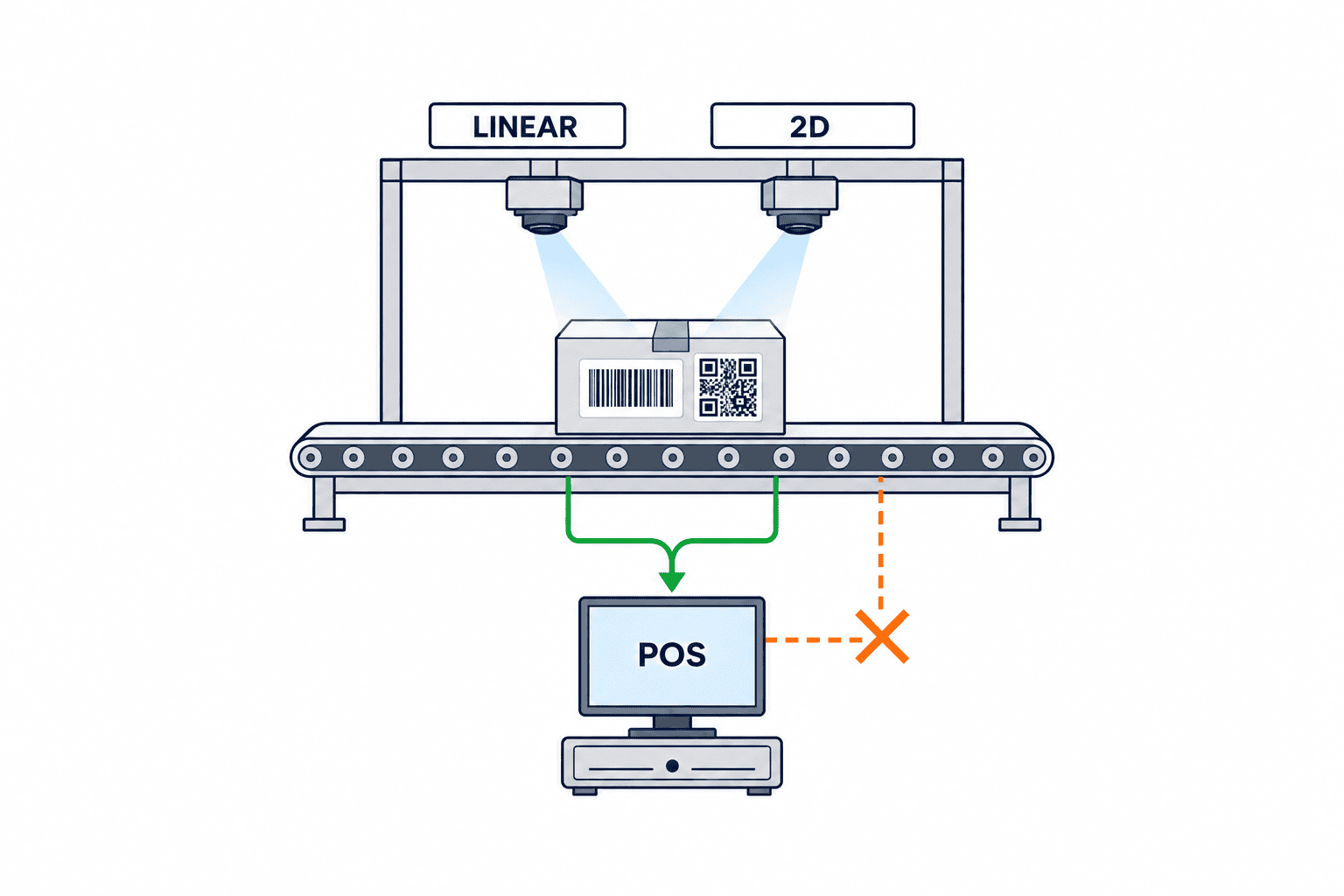
Treat the responsibilities as separate deliverables. The print supplier must provide the generated data, printing conditions and verification result. The reader supplier must specify supported symbologies, output mode and separator handling. POS/WMS suppliers must parse, match and prevent duplicate entries. The web owner must manage domain, HTTPS, link selection, redirects and monitoring. Even when several suppliers participate, assign one owner to the end-to-end integrated test.
Acceptance: desk checks, FAT and SAT
At the desk, validate sample URIs and AI data using GS1 resources and your own test data. Include wrong length, invalid check digit, reserved characters in a lot and missing dates. This checks a parser, not whether a physical label can be read. State whether the scope is QR Code carrying a Digital Link URI, GS1 DataMatrix, or another supported carrier.
FAT uses the actual printer, ink, packaging, line speed and scanner to pass a label through the business application. Vary symbol size, gloss, curvature, folds, weak print and moving-product conditions. Put the quality method and pass criteria appropriate to the selected symbol and use case in the purchasing specification. There is no universal grade or read distance in this article.
SAT repeats the work with real site lighting, connectivity, installation height, operator movement and existing POS settings. Test dual-marked packs and 2D-only samples separately, including consecutive products. Reconcile receipts, WMS receiving records and web access logs. Distinguish an unreadable image from a decoded URI without network access and from a resolver returning the wrong destination.
| Stage | Input | Evidence | Primary owner |
|---|---|---|---|
| Desk | Valid and invalid strings | Parser result, error class, version | IT and data |
| FAT | Physical pack, printer and reader | Verification report, scan log, application result | Equipment supplier |
| SAT | Site lighting, network and POS/WMS | Transaction log, photo, corrective action | Site owner |
| Partner | Shipment sample and specification | Partner confirmation and exception list | Sales and logistics |
Define the denominator for any read-rate measure. Keep intentionally damaged labels, changed lighting and normal production separate. Record first-pass and after-retry rates separately. A decoded symbol and a correctly billed transaction are different outcomes.
Version both valid and deliberately invalid site samples. Keep a registered and unregistered GTIN, the same GTIN with distinct lots, a lot containing reserved characters, a pack with a missing expiry field, and a pack whose linear and 2D symbols carry mismatched GTINs. Give each sample an unambiguous test name and mark physical samples as test-only so they cannot enter saleable stock. Store raw scans alongside expected results for regression tests after software changes.
Decide in advance who may adjust settings after a failed site test and which conditions must be rerun. If a POS setting fixes one checkout, the change is not a fleet rollout until distributed to the other stores. If packaging data change, retest from printing through the web destination. Keep failed records and corrective-action history in the acceptance package; selecting only successful samples conceals production risk.
Test “bill once” at POS
With linear and 2D symbols on one pack, duplicate billing needs its own acceptance case. GS1’s POS guideline describes a mode that transmits the GTIN once after the first compliant barcode is identified. Confirm whether existing scanners need only configuration or whether the decoder and POS application need changes. One representative store does not prove every fleet configuration.
Test a pack with both symbols, two adjacent packs in sequence, a return using another mode, and a rescan with one symbol obscured. Reconcile screen, receipt and transaction log by GTIN and quantity. If POS uses only GTIN, the presence of lot or date in the code does not mean POS stores those attributes.
Keep the printed URI alive
A printed URI cannot be changed while stocked packs circulate. Keep the identifier stable as product pages, campaigns and country displays change. Use a domain the business can maintain; assign domain renewal, certificates, DNS, monitoring and incident contacts. A temporary campaign domain is a poor foundation for a long-lived product identifier.
The URI identifies the product, not the information page itself. Route it to the information needed by each audience. Specify language, country and use-case selection as well as a default response; test stable sample URIs after changes. When the network fails, distinguish local GTIN parsing and sale from fetching digital content. Do not make POS extraction of the GTIN depend unnecessarily on live website availability.
Specify language, country and use-case selection rather than relying only on the visitor’s browser language. A trading partner may need to request a defined data language regardless of that browser setting. Record the default response, and rerun fixed test URIs after every content or resolver change. Map which functions work offline: optical reading, GTIN parsing and local sale may be independent of fetching product information, while a resolver link requires connectivity.
Integrate data, not just scanner output
Keyboard-wedge scanners, serial devices, APIs and POS messages represent the same scan differently. Decide where parsing happens and whether to keep the original URI, normalized GTIN/lot/date, or both. A recall requires the scan event to be associated with a particular transaction or operation. Define retention and access permissions.
WMS needs a rule when a printed lot disagrees with a receiving document. MES needs a mapping from production lot to finished pack. Sharing events across organizations requires a separate event-data layer such as EPCIS 2.0. Digital Link expresses an identifier and access path; it does not create process history automatically. Put field name, GS1 AI, type, required status, missing-value behavior, exchange format and master-data match in a data dictionary. Compare raw scan, parsed fields and stored transaction in one test record.
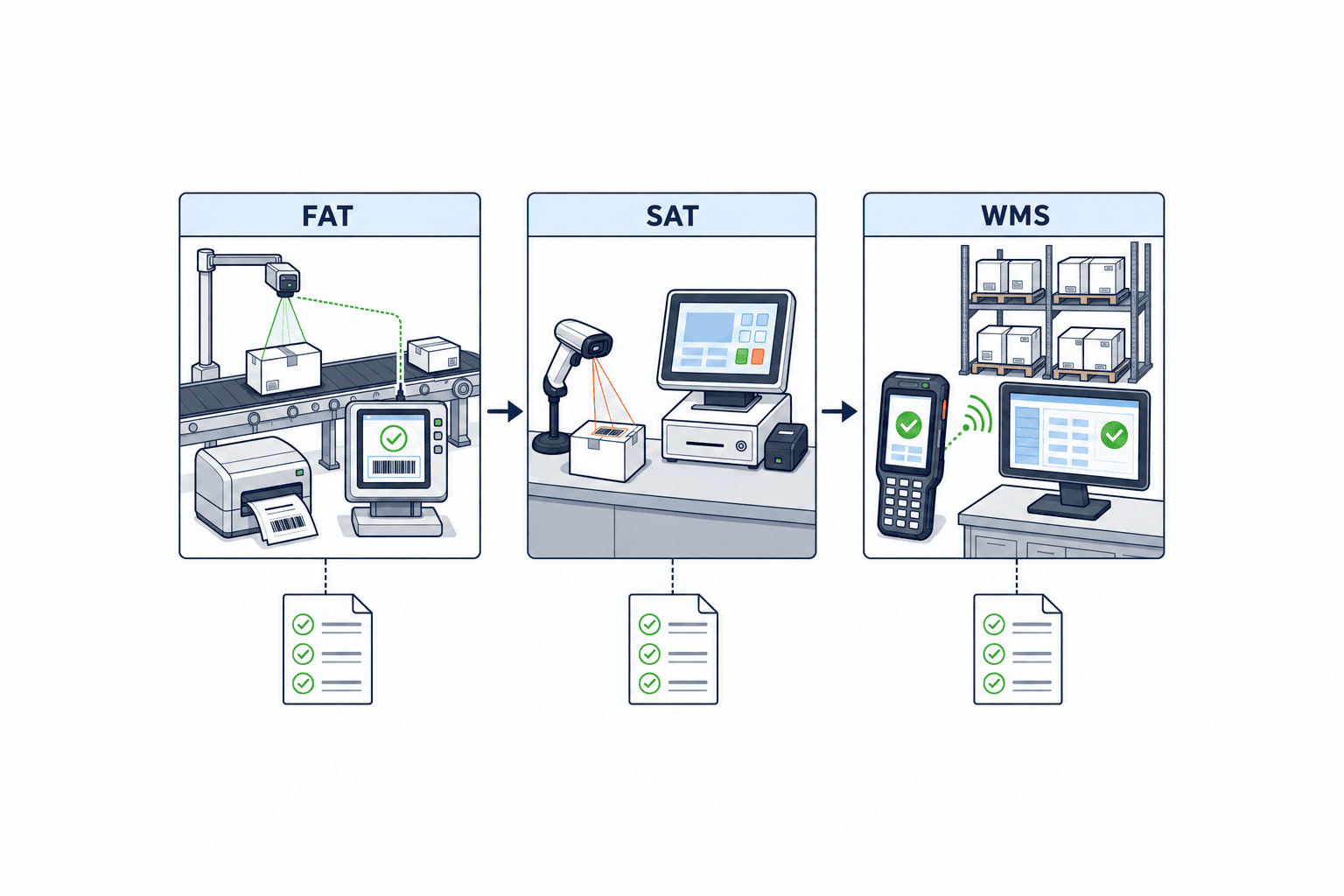
The data dictionary must list each field name, GS1 AI, data type, required condition, behavior when missing, exchange format and master-data source for comparison. Do not label a field merely “date”: state which date it is, how year-month-day is interpreted and how it differs from an event timestamp with a time zone. In each test, place the raw scan, parsed fields and value actually stored in the business system on the same row. Define data retention and access rights.
A three-gate 90-day pilot example
Ninety days is an illustrative project plan, not a GS1-defined duration. Gate one confirms SKUs, partner requirements, current devices and a data dictionary. Gate two completes print samples, FAT, web routing and application integration. Gate three completes SAT, partner confirmation, exceptions and the production-release decision. Extend the schedule when artwork or packaging inventories demand it.
| Gate | Deliverable | Stop condition |
|---|---|---|
| Design freeze | SKU list, AI set, URI rules, owners | GTIN or partner requirement unresolved |
| FAT approval | Physical samples, syntax/quality/application evidence | Minimum condition unreadable or duplicates item |
| SAT approval | Site log, partner result, failure tests | No traceable exception or recovery procedure |
Manufacturing, quality, IT and partner-facing teams should approve each gate. An early physical sample tested through the final application exposes more than an artwork-only or webpage-only review.
Compare supplier quotes
Compare code generation, print and verification equipment, scanner upgrades, POS/WMS integration, web or resolver, testing, training and support separately. Confirm who owns artwork, test data and domain, and who pays for retesting after changes.
Ask suppliers to demonstrate their supported URI version, GS1 AIs, 14-digit GTIN handling, character encoding, print verification, dual-code POS behavior, offline behavior and logs with your sample packs. The GS1 solution-provider 2D readiness guide provides a useful checklist across encoding, print, verification, reading and connected services. A quote for generating QR artwork alone cannot be compared directly with one that includes application integration and site acceptance. Multiple plants may also have different firmware and maintenance costs. Ask who owns the test data and artwork, who renews the domain, what incident response time is covered, and who pays for retesting after a label or software change.
A scanner decoding an image is a different deliverable from a POS application receiving the correct GTIN. Make the scope boundary among scanner maker, POS vendor and systems integrator explicit. Even if overseas headquarters specifies a device, check local packaging materials, Thai-language workflows, network conditions and POS software version before adopting its test result at the Thailand site.
Control revisions and changes
The hardest post-launch failure is often a mismatch introduced by a change rather than a defect in the first approved print. Changes to GTIN allocation, packaging hierarchy, lot assignment, product-information URL or receiving-side POS configuration can invalidate a previously passing combination. A change request should identify data being changed, labels and physical stock affected, partners, resolver links and steps to retest. Name separately who approves the change, updates the master and releases new artwork.
The minimum version record covers product master, URI-generation rules, artwork, printer settings, reader settings, POS application and web-link settings. They need not all change on the same day, but the tested combination must be reproducible. An old scanner configuration left on one line can stop a product at a different receiving site even after outbound inspection passed. Put configuration and version beside model numbers in acceptance evidence.
Include already printed packaging material in the change plan. Decide how long old and new designs may coexist, where old URIs lead, how product-information revisions are recorded and how returned packs are handled. Do not retire an old domain or link while earlier lots circulate. When discontinuing an SKU, determine how to communicate discontinuation, successor products and necessary safety information instead of leaving only a bare 404 response.
Define abnormal-case responses
A clean label read once by a correctly configured device is only the entry test. Acceptance should include a dirty label, wrong GTIN, URI missing an expiry value, unregistered lot, a pack with both symbols visible, a network outage and an expired TLS certificate. For each, define the terminal message, transaction treatment, log and operator action. A generic “error” invites uncontrolled manual entry or reprinting that can put incorrect data into production records.
For a wrong GTIN, choose whether master-data matching blocks the transaction or holds it pending a partner-master update. For a date that is syntactically valid but already expired, choose rejection or a quality review. For an unreadable lot, choose whether manual entry is allowed and whether a supervisor approves it. These are business rules, not outcomes defined by the GS1 URI syntax. Put syntax faults and business exceptions in different columns of the test matrix.
A web failure must not be collapsed into “QR cannot be read.” Optical decoding, URI parsing, GTIN master matching and HTTP retrieval are separate stages. Stage-specific logs determine whether to call scanner service, master-data administration, network support or the web team. The written contingency procedure should state when alternative processing starts and how its transactions will be reconciled later.
Write a measurable acceptance row
Avoid “reads GS1 QR” as a pass criterion. Write an input, environment, observation and verdict in one row: scan a specified SKU’s actual pack three consecutive times on a named checkout and software build, then confirm that each scan registers one GTIN and receipt quantity matches the transaction log. Three is an example of test wording, not a GS1 sample-size rule. Set the real sample size according to distribution volume and quality risk.
For print quality, take production samples on the specified material at the specified speed and retain the results from the chosen verification method. For lot integration, confirm that AI (10) from the same physical pack appears identically in WMS receiving and manufacturing records. For the web path, open the printed URI by phone, reach the intended SKU information, and confirm an old URI still works after a product revision. Add examples of both passing and failing outcomes so vendor and site interpret the result consistently.
The acceptance record should connect test ID, SKU, package revision, date, site, device and software build, label photo, raw scan, parsed result, business log, web response, verdict, exception ticket and retest date. Screenshots alone are hard to compare automatically; preserve CSV or machine logs when possible. Apply access control and retention rules when these records contain personal or commercially sensitive information.
Operating KPIs after rollout
Once live, monitor print defects, first-pass reads, retries, master-data mismatches, duplicate POS items and failed links separately. These are proposed operational metrics, not GS1-set target values. Segment by line, material, SKU, site and device. A falling read rate may point to print or lighting; link failure may point to DNS or certificates; duplicate billing may point to scanner mode or POS events. Segment the denominator of each proposed metric by line, packaging material, SKU, site and device type; a site-wide average can hide a curved container or old scanner that fails repeatedly. These are operational indicators proposed for this rollout, not target thresholds set by GS1.
When first-pass reads fall, inspect print density, packaging-material lot, scan angle, device updates and site lighting. When link failures rise, inspect DNS, certificates, resolver rules and publication of destination pages. Duplicate POS entries may stem from scanner transmission mode or POS event handling rather than print quality. Connect each metric to an owner and review recurring exceptions monthly.
Common mistakes and remedies
Assuming every QR is GS1-compliant. Check the Digital Link URI syntax and required AIs; an arbitrary URL cannot reliably yield the defined identifier. Assuming a valid URI works at checkout. Verify scanner settings and the downstream POS application in a transaction-equivalent test.
Assuming a page view creates traceability. Record process events and connect them to lot data. Describing Sunrise 2027 as a legal duty for all goods. Separate the industry goal from each partner deadline and applicable law. Extrapolating one store’s success to every site. Group sites by scanner, software, network and packaging conditions before testing.
Judging print quality only by eye. A dark-looking code may still fail on equipment; combine suitable verification with real reading. Abandoning the URL after launch. Maintain the domain and destinations while printed packs remain, including rules for discontinued and revised products.
Frequently asked questions
Can we remove linear barcodes immediately?
There is no universal answer. Confirm that partner POS, warehouse and returns processes can read the 2D symbol. During dual-marking, test that decoded GTINs match and one pack produces only one billable item. Remove the old symbol only after the partner acceptance conditions and on-site results justify it.
Does encoding lot and expiry complete recall readiness?
No. Recording data on a package is distinct from retaining searchable production, receiving, shipping, sale or use events for the affected lot. Define the traceability granularity and which organization owns each record. Consider EPCIS or another exchange layer when partners need to share events.
Is a resolver mandatory?
GS1 Digital Link URI syntax and a GS1-conformant resolver are different concepts. A simple redirect may be enough for an initial application. If the same identifier must lead different users or languages to multiple information sources, design and maintain resolver behavior accordingly, including future change cost.
Must every product change by 2027?
Sunrise 2027 is an industry target for POS capability to read 2D symbols; it is not a single law requiring QR printing on all goods by one date. Check the retailer’s acceptance terms, product and sector regulations, and the packaging-release plan to set the actual schedule.
Prepare for a practical discussion
Bring six items: target SKUs and packages; current symbols and GTIN governance; printer and verifier details; scanner, POS and WMS/MES versions; partner acceptance specifications; and the intended digital information and domain owner. Unknowns can remain open at the first meeting. Prove one distribution path from physical pack to business record, then expand the acceptance criteria.
TOMAS TECH can help a Thailand operation define read points, a data dictionary, FAT/SAT and exception handling across factory and business systems. Contact us with “GS1 Digital Link acceptance design,” your target products, read points and integration gap.


