


When a supplier changes, can your team trace a finished product back through its components and supporting evidence without joining spreadsheets by hand? NIST IR 8536 manufacturing traceability offers a useful way to frame that problem. Finalized on September 9, 2026, the report describes a manufacturing meta-framework for organizing, linking, and querying traceability data across different systems and stakeholders. This guide turns that idea into a supplier data contract, RFP questions, a 90-day pilot plan, and acceptance tests for manufacturers operating in Thailand. NIST IR 8536 final
What NIST IR 8536 does
The report, *Supply Chain Traceability: Manufacturing Meta-Framework*, addresses a familiar gap: every company may have records, but the links between a component, a supplier lot, a transformation, an inspection, and a finished product are often weak or unavailable to the next company. IR 8536 presents a technology-neutral approach to organizing, linking, and querying records across diverse manufacturing supply chains. It describes common structural patterns such as encapsulation, links, and interoperable interfaces; it also discusses cryptographically verifiable links, selective disclosure, and a provenance chain that can cross industries and regions without requiring a single central repository. NIST IR 8536
Think of it as a design layer above individual plant applications. An ERP, MES, warehouse system, quality platform, supplier portal, and document repository can remain in place. The meta-framework helps a group agree how records in those systems relate: which product or lot an event concerns, who issued the record, where supporting evidence can be checked, and which fields can be shared with a particular party.
NIST’s release announcement describes IR 8536 as an industry-neutral way to exchange and verify traceability information across supply chains while enabling organizations to continue using existing industry standards. The NCCoE project page also describes the work as a decentralized data approach and notes a companion minimum viable product reference implementation effort. These descriptions are useful context, but a reference implementation is not the same thing as a production-ready system for every factory. NCCoE release announcement · NCCoE project page
What it is not: a regulation, certification, EPCIS replacement, or blockchain mandate
IR 8536 is a NIST Internal Report. The report itself does not impose a new legal duty on a Thai manufacturer. It is also not a new NIST certification or pass/fail conformity scheme. Customer contracts, destination-market rules, and product-specific laws may create separate obligations; determine those separately with legal and regulatory specialists. Do not describe interest in IR 8536 as a new Thai legal requirement.
It is not a replacement for EPCIS. GS1 EPCIS is a standard for sharing supply-chain event data—the “what, when, where, why, and how” of products and assets. EPCIS 2.0 and the related CBV guidance provide implementation mechanisms, including event vocabularies and APIs. IR 8536 is better understood as a higher-level way to organize, connect, and verify records across organizations while allowing existing standards to remain in use. A project may use EPCIS for events and still need to agree on identifiers, evidence links, access rules, and correction processes. GS1 EPCIS · EPCIS and CBV 2.0 implementation guideline
Nor does IR 8536 require blockchain. NIST IR 8419, published in 2022, explored blockchain and related technologies, their possible role in manufacturing traceability, and industry perspectives. IR 8536 builds on earlier NIST work, but its core question is how records and links can support verification, integrity, interoperability, and selective disclosure. The technology choice should follow the trust model, privacy needs, operations, cost, and the agreement among participants. A conventional database with signed records, controlled APIs, or a distributed ledger may each be considered where appropriate. NIST IR 8419
If a vendor claims that a product is “NIST IR 8536 compliant,” ask exactly what has been assessed: a set of principles, a defined interface, a test suite, or a contractual profile. Do not let a marketing label imply NIST certification or endorsement unless an applicable official program actually exists and the vendor can document it.
From plant-level tracking to a cross-company provenance chain
Inside one factory, traceability often links an incoming material lot to a work order, production steps, inspection results, and a finished-product serial number. Across companies, additional questions arise: Which supplier lot became this component? Which company issued its certificate? Which downstream organization accepted it? Can the recipient tell whether the referenced evidence has changed or expired?
Consider a pump assembled in Thailand. Its motor comes from one supplier, its casting from another, and a material certificate from an upstream source. The assembly plant may record a supplier code and receiving lot in its MES. But if the certificate identifier is not linked to the motor production lot, and the casting supplier’s lot relationship exists only in an email attachment, a user may not be able to follow the chain from a finished pump back to source evidence. The answer is not necessarily to copy every company’s raw data into one central database. First agree which identifiers, events, evidence references, and verification steps connect the parties’ records.
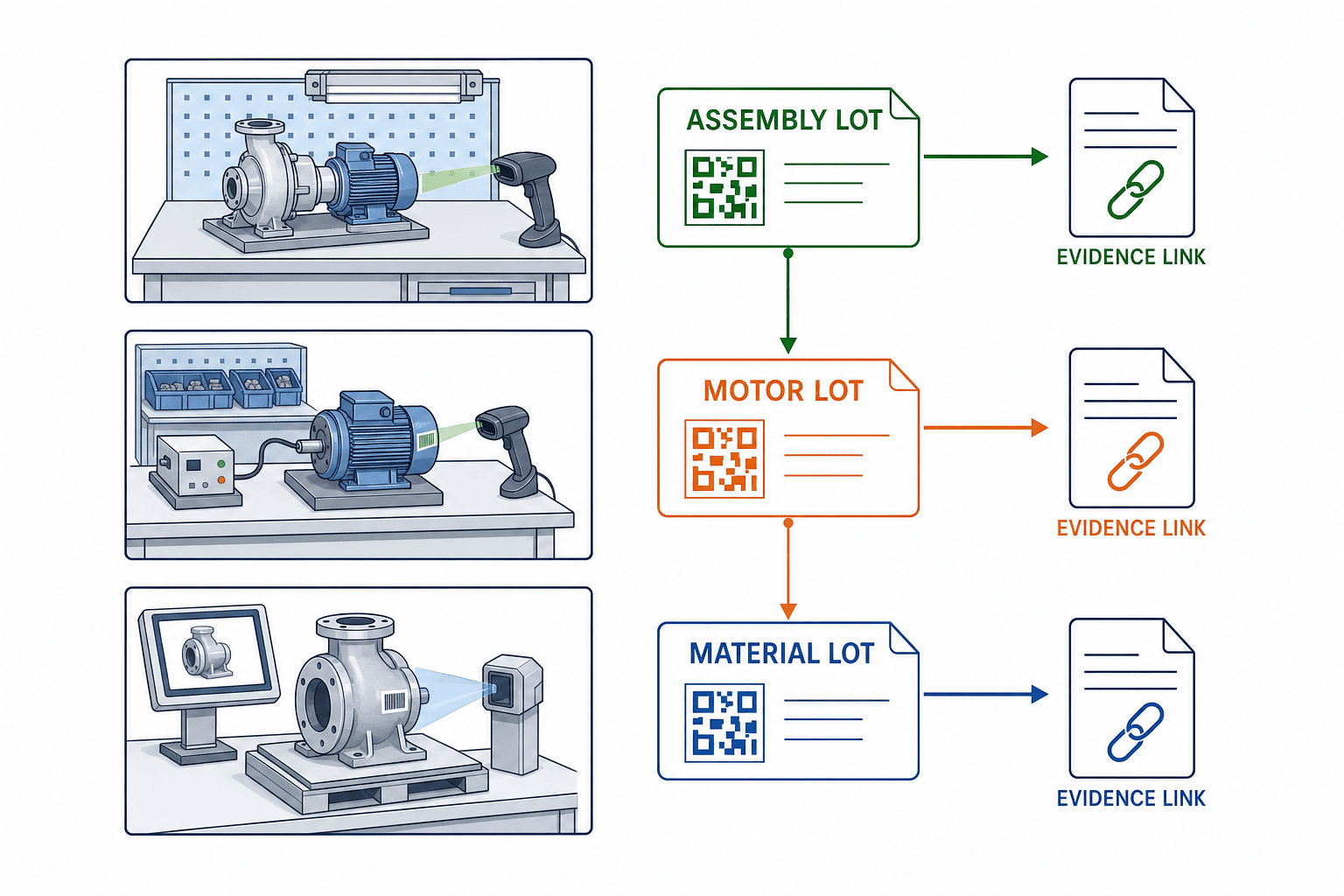
A practical minimum data contract
The following elements are an implementation proposal inspired by IR 8536’s linking and provenance concepts. They are not quoted as mandatory NIST fields.
- Object identity. Define how products, parts, lots, serials, and shipping units are identified, including the issuer and namespace. If a supplier sends only its private item code, agree who can interpret it and how long it remains valid.
- Event meaning. Define events such as manufacture, inspection, packing, shipment, receipt, processing, split, and merge. Specify event type, time, location, organization, object identifiers, and quantities with units. Set rules for time zones, precision, delayed events, and corrections.
- Transformation lineage. Represent when one input lot is split among work in process or multiple inputs are combined into a product. Make rework, scrap, and substitutions visible rather than requiring a later investigator to infer them.
- Evidence references. For inspection records, material certificates, or declarations, agree on issuer, document type, reference ID, issue date, storage location, version, expiry, and access conditions. A recipient may need a verifiable reference rather than a copy of every document.
- Verification information. If signatures or hashes are used, define which data is protected, who controls keys, how revocation and rotation work, and what happens when verification fails. A valid hash does not prove that the original measurement was correct.
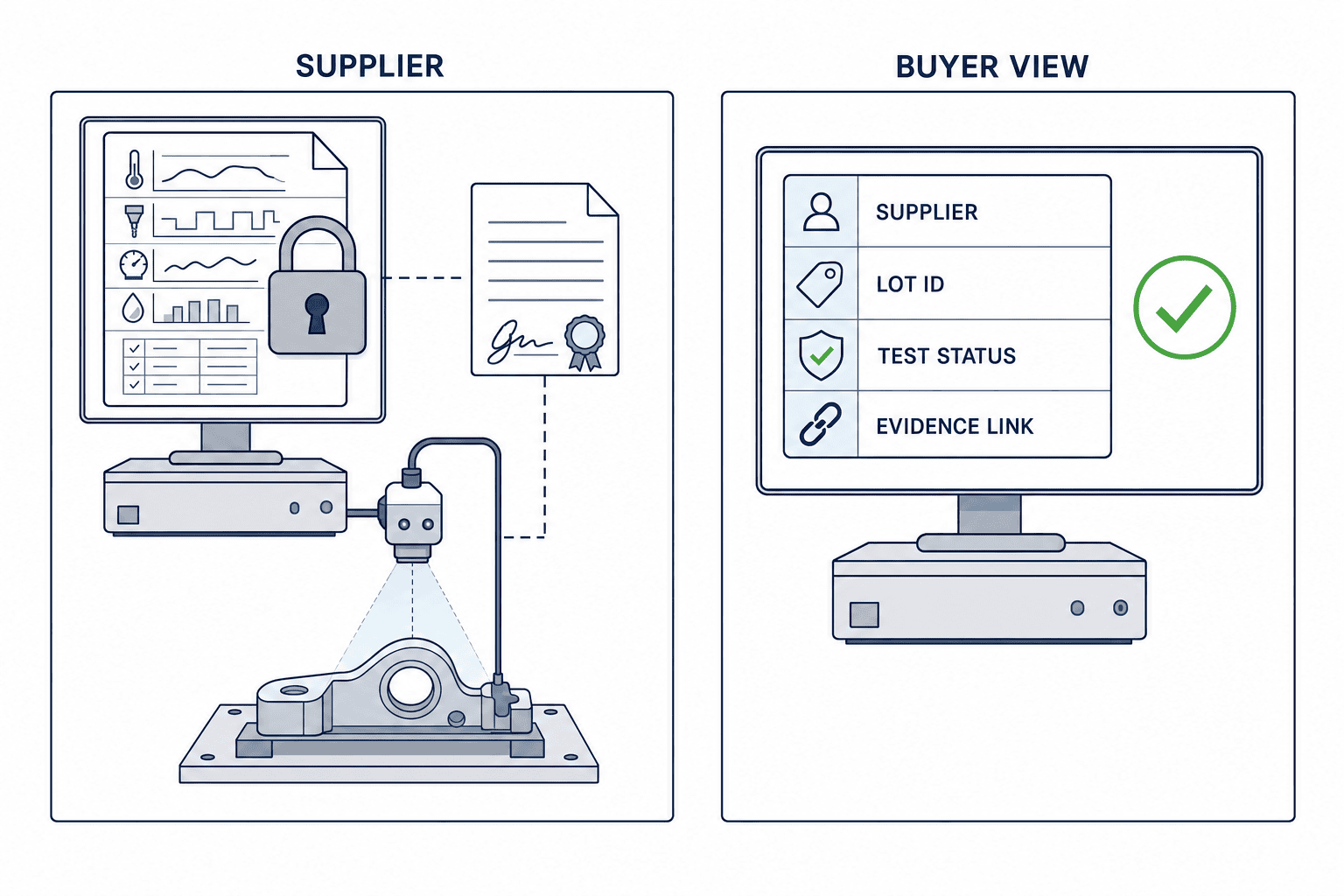
- Access and selective disclosure. Define what a supplier, buyer, auditor, or regulator can see, for what purpose, and for how long. Restrict onward sharing and avoid exposing process recipes, pricing, or information about other customers without a business reason.
- Retention and correction. Agree on retention periods, archival format, correction history, deletion conditions, and data return or deletion when a contract ends. Immutable history must not become an excuse to leave known errors uncorrected.
An event format alone is not a complete data contract. Participants also need agreement on who owns identifiers, who is responsible for evidence, how access is granted, and who corrects a mistake. On the other hand, a pilot does not need to standardize every site, product, and supplier. Choose one product family and a boundary that the participating organizations can actually support.
RFP questions for a Thai manufacturing site
Avoid reducing the RFP to “NIST IR 8536 compliant” or “blockchain enabled.” Since IR 8536 is a meta-framework, compare proposals through testable functions, evidence, and responsibility boundaries.
Scope and boundaries
- Which products, components, lots, events, factories, suppliers, and customers are in scope?
- Which internal fields are transformed into shareable records, and which remain private?
- What does the platform actually assure: record integrity, issuer identity, semantic meaning, or a link to a physical object?
- How are paper certificates, email, instruments, and manual labels handled when they remain outside the system?
Interoperability and exit
- How does the solution handle EPCIS/CBV, existing APIs, CSV, or EDI? If it supports a standard, which version and profile, and which fields are required or optional?
- Who maps supplier-specific codes to shared vocabularies and maintains that mapping?
- What happens when identifiers are duplicated, changed, or reused?
- Can the company export records in a machine-readable form and load them into another product after contract termination?
Verification and access
- Can the recipient verify the sender, detect changes, interpret event order, validate the evidence issuer, and access the appropriate evidence content?
- At what level can disclosure be limited: field, record, partner, or purpose?
- How are access grants revoked when a person leaves, an account is compromised, or a supplier relationship ends?
- What does the interface return for missing, invalid, expired, or conflicting evidence, and who decides how to respond?
Operations and security
- During a factory network outage, can events be queued and resent without creating duplicates or corrupting order?
- How are time synchronization, time zones, user and device identity, service accounts, and audit logs managed?
- What authentication, authorization, encryption, backup, recovery, vulnerability handling, incident notice, and support arrangements are included?
- If an agent connects to OT, what traffic direction, ports, privileges, change controls, and failure impacts are required?
Deliverables that can be accepted
Ask bidders for a data dictionary, example events, identifier scheme, access matrix, threat and risk notes, interface specification, test cases, operating procedures, and data-return plan. In a demo, test failure cases as well as the success path: missing fields, invalid signatures, duplicate transmissions, time drift, denied access, corrections, and supplier downtime.
A 90-day pilot plan
The timeline below is an illustrative project plan, not a duration or mandatory sequence set by NIST IR 8536. A pilot should test whether a cross-company data contract helps a defined quality or sourcing decision; it is not simply a smaller copy of an enterprise rollout.
Days 0–15: narrow the use case and risks
Name owners from quality, procurement, manufacturing, IT/OT, security, and legal or export compliance. Select one business question, such as: “When a critical component has a quality issue, can we identify affected finished products and retrieve upstream evidence?” Limit the trial to one product family, one or two upstream suppliers, and a small set of events such as receipt, use in production, assembly, inspection, and shipment.
Agree whether real or synthetic data will be used, the purpose of use, and the treatment of confidential fields. Sample actual labels and records to confirm that the identifiers in the physical process map to system IDs. A part number alone may not distinguish lot, serial, revision, or manufacturing site. Document the scope, business question, current evidence-retrieval baseline, data owners, and risk register.
Days 16–30: agree the data contract and acceptance tests
With suppliers, define shareable records, identifiers, required events, time and unit conventions, code lists, evidence references, integrity checks, access, retention, corrections, and an outage fallback. Also specify who notifies whom when incorrect data is found and who updates the source record and the shared reference.
Agree acceptance tests before building. Examples include tracing a selected lot from finished product to supplier evidence; allowing an authorized user to reach the evidence; withholding restricted fields; detecting a modified record; and resending after a network outage without creating a duplicate event. Set any thresholds or response times as project agreements based on the site’s needs. Do not present them as numbers prescribed by NIST.
Days 31–60: connect one boundary and verify the shop-floor workflow
Implement one interface. For ERP/MES extraction, design change capture, retries, deduplication, and an error queue. If a supplier cannot provide an API, compare practical alternatives such as signed file exchange or a controlled portal. Different connection methods can work if they preserve agreed semantics and verification.
Test normal and abnormal cases: identifier mismatch, out-of-order events, missing required values, expired certificates, failed signature checks, revoked access, disconnected networks, and repeated messages. Observe how operators scan labels and record production. A design that forces permanent double entry increases user burden; a design that adds unnecessary access to an OT network may also add risk.
Days 61–90: evaluate business decisions and exit conditions
Have a quality or procurement user run a simulated investigation starting from a selected lot. If comparing with a current paper-and-email process, use the same scope, evidence list, and measurement method. Record the result as a finding for this pilot sample and baseline; do not publish a small sample as an industry-wide performance statistic.
At the final review, decide whether the provenance chain has unresolved gaps, whether shared data is usable, which evidence could actually be verified, whether selective disclosure worked, what workload the process adds, how operating costs were estimated, what legal or contractual questions remain, and who would own a next phase. If acceptance fails, classify the cause: event definitions, identifier quality, partner operations, permissions, network, or interface design.
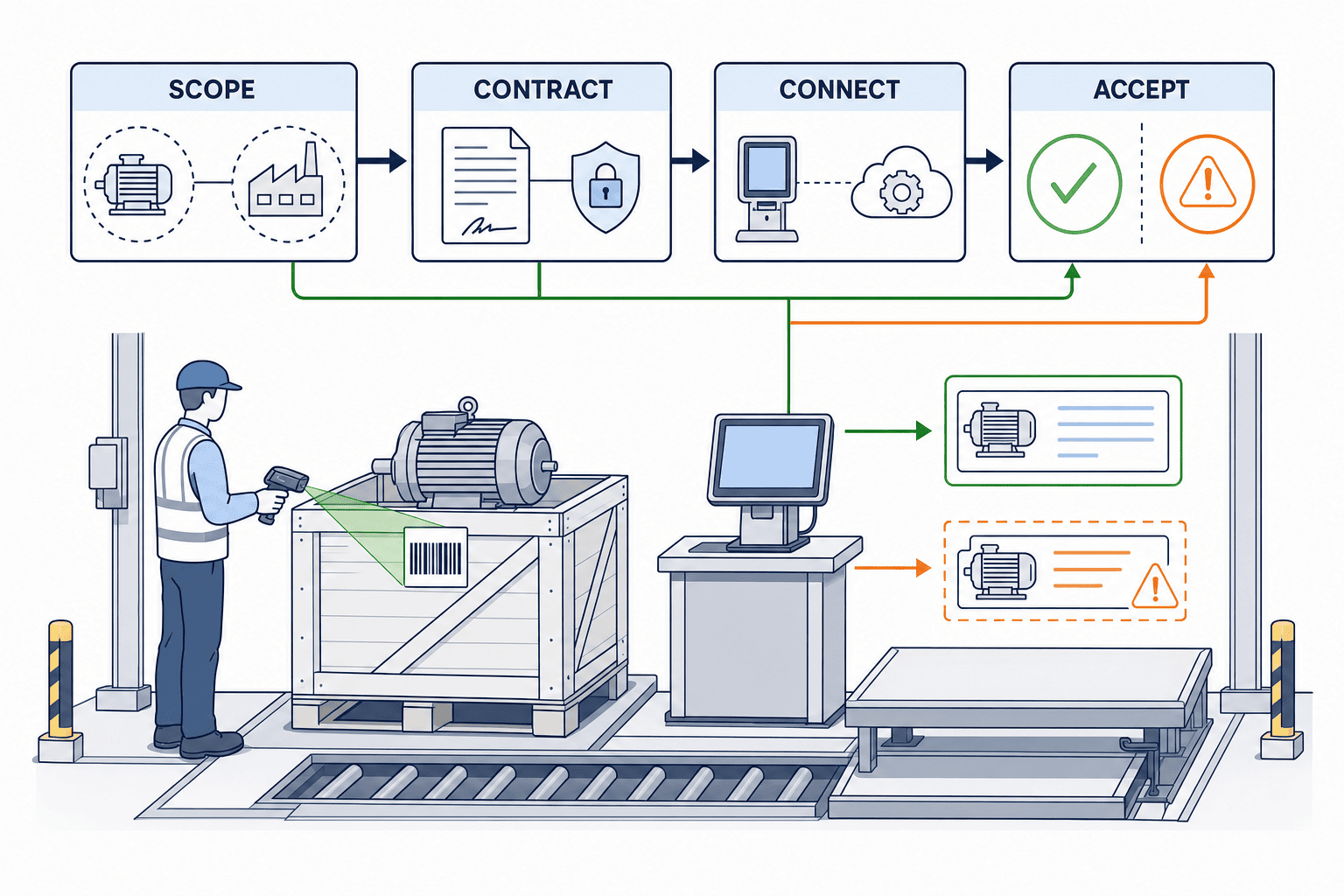
Make acceptance criteria more specific than “traceable”
“Traceable” is too broad to serve as an acceptance result. Break it into tests so that business teams and vendors share the same definition. The checks below are examples; agree thresholds based on the product and risk.
| Area | Example test | Agree before the pilot |
|---|---|---|
| Identity | Use a receiving label ID to retrieve related events and evidence | IDs, namespace, issuer, revisions, reuse exceptions |
| Lineage | Reconstruct material-to-work-in-process-to-finished-product split/merge | Units, yield variance, scrap, rework |
| Time | Order events using occurrence time and record time | Time zone, allowed clock drift, late event handling |
| Evidence | Confirm that a reference is linked to the correct issuer and lot | Original location, version, expiry, signature checks, revocation behavior |
| Integrity | Detect a changed shared record and inspect correction history | Protected fields, key custodian, correction and deletion policy |
| Disclosure | Show required fields while hiding process recipes or other customers | Role, purpose, duration, onward sharing, audit log |
| Interoperability | Export/import records while preserving event meaning | API or format version, code mapping, errors, compatibility |
| Resilience | Resume after an outage without duplicate or reordered events | Offline period, retry rules, queue limit, manual recovery |
| Usability | Let a quality user investigate without engineering support | User roles, interface, audit trail, training, language |
“Faster investigation” can be a useful outcome, but the pilot should define the start and end points, required evidence, and staffing assumptions. If there are only a few cases, do not generalize the result to every product or supplier. Also distinguish finding a record from proving the underlying fact. A signature can help show that data was signed by a particular key and not changed afterward; it does not automatically establish the physical authenticity of a component or the calibration of a sensor.
Selective disclosure and evidence quality
A common obstacle to cross-company data sharing is how much to reveal. A supplier may want to protect process parameters, cost, equipment configuration, and other customers. A buyer may need material origin, inspection status, change history, or a basis for a conformity claim. Selective disclosure allows parties to share only the fields or proof needed for an agreed purpose, while limiting access to detailed evidence by role and time. It does not mean publishing every record to a common ledger.
A hidden URL is not a complete privacy plan. Lot IDs and event times can reveal production volumes or commercial relationships. Consider access logs, copies downloaded by recipients, user accounts, backups, and post-contract retention. Classify data, for example as public, shared under contract, restricted, or internal, and apply controls accordingly.
Keep provenance distinct from truth. It may be possible to verify who issued a record and whether it changed, yet the original measurement could still have been entered incorrectly. Sensor identity, calibration, operator authorization, inspection method, clock synchronization, and sampling are separate quality controls. A traceability platform should not be sold as an automatic guarantee that physical measurements or products are correct.
How IR 8536 relates to the EU Digital Product Passport
The EU Ecodesign for Sustainable Products Regulation (ESPR), Regulation (EU) 2024/1781, establishes a framework for digital product passports for product groups covered by relevant requirements. It does not mean every product has identical passport fields and timing immediately. Commission Implementing Regulation (EU) 2026/1778, adopted on July 16, 2026, sets implementation rules for the DPP registry established under the ESPR. Check the product-specific rules for scope, timing, data, and the role of each economic operator. ESPR (EU) 2024/1781 · DPP registry implementing regulation (EU) 2026/1778
IR 8536 does not define or replace those legal requirements. A Thai factory supplying products into the EU can use the report’s ideas as a technical reference when it needs to organize and link evidence, but should first determine its role in the product chain and confirm required data, timing, format, and retention with its customer and regulatory specialists. This article is not legal advice.
Keep this topic distinct from system cost and EPCIS implementation
If you are already comparing factory traceability system costs or EPCIS 2.0 data exchange, keep the scopes clear. A system-cost study usually covers equipment, labels, terminals, ERP/MES interfaces, licensing, and maintenance. EPCIS 2.0 focuses on event-data exchange, vocabularies, APIs, and implementation interoperability. This article focuses on cross-company provenance links, who can verify what, evidence and correction responsibilities, disclosure boundaries, and how to write an RFP and acceptance plan.
Frequently asked questions
Is NIST IR 8536 mandatory for manufacturers in Thailand?
The NIST report itself does not impose a legal duty on Thai businesses. Separate customer contracts, export-market rules, and product-specific laws may apply. Confirm those against the actual product, transaction, and market.
Do we need an IR 8536 certification?
The cited materials do not establish a new NIST certification or accreditation scheme for IR 8536. If a vendor says “compliant,” ask which principles, interfaces, or tests that statement covers and whether it could be confused with official NIST certification.
Does a company using EPCIS still need IR 8536?
They address different layers. EPCIS can represent and exchange events; IR 8536 offers a higher-level reference for organizing, linking, and verifying information across organizations. A project using EPCIS may still need agreements on identifiers, evidence, access, and corrections.
Is blockchain required?
No. Start with the data that must be protected, who can attest to it, the participants’ trust model, confidentiality, and correction needs. Then compare databases, signed records, APIs, or distributed approaches against those requirements.
What if suppliers resist sharing data?
Do not begin by asking for every process detail. Identify the fields needed for a specific buyer decision, such as lot identity, manufacturer, inspection status, evidence issuer, and a verification reference. Agree on purpose, duration, onward sharing, and audit rights. Keep recipes and unrelated customer information outside the disclosure scope where possible.
Can a 90-day pilot trace the whole supply chain?
The 90-day plan here is an illustrative, limited pilot, not a promise of full production coverage. Start with one use case and a small set of partners. Identifier quality, supplier readiness, contract terms, and interfaces will affect the scope and duration.
Does a signature or hash prove that the evidence is true?
No. Cryptographic checks can help verify a signer or detect changes to a record. They do not automatically rule out an incorrect original measurement, a faulty sensor, or a physical substitution. Address calibration, inspection, identity binding, and operational controls separately.
Conclusion: start with one product and one data contract
NIST IR 8536 is a meta-framework for organizing, linking, querying, and verifying provenance data across companies and systems. Its final version was released on September 9, 2026. It should not be mistaken for a new Thai law, a certification, an EPCIS replacement, or a blockchain mandate. A practical starting point is one product family and one business question, followed by a supplier data contract that defines identifiers, events, evidence links, selective disclosure, correction, retention, and operational ownership.
Use the RFP to ask for testable functions and clear responsibility boundaries. Use a limited pilot to test normal and failure cases, evidence traceability, shop-floor effort, interoperability, and the scope of disclosure. Set numerical targets from your own baseline and label sample results as pilot findings. Alongside system cost and event-standard decisions, explicitly agree who proves what to whom. That makes conversations among procurement, quality, IT, and OT concrete.
If your Thailand operation is selecting a product scope, drafting supplier data terms, mapping EPCIS or existing systems, or designing acceptance tests, talk with TOMAS TECH during the early planning stage.
References
- NIST IR 8536 Final: Supply Chain Traceability: Manufacturing Meta-Framework
- NCCoE releases NIST IR 8536, September 9, 2026
- NCCoE project: Supply Chain Traceability Principles
- NIST IR 8419 Final: Blockchain and Related Technologies to Support Manufacturing Supply Chain Traceability
- GS1 EPCIS
- GS1 EPCIS and CBV Implementation Guideline 2.0
- Regulation (EU) 2024/1781: Ecodesign for Sustainable Products
- Commission Implementing Regulation (EU) 2026/1778: DPP Registry


