


A production management system implementation timeline is not fixed when a product is selected. It changes with process scope, fit-to-standard versus customization, master-data quality, integrations, site count, UAT, migration rehearsals, training, and cutover. This guide explains how a Thai factory can build a credible plan through six gates agreed by Japanese headquarters, the Thai organization, and shop-floor users.
Production management system implementation timeline: plan by exit criteria, not a promised month
Executives understandably ask, “How many months until go-live?” A dependable answer is not one number. It is a set of conditions that must be satisfied, and a dependency sequence showing when those conditions can be met. A configured screen is not enough to test production planning if item, BOM, routing, work-center capacity, and inventory-location masters have not been validated. A completed UAT is not proof that the system can go live inside the available shutdown window if the team has never timed a migration rehearsal.
For early planning conversations, this article uses three illustrative planning ranges. They are not market averages, vendor commitments, or published product benchmarks.
| Implementation pattern | Illustrative duration | Assumptions |
|---|---|---|
| Limited-scope pilot | 12–20 weeks | One site, mostly standard capability, few interfaces, and named master-data owners |
| Standard one-factory rollout | 24–40 weeks | Core planning, execution, inventory, quality and costing flows, ERP or accounting integration, and repeated migration rehearsals |
| Multi-site or customization-heavy rollout | 40–72 weeks | A site template, multilingual delivery, complex interfaces, and phased deployment |
Use these only to start a scope discussion. Recalculate the timeline from your deliverables, resources, dependencies, approval lead times, and allowable cutover window. Starting earlier is less valuable than becoming genuinely ready to start each dependent activity.
Why the production management system implementation process differs by factory
Production management is connected to sales, purchasing, inventory, engineering, quality, maintenance, costing, and finance. Microsoft’s “Plan to produce” model presents production as an end-to-end business process connected to forecast, inventory, procurement, orders, assets, people, projects, and accounting. An estimate that covers only the manufacturing module has not removed those dependencies; it has merely pushed their discovery into a later phase.
ISA-95 provides a technology-neutral vocabulary for the layers between the physical process, sensing and control, manufacturing operations management, and enterprise planning such as ERP. Using that boundary during planning helps teams decide which system owns a production order, equipment signal, material issue, completion, quality status, and cost posting. It also reveals whether a transaction is captured automatically, entered by an operator, or derived in another system.
Oracle’s SCM implementation guidance similarly starts by opting into offerings that match business requirements, reviewing the ordered setup tasks, and using offering-specific implementation guides. Products differ, but the planning principle is stable: select the scope, sequence prerequisite tasks, and then detail each functional area.
The three-party reality of a Thai factory project
Japanese headquarters, the Thai management organization, and the shop floor can use the same word with different expectations. Headquarters may mean common item structures and approval controls when it says “standardization.” Thai finance and operations may think about local accounting, tax, import-export processes, and an existing local ERP. Operators and supervisors prioritize uninterrupted execution, readable instructions, timely exception visibility, and reliable printers and terminals.
If these expectations are not reconciled, requirements workshops may appear successful while UAT later reveals that the process cannot be used on the floor, does not aggregate at the level required by headquarters, or does not reconcile to local accounting. The first timeline accelerator is therefore not simply translating documents. It is defining who decides, who validates, and which language version is the controlled record for every important decision.
Using Japanese, Thai, and English deliberately
Even if English is the project language, English-only operation may not work for training and incident response. A practical language model is:
- Executive decisions and headquarters reporting: Japanese or Japanese-English, covering scope, investment, and exception approval.
- Design and vendor collaboration: English as the controlled version, linked to Japanese and Thai in a glossary.
- Work instructions, input guides, and training: Thai-led, with the English field names visible in the application.
- Defects and change requests: one common ID, with an English summary and enough Thai explanation for floor users.
Translation is not a publishing task left to the end. It is a test of whether the requirement has one meaning. If the team cannot distinguish “production completion,” “operation completion,” and “put-away completion” consistently in three languages, the interface design will preserve that ambiguity.
Put the Thai operating calendar into the plan first
Songkran, year-end shutdowns, stock counts, customer audits, preventive-maintenance windows, and peak orders determine when key users can participate. A calendar may look open while production, warehouse, quality, and costing owners cannot attend at the same time. The project plan should show the availability of each process owner and a delegated substitute, not just the availability of IT staff.
Six gates for a credible implementation timeline
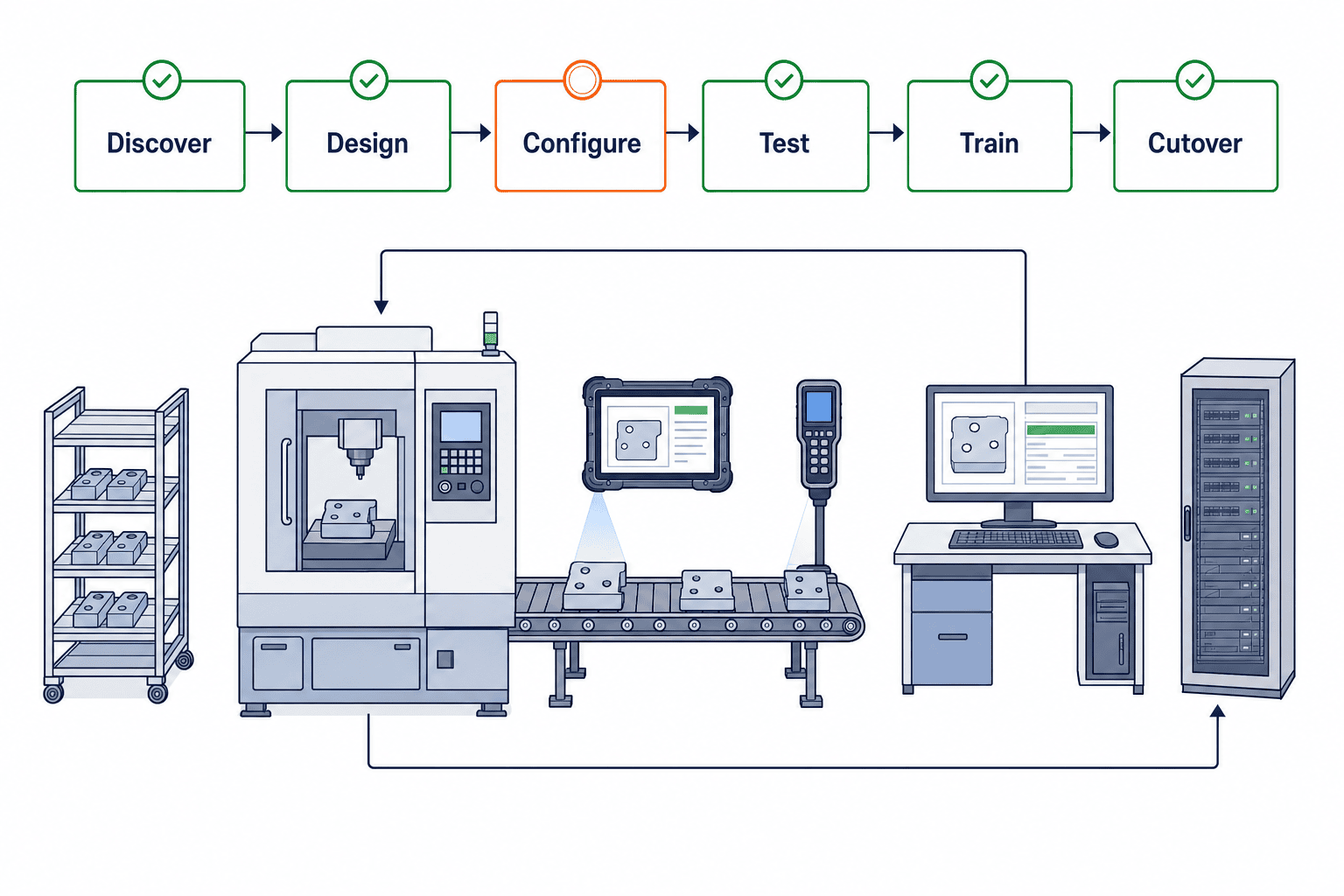
The six gates are discovery, design, configuration and development, integration testing, UAT and training, and cutover and stabilization. The label of the phase is less important than the evidence required to exit it.
Gate 1: Discovery and scope confirmation
Begin with business scenarios, not a feature checklist. Make-to-stock, make-to-order, engineer-to-order, process manufacturing, subcontracting, and mixed modes require different masters and transactions. Include not only a representative product but also products with exceptions: substitute materials, urgent orders, rework, scrap, co-products, outside processing, and atypical quality decisions.
The gate deliverable is a scope sheet that identifies sites, lines, user groups, processes, exclusions, success measures, interfaces, data owners, and decision-makers. Microsoft’s implementation strategy guidance emphasizes vision, measurable success, roles, resources, methodology, deployment, and change management because these choices frame a predictable delivery.
The exit criterion is that all three parties can explain the major scenarios from their trigger to the accounting or analytical endpoint. Approval of a long requirement list alone is not sufficient.
Gate 2: Fit-to-standard and customization decisions
Fit-to-standard can simplify configuration and future updates, but it does not mean ignoring regulations, customer commitments, or physical constraints. In workshops, demonstrate a standard process in a prototype and classify every material gap:
- Absorb it through a business-process change.
- Resolve it through standard configuration or security.
- Complement it with an approved peripheral tool, report, or integration.
- Build a customization.
When the fourth option is selected, include specification closure, design review, multilingual behavior, unit test, integration test, regression test, deployment, and support—not only coding time. A small additional screen can have a large impact if it changes the state transition of an item, order, or inventory transaction.
For broader selection criteria, see our production management system comparison. When deciding where standard software should end and custom development should begin, also review scratch development versus packaged systems.
Gate 3: Configuration, development, and master-data readiness
Configuration and master preparation can run in parallel, but they are not independent. BOMs and routings cannot be finalized if item granularity is undecided. Capacity cannot be tested if equipment, work center, shift, and calendar definitions remain inconsistent. Define attributes that carry business rules, including lot and serial control, expiry, quality status, alternates, yield, standard time, and cost elements.
Master migration is not a column-copying exercise. It is a business decision about obsolete codes, duplicates, unit conversions, character encoding, Thai and English names, headquarters code mapping, effectivity dates, and accountable departments. IT can detect format errors, but it cannot declare a routing or quality rule operationally correct on behalf of the process owner.
Configuration should connect legal entities, plants, warehouses, locations, work centers, calendars, capacity, planning parameters, order types, number ranges, security roles, approvals, costing, and quality inspection to the agreed scenarios. Record the reason and approver behind a configuration decision, not just the resulting value.
Gate 4: External interfaces and integration testing
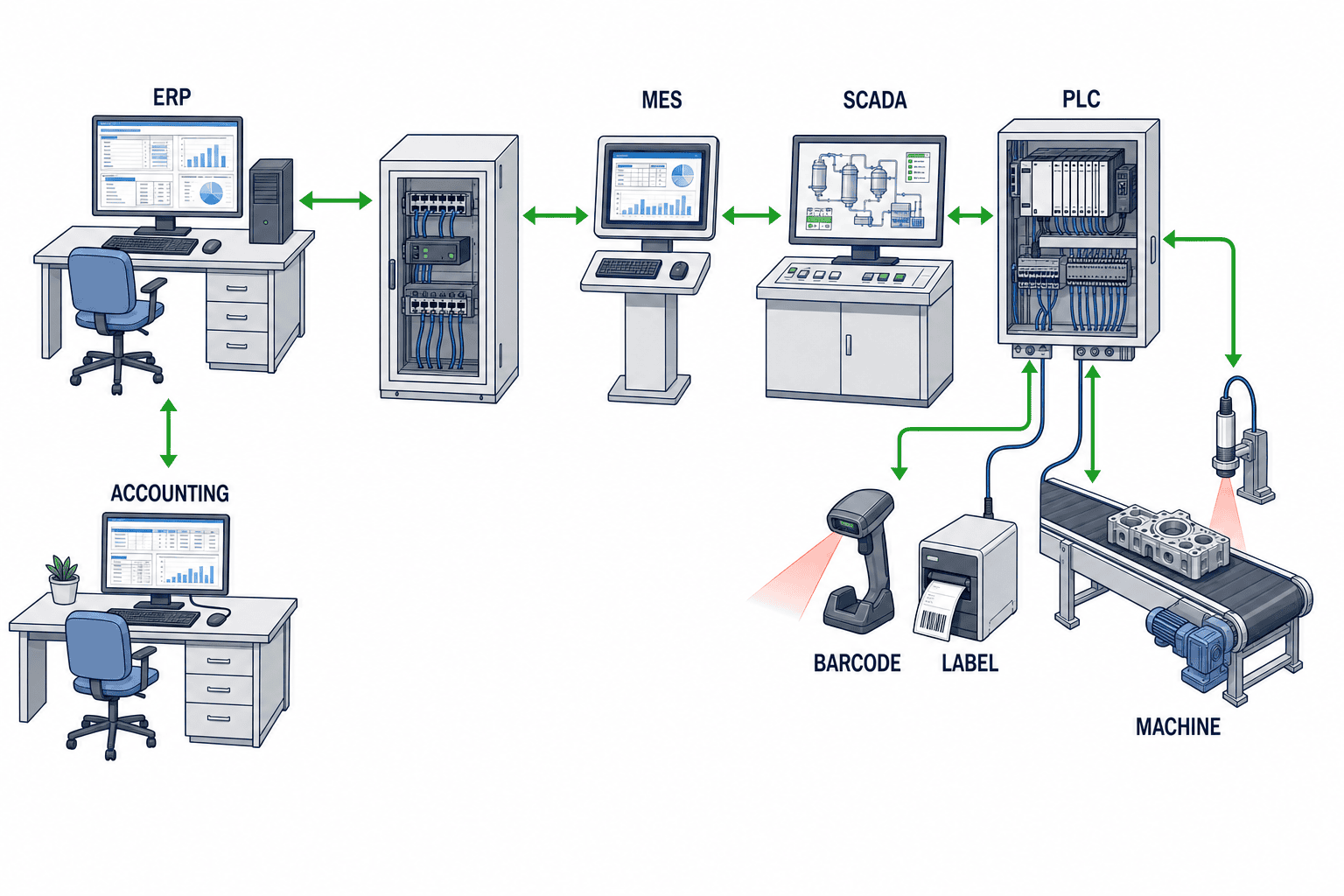
Likely interfaces in Thailand include headquarters ERP, local accounting, WMS, barcode devices, scales, PLC/SCADA/MES, quality equipment, label printers, and EDI. ISA-95 helps clarify the system of record for orders, execution results, inventory, quality, and equipment state across operational and enterprise layers.
For each interface, document source, destination, fields, direction, frequency, trigger, retry, duplicate prevention, time basis, error notification, reconciliation method, and owner. A successful API call is not the end of integration testing. Test a complete scenario: receive an order from headquarters ERP, issue material, record labor and output, capture defects, receive finished goods, send cost or accounting information to the local system, and reconcile the daily result.
Thailand ICT, UTC, and Japan JST often coexist. Specify conversions for timestamped events, date-only fields, overnight shifts, month-end boundaries, and any overseas partner that uses daylight saving time. Offline operation, recovery after a network interruption, and prevention of duplicate posting are operational requirements, not optional technical details.
Gate 5: UAT, migration rehearsals, and training
UAT is not an informal session in which users try screens. It is the business owner’s evidence that an agreed scenario works with production-like data, roles, and controls. Cover cancellations, reversals, material shortages, breakdowns, defects, rework, stock discrepancies, urgent orders, and month-end crossover—not only the happy path.
A migration rehearsal measures extraction, cleansing, transformation, load, validation, and business reconciliation. In addition to static masters, decide how to carry opening inventory, open production orders, WIP, purchase and sales balances, lots and serials, and relevant cost balances. Use the rehearsal result to update the freeze time, delta migration, validation, restart, and rollback milestones.
Training must be role-based. Planners, production controllers, supervisors, operators, warehouse users, quality, maintenance, costing, and IT support make different decisions. Do not use attendance alone as completion evidence. Confirm that users can execute a representative scenario, recognize an exception, and state where to get help. Include night shifts, contract employees, and replacements.
Microsoft’s go-live guidance includes approved system integration, UAT and performance testing, a migration plan, a signed cutover plan, user training, security roles, licenses, support readiness, and mitigation of critical open issues. Define the proof for each item during design instead of discovering the checklist at the end.
Gate 6: Cutover, Go/No-Go, and stabilization
Cutover is more than deploying software into production. It includes stopping entry in the old system, final extraction, delta migration, reconciliation, role assignment, device and printer confirmation, floor communication, the first released order, the first completion, inventory and accounting reconciliations, and the future read-only policy for legacy data.
The Go/No-Go board should cover data, integrations, UAT, training, support, critical defects, elapsed cutover time, and business continuity. Each item needs an owner, evidence, unresolved risks, workaround, and decision deadline. The goal is not perfection; it is separating risks that can stop the business from manageable items that can be controlled after go-live.
During hypercare, define the support channel, severity model, level-one through level-three responsibilities, Thai and English escalation, daily reconciliation, defect trends, and refresher training. Stabilization should end only when inventory, production, costing, and closing are reliable and the local team can operate independently—not merely when ticket volume drops.
Nine dependencies that extend the implementation timeline
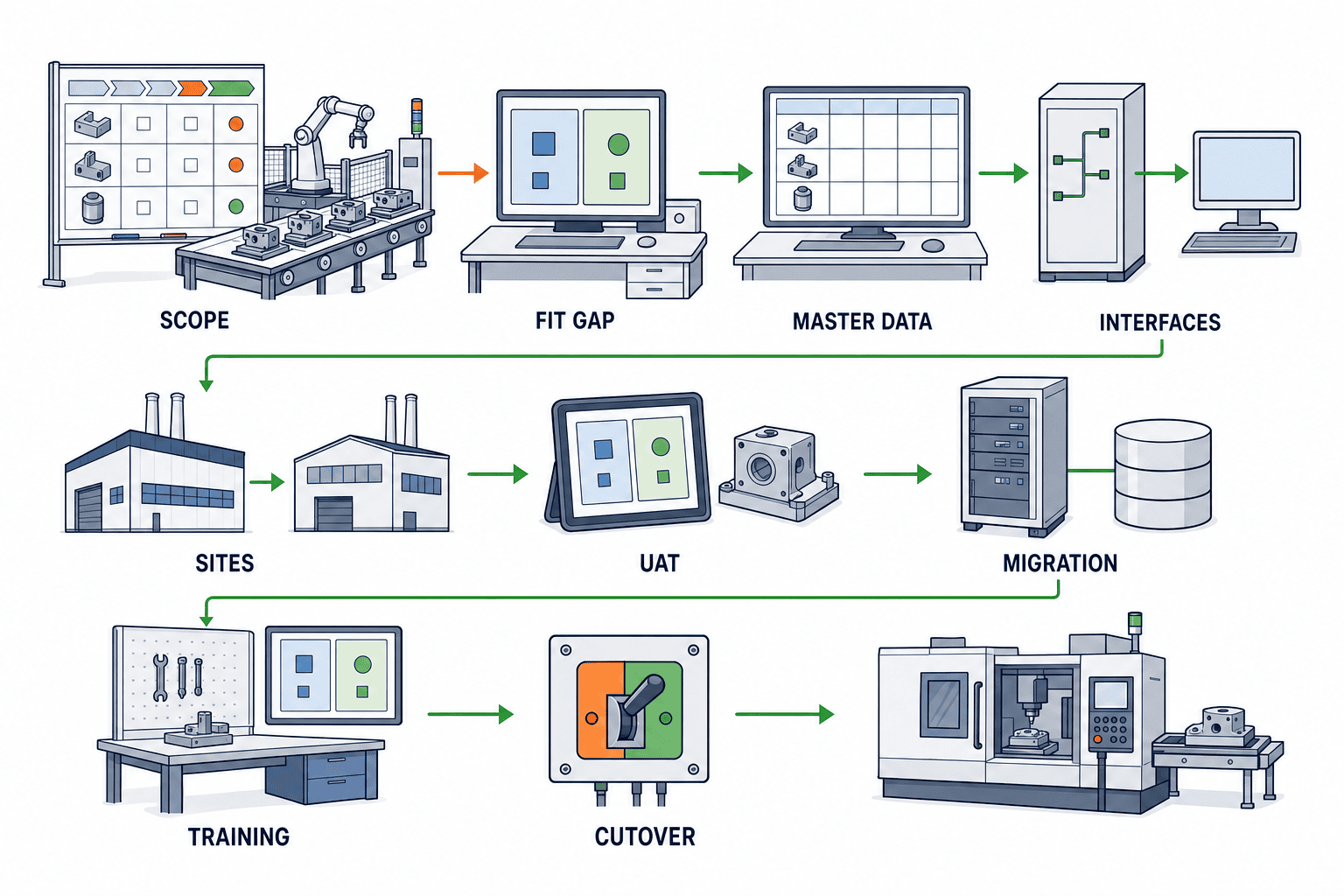
1. Business scope
Clarify what “production management” includes. Planning and confirmation alone are different from a scope that also includes inventory, purchasing, quality, costing, maintenance, and traceability. Excluded processes still need defined handoff points.
2. Fit-to-standard versus customization
Do not manage this through a single “standardization percentage.” Decide each gap using business value, regulatory or customer need, alternatives, and upgrade impact. Customization adds a chain of design and testing activities, so establish a decision deadline.
3. Master-data quality
Meaning and ownership matter more than record count. Unresolved BOM revisions, alternate routings, units, lot rules, multilingual names, and obsolete codes make later test results unreliable.
4. External integrations
Duration depends not only on interface count but also on the other system’s change process, owner, test environment, data readiness, retry design, and reconciliation. Headquarters release reviews and local-vendor lead times can become critical-path items.
5. Number of sites
Simultaneous multi-site delivery increases decisions and exceptions. Validate a template at a lead site, separate common design from local variation, and roll it forward deliberately rather than treating the next site as a simple copy.
6. UAT readiness
Scenarios, data, roles, environment, participants, acceptance criteria, and defect retesting must all be ready. Reserving a UAT date without these prerequisites simply compresses quality work at the end.
7. Migration rehearsals
Expect the first rehearsal to reveal problems and later rehearsals to improve elapsed time and accuracy. Rather than choosing an arbitrary count, repeat until the process finishes inside the allowable window and meets reconciliation criteria.
8. Training and adoption
This includes role-specific judgment, exception handling, supervisor coaching, and night-shift rollout—not only translation. Late screen changes delay materials, so connect the change freeze to content development and train-the-trainer sessions.
9. Cutover and the production calendar
A factory with a narrow shutdown window needs early design for automated migration, preloading, delta loads, and rollback decisions. Avoid clashes with month-end, stock count, long holidays, customer attendance, maintenance, or peak production.
A practical way to estimate the timeline
Step 1: Select scenarios that cover the business
There is no universal correct number of scenarios. Cover manufacturing modes, inventory movement, quality decisions, exceptions, and accounting outcomes. For each scenario, record trigger, input, role, system, output, and reconciliation target.
Step 2: Plan deliverables and owners
Build the WBS around approvable outputs rather than meetings. “Approve BOM conversion rules,” “complete night-shift training,” and “pass month-end WIP reconciliation” can be observed. Use a responsibility model such as RACI across headquarters, Thai management, floor owners, and the implementation partner.
Step 3: Connect dependencies
Integration test data depends on a settled interface design. UAT depends on approved security roles. A cutover window depends on timed migration rehearsals. Tasks that look parallel also compete for the same key users, so include resource constraints.
Step 4: Replace the illustrative ranges with your conditions
The 12–20, 24–40, and 40–72 week ranges above are examples. Replace them with estimates based on your deliverables, resource availability, project languages, approval lead times, test environments, and allowable downtime. Include time to close decisions and retest corrected work.
Step 5: Forecast through gate reviews
Track readiness evidence, not only a weekly percentage complete. A design phase can appear 90 percent complete while one unresolved critical scenario makes the forecast worse. Conversely, early passage of complete standard scenarios can reduce uncertainty even when many screens remain to be configured.
Timeline shortcuts that cause production management system implementation failure
Shortening requirements by postponing decisions
Fewer meetings do not mean fewer decisions. Undecided topics move into development, UAT, or cutover, where changes affect more artifacts. Accelerate decisions with standard demonstrations, representative scenarios, named owners, and decision deadlines.
Turning UAT into user training
When training and acceptance are combined, it becomes hard to distinguish a user’s unfamiliarity from a solution defect. Train key users first, then conduct UAT against explicit acceptance criteria.
Assigning master-data correctness to IT
IT can validate format, but process owners must validate routing sequence, alternate materials, standard time, and quality rules. Give each domain an owner, due date, sample validation, and formal approval.
Never timing the production migration
A documented procedure cannot predict extraction speed, transformation errors, API throttling, reconciliation time, or device deployment. Time every rehearsal, record bottlenecks, and test the rollback decision point.
Concentrating all training immediately before go-live
Shift workers cannot always be assembled in a short window, and knowledge fades if there is no practice. Train super users, supervisors, and end users in waves. Provide concise Thai work instructions and a visible support path at the workstation.
How system selection affects implementation duration
Compare the delivery model as well as functions. Review the availability of a demonstrable standard process, industry templates, Thai and English support, local training, integration patterns for your ERP, migration tools, test support, update policy, cutover assistance, and post-go-live coverage.
A product marketed as fast to implement does not remove the customer’s data and decision workload. Full custom development does not automatically guarantee a perfect fit either; it increases responsibility for specification, testing, maintenance, and future change. The better selection question is not only “How fast can the first site go live?” but also “Can exceptions be controlled and can the design be repeated at the next site?”
Ask each RFP respondent to state the delivery phases, customer tasks, required key-user capacity, interface assumptions, migration scope, UAT assistance, cutover responsibility, training languages, hypercare, deliverables, and acceptance conditions. Timeline estimates become more comparable when suppliers answer the same operational questions.
Preparation that can begin 90 days before the project
Even before contract signature, a factory can reduce uncertainty:
- Inventory current systems, spreadsheets, owners, and update frequency.
- Sample-check item, BOM, routing, inventory, and supplier/customer data quality.
- Name decision-makers and delegates for headquarters, Thai management, and the shop floor.
- List shutdowns, stock counts, audits, peak periods, and maintenance windows.
- Write representative and exception scenarios in business terms rather than screen names.
- Identify owners for headquarters ERP, local accounting, devices, labels, and EDI.
- Create a Japanese-English-Thai glossary with preferred and prohibited terms.
- Make an executive decision on allowable downtime and processes that cannot stop.
These steps improve proposal comparisons and reduce the time spent searching for an owner after implementation begins.
FAQ: Production management system implementation timeline and process
What is the average production management system implementation timeline?
This article does not claim one universal average. Scope, fit-to-standard, master quality, interfaces, sites, UAT, migration, training, and cutover make projects materially different. The 12–20, 24–40, and 40–72 week figures are illustrative planning ranges only. Recalculate them using your deliverables and dependencies.
What should be decided first in a production management system implementation?
Before choosing features, define target scenarios, sites, exclusions, success measures, decision-makers, and data owners. Scope is credible when headquarters, Thai management, and floor representatives can explain the same process endpoint.
What is the most important way to prevent implementation failure?
Do not treat UAT, migration, training, and cutover as late-stage activities. Define acceptance evidence and owners during design, expose unresolved decisions, and require evidence at each gate.
Can system selection shorten implementation duration?
Yes, but not through the product name alone. Compare how well the standard process matches, integration patterns, migration tooling, local support, language coverage, test assistance, and cutover scope. Separate gaps that can be absorbed through process change from gaps that genuinely require development.
Which language should a Thai factory use for requirements?
English is often practical as the controlled design language, with Japanese for headquarters decisions and Thai for instructions and training. The critical control is one decision ID and one glossary linking all three versions, so translation does not create separate specifications.
When should headquarters ERP and local accounting interfaces be decided?
Identify ownership and data scope during discovery, then settle fields, timing, error handling, and reconciliation during design. Waiting until integration testing turns partner approvals and test-data preparation into critical-path surprises.
Conclusion: manage implementation duration with proof of readiness
To stabilize a production management system implementation timeline, do not promise a month before defining the work. Establish exit criteria for discovery, fit-to-standard, configuration and masters, integration testing, UAT and training, and cutover. For a Thai factory, explicitly plan the three-party decision model, Japanese-English-Thai communication, the operating calendar, and both local accounting and headquarters ERP integration. Illustrative ranges are only a starting point. Update the forecast at every gate using current evidence about scope, data, interfaces, resources, and the migration window.
You can discuss the timeline even when the final scope or ERP interface is not yet settled. If you want to visualize responsibilities, representative scenarios, and the data and integration dependency chain for a Thai factory, contact TOMAS TECH.
References
- ISA, ISA-95 Series of Standards: https://www.isa.org/standards-and-publications/isa-standards/isa-95-standard
- SAP Help Portal, SAP Business ByDesign implementation documentation: https://help.sap.com/docs/SAP_BUSINESS_BYDESIGN/2754875d2d2a403f95e58a41a9c7d6de/42d1bbccfd9446618fe59c6c63e3c50f.html
- Oracle, Oracle Fusion Cloud SCM Common Configuration Overview: https://docs.oracle.com/en/cloud/saas/supply-chain-and-manufacturing/25c/faicf/overview-of-oracle-scm-cloud-common-configuration.html
- Microsoft Learn, Plan an implementation strategy: https://learn.microsoft.com/en-us/dynamics365/guidance/implementation-guide/implementation-strategy
- Microsoft Learn, Prepare to go live: https://learn.microsoft.com/en-us/dynamics365/guidance/implementation-guide/prepare-to-go-live
- Microsoft Learn, Plan to produce overview: https://learn.microsoft.com/en-us/dynamics365/guidance/business-processes/plan-to-produce-overview
*The ranges in this article are illustrative planning scenarios, not market averages reported by these sources. Confirm legal, accounting, and tax requirements with the responsible professionals and system owners for your circumstances.*