


Factory drone delivery implementation is not a project to buy a faster vehicle. It is a program to identify boundaries that carts and AMRs handle poorly—vertical travel, separated buildings, congested floor routes, and urgent lightweight parts—and turn them into unattended, traceable handoffs. This guide is written for factories in Thailand and takes the project from route selection and AMR comparison through safety, regulation, ROI, and a 90-day proof of concept.
Why consider factory drone delivery now?
Intralogistics is not limited to heavy loads and scheduled bulk movement. Maintenance parts, inspection samples, jigs, documents, and workpieces awaiting a quality decision are often light but urgent. The quantity per trip may be small, yet a delay can affect a production line. When an operator performs these trips, the burden includes calling, acceptance checks, access control, elevator queues, and waiting for the recipient—not just walking time.
On September 18, 2026, Arrive AI announced a partnership with DXC and described an intention to bring autonomous-delivery infrastructure to large manufacturing campuses. According to the company release, drones, ground robots, autonomous vehicles, and human couriers could exchange goods through secure asynchronous endpoints, with drones contemplated for longer campus distances. This is a vendor announcement containing forward-looking statements. It is not independent evidence of customer ROI or deployment scale.
The useful design signal is therefore not that drones make every delivery faster. It is the asynchronous handoff before and after the airborne segment. If the sender waits for the aircraft and the recipient must be present at arrival, a few minutes saved in flight do not remove human constraint. The economic unit of factory intralogistics automation is not a flight. It is one completed, traceable handoff from request to confirmed receipt.
Improve the existing flow first: a drone is rarely step one
Adding an aircraft to crossed routes, ambiguous storage locations, and department-specific calling rules only moves existing problems into the air. First, visualize request frequency, travel distance, package form, waiting, misdelivery, and the relationship with line stoppages. Eliminate unnecessary movement before mechanizing it. Our guide to [in-plant logistics improvement](/en/blog/in-plant-logistics-improvement-2026-en/) explains this layered approach.
Next, standardize fixed-volume routes with milk runs or conveyors and consider AMRs or AGVs for variable floor routes. [AGV implementation case studies](/en/blog/agv-implementation-case-studies-2026-en/) show how operating conditions affect the result. Retain drone candidates only where these methods remain structurally disadvantaged: travel between floors, buildings separated by roads or pipework, controlled areas where human entry should be reduced, and routes where floor congestion is the main constraint.
Factory drone delivery decision matrix

Choose the mode by route geometry, load, frequency, handoff, and fallback—not by novelty.
| Mode | Good fit | Poor fit | Typical handoff | Decision focus |
|---|---|---|---|---|
| Person/cart | Small volume, low frequency, frequent route changes | Long distance, high frequency, high operator constraint | Hand-to-hand or shelf | Total walking and waiting time, safety, dependency on individuals |
| Conveyor | High frequency, fixed route, stable load form | Layout changes, new branches, aisle crossings | Automated infeed/outfeed | Availability, buffers, maintenance, evacuation routes |
| AMR/AGV | Medium loads, repetitive floor transport, multiple destinations | Stairs, narrow doors, congestion, cross-building obstacles | Rack, conveyor, locker | Floor traffic, door/elevator interface, charging |
| Drone | Lightweight, urgent, vertical or cross-building routes, floor obstacles | Heavy loads, dust/wind, cramped space, dense pedestrian activity | Secure dock or locker | Flight corridor, safety zone, legal scope, asynchronous handoff |
A drone is not a broad replacement for an AMR. A valid solution may use an AMR from storage to a consolidation point, a drone for the long segment between buildings, and a person or conveyor at the final process. As discussed in [conveyor-top AMR integration](/en/blog/conveyor-top-amr-integration-thailand-2026-en/), automated transfer at the boundary between transport modes often determines overall efficiency.
Eliminate unsuitable routes early
Do not assess a route using straight-line map distance alone. Walk the route from the loaded origin to the final destination. Observe doors, roofs, ceiling equipment, piping, cranes, restricted areas, pedestrian crossings, and wind channels. Detailed factory drone delivery assessment is justified when several of the following are true:
- Operators make long round trips or change floors only to carry lightweight items.
- Buildings or height differences make actual floor travel much longer than the direct route.
- Delay of an urgent delivery can cause equipment downtime or quality-decision waiting.
- Crowds, steps, narrow doors, or road crossings make an AMR route difficult.
- A dock or locker can decouple sender and recipient rather than making both wait.
- Work can continue by person or cart when flights stop.
Ten checks for route screening
1. Payload and package
Check maximum, not merely average, weight as well as center of gravity, dimensions, liquid movement, drop consequences, temperature, and contamination control. The container should prevent incorrect attachment and detect release. Quality samples may require tamper evidence and temperature history; maintenance parts may require part-number and asset-ID matching.
2. Distance and verticality
Measure the full interval from request receipt through loading, preflight confirmation, flight, landing, locker operation, and receipt—not flight time alone. A route with substantial vertical or cross-building travel is more likely to differentiate itself from floor-based modes.
3. Doors, elevators, and boundaries
Define how automatic doors, fire compartments, airlocks, and indoor/outdoor boundaries are handled. Keeping a door open for a drone can undermine fire, pest, air-conditioning, or pressure controls. Compare an architecture that leaves the boundary intact and transfers goods between lockers on either side using different modes.
4. People and vehicle traffic
Observe shift changes, evacuation drills, maintenance work, and forklift peaks as well as normal operation. Determine whether the area below a route can remain unoccupied, whether physical drop protection is possible, and whether entry detection can trigger a safe stop or diversion.
5. Dust, wind, temperature, and humidity
Assess large fans, opening shutters, exhaust, thermal currents, dust, vapor, and corrosive atmospheres as well as outdoor wind. Meeting a catalogue rating is not enough; factory worst cases must become acceptance-test conditions.
6. RF and positioning
Metal machinery and racks reflect radio signals, while GNSS may be unavailable indoors. Measure latency, dead zones, access-point failure, interference, and positioning drift. For each segment, define whether loss of communications should cause a stop, return, or controlled landing.
7. Charging and battery operation
Define state-of-charge limits, degradation, temperature monitoring, replacement, storage, fire protection, and isolation of abnormal batteries. Confirm that charging cabinets do not obstruct evacuation routes or sit beside combustible material.
8. Emergency landing and isolation
Provide safe landing points with access control and recovery procedures. If an aircraft stops while carrying a load, specify who may recover it, which tools they use, how the product is dispositioned, and how the delivery request resumes.
9. Asynchronous handoff
This is the core economic check. A secure dock or locker should detect arrival, restrict access to an authorized recipient, and escalate when the load remains uncollected. A PoC that requires a person to wait for every aircraft fails to test the intended operating model.
10. Fallback operation
Specify when weather, maintenance, communications, or legal constraints return work to a person, cart, or AMR. Do not use aircraft uptime as the only KPI. Assess whether the operation can still complete requests without interrupting production.
Architecture of an autonomous delivery system
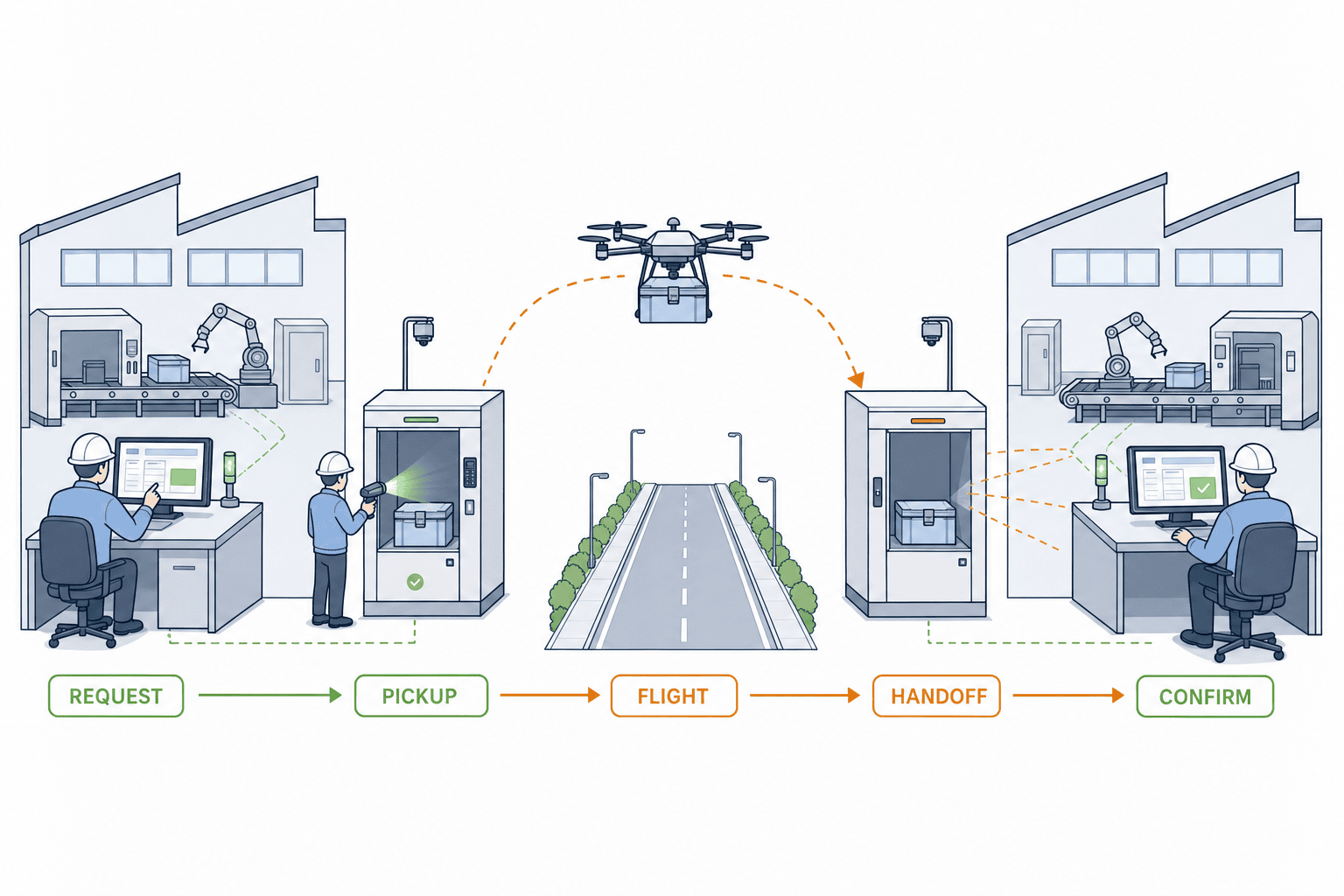
An aircraft alone cannot complete an industrial delivery. The architecture must treat request, authentication, loading, movement, receipt, and exception resolution as one transaction.
Request source: MES, WMS, maintenance, andon
Requests may originate from an MES shortage, WMS issue, maintenance-parts call, or andon event. Include item, quantity, origin, destination, requested time, priority, temperature, and handling conditions. Requests initiated only by speech or chat cannot later explain priority or accountability.
Mission orchestration
The orchestrator considers available drones, AMRs, people, and equipment status when assigning a mode and route. It handles urgent interruption, low battery, prohibited flight, a full dock, and communications failure. Require APIs and events that expose status to upstream systems instead of relying entirely on a vendor-specific aircraft console.
Identity and chain of custody
Link the load, container, request, aircraft, sender, and recipient IDs. Scan a barcode or RFID at load and receipt; do not depart if actual identity differs from the plan. A record of when custody changed supports investigation of misdelivery, loss, and quality deviation.
Dock and locker
A dock is more than a landing pad. It detects the load, door, lock, loading completion, container or weight, and charging state, while establishing a safe zone at arrival. The destination locker stores goods without requiring a waiting recipient and logs the authorized retrieval.
Flight and vehicle systems
Flight control follows approved routes, speeds, heights, and clearances and synchronizes state with ground systems. In a mixed AMR architecture, define which system owns the load state, how duplicate execution is prevented, and who recovers a transfer stopped at the boundary.
Exception workflow
Model barcode mismatch, occupied dock, overdue pickup, lost communications, battery anomaly, corridor intrusion, and emergency stop as explicit states. Notifications alone are insufficient. The workflow must transition to retry, alternate route, fallback mode, manual recovery, or quality quarantine, without completing the same request twice after recovery.
Record “transferred,” not merely “flew,” with EPCIS
GS1 EPCIS can describe what moved, when, where, why, and how, including chain-of-custody and sensor information. EPCIS itself need not be mandatory, but an equivalent event model is important.
For one delivery, connect events for request, picking, container sealing, dock deposit, aircraft loading, departure, arrival, locker deposit, and authenticated collection. Each event carries request and item IDs, location, timestamp, actor or device, and result. When temperature or shock matters, associate the reading and accepted range.
“Flight success rate” is not a sufficient KPI. Measure request-to-receipt lead time, on-time completion, zero misdelivery, uncollected time, manual intervention, exception-recovery time, and evidence completeness. A successful flight followed by hours in a locker has not achieved the production objective.
Safety and regulation: verify scope for each route
Use ISO 12100 as a methodology
ISO 12100:2010 provides machinery risk-assessment and risk-reduction methodology across lifecycle phases. It is not drone-specific, but its sequence—identify hazards, estimate risk, reduce by design, add protective measures, and provide information for use—is applicable. The edition was confirmed in 2022 and is under revision, so verify the current edition at contracting.
Assess normal use and failed loading, rotor damage, positioning drift, communications loss, battery anomaly, dock failure, human intrusion, maintenance, fire, and incorrect manual action. Do not rely on warning signs alone. Prefer route separation, physical protection, speed and load limits, redundant detection, and safe-stop design.
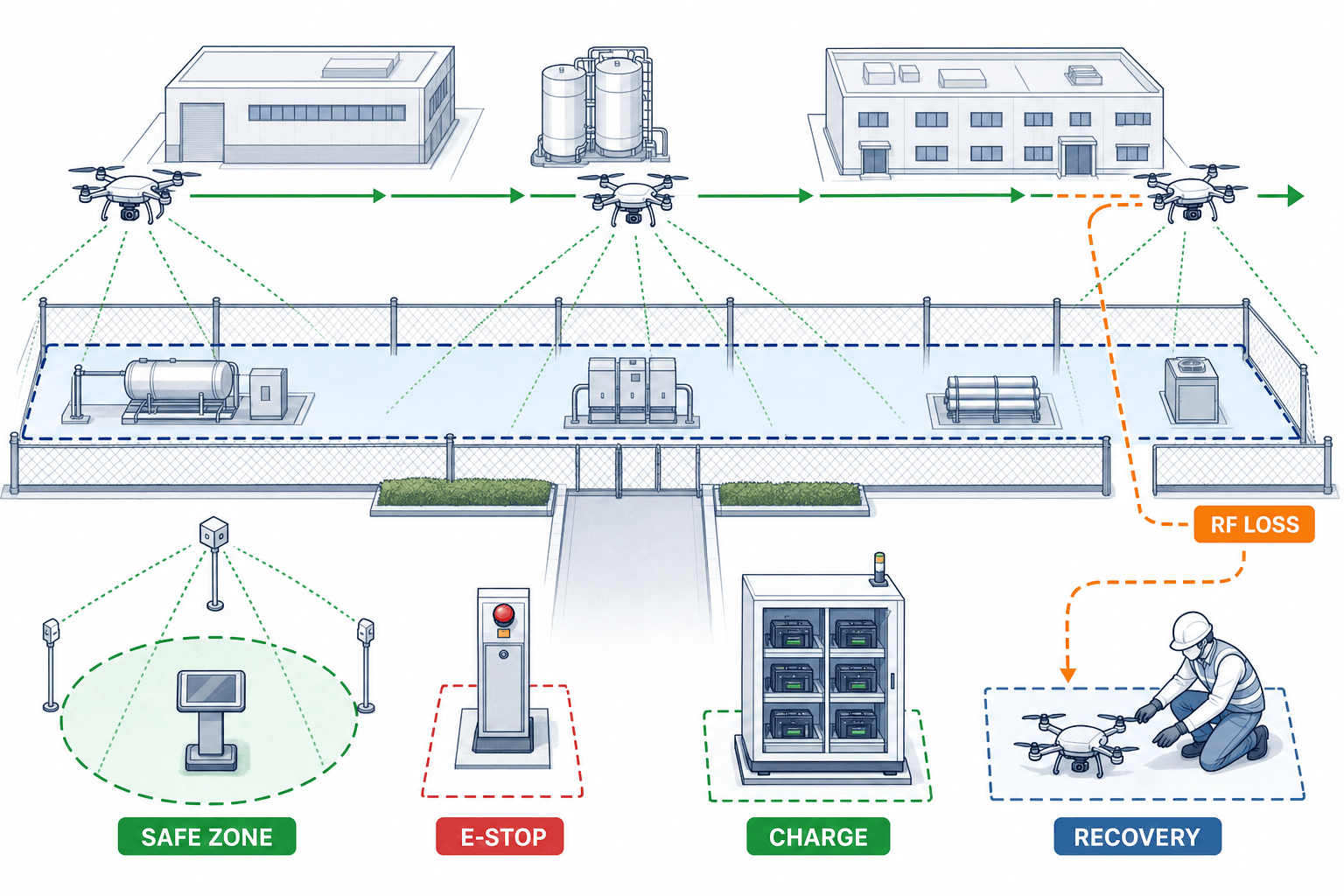
Do not assume “indoors” means no CAAT or NBTC review
The Civil Aviation Authority of Thailand directs operators to its UAS Portal for pilot certification and aircraft registration. A CAAT explainer also discusses camera-equipped aircraft, weight thresholds, and CAAT and NBTC processes. Exact requirements can depend on aircraft, use, route, and location.
Accordingly, do not make a categorical indoor-exemption claim. For routes between buildings or across an outdoor campus, confirm current CAAT, NBTC, airspace, property, insurance, and privacy requirements against the exact aircraft and route. The RFP should identify the regulatory owner, submission evidence, permit-dependent schedule, and triggers for revalidation.
Build OT cybersecurity in from the beginning
Connecting aircraft, docks, radio, cloud services, and MES/WMS creates new communications and update paths. IEC PAS 62443-1-6:2025 addresses application of the IEC 62443 series to IIoT and its new channels and concerns. IEC 62443-2-1:2024 defines asset-owner security-program policies and procedures for operational IACS. The NIST PSCR UAS material also highlights cyber hygiene beyond conventional IT and AI risk considerations.
At minimum, make the following design and acceptance requirements:
- Give aircraft, docks, users, and service accounts unique identities; avoid shared accounts.
- Separate request, configuration, and manual-control privileges using least privilege and stronger authentication for critical action.
- Segment OT, fleet control, guest, and maintenance access into network zones and permit only necessary flows.
- Verify signatures on firmware and configuration; define approval, rollback, and vulnerability-remediation times.
- Preserve time-synchronized operation, flight, dock, authentication, API, and administrator logs.
- Fail safely during cloud outage or credential expiry and provide a local manual-recovery procedure.
- Test authority, reach, result, and reset procedure for the kill switch or E-STOP.
Plan penetration testing so it cannot drive flight control into an unsafe state, and never scan the entire production network without authorization. Confirm remote service access, data location, log export, vulnerability disclosure, and end-of-support obligations before contract award.
ROI model: calculate waiting, not just flying
The following values are illustrative assumptions, not market benchmarks. Replace them with time studies, labor rates, downtime losses, and quotations from the actual factory.
| Input | Assumption |
|---|---|
| Urgent lightweight deliveries | 24 trips/day, 250 days/year |
| Current manual trip | 12 minutes/trip |
| Human touch after implementation | 4 minutes/trip |
| Time saved | 8 minutes/trip |
| Loaded labor | THB 180/hour |
| Avoided line stops | 2/month, 10 minutes each |
| Line-stop loss | THB 48,000/hour |
| Annual recurring cost | THB 120,000/year |
| Initial investment | THB 1,080,000 |
Labor benefit is 24 × 250 × 8/60 × 180 = THB 144,000/year. Avoided line-stop benefit is 2 × 12 × 10/60 × 48,000 = THB 192,000/year. Total gross annual benefit is THB 336,000. After THB 120,000 in recurring cost, net annual benefit is THB 216,000. Simple payback is 1,080,000 ÷ 216,000 = 5.0 years.
The key is not the assumed price but asynchronous handoff. If five minutes of sender or recipient waiting returns on every trip, added labor burden is 24 × 250 × 5/60 × 180 = THB 90,000/year. Net benefit falls to THB 126,000 and payback lengthens to about 8.57 years. Removing asynchronous-handoff waiting through lockers, authentication, and exception alerts can materially affect the investment decision.
The PoC must also test whether avoided downtime is genuinely attributable to delivery improvement. Define the stop event, causal link, and exclusions in advance. Otherwise, only favorable effects may be counted after implementation. Present downside and upside ranges with the payback result.
Responsibilities that an RFP must not leave ambiguous
An RFP should define who assures a completed delivery, not merely list aircraft specifications.
| Area | Responsibility to assign | Example acceptance evidence |
|---|---|---|
| Process | Factory logistics and production owner | Current/future flow, exception list, KPI definitions |
| Flight safety | Supplier and site safety owner | Risk assessment, route tests, stopping distance |
| Regulation | Named compliance owner | Route-specific review, registration/permit records |
| Integration | SI and MES/WMS owners | API, retry, deduplication, time-sync tests |
| Cybersecurity | Asset owner and supplier | Asset register, zone diagram, access matrix, update/log tests |
| Dock/locker | Equipment supplier | Wrong load, lock, full, and power-recovery tests |
| Operation/maintenance | Factory and service company | Inspection, spares, recovery time, training records |
| Data | Asset owner | Event completeness, retention, export test |
Terms such as “autonomous” and “AI-enabled” are not acceptance criteria. State the conditions for autonomy, conditions for stopping, notification deadline, fallback deadline, and evidence. Performance should be guaranteed on the target route, load, and operating period rather than by catalogue maximums.
Acceptance criteria for change control and rollout
Success on one PoC route does not authorize copying the configuration to another route. Register route additions, aircraft, battery or container changes, software updates, building-layout changes, and new radio equipment as controlled changes. Reassess safety, regulation, cybersecurity, and operations. Preserve the previous configuration, approver, test evidence, and rollback conditions, and retrospectively review emergency changes.
Before production handover, finalize a RACI for dispatch decisions, daily inspection, first-line fault response, quality quarantine, cyber updates, and supplier escalation. Train scenarios in which no usual alarm recipient is present and multiple urgent requests compete. Monthly review should cover waiting, manual intervention, uncollected loads, hazardous near misses, lost communications, battery replacement, and missing logs as well as completion rate. The RFP and operating standard must define thresholds that stop the route safely for correction instead of expanding it automatically.
The Thailand BOI investment guide lists promoted activities involving automation machinery and equipment, engineering design, systems integration, and control-system configuration. It does not promise an end-user tax incentive for this project. Confirm current measures and eligibility case by case with BOI.
FAT, SAT, and a 90-day PoC
FAT: expose failures before factory delivery
Factory acceptance testing should reproduce maximum and minimum loads, center-of-gravity shift, wrong containers, barcode mismatch, full docks, failed doors, network delay, battery limits, failed updates, and missing logs. A normal demonstration flight is not enough. Verify that recovery does not complete one request twice and that manual action is recorded.
SAT: test the real route at the worst time
Site acceptance testing must cover shift changes, forklift peaks, shutter movement, and fan operation—not only an empty weekend. Verify RF, positioning, entry detection, emergency landing, E-STOP, fire response, and fallback transfer. For outdoor segments, test within authorized wind and weather boundaries and verify the stop decision.
90-day PoC: expand through three gates
Gate 1, days 1–30: safety and data integrity. Operate a restricted route under supervision. Require zero hazardous events, no missing request/receipt events, and completed stop-and-recovery drills. If it fails, correct the design before measuring benefit.
Gate 2, days 31–60: asynchronous operation. Senders and recipients must continue work while the dock, locker, and alerts handle transfer. Measure manual intervention, uncollected time, exception recovery, and fallback rate. Remove the causes of returning wait time.
Gate 3, days 61–90: economics and sustained operation. At demand equivalent to 24 trips per day, recalculate saved time, causal downtime avoidance, recurring cost, and maintenance effort. Confirm that benefit has not been created by weakening safety or traceability, then decide whether to scale, retain a limited route, or stop.
Sign success criteria before the PoC; do not change them to fit results. At the same time, give the site authority to stop when it identifies a hazard. Before adding aircraft, assess incremental RF coverage, dock capacity, fleet monitoring, maintenance staffing, and regulatory work for each added route.
Implementation roadmap
- Measure: record requests for two to four weeks, including distance, time, waiting, errors, and production impact.
- Compare modes: assess person/cart, conveyor, AMR/AGV, and drone against the same completion definition.
- Walk hazards: inspect machinery, people, wind, dust, RF, emergency landing points, and indoor/outdoor boundaries.
- Confirm compliance: determine CAAT, NBTC, facility, insurance, and privacy requirements for the exact aircraft and route.
- Design future work: define asynchronous docks, authorization, chain of custody, exceptions, and fallback.
- Contract and FAT: allocate responsibility and evidence, then test abnormal conditions before site delivery.
- SAT and 90-day PoC: stage the evaluation of safety, completion quality, waiting, and economics.
- Standardize: incorporate training, maintenance, cyber updates, change control, and audits into the factory system.
Frequently asked questions
What is factory drone delivery?
It is the movement of parts, samples, jigs, or documents within a factory or manufacturing campus by unmanned aircraft, with controlled request, loading, flight, and confirmed receipt. The system includes MES/WMS integration, docks or lockers, identity, tracking events, and exception handling. Its value is a safe, traceable handoff—not flight alone.
What should an AMR vs drone comparison prioritize?
Prioritize payload, route geometry, floor congestion, floor/building boundaries, handoff, and fallback. An AMR is generally suited to repetitive movement of medium loads on the floor. A drone can suit lightweight, urgent routes that are vertical, cross-building, or blocked at floor level. A hybrid arrangement may be preferable.
How should factory drone delivery ROI be calculated?
Include aircraft, dock, integration, safety, compliance, communications, maintenance, batteries, and training in initial and recurring costs. Limit benefits to walking reduction, attributable downtime avoidance, and error reduction supported by site data. Calculate sender and recipient waiting explicitly and perform a sensitivity case when waiting remains.
Does indoor use remove the need for CAAT and NBTC review?
Do not assume a categorical exemption. Review the aircraft, weight, camera, radio, use, route, and indoor/outdoor boundary. For cross-building or outdoor-campus routes, confirm current CAAT, NBTC, airspace, property, insurance, and privacy conditions and retain the evidence.
What is the most common factory drone intralogistics failure?
Teams focus on a flight demonstration and postpone handoff and exception design. A solution cannot scale if people wait for every flight, the wrong load can depart, a full locker has no workflow, or a communications recovery duplicates a request. Test asynchronous handoff and abnormal conditions early.
What should autonomous delivery acceptance testing cover?
Test wrong loads, dock occupancy, communications loss, battery anomaly, human entry, E-STOP, manual recovery, power restoration, missing logs, and fallback as well as normal flight. Verify that events connect the original request to authenticated receipt without duplicate completion or gaps.
Conclusion: buy a completed handoff, not an aircraft
Factory drone delivery creates value when it crosses a boundary that people, carts, conveyors, and AMRs handle poorly and safely completes the request through receipt. Focus candidates on lightweight, urgent, vertical, cross-building, or floor-obstructed routes. Design asynchronous lockers, traceability, and exception recovery before optimizing flight. Use ISO 12100 methodology, route-specific CAAT/NBTC confirmation, IEC 62443-aligned defense, FAT/SAT, and a 90-day PoC. Decide by completion quality and waiting time, not speed alone.
You can discuss candidate routes, AMR comparison, and PoC requirements with TOMAS TECH even while the concept is still taking shape. We can support the path from current-state measurement to integration and acceptance criteria around your installed equipment. Visit our contact page to start a practical review.
References
- Arrive AI and DXC autonomous delivery announcement (2026-09-18)
- CAAT: UAS Portal and drone requirements
- CAAT: Important things to know before using drones
- ISO 12100:2010 official page
- IEC PAS 62443-1-6:2025 official page
- IEC 62443-2-1:2024 official page
- GS1 EPCIS standard
- Thailand BOI Investment Guide
- NIST PSCR UAS cybersecurity reading list


