


Manufacturing Operations Management implementation should not begin with a count of software features. It should begin by defining the execution gap between the plan held in ERP and what machines, operators and materials are actually doing. This guide explains the MOM–MES distinction, the responsibility boundary for ERP–MES integration, and a 90-day proof of concept designed for the realities of a factory in Thailand.
The decision in one sentence: design the operating decisions before choosing a MOM platform
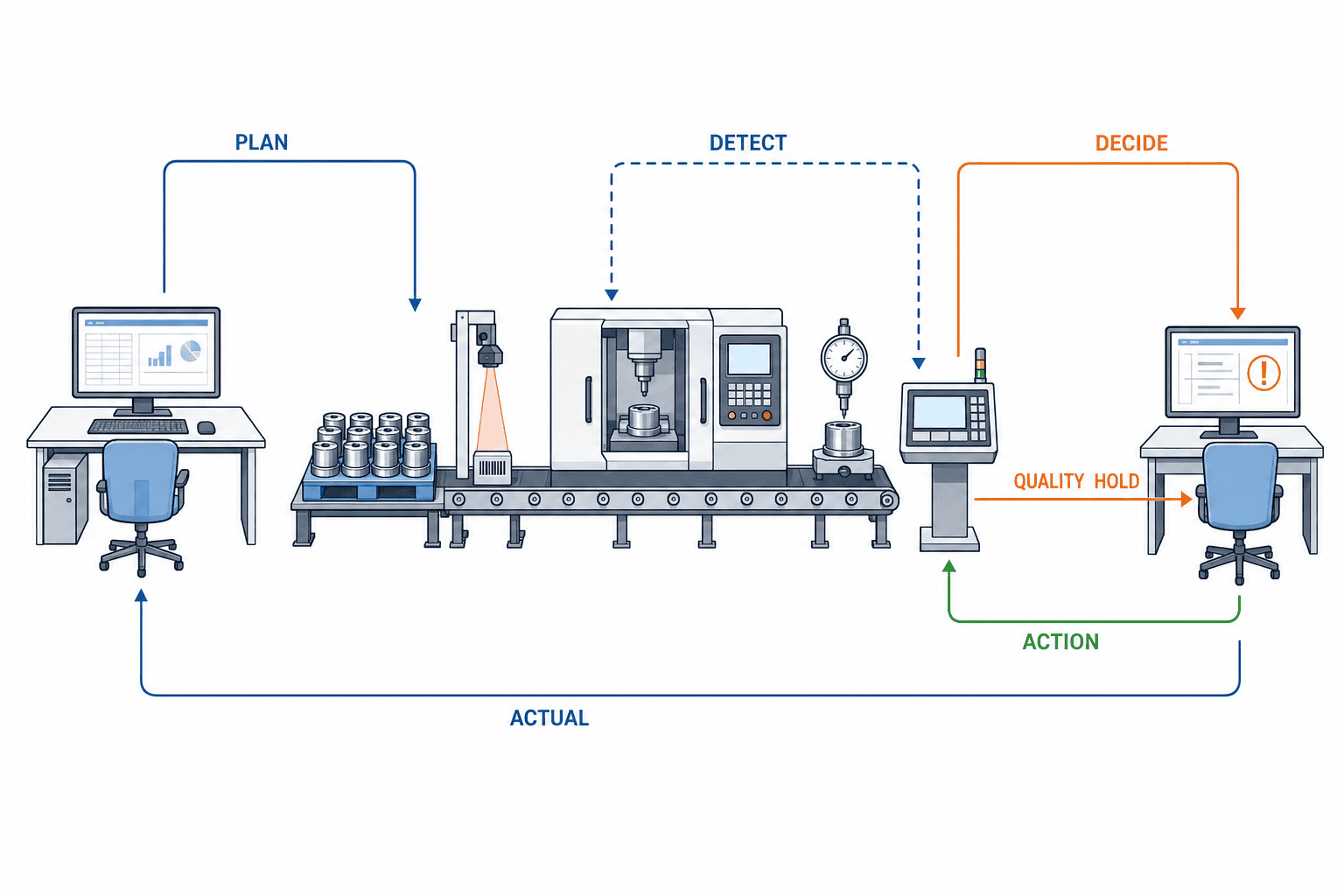
The goal is not a single dashboard. The goal is a controlled loop: detect a change, add production context, notify the right owner, make a decision, execute it, update the relevant systems, and verify that records still reconcile. A practical sequence is:
- Describe recurring execution gaps as business scenarios.
- Draw the responsibilities of ERP, MOM/MES, SCADA, PLCs and people.
- Define a data contract for orders, actuals, exceptions, corrections and retries.
- Limit the first scope to one line, one product family and representative shifts.
- Test normal work, exceptions, disconnection and recovery during a 90-day PoC.
This sequence reveals whether the factory needs a new MOM platform, an extension to its current MES, or a narrower repair of ERP integration.
What the September 2026 announcements really tell buyers about the execution gap
On 14 September 2026, MachineMetrics introduced MaximaOS as a Manufacturing Operations Management platform. Its announcement describes machine connectivity, manufacturing execution, production analytics and plant-specific workflows on one foundation, linking machine signals, operator entries and ERP work orders. These are vendor claims, not independent proof of performance or return. Their useful signal for buyers is the shift from reporting yesterday’s result to identifying a deviation and supporting action while the shift is still running.
On 15 September, Siemens announced the first phase of Meet at the Machine, a workflow intended to let manufacturers program, simulate and validate production before a machine is delivered. A Metso announcement on 10 September likewise described digital solutions that combine planning, field information and simulation models. The Metso example concerns mining and should not be treated as proof for a general factory. Across the examples, however, the relevant design theme is consistent: connect planning, validation, execution and feedback instead of leaving them as separate digital islands.
The procurement question is therefore not whether a product includes AI or a digital thread. Ask which raw facts are transformed into an operational state, by which rules, who must act, how quickly that factory requires a decision, what is written back, and how reconciliation is proven.
What is Manufacturing Operations Management?
In the ISA-95 model, Level 4 covers business planning and logistics and commonly includes ERP. Level 3 is Manufacturing Operations Management. It coordinates plant operations across production, quality, maintenance and inventory movement. Levels 0–2 cover the physical process, sensing and supervisory control, including devices such as sensors, actuators, PLCs and DCSs.
The OPC Foundation’s ISA-95 overview explains that the collective MOM domain may include MES for production, LIMS for laboratory quality, WMS for inventory operations and EAM or CMMS for maintenance. MOM is therefore not simply “a bigger MES.” MOM is the operating domain and integration model; MES is usually a central application for production execution within it.
ISA-95 Part 3 addresses MOM activity models, Part 4 the objects and attributes used in MOM integration, and Part 5 business-to-manufacturing transactions. The public Part 8 preview describes information exchange profiles that define objects, verbs, nouns and implementation constraints for Level 4–Level 3 or intra-Level 3 exchanges. A standard provides vocabulary and boundary discipline; merely buying a product associated with a standard does not guarantee interoperability.
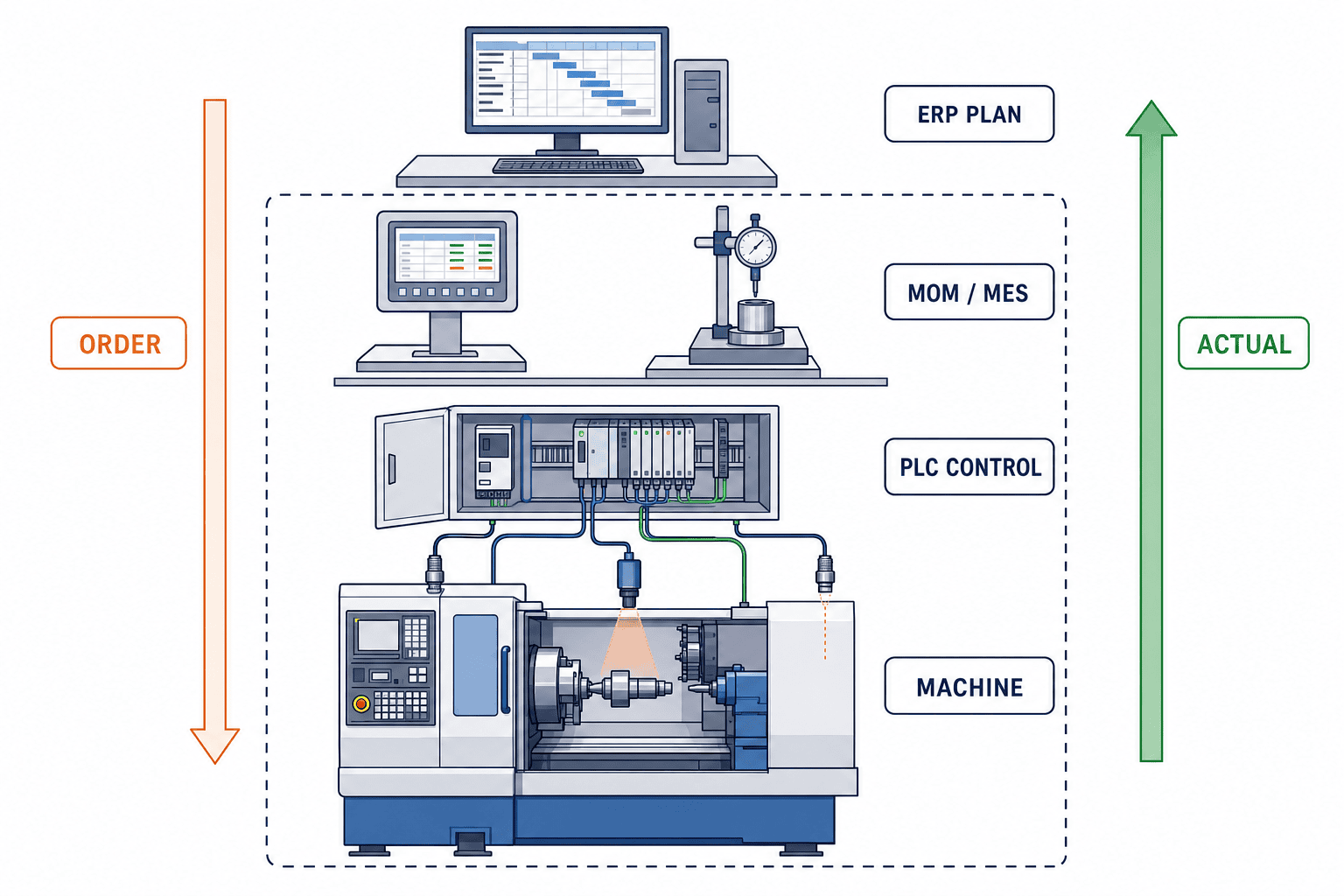
MOM vs MES: compare responsibilities, not product labels
| Question | ERP | MES | MOM integration view |
|---|---|---|---|
| Primary job | Orders, purchasing, enterprise inventory, costing and accounting | Dispatch work, collect production and quality actuals, preserve genealogy | Coordinate decisions across production, quality, maintenance and inventory movement |
| Time grain | Days, weeks, months and orders | Shifts, operations, lots and serials | The event-to-decision-to-correction loop |
| Typical system of record | Commercial order, item, financial inventory, cost | Operation state, actuals, genealogy, operator record | Cross-system state transitions and correction rules |
| Typical exception | Order change, cancellation, inventory difference | Downtime, scrap, hold, rework | Detection, ownership, escalation, alternative action and ERP feedback |
Products called MES vary widely. One may focus on machine data and OEE, another on traceability and quality, and another on detailed scheduling. During a demonstration, use your business scenario and require the vendor to show who acts, on which screen, from which source fact, and which record is updated. For a deeper treatment of commercial scope and the ERP boundary, see our same-language guide to MES implementation cost and ERP responsibility.
Define the factory execution gap as a loop that can be closed
An execution gap is not only the numerical difference between planned and actual output. It can be a released order whose material has not reached the line; an available machine waiting because an upstream lot is on quality hold; an extended setup that threatens later orders but does not reach planning until tomorrow; or good, rejected, held and rework quantities collapsed into one completion figure.
For each scenario, specify seven stages: detection, context, notification, decision, action, feedback and verification. For a machine stop, a PLC signal may detect the event; the system links it to the active operation; deterministic rules classify known causes; the operator is asked only when necessary; a supervisor decides whether to change sequence or equipment; new status is sent to scheduling and ERP; and daily reconciliation confirms no duplicate completion.
Requirements are the decision on which stages software automates, which require human approval, and where another system takes responsibility. “Real time” is not enough: name the decision owner and the factory-specific allowable delay.
ERP–MES integration is a data-contract problem before it is an API problem
API, message queue, CSV and database integration are transports. Define shared meaning first.
| Contract element | Required definition | Typical failure |
|---|---|---|
| Idempotency key | Keys for order, operation, lot and event | A retry is posted as a new actual |
| Quantity meaning | Delta or cumulative; good, reject, hold or scrap | A cumulative value is repeatedly added |
| State transition | Release, start, pause, complete, cancel, reopen | A cancelled order remains startable at the terminal |
| Time | Time zone, event time, receipt time and correction time | Buffered events return in the wrong order |
| Version | Applicable BOM, routing, recipe and inspection version | The factory cannot reproduce what instruction was executed |
| Correction | Reversal, reason, requester, approver and audit trail | An overwrite destroys the reason for a difference |
| Failure | Timeout, retry, quarantine, manual replay and owner | Technical delivery is mistaken for business acceptance |
The acceptance condition is not “the API returned success.” ERP and MOM/MES must explain the same order, quantity and state after normal processing, retry and correction.
Six realities of a MOM implementation in a Thailand factory
1. Headquarters ERP and local execution use different granularity
One ERP production order may become several shifts, subcontract steps, rework routes and substitute machines in Thailand. Keep the enterprise financial record distinct from the operational decomposition used by MOM.
2. Legacy equipment, new equipment and manual work coexist
Do not assume identical data from every asset. Compare direct PLC access, existing SCADA, read-only gateways, external sensors, barcode scans and controlled manual entry. Record accuracy, latency, downtime risk and support ownership for each method.
3. Thai shop-floor language coexists with English and Japanese management
A translated screen is not enough. Validate Thai stop reasons, defect reasons, exception handling and approval terms with operators. Keep displayed language separate from stable reporting codes so headquarters receives consistent classifications.
4. Production may have to continue during a network outage
Specify local cache, permitted offline actions, event buffering, replay order and duplicate protection. During the PoC, prove what can continue safely and what must stop.
5. Month-end close and shift correction run on different clocks
MOM supports fast operating decisions, while ERP remains the system of record for agreed inventory, work in process and accounting. Daily reconciliation must prevent unresolved differences from accumulating until month end.
6. Local staff must be able to triage incidents
The Thailand team needs to identify whether a fault lies in cloud service, network, gateway, PLC, ERP or master data. Every alert should state the next owner, the evidence to collect and the degraded operating procedure.
Build an execution-gap register before sending an RFP
For every recurring case, record the plan state, shop-floor fact, earliest detection source, operational impact, decision owner, alternative action, system feedback and required evidence. Start with repeated conditions such as downtime, quality hold, material shortage, setup overrun, missing labor and mismatched master data.
Prioritise by recurrence, delivery or quality impact, decision delay and data availability. Do not import universal thresholds. The factory owner should approve each target from the selected line’s measured baseline.
The 90-day MOM PoC
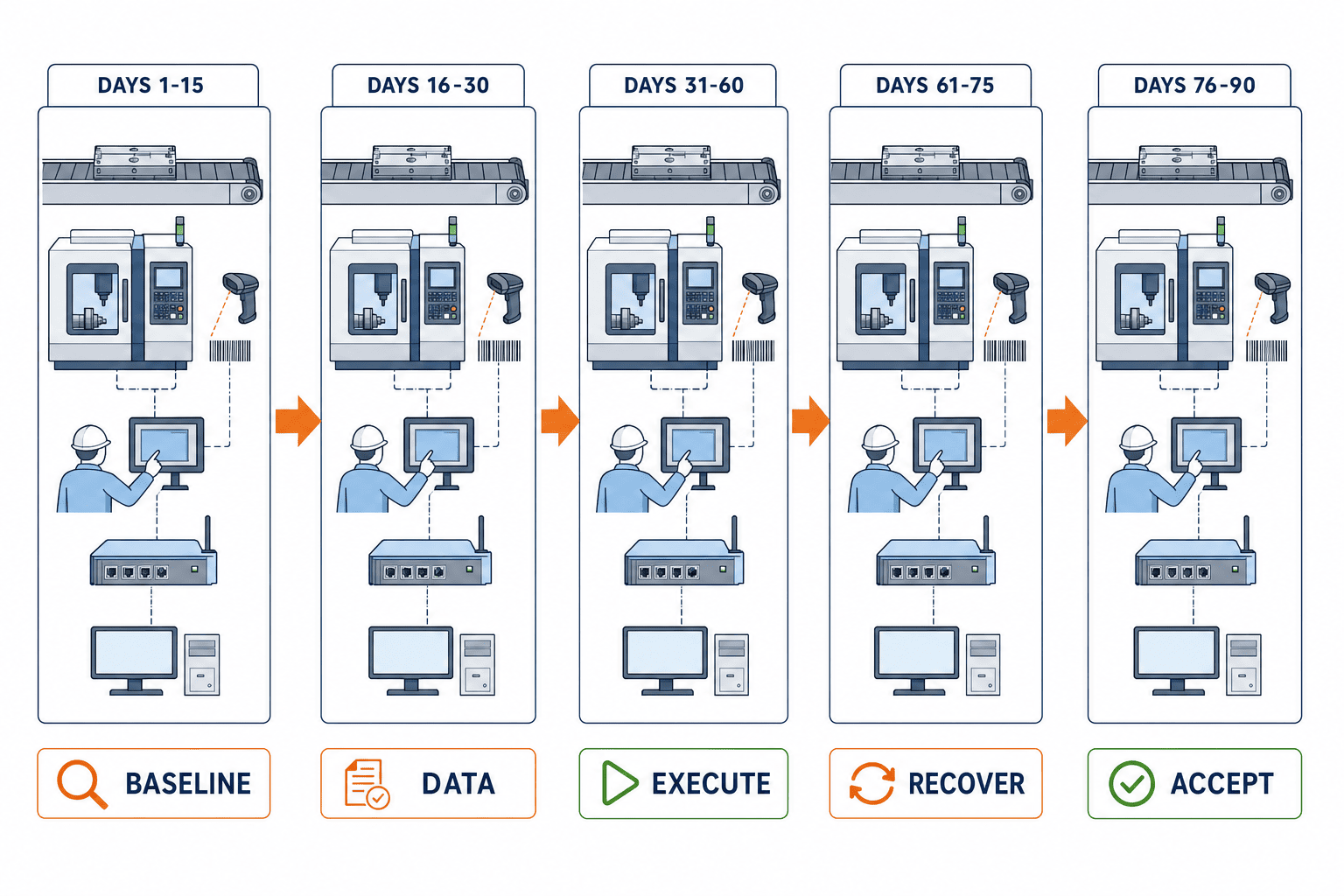
Days 1–15: boundaries and baseline
Fix the line, product family, shifts and order types. Select scenarios from the execution-gap register and record the current path from event to decision and feedback. Draw responsibilities across ERP, MOM/MES, scheduler, WMS, QMS/LIMS, CMMS and SCADA/PLC.
Days 16–30: data contract and test data
Agree keys and state transitions for orders, material, equipment, personnel, actuals, quality, downtime and maintenance requests. Create test sets containing normal records plus duplicates, missing events, reversed sequence, unknown codes, cancellations, date boundaries and replay after offline operation.
Days 31–60: run one complete execution loop
Connect order import, start, material check, machine collection, downtime categorisation, quality result, completion and ERP feedback. Supervisors use the solution on representative shifts and test double entry, Thai terms, terminal placement, glove operation and scan-error recovery.
Days 61–75: exceptions and recovery
In a controlled environment, test communication loss, edge interruption, duplicate delivery, ERP timeout, order cancellation, unknown material, correction of a quality decision and restoration from backup. Distinguish actions that may continue from those that must stop, then reconcile counts and states after recovery.
Days 76–90: UAT and go/no-go
Thai users execute the scenarios from the register. Classify open issues by safety/legal/customer quality, production interruption, data integrity, operational load and usability. Assign an owner and retest date. Decide Go, conditional Go, another PoC, or No-Go using the same evidence pack.
If detailed planning itself is still undecided, use our production scheduler comparison to define the planning boundary before adding MOM execution and feedback requirements.
Acceptance tests must make failure visible
| Test | Action | Expected outcome | Evidence |
|---|---|---|---|
| Duplicate event | Resend the same idempotency key | Accept once and record duplicate | Inbound log, business record, reconciliation |
| Reversed sequence | Send completion before start | Quarantine; do not silently complete | Queue, alert, replay history |
| Disconnection | Break an agreed link | Only authorised work continues; events remain buffered | Terminal state, queue count, post-recovery check |
| Cancellation | Cancel an unstarted ERP order | Order becomes unavailable to start | State history, screen, message ID |
| Correction | Change reject to hold | Preserve before/after values, reason and approval | Audit trail, ERP state, inventory state |
| Authorisation | Operator attempts approval-only action | Reject and audit the attempt | Role matrix, rejection screen, log |
| Restore | Restore by the documented procedure | Return to a consistent point and identify pending items | Restore log, counts, business verification |
Response times, tolerances and recovery targets must come from the factory’s production, safety and quality needs. This article does not invent a universal pass number. Keep test input, configuration version, tester, time, log location, variance and retest result as one evidence package.
What to require in the MOM RFP
Require deliverables, not only feature names:
- normal and exception scenarios plus a responsibility map;
- an equipment, PLC, protocol and downtime-window connection register;
- code mappings for items, operations, equipment, downtime and defects;
- ERP–MOM/MES data contracts, interface inventory and retry/correction design;
- Thai, English and Japanese terminology and screen-approval procedures;
- offline, degraded operation, recovery and daily-reconciliation procedures;
- FAT, SAT and UAT cases and evidence locations;
- monitoring, alerts, backup, restore, account and remote-support responsibilities;
- ownership and exit terms for configuration, custom code, data and exports.
When a vendor says a function is standard, confirm product version, extra licence, configuration work, customer data preparation and cloud/on-premises differences. Demonstrations should use your codes, exceptions and roles.
Connect planning and MOM with an explicit decision loop
Planning uses assumptions about capacity, materials, due dates, setups and subcontracting. MOM captures starts, completions, stops, cycles, defects, personnel and material lots. Do not send every event back to planning. Define which change is large enough, in the factory’s context, to request a new plan or human decision. Short disturbances may be absorbed within a line; a disruption affecting subsequent orders becomes a replanning candidate. The threshold is specific to product, line, shift and downstream constraints.
When alternative plan comparison is required, our guide to production planning simulation provides a complementary framework for assumptions and scenarios.
Numbers not to invent in the investment case
Market size, average ROI, standard MOM implementation cost and universal payback vary with country, scope, legacy connectivity, customisation and support. Do not combine unrelated figures to create false precision.
Instead, compare the same internally defined baseline during the PoC: investigation time for differences, delay from order change to shop-floor visibility, untransmitted events, double entry, corrections and unclassified downtime. If converting evidence to money, keep labor, capacity opportunity, quality loss and delivery assumptions separate to prevent double counting.
TCO should include licences, implementation, machine connection, network, terminals, testing, master-data upkeep, monitoring, out-of-hours support, backup, upgrades, localisation, multi-site rollout and end-of-contract data export.
Operating model after the PoC
Document L1 shop-floor support, L2 Thailand IT/OT and L3 integrator/product-vendor responsibilities. For every alert, name the first responder, logs to collect, production-continuity decision and escalation package.
Monitor more than availability: pending events, replay counts, manual entry, unknown codes, master-data mismatches, corrections, fallback to paper or spreadsheets, alert backlog, restore tests and training completion. For multi-site deployment, standardise the data model, interface rules, roles, audit and acceptance tests; manage machine protocols, product rules, language, shifts and customer requirements as controlled differences.
Frequently asked questions
Is MOM system implementation the same as replacing MES?
No. MOM is the Level 3 operating domain across production, quality, maintenance and inventory movement. A factory may retain its MES and improve interfaces and decision workflows.
What is the difference between MOM and MES?
MES primarily executes and records production. MOM is the broader operating and integration view. Actual product boundaries vary, so decide by business scenarios and systems of record, not labels.
Should ERP–MES integration be bidirectional?
Only where a business transaction requires it. Orders and masters often flow down; completion, consumption and quality state flow up. Avoid allowing both systems to update the same field without ownership rules.
What passes a 90-day PoC?
Ninety days is this article’s governance template, not an industry guarantee. Passing means the selected execution gaps can be detected, decided, reflected and reconciled in both normal and failure conditions, against targets approved from the factory baseline.
Can a Thailand factory with old machines adopt MOM?
Potentially. Compare existing SCADA, read-only gateways, external sensors, scans and controlled manual entry. Prove downtime risk, accuracy and maintainability in the PoC.
Is there a standard MOM cost or ROI?
No safe universal figure exists. Compare equivalent TCO scope with benefits evidenced in your own PoC; do not treat vendor or market averages as a promise.
Summary: MOM implementation designs the decisions between plan and actual execution
Manufacturing Operations Management is not simply a project to collect data at a finer level than ERP. It connects production, quality, maintenance and inventory facts to decisions, actions and governed feedback when reality diverges from plan. Build an execution-gap register, define ERP–MOM/MES–control responsibilities, write the data contracts, and use the 90-day PoC to test normal work, failure, recovery, reconciliation and local operations. This creates one evidence base for comparing a new MOM platform, an MES extension and an ERP integration repair.
TOMAS TECH can support the evaluation stage for MOM implementation in Thailand, including ERP–MES responsibility mapping and a 90-day PoC design. If your starting point includes legacy machines, manual work, Thai-language operations or headquarters ERP constraints, contact TOMAS TECH to begin with the current-state boundary map.
References
- MachineMetrics, Introducing MaximaOS, 14 September 2026: https://www.machinemetrics.com/blog/introducing-maximaos-the-manufacturing-operations-management-platform
- ISA, ISA-95 Series of Standards: https://www.isa.org/standards-and-publications/isa-standards/isa-95-standard
- OPC Foundation, ISA-95 Summary: https://reference.opcfoundation.org/specs/OPC-10030/4.2
- Siemens, Manufacturing Operations Management: https://www.siemens.com/en-gb/technology/manufacturing-operations-management-mom/
- Siemens, Meet at the Machine, 15 September 2026: https://press.siemens.com/global/en/pressrelease/siemens-launches-meet-machine-initiative-next-level-cnc-productivity
- Metso, three digital solutions, 10 September 2026: https://www.metso.com/corporate/media/news/2026/9/metso-launches-three-new-digital-solutions-to-help-mining-customers-optimize-production-improve-operational-outcomes-and-enhance-safety/
- ISA-95 Part 8 public preview: https://www.isa.org/getmedia/ca0c1efd-860b-4fe0-bb2d-2b7d2f58c2f9/ISA-95-00-08_2020_Preview.pdf
Information checked on 16 September 2026. Vendor announcements are treated as vendor claims and do not guarantee performance or investment return.


