


An executive generative AI seminar should not be selected as a shorter version of tool training. Its job is to let management decide where AI should be used, where it must stop, who owns each decision, and how the board will judge progress after 90 days. This guide shows Thailand-based companies how to select and design a decision workshop that ends with four usable management artifacts.
Executive answer: select the seminar by four tangible outputs
A useful executive workshop ends with the company’s own version of:
- Use-case priorities and stop criteria: what to test first, what not to start, and what events trigger a stop.
- Governance decision boundaries and a RACI: who performs, approves, advises on, and is informed about DATA, AI and HUMAN decisions.
- A 90-day sponsor plan: how the sponsor protects budget, people, frontline time and decision gates.
- A measurement and ROI ledger: one record connecting baselines, benefits, full costs, quality, risk, evidence and the next decision.
A seminar alone does not create transformation. It turns management intent into a testable agreement. Field observation, data work, a controlled pilot, workflow redesign, training and audit must follow.
Why ordinary corporate generative AI training stalls at the executive level
Employee training rightly covers safe use, prompts, output checking and daily productivity. Executives face different unresolved questions:
- Which of customer service, engineering, production, quality, procurement and administration receives scarce resources?
- Which ideas remain personal productivity experiments, and which become standard company workflows?
- Who sets boundaries for confidential or personal data, intellectual property, false output, discrimination and cyber risk?
- Which decisions always require human approval?
- When should a technically improving project stop because workflow time, rework, incidents or revenue do not improve?
- How should headquarters, the Thailand entity, factories, IT, legal, HR and finance share accountability?
An executive program should therefore rehearse hard choices, not maximize feature demonstrations. A demo is evidence for a decision; it is not the decision artifact.
What current primary sources say about Thailand’s decision gap
The following are sourced facts. Their populations and contexts matter; they should not be applied mechanically to every company.
| Sourced fact | Implication for the workshop |
|---|---|
| Microsoft’s 2026 Work Trend Index combined behavioral signals with a survey of 20,000 AI users in 10 markets and reported that 32% of Thailand’s workforce were “Frontier Professionals” | Do not infer organizational capability from advanced individual use; separate experimentation from standardization |
| In Thailand, 53% recognized quality control of AI output as increasingly vital and 45% considered critical thinking essential | Put verification, challenge, approval and records ahead of usage volume |
| 51% of Thai employees said leaders communicated clear AI direction, while only about one-third of Thai leaders rewarded experimentation without demanding immediate results | Convert direction into protected experiment time and explicit stop conditions |
| Eight in ten Thai managers encouraged AI-driven work redesign, but only two in ten teams systematically documented successes as standardized workflows | Name an owner for evidence and standardization before the workshop ends |
| OECD reported that around 40% of non-adopting employers in manufacturing and finance cited skills as the main barrier | Break “skills” into management, process, data, technical and control capabilities |
| OECD found that fewer than 1% of workers need advanced AI-specific skills; digital and data skills plus management, problem-solving, creativity and innovation remain important | Do not turn executive training into a coding course |
The Microsoft figures reflect its survey design and do not automatically represent every Thai employer. They are valuable because they distinguish readiness, leadership direction, support for experimentation and organizational documentation.
Executive AI training versus a decision workshop
| Dimension | Literacy / tool training | Executive decision workshop |
|---|---|---|
| Primary purpose | Use tools safely and understand functions | Agree investment, controls and sponsorship |
| Participants | Users and practitioners | CEO, business and plant leaders, CFO, IT, legal, HR |
| Inputs | Common courseware and sample tasks | Strategy, real workflows, data, incidents, budget and constraints |
| Core activity | Demonstration and prompt practice | Prioritization, challenge, risk boundaries, RACI and gates |
| Finish line | Attendance, quiz or satisfaction | Four artifacts with owners, deadlines, evidence and conditions |
| Next step | Personal use and further learning | A 90-day experiment and board gates |
| Measurement | Completion and usage | Workflow KPI, quality, risk, full cost and adoption decision |
For a role-based company-wide program, use our AI training curriculum design guide. This article focuses specifically on the layer that selects, stops and sponsors initiatives.
Prepare before the seminar so the day is not spent on introductions
At least two weeks before the event, collect:
- current strategic priorities and KPIs such as revenue, margin, delivery, quality, inventory or engineering lead time;
- five to ten candidate workflows with inputs, work, decisions, outputs, exceptions, volume and current time;
- data location, owner, quality, classification, rights, residency and retention constraints;
- prior digital programs, pilots, incidents and stopped projects, including why they were not adopted;
- security, personal data, procurement, model-use and retention policies; and
- the decision-makers’ availability and an approximate envelope for frontline time and budget over 90 days.
Sensitive records need not be handed wholesale to an external facilitator. Anonymized workflow cards can work. But removing all volumes, waiting time, error, approval steps and loss makes prioritization impossible. Agree the minimum decision information and how it will be protected.
Choose participants by decision rights, not prestige
A CEO-only event lacks frontline, data and control reality. A practitioner-only event cannot set risk tolerance or cross-functional budget. A practical core is often 8–14 people; this is a TOMAS TECH design assumption, not an external benchmark.
| Role | Evidence brought to the room | Decision made in the room |
|---|---|---|
| Executive sponsor | Strategy, tolerance and priority KPI | Priority, funding envelope and gates |
| Business / plant owner | Operations, customers and capacity | Scope, frontline time and process owner |
| CFO / finance | Cost, benefit recognition and hurdle logic | Ledger rules and benefit approval |
| IT / data | Architecture, identity, logs and quality | Connectivity, environment and technical stops |
| Legal / compliance | Contracts, personal data and IP | Prohibited, approval-required and permitted zones |
| HR / organization | Roles, appraisal, learning and employee impact | Role change and communication |
| Frontline representative | Exceptions, tacit work and rework | Test scenarios and acceptance conditions |
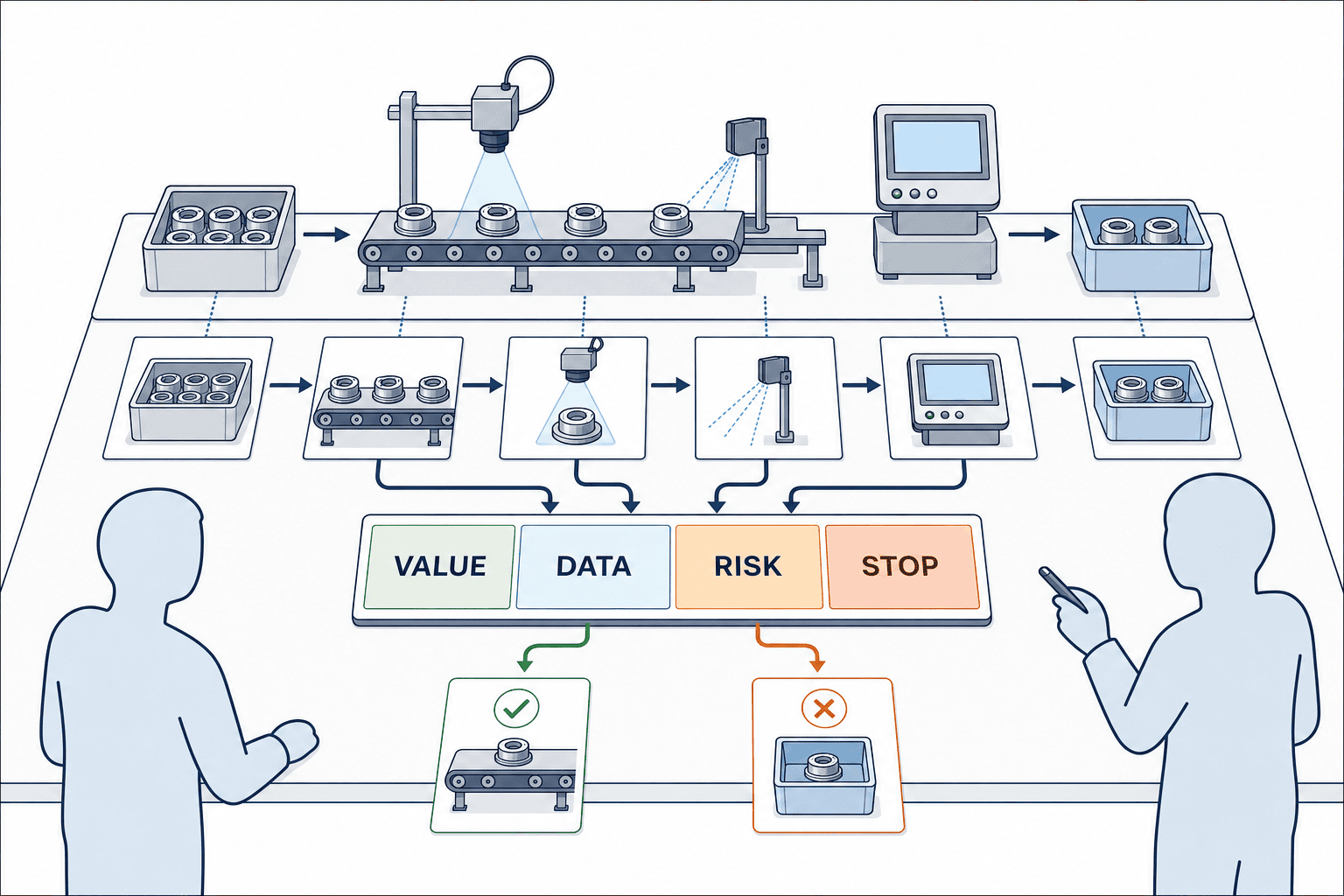
An executive AI curriculum that produces four outputs in one day
The schedule below is a design example. Keep lectures below 25% and use the rest for company work and decisions. That ratio is a TOMAS TECH recommendation, not an industry statistic. Regulated or multi-country businesses need more discovery and follow-up.
| Time | Session | Work | Output |
|---|---|---|---|
| 09:00–09:40 | Management premise | Tasks, limits and Thailand context | Strategic purpose and non-purpose |
| 09:40–11:10 | Use-case selection | Compare value, feasibility and risk | Priority and stop criteria |
| 11:20–12:20 | Challenge review | Worst cases, alternatives and missing evidence | Assumptions and evidence gaps |
| 13:10–14:30 | Governance | Design DATA→AI→HUMAN boundaries | RACI and approval boundaries |
| 14:40–15:50 | 90-day plan | Weekly activity, gates and intervention | Sponsor plan |
| 16:00–16:50 | Measurement and ROI | Baseline, benefit, cost and risk ledger | Measurement ledger |
| 16:50–17:30 | Executive agreement | Owners, open issues and next board date | One-page board draft |
Output 1: use-case priority and stop criteria
Start with the business decision, not “what AI can do.” Use one card structure:
[User] at [workflow event] uses [data] and [AI assistance] to improve [current task or decision] and change [business KPI], while [human role] retains final accountability.
“Improve quality with generative AI” is too broad. A usable case is: “When a complaint arrives, a quality engineer searches approved 8D reports and standards, receives draft cause hypotheses and verification questions, checks cited evidence and remains responsible for release.”
Keep reasons behind the priority score
This hypothetical TOMAS TECH model uses 100 points. It is a discussion device, not a universal standard.
| Dimension | Assumed weight | Score 5 | Score 1 |
|---|---|---|---|
| Strategic value | 25 | Directly affects this year’s KPI | No explainable KPI link |
| Frequency / loss | 20 | Frequent or costly delay/loss | Rare and immaterial |
| Data readiness | 15 | Owner, quality and rights confirmed | Location or right unknown |
| Change feasibility | 15 | Owner and frontline time secured | Nobody can change the process |
| Measurability | 10 | Baseline and evidence available | Outcome cannot be observed |
| Risk fit | 15 | Bounded with human approval | Unacceptable or legally unclear |
Calculate total = Σ(score ÷ 5 × weight). If the six scores are 5, 4, 3, 4, 4 and 3, the result is 25 + 16 + 9 + 12 + 8 + 9 = 79. A score of 79 does not mean automatic approval. Compare the evidence and uncertainty behind it.
Separate pre-start rejection from live stop criteria
Pre-start rejection can include unverified data rights, no accountable owner, no baseline, missing customer or regulatory permission, or a simpler process change that is cheaper. Live stops include confidential-data leakage, a serious wrong decision, inability to show evidence, quality deterioration, user workarounds or full-cost overrun.
| Condition | Example threshold | Immediate action | Restart approval |
|---|---|---|---|
| Unauthorized confidential transfer | Any confirmed case | Stop, preserve logs, incident process | Security owner |
| Unsupported important output | More than 5 of 100 evaluations (assumption) | Narrow scope and correct retrieval/instructions | Business owner + IT |
| Rework rate | More than 10% worse than baseline (assumption) | Return to manual work, investigate | Plant/business owner |
| Monthly full cost | 15% over approved ceiling (assumption) | Freeze new use and decompose cost | CFO + sponsor |
Every threshold above is illustrative; the company sets it using actual data and impact.
Output 2: governance boundaries and RACI
Turn principles into the handoffs of one workflow:
- DATA: who collects data and confirms source, rights, classification, quality and retention?
- AI: which classification, search, summary, generation or prediction may the model perform, and what is logged?
- HUMAN: who checks evidence, handles exceptions and approves decisions affecting customers, equipment or employees?
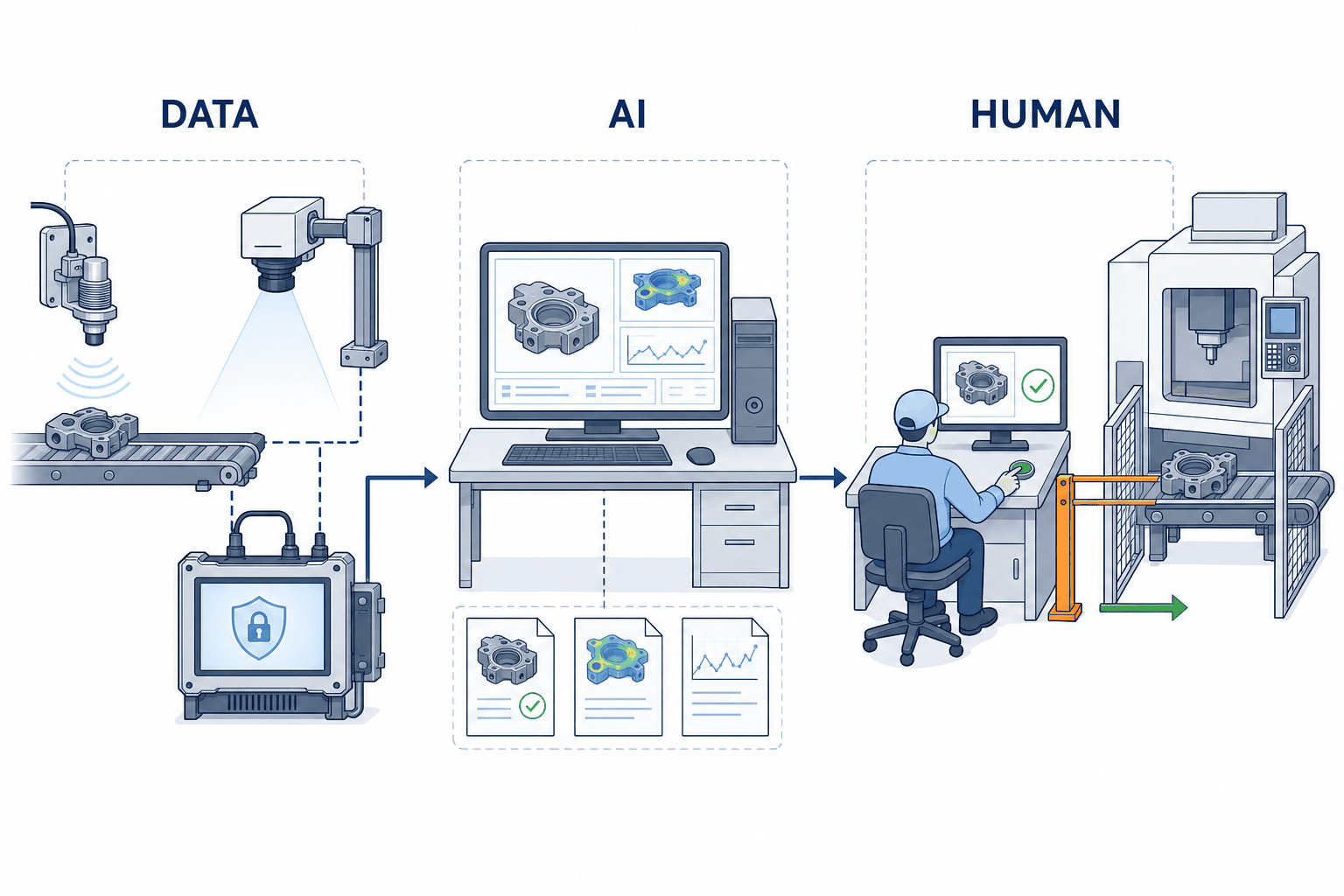
The World Economic Forum’s 2026 report, informed by more than 450 executives, identifies five enablers of scaled adoption: human accountability, end-to-end operating-model redesign, scalable talent systems, transparency-driven trust and disciplined experimentation. This is not a performance guarantee; it is a reason not to isolate the RACI inside IT.
| Activity | A: accountable | R: responsible | C: consulted | I: informed |
|---|---|---|---|---|
| Use-case go/no-go | Executive sponsor | Business owner | CFO, IT, legal, frontline | Board |
| Data-use approval | Data owner | Data steward | Legal, security | Sponsor |
| Model/environment change | IT owner | Technical owner | Business, procurement, security | Users |
| Business release of output | Business owner | Named reviewer | Quality, legal | Affected teams |
| Incident stop | Security owner | Operations | Business owner, legal, vendor | Sponsor |
| Benefit measurement | CFO or KPI owner | Analyst | Business, IT | Executive committee |
Avoid multiple A’s in one row. ETDA’s 2026 direction emphasizes putting AI Governance Guidelines and Toolkits into practice through risk, ethical-impact and value assessment, workshops and testing. A company RACI should therefore end in real approvals, logs and tests, not merely cite an external framework.
OECD’s public-workforce report says leaders need strategic understanding of AI’s potential and risk, ethics and regulation, implementation strategy, governance, data infrastructure, workforce readiness, collaboration, communication, stakeholder management and change management. This is public-sector analysis. Applying it as a completeness check for private-sector curricula is our inference, not a private-sector rule.
Output 3: a 90-day sponsor plan
Sponsors must do more than express support. They protect experiment time, resolve cross-functional decisions and own stopping decisions.
| Period | Team activity | Sponsor action | Gate |
|---|---|---|---|
| Days 0–15 | Baseline, rights, quality and test design | Confirm scope, frontline time and owners | Hold if baseline or owner is absent |
| Days 16–30 | Secure environment, logs, evaluation set and manual fallback | Clear IT, legal and procurement blocks | Do not start without data/environment approval |
| Days 31–60 | Limited use and weekly quality/time/incident measures | 15-minute weekly review and stop decisions | Continue only within quality/risk conditions |
| Days 61–75 | Exception, outage, misuse and user acceptance tests | Join challenge review and control scope | Fix or stop critical defects |
| Days 76–90 | Final ledger, procedure, learning and rollout option | Decide continue, conditional continue, retest or stop | Submit evidence-backed decision to board |
A September 2026 WEF article describes Larsen & Toubro embedding AI learning for a 50,000-person workforce in company projects and business challenges, rather than treating it as a standalone course. The article reports a 40% improvement in AI-related skills within months. That figure belongs to the example as reported; it is not a promised result for another company. The transferable lesson is to connect learning to work.
Connect the sponsor plan to a broader AI implementation roadmap so roles, environment and evaluation continue after the seminar.
Output 4: measurement and ROI ledger
Usage counts are leading indicators, not the business result. Keep both in one ledger.
| Ledger field | Example | Evidence |
|---|---|---|
| Baseline | 45 minutes/case, 400 cases/month, 12% rework | Time study and workflow log |
| Hypothesis | 30 minutes/case, rework at or below 8% | Approved experiment plan |
| Actual | Treatment/control and weekly distribution | Logs and sampled audit |
| Benefit | Time saved × genuinely redeployed labor cost; avoided loss | Finance approval and operations record |
| Cost | Licenses, API, build, integration, evaluation, learning, operation, audit | Invoice, hours and contract |
| Quality | Evidence, omissions, rework and customer impact | Blind review, complaints and quality record |
| Risk | Incidents, near misses, policy exceptions and downtime | Incident and audit log |
| Decision | Continue, conditional continue, retest or stop | Gate minutes |
A hypothetical model with visible arithmetic
This is not a market price or benefit promise. It only demonstrates the calculation in THB.
- Baseline: 400 cases × 45 minutes = 18,000 minutes = 300 hours/month.
- After the experiment: 400 × 30 minutes = 12,000 minutes = 200 hours/month.
- Apparent saving: 300 − 200 = 100 hours/month.
- Assume only 60% can be redeployed to valuable work: 100 × 60% = 60 hours/month.
- Assume loaded labor cost of THB 450/hour: 60 × 450 = THB 27,000/month = THB 324,000/year.
- Assume rework avoidance of THB 15,000/month: 15,000 × 12 = THB 180,000/year.
- Annual total benefit: 324,000 + 180,000 = THB 504,000.
- Assume THB 220,000 initial cost and THB 180,000 annual operating cost: first-year cost = THB 400,000.
- First-year net benefit: 504,000 − 400,000 = THB 104,000.
- Simple ROI: 104,000 ÷ 400,000 × 100 = 26%.
- Simple payback: THB 220,000 initial cost ÷ ((THB 504,000 annual benefit − THB 180,000 annual operating cost) ÷ 12) = about 8.1 months.
Do not monetize all 100 hours. Fifteen-minute fragments may not change staffing or output. Delivery, quality, knowledge retention and reduced risk can be tracked separately with evidence. Our AI ROI measurement framework explains sensitivity, double-count prevention and quality/risk alongside financial return.
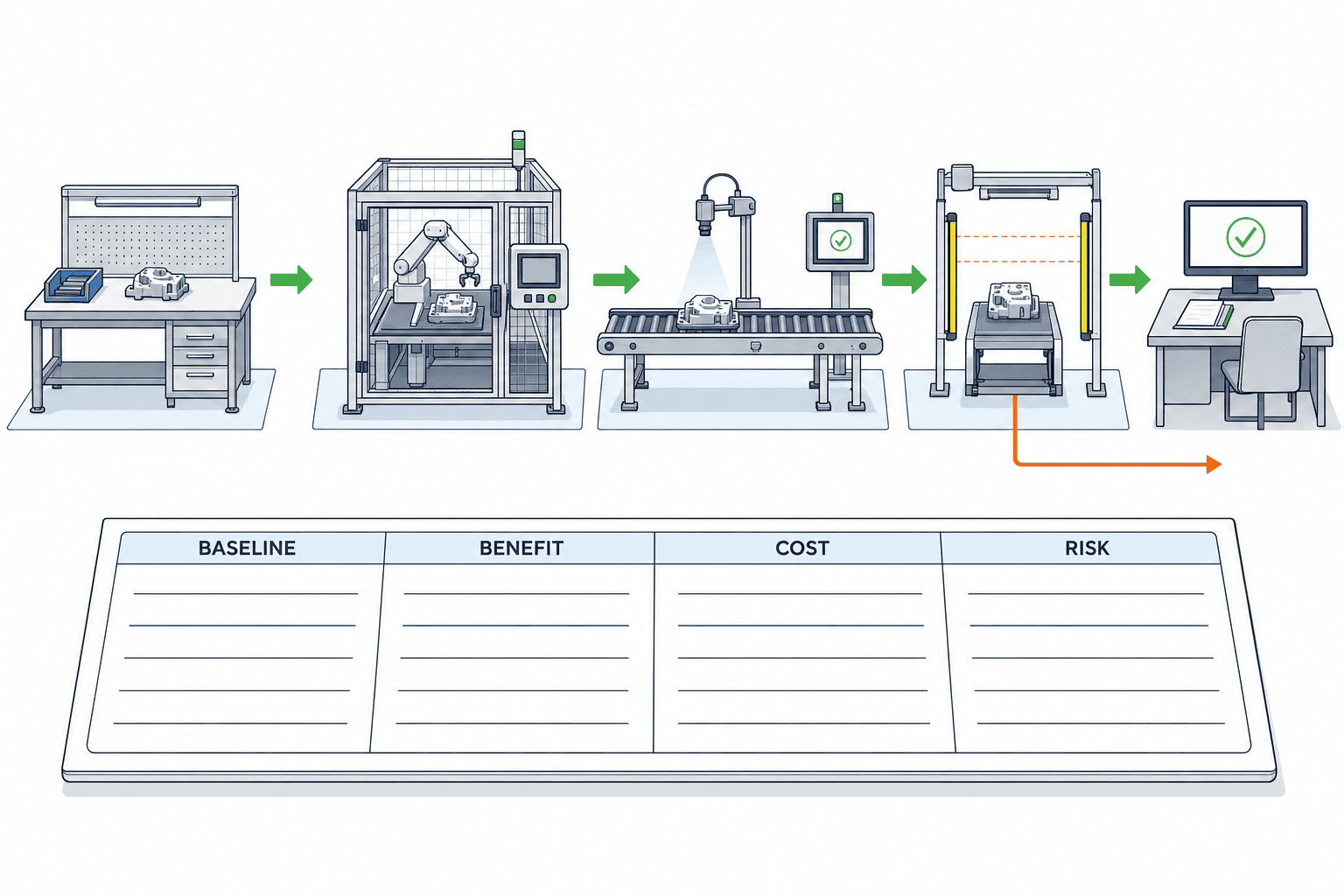
How to compare generative AI training fees
Avoid unsupported claims about vendor market prices. Compare what is included in the decision scope.
| Cost component | What should be included | Risk if omitted |
|---|---|---|
| Discovery and design | Executive interviews, documents, cases and constraints | Generic discussion |
| Facilitation | Briefing, priority, challenge, RACI and agreement | Conversation without decision |
| Artifact production | Four outputs, open issues and board page | Nobody documents afterward |
| Technical/data check | Data, environment, logs and evaluation | Selection of an infeasible case |
| Governance check | Legal, privacy, IP and security | Late-stage stop |
| 90-day follow-through | Gate review, issue resolution and measurement | Sponsor disappears |
| Localization | Japanese, Thai, English and local operating context | Agreement remains in the boardroom |
The Thai Revenue Department’s English corporate-income-tax page lists a 200% deduction of job training expense among special deductions. Do not infer that every seminar invoice qualifies. Entity, course, provider, approval, documentation and timing conditions should be confirmed with a qualified Thai tax/accounting adviser before contracting. This article is not tax advice, and the ROI case should not depend on an unconfirmed incentive.
Twelve questions for the provider
- What are the templates and completion criteria for the four outputs?
- What company data is reviewed before the event, and how is it protected and deleted?
- What proportions are lecture, demo, company work and decision time?
- How are unresolved executive disagreements recorded and closed?
- How are priority and stop conditions designed?
- At what level are DATA, AI, HUMAN boundaries and the RACI built?
- Who checks Thailand-specific privacy, employment, contract and AI-governance issues?
- Are facilitators independent of product sales, and are commercial relationships disclosed?
- What sponsor gates appear in the 90-day plan?
- How are baseline, comparison, quality, full cost and risk measured?
- Will Japanese-, Thai- and English-speaking participants receive equivalent decisions?
- Who reviews what on days 30, 60 and 90?
“Flexible,” “latest cases,” and “high satisfaction” are not enough. Ask for blank templates, anonymized gate structures and facilitation roles—not client secrets.
Convert four outputs into one board page
| Field | Content |
|---|---|
| Decision requested | Start, budget ceiling, owner and next gate date |
| Workflow | User, event, AI assistance, human decision and exclusions |
| Strategic value | KPI link, baseline and hypothesis |
| Evidence gaps | Data, rights, adoption, technology and customer conditions |
| Risk boundary | Prohibited, approval-required, permitted and immediate stop |
| 90-day resources | Sponsor, business, IT, legal and finance time/cost |
| Gates | Day 30/60/90 continuation or stop conditions |
| Measurement | Benefit, full cost, quality, risk and evidence owner |
The page should say: “Test this hypothesis within this bounded scope and accountability, tolerate no more than this loss, and use this evidence for the next decision”—not merely “approve an AI budget.”
Facilitation for Japanese companies in Thailand
Separate headquarters policy from Thailand decision rights
Identify what needs headquarters approval, what Thailand can decide and what customers or regional management must approve. “Ask HQ” cannot be an ownerless holding box. A global contract may still fail to fit Thai documents, shifts, devices and customer requirements.
Compare evidence, not speaking volume
Hierarchy and language can suppress disagreement. Let participants score privately, then discuss the highest and lowest scores and their reasons. Maintain equivalent Thai frontline cards, a Japanese executive summary and an English glossary, especially for “approval,” “accountability” and “stop.”
Do not confuse a safe exercise, pilot and production
An anonymized exercise, an approved isolated pilot and customer-impacting production are separate gates. Do not have participants paste confidential documents into public tools. Define the environment, accounts, logs, deletion and take-away data. See our guide to a secure generative AI environment.
Common failure patterns
| Failure | Symptom | Correction |
|---|---|---|
| Keynote only | High satisfaction, no next meeting | Contract for company work and four outputs |
| Product-demo centered | Only product-shaped problems survive | Start from workflow and stop conditions |
| Idea count as success | Fifty ideas, no owner | Select one or two; record why others wait |
| Risk delegated to legal | Everything is blocked late | Include legal/security during case formation |
| ROI equals time saved | Quality and non-redeployable time disappear | Include realization, full cost, quality and risk |
| Multiple RACI A’s | Nobody can stop an incident | One accountable role per event |
| Calendar-only 90-day plan | No frontline time or data work | Weekly work, evidence and intervention |
| Seminar called transformation | Success declared before implementation | Separate learning, pilot, adoption, scale and benefit |
Selection checklist
- The board question is one clear sentence.
- Templates and completion criteria for all four outputs are confirmed.
- Baselines and data owners are collected in advance.
- Business, finance, IT/data, legal/HR and frontline join the sponsor.
- Company decision work receives enough time.
- Both pre-start rejection and live stop criteria are designed.
- DATA, AI and HUMAN handoffs and exceptions are diagrammed.
- No RACI owner, deadline or evidence field remains blank.
- Day 30, 60 and 90 gates include sponsor actions.
- The ROI ledger includes quality, risk, realization and full cost.
- Thai legal, tax and personal-data conditions receive case-specific professional review.
- Important terms are equivalent in Japanese, Thai and English.
- Provider relationships with particular products are disclosed.
- Storage, updating and board submission of the artifacts have owners.
FAQ: selecting an executive generative AI seminar
How long should an executive generative AI seminar be?
A short briefing can share knowledge, but company-specific artifacts require preparation and concentrated work. The one-day format is one option. A regulated, multi-business or trilingual organization may need discovery, a workshop and a day-30 review. Compare finish conditions, not hours alone.
Who should attend executive AI training?
Include the sponsor plus business or plant operations, finance, IT/data, legal/compliance, HR and a frontline representative. Decision holders must join the priority, governance and final-gate sessions. If a delegate has no authority, set a deadline for the real decision.
How is a corporate generative AI seminar different from a general seminar?
A corporate program connects the discussion to the company’s data, workflows, accountability, policies and investment criteria. For executives, the center of gravity is not tool operation but deciding use-case go/no-go and stop criteria, the RACI, the 90-day sponsor plan, and the ROI ledger.
Is prompt practice unnecessary?
No. A short exercise helps leaders experience capability and failure. It should lead to evidence, workflow integration, human approval and measurement rather than occupy most of the program. Detailed tool practice belongs in a practitioner course.
How should corporate generative AI seminar fees be compared?
Decompose discovery, facilitation, artifact production, technical and governance checks, localization and 90-day support. A low keynote fee may shift design work back to the company; a high fee does not guarantee outcomes. Compare deliverables, owners, scope, exclusions and gates.
Can AI implementation impact be measured immediately?
Immediately you can measure artifact completeness, open decisions, owners and gate dates. Business impact requires a baseline, bounded experiment and observation of quality, cost and risk. Do not substitute satisfaction for ROI.
Can a seminar alone deliver AI transformation?
No. It is a decision starting point. Data readiness, a secure environment, workflow design, evaluation, learning, change management, audit and management gates must follow.
Conclusion: take home the next management decision, not just learning
Select an executive program by how completely it produces company-specific priorities and stops, governance boundaries and RACI, a 90-day sponsor plan, and a measurement/ROI ledger. Those outputs let a board move on evidence rather than excitement.
TOMAS TECH can help from the early stage of structuring candidate workflows and a board-ready one-page decision. If your Thailand operation needs to align Japanese-, Thai- and English-speaking leaders before selecting a product, contact us with the decision you are trying to make.
References
- World Economic Forum, “From AI disruption to diffusion: Four leadership principles,” 9 Sep 2026: https://www.weforum.org/stories/artificial-intelligence/from-ai-disruption-to-diffusion-four-leadership-principles/
- Microsoft Thailand, “Microsoft Unveils Work Trend Index 2026,” 4 Aug 2026: https://news.microsoft.com/source/asia/2026/08/04/microsoft-unveils-2026-ai-work-trends-for-thailand/
- OECD, “AI and skills,” 5 Jun 2026: https://www.oecd.org/en/publications/ai-and-skills_f843b352-en/full-report.html
- OECD, “Building an AI-ready public workforce,” 19 Jan 2026: https://www.oecd.org/en/publications/building-an-ai-ready-public-workforce_b89244c7-en/full-report.html
- World Economic Forum, “Organizational Transformation in the Age of AI,” 16 Mar 2026: https://www.weforum.org/publications/organizational-transformation-in-the-age-of-ai-how-organizations-maximize-ais-potential/
- ETDA, “Driving Trust AI Governance,” 9 Jun 2026: https://www.etda.or.th/th/pr-news/aigc_Driving-Trust_AI_Governance.aspx
- Thai Revenue Department, “Corporate Income Tax”: https://www.rd.go.th/english/6044.html
- ETDA, “16 ปี ETDA เปิด Big Move ปี 70,” 7 Sep 2026: https://www.etda.or.th/th/newsevents/pr-news/Digital-ID/Digital-ID_Big_Move.aspx