



A conveyor-top AMR will not transfer loads reliably merely because its payload and travel speed look suitable. Success depends on specifying the mechanical docking interface, sensors, PLC and WMS/WCS handshake, abnormal recovery, FAT/SAT and ownership as one deliverable. This guide shows how a Thai factory can procure a working transfer process, not just a vehicle.
Executive conclusion: procure a transferable process, not an AMR vehicle
If the purchasing unit is defined as “AMR plus top module,” the gaps between systems remain unowned. The factory should accept a process in which an agreed load reaches and leaves the fixed conveyor at the agreed time, without duplicate movement or stranded inventory, and with safe, auditable recovery when the transfer fails.
The specification should join five layers:
- Mechanical: roller height, gap, stopper, guide, floor condition and docking tolerance.
- Detection: photoeyes, load present, full, overhang, jam, docking and safety scanners.
- Control: state transitions and interlocks among the AMR, top module and fixed PLC.
- Information: WMS/WCS, fleet manager, production order, transport ID, retries and audit logs.
- Operations: recovery authority, maintenance, spares, FAT/SAT and change control.
VDA 5050 3.0.0 advances a common interface between master control and vehicles from multiple suppliers. It does not, by itself, standardize the fixed conveyor, external IT, functional safety, commissioning, acceptance process or operational ownership. Do not make “VDA 5050 compliant” the final acceptance statement. Freeze the version, JSON schema commit, implemented scope and test evidence.
Freeze the conveyor-top AMR transfer boundary first
Many failures arise at boundaries rather than inside the vehicle. The first design workshop should assign every interface to the AMR side, fixed-equipment side or upper IT side, using drawings and a signal list.
Mechanical interface
Define minimum and maximum dimensions, mass, center-of-gravity envelope, bottom geometry, permissible tilt and prohibited contact surfaces for every load type. Empty containers look easy, but deformation, bottom sag, nesting, static electricity and loose labels can alter photoeye and roller behavior. A full box is not a valid substitute for an empty-box test.
Assess conveyor height with floor slope, tire wear, load deflection and docking variation, not only nominal dimensions. Agree on the transfer gap, roller diameter and pitch, stopper projection, guide clearance and minimum supported length. If floor repair is needed, name who performs it, when it is remeasured and which tolerance is accepted.
Sensor interface
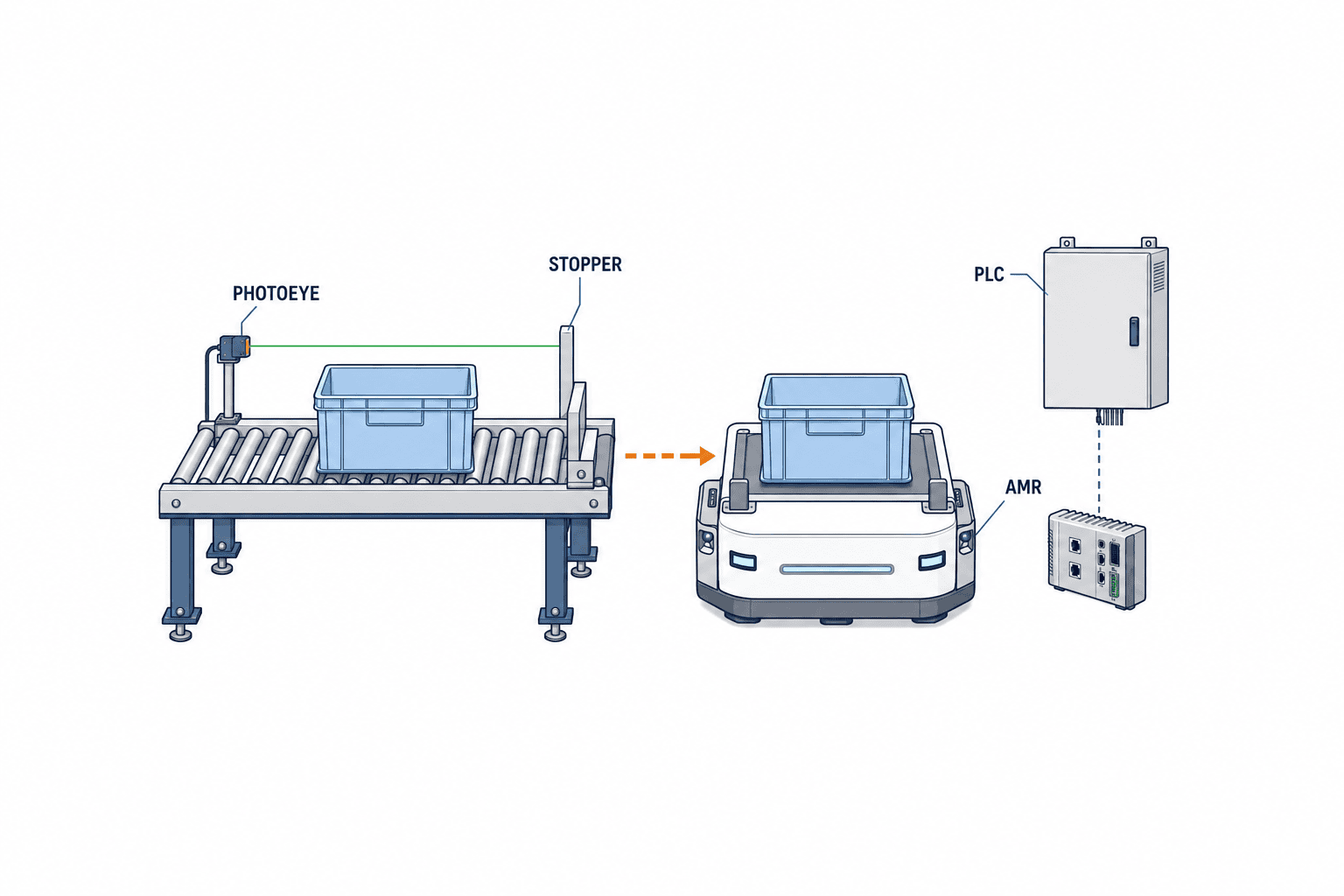
“Load-present sensor included” is too vague. Specify photoeye position and quantity, light-on or dark-on logic, debounce, transparent or dirty-container behavior and fail state. During transfer, sensors on both sides may be active; the state model must not misclassify this expected overlap as a fault.
Useful detection points include fixed-side permission, conveyor exit, gap crossing, AMR entry, AMR end stop, stopper position and docking confirmation. The quantity is not universal. Select the minimum arrangement that can determine how far the agreed load has moved in each credible failure mode.
Electrical and control interface
For hardwired I/O, industrial Ethernet or message APIs, define signal owner, assertion condition, hold time, timeout, retry, initialization and communication-loss behavior. Bind state to a transaction or transport ID so a PLC reboot cannot leave an old READY value that the AMR interprets as a new permission.
Select the AMR top module as part of an equipment combination
Commercial AMRs can use roller, belt, lift, pin and rack-towing modules. Compare more than maximum payload. For a roller module, examine drive zones, reversing, speed control, braking, stopper, load detection, emergency-stop retention and manual removal. The answer depends on the product and the integration design.
Omron publishes examples covering mobile robots such as the LD-250 and AMR toppers. Interroll publishes technical material for an AMR Top Module. These sources help understand available concepts; they do not guarantee acceptance performance at a particular factory. Require the supplier to submit the combined AMR, top module and fixed-conveyor drawings, I/O, power, control and maintenance responsibilities.
| Comparison item | State in the requirement | Evidence |
|---|---|---|
| Load | Dimensions, mass, center of gravity, bottom, deformation | Sample matrix and test record |
| Transfer | Direction, speed, gap, docking tolerance | Combined drawing, video and log |
| Retention | During travel, stop and emergency stop | Risk assessment and physical test |
| Detection | Presence, crossing, end, overhang | Sensor layout and fault tests |
| Recovery | JAM, TIMEOUT, PARTIAL LOAD | Procedure, authority and recovery log |
| Maintenance | Wear parts, cleaning, replacement and spares | BOM, interval and local stock plan |
Price-only comparisons often exclude fixed-conveyor modifications, extra PLC work, sensors, floor repair, API development and night SAT. Ask each quotation to separate included work, exclusions, assumptions and unit rates so the decision reflects the total process cost.
Make a six-step handshake the core of the specification
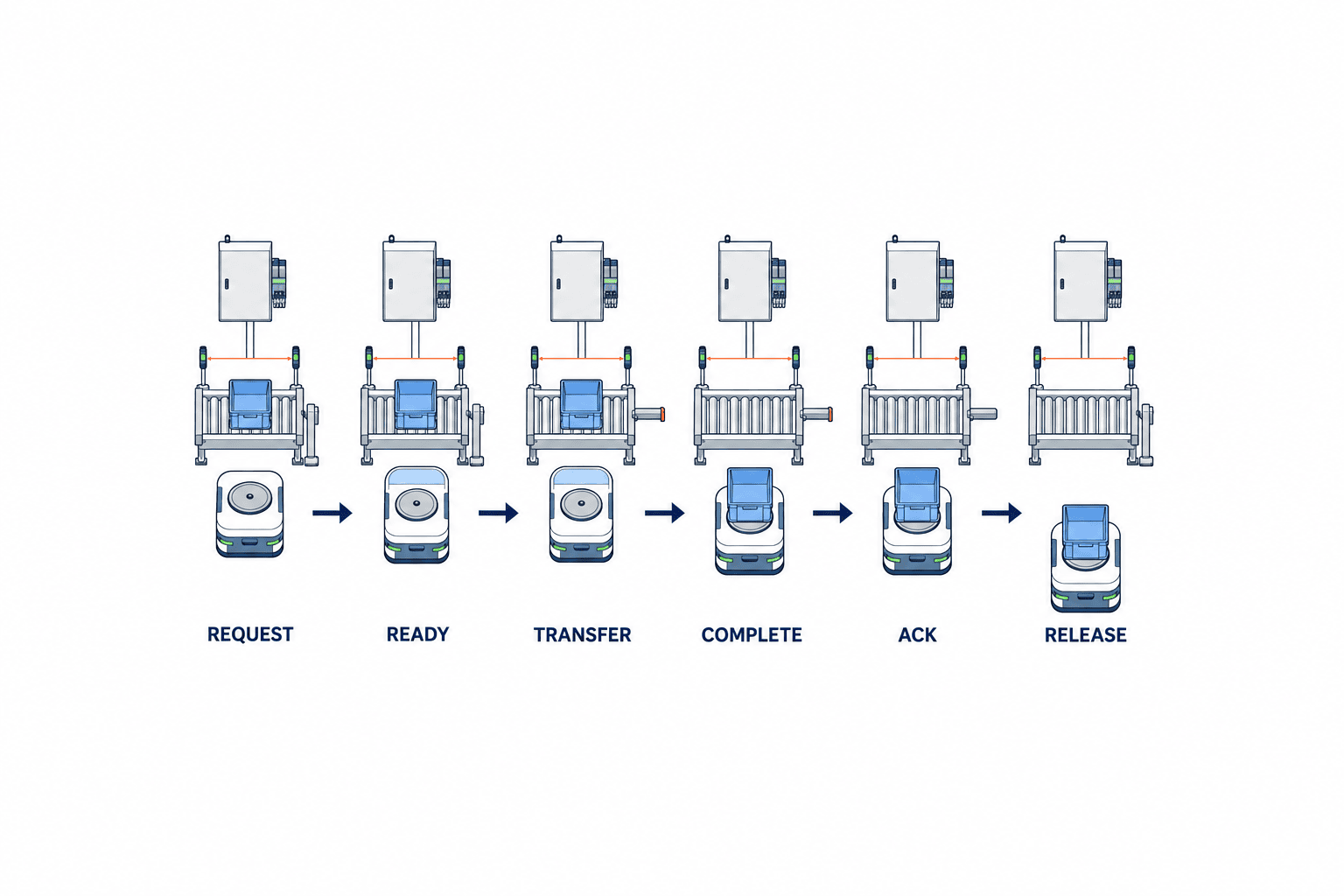
Define normal operation with REQUEST, READY, TRANSFER, COMPLETE, ACK and RELEASE. The labels can change, but their meaning and owner must not.
| State | Main owner | Transition condition | Prohibited behavior |
|---|---|---|---|
| REQUEST | Host/AMR | Valid transport ID, source, destination and load | Executing the same ID twice |
| READY | Fixed PLC | Docked, empty, safe and stopper ready | Reusing a previous state |
| TRANSFER | AMR/PLC | Both permit the same transaction | Driving from only one side’s decision |
| COMPLETE | Receiving side | Load at end and sending side empty | Completion from one sensor only |
| ACK | Host | Physical result matches the record | Inventory update before completion |
| RELEASE | AMR/PLC | Drives stopped, stopper restored, departure clear | Departure with an overhanging load |
After TRANSFER begins, define speed matching, start order and stop order. Starting the receiving side first may be appropriate, but it is not a universal rule; load inertia, roller pitch and stopper design require physical validation.
COMPLETE should combine sending-side empty, receiving-end occupied, valid intermediate sensors, stopped motors, matching transport ID and elapsed-time condition. If WMS confirms inventory before that, a partial transfer can separate digital inventory from the physical load.
In AGV-WMS integration, define the system of record by state
The difficult question is not whether WMS can dispatch a task. It is which system is authoritative after a fault. If WMS, WCS, MES, fleet manager and PLC each hold their own completion, a network interruption creates several conflicting truths.
Assign a unique transport ID and relate it to load ID, source, destination, request time, priority, load type, current state, state time and reason code. A retry with the same transport ID must be an idempotent update or status inquiry, not a new movement.
Authority can be divided by fact: PLC and sensors own physical presence, the fleet manager owns vehicle position and movement, WMS owns inventory custody, and MES owns process completion. They are linked by the transport ID. If a proposal says WMS owns everything, require an explanation of how it guarantees facts it cannot directly observe.
At minimum, log transport ID, load ID, station ID, AMR ID, command, state, source timestamp, receive timestamp, reason code and software version. Acceptance evidence should be exportable CSV or JSON, not screenshots.
For vehicle-selection context, see our AGV and AMR introduction guide for Thailand. Route and aisle design are covered in AGV layout design. This article deliberately focuses on conveyor interfaces and acceptance evidence rather than vendor, price or layout comparisons. For prioritizing the wider material-flow program, see in-plant logistics improvement.
Do not procure VDA 5050 3.0.0 with the word “compliant” alone
According to VDA, VDA 5050 3.0.0 was published in March 2026 and added support for free-ranging mobile robots and functions such as zone and path sharing. It is an important step for interoperability between multi-vendor vehicles and master control. It is not a safety standard, a mechanical/electrical interface standard for peripheral equipment, a WMS business specification, or an implementation and acceptance procedure.
On 13 September 2026, a third-party user opened issue #660 in the official VDA5050 GitHub repository, reporting an inconsistency in JSON schemas packaged with the v3.0.0 tag. It is shown as open and unassigned at the time of writing, but it is not a formal VDA/VDMA confirmation of the reported conclusion. It therefore does not prove VDA 5050 is unusable; it is a reason to verify the selected schema and implementation instead of accepting a commercial statement of “3.0 compliant.”
Require the following in the RFP:
- VDA 5050 version, release tag, schema file and commit hash.
- Implemented optional fields and vendor extensions.
- Scope for orders, instant actions, state, factsheet and other messages.
- Tests for broker loss, duplicates, reordering and older-schema messages.
- Conformance matrix for both master control and vehicle.
- Response and retest plan for known issues, including issue #660.
Do not follow a new specification automatically. Freeze the approved schema and update it through change control. Contract evidence should identify products, software versions, schema commit, test cases and results.
Connect ISO 3691-4 safety responsibility to peripheral equipment
ISO 3691-4:2023 addresses safety requirements for driverless industrial trucks and their systems, including the AGV/AMR field. A DIS for the next edition is in progress. Confirm the adopted edition, local legal obligations and company requirements with the responsible safety team; do not claim future-edition compliance without evidence.
A certified AMR safety function does not automatically remove transfer hazards created by the top module and fixed conveyor. Assess crushing during docking, roller entanglement, unstable loads, overhang, restart after emergency stop, manual jam removal and battery-related restrictions as a combined system.
Document how scanner protective fields relate to the fixed conveyor’s permission to move. A normal PLC READY bit must not substitute for a safety function. Draw functional safety, business interlock and information notification as separate layers and verify that a failure cannot progress toward danger.
Specify recovery for JAM, TIMEOUT and PARTIAL LOAD
An alarm is not a recovery design. The system must reconcile the physical position of the load, digital custody and the authority to energize drives.
JAM
Detect JAM through agreed combinations of motor current, photoeye duration, travel distance and speed. Stop both sides and limit automatic retries. Before anyone touches the load, confirm energy isolation, AMR movement inhibition, stopper condition and work authority. Record whether recovery continues the same transport ID or cancels it and creates a new ID.
TIMEOUT
Use separate reason codes for waiting READY, docking, TRANSFER, COMPLETE and ACK. Timeout values are not universal industry constants. Agree them for the transfer length, speed, load, communication cycle and business tolerance, and audit later changes.
PARTIAL LOAD
A load bridging fixed conveyor and AMR is the most ownership-sensitive condition. Inhibit travel, stop both drives and estimate position from multiple sensors. Whether to reverse, pull forward or remove manually must come from load-specific validation. Keep WMS completion pending until physical recovery and ID reconciliation are complete.
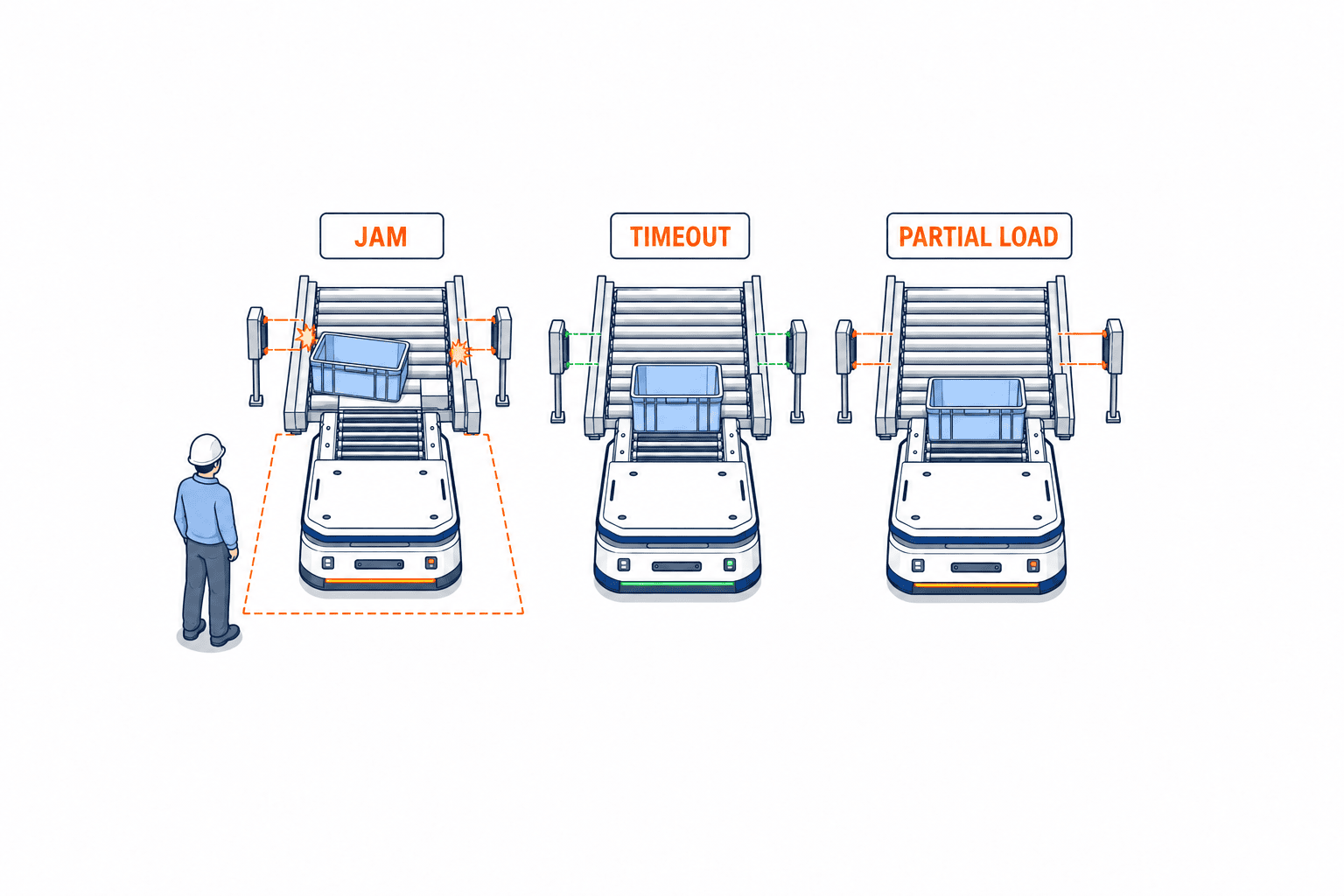
Create a recovery card for each abnormal state: detection, safe state, first responder, authority, tools, logs, inventory correction, restart criteria and escalation. Recovery time can be an operational KPI, but a contract value requires explicit start and finish points.
Empty-container return automation needs its own tests
Empty-container return automation can use the return trip, yet differs from full-container movement:
- Light boxes may slide, bounce or skew on rollers.
- Damage, sag, labels and tape can make detection unstable.
- Nested and single boxes differ in height and center of gravity.
- Mixed container types can create downstream supply errors.
- Low-priority returns can accumulate and obstruct escape or work areas.
Use worn, dirty, deformed, lightest, maximum-stack and loose-label samples in the PoC, not only a new representative box. Even without individual container serialization, define where type, quantity, orientation and transport unit are confirmed.
If one AMR carries full boxes outward and empties back, assess contamination classes, priority, residue on the module and wrong-load detection. Measure empty-container dwell, request-to-completion time, wrong-box rate and manual interventions, not only AMR utilization.
Separate FAT and SAT, linked by the same requirement IDs
FAT reproduces control logic and abnormal scenarios at the supplier facility. SAT proves operation with the real floor, network, PLC, operators and loads. Trace each RFP requirement ID to tests, evidence and open items.
Recommended FAT scope
- Simulate signals for AMR, top module and fixed PLC.
- Run every valid six-step transition and reject illegal transitions.
- Test duplicate requests, retry and reordered messages for the same transport ID.
- Trigger timeout at each stage, stuck sensors, communication loss and power restart.
- Detect, stop and recover JAM and PARTIAL LOAD under controlled authority.
- Export WMS/fleet logs and confirm timestamp alignment.
- Preserve software version, PLC program and schema commit.
Recommended SAT scope
- Measure docking on the actual floor across load, battery and tire conditions.
- Transfer real full, empty and deformed containers in both directions.
- Disconnect the factory network and resume idempotently.
- Test emergency stops, scanners and authorized manual recovery.
- Include shift change, different user rights and maintenance mode.
- Reconcile WMS inventory, physical load and transport history.
- Have trained local staff recover and export evidence without supplier operation.
“100 consecutive successful transfers,” “JAM recovery within the agreed time” and “zero duplicate inventory records” are examples of project acceptance metrics. They are not universal limits prescribed by ISO, VDA or the industry. Agree repetitions, conditions, tolerance and measurement for the load, cycle, risk and production target of each project.
Recommended 90-day PoC stages and gates
This is a recommended project structure, not a standard. Adjust the days to project conditions.
| Period | Main work | Completion gate |
|---|---|---|
| Day 1–15 | Site survey, load classification, hazards and boundaries | Approve interface drawing, ownership and PoC loads |
| Day 16–30 | Mechanical/electrical design, six-step states, ID and logs | Freeze drawings, signals, transition table and test plan |
| Day 31–45 | Offline integration, simulator and fault preparation | Pass FAT readiness review |
| Day 46–60 | FAT, correction, retest and site-work plan | Close or conditionally accept critical open items |
| Day 61–75 | Installation, network, WMS connection and training | SAT readiness and safety approval |
| Day 76–85 | SAT with real loads, disconnection, recovery and shifts | Meet agreed acceptance criteria |
| Day 86–90 | Stabilization, evidence handover and scale decision | Sign Go, conditional Go or Stop |
The PoC can use one station and one AMR, but it must complete one small loop of load, handshake, failure recovery, logs and ownership. A normal-operation demo is not enough. Conversely, deploying every line first makes boundary defects expensive construction problems.
Each open item needs impact, containment, owner, due date and retest condition. “Future support” is not acceptance. The scaling gate should also review maintenance effort, spares, training, support hours and change cost.
Put an ownership matrix in the purchase specification
| Subject | Factory | AMR vendor/SI | Fixed-equipment vendor | IT/WMS owner |
|---|---|---|---|---|
| Loads/capacity | Master data and demand | Transport validation | Conveyor validation | ID and custody rules |
| Floor/route | Survey and repair approval | Travel and docking needs | Installation datum | Out of scope |
| Top module | Requirement and acceptance | Design, integrate, maintain | Connection condition | State integration |
| PLC/safety | Approve plant standard | AMR-side I/O | Fixed-side logic | Monitor only |
| WMS integration | Business owner | Fleet API | Station state | Dispatch, inventory, audit |
| Recovery | Operations owner | AMR procedure/training | Equipment procedure | Idempotency/correction |
| FAT/SAT | Decide pass/fail | Integration evidence | Equipment evidence | Data evidence |
Avoid excessive “shared responsibility.” Give every deliverable one accountable owner and separate contributors, executors and verifiers. Define handover formats for source code, PLC backups, configuration, schemas, drawings, BOM and logs.
Confirm BOI 2026 investment conditions formally
Thailand BOI’s 2026 automotive-industry measure is limited to general automobile manufacturing under activity 3.6 and specified targets under activity 3.8, including PHEV/HEV-related cases; it is not a general incentive for every automotive company or AMR purchase. The published framework states an application period of 2026–2027, a minimum investment of THB 1 million, a three-year corporate-income-tax (CIT) exemption and an exemption cap equal to 50% of eligible investment. The cap becomes 100% when the value of machinery that supports Thailand’s domestic automation-machinery industry is at least 30% of the value of the eligible machinery and equipment. Confirm the precise eligible activity, PHEV/HEV scope, qualifying cost, value calculation, evidence, deadline and interaction with other incentives directly with BOI or an accredited adviser.
BOI also reported 132 applications worth THB 17.2 billion for Smart and Sustainable Industry in the first half of 2026. These are application counts and amounts, not proof that every project was approved, commissioned or delivered benefits. They provide investment context, not a substitute for PoC acceptance or ROI.
Link quotation, purchase order, inspection, payment, asset registration and benefits evidence through the same equipment ID and requirement IDs so incentive documentation and engineering acceptance do not diverge.
RFP checklist for suppliers
- Full load list, worst cases and sample conditions.
- Combined drawings for fixed conveyor, AMR and top module.
- Six-step handshake, abnormal transitions and transaction ID rules.
- Photoeyes, stopper, motors, safety circuits, docking and I/O.
- Systems of record and APIs across WMS/WCS/MES/fleet manager.
- Detection, stop, recovery and inventory correction for all three fault classes.
- VDA 5050 version, tag, schema commit, implementation scope and known issues.
- Applicable standards, including ISO 3691-4:2023, law and risk-assessment owners.
- FAT/SAT cases, inputs, expected results, evidence and retest rules.
- 90-day PoC schedule, deliverables, payment gates and scaling conditions.
- Local maintenance, SLA, spares, training, updates and cybersecurity.
- Included and excluded cost, assumptions, rates, IP and data ownership.
Require document names, versions, drawing numbers and test case IDs, not “supported.” If an item is unknown at proposal time, request its decision date and price impact.
Summary: buy the interface and recovery before buying scale
A conveyor-top AMR succeeds when transfer to the fixed conveyor can be tested and reproduced, not when the AMR data sheet looks strong. Connect mechanics, sensors, PLC and WMS/WCS through the six-step state model; track physical load and inventory using transport IDs; and recover JAM, TIMEOUT and PARTIAL LOAD safely. Use VDA 5050 3.0.0 for interoperability while freezing the schema commit and specifying safety, peripheral equipment and acceptance separately. Procure the 90-day PoC as a small complete cycle of FAT/SAT and ownership, not a normal-operation demonstration.
TOMAS TECH can support site measurement, interface drawings, signal tables, RFP preparation, a 90-day PoC and FAT/SAT evidence before vendor selection. You can contact us while the transfer concept is still being defined.
FAQ: conveyor-top AMR procurement and acceptance
Should the AMR top module come from the AMR supplier?
A single supplier can simplify ownership, but does not automatically guarantee fixed-conveyor fit. Contract who integrates the combined drawings, signals, FAT and SAT, whether one supplier or an SI coordinates several parties.
What is the minimum data for AGV-WMS integration?
Start with transport ID, load ID, source, destination, state, state time and reason code. Assign authority for physical presence, movement, inventory and process completion, then test that a retry cannot create a duplicate movement.
Can full-container tests cover empty-container return automation?
No. Light weight, deformation, nesting, labels and sliding change behavior. Test worn and dirty worst-case samples for detection, skew, accumulation and wrong-box risk.
Does VDA 5050 3.0 support guarantee immediate multi-vendor operation?
No. Freeze the release, JSON schema commit, optional fields, extensions and master-control scope, then run implementation tests. VDA 5050 does not replace peripheral-equipment, safety or acceptance specifications.
Is 100 consecutive transfers a mandatory standard value?
No. It is an example of a project-agreed metric. Set the repetitions, allowed failures and measurement method for the required cycle, load mix and risk.
How is JAM recovery time measured?
Define whether it begins at detection and ends at physical clearance, digital reconciliation or production restart. Also define excluded time, owner and supporting logs.
What is the difference between FAT and SAT?
FAT proves logic, communication and abnormal inputs at the supplier site. SAT proves the actual floor, loads, PLC, network and user authority. Link both with the same requirement and test case IDs.
Is every AMR investment eligible for the BOI measure?
No. Company, activity, expense, timing, domestic linkage and evidence conditions apply. Confirm the 2026–2027 rules and caps formally with BOI or an accredited adviser.
Primary and official references
- VDA press release, VDA 5050 3.0.0 — https://www.vda.de/en/press/press-releases/2026/260421_PM_VDA_5050_EN
- VDA 5050 Version 3.0.0 specification — https://www.vda.de/dam/jcr%3A09f03b91-13e2-4db3-bf30-4f221710071b/VDA5050-V3.0.0-2025-03.pdf
- Official VDA5050 GitHub releases — https://github.com/VDA5050/VDA5050/releases
- Third-party issue #660 in the official VDA5050 GitHub repository (open and unassigned at drafting; not a formal VDA/VDMA confirmation) — https://github.com/VDA5050/VDA5050/issues/660
- ISO 3691-4:2023 — https://www.iso.org/standard/83545.html
- ISO/DIS 3691-4 edition 3 — https://www.iso.org/obp/ui?_escaped_fragment_=iso%3Astd%3Aiso%3A3691%3A-4%3Adis%3Aed-3%3Av1%3Aen
- Omron LD-250 — https://robotics.omron.com/products/mobile-robots/ld-series/ld-250/
- Omron AMR toppers overview — https://automation.omron.com/en/us/blog/autonomous-mobile-robot-toppers
- Interroll AMR Top Module — https://www.interroll.com/fileadmin/user_upload/Downloads__PDF_/AMR/AMR_Top_Module_EN.pdf
- Thailand BOI automation information — https://www.boi.go.th/th/automation
- Thailand BOI, first-half 2026 investment news — https://osos.boi.go.th/EN/news/2430/Thailand-Secures-43-6bn-1H-2026-Investment-Surge-as-Big-Tec/


