


Generative AI use cases in manufacturing often arrive with impressive numbers, but those numbers alone are not a sound basis for an investment decision. This guide examines seven company cases presented in primary sources available in 2026 and translates them into practical questions: what was built, what conditions supported the outcome, what should be tested locally, and what evidence is needed after 90 days. It is written for executives, plant managers, and DX or IT/OT leaders in Thailand who need to move beyond a demonstration and make a scale, revise, or stop decision.
Executive takeaway: buy the repeatable conditions, not the headline number
The cases cover maintenance knowledge, production scheduling, conversational machining, quality analysis, and employee-built agents. Despite the variety, the operating pattern is consistent. Each successful application has a narrow task boundary, governed source data, a human decision point proportional to the consequence, paired business and safety metrics, and an owner for ongoing operation.
Do not put another company’s “75%,” “25%,” or “three weeks” directly into your Thailand business case. Those results belong to a particular process, data set, baseline, organization, and measurement period. Use the case to identify the operating conditions and test design. Measure your own baseline, reproduce the pattern in a controlled 90-day scope, and fund the next stage only with your own evidence.
Vendor customer stories are useful primary sources, but they are not cross-industry benchmarks or controlled comparisons. Every figure below is attributed to the customer context in which it was reported.
Comparing seven manufacturing AI cases
| Company and scope | Role of AI | Result reported by the primary source | Conditions to establish before expecting a result | 90-day acceptance focus |
|---|---|---|---|---|
| Volkswagen Group | Maintenance chatbot and shared AI platform | Maintenance chatbot rolled out to 8 plants in 3 weeks | Shared platform, plant-specific content boundary, access control, rollout template | Grounded-answer rate, critical errors, search time, effort to add a plant |
| Jabil | Multilingual shop-floor knowledge retrieval | First iteration built in 1 week; later connected to more than 1,700 policies, specifications, and troubleshooting documents | Authoritative sources, metadata, update owner, multilingual test set | Citation accuracy, resolution rate, search time, stale-answer rate |
| Sight Machine | Re-optimizing production plans with live constraints | For the beverage manufacturer in the story, non-value-added production time fell 75% and capacity increased by more than 5% | Live constraint data, agreed objective, feasibility checks, human approval | Zero constraint violations, time to approval, changeover and capacity impact |
| ARUM | Natural-language assistance for NC machining preparation | Source reports 177 NC programming steps reduced to 2 and manufacturing cost per part reduced 50% | Bounded commands, deterministic safety interlocks, validated process library, novice usability test | Unsafe-command blocking, setup completion, first-pass yield, interventions |
| AGCO | Governed citizen development of business agents | More than 900 employees volunteered as makers; some quality reviews moved from weeks to about 1 hour | Maker training, central review, portfolio consolidation, named business owner | Owner coverage, release pass rate, usage, verified time saved, incidents |
| Toyota Industries | Contextualized paint-process data and quality analysis | Three-month pilot showed about 25% fewer defects; executive summary reports analysis cycle reduced from 5 days to under 4 hours | OT context, variable definitions, operator adoption, controlled trial, action log | Analysis time, validated cause rate, defects and rework, false alerts |
| Georgia-Pacific | Operator assistant across documents, maintenance records, IoT data, and expert knowledge | Source reports lower off-quality and downtime; this article does not assign a percentage | SME review, equipment/site context, freshness owner, source traceability | Grounded answers, first-contact resolution, downtime, time to refresh knowledge |
These rows are not a league table. The metric, time window, maturity, and process boundary differ. Volkswagen’s three weeks describes rollout speed to eight plants, not payback. Jabil’s one week refers to the first iteration, while connection to more than 1,700 documents followed additional integration. Sight Machine’s figures refer to a particular beverage-manufacturing optimization. Toyota Industries’ defect result came from a paint-process pilot. Removing those boundaries creates an expectation that the local project cannot responsibly defend.
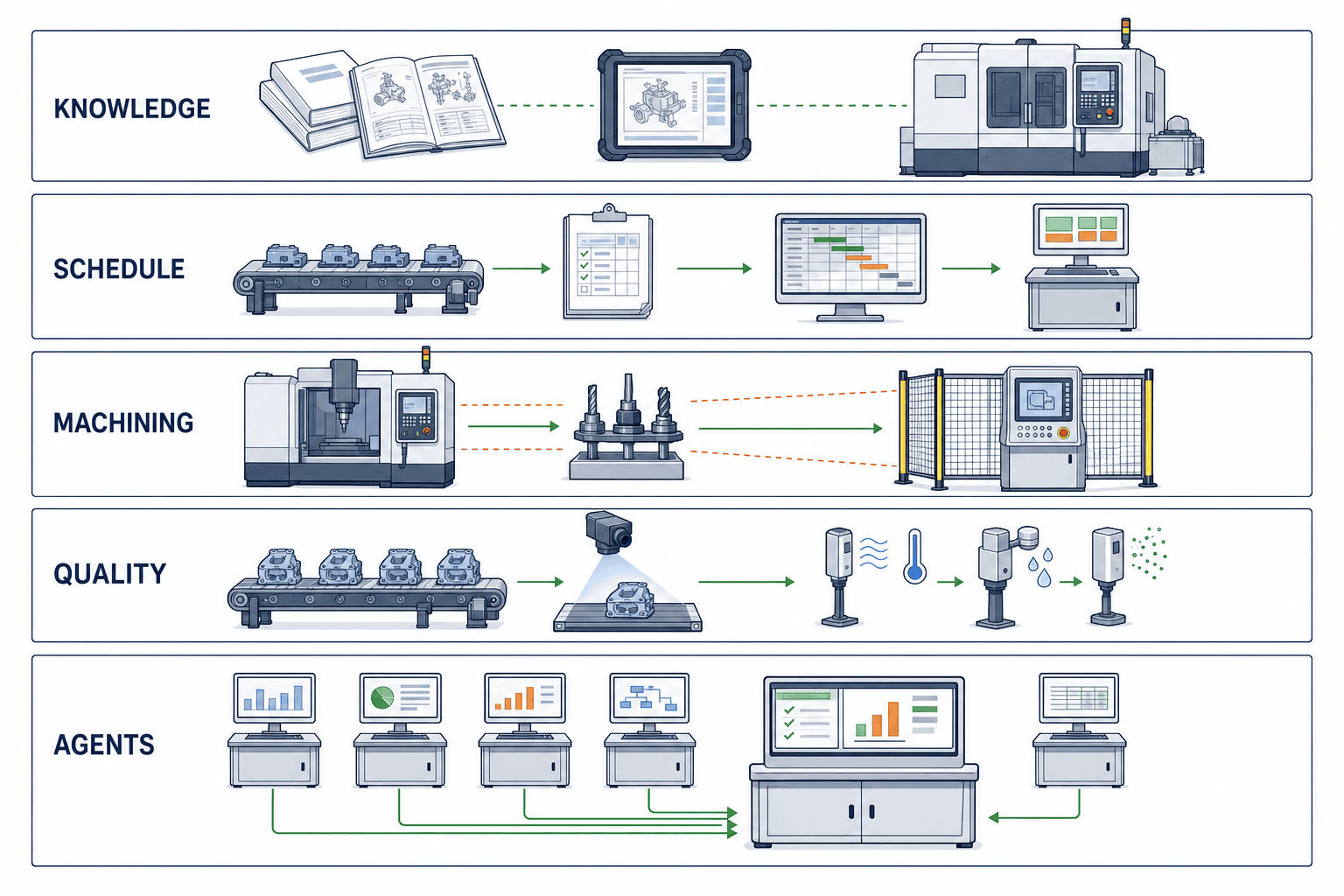
Case 1: Volkswagen scales maintenance support through a common platform
The AWS story describes Volkswagen Group’s Genius central generative AI platform and a maintenance chatbot that gives technicians rapid access to technical data. Volkswagen’s representative says the maintenance chatbot was rolled out to eight plants in three weeks. The transferable lesson is not simply that a chat interface can be built quickly. It is that a new plant can be added without rebuilding authentication, model access, logging, monitoring, and evaluation from zero.
A repeatable design separates the common control plane from plant-specific knowledge. Identity, logs, model routing, evaluation, and monitoring can be shared. Equipment records, maintenance procedures, terminology, and permissions remain isolated by site or role. In a Thailand plant, metadata must also connect Thai shop-floor nicknames, English equipment names, and Japanese headquarters document numbers to the same asset.
For a 90-day acceptance test, build a set of 50 to 100 representative fault questions. Test whether the assistant retrieves an approved procedure, displays its version and effective date, blocks unauthorized material, and escalates safely when evidence is missing. Then measure the configuration effort for a second site. That figure tells management more about platform leverage than the number of screens in the first demo.
Case 2: Jabil separates a one-week first iteration from a governed 1,700-document service
Jabil’s AWS story states that the first iteration of its intelligent shop-floor assistant was built in one week. Additional data sources were added during the following weeks. The source says employees later received real-time access to more than 1,700 policies, manufacturing specifications, and troubleshooting documents in multiple languages. Speed to a first iteration and readiness of a production knowledge service were treated as different milestones.
The most common failure in generative AI for business operations is to upload many files and call the result “trained.” A trustworthy service needs an authoritative source for every topic, an update owner, expiry handling, and metadata for equipment, product, site, language, and document status. An answer should show the source title, revision, effective date, and link to the exact evidence. Retrieval can confidently surface the wrong document if document governance is weak.
During the 90-day trial, use the top 20 question types and compare the old search time with assisted time. Measure citation correctness, critical-error count, escalation rate, and percentage of answers using an obsolete revision. A response-time KPI without an evidence-quality KPI can reward fast, plausible errors.
Case 3: Sight Machine generates a constrained production plan, not just text
Microsoft’s June 3, 2026 Sight Machine story describes a beverage manufacturer that replanned production 10 to 15 times per week through manual meetings. The solution connects actual line speeds, changeovers, ramp-up, cleaning, demand, and other operational inputs. A natural-language description of the business problem is converted into an optimization formulation, and the plan can be recalculated as conditions change. For that manufacturer, the story reports a 75% reduction in non-value-added production time and a capacity improvement of more than 5%.
The repeatable system is larger than a language model. It combines current plant data, formal constraints, an agreed optimization objective, and a feasibility check. A request such as “reduce cleaning while meeting delivery” is incomplete until the system represents allergens, color sequence, molds, worker qualifications, maintenance windows, material lots, and other non-negotiable rules.
Acceptance should focus first on zero critical constraint violations, repeatable calculations, approval time, explanation of changes from the current plan, and rollback during an abnormal event. Capacity or non-value-added time is a second-stage outcome. A single severe constraint violation can justify stopping the release even when the average score appears high.
Case 4: ARUM limits the boundary between conversation and machine action
Microsoft’s April 15, 2026 ARUM story presents a machining center designed so a less experienced user can proceed through setup and operation by speaking with an AI character. The source reports that an NC programming process with 177 conventional CAM steps is reduced to two and that manufacturing cost per part is cut by 50%. The detailed story connects the cost statement to the share of work attributed to NC programming, so the number must not be generalized to another part family or factory.
In conversational machine support, the crucial architecture decision is not to give a generative model unrestricted control authority. The model can interpret intent and explain a procedure, while deterministic components map the request to an allowed command set, validate tool and material combinations, check collisions, enforce emergency stops, and preserve PLC or CNC safety interlocks. The final program must have an explicit approver and a state transition that cannot proceed without authorization.
Test ambiguous instructions, incorrect units, unavailable tools, unauthorized parameter changes, and sensor disagreement—not only the happy path. A safe failure must stop, explain the reason, and hand the task to a qualified person. Faster novice operation is not an acceptable trade for allowing one hazardous command.
Case 5: AGCO makes citizen development a governed supply chain
Microsoft’s July 6, 2026 AGCO story says that, at a leadership meeting of about 2,200 people, more than 900 employees volunteered to become agent makers. The source also reports that some quality reviews moved from weeks to about one hour. The more transferable signal is not the size of the maker population; it is the division of work. Employees identify real friction, while AI leaders and specialists shape, review, and consolidate solutions for enterprise use.
Collecting corporate ChatGPT use cases without portfolio governance produces many small, overlapping bots. Each agent needs a data classification, owner, audience, retention rule, model, external-transmission rule, log, and suspension procedure. Similar applications should be combined. AGCO’s example points to a model in which ideation is distributed but authority to release into production remains governed.
Measure owner coverage, test-data coverage, review pass rate, duplicate consolidation, weekly active use, verified time saved, and incident count. A large catalogue of unused agents is not an asset. A retirement criterion is part of a healthy citizen-development program.
Case 6: Toyota Industries builds context before asking AI to explain quality
Microsoft’s April 15, 2026 Toyota Industries and Sight Machine story describes contextualizing paint-process sensor and environmental data so teams can analyze the process as a connected operation. After a three-month proof of concept using actual factory data, the source reports about a 25% drop in defects during the relevant period. Its executive summary says analysis cycles were reduced from five days to under four hours. The story also describes analyzing nearly 400 variables before narrowing attention to signals most correlated with defects.
Where a plant says, “We collect data but cannot find the cause,” the first task is to connect tag names, units, timestamps, product, machine state, recipe, inspection result, and rework outcome to the same production event. Without that context, an AI explanation can be fluent but operationally wrong.
Acceptance should include analysis time, the percentage of suggested factors reproduced in a plant test, the period during which a countermeasure remains effective, false alerts, missing-data rate, and preparation time for daily review. Correlation must not be presented as causation. Recording the loop from hypothesis to countermeasure to observed outcome creates a reusable asset for another product or line.
Case 7: Georgia-Pacific creates a workflow for capturing expert knowledge
The Georgia-Pacific AWS story describes ChatGP, an operator assistant connecting digital documents, maintenance records, and IoT sensor data and tailoring guidance to the facility and equipment. It also describes recording conversations among experienced workers and turning the content into reusable documents. The primary source reports reduced off-quality and machine downtime, but this article does not assign a percentage because no comparable verified percentage is provided for the claim used here.
The transferable lesson is not that AI replaces experienced employees. It is that tacit knowledge is converted into a reviewed source while experts are available to validate it. A conversation summary should not automatically become truth. It needs an equipment identifier, symptom, preconditions, hazards, reviewer, and effective date. Questions that reveal missing knowledge should return to the owner and update the source.
The 90-day scorecard can measure first-contact resolution on representative problems, time to the correct procedure, citation visibility, stale-knowledge detection, and expert review effort. Expert effort may increase early as the knowledge base is prepared; the operating target is to move later toward exception-only review.
Five repeatability conditions extracted from the cases
1. Define one decision, not a broad ambition to “use AI”
Replace “improve maintenance” with a bounded statement such as “when fault code X occurs on asset class Y, present the currently approved diagnostic procedure and required safety checks.” Specify the input, output, user, moment of use, and next step. This exposes required data and makes an acceptance test possible. If the scope cannot be evaluated in 90 days, split it.
2. Establish authority, access, and freshness together
RAG and enterprise search do not repair weak information management. Define the owner, approved revision, expiry, asset and product metadata, access permissions, and update service level. Decide field by field whether ERP, MES, maintenance management, SCADA, or a controlled repository is authoritative. In a multilingual plant, include a terminology table and access to the original-language source.
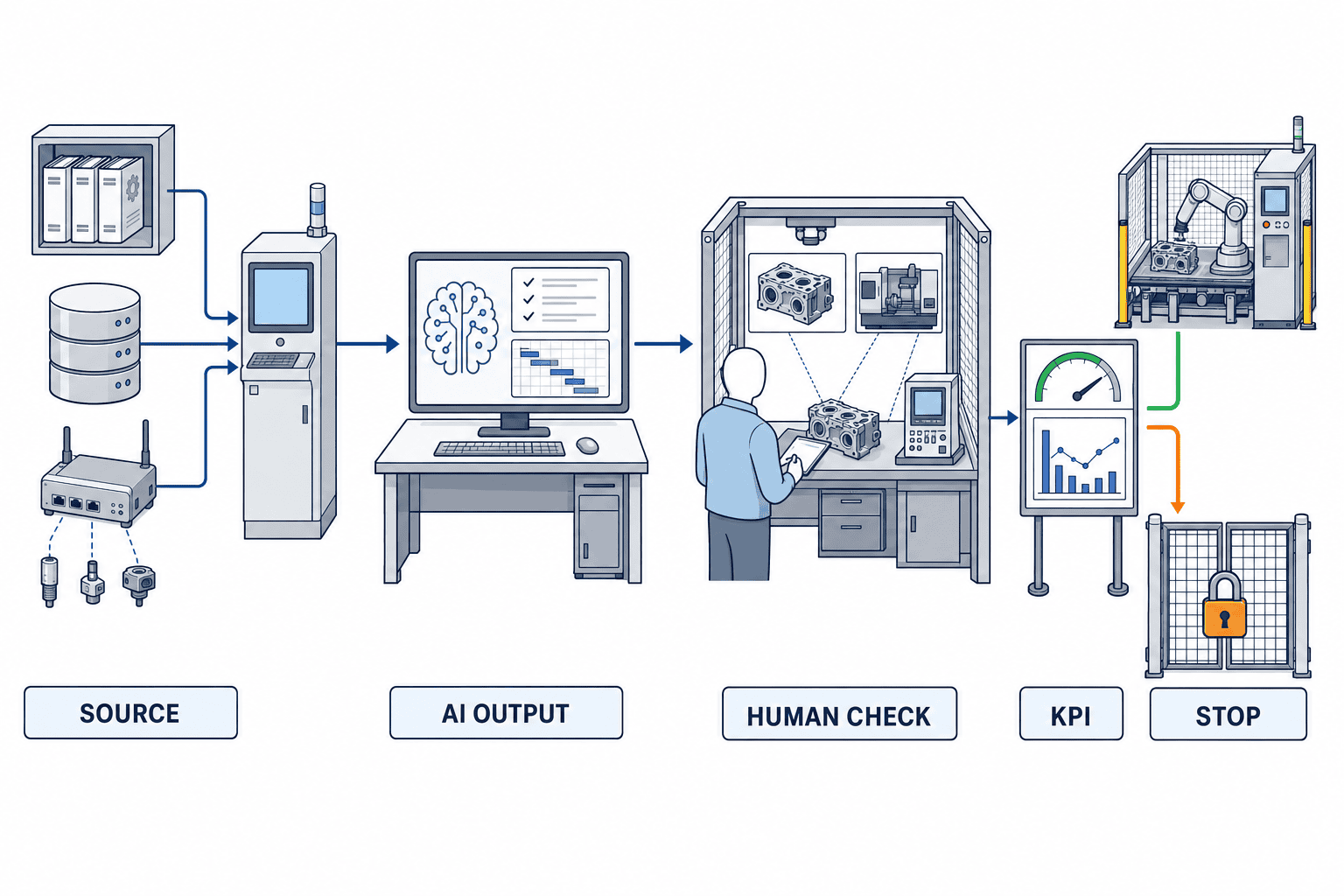
3. Match human control to the consequence
An FAQ response, a released production schedule, and an NC command do not carry the same risk. A low-consequence response may be automatic; a medium-consequence recommendation may require review; a high-consequence action may require two approvals and deterministic interlocks. Define what the reviewer must inspect, how quickly the decision can be made, and where a rejected output returns.
4. Pair a business KPI with a guardrail KPI
Time saved can hide quality loss. Put search time beside critical errors, schedule time beside constraint violations, defect reduction beside false alerts, and automation rate beside human overrides. Measure the baseline before development and fix the population, product mix, shifts, and evaluation period.
5. Test the operating owner and unit economics before the pilot ends
In production, document updates, evaluation, monitoring, support, permission changes, and incident response can cost more than model tokens. Name the business, data, technical, and security owners. Estimate marginal cost per request, plant, and user. Test whether a shared foundation lowers the cost of the second deployment.
Which generative AI business use case should go first?
| Current friction | Suitable first pattern | Data needed first | Stop condition before production |
|---|---|---|---|
| Too much time spent finding procedures | Evidence-grounded knowledge retrieval | Approved procedures, revision, effective date, equipment ID | Critical error, permission leak, answer without evidence |
| Frequent replanning meetings | Constraint-aware planning support | Actual rates, changeovers, inventory, due dates, outages | Infeasible plan, constraint violation, unexplained change |
| Only experts can set up equipment | Conversational work assistance | Allowed commands, standards, tools, hazard rules | Unsafe command passes, no safe stop, unapproved execution |
| Root-cause analysis takes days | Quality and process analysis | Time-series tags, product, result, action history | Causal overclaim, excessive missing data, non-reproducible finding |
| Many small improvement ideas | Governed citizen agents | Data class, users, workflow, owner | No owner, duplicate agent, no audit log |
A knowledge or analysis assistant can be an easier first project because it does not directly actuate equipment. However, a maintenance answer or quality disposition can still be high risk. Classify by the consequence of a wrong output, not by the label of the application.
When many ideas compete, use our generative AI use-case prioritization guide for Thailand to compare value, data readiness, difficulty, and risk. The four shop-floor AI use-case patterns provide a complementary map of frontline applications.
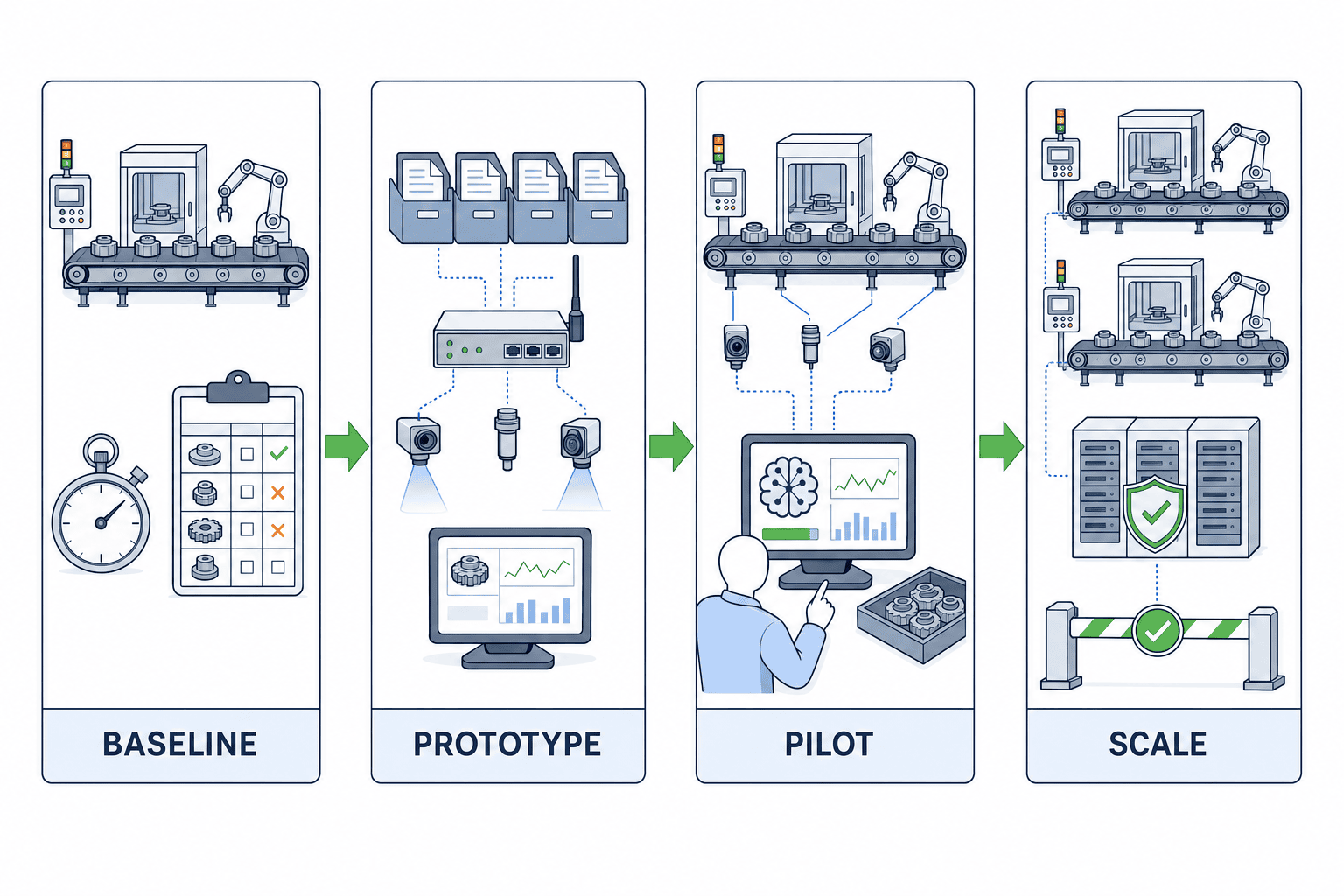
A 90-day roadmap that produces a decision, not a demo
Weeks 0–2: fix the process boundary and baseline
Name an executive sponsor and an operating owner. Write the target workflow in one sentence and measure current time, volume, quality, downtime, rework, and inquiry load. List exclusions and classify personal data, trade secrets, customer drawings, export-controlled information, and equipment-control data. Agree who will decide “scale,” “continue with conditions,” or “stop” at day 90.
Deliver a process map, data inventory, risk register, baseline, and acceptance criteria. A chat screen is not yet necessary. If the source has no owner, the baseline cannot be measured, or the process varies without control, narrow the scope.
Weeks 3–4: build a thin vertical slice and expose dangerous failures
Use representative data to connect input, AI output, review, and final action. Before optimizing accuracy, test unauthorized documents, obsolete instructions, ambiguous requests, missing inputs, model outage, network interruption, and Thai terminology variants. Confirm that the system fails safely and tells the user what to do next.
The gate is architectural: can severe risks be controlled, can authoritative data be acquired continuously, and will operations participate in testing? A “no” should trigger redesign, not more surface features.
Weeks 5–8: compare in parallel operation
Keep the existing process and run the new workflow with a limited shift, machine, product, and user group. Record whether each AI suggestion was accepted, edited, or rejected and why. Review severe errors daily and update the evaluation set weekly. Measure interface clarity, evidence readability, and approval workload as well as model output.
The gate requires no severe incident, achieved guardrails, and users who can understand and judge the output. If errors cluster around one equipment type or language, divide the scope rather than averaging the weakness away.
Weeks 9–12: prove operating readiness and expansion cost
Exercise monitoring, access requests, knowledge updates, incident response, re-evaluation after a model change, and retirement. Simulate a second site, product, or department and measure its setup time and added cost. Present conservative, expected, and upside cases based on verified volumes—not an unsupported productivity promise.
At the final gate, summarize KPI results, residual risk, annual operating cost, accountable owners, and the next 90-day plan on one page. Passing one plant does not automatically authorize all plants; a different process boundary may require a new evaluation.
KPI and acceptance-test examples
| Pattern | Business KPI | Guardrail KPI | Acceptance test | Decision gate |
|---|---|---|---|---|
| Knowledge retrieval | Median answer time, first-contact resolution | Zero critical errors, citation correctness, zero permission leaks | 100 approved questions, 20 obsolete-document traps, 20 permission cases | Stop on any critical error; limited release only after other thresholds pass |
| Planning support | Time to approved plan, changeover time, capacity | Zero constraint violations, feasible-plan rate, explained-change rate | Replay a production week and inject outage, shortage, and urgent order | Any critical constraint violation fails the gate |
| Conversational equipment support | Setup time, first-pass yield | 100% hazardous-command blocking, zero unapproved execution | Wrong units, missing tool, unauthorized edit, sensor conflict | All safety tests before a limited physical trial |
| Quality analysis | Analysis time, defect and rework rate | False alerts, reproduced findings, missing-data rate | Blind test on historical lots followed by controlled plant validation | Correlation alone cannot authorize a countermeasure |
| Citizen agents | Verified hours saved, weekly active use | 100% owner and logging coverage, zero severe incidents | Run release, access change, model update, and retirement workflows | No owner or incomplete review means no release |
Set thresholds from the local baseline and risk tolerance, not from a customer-story headline. A 50% reduction in search time still fails if a severe safety error occurs. A 20% improvement may justify investment if volume is high and the service can be reused across plants.
Keep acceptance data separate from development data. Record the expected answer, allowed variation, prohibited answer, evidence, and judge. Re-run the set when the model, prompt, connection, or source document changes. Generative AI quality is a controlled operating process, not a one-time benchmark.
Governance for generative AI operations in Thailand
ETDA’s AI 2026 direction emphasizes an AI ecosystem that is safe, transparent, fair, and aligned with international governance principles. The page describes practical AI Governance Guideline & Toolkits, with 12 sets available and two further sets under development. This policy direction does not determine legal compliance for an individual project, but it reinforces a practical principle: ownership, risk assessment, human oversight, logging, explanation, and suspension should exist from the first day of a pilot.
At minimum, maintain a register of purpose, affected users, input data, external destinations, retention, model, permitted use of output, approver, and incident contact. When the application handles personal data, customer-confidential information, drawings, contracts, or employee assessment, include legal, security, and data-protection review in the project plan. Cloud versus on-premises is not by itself a safety decision. Evaluate access, encryption, isolation, logs, deletion, vendor terms, and operator behavior together.
Before selecting a technical stack, our guide to a secure generative AI environment can help structure data classification, RAG, access control, audit logs, and model evaluation.
Evaluate BOI treatment separately from AI value
The Thailand BOI automation page is a starting point for checking current measures. Applicability can depend on the promoted activity, eligible investment, timing, treatment of existing equipment, evidence, and current program conditions. This article does not state that a particular AI project qualifies or promise an incentive rate. Confirm the current rules with BOI or an appropriately qualified adviser.
First calculate whether the project is rational without an incentive. Include pilot work, production engineering, integration, data preparation, training, operation, model usage, and audit. Compare this total cost with verified time savings, avoided downtime, quality impact, and capacity value. An incentive can strengthen a sound investment; it should not rescue an application without operating value.
Questions for a build, buy, or co-delivery decision
The realistic choice is rarely total internal development versus total outsourcing. The manufacturer should retain ownership of the operating decision, reference answers, acceptance criteria, and ongoing accountability. A partner can help with the shared platform, integration, automated evaluation, and security engineering. Gaps in the answers below indicate where help may be needed:
- Who can define the correct result and a critical error for the target process?
- Which system is authoritative for each field across ERP, MES, SCADA, maintenance, and documents?
- Who can implement and support the IT/OT connection safely?
- How will equivalent quality be tested in Thai, English, and Japanese?
- Who owns regression tests, monitoring, and suspension after a model change?
- What can be reused when a second plant is added?
- Which executive will choose scale, revise, or stop at day 90?
A request for proposal should not say only “build a chatbot.” State the volume, current cycle time, systems, prohibited data, acceptance test, operating service level, and ownership of the deliverables. Compare suppliers on their ability to connect plant data safely and hand over measurable operations—not on the fluency of a prepared demo.
FAQ
Where should a manufacturer start with generative AI for business operations?
Start with a frequent workflow whose current effort can be measured and whose final decision can remain with a person, such as procedure retrieval, schedule-change analysis, or quality investigation. Evaluate data readiness and the consequence of a wrong answer as well as expected value. Equipment actuation can be valuable but usually requires a heavier safety case, so the first phase can remain advisory.
How should a company define success for a generative AI proof of concept?
Success means meeting both the agreed business KPI and guardrail KPI. Fix the population, baseline, test set, threshold, and judge before development. At day 90, make an explicit scale, conditional continuation, or stop decision.
Can manufacturing AI adoption targets use results from other company case studies?
They can inform a hypothesis, but should not be copied into a budget. Equipment, products, data, period, and baseline differ. Borrow the repeatability conditions and test method; set the target from local measurements.
What is required to expand corporate ChatGPT use cases safely?
Provide an approved environment, data classification, business owner, evaluation set, audit logging, release review, and retirement rule. Invite ideas broadly, but govern production release and consolidate overlapping agents. Training must also give employees a safe alternative to entering confidential information into personal tools.
How should a Thailand plant test multilingual generative AI?
Do not simply translate a Japanese or English test set. Collect real Thai terms, abbreviations, English equipment names, and spelling variants from the plant. Measure evidence retrieval, critical errors, and safe escalation separately by language, and require access to the original source.
Conclusion: the 90-day question is not whether AI is impressive
The seven cases show that generative and industrial AI can support manufacturing knowledge, planning, machining, quality, and employee-built workflows. Their results remain specific to each customer, process, period, data foundation, and operating model. The local 90-day question is whether the pattern can be reproduced safely, operated sustainably, and extended to the next site at a rational marginal cost.
TOMAS TECH can help Thailand manufacturers structure use-case selection, IT/OT data connections, RAG and AI agents, acceptance testing, and the operating model. You can start before a full requirement is fixed: the first discussion can focus on what must be measured within 90 days to make an investment decision. Contact TOMAS TECH to share the current bottleneck.
Sources
- Volkswagen Group — Using generative AI to transform production with AWS
- Jabil — Manufacturing transformation with generative AI
- Sight Machine — AI-driven manufacturing optimization
- ARUM — LLM-enabled machining center
- AGCO — Employee-built AI agents
- Toyota Industries — Azure industrial AI in paint processes
- Georgia-Pacific — Operator efficiency using generative AI
- ETDA — AI 2026: Driving Trust AI Governance
- Thailand BOI — Automation measures


