


When commissioning ChatGPT training in Thailand, do not choose solely on the clarity of the lecture. A Japanese company needs Japanese managers and Thai staff to apply the same safety decisions, complete exercises that resemble their jobs, verify evidence, recognize confidential information and escalate to a human owner. This guide does not repeat generic course pricing or instructor rankings. It focuses on a safe Japanese–Thai practice environment, role-based tasks, practical demonstration, administrator settings, RFP acceptance evidence and the first 30 days of workplace transfer.
1. Start with the outcome: the deliverable is repeatable, safe work—not slides
A course has not achieved its operational purpose merely because learners attended, wrote one prompt or rated the session highly. The buyer should receive a reproducible way for each target role to define who performs an approved task, in which managed environment, with which information, producing which output, checking it against what source and escalating under which condition.
This article uses the following proposed acceptance unit. It is a TOMAS TECH design example, not an external standard:
one learner × one approved workflow × one unseen case × one named assessor × one evidence packet
The evidence packet records the input-data class, the instruction used, the ChatGPT output, the authoritative source checked, corrections, the final human decision, the reviewer and the escalation route. The question is not only whether the learner wrote a polished answer. It is whether the learner reproduced a safe procedure.
This definition changes the buyer’s question from “Can you deliver in Thai?” to “Does the Thai version produce the same decision to refuse prohibited input, verify a source and escalate as the Japanese version, and will you deliver administrative and practical evidence?”
2. Why translating Japanese slides into Thai is not enough
The hard part of bilingual training is decision equivalence, not vocabulary. A Japanese classification such as “confidential outside the company” may be translated into everyday Thai terms for secret, internal-only or personal data. Learners may then reach different conclusions about whether an input is permitted. The force of “must verify,” “verify when necessary” and “obtain manager approval” can also change in translation.
Manufacturing sites add role and reporting ambiguity. A Japanese expatriate’s understanding of plant-manager approval may not perfectly match how Thai colleagues interpret ผู้จัดการโรงงาน, ผู้บังคับบัญชา or ผู้อนุมัติ. If the approving role is unclear, governance breaks before ChatGPT is used. The program needs more than two sets of slides; it needs an approved mapping of who makes each decision.
Separate three bilingual layers:
| Layer | What must be equivalent | How to verify |
|---|---|---|
| Terminology | data class, source of truth, approver, prohibited input, external release | management approves a controlled glossary |
| Decision | input permission, output acceptance, human escalation | run the same risk pattern in both languages |
| Evidence | activity record, citation, correction reason, final approval | use one evidence schema |
Literal wording does not have to match. Operational decisions do. For the same case, both versions should lead to “do not input,” “hold because evidence is missing,” or “return to the named owner” for the same reason.
3. Define four goals before asking for proposals
Before contacting training providers, executives, HR, IT/DX, information governance and process owners should separate four goals.
The first is knowledge. Learners should explain that fluent output is not guaranteed to be correct, distinguish personal, confidential and intellectual-property information, and avoid confusing company policy with product behavior.
The second is operation. Learners should enter the approved company account, confirm the correct workspace, select only enabled features, structure an instruction, save permitted evidence and avoid unnecessary sharing. Because interfaces change, the course should not reward memorizing button locations. It should teach learners to check the current managed environment and company procedure.
The third is job performance. A learner should complete one approved work item, such as extracting missing fields from a purchasing request, structuring a fictional quality report or converting meeting notes into action items. Use a task with known input, output, authoritative source and reviewer rather than free-form writing.
The fourth is control. A learner must recognize prohibited information before entry, reject unsupported output and escalate uncertainty. A beautiful response should not compensate for failure of a critical control.
4. The administrator gate: configure the environment before opening class
Training is not a safe workplace laboratory if learners use personal accounts and paste real data into public links supplied by an instructor. Before the course, IT or the workspace administrator should inspect the environment, and the accountable buyer should issue a documented go/no-go decision.
OpenAI’s current managed-account information says an administrator may, depending on configuration and applicable law, be able to access, export, audit, retain or delete managed-account data and restrict features. It also explains that managed and personal workspaces remain separate and that account switching does not move data between them. At the start of training, learners should therefore verify the company workspace name and sign-in procedure rather than relying on how the interface looks.
The following is a proposed pre-course gate. Available controls vary by product, plan, region, contract and configuration, so the current interface and agreement must be checked immediately before delivery.
| Control area | Evidence retained before class | If uncertain |
|---|---|---|
| Identity and account | target workspace, learner list, joiner/mover/leaver procedure | do not substitute personal accounts |
| Permission | allowed models, sharing, GPTs, apps and file functions | remove from exercise scope |
| Data | contractual handling, retention, deletion and training-use conditions | escalate to legal, DPO and governance |
| Connections | enabled apps, accessible sources and third-party terms | use a disconnected exercise environment |
| Monitoring | usage view, audit/support route and incident contact | define an alternative evidence route |
| Sharing | link, GPT and external-sharing permissions | begin from restricted scope |
OpenAI’s business-data page says that inputs and outputs from the listed business offerings and API are not used to train or improve models by default and describes encryption and administrative protections. “Not used for training” does not mean “never retained,” nor does it mean every plan offers the same retention, audit or residency options. Training material should state conditions by contract and feature, not label a service universally safe.
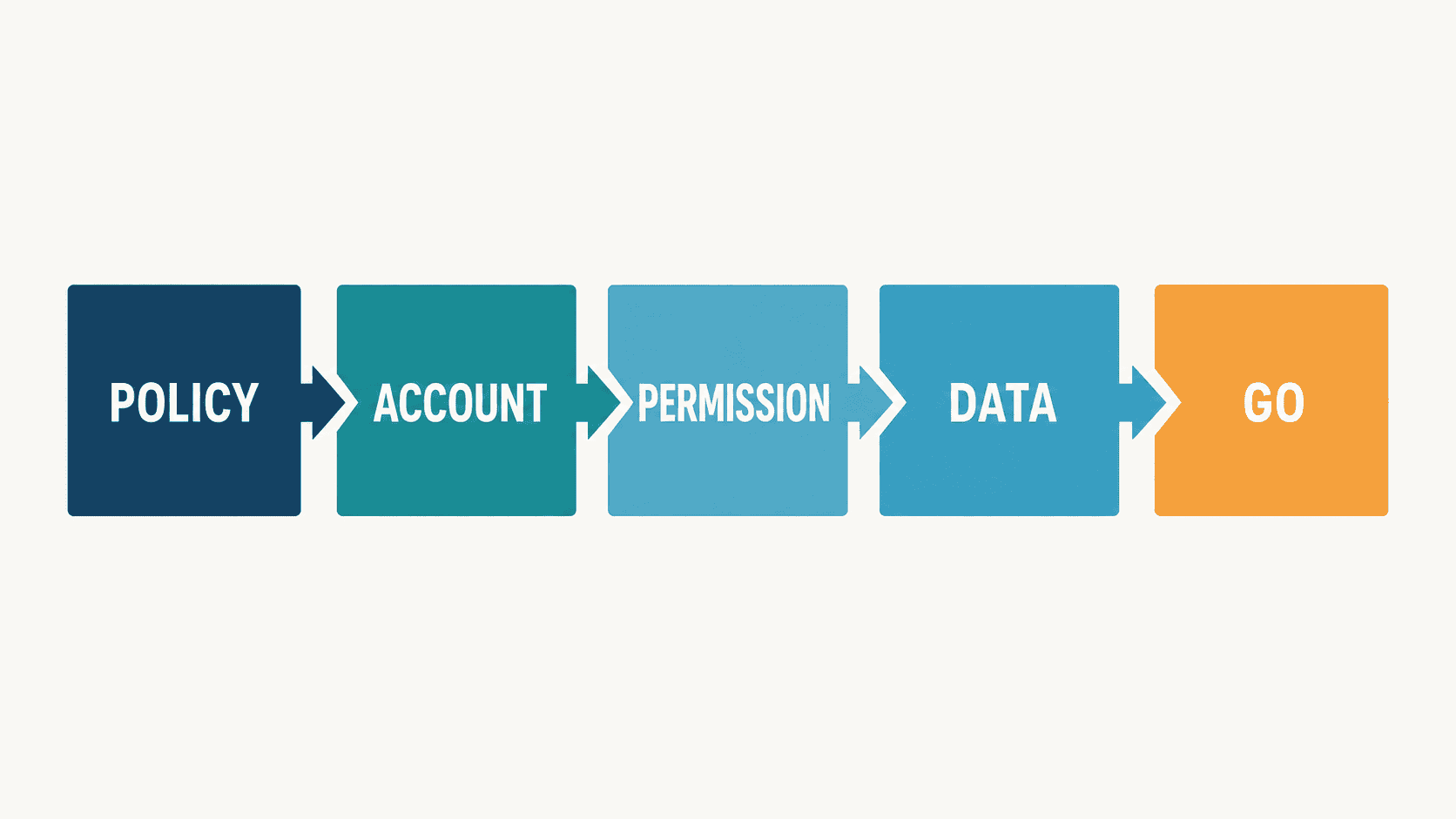
5. Put PDPA and confidential-data decisions at the entrance to each exercise
If PDPA and security appear only in closing slides, a learner may already have pasted real data into the first exercise. Place the safety decision before prompt writing. Every task starts by classifying candidate inputs and choosing one action: use as-is, mask and minimize, obtain approval, or do not use.
The classification must follow the organization’s policy and legal assessment. The table below is a training-design example, not a Thai legal conclusion.
| Candidate input | Initial exercise decision | Owner to consult |
|---|---|---|
| published product catalogue | use with source and version | marketing or technical owner |
| fictional purchase request | use as safe practice data | training owner |
| real email with customer and contact name | stop; confirm purpose, agreement and policy before use | DPO, legal and information governance |
| unpublished drawing, formulation or machine parameter | treat as highly confidential and confirm necessity and approved environment | engineering and information security |
| employee evaluation, health or disciplinary data | keep out of the exercise; replace with synthetic data | HR, DPO and legal |
| supplier contract | review confidentiality, IP, processing and third-party terms | procurement and legal |
A practical course rarely needs unaltered source records. Create synthetic datasets that preserve structure, exceptions and decision points while replacing names, companies, prices, part numbers and drawing numbers. A visual redaction may leave comments, revision history or metadata behind; build a clean exercise file independent from the original.
ETDA’s Generative AI Governance Guideline for Organizations discusses benefits alongside limitations, personal and confidential information, cybersecurity, human oversight, third parties and post-deployment monitoring. Use it to derive risk scenarios, not as a legal compliance checklist or course certification. The organization must determine its own PDPA, employment, contractual and cross-border position with qualified DPO, legal and security personnel.
6. Put bilingual safety decisions on one pocket card
Learners cannot search a long policy every time they need to stop. Provide a Japanese–Thai decision card with three gates: before input, after output and before sharing.
| Moment | English operating meaning | Thai learner wording |
|---|---|---|
| Before input | Is this information permitted in this environment, and is it the minimum necessary? | ข้อมูลนี้ใส่ในสภาพแวดล้อมนี้ได้หรือไม่ และจำเป็นเท่าที่ควรหรือไม่ |
| After output | Was it checked against the source of truth, without treating an assumption as fact? | ตรวจสอบกับแหล่งข้อมูลหลักแล้วหรือยัง และไม่ได้ถือข้อสันนิษฐานเป็นข้อเท็จจริงใช่หรือไม่ |
| Before sharing | Are recipient, access, personal data, confidentiality and final approval correct? | ตรวจผู้รับ สิทธิ์ ข้อมูลส่วนบุคคล ความลับ และผู้อนุมัติขั้นสุดท้ายแล้วหรือยัง |
| If unsure | Stop: do not save, send or execute; escalate to the named owner. | หากไม่แน่ใจ ให้หยุด ไม่บันทึก ไม่ส่ง ไม่ดำเนินการ และส่งต่อผู้รับผิดชอบ |
The glossary should be approved by Japanese and Thai process owners, information governance and, where needed, the DPO. Similar everyday words for data, document, record and information may have different policy meanings; annotate those distinctions. Instructors should not improvise translations of prohibitions or escalation steps during the session.
Explaining the Japanese answer in Thai is not proof that Thai learners can decide in their own job context. Use a Thai unseen case and check whether learners stop for the same reason and reach the same authoritative source.
7. Common foundation exercise: hand over work that can be inspected
The common exercise should not be a prompt-writing contest. Learners repeat a controlled sequence:
- Define the work purpose and recipient in one sentence.
- Classify candidate inputs as prohibited, approval-pending or permitted.
- Give ChatGPT the role, input, constraints, output format and behavior when evidence is missing.
- Check the response against sources, calculations, dates, names and prohibitions.
- Record corrections and the parts decided by a human.
- Obtain named approval before sharing, sending or registering the output.
For example, when turning a fictional purchasing email into a table, do not ask merely to “extract the fields.” Require ChatGPT not to invent a missing delivery date, to copy part numbers exactly, to produce questions for missing items and to return a table with specified columns. The learner then compares every row with the source and records corrections.
Run the risk-equivalent task in both languages. The wording of prompts may differ, but required fields, evidence, uncertainty, prohibited information and approval route should reach equivalent outcomes.
8. Build role packs backward from daily work products
One generic example does not transfer to local staff’s jobs. Completely separate courses for every department, however, fragment controls. Keep one safety gate and one evidence schema, while varying work products by role.
| Audience | Practical task example | Source and reviewer | Decision not delegated to AI |
|---|---|---|---|
| executives and plant leadership | turn a monthly report into issues and questions | approved KPIs and functional owners | investment, workforce or quality policy |
| HR and administration | structure a fictional bilingual internal FAQ | policy, HR owner and legal | applying a rule to an individual employee |
| sales and procurement | identify missing items in an inquiry or RFQ | CRM/ERP and sales/procurement owner | price, delivery commitment and contract |
| quality and production | structure a fictional nonconformance in 5W1H | QMS and quality owner | root cause, release or corrective-action approval |
| maintenance | generate inspection questions from a fictional failure record | current manual and maintenance owner | isolation, machine operation and restart |
| IT and DX | classify a use-case request by governance checks | AI policy and system inventory | access, connection and exception approval |
In a factory, safety, quality and machine decisions should not be finalized from ChatGPT text alone. Do not create an exercise where AI “successfully” declares the root cause, accepts product or authorizes a restart. AI can organize information, propose questions, draft and compare; the authoritative source and accountable human remain in control.
Each task card specifies start condition, permitted input, expected output, authoritative source, critical failures, escalation condition and evidence to retain. That card becomes the seed of a post-training standard workflow.

9. Operate Thai-language generative-AI training with distinct responsibilities
One bilingual instructor should not privately own product knowledge, translation, process safety and assessment. Separate responsibilities even when one person holds multiple roles.
| Role | Main responsibility | Acceptance evidence |
|---|---|---|
| lead instructor | concepts, operation, demonstrations and question routing | facilitation script, version and Q&A log |
| Japanese–Thai facilitator | decision equivalence, terminology and learner understanding | glossary, decision differences and revision log |
| process and safety reviewer | realistic cases, sources, prohibitions and approval route | case approval and critical-failure list |
| workspace administrator | account, permission, sharing, connections and support | configuration check and incident log |
| assessor | unseen-case observation, scoring, evidence completeness and retest | assessment sheet, evidence packet and rationale |
Questions the instructor cannot safely answer are classified as product behavior, company policy, legal interpretation or process decision and routed to the named owner. Record the response deadline and the material version that incorporates the answer.
In class, use explanation, instructor demonstration, individual practice, peer evidence checking and learner explanation to the assessor. A Japanese speaker should not operate on behalf of Thai colleagues; every learner must perform the steps and explain the decision in their own working language.
10. Use an unseen case for practical demonstration, not prompt recall
Repeating a case solved with the instructor measures memory, not transfer. The practical demonstration uses new data with the same role and risk pattern. Observe whether the learner independently classifies input, instructs the tool, validates output, corrects it, escalates and preserves evidence.
At minimum, verify that the learner can:
- select the approved environment and account;
- detect prohibited or approval-required data before input;
- specify purpose, constraints, output format and behavior under uncertainty;
- check output against the source of truth and identify unsupported claims;
- avoid sending AI text directly to an external party or operational system;
- record decisions and corrections and escalate to the named owner.
The organization sets thresholds based on risk and role. A polished output must not offset a critical failure such as entering prohibited information, accepting invented evidence or sending externally without approval. For the detailed rubric, non-compensable failures, bilingual assessor calibration, retesting and evidence schema, see our practical test guide for employee generative-AI training. This article intentionally focuses on the interface between that test and the training RFP.
11. Remediate and adjust work release instead of excluding learners
A critical failure does not require declaring the entire program a failure. Identify the missing control and prevent the learner from using AI beyond the demonstrated safe scope.
A learner who classifies input correctly but misses unsupported claims may work only on tasks with one explicit source and manager review. A learner who operates ChatGPT well but skips the pre-sharing check may be limited to internal drafts without external delivery. If the learner understands the Japanese policy but the Thai terminology is ambiguous, repeat the case with the language facilitator.
Retesting uses a different text and dataset with the same risk structure, not the memorized question. Record the case version, assessor, remediation, released workflow and remaining restriction.
Do not collapse course attendance and work authorization into one field. Track attended, knowledge check complete, practical demonstration for Workflow A complete, Workflow B not released and administrator approval separately.
12. Align administrator controls with the behavior taught
Telling users “do not share” while unnecessary sharing and external connections remain broadly open places the entire control burden on training. Align learner guidance with administrator settings.
OpenAI’s current help information describes workspace-owner and administrator controls for members, feature and model access, GPTs, apps, sharing, analytics and identity, depending on configuration. Because names and availability may change, the RFP should not freeze a UI label. It should state who authorizes each capability and what evidence proves the intended state.
Acceptance should reconcile three things:
- Features taught as permitted are actually available to the target learners.
- Sharing and connections taught as prohibited or approval-required are constrained by settings or a documented approval workflow.
- There is an owner to recheck controls after product change, model update, organizational movement, termination or incident.
For plan selection, identity, tenant design and broader operations, refer to our ChatGPT Enterprise adoption guide for Thailand. The training RFP should use that decision as an input and accept only that course assumptions match the live configuration.
13. Put deliverables and evidence in the RFP
“Deliver ChatGPT training in Japanese and Thai” allows a vendor to finish after the lecture. The RFP should define deliverable, responsibility and acceptance method.
| RFP item | Vendor deliverable | Buyer acceptance evidence |
|---|---|---|
| target workflow | roles, start condition, output, source and approver | process-owner approval |
| bilingual design | glossary, decision card and case mapping | equivalent decisions on risk cases |
| exercise data | synthetic or anonymized set, creation method and version | no unintended live data |
| managed environment | required and prohibited features, account procedure | administrator checklist |
| practical demonstration | unseen case, observations, critical failures and retest | individual assessment and evidence packet |
| facilitation model | ownership of product, language, process, safety and assessment | RACI and escalation contacts |
| 30-day transfer | workplace task, manager review, support and improvement session | periodic evidence and Day 30 decision |
| change management | triggers for product, policy and case revision | version history and reapproval |
Evidence collection does not authorize unlimited collection of names or full conversations. Define purpose, necessity, access, retention, deletion and employee notice under company policy and legal assessment. Retain no personal or confidential content unnecessary for the decision.
The contract should also address intellectual property in materials and exercises, recording, generated outputs, reuse, third-party services, subcontracting, incident response, product-change revisions and data return or deletion. Replace a generic “PDPA compliant” statement with an explicit data flow and allocation of responsibility.
14. Design the 30-day transfer loop before the course
Thirty days is a TOMAS TECH editorial example for observing the transition into work, not an external standard or adoption guarantee. The principle is to repeat the same safe procedure on approved work, have a manager inspect evidence and feed failures back into the material.
| Proposed checkpoint | Learner | Manager or champion | IT/DX and administrator |
|---|---|---|---|
| Day 0 | complete unseen demonstration and submit evidence | approve the released workflow scope | verify account and configuration |
| Day 7 | perform one approved work item | review procedure, not only output | classify questions and access issues |
| Day 14 | repeat on a different case | inspect correction, escalation and evidence | update materials for common failures |
| Day 30 | submit a reproducible template | continue, retrain or stop | recheck permissions, settings and support |
Managers should ask more than “Did you use ChatGPT?” They should ask which source was authoritative, what the human changed, when the learner stopped before input and whether the procedure can be repeated. Non-use should be diagnosed as no eligible task, blocked access, unclear policy, insufficient quality or missing support.
OpenAI Academy’s deployment guide treats completion, awareness, application, adoption and progression to repeatable workflows as different signals. That supports looking beyond completion, but the Day 7/14/30 cadence and thresholds here are organization-defined examples, not OpenAI requirements.

15. Move measurement from attendance to safe repetition
Attendance and satisfaction remain useful leading signals, but should not stand in for outcomes. Use five layers.
| Layer | Example indicators | Misinterpretation to avoid |
|---|---|---|
| reach | invitation, attendance, completion, support contact | completion is not work authorization |
| proficiency | unseen demonstration, evidence check, prohibited-input decision, escalation | averages must not hide critical failures |
| application | approved work items and reusable templates | message volume is not business value |
| quality | human correction, evidence match, omission and rework | separate style preference from factual error |
| safety | pre-input stops, mis-sharing, exceptions, incidents and access deviation | stopping can be evidence that control worked |
A pre-input stop may reveal exposure to risk, but it may also show that training worked. Review severity, reason and resolution. Do not mark low-use employees as failures without considering work frequency and approval status.
If quality differs by language, investigate glossary, case, source, model output and assessor interpretation—not only learner skill. Report by language and role rather than hiding the difference in one average.
16. What named enterprise cases teach—and what they do not prove
OpenAI’s July 2026 MUFG customer story describes deployment of ChatGPT Enterprise to approximately 35,000 Mitsubishi UFJ Bank employees, mandatory e-learning before access and departmental AI champions. It reports more than 1,800 custom GPTs created in four months after training and a reported 20–30% workload reduction in selected research tasks. This is a named customer’s reported context, not a target, guarantee, Thailand benchmark or manufacturing result.
OpenAI’s January 2026 Taisei story reports 90% weekly active use, 3,300 custom GPTs and more than 5.5 hours saved per employee per week. It also describes training, internal events, communities, hackathons, access controls, usage logs and monitoring. These are Taisei/OpenAI-reported results, not an industry average or guaranteed return.
The transferable structure is more useful than the numbers:
- place common safety learning before or alongside access;
- create help capacity inside business functions, not only in a central team;
- move from attendance into real work products;
- operate education, access control, logs and monitoring together;
- inspect workflow results and human accountability, not usage alone.
A Thailand site must resize that structure to its roles, languages, contracts and risks. Do not copy another organization’s GPT count or usage rate into an RFP KPI.
17. FAQ about commissioning ChatGPT training in Thailand
Should Japanese and Thai ChatGPT training run at the same time?
The controlled glossary, safety decisions, cases and evidence schema should be designed together when both groups share a process. Lectures may run in separate language cohorts, but equivalent risk cases must lead to equivalent prohibition, verification and escalation decisions.
Is a translation provider enough for Thai-language generative-AI training?
Translation support is valuable, but it cannot decide process ownership, information classification or approval. Japanese and Thai process owners, information governance and, where required, DPO/legal personnel should approve terms and cases. See our AI training guide for Thai staff for broader localization design.
Does practical training require real company data?
No. Synthetic or anonymized data can preserve structure, exceptions and decisions. A separate controlled validation may use minimum necessary real data only after approval of environment, purpose, owner and retention.
What is the right practical-test pass score?
There is no universal score. Set thresholds by role, impact, authoritative source, human review and reversibility. Treat prohibited input or unapproved external release as a non-compensable failure where appropriate.
Can a small site run training without a dedicated administrator?
It still needs named responsibility for accounts, access, sharing, support, joiners/movers/leavers and change review. A headquarters team or external provider may support the task, but the organization should retain an accountable approver.
Should training use ChatGPT Business or Enterprise?
That is a broader procurement decision. Compare current identity, access, retention, audit, connection, support, contractual and regional needs against official information. Do not freeze a product comparison copied from an article.
Is low usage after 30 days evidence of failure?
Not by itself. Diagnose task frequency, access, manager approval, available sources, output quality and support. The goal is repeatable, safe value—not maximum message count.
Does completing a PDPA-oriented course make the use compliant?
No. Training supports awareness and behavior. Purpose, legal basis, notice, processor arrangements, transfers, access, retention and security require fact-specific organizational review.
18. Summary: buy bilingual decisions and evidence through the RFP
ChatGPT training in Thailand should deliver more than translated slides and a prompt collection. Accept a single operating package covering managed accounts, permitted-data boundaries, Japanese–Thai decision equivalence, role-based unseen cases, source verification, human escalation, practical evidence, administrator configuration and the first 30 days of manager review.
Moving the success criterion from “understood the lecture” to “can reproduce safe work” lets buyers compare providers by evidence rather than presentation style. Keep detailed scoring in the specialist practical-test guide and tenant architecture in the enterprise adoption guide; put only the classroom-to-work interface into this RFP.
TOMAS TECH helps Japanese companies and manufacturing sites in Thailand design Japanese–Thai exercise cases, data boundaries, role packs, administrator checks, practical acceptance and 30-day workplace transfer around their current environment and policies. You can contact us while target workflows and product plans are still being defined.
Official references checked 10 September 2026
- OpenAI, Business data privacy, security, and compliance: https://openai.com/business-data/
- OpenAI Help Center, Managing workspace settings in ChatGPT Enterprise: https://help.openai.com/en/articles/8411955-what-workspace-settings-can-i-control-for-my-workspace
- OpenAI Help Center, Data access for your managed ChatGPT account: https://help.openai.com/en/articles/20001067
- OpenAI Academy, Data governance and compliance: https://academy.openai.com/en/public/clubs/admins-6o6xf/resources/data-governance-and-compliance
- OpenAI Academy, Champion deployment guide: https://academy.openai.com/en/public/clubs/champions-ecqup/resources/openai-academy-courses-champion-deployment-guide-2026-06-11
- OpenAI, MUFG aims to become AI-native with OpenAI: https://openai.com/index/mufg/
- OpenAI, Taisei Corporation shapes the next generation of talent with AI: https://openai.com/index/taisei/
- ETDA, Generative AI Governance Guideline for Organizations: https://www.etda.or.th/getattachment/6050a4b7-defd-4dba-8cbc-ff6a444a3d08/20240910_GenerativeAIGovernanceGuideline_Vol1_AIGC.pdf.aspx
- NIST, AI RMF Core: https://airc.nist.gov/airmf-resources/airmf/5-sec-core/
- NIST, Generative Artificial Intelligence Profile: https://nvlpubs.nist.gov/nistpubs/ai/NIST.AI.600-1.pdf
- Thailand PDPC/GPPC, PDPA learning program: https://gppc.pdpc.or.th/gppc-training-news-2/
This article is a general operational guide based on public information checked on 10 September 2026. Product features, plans, contracts, retention, admin interfaces and laws may change. Recheck official information and your agreement immediately before a decision, and consult your DPO, legal and information-security owners about personal data, cross-border transfer and workforce monitoring.


