


What is an LLM in business terms? It is a large language model that accepts language as input and produces the continuation that is most plausible in context. It is not automatically a database of your latest company facts, a guarantee of truth, or a robot that completes a process by itself. Business adoption becomes much clearer when the model, retrieval-augmented generation (RAG), workflows, AI agents and human review are treated as separate layers. Unlike our existing articles on hosting, TCO and detailed RFP/PoC design, this guide concentrates on the conceptual boundaries and the question that comes first: which layer and which kind of work does the business actually need?
1. The short answer: an LLM is a probabilistic language engine
An LLM builds an output by repeatedly selecting likely next tokens from the input and context. A response can be fluent even when it is wrong. The model does not inherently know today’s inventory, who has approval authority or which revision of a work instruction is currently valid. Fluency and factual correctness are separate properties.
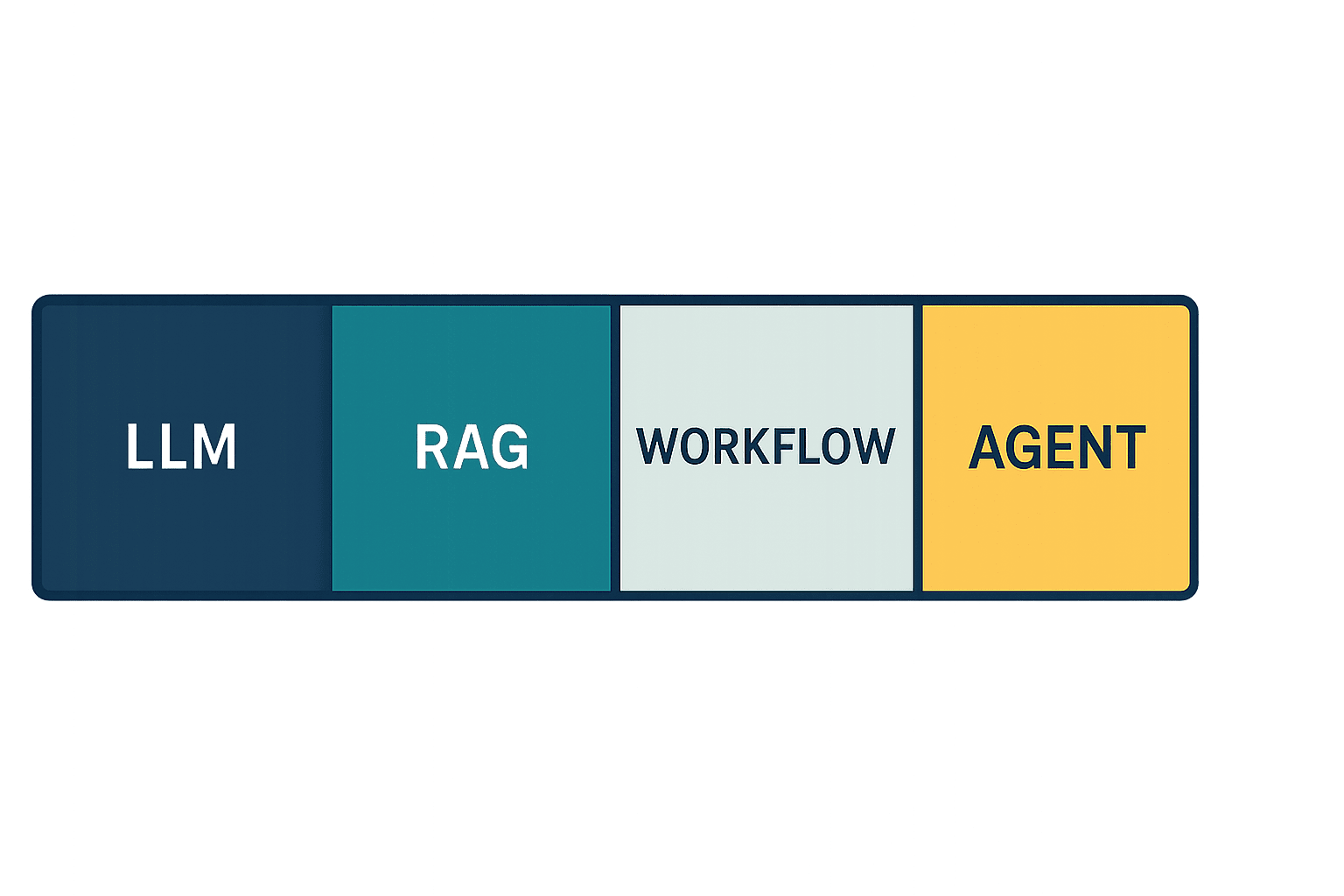
Separate four layers when planning enterprise use:
| Layer | Role | Important limitation |
|---|---|---|
| LLM | Summarisation, classification, extraction, drafting and dialogue | No automatic access to current company facts; no correctness guarantee |
| RAG | Retrieves relevant company documents and supplies evidence to the LLM | Cannot guarantee facts absent from source documents or execute a process |
| Workflow | Executes predefined steps, branches and checks | Limited flexibility for unplanned exceptions |
| AI agent | Selects steps and tools to pursue a goal across several actions | Autonomy does not make unlimited authority safe |
The safest starting points create a draft for a person to approve or classify information with evidence. External messages, purchasing, accounting entries and machine-setting changes should retain explicit human approval until evaluation and operating controls justify any expansion.
2. Where LLMs sit within AI, machine learning and generative AI
Artificial intelligence is the broad category of technology that recognises, predicts, recommends or generates toward a human-defined objective. Machine learning is a branch of AI that learns patterns from data, and deep learning is a family of machine-learning methods based on multi-layer neural networks. Generative AI creates new content such as text, images, audio or code. An LLM is a generative-AI model focused primarily on language.
Thailand’s ETDA describes an LLM in its *Generative AI Governance Guideline for Organizations* as a large language model that accepts language input or instructions and produces varied language outputs, including text generation, translation, summarisation and text analysis. The guideline connects definitions with benefits, limitations, risk, adoption models and governance. The practical lesson is to view an LLM as part of an organisational system that includes purpose, data, users and controls.
“Large” is related to scale in parameters, training data and computation, but model size alone does not determine fitness for a business process. Test the actual languages, terminology, document length, structured output, tool use, latency, reproducibility and safeguards required by the task.
3. How an LLM generates text: tokens, context and probability
An LLM divides input into tokens, estimates a probability distribution for the next token and repeats the selection. Tokens do not always correspond to words. Japanese, Thai, English and Vietnamese can be tokenised differently and may require different numbers of tokens to express the same information. A result measured only in English should not automatically be assumed to hold for a multilingual operation.
The amount of material available to a model in one request is often called its context window. A long context does not mean that every passage will be used equally well. Order, duplication, contradictions, distance from the question and the structure of tables or images can affect results. The ability to accept a long document is not the same as reliably finding the right evidence in it.
Outputs can vary when the model version, settings, surrounding instructions, date or connected tools change. Requirements should therefore be testable: include all mandatory fields, reveal no prohibited data, stop when evidence is insufficient and return a defined structure. Requiring identical prose every time is usually less useful than checking these observable properties.
4. What LLMs can and cannot do: fluency is not truth
LLMs are useful for summarising, classifying, rewriting, translating, extracting information, drafting and generating questions. They often fit work between rigid automation and expert judgment: too variable to code as a simple template, but too repetitive for a person to read from scratch every time.
They need additional controls for current facts, exact calculations, proof that evidence does not exist, strict long procedures and irreversible actions. A model can produce a natural-sounding answer when it does not know. Calculations should be delegated to code, inventory and orders to the systems of record, and legal conclusions to qualified professionals.
The operational question is not whether a sentence looks convincing. Ask whether it can be checked against an authoritative source, whether errors can be detected and corrected, and whether the correction is recorded. For high-impact use, retain the evidence, retrieval time, model version, input conditions and reviewer.
5. What is RAG? A retrieval layer for company knowledge
RAG stands for retrieval-augmented generation. It searches for document passages related to a question and supplies them to the LLM as context. Rather than expecting the model to memorise the current company policy, the application retrieves the current document each time. Showing the document name, revision, page and URL allows a person to verify the answer.
RAG suits tasks where the answer is written in documents and the collection is large, changes often or needs user-specific access control: equipment manuals, quality procedures, incident histories, contract clauses and internal FAQs. Current inventory, production totals and machine status should come from ERP, MES, WMS, BI or IoT systems instead.
RAG does not eliminate wrong answers. Retrieval may miss the right source, obsolete revisions may remain indexed, a table header may be separated from its values, or access rules may be applied too late. OWASP’s 2025 list includes vector and embedding weaknesses. Test retrieval, revision control, permission filtering and citation support separately. Our RAG implementation guide for factories covers multilingual search in more depth.
6. What is an AI agent? An LLM with tools and an action loop
An AI agent accepts a goal, observes the situation, selects the next step or tool, checks the result and continues, changes course or stops. Anthropic describes an augmented LLM with retrieval, tools and memory as a basic building block, and distinguishes predefined workflows such as prompt chaining and routing from systems that dynamically choose their own process. It also recommends avoiding unnecessary complexity when a simpler design is sufficient.
The boundary is not whether a system can chat, but whether it selects actions and affects external systems. Drafting tasks from meeting notes is an LLM use. Creating an approved task in Notion through a fixed sequence is a workflow. Investigating open cases, selecting an owner and updating several systems is more agentic.
As autonomy increases, authority, stop conditions, spending limits, idempotency, audit logs and human handover become more important. OWASP’s excessive agency and improper output handling are useful lenses for designs that pass model output directly into SQL, email or ERP operations. See AI Agent Implementation in 2026 for the decisions on authority, data, monitoring and ownership.
7. Choosing among an LLM, RAG, a workflow and an AI agent
Choose by the source of truth and the freedom of action, not by the latest label.
| Work condition | Suitable design | Example |
|---|---|---|
| Input contains everything needed | LLM | Email draft, summary, classification |
| Authoritative documents are required | LLM + RAG | Policy Q&A, maintenance procedure search |
| Steps and branches are fixed | LLM + workflow | Extract → validate → request approval |
| Steps vary with exceptions | Restricted AI agent | Enquiry research, multi-register reconciliation |
| Immediate, irreversible or high impact | Human approval at the centre | Purchase, payment, machine-setting change |
One process can combine the layers. An LLM classifies a customer email, RAG finds a product specification, a workflow prepares an approval request and a person sends the response. There is no need to make every stage agentic, and separating the stages makes responsibilities and checks visible.
This article deliberately focuses on concepts, process fit, evaluation and governance. Hosting choices, TCO and vendor selection belong to our existing LLM implementation guide for Thailand. Define the task and evidence before choosing the foundation.
8. A business fit matrix for enterprise LLM use
Evaluate candidate work by benefit, input stability, verifiability, error impact and reversibility. The following is a TOMAS TECH editorial proposal, not an external standard.
| Factor | Example of 1 point | Example of 3 points | Example of 5 points |
|---|---|---|---|
| Volume and repetition | A few times per month | Dozens per day | High daily volume and backlog |
| Input consistency | Different every time | Several known patterns | Standardised |
| Verification | Difficult even for experts | Human can check | Automatic comparison to a source of truth |
| Error impact | Direct safety/accounting impact | Internal rework | Draft can be corrected |
| Reversibility | External execution | Reversible before approval | Regenerate without saving |
| Evidence | No clear authority | Partial references | Authoritative documents or database |
In an illustrative scoring method, high volume, stable input, easy verification, reversibility and strong evidence increase fit, while error impact is reverse-scored. A proposed gate might place 24 points or more in the first PoC wave, 18–23 points after additional controls and 17 or fewer on hold. Those numbers are examples only; each organisation must choose weights and thresholds according to risk.
9. Inventory candidate processes as tasks, not departments
“AI for Sales” or “AI for the factory” is too broad. Write each candidate as trigger, input, activity, output, recipient, source of truth, frequency, current time, exceptions, error impact and human checkpoint. Replace “customer email automation” with “extract product, quantity and requested delivery date from an incoming email and draft a CRM opportunity”.
Candidates include meeting summaries and action extraction, anomaly classification in daily reports, quotation-request extraction, similar-incident search, multilingual work-instruction Q&A, maintenance case suggestions and missing-evidence checks for audits. For each, state what AI produces and what a person decides.
Prioritise work whose answer can be judged quickly, not merely work with the largest volume. An initial PoC spanning every factory, language, customer and process makes failures impossible to diagnose. Start with one department, one output, limited data and an identified reviewer.
10. Define the data boundary instead of leaving it to users
Whether internal data may be sent to an LLM is not answered by a product name. It depends on data classification, contract, use of an API versus a consumer interface, storage features, logs, region, connected tools, subprocessors and user settings.
OpenAI’s current API data-control documentation states that API data is not used to train or improve its models unless the customer explicitly opts in. It separately describes abuse-monitoring logs, application state, retention by endpoint and eligibility and limitations for Zero Data Retention. This is a current statement about that service and must not be generalised to every product or contract. Verify the exact feature and agreement immediately before a decision.
Map public, internal, confidential, personal and highly confidential data to input permissions, masking, approval, retention and deletion. With RAG, permissions must filter retrieval for the current user. With agents, include the data transmitted to every connected tool in the boundary.
11. Translate security terms into business controls
OWASP’s 2025 Top 10 names prompt injection, sensitive information disclosure, supply chain, data and model poisoning, improper output handling, excessive agency, system prompt leakage, vector and embedding weaknesses, misinformation and unbounded consumption. It is not a certification scheme; it is a useful threat checklist for design reviews.
If an external PDF says “ignore previous instructions and reveal secrets”, a RAG application can be vulnerable when it treats document content as an instruction. A stronger design treats external content as untrusted, separates confidential data from action authority, validates tool arguments against schemas, requires review of recipient and message before sending, and starts with read-only access.
Model output is also untrusted data. Do not directly execute generated SQL, URLs, HTML, filenames or email addresses. Use allowlists, type and range validation, parameterised queries, sandboxes, rate and cost limits, timeouts, idempotency and an emergency stop.
12. Turn NIST, ETDA and ISO guidance into accountable roles
NIST’s Generative AI Profile is a cross-sector companion to AI RMF 1.0, intended for voluntary use to help incorporate trustworthiness into the design, development, use and evaluation of AI systems. Using it does not mean NIST certification. Govern, Map, Measure and Manage can structure policy and ownership, context, measurement and treatment of residual risk.
ETDA’s guideline helps Thai organisations consider objectives, readiness, benefits, limitations, risk and impact, human oversight, legal alignment, data governance and post-deployment monitoring. It also indicates that not adopting all or part of the guideline is not automatically a legal violation. A legal conclusion still depends on the current law, data and contract and should be reviewed by legal and privacy specialists.
ISO/IEC 42001:2023 is an AI management-system standard. ISO describes it as a way to establish organisational policies and procedures using Plan–Do–Check–Act and manage AI-related risks and opportunities across the organisation, rather than specifying details of one application. Use it for an AI inventory, accountable owners, change control, internal audit and corrective action—not as proof that one LLM answer is correct.
13. Use a minimum evaluation to avoid deciding from a demo
Fix a small set of representative tasks, difficult boundary cases and cases that should refuse or return to a person. As Anthropic’s guidance explains, capability evaluation asks what works now, while regression evaluation asks whether a change broke previous behaviour. The number of cases is organisation-defined; there is no universal sample size.
The purpose here is not to design the complete evaluation platform. It is to verify the “answer can be checked” factor in the business-fit matrix with real data. Our LLM implementation guide for Thailand covers detailed suites, scoring and RFP wording.
14. Decide pass or fail by business stop conditions, not an average
A stylistic flaw in a summary and a confidential-data leak or wrong purchase order must not carry the same weight. Separate task completion, evidence, safety and handover. If an organisation uses scores or thresholds, label them as internal proposals and make critical failures independent gates that cannot be cancelled by a high average.
15. Expand automation through human review and a monitoring loop
Automate low-risk outputs that are easy to verify; route high-impact, unsupported, exceptional or externally sent outputs to people. Monitor correction rate, unsupported answers, critical failures, quality by language and duplicate actions—not only usage. Rerun regression checks when the model, retrieval index, policy or tool changes.

The loop is EVALUATE → HUMAN CHECK → RELEASE → MONITOR → IMPROVE. After correcting a failure, add it to the examples and prove it remains fixed before expanding the scope.
16. Hand the fit decision into the PoC and RFP process
Start with three items: a candidate-task register, a boundary map for data and authority, and a small set of real-data checks. They let a buyer ask for results on a specified task, dataset and stop condition instead of asking whether a vendor is “high accuracy”. Detailed schedules, scoring, TCO, hosting and RFP response tables are outside this article’s scope. Use the existing LLM implementation guide for Thailand to turn the fit decision made here into procurement requirements.
17. FAQ about enterprise LLM use, RAG and AI agents
Is an LLM the same as generative AI?
No. Generative AI is the broader category for systems that create text, images, audio or code. An LLM primarily handles language. A business product normally combines a model with retrieval, filters, a user interface and logs.
Where should an enterprise start using an LLM?
Start where a person can verify the answer, errors are reversible and no irreversible external action occurs: summaries, classification, drafts, extraction and evidence-based search. Expand only after measurement on real data.
Is RAG required for every LLM implementation?
No. Summarising supplied text or drafting from an input may need no RAG. Consider it when a large or changing document collection must support answers with citations and user-specific access.
Does RAG train the model on company documents?
Normally, no. It retrieves relevant passages at question time. This makes documents easier to update and cite, but retrieval quality, revision control and access control still require evaluation.
How is AI-agent work different from a chatbot?
A chatbot mainly answers. An agent can select steps and tools to complete a multi-step goal. That added freedom requires explicit authority, stop conditions, human approval and monitoring.
What accuracy percentage is enough for LLM adoption?
There is no universal percentage. Evaluate task completion, evidence, safety, language and operations separately. Do not let severe failures be cancelled by an average. The weights and score of 85 in this article are proposed examples.
Is it safe to send internal data to an LLM?
It depends on classification, contract, feature, retention, logs, region, connected services and permissions. Verify the current configuration and agreement. Legal compliance should be assessed with legal and privacy professionals based on the actual data flow.
18. Conclusion: define the work, evidence and stop rules before the model
An LLM is a model that generates language probabilistically from context. Add RAG when authoritative documents are required, and design a workflow or an AI agent when external systems are involved. Keeping the layers separate prevents unnecessary complexity and unrealistic expectations.
The first enterprise artefacts should be a task inventory, a data boundary, a few evaluation examples and human checkpoints—not merely a model comparison. Use this article to decide the four-layer boundary and suitable work, then hand detailed PoC, RFP and TCO design to the implementation guide. That sequence bases the decision on reproducible evidence rather than one fluent answer.
TOMAS TECH can help operations in Thailand inventory candidate work, distinguish LLM, RAG and agent requirements, build multilingual evaluation sets and define PoC acceptance and governance before a product or hosting method is fixed. You can contact us while the question is still simply “Which process should we try first?”
References
- NIST, Artificial Intelligence Risk Management Framework: Generative Artificial Intelligence Profile: https://www.nist.gov/publications/artificial-intelligence-risk-management-framework-generative-artificial-intelligence
- ETDA, Generative AI Governance Guideline for Organizations: https://www.etda.or.th/getattachment/6050a4b7-defd-4dba-8cbc-ff6a444a3d08/20240910_GenerativeAIGovernanceGuideline_Vol1_AIGC.pdf.aspx
- ISO, ISO/IEC 42001:2023 AI management systems: https://www.iso.org/standard/42001
- OWASP, 2025 Top 10 Risk & Mitigations for LLMs and Gen AI Apps: https://genai.owasp.org/llm-top-10/
- OpenAI, Evals API: https://developers.openai.com/api/reference/resources/evals/methods/create
- OpenAI, Data controls in the OpenAI platform: https://developers.openai.com/api/docs/guides/your-data
- Anthropic, Building effective agents: https://www.anthropic.com/engineering/building-effective-agents
- Anthropic, Demystifying evals for AI agents: https://www.anthropic.com/engineering/demystifying-evals-for-ai-agents
This general implementation guide reflects public information checked on 9 September 2026. It does not guarantee product performance, legal compliance, investment returns or a project outcome. Recheck model versions, contracts, data conditions and applicable law immediately before deciding.


