


Searching for a “production management system ranking” rarely reveals which platform fits your factory. Company size, production method, incumbent ERP, Thai-language operations, and network conditions differ too much for one universal league table. This guide replaces a vendor popularity ranking with an evidence-based scorecard, use-case shortlist, 90-day proof of concept, TCO review, and FAT/SAT process for factories in Thailand.
The answer: rank a shortlist for your use case, not the market
There is no system that ranks first for every plant. A multi-site manufacturer seeking one backbone for purchasing, accounting, and production needs a different candidate set from a small factory that wants to launch work orders and inventory quickly. A plant keeping its ERP while improving bottleneck scheduling needs a different solution again.
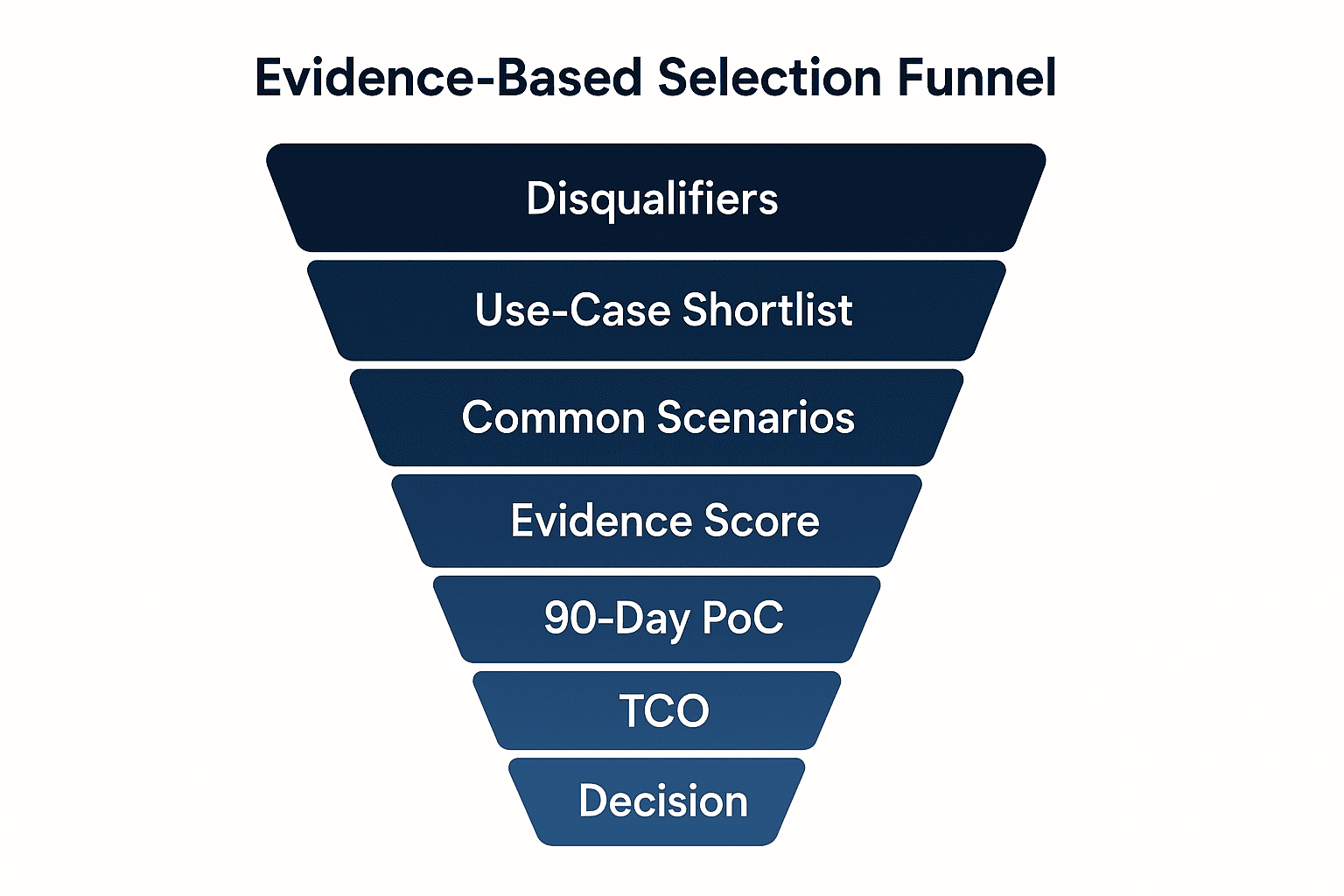
Use this sequence: define disqualifiers; separate candidate families by purpose; run the same scenarios with the same data; award points only for evidence; measure KPIs and workload in a 90-day PoC; and decide with three-to-five-year TCO and delivery capability included. This prevents a feature-rich system from winning even though operators cannot use it, or a low entry price from hiding integration and spreadsheet work.
Use-case production management system ranking for Thailand
This is an initial shortlist derived from capabilities described in official documentation, not a claim that one product is superior. Availability, licensing, configuration, local delivery partners, and contract scope must be verified.
| Candidate family | Useful starting point | Capability confirmed in official information | What the PoC must prove |
|---|---|---|---|
| SAP S/4HANA + PP/DS | SAP-based multi-site operations; critical products and bottlenecks | Procurement proposals and detailed scheduling considering resource and component availability | Master-data effort, calculation time, and gaps from the corporate template |
| Microsoft Dynamics 365 SCM | Microsoft estate; discrete, process, and lean production in one network | Mixed-mode production orders, batch orders and kanban; resource assignment with finite capacity | ERP integration, local documents, shop-floor input, and license boundaries |
| Odoo 19 Manufacturing | Small or mid-size operation seeking phased deployment | BoMs, operations, work orders, lot/serial tracking, MPS, and work-order dependencies | Costing, approvals, exceptions, and ownership of custom code |
| Asprova APS | Existing ERP retained; finite-capacity scheduling is the priority | Finite-capacity scheduling for equipment and people, visualization, differential import/export | Two-way ERP/MES data, setup constraints, replanning rules, and planner capability |
| Existing ERP + MES/shop-floor extension | Accounting and purchasing remain; progress, quality, and lot data need improvement | An architecture option rather than one product | System of record, offline synchronization, devices, permissions, and fallback work |
ERP suites, manufacturing modules, APS, and MES do different jobs, so a single feature-count comparison is misleading. If the purpose is better capable-to-promise while retaining accounting, APS integration may outweigh an ERP’s total score. If the purpose is one record for orders, purchasing, inventory, cost, and finance, a scheduler alone will not be enough.
Set disqualifiers before comparing production systems
A weighted score can let attractive secondary features cancel a fatal weakness. Define five to ten pass/fail conditions first. Typical Thailand conditions include:
- Critical operator tasks cannot be performed in Thai or terminology cannot be adapted.
- The supplier cannot show a continuity process for network outages.
- API objects, update frequency, retries, and reconciliation with the incumbent ERP are unclear.
- Lot genealogy cannot be searched from raw material to shipment and in reverse.
- Changes to masters, plans, transactions, and cost are not auditable.
- FAT, SAT, migration rehearsal, and rollback are outside the agreed scope.
- Thailand-time support and escalation ownership are undefined.
- Three-to-five-year TCO assumptions, exclusions, and escalation clauses are missing.
Thai support means more than translated menus. Test Thai item and operation names, reason codes, inspection fields, instructions, reports, search, sorting, fonts, long strings, dates, times, and units with real operators. An English-speaking administrator cannot compensate for inaccurate shop-floor transactions.
A 100-point evidence-based scorecard
The weights below are proposed values, not an industry standard or vendor rating. Adapt them to the business outcome. Verifiable evidence includes configuration, execution logs, API responses, reports, test records, and contract appendices—not a verbal “yes.”
| Evaluation dimension | Proposed points | What to examine | Acceptable evidence |
|---|---|---|---|
| Production and planning fit | 18 | ETO/MTO, forecast, repetitive, process, mixed mode, finite capacity, setup | Plan made with company data; constraint exceptions |
| Execution, quality, traceability | 16 | Issue, output, scrap, rework, inspection, genealogy | Operator run, genealogy report, audit log |
| ERP, APIs, and data | 14 | Items, BoM, orders, inventory, actuals, cost, retry, reconciliation | API specification, logs, recovery test |
| Thai UX and adoption | 10 | Language, devices, clicks, barcode, training, permissions | Task completion by Thai operators |
| Offline and availability | 8 | Disconnection, resync, deduplication, backup, recovery | Outage test; measured RTO/RPO |
| Cost management | 10 | Standard/actual cost, variance, WIP, lot profitability | Month-end scenario and reconciliation |
| Delivery and support | 10 | Thai/English/Japanese team, PM, migration, training, SLA, handover | Named roles, interviews, delivery plan |
| Security and control | 6 | SSO, segregation, logs, retention, personal data | Design, role test, audit trail |
| TCO and contract flexibility | 8 | 3–5 years, extra sites, API, environments, exit, data return | Assumption-based quotation and clauses |
| Total | 100 | Reweight by purpose | Store the evidence behind every score |
Use a shared maturity scale: 0 unanswered; 1 roadmap or verbal claim; 2 standard screen shown; 3 sample data completed; 4 company data completed; 5 exceptions, failure, and ongoing operation passed. A check mark in a brochure is not a top score.
Reweight the ranking by factory type
| Factory type | Increase weight | Lower weight where appropriate | Shared scenario |
|---|---|---|---|
| High-mix, low-volume/MTO | Finite capacity, setups, promise date, engineering change | Long-range forecast | Insert an urgent order and recalculate impact |
| Repetitive/automotive supplier | Kanban, traceability, EDI, quality | Project costing | Trace a defective lot to shipments and materials |
| Food/chemical process | Formula, yield, by-products, expiry, quality | Unit serial tracking | Trace ingredient lot through batch and shipment |
| Small assembly plant | Usability, speed, inventory, BoM, TCO | Complex multi-site optimization | Run order-to-shortage-to-production-to-shipment |
| ERP-retaining plant | APIs, delta integration, ownership, reconciliation | ERP replacement breadth | Fail, retry, deduplicate, and reconcile an interface |
What official product information does—and does not—prove
Microsoft Dynamics 365 Supply Chain Management
Microsoft’s production overview links production control with product, inventory, general ledger, and warehouse functions. It describes production orders, batch orders, and kanban in mixed-mode manufacturing, with jobs assigned according to resource availability when finite capacity is used. The mixed-mode planning documentation also describes supply policies by product, site, and warehouse across production, batch, kanban, transfer, and purchase supply.
That supports a shortlist for organizations combining production modes. It does not prove Thai operator fit, custom integration effort, offline continuity, or total licensing cost. Those require a PoC and a scoped quotation.
SAP S/4HANA Production Planning and Detailed Scheduling
SAP Help for S/4HANA 2025 FPS01 (February 2026) describes PP/DS as creating proposals for in-house or external procurement and optimizing detailed resource and order timing while considering component and resource availability. It focuses particularly on critical products with long replenishment times or bottleneck resources.
This is relevant for an SAP-centered multi-site operation. It does not remove the need to test master-data readiness, template gaps, authorization, training, migration, and the operating model. Score the replanning result produced from your orders, stock, and capacity—not the brand.
Odoo 19 Manufacturing
Odoo’s official documentation describes BoMs with components and operations, work orders, lot or serial tracking, an MPS that suggests future replenishment against adjustable demand, and work-order dependencies. A manufacturing order is created when replenishment is executed from the MPS or when an automatic trigger is configured.
These capabilities justify evaluation for a phased small or medium deployment. Their existence does not prove that complex approvals, cost accounting, quality, or tax interfaces work without extensions. Separate Community/Enterprise, hosting, modules, custom code ownership, and upgrade maintenance.
Asprova APS
Asprova describes finite-capacity schedules that do not exceed equipment and labor availability, visual plans, and differential data exchange with incumbent systems. It is therefore relevant when the ERP remains but lead-time promises, setups, WIP, or bottleneck plans need improvement.
APS does not automatically replace the records for accounting, purchasing, inventory actuals, or quality. Define what masters and orders arrive from ERP, what schedule returns, how actuals trigger replanning, and who maintains constraints and priorities.
Boundary with Thailand e-Tax Invoice & e-Receipt
The Thailand Revenue Department’s official overview covers the creation, submission, and retention of e-Tax Invoices and e-Receipts. The presence of manufacturing functions alone does not prove Thai e-Tax compliance. In the RFP and PoC, verify the accounting and tax boundary: data passed from production and shipment, the system that creates the electronic document, and responsibility for submission, retention, and corrections.
Keep the existing ERP or move to an integrated backbone?
With a retained ERP, it remains the record for items, customers, orders, purchasing, and accounting; APS manages plans; MES or a shop-floor application captures actuals and quality. The replacement scope is smaller, but interface ownership and reconciliation become permanent work. An integrated platform reduces duplicate records, but expands migration and organizational change.
Ask: Is the main problem planning accuracy, delayed actuals, inventory differences, or cost close? Are current item, BoM, and inventory records trustworthy? Will ERP change within three years? Can the corporate template change? What may the Thai site decide? How long can daily integration stop? A narrow scheduling problem may not justify ERP replacement; unreliable inventory and scattered BoMs will not be fixed by adding a scheduler alone.
Evaluate APIs through failure, not just availability
“API available” says little. Confirm objects, directions, frequency, limits, authentication, error structure, retries, idempotency, deletion, history, and version policy. In the PoC, corrupt one of 100 orders, cut the connection mid-run, resend the same request, change an ERP item, update a plan, and reconcile count, quantity, timestamp, and error on both sides.
A credible proposal identifies the system of record, write authority, monitoring owner, retry procedure, daily reconciliation, and recovery target. CSV can be sufficient, but manual placement, encoding, time zones, duplicate import, and partial failure still require design.
Put Thai UX and offline behavior at the center of the demo
Use representative operators, not only managers in a meeting room. Ask them to log in, read a work order, scan materials, start work, record a stop reason and defect, complete output, and reprint a label. Do not coach them. Measure completion time, errors, backtracking, and questions.
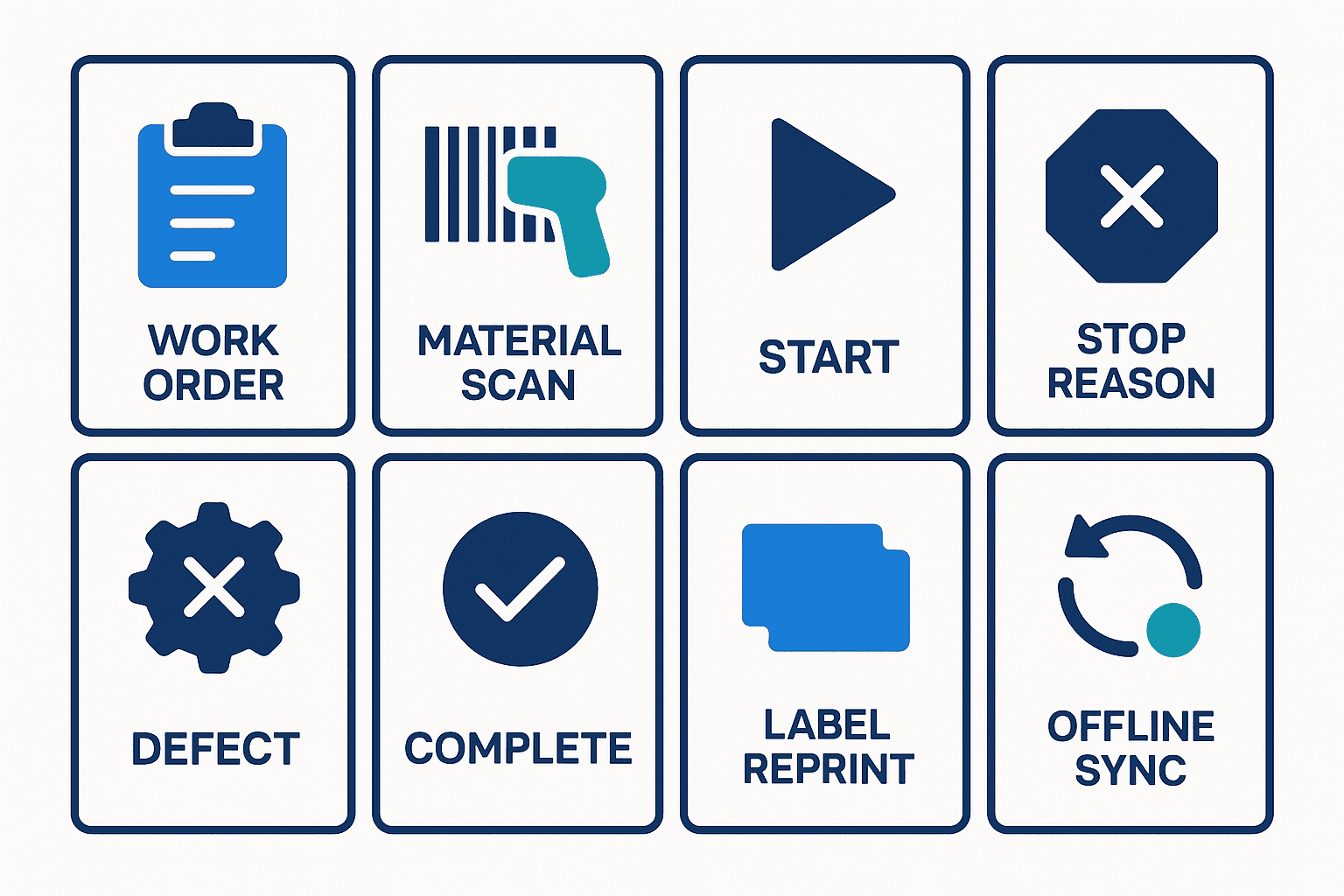
For a network outage, establish which functions continue and for how long. Examine data held on the device, synchronization order, duplicate prevention, timestamp handling, master-data conflicts, and visibility of unsynchronized records. A non-offline system can still have a safe continuity procedure if paper capture, later entry, duplicate control, and approval are explicit.
Cost, lot, and quality scenarios
For costing, distinguish standard and actual cost, moving average, material and labor variances, overhead, subcontracting, WIP, scrap, by-products, and currency. Reconcile manufacturing quantities with accounting entries in month-crossing, rework, and return cases.
For traceability, search from a raw-material lot through work order, operation, equipment, inspection, finished lot, and customer shipment, then reverse the search. Splitting, mixing, repacking, and rework must preserve genealogy. A criterion such as “identify affected shipments within 30 seconds” is a proposed value and should be calibrated.
For quality, test receiving, in-process, final, and shipment inspection; specifications and readings; concession; quarantine; retest; and corrective action. Verify that failure can hold inventory or block shipping, and that release permission and an audit trail remain.
Compare production management system cost with 3–5-year TCO
Public list prices cannot represent the factory’s actual cost. Do not invent prices. Obtain quotations on identical assumptions for currency, tax, user type, sites, volume, and environments. See our detailed production management system cost guide for the broader method.
| TCO category | Include | Frequently missed |
|---|---|---|
| Implementation | Requirements, configuration, extensions, interfaces, migration, test, training, PM | Thai data preparation, night cutover, travel, retest |
| Recurring | License, cloud, maintenance, monitoring, support | API, storage, test environments, backup charges |
| Internal effort | Business, IT, master data, training, support | Key-person time and retraining after turnover |
| Change and growth | Reports, items, sites, entities, regulation, upgrades | Custom-code upgrade and regression testing |
| Exit | Extraction, contract end, migration | Return format, history, attachments, deletion proof |
Use at least three years, and five for a core replacement. Baseline spreadsheet effort, expediting, shortages, inventory differences, and delayed close. Do not accept a benefit such as “20% inventory reduction” without proving its mechanism and scope.
A proposed 90-day PoC to decide the recommendation
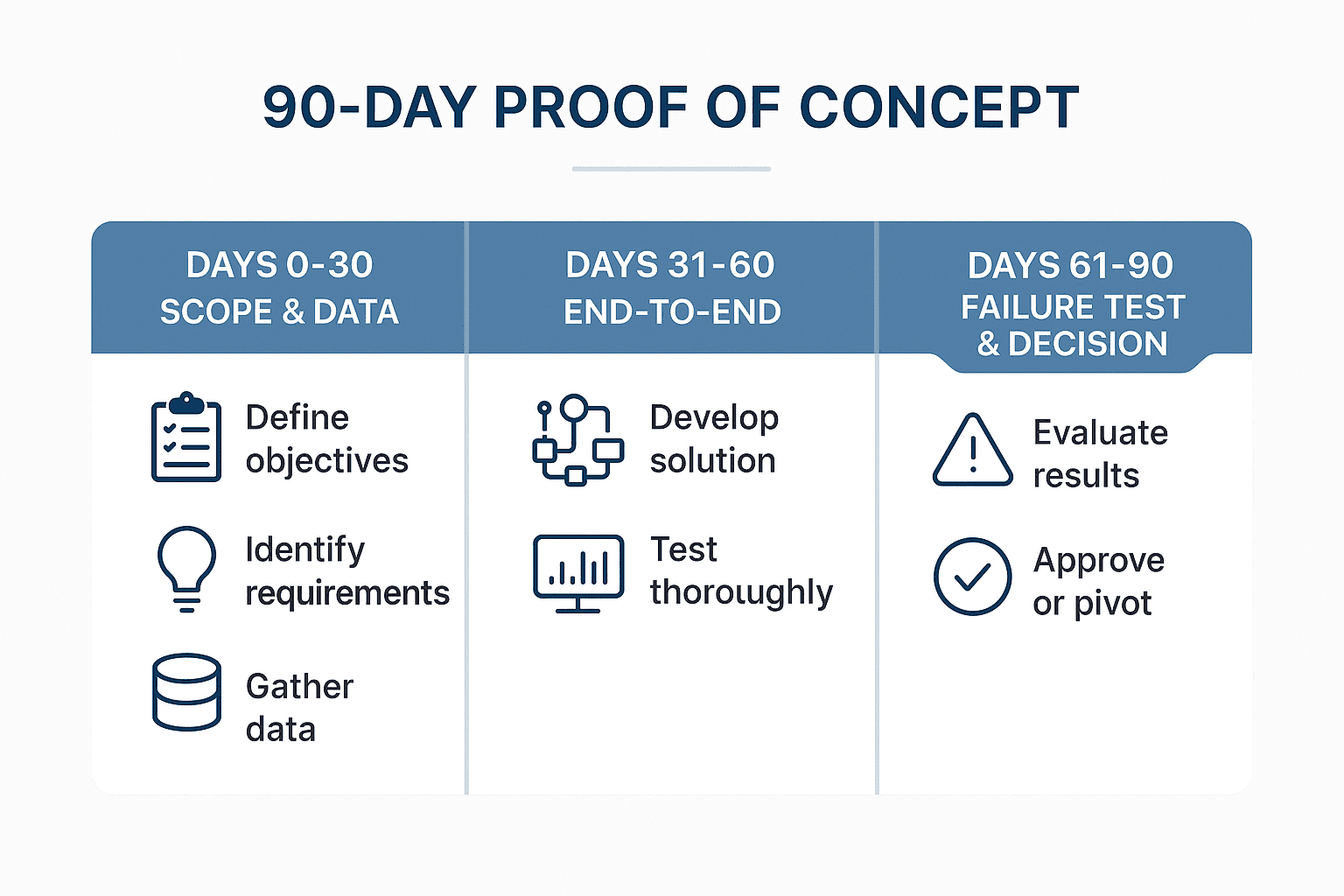
The 30/60/90-day stages below are proposed values, not a promise that a large implementation can finish in 90 days. The purpose is to expose data gaps, exceptions, operator burden, and integration failure early.
| Period | Proposed objective | Deliverables | Example gate |
|---|---|---|---|
| Days 0–30 | Fix outcome, scope, baseline, data, disqualifiers | Scenarios, weights, RACI, data dictionary, migration diagnosis | Stop if record ownership remains undefined |
| Days 31–60 | Run end-to-end on representative products and processes | Configuration, interface logs, Thai task results, issue log | Stop if a fatal need cannot be met acceptably |
| Days 61–90 | Test failure, performance, FAT, operations, and TCO | KPI delta, FAT results, SOP, quotation, risk register | Decide from evidence-backed scores |
Use seven common scenarios: replan after an order change; combine a shortage and machine failure; transact issue, defect, and completion in Thai; trace both genealogy directions; fail and retry integration; reconcile a representative month-end cost case; and ask a new planner to operate from the SOP alone. Give every candidate the same data and keep vendor showcase time separate from the common score.
Separate FAT, SAT, and production authorization
FAT tests requirements, interfaces, reports, roles, and performance in the build environment. SAT tests real Thai-site devices, scanners, printers, Wi-Fi, users, shifts, and movement. Exact definitions vary by contract, but separating them reduces the risk of software working in a conference room and failing at the line.
Each acceptance case needs steps, input, expected result, pass/fail, evidence, owner, and retest date. Replace “works correctly” with observable targets based on your baseline: schedule a defined order volume within an agreed time, retrieve genealogy within the proposed threshold, and synchronize without duplicates after recovery. Production approval also checks migration rehearsal, inventory freeze, delta migration, access, training, support, legacy access, and rollback.
Rank the implementation team separately
The same product can produce different outcomes with a different partner. Score product and partner separately. Interview the people who will actually work: project manager, manufacturing consultant, integration and migration engineers, Thai trainer, and operations support. Record role, allocation, location, language, substitute, and whether proposal experts remain during delivery.
Define ownership for BoM correction, cleansing, interface monitoring, triage, change approval, training, and close support. Require configuration registers, code, API documentation, test cases, and administrator training for tasks that would otherwise create lock-in.
Common selection failures
Do not confuse brand recognition with fit; copy today’s spreadsheets into tomorrow’s specification; postpone master-data quality; test Thai UX and devices only at SAT; or select on entry price. Use disqualifiers and common scenarios, redesign waste out of current work, diagnose master data in the first PoC stage, test on the floor early, and compare full TCO. For adjacent views, read our Thailand production management system comparison and small-scale production management guide.
RFP questions ready to use
- Classify each requirement as standard, configuration, extension, external product, or unsupported.
- Identify Thai screens and responsibility for translation and terminology.
- Demonstrate outage continuity, synchronization, and duplicate prevention.
- Diagram the record and direction for item, BoM, order, inventory, actual, and cost data.
- State API limits, monitoring, retry, and version-change policy.
- Measure trace time in both genealogy directions.
- Quote 3–5-year TCO with assumptions, exclusions, currency, and taxes.
- Propose FAT, SAT, performance, migration, and security acceptance criteria.
- Name the working Thai/English/Japanese team and escalation chain.
- Explain data return, cost, timing, format, and deletion at contract exit.
FAQ: recommendations, comparison, selection, and cost
Which production management system ranks number one?
None ranks first for every factory. Integrated multi-site control, mixed-mode manufacturing, lightweight phased deployment, and finite-capacity scheduling are different goals. Decide a use-case winner with disqualifiers, shared scenarios, and company data.
What production management system is recommended for a Thai factory?
One that fits Thai operator work, network conditions, incumbent ERP, production method, traceability, quality, costing, and local support. Evaluate the implementation partner and operating design separately from the product.
What matters in a production system comparison?
Evaluate planning, execution, quality, lots, ERP/API, Thai UX, recovery, costing, delivery, and TCO. Award points only for evidence and never let optional strengths cancel a fatal condition.
What is the first step in selecting a production management system?
Define the business outcome, process scope, baseline, data ownership, and disqualifiers before requesting product demos.
How much does a production management system cost?
Cost changes with users, sites, functionality, environments, interfaces, migration, training, support, and customization. Obtain formal quotations on shared assumptions and compare three-to-five-year TCO.
Can a 90-day PoC complete implementation?
No. Ninety days is a proposed decision period for fit and risk, not a guarantee for a large rollout. Detailed design, migration, FAT, SAT, training, and authorization follow.
What is the difference between ERP, APS, and MES?
ERP usually holds commercial and financial records; APS plans against constraints; MES manages execution and actuals. Boundaries overlap, so explicitly assign the system of record for each data object.
Conclusion: turn a ranking into a decision system
A production management system ranking becomes useful when it is a Thailand-specific shortlist, not a popularity chart. Start with disqualifiers, reweight a 100-point scorecard by use case, and test company data, Thai operator tasks, outages, API failures, cost, lots, and quality in a 90-day PoC. Decide only after reviewing FAT/SAT, implementation capability, and three-to-five-year TCO.
TOMAS TECH can help at the pre-product stage with current-state assessment, RFPs, shortlists, PoC scorecards, ERP/MES/APS integration, and FAT/SAT design for Thai factories. If you need to establish the selection method before narrowing vendors, contact us.
References
- Microsoft Learn, “Production process overview,” https://learn.microsoft.com/en-us/dynamics365/supply-chain/production-control/production-process-overview (accessed 7 Sep 2026)
- Microsoft Learn, “Mixed mode planning,” https://learn.microsoft.com/en-us/dynamics365/supply-chain/production-control/mixed-mode-plan (accessed 7 Sep 2026)
- SAP Help Portal, “Production Planning and Detailed Scheduling (PP/DS), S/4HANA 2025 FPS01,” https://help.sap.com/docs/SAP_S4HANA_ON-PREMISE/f899ce30af9044299d573ea30b533f1c/0e1c0651de86d406e10000000a44176d-1594.html (accessed 7 Sep 2026)
- Odoo 19 Documentation, “Manufacturing product configuration,” https://www.odoo.com/documentation/19.0/applications/inventory_and_mrp/manufacturing/basic_setup/configure_manufacturing_product.html (accessed 7 Sep 2026)
- Odoo 19 Documentation, “Master production schedule,” https://www.odoo.com/documentation/19.0/applications/inventory_and_mrp/manufacturing/workflows/use_mps.html (accessed 7 Sep 2026)
- Odoo 19 Documentation, “Work order dependencies,” https://www.odoo.com/documentation/19.0/applications/inventory_and_mrp/manufacturing/advanced_configuration/work_order_dependencies.html (accessed 7 Sep 2026)
- Asprova, “Production Scheduling System,” https://www.asprova.com/en/ (accessed 7 Sep 2026)
- Thailand Revenue Department, “e-Tax Invoice & e-Receipt Overview,” https://etax.rd.go.th/etax_staticpage/app/emag/flipbook_2567/pdf/01_Overview.pdf (accessed 7 Sep 2026)
The weights, 30/60/90-day stages, and time thresholds are proposed consulting values. Verify current availability, pricing, regions, licenses, and support with official suppliers and implementation partners before contracting.


