


Inspection certificate digitization is more than paper-to-PDF conversion. It links results, lots, specifications, approvals and customer copies so a Thailand factory can reconstruct each release. This guide turns versioning, tamper detection and reissue into RFP and 90-day PoC requirements.
Inspection certificate digitization in one sentence: control the release, not the PDF
The first deliverable should be an issue-control model, not an attractive report template. Results become an official certificate only after the right review, against the correct specification and customer rules. The issued representation must then remain connected to its source records, approvals, version and recipients. A PDF is one possible representation at a point in time; it is not automatically the only system of record.
The solution should answer seven questions without manual detective work:
- Which item, production order, lot and serials does the certificate cover?
- Which inspection plan, drawing, standard and customer-specification versions governed acceptance?
- Where did each value originate, and where were transcription, correction, conversion or rounding applied?
- Who prepared, technically reviewed and authorized the issue?
- Which issue number and exact version reached each customer?
- If a correction followed, how was the prior issue superseded and how were reason and impact retained?
- What can a recipient or auditor use to check integrity and origin later?
Once those answers are stable, template and workflow tools can be selected against them. Starting with a PDF tool often leaves separate fixes for premature sending, customer-rule mix-ups, lost history and duplicate reissue numbers.
Scope boundary: the controlled step after automated inspection data collection and AI drafting
This article covers the lifecycle after quality records are available and before and after an official certificate is delivered. Connecting gauges, PLCs and instruments is explained in the inspection data collection system guide. Using AI to draft a certificate or narrative is covered in the AI inspection certificate generation guide.
| Process | Main purpose | Record that must be protected | Scope here |
|---|---|---|---|
| Inspection data collection | Capture measurements accurately and quickly | Original value, time, instrument, operator | Define linking IDs only |
| AI/rule-based drafting | Produce a candidate report or explanation | Input evidence, generation condition, human review | Define the gate to official status |
| Approval, issue and reissue | Control the official customer record | Version, approval, delivery, correction, integrity | Core scope |
An AI-produced file and a spreadsheet-produced file should pass the same formal issue gate. Otherwise the meaning of “official record” changes with the authoring method and becomes hard to defend during an audit or customer inquiry.
Primary-source foundation for electronic quality records
ISO’s guidance on documented information for ISO 9001:2015 explains that organizations have flexibility in documenting their QMS. Documented information can communicate, provide evidence that planned work was done and share knowledge. The guidance includes examples concerning unique identification when traceability is required, authorized release and traceability to authorizers, review of changes and nonconformity records. It does not prescribe one certificate system, retention period, digital-signature method or hash algorithm.
When checked on 7 September 2026, ISO’s public page marked the sixth edition of ISO 9001 as “Under publication.” This article therefore does not call ISO 9001:2026 published; it uses the 2015 documented-information guidance for the general QMS points. Transition details and new requirements should be checked after formal publication against the final text and certification-body guidance.
ISO/IEC 17025:2017 addresses competence, impartiality and consistent operation of testing and calibration laboratories. ISO’s page says the 2017 edition was confirmed in 2023 and remains current. It is relevant conditionally—for an accredited or otherwise in-scope laboratory, customer contract or regulated process—not automatically to every factory inspection certificate.
The GS1 Global Traceability Standard offers a common framework for traceability across organizations and systems. Here it informs a design that identifies objects and connects events and data upstream and downstream. It is not used to claim that every factory must adopt GS1 identifiers.
Turning Thailand electronic-transaction and digital-signature context into requirements
Thailand’s ETDA lists the Electronic Transactions Act and notifications concerning preparation or conversion of documents and messages into electronic data. ETDA’s digital-signature page describes certificate- and PKI-based signatures as helping identify a signer or organization, indicate acceptance of electronic data, and check whether data changed after signing.
“Electronic approval,” “electronic signature,” “PKI digital signature” and “hash” should not be treated as synonyms.
| Term | Meaning in this guide | Evidence to examine |
|---|---|---|
| Electronic approval | A review or authorization action in an internal workflow | Identity, role, time, target version, activity log |
| Electronic signature | A broad electronic method indicating a signer’s intent | Identity, intent and linkage required by applicable law/contract |
| PKI digital signature | A certificate- and cryptography-based signature method | Certificate, validation, signed object, revocation, change detection |
| Hash | A digest used to compare whether data is identical | Algorithm, exact byte sequence, generation time, storage |
An approval button does not automatically satisfy every legal or contractual requirement for an external document. Equally, every certificate may not need a costly PKI signature. Decide after mapping customer contracts, transaction type, sector, dispute evidence and the recipient’s validation capability, with qualified Thailand advice where required.
Inspection certificate data model: preserve seven linked IDs
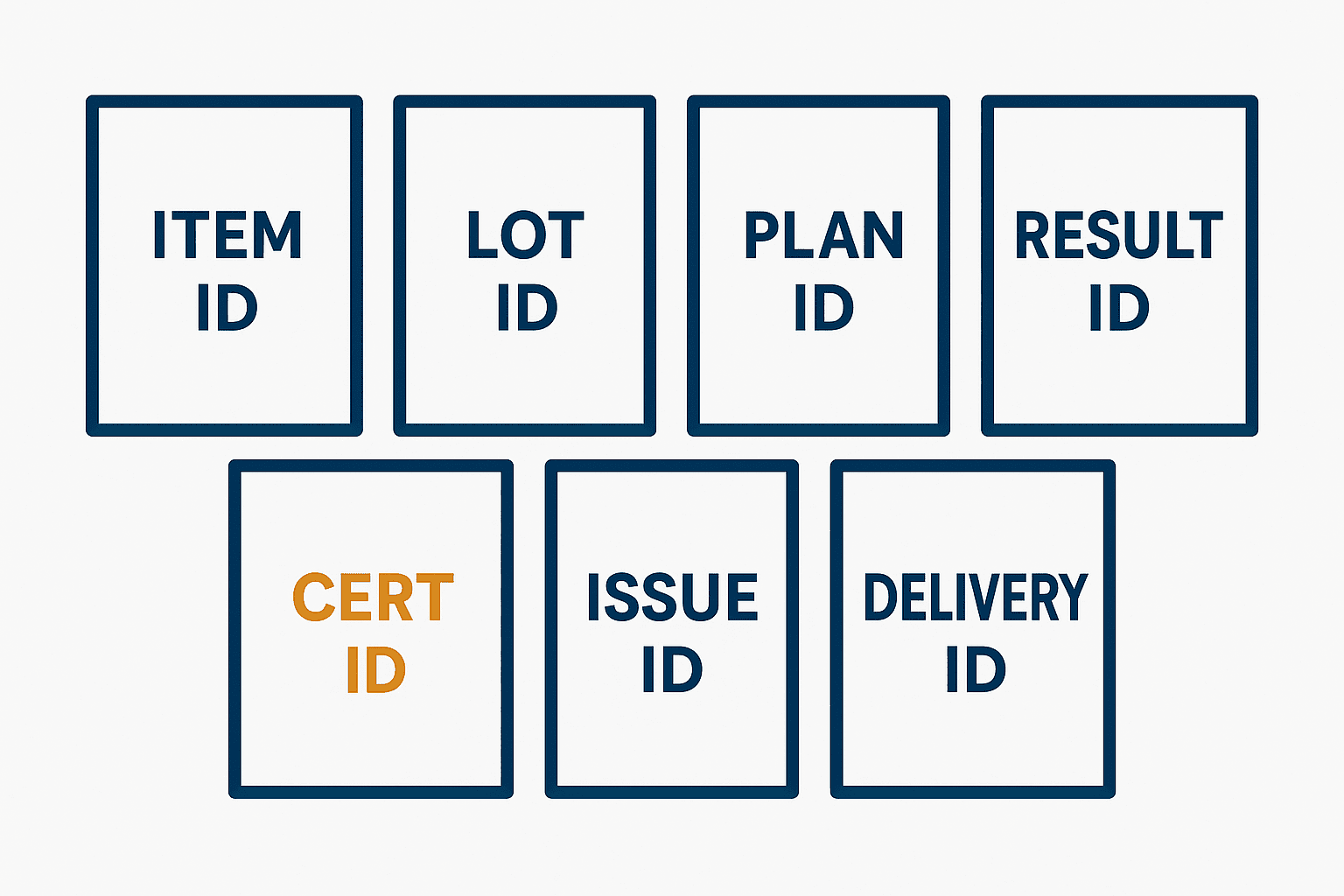
In inspection certificate digitization, business IDs—not a PDF filename—should be the backbone. A proposed model links:
- ITEM ID for item, drawing or customer part.
- LOT ID for manufacturing, receiving or shipping trace units.
- PLAN ID for inspection plan and applicable specification version.
- RESULT ID for original measurements and decisions.
- CERT ID for the logical certificate.
- ISSUE ID for each customer-issued representation and version.
- DELIVERY ID for recipient, route, time and delivery result.
Separating CERT ID from ISSUE ID is essential. A correction can concern the same logical certified subject while creating a different representation delivered to the customer. CERT-001 / ISSUE-01 can be superseded and linked, with a reason, to ISSUE-02 without deleting history.
Customer layouts may differ in order, units, decimals, language or attachments, but their displayed values should reference common RESULT IDs. Duplicating values per customer creates competing copies. Store source data separately from rendering rules, and version the transformations.
Extend lot traceability through certificate delivery
Lot traceability is incomplete if it stops at inspection or shipment. A business should also know which certificate described a lot, which issue reached the customer, and whether later correction and redistribution reached all affected recipients.
A useful proposed event model records the object, time, location, actor and reason/status for every issue event. This is an implementation proposal informed by interoperable traceability thinking, not a verbatim GS1 requirement.
When a manufacturing lot is split across shipments, keep the many-to-many relationship. If reinspection changes only selected serials, do not silently overwrite a whole-lot certificate. Identify the affected scope and issue a controlled replacement. Whether delivery uses a portal or email, connect receipt status, failure and resend to DELIVERY ID.
Design the electronic approval workflow around responsibility
A common flow has preparation, technical review, quality authorization and issue. Define each by what must be checked and what may be rejected, not by job title alone. Titles do not handle night shifts, delegation, dual roles and customer exceptions well.
| Role | Review object | Example rejection | Required evidence |
|---|---|---|---|
| Preparer | Lot, result completeness, candidate output | Missing data, wrong subject | Time, source, template version |
| Technical reviewer | Method, unit, rounding, specification | Wrong method or revision | Result, comment, target version |
| Quality authorizer | Acceptance, deviation, customer condition | Unapproved deviation | Identity, authority, time, intent |
| Issuer | Recipient, language, attachments, issue number | Unknown recipient, mixed version | Issue version, recipient, channel |
As a proposed control, prevent consecutive approvals by the same person or require a reason and higher authorization for exceptions. That is a risk-based segregation-of-duties design, not a universal statutory rule. A small site may use compensating controls such as post-review and scope limits.
Delegation should record period, scope, delegator and delegate rather than share accounts. If a value, specification, customer condition or attachment changes after approval, the workflow should invalidate approval and return the object to review.
Version control: separate template, data and issue versions
“Latest version” is insufficient. Manage at least three versions:
- Template version: layout, labels, fixed statements and customer format.
- Data version: results, limits, decisions, notes and source-record snapshot.
- Issue version: the approved representation delivered outside the organization.
Updating a template must not retroactively restyle a past issued certificate. Preserve the issue-time template and relevant rendering conditions. At the same time, proprietary formats can become unreadable, so consider retaining both searchable structured data and a stable human-readable representation.
Link version to state—for example DRAFT, IN REVIEW, APPROVED, ISSUED, SUPERSEDED, VOID. Specify allowed transitions, roles and reversals. Test that a database update cannot alter an issued artifact without creating a new ISSUE ID.
Master customer-specific submission rules and expose exceptions
Customer certificates vary in part naming, fields, units, decimals, limits, language, signature blocks, photographs, channel and due date. Conditions hidden in personal spreadsheets and email history are likely to be missed after reassignment or product expansion.
A customer submission profile can hold customer and ship-to codes, item scope, template version, display conversion, attachments, signature method, recipients, encryption, filename, deadline and receipt method. Give each rule effective dates and an approver, then snapshot the applicable rule into the issue record.
Do not over-generalize “Customer A.” Requirements may vary by site, division, part and contract. Define precedence. If no rule or multiple conflicting rules match, stop automatic issue and send the case to a human resolution queue.
Tamper detection: do not stop at a hash
A hash helps detect whether a byte sequence changed, but by itself it does not establish who authored or approved a document, when it existed, or whether the approver intended to sign that content. If both file and stored hash can be replaced, an additional protected reference is needed.
Layer evidence according to risk:
- Fix the canonicalization method and hash algorithm.
- Store the hash in an issue ledger, audit trail or separately controlled repository.
- Bind approval to authenticated identity, authority, target version and time.
- Where justified, use PKI digital signatures or trusted timestamps.
- Retain enough source data and rendering conditions to reproduce the issue.
- Document a validation procedure that recipients and auditors can actually execute.
Immutable or WORM storage is not magic either. Test scope, retention, administrator privilege, deletion exceptions, backup and integrity after restore. Select technology by the error or abuse it detects, who sees the alert and how quickly—not by terminology alone.
Close the loop from review to correction and reissue

The proposed six-state loop is REVIEW → APPROVE → ISSUE → DELIVER → CORRECT → REISSUE. If no correction is needed, DELIVER completes the normal path. If an error is found, CORRECT records impact and reason; REISSUE returns through review and approval.
At issue, freeze issue number, version, lot, customer, approved hash, issuer and time. At delivery, record recipient, channel, encryption condition, send result and receipt. An email attachment alone can make withdrawal and version visibility difficult; for higher-risk records, compare authenticated portals or expiring links.
Classify the correction cause—typographical error, measurement change, specification mismatch, customer-rule error or missing attachment—and assess impact on quality, shipping and commercial communication. Keep the prior issue as SUPERSEDED or VOID and link it from the new issue. Add correction notices, resend targets and receipt status to delivery history so that “fixed internally, stale externally” cannot disappear.
Use 21 CFR Part 11 only in the applicable context
FDA’s Part 11 guidance addresses the scope where records required by FDA statutes or regulations are maintained electronically, or designated information is submitted electronically. The guidance says it contains nonbinding recommendations and describes a narrow interpretation and enforcement discretion regarding some requirements.
It is therefore incorrect to say every electronic industrial record requires Part 11 compliance. For FDA-regulated products, identify the predicate rule, record, electronic use and submission context with regulatory specialists. An out-of-scope factory can learn from access-control, audit-trail, validation and retention concepts without claiming Part 11 compliance.
In an RFP, do not accept “Part 11 ready: Yes.” Ask which capability is standard, configured, procedural, customer-owned or third-party, and what evidence is available. A product label cannot replace applicability analysis or validated use.
RFP selection criteria: compare answers through evidence
An inspection certificate digitization RFP should use scenarios and proof, not only feature lists. The weights below are a TOMAS TECH example, not a legal or standards requirement.
| Evaluation area | Example weight | Required answer | PoC evidence |
|---|---|---|---|
| IDs and data model | 15 | Seven IDs, source, transformation, relations | Trace from lot through delivery |
| Approval and separation | 15 | Roles, delegation, rejection, reapproval | Role scenarios and audit log |
| Version/change control | 15 | Template/data/issue versions | Past-version reconstruction |
| Customer submissions | 10 | Rule master, precedence, collision stop | Two-customer output comparison |
| Integrity/signature | 15 | Hash, log, PKI, time, validation | Modification test and result |
| Correction/reissue | 15 | Supersession, reason, impact, redistribution | Closed-loop demonstration |
| Integration/operation | 10 | ERP/MES/QMS, monitoring, recovery, support | Failure, replay, reconciliation |
| Exit/portability | 5 | Export of data, files and logs | Export and reconstruction |
Separate mandatory and scored conditions. Proposed disqualifiers can include undetected overwrite after issue, no link between superseded and new issues, approval not bound to a target version, automatic issue despite conflicting customer rules, or audit logs unavailable to the customer. Adjust these examples to the company’s risk assessment.
Demonstrations should include missing values, wrong specification revision, unit mismatch, duplicate filenames, expired delegation, value change after approval, send failure, old-link access and a customer still holding the prior issue after reissue. Require “possible” to be supported by settings, logs, exports, API output and recovery records.
How to decide cost: decompose drivers before comparing prices
Cost is not determined by user count alone. Give bidders common assumptions for sites, lines, items, customers, templates, monthly and peak issue volume, attachments, retention, integrations, migration quality, approval stages, signature method, languages, validation, availability and local support.
Separate implementation, subscription, usage, third-party trust services, certificates, cloud, support, change work, data export and end-of-contract assistance. A three-year comparison can be useful but is an example. Model sensitivity to currency, data volume, new templates and API change so a low initial quote is not reversed by operating change costs.
Benefits should not be limited to document preparation time. Measure rework after misdelivery, inquiry search time, shipment waiting, audit preparation, missed correction notices and stale-version risk in the current process. Do not use a universal ROI percentage; use the factory’s baseline and PoC measurements.
Proposed 90-day PoC roadmap: produce acceptance evidence at four gates

The following schedule is a proposal. Adjust it for shutdowns, customer approval, legal review and data readiness. The objective is an evidence-based limited deployment, conditional continuation, redesign or stop decision—not forced production on day 90.
Days 1–20 — SCOPE: freeze subjects, IDs and current controls
Limit the PoC to one site, one product family and perhaps two customer formats; the counts are examples. Walk through preparation, review, approval, issue, delivery and correction. Identify which spreadsheet, paper, mailbox or folder is currently treated as authoritative. Agree on the seven IDs, states, owners, customer rules, exceptions and applicable contracts/regulations.
An example gate is that a selected lot traces uniquely to original results and customer conditions, several representative historical issues can be reconstructed, and every unresolved applicability question has an owner and date.
Days 21–45 — BUILD: configure workflow and customer-facing issuance rules
Use protected representative data rather than migrating everything. Configure templates, transformations, roles, issue numbers and delivery. Intentionally trigger post-approval change, expired delegation and customer-rule conflict; verify that the process stops.
An example gate requires missing data, wrong specification, unauthorized action and delivery failure to enter the correct queue with a visible reason. If signatures or timestamps depend on external services, test certificate revocation, outage and the fallback validation procedure.
Days 46–70 — PROVE: test modification, correction, reissue and restore
Change one character in an issued file, change source data, replace a template, restrict log access and restore a backup. Record which layer—hash, signature, log or immutable storage—detects each change. Supersede an old issue, reissue it and continue until affected recipients receive the correction.
An example gate requires issue-time reconstruction, expected tamper detection, unambiguous old/new presentation and preserved ID/approval links after restore. Separate absolute integrity conditions from tolerated open items.
Days 71–90 — ACCEPT: finalize evidence and procurement conditions
Business, quality, IT, security, sales/logistics and local management jointly review the evidence. Every open item receives severity, interim action, owner, due date and residual-risk acceptor. Decide on test results, not a vendor narrative.
Deliverables include requirement-test-evidence traceability, data model, access matrix, state transitions, customer-rule master, migration and operating procedures, correction and recovery instructions, training, cost breakdown and exit plan. A production approval should still state limited scope and expansion conditions.
Acceptance evidence pack: make the decision reproducible
A folder of screenshots is not enough. Index requirement ID, risk, configuration, test, expected and actual results, evidence, decision and approval.
- ID relationships from item, lot and plan through result, certificate, issue and delivery.
- Versions of templates, conversions, units, rounding, decisions and customer rules.
- Roles, delegation, segregation, emergency exception and periodic review.
- Results for normal, missing, wrong-specification, unauthorized, post-approval change, tamper and reissue scenarios.
- Configuration and limits of hashes, signature validation, logs, timestamps and immutable storage.
- Events for issue, send, receipt, failure and correction notice.
- Backup, restore, replay, deduplication, manual fallback and return-to-service records.
- Open items, interim actions, due dates, owners and residual-risk acceptance.
- Pricing assumptions, additions, third-party charges and contract-exit export terms.
- Owner and date for applicability checks on contracts, laws and standards.
Record time, environment, system version, configuration version and executor for each item. Combine screenshots with configuration exports, logs, API results and generated files. Protect the evidence pack itself if it contains customer confidential or personal data.
Migration: keep obsolete and unapproved files out of the official set
Shared folders often mix issued, working, resent and customer-edited copies. Do not determine official status from final in a filename or modification time alone. Business and quality owners must confirm issue evidence.
Classify legacy records into structured migration, reference archive, disposition after policy, or investigation hold. If issue numbers conflict, retain the original number and add a migration identity rather than silently renumbering. A migration-time hash only proves later identity with the file ingested at migration; it does not retroactively prove historic authorship or approval.
For parallel operation, declare the lot/date at which the new system becomes authoritative. Avoid two simultaneous systems of record. Define the temporary authority and back-entry deadline for an exception. Monitor the first issue, first correction and first reissue after cutover.
Operating KPIs: measure speed and control together
Proposed KPIs include lead time from inspection completion through approval, issue and receipt; holds from missing data or conflicting rules; first-time-correct issue rate; corrections by cause; stale-version access and misdelivery; delegation and access exceptions; inquiry reconstruction time; and restore/fallback drill results.
Optimizing issue speed alone can encourage skipped review or hidden exceptions. Pair time and quality measures, then classify delay by data readiness, approval queue, system failure or missing customer rules. All targets should be set from the company’s baseline and PoC results.
Common failure modes and controls
Treating the PDF as the only original
Unit conversion, rounding and acceptance cannot be rechecked. Separate RESULT ID from the issued representation and version the rendering rule.
Changing the content behind the same approved URL
What the customer saw no longer matches the audit view. Freeze the issue and publish a new ISSUE ID.
Embedding customer rules inside templates
Change impact becomes invisible. Separate submission profiles, effective dates and approval from layout.
Calling a hash a digital signature
Data comparison is confused with signer identity and intent. Require each technology’s assurance boundary to be explained.
Correcting by overwrite
Reason and affected recipients disappear. Use supersession, impact assessment, reapproval and redistribution.
Ending the 90-day PoC with a happy-path demo
Normal issue alone cannot prove control. Test post-approval change, tamper, send failure, stale issue, restore and exit.
Implementation checklist
Before the RFP
- [ ] Make approval, issue and reissue the project center.
- [ ] Define seven IDs and systems of record.
- [ ] Inventory customer rules and effective versions.
- [ ] Assign Thailand electronic-transaction, contract and sector reviews.
- [ ] State mandatory, scored, disqualifying and pricing assumptions.
During the PoC
- [ ] Test normal, missing, wrong-specification, unauthorized and post-approval changes.
- [ ] Validate the separate roles of hash, log, signature and timestamp.
- [ ] Test customer output and conflict stop.
- [ ] Demonstrate reason, supersession, reapproval and redistribution.
- [ ] Test restore and manual fallback.
Before production acceptance
- [ ] Complete requirement-test-evidence-approval traceability.
- [ ] Give every open item severity, interim action, owner and date.
- [ ] Separate migration, archive, hold and disposition.
- [ ] Declare system-of-record cutover by time/lot.
- [ ] Verify export, contract exit and long-term readability.
Conclusion: inspection certificate digitization ends after controlled delivery and reissue
Inspection certificate digitization is more than replacing paper with PDFs. Link item, lot, inspection plan, result, certificate, issue and delivery IDs; connect electronic approval, three-layer versioning, customer-specific submission, tamper detection and correction/reissue in one closed loop. Separate primary-source facts, customer-specific obligations and proposed controls. In the 90-day PoC, prove changes, failures, restores and stale versions—not only the happy path.
If you are still defining scope, RFP assumptions, cost drivers or acceptance gates for a Thailand factory, contact TOMAS TECH. We can begin with the evidence needed for official issue and reissue while keeping measurement collection and AI drafting as clearly separated workstreams.
FAQ: Is inspection certificate digitization just PDF storage?
No. A PDF is one issued representation. Source results, specifications, lot, approval, version, recipients and correction reason must stay linked and reproducible. Consider both searchable structured data and a stable human-readable format.
FAQ: Must automated inspection data collection come first?
Not always. A limited issue-control PoC can start when source identities, times, instruments and operators are reliable. Manual intervals need explicit entry, verification and correction history. Equipment connectivity can be phased separately.
FAQ: Does an electronic approval workflow require a digital signature?
There is no universal answer. Internal approval, customer contract, industry, dispute evidence and recipient validation determine the assurance needed. Separate workflow approval, electronic signature, PKI digital signature and hash, then confirm Thailand-specific implications with qualified advisers.
FAQ: How far should lot traceability extend?
At minimum, trace a lot to source results, applicable specification, approved issue and recipients; trace a reissue back to the prior issue and correction reason. Add serial and split/merge relations as product and customer requirements demand.
FAQ: How should inspection certificate digitization costs be compared?
Normalize assumptions for sites, items, customers, templates, volumes, integrations, migration, approval stages, signatures, retention, support and validation. Separate upfront, recurring, usage, third-party, change and exit costs, then compare a proposed multi-year total with PoC evidence.
FAQ: What is the most important 90-day PoC acceptance condition?
Beyond normal issue, require the solution to stop post-approval change, preserve prior issues, detect tampering as designed, trace correction through redistribution, and preserve approval links after restore. Treat severe integrity defects as absolute gates, not defects averaged into a score.
Important notice
This article is general implementation guidance based on public primary sources checked on 7 September 2026, not legal, certification or regulatory advice. ISO’s page showed the sixth edition of ISO 9001 as under publication at that time. Confirm retention, signature, standards and FDA 21 CFR Part 11 applicability for the specific contract, product, jurisdiction, predicate rule and certification scope with qualified specialists. All weights, thresholds, sample counts, 90-day phases and KPIs are proposals/examples.
References
- ISO, ISO 9001 — Quality management systems — Requirements (sixth edition shown as Under publication when checked).
- ISO/TC 176, Guidance on the requirements for Documented Information of ISO 9001:2015.
- ISO, ISO/IEC 17025:2017.
- GS1, GS1 Global Traceability Standard.
- ETDA, Electronic Transactions laws.
- ETDA, Digital Signature.
- U.S. FDA, Part 11, Electronic Records; Electronic Signatures — Scope and Application.


