


Electrical Design Outsourcing for Thailand Factories: RFP to FAT/SAT
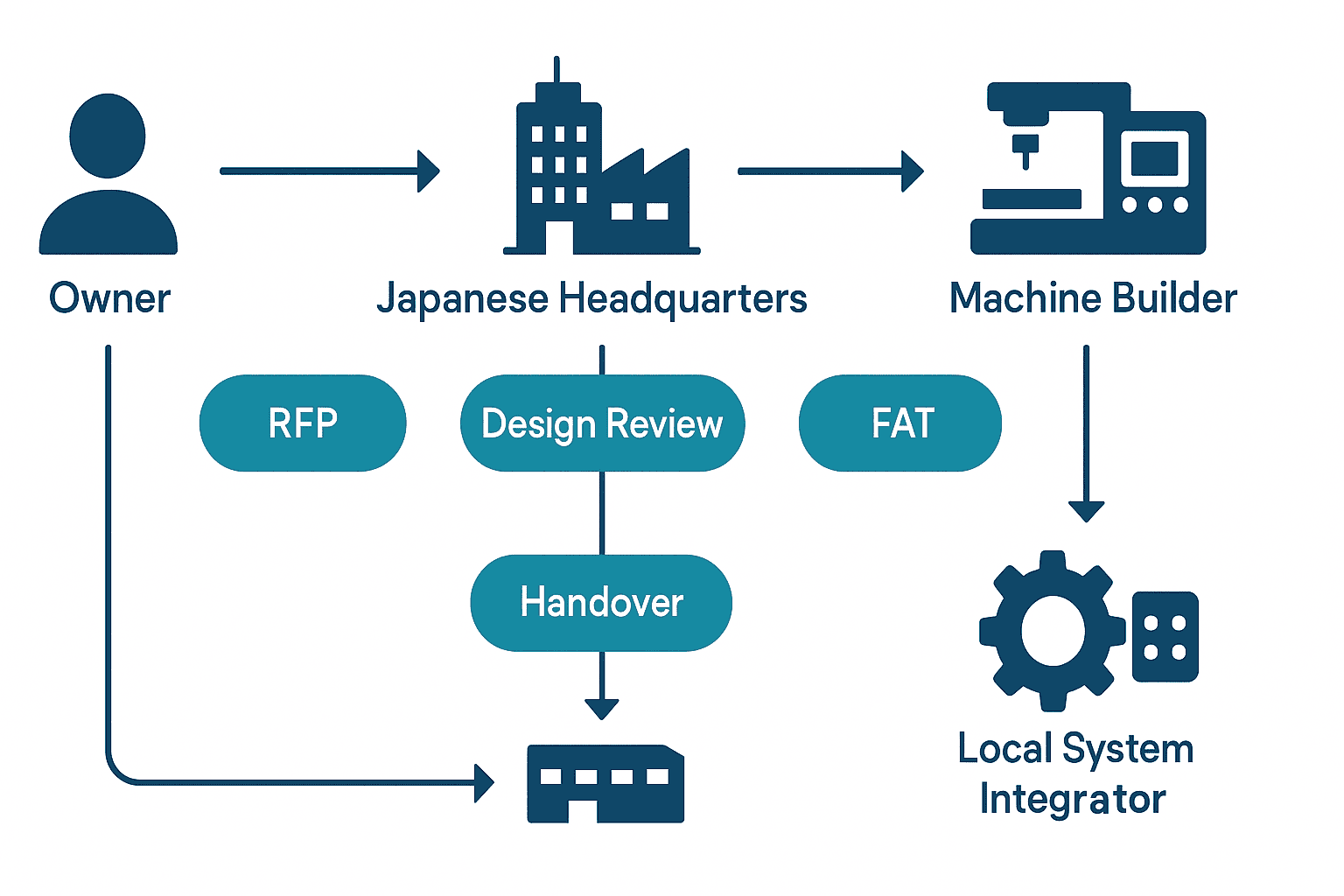
When a factory in Thailand installs, relocates or modifies equipment, successful electrical design outsourcing requires more than finding a company that can draw circuits. In a project involving a Japanese headquarters, a Thai plant, a machine builder, a panel builder and a local system integrator, the buyer must decide who freezes the design inputs, who determines the applicable law and standards, who owns the PLC source and editable electrical drawings, and which tests release payment and acceptance. This guide treats the RFP, control-panel drawings, editable EPLAN assets, IEC 60204-1 and IEC 61439, FAT/SAT, change control and maintenance handover as one procurement-governance system for a Thailand factory.
Electrical design outsourcing should buy verifiable engineering assets
If the deliverables are only PDF drawings and a completed cabinet, the equipment may run at start-up but become difficult to maintain six months later. Terminal numbers may not match the field, nobody may know which PLC source is final, an EPLAN project may open without referenced parts or forms, and changes may have no recorded rationale. Maintenance then has to reconstruct the design from the machine whenever a component is replaced or the line is modified.
The buyer should obtain engineering assets that trace requirements to test results and that another qualified engineer can reuse. The package normally includes a design-basis document, load list, single-line diagram, control-panel circuit diagrams, panel layout, terminal and cable schedules, I/O list, device list, PLC/HMI/safety source, parameter list, network architecture, links to the risk assessment, calculations, FAT/SAT records, punch list and as-built documentation.
Separate drafting capability from engineering accountability. Redrawing legacy documents, expanding approved standard circuits and preparing a bill of materials are divisible tasks when inputs are stable. Protection coordination, prospective fault conditions, enclosure temperature, safety functions, power quality, legal signatures and the safe state after failure require named decision owners. The RFP must define these boundaries, not merely estimated hours.
Establish governance for the Thailand factory first
The contracting entity and the real decision makers may differ. Headquarters may approve specifications, the Thai company may issue the purchase order, the plant may control shutdown windows, the machine builder may understand the mechanical risks, and the SI may integrate controls. “Customer approval” is therefore too vague. Name the approver, reviewer, consultant and notification party for each asset.
| Decision or deliverable | Example accountable owner | Example working team | Approval evidence |
|---|---|---|---|
| Production requirement and shutdown window | Thai production owner | Production and maintenance | Approved URS and shutdown plan |
| Machinery risk and safety functions | Equipment owner and machine-design lead | Safety, electrical and controls engineers | Risk register and safety requirement specification |
| Thai legal and licence applicability | Thai entity’s facility owner | Locally licensed engineer | Applicable-law register, signatures and inspection records |
| Electrical and controls design | Named design authority | Outsourced designer or SI | Review log and approved drawings |
| FAT disposition | Equipment owner, not procurement alone | Quality, maintenance and SI | Signed results and punch list |
| SAT and final acceptance | Thai equipment owner | Production, maintenance and safety | Results under operating conditions and handover receipt |
A RACI chart alone is insufficient. Set approval deadlines, the consequence of no response, the contractual master language and the order of precedence when translations conflict. For example, the safety requirements may have an English master, field labels and instructions may be in Thai, and Japanese may be supplied for headquarters review. Translation differences must never be resolved informally on the shop floor.
Write a factory electrical design RFP that produces comparable bids
A factory electrical design RFP is not an invitation for vendors to write unrestricted proposals. It is the common design input used to compare price, scope and capability on equal terms. Include at least these sections:
- Objective and equipment: new installation, relocation, capacity expansion, obsolescence renewal or safety upgrade.
- Battery limits: incoming power, panel-to-panel and machine-to-machine boundaries, and MES/SCADA interfaces.
- Existing information: current as-builts, field photos, loads, I/O, network and shutdown constraints.
- Design conditions: supply, environment, language, preferred components, maintenance standard and cybersecurity policy.
- Laws and standards: buyer-mandated documents and the contractor’s duty to verify and propose applicability.
- Deliverables: file format, editability, template, naming, language and issue dates.
- Review gates: concept, basic design, detailed design, fabrication, pre-FAT and as-built.
- FAT/SAT: objects, prerequisites, acceptance criteria, retest rules and witnessing method.
- Change control: design baselines and impact analysis, not just a count of included revisions.
- Intellectual property and licences: editable drawings, PLC/HMI source, libraries, passwords and reuse rights.
- Site work: access, permits, lockout/tagout, interpretation, night/weekend work and travel.
- Acceptance and warranty: milestones, final acceptance, defect correction and support hours.
Require every bidder to return assumptions, exclusions and questions in the same format. A low price may omit site verification, checking against legacy drawings, validation of safety circuits, source handover or retesting. Compare blank cells and assumptions in the deliverable matrix, not only the total price.
Freeze design inputs through a site survey
For a brownfield modification, never assume that supplied drawings are accurate. Verify panel nameplates, power distribution, protective devices, earthing and protective bonding, cables and terminals, spare capacity, enclosure space and cooling, PLC and remote I/O, networks, interlocks, emergency stops and field devices against both the documents and the physical installation. Mark inaccessible circuits or signals as “not verified” and transfer them to a shutdown inspection list.
Freezing design inputs does not prohibit change. It identifies the information baseline used for quotation and design. Each discrepancy should carry a photo reference, equipment tag, drawing page, issue, risk, action owner and due date. If additional work found at site proceeds on an oral agreement, the editable design and installed condition will diverge.
For power-related work, check the regulated-engineering categories published by Thailand’s Council of Engineers. Its unofficial English translation describes categories for electrical system or device design and calculation starting at 300 kVA or a peak line voltage of 3,300 V, among other regulated work. Do not use the translation alone for a contractual or legal conclusion. Confirm the Thai text with a locally licensed professional for the actual voltage, capacity, building type and design/supervision scope. The purpose is to name the verifier and signatory in the RFP, not to give legal advice.
Define interfaces in PLC electrical design outsourcing
The more circuit design and software are split, the more likely interface signals will be missed. Saying that the electrical designer assigns sensors and actuators while the PLC engineer writes sequences does not define wire-break states, loss of communication, manual mode, restart, emergency-stop reset or ownership between machines.
An I/O list should contain the tag, description, signal type, normal and fail state, scaling, alarm, interlock, safety classification, drawing reference, PLC variable, HMI presentation and test method—not only an address. Describe machine handshakes with a state diagram or timing diagram and approve exactly when Ready, Run, Complete, Fault and Reset become true or false.
Keep safety-related controls in a dedicated safety requirement specification instead of burying them in the general sequence. ISO 13849-1:2023 gives general principles for designing and integrating safety-related parts of control systems, but the required performance and architecture depend on the risk assessment and machine conditions. A safety PLC or a copied legacy circuit does not prove safety. Trace hazards, required safe states, triggering conditions, resets, diagnostics and verification to the mechanical risk-reduction measures.
For deeper software procurement practices, see PLC Program Development Outsourcing for Thailand Factories.
Put engineering rationale into control-panel circuit diagrams
Control-panel circuit diagrams are installation instructions and an entry point for verifying protection, separation and maintainability. The set should cover single-line, power, control supply, safety, PLC I/O, communication, terminals, external connections, earthing, layout, parts, labels and cables. Use consistent tags and cross-references so the same coil, contact or terminal never appears under multiple identities.
The consolidated IEC 60204-1:2016+A1:2021 applies to electrical, electronic and programmable electronic equipment of machines that are not portable by hand while working, including coordinated groups of machines; its scope begins at the point where power connects to the machine’s electrical equipment. IEC’s official information checked on 7 September 2026 identifies the base standard as Edition 6 and the AMD1 consolidated version as Edition 6.1, with a stability date of 2027. Do not reduce the RFP to “IEC 60204-1 compliant.” Define the machine-electrical boundary, applicable verification topics, evidence and responsible engineer. Any clause-level interpretation must use the purchased current standard and the actual project conditions.
For low-voltage assemblies, map the IEC 61439 series. IEC 61439-1:2020 covers general definitions, service conditions, construction requirements, technical characteristics and verification requirements; its published stability date is 2030. It is used with the relevant product part. IEC 61439-2:2020 covers PSC assemblies and its official scope description includes assemblies up to 1,000 V AC or 1,500 V DC. Specify which part applies and who acts as the original manufacturer or assembly manufacturer with responsibility for verification.
IEC TR 61439-0:2022 is useful on the buyer’s side because it guides specification of assembly functions and characteristics. Convert ratings, fault conditions, temperature and humidity, installation environment, IP, cooling, maintenance access, internal separation and future expansion into a structured vendor questionnaire.
For the cabinet-specific design process, also read Control Panel Design for Thailand Factories. The focus here is connecting that technical design to multi-country contracting and asset handover.
Accept EPLAN electrical drawings by recoverability, not by PDF appearance
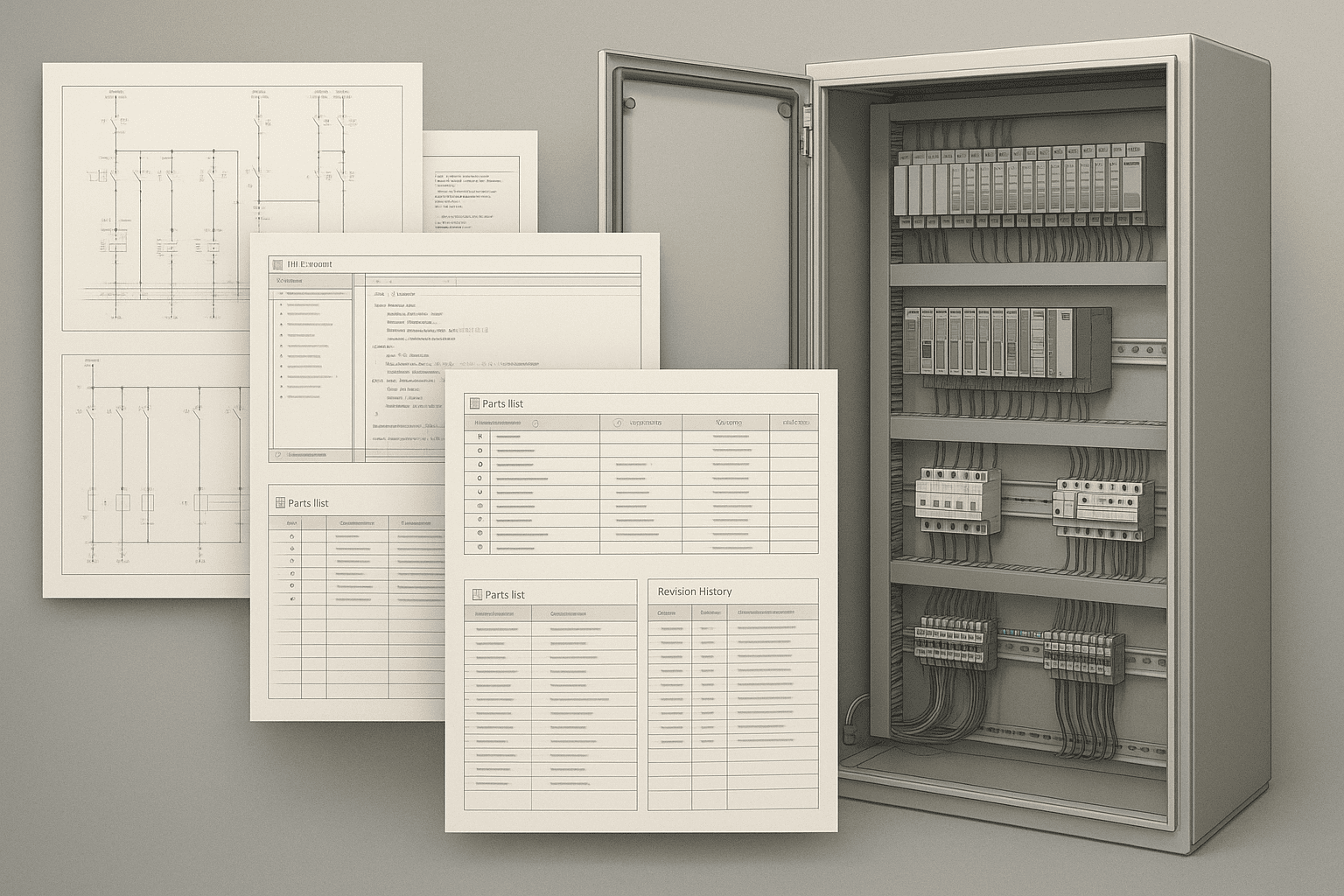
The purpose of specifying EPLAN electrical drawings is not an attractive PDF. It is to retain structured, editable data for parts, connections, terminals and references and reuse it in the next modification. The deliverable schedule should therefore name the EPLAN version, project format, master data, parts data, macros, forms, plot frames, dictionaries, external documents, images, fonts and output settings.
EPLAN’s official help describes backup, restoration and long-term archiving of projects and related master data. Its 2026 API documentation for the backup function also describes project and master-data backup and options to include external documents and images. Translate that into acceptance: restore the archive in a clean receiving environment, open it without missing dependencies, regenerate PDFs and confirm that key parts, cross-references, terminals and reports remain intact.
If a vendor-specific library or licence cannot be transferred, agree on an alternative before award: a handover copy using standard parts, a readable exchange format, complete PDF/DWG, CSV parts/terminal/cable schedules and library reconstruction instructions. This makes future tool lock-in visible before the buyer depends on it.
Make source ownership and use rights explicit
The issue is broader than a blanket assignment of copyright. For sustainable maintenance, the owner needs rights to use, copy and back up the project, modify it internally, disclose it to another maintenance contractor under confidentiality, and commission future changes. A contractor’s generic library, know-how and third-party licensed assets can be identified separately.
| Asset | Terms to decide before award | Acceptance evidence |
|---|---|---|
| EPLAN/CAD source | Editable format, references, version, use/modification/third-party maintenance rights | Restore test and regenerated-output comparison |
| PLC/HMI source | Commented final version, library dependencies, build environment and online match | Version/checksum and controller comparison |
| Safety program | Access, signature, validation records and change authority | Traceability to safety requirements |
| Drive/device settings | Parameters, firmware and recovery method | Restoration procedure or test on replacement hardware |
| Passwords/certificates | Secure transfer, custody, expiry and post-contract rotation | Receipt in the secret register |
| Generic libraries | Background-IP boundary, licence and replacement route | Licence list and dependency map |
Do not treat a one-time email attachment as source management. Keep approved, FAT, SAT and as-built versions in a repository or controlled register. Record who changed what, why, which requirement or field condition prompted it and which tests were repeated.
Design a multilingual, multi-country drawing handover
When a Japanese machine builder prepares English drawings, a Thai panel shop applies Thai labels and a Vietnamese team later deploys a similar machine, translation cannot be a final formatting step. Use language-independent tags, device identifiers, cable numbers and alarm codes, with descriptions maintained by language.
Choose one contractual master and designate the others as controlled translations. Nevertheless, warnings, operating displays, lockout/tagout instructions and test records used in Thailand must be reviewed in a language understood by the people doing the work. A reviewer familiar with electrical and mechanical context should verify machine-translated safety terminology. Maintain a glossary with tag, standard English, Thai, Japanese, when relevant Vietnamese, and prohibited legacy terms.
Drawing templates should include document number, equipment tag, page, revision, state such as For Review/Approved for Construction/As-built, author/checker/approver, language and source reference. Do not control versions through filenames alone. The document register must identify superseded issues, and SAT should confirm that obsolete printed drawings have been removed from panels and maintenance stations.
Set the hierarchy of IEC standards, Thai law and customer rules
Using an international standard does not automatically satisfy Thai law, permits or professional-licence requirements. Conversely, minimum legal compliance may not satisfy a customer’s safety and maintenance standard. Maintain an applicable-requirements register grouped into Thai law/authority rules, customer/industrial-estate/insurer requirements, international standards, internal standards and equipment-specific requirements.
Thailand’s Department of Industrial Works publishes Factory Act materials and lists safety-related ministerial regulations, notifications and rules. The official page also lists a document dated 22 January 2025 concerning inspection and certification of factory electrical safety. Because requirements change, a URL checked on 7 September 2026 must not be the final legal review. Recheck immediately before award and design freeze, then have a locally qualified person determine applicability by location, factory category, capacity, voltage, modification scope, inspection and filing authority.
For every requirement, record issuer, edition/date, reason for applicability, design response, verification method, evidence and owner. Link it to design reviews and FAT/SAT instead of listing standard numbers without a compliance plan. Where requirements conflict, record the priority decision and written approval.
Use electrical design FAT and SAT as contract gates
Electrical design FAT and SAT are not ceremonies performed after the design is complete. They convert requirements into testable statements and give all parties the same acceptance measure before fabrication. IEC 62381:2024 defines requirements and checklists for FAT, FIT, SAT and SIT for automation systems in the process industry and helps owners, buyers and vendors agree activities and responsibilities. Its structure can inform other projects, but using it does not itself complete machinery-law compliance, loop checks or commissioning for a specific plant.
FAT readiness should require approved drawings, the latest source and settings, a controlled procedure, simulation plan and a known-open-item list. FAT should cover build and labels, wiring, supply and protection, I/O, interlocks, alarms, modes, failure states, communications, backup/recovery and document consistency. For unavailable field devices, record what was simulated and how.
SAT verifies actual power, earthing, field wiring and devices, networks, machine interfaces, load and operator environment. A logic function that passed FAT can behave differently because of polarity, noise, network timing, mechanical adjustment or local operation. Never copy FAT results into the SAT record.
| Gate | Main subject | Example release criterion | Evidence |
|---|---|---|---|
| Design review | Requirements, circuits, I/O, safety, maintainability | Open inputs have owners and dates | Comment log and approved drawing |
| FAT Ready | Fabrication, software, procedure and rig are testable | No blocker, exceptions formally approved | Readiness checklist and version list |
| FAT | Reproducible functions and failures at vendor | Predetermined expected results achieved | Measurements, captures, logs and signatures |
| SAT Ready | Installation, power, network and work permits | Safe energisation and test possible | Site/LOTO/installation records |
| SAT | Field integration and operating conditions | Requirements achieved on real equipment | Loop and operation records, signatures |
| Handover | As-builts, source, training and spares | Receiving team can restore, find and prepare a change | Receipt, restore test and training evidence |
Classify punch items by severity. Safety, legal, equipment-damage, product-quality and core-function issues must not become “later actions” only to meet a payment date. For conditionally accepted cosmetic items, name the owner, due date, verification route and payment retention.
For test-case design, see Sequence Control Design and FAT for Thailand Factories.

Change control must trace technical impact before price
If change management only negotiates added cost, technical effects disappear. A change request should record the reason, requester, affected requirements/drawings/software, old and new state, safety/legal/production/schedule/cost impact, retest scope and approver. Oral or chat approvals must enter the change register before implementation.
A baseline is the combination of requirements, approved drawings, PLC/HMI source, bill of materials and test procedure. If only the drawing revision changes while PLC source remains old, an as-built package cannot be produced. Use the change number across commits, drawing revisions, parts changes and FAT/SAT cases.
An emergency field fix during a shutdown is a temporary change. Define restart conditions, safety review, backup, formal review on the next business day and the as-built update deadline. “It ran at site” is not design approval, and the final source must never remain only on one engineer’s laptop.
Make maintenance handover part of final acceptance
If start-up completion triggers acceptance, training and documents are postponed. Maintenance handover must be a final gate. The target state is that Thai maintenance personnel can explain the architecture, trace a terminal from the drawing, investigate alarms, restore a backup, connect to the correct source and issue a controlled change request.
The handover package should include as-built PDFs and editable sources, build/connection instructions, software and licence list, network and addressing, user/role procedure, device settings, spares, maintenance guidance, known constraints, open punches, vendor contacts and warranty terms. Transfer secrets separately through a secure route.
Training should not pass on attendance alone. Include hands-on demonstrations of recovery, I/O diagnosis, replacement-device setup, drawing search, normal shutdown and escalation. Provide language-appropriate materials and verify technical understanding even when interpreters are used.
Questions that evaluate an electrical design contractor beyond price
- Who performs the Thailand site survey, design, start-up and long-term support?
- Who verifies Thai legal and licence applicability and arranges required signatures or inspections?
- How are IEC 60204-1, IEC 61439 and machinery risk results converted into deliverables and tests?
- When are editable EPLAN files, master data, PLC/HMI sources and credentials released?
- How is safety-related control designed and validated separately from standard PLC logic?
- How will absent field signals and machine interfaces be simulated at FAT, and what moves to SAT?
- How do field changes update drawings, source, test records and as-builts?
- Can another engineer recover the final design if the original project engineer is unavailable?
- How are English, Thai and Japanese terminology and the contractual master controlled?
- What technical or contractual limits apply if a different company maintains the system after warranty?
Ask for anonymised examples of a deliverable list, change register, FAT procedure, handover index and restoration check. Confidentiality may prevent sharing project documents, but a mature contractor can still explain the management structure and templates.
Practical sequence from procurement to handover
First, appoint the equipment owner and state the scope and success criteria. Second, survey the site and identify differences from legacy documentation. Third, register the applicable law, standards and customer rules and define where a Thai licensed professional participates. Fourth, put deliverables, source rights, review gates and FAT/SAT into the RFP and compare proposals against the same matrix.
After award, use gates for requirements baseline, basic design, detailed design, fabrication, FAT Ready, FAT, installation, SAT Ready, SAT, as-built/training and final handover. An open issue cannot move to the next gate without an owner and date. Any exception records its safety, quality and schedule impact and the approving authority.
Finally, restore the drawings, sources and backups in the receiving environment. Do more than count files: search, regenerate output, compile where authorised, compare online versions, restore settings and inspect history. Electrical design outsourcing then becomes acquisition of lifecycle engineering assets, not one-off drafting.
Frequently asked questions
What should a factory electrical design RFP decide first?
Define equipment and battery limits, owners of design inputs, the verifier of law and standards, rights to editable source, review gates and FAT/SAT acceptance. Pricing by drawing count or hours alone tends to omit verification and sustainable handover.
When should PLC source be received in PLC electrical design outsourcing?
Receive and control it at approved, FAT, SAT and as-built milestones—not only on the last day. Confirm each version matches the controller, drawings, I/O, HMI and settings, and include engineering software, libraries and credentials.
Can control-panel circuit diagrams be accepted as PDF only?
PDF is convenient for installation, but future modifications need editable source and dependencies. Accept the CAD/EPLAN project, bills and schedules, parameters and revision history, and prove recovery and regeneration in another environment.
What should be checked when EPLAN electrical drawings are handed over?
Check version, project backup, parts, macros, forms, plot frames, dictionaries, external files and images, output settings and third-party licences. Restore in the owner’s environment and resolve missing references or substitution warnings.
Should IEC 60204-1 or IEC 61439 be specified?
They address different subjects, so this is not necessarily either/or. IEC 60204-1 covers machinery electrical equipment; the IEC 61439 series covers low-voltage switchgear and controlgear assemblies. The responsible engineer must map their scope with Thai law, customer rules, product parts and contractual boundaries.
What is the difference between electrical design FAT and SAT?
FAT normally checks functions and documents reproducible at the vendor before shipment or installation. SAT checks integration with actual power, wiring, field equipment, networks and load. Define simulations, exclusions, expected results and carried-over tests in advance.
Is a locally licensed engineer required for electrical design in Thailand?
The answer depends on capacity, voltage, factory/building category and the scope of design, construction and supervision. Check the current Council of Engineers and DIW rules in Thai and obtain a determination from a locally licensed professional.
Conclusion: procure a handover that will not stop the factory
For electrical design outsourcing in a Thailand factory, the decisive factor is not the drafting rate. It is whether the contract integrates accountability, Thai legal and standards review, editable drawings and source, FAT/SAT acceptance, revision history and maintenance handover. A verifiable RFP, surveyed baseline and common version trail from design through as-built create an asset that remains useful during the next modification.
If you are preparing a factory electrical design RFP, cleaning up legacy drawings or planning PLC/panel design and FAT/SAT in Thailand, the scope can be discussed before every specification is fixed. Contact TOMAS TECH with the equipment type, available documents, target timing and the interface that remains unclear.
Official references
- IEC 60204-1:2016+A1:2021 consolidated
- IEC 61439-1:2020
- IEC 61439-2:2020
- IEC TR 61439-0:2022
- IEC 62381:2024
- ISO 12100:2010 and ISO 13849-1:2023
- Thailand DIW factory-safety laws
- Council of Engineers Thailand: Engineer Act and regulations
- Council of Engineers Thailand: ministerial regulation on regulated engineering fields (unofficial English translation)
- EPLAN Help: Data Backup
- EPLAN API Help 2026: Backup
Sources were checked on 7 September 2026. This article supports procurement planning and is not legal advice or a certificate of conformity. Confirm clause-level interpretations, Thai legal text, licences, inspections and signatures against the purchased current standards and actual project conditions with qualified local professionals and the relevant authorities.


