


TOMAS TECH CEO Ryo Nozaki Spoke at the BOI Tokyo Office Webinar
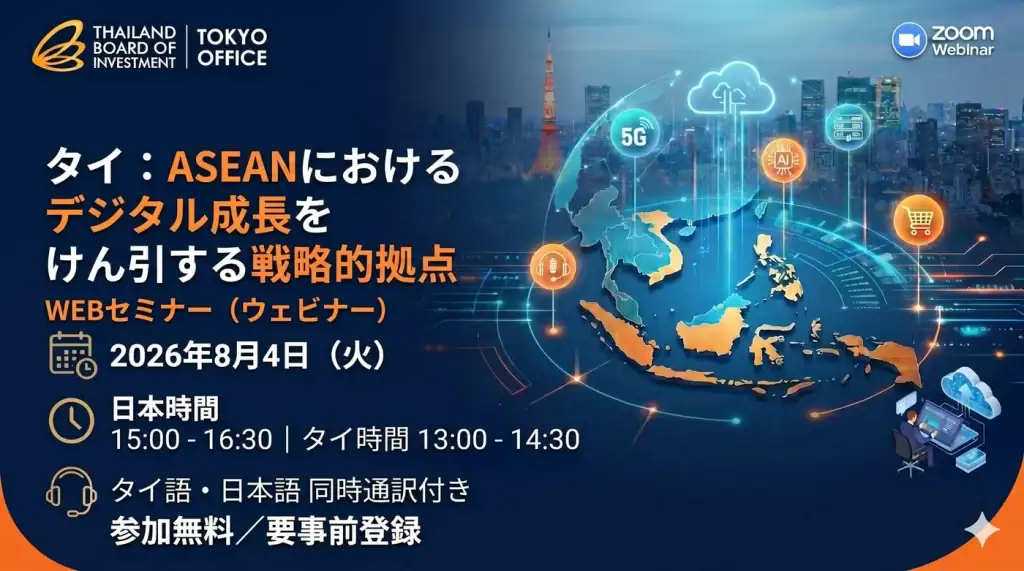
On Tuesday 4 August 2026, the Thailand Board of Investment Tokyo Office (Royal Thai Embassy, Office of Economic and Investment Affairs) hosted the webinar “Thailand: A Strategic Hub Driving Digital Growth in ASEAN,” at which Ryo Nozaki, President and CEO of TOMAS TECH CO., LTD., delivered a presentation. Following briefings on national support schemes by the Digital Economy Promotion Agency (depa) and the Thailand Board of Investment (BOI), TOMAS TECH presented “As a Japanese-affiliated Private Company that Obtained BOI Promotion — Doing Business in Thailand and Using BOI in Practice.”
This article publishes the archive recording of the session and summarises what was discussed, organised from our own perspective. We have tried to keep the detail concrete enough to be useful to anyone considering entry into Thailand, the digitalisation of an existing Thai subsidiary, or an application for BOI investment promotion.
Please note that every scheme, figure and requirement described below is a summary of what the presenting organisations explained on the day. Schemes are subject to revision, so please confirm the current terms with the official BOI and depa sources before acting on them.
Archive Recording
The full session is available below. This page carries the English-language recording; a Japanese-language recording of the same webinar is published on the Japanese version of this article.
Event Overview
- Title: “Thailand: A Strategic Hub Driving Digital Growth in ASEAN” web seminar
- Organiser: BOI Tokyo Office (Royal Thai Embassy, Office of Economic and Investment Affairs)
- Date: Tuesday 4 August 2026
- Time: 15:00–16:30 Japan time / 13:00–14:30 Thailand time
- Format: ZOOM webinar, with simultaneous Thai–Japanese interpretation, free of charge
- TOMAS TECH session: Ryo Nozaki, President and CEO — “As a Japanese-affiliated Private Company that Obtained BOI Promotion: Doing Business in Thailand and Using BOI in Practice”
The webinar was supported by a wide range of organisations, including the Japan Embedded Systems Technology Association, the Japan Information Technology Services Industry Association, the Software Association of Japan, the Digital Content Association of Japan, the ASEAN-Japan Centre, JETRO, SMRJ, AOTS, Sumitomo Mitsui Banking Corporation, MUFG Bank, Mizuho Bank, the Shoko Chukin Bank, and the Japan-Thailand Business Forum (JTBF).
Session 1: depa — Thailand’s Digital Industry and Support for Corporate Transformation
The first half was presented by a Deputy Director General of the Digital Economy Promotion Agency (depa), covering the shape of Thailand’s digital industry and the support schemes the agency operates.
The Structure of Thailand’s Digital Economy
According to the briefing, the fastest-growing segment of Thailand’s digital industry is hardware and smart devices, followed by digital services and by software and software services. Hardware depends substantially on imports, while a meaningful share of software and digital services is domestically produced, leaving the market reasonably balanced. Digital content is not yet large in absolute terms, but continues to grow at double-digit rates.
In terms of contribution to GDP, large enterprises account for a little over half, small and medium-sized enterprises follow, and the agricultural sector — which supports a very large number of households — contributes comparatively little. depa positions the digitalisation of this broader base, agriculture included, as one of its roles in lifting GDP contribution. Many areas of industry remain at what would be described as an Industry 2.0 level of maturity, which, read the other way, is where the room for growth lies.
Startup Investment and the Capital Gains Exemption
Unlike other government agencies, depa can take equity positions rather than only provide grants, and at the time of the webinar had invested in roughly 200 companies. The briefing also covered a framework under which capital gains arising from the sale of shares in a Thai startup are exempt from tax when a foreign company has invested. As explained, this can apply to corporate and individual investors, domestic and foreign alike.
Thai Digital Catalog — the “Special Procurement” Route
The centrepiece of depa’s support is the Thai Digital Catalog, a register of products and services from operators that hold international certifications such as ISO/IEC 29110. At the time of the webinar, 277 companies and 1,511 services and products were registered.
Registration produces effects on both the public and private sides. On public procurement, Thai procurement law allows the “special procurement” route — procurement without competitive quotation — which is normally capped at THB 500,000, to be applied to catalogue-registered products regardless of value. Examples cited included an electronic ticketing system for a national venue, ERP systems, smart-city hardware, and online consultation desk systems, all well above the THB 500,000 threshold and all procured through this route. Registered products and services become searchable by government agencies nationwide through the state procurement system.
Benefits Available to Private Companies
For Japanese-affiliated companies, the private-sector benefits are likely to be of most immediate interest. The briefing covered the following.
- 200% expense deduction: SMEs may deduct twice the cost of adopting products and services registered in the Thai Digital Catalog. An expense of THB 200,000 can be recognised as THB 400,000.
- Transformation fund (matching fund): depa covers 50% of the cost, up to THB 200,000 per case. Around 600 cases were planned for the year, of which roughly 450 were listed as AI transformation projects. Adoption by government bodies including local authorities is also progressing, with pilot projects running across roughly 400 organisations.
- Expanded scheme for SMEs: In partnership with the Office of SMEs Promotion (OSMEP) and SME Bank, a new framework combining a larger support allocation with low-interest lending is being launched. As with the other schemes, use of a catalogue-registered product or service is a condition.
- Cloud discount: Registered operators can use a partner cloud provider’s services at a 30% discount for one year.
- Reskilling support: Where a registered digital curriculum is used, training costs can be deducted at 2.5 times, alongside deductions related to new hiring and grants from a manpower fund.
Support for International Certification
Because registration in the Thai Digital Catalog requires certification such as ISO/IEC 29110, depa also supports obtaining it. A cumulative 665 companies have been supported since 2018, and more than half of the registered products and services now meet international standards. From the current year, support of up to THB 30,000 towards certification-body fees has also begun for ISO/IEC 27001.
The session closed with an example of a Japanese-affiliated company with a Thai subsidiary that obtained international certification, registered in the Thai Digital Catalog, and now encourages its own customers to use the BOI and depa schemes — moving from being a user of the schemes to being the party that helps customers use them, which benefits both its revenue and its customers’ tax position.
Session 2: BOI — Investment Promotion for the Digital Industry
The Thailand Board of Investment then presented its investment promotion measures for the digital sector and the business opportunities that follow from them.
Thailand’s Digital Economy and the Role of BOI
Thailand’s digital economy is projected to grow at roughly twice the rate of the economy as a whole. The drivers cited were the shift to cloud-first policies and the rapid spread of AI, with software (contract development and application development) and digital content (games, animation, AR and VR) showing the largest gains.
BOI also described its own role as going beyond that of a promoter, taking on the functions of integrator, facilitator and connector. In 2025, foreign direct investment applications reached the highest value in BOI’s history, and within that total the digital sector accounted for the largest share.
How Incentives Are Structured, and Which Categories Apply
BOI incentives are divided into basic incentives based on the activity itself and additional incentives layered on top. Basic incentives are grouped by technology level, with activities using advanced technology placed in the higher tiers such as A1+. Even Group B activities, which do not receive a corporate income tax exemption, can receive non-tax incentives such as exemption from import duty on machinery.
The most generous incentives in the digital field apply to the development of software, digital services, digital platforms and digital content (category 8.1.1), classified as A2 with a corporate income tax exemption of up to eight years. Digital infrastructure such as data centres and cloud services, and ecosystem activities that support the digital economy, are also covered.
Eligible work is not limited to new development: adding functions or new modules to an existing system also qualifies. Alongside exemption from import duty on machinery and from corporate income tax, the incentives include non-tax measures such as bringing in overseas specialists and access to the LTR visa and SMART visa.
Principal Requirements
Applications in the digital field require investment of at least THB 1.5 million per year. Eligible costs were described in three categories.
- Salaries of Thai IT personnel newly hired after the application
- Costs of IT development training aimed at raising the capability of Thai personnel
- Costs of obtaining certification against international standards such as ISO/IEC 29110
For data centre projects, the requirements cited included an IT load capacity of at least 2 MW, a high-efficiency air-conditioning system with backup, and obtaining ISO/IEC 27001 together with international data centre certification before the incentive is renewed.
Productivity Measures for Existing Operators
Companies already operating in Thailand can also receive a three-year corporate income tax exemption when they adopt automation, digital technology or alternative energy technology. ERP, CRM, SRM, RPA, cloud and AI adoption were given as concrete examples.
Under this measure, where the solution adopted was developed in Thailand — certified by depa, NSTDA or BOI — 100% of the investment counts towards the exemption, against 50% otherwise. The briefing stressed that this allows industrial upgrading and a reduction in the tax burden to be pursued at the same time.
Session 3: The TOMAS TECH Presentation — Doing Business in Thailand and Using BOI in Practice
In the second half, our CEO Ryo Nozaki spoke from experience about what it actually took to apply for and obtain BOI investment promotion.
Why We Applied for BOI
Nozaki opened by setting out three reasons. First, the Thai government positions the digital industry as a pillar of next-generation growth within the national Thailand 4.0 strategy. Second, BOI’s investment promotion strategy for 2023–2027 designates automation, digitalisation and decarbonisation — green and smart industry — as priority areas. Third, digital infrastructure has been built out: the announcement in 2023 by Amazon, Microsoft and Google of combined investment in Thailand exceeding THB 300 billion has put data centres and cloud platforms in the country, and the environment for using digital technology has improved rapidly.
In other words, Thailand is moving from being a low-cost production base to being ASEAN’s base for digital growth, and incentives are available to companies providing solutions in that field. Wanting to grow a digital business from a Thai base within that shift was, he explained, the background to applying for BOI promotion.
The Business We Applied With
The application covered an integrated smart factory platform built on five pillars: AI-based predictive maintenance, big data analysis of production processes, cloud-based integrated management of production, inventory and quality information, automation using robots and IoT devices, and green technology through energy monitoring.
Nine Months from Application to Certificate
The point that drew the most concrete interest was the timeline. From shortly after incorporation, we maintained an ongoing online dialogue with BOI officers, working out in advance which category our business fell under and what requirements we would have to meet. We filed online through BOI’s e-Investment portal in August 2024, then spent three to four months on feedback, revision and resubmission. Board approval came around the turn of the year, and we received the certificate in May 2025.
In total, approval took roughly five months from application, and the certificate took about nine months. Nozaki advised allowing six months to a year: this is not a process that ends when the documents are filed. The sequence is preliminary consultation, online application through e-Investment, document review including requests for additional material, presentation of the business plan, deliberation and approval by the BOI board, acceptance of the approval notice, application for issuance of the promotion certificate, and finally receipt of the certificate. He also stressed that BOI’s preliminary consultation is free, so there is no reason not to use it early.
There is no prescribed format for the business plan; we prepared roughly 20 slides in PowerPoint. It covered the business overview, company track record, solution detail, market analysis, business model, technology partners, a training plan for Thai engineers, a plan for obtaining quality certifications, the separation from existing business, and a three-year revenue plan. The most important point is that the narrative — employment and development of Thai personnel, and contribution to Thailand’s digitalisation — runs consistently through the whole document. BOI is an investment promotion agency, so the plan has to answer, on every page, what your company will bring to Thailand.
The Incentives Received, and the Obligations That Come With Them
The main requirements of category 8.1.1 (software development), under which we were promoted, are four: carrying out all six stages — requirements definition, design, development, testing, deployment and configuration management — within Thailand; newly hiring Thai IT personnel and paying at least THB 1.5 million in annual salaries; paying in registered capital; and starting operations within 12 months of the certificate being issued.
Beyond the corporate income tax exemption, the practical benefit Nozaki highlighted was how much simpler visa and work permit procedures become when bringing in overseas specialists. BOI is often read as a tax scheme, but taken together with the ability to operate with 100% foreign ownership and the freedom of overseas remittance, it is more accurate to understand it as a scheme designed to make it easier for foreign companies to do business in Thailand.
The incentives come with obligations. In addition to paying in registered capital, investing at least THB 1.5 million a year in Thai IT personnel, and starting operations within 12 months, quarterly progress reports and annual reports are required after the certificate is granted. Where promoted and non-promoted businesses run in parallel, the accounts must be managed separately, and audited reports must accompany the filing in years when the corporate income tax exemption is used. As Nozaki put it: obtaining the certificate is not the finish line — that is where the operating obligations begin.
Five Practical Pieces of Advice
The presentation closed with five points.
- Talk to BOI early. Preliminary consultation is free, and we spent time shaping our approach from an early stage.
- Design the business backwards from the incentives. Decide which category you are applying under, and build that into the business plan.
- Assume separated accounting from the start. Promoted and non-promoted business must be accounted for separately, so work with an accounting firm that has done it before.
- Become a company that can articulate its contribution to Thailand. Employment, capability building and technology transfer all need to be explainable.
- Design for the post-approval obligations. Build the reporting duties and the start-of-operations deadline into a plan you can actually keep.
From the Q&A
Questions submitted in advance were answered in the closing section. The following are the ones TOMAS TECH responded to.
Why Automation Investment Is Polarising
Asked what separates companies that invest aggressively in automation from those that do not, Nozaki acknowledged the difference in available capital, then gave two further factors. The first is an understanding of BOI’s direction of travel. Incentives including corporate income tax exemption are available for automation, labour-saving equipment and DX investment, and the companies using them tend not simply to buy equipment but to invest strategically with the policy direction in mind. The second is infrastructure: the large investments by the three major cloud providers have made cloud and AI far easier to use, which lowers the barrier to taking the first step.
The Most Unexpected Hurdles
Asked about the most unexpected operational or regulatory hurdles, he named two. The first is funding. As a foreign-majority company, borrowing from Thai domestic banks is not straightforward, and this continues to constrain the pace at which we can expand. The second concerns customers’ own investment approvals. Even where a customer could use BOI’s productivity-related promotion measures, an application is not automatically approved. Where approval is not granted, the investment is sometimes abandoned — and a project that would have raised productivity and competitiveness in Thai manufacturing goes unrealised.
Advice for Foreign Investors
Asked what advice he would give foreign investors wanting to scale smoothly in Thailand, Nozaki recommended obtaining BOI promotion, for three reasons: exemption from corporate income tax, easier visa procedures for foreign nationals, and the ability to operate while retaining a foreign majority. Being able to run the business with genuine ownership matters from an investor’s point of view, and any company planning to grow in Thailand over the medium to long term should start moving towards BOI early.
Local Partnerships and the Support Ecosystem
Asked how local partnerships and the government support ecosystem contributed to success, Nozaki pointed beyond the direct benefits to the signalling value: being a BOI-promoted company itself conveys a level of credibility. When meeting new customers or partner companies in Thailand, BOI promotion indicates that the company meets a certain standard.
He added that a customer’s own eligibility for BOI measures matters just as much as our own promotion. When customers can receive incentives, the barrier to capital and DX investment falls, and our solutions become easier to propose. Government support and the BOI ecosystem function not only for our own operations but as a mechanism that supports our customers’ investment decisions.
On IT Talent in Thailand
On the question of whether Thailand faces an IT talent shortage, depa replied that shortages are a worldwide phenomenon rather than a Thai one, and that the agency is promoting reskilling and upskilling of existing personnel. Using a curriculum registered with depa makes grant support available, alongside training cost deductions arranged with the tax authority and support from a manpower fund.
About TOMAS TECH
TOMAS TECH CO., LTD. is a system integrator based in Bangkok, Thailand, providing DX, AI and automation solutions to Japanese-affiliated manufacturing and logistics customers. Our mission is to maximise productivity at the *Genba* — the shop floor — through technology. We have around 52 employees and offices in Thailand, Vietnam and Japan.
We work across four areas: production management systems, AI, IoT and visualisation, and logistics and factory automation. This covers business application development for smartphones and tablets, control programming for PLCs and industrial robots, delivery and deployment support for our own production management system, development of AI systems fitted to the customer’s work and AI adoption training, visualisation of equipment and process status with traceability, and labour-saving through robots and conveyance equipment — combining software and hardware in each case.
Our strengths are threefold. First, we deliver solutions that combine IT, AI, OT and FA in one place. Second, we support customers end to end on the ground, from consulting through implementation to after-sales support. Third, we operate in Japanese, Thai, Vietnamese and English in house, so local staff can be part of the discussion from the outset. Roughly 60% of our customers are in manufacturing, 30% in logistics and 10% in food and retail, and we have worked with more than 120 companies to date.
Contact Us
TOMAS TECH welcomes enquiries about DX, AI adoption and automation in manufacturing and logistics across Thailand and ASEAN — whether that means building a local DX capability as part of entering Thailand, digitalising production management and shop-floor forms, or evaluating conveyance automation and generative AI. Enquiries at the stage of simply not knowing where to start are equally welcome.
On BOI itself, we have been through the application, the approval and the post-approval operating obligations ourselves. Applications and formal questions about the scheme should go to BOI’s official channels, but on the practical points — how a business plan for a digital activity is put together, how a training plan for Thai IT personnel is written — there is a good deal we can share from experience.
Please contact us through the enquiry form on our website (https://tomastc.com/contact/). We look forward to building the future of manufacturing and digital technology in Thailand and ASEAN together with you.


