


AI adoption impact measurement should not begin with purchased seats, logins, or prompt volume. Management needs to know whether completed work, quality, risk, and cost changed—and whether the difference can be defended with evidence strong enough for an investment decision. This guide gives Thailand-based and regional teams a practical evidence chain from baseline to incremental value, then uses 30-, 60-, and 90-day gates to continue, modify, or stop a generative AI or AI-agent pilot.
AI adoption impact measurement: connect an evidence chain, not a seat count
A dashboard showing “40 accounts, 30 weekly active users, 1,800 prompts” describes rollout activity, not impact. Looking only at revenue is equally weak because price changes, seasonality, sales activity, and exchange rates are mixed into the result. Use the same work unit, scope, and period through six layers:
- Baseline: freeze pre-AI volume, time, quality, rework, delay, and risk events.
- Adoption: count eligible people and in-scope cases using an approved use case.
- Useful completed work: count work that a human accepted, completed, and passed to the next step.
- Quality and risk: measure correctness, first-pass quality, corrections, serious incidents, confidential data, and approval exceptions.
- Full cost: include licenses, implementation, enablement, evaluation, controls, integration, operations, and rework.
- Incremental value: recognize only the baseline difference that finance and the process owner agree is realizable.
Order matters. More use without more useful completion is adoption without value. Faster drafting with lower quality may simply move rework to a manager. Even genuine time released is initially capacity—not cash—until it is demonstrably converted into additional throughput, reduced overtime, avoided outsourcing, or another approved value mechanism.
Why generative AI ROI is easy to overstate
Generative AI is not a closed machine with one physical input and output. One employee may use it for translation, research, summaries, code, and email; several people may contribute to one outcome; a quality gain may take months to affect retention or revenue. The *OECD Compendium of Productivity Indicators 2026* highlights the importance of output/input boundaries and careful interpretation as digitalisation and intangible investment complicate productivity measurement. We use that as measurement discipline, not as permission to transfer an economy-wide statistic to one company pilot. OECD Compendium 2026
Typical distortions include:
- self-selection, where already productive enthusiasts join first;
- a different case mix before and after launch;
- seasonality, policy change, or learning curves;
- hidden downstream review and correction;
- counting the same saved hour as labor, revenue, and outsourcing value;
- omitting evaluation, governance, support, and incident work;
- making prompt volume a target and encouraging unnecessary use.
Generative AI ROI is therefore a final ratio, not the first KPI. First define what completed work creates value for a customer, operation, or control owner.
Write a one-page measurement charter before the pilot
The sponsor, process owner, finance, IT, risk/legal, and user representative should approve one page before measurement begins.
| Field | What to decide | Weak wording | Decision-ready wording |
|---|---|---|---|
| Decision | what and when | assess impact | decide continue/modify/stop on Day 90 |
| Workflow | start and finish | back office | request received to approved answer recorded |
| Population | denominator | users | 40 eligible staff and 500 eligible cases in five teams |
| Comparison | baseline and method | compare before | previous four weeks, matched by weekday and case class |
| Value unit | recognition rule | time × salary | approved capacity rate, outsourcing and overtime shown separately |
| Quality floor | cannot deteriorate | maintain quality | first-pass quality ≥94%, zero critical wrong answers |
| Risk limit | stop condition | stop if needed | confidential disclosure, unapproved sending, or critical customer impact stops use |
| Evidence | source and owner | check logs | join work, AI use, approval, and correction with case_id |
Write what would justify the next budget before the result is known. Otherwise a team can choose whichever of utilization, satisfaction, or time appears favorable after the fact.
Baseline the work, not only average handling time
Capture volume, completions, backlog, difficulty, language, customer or product type, exceptions, and periodic peaks. A Thai operation may have different time and accuracy profiles in Thai, English, and Japanese; one blended average can hide the minority segment.
Separate touch time from elapsed time. An AI draft may reduce ten minutes of work while a two-day approval queue remains unchanged. Track first-pass quality, correction count, rework minutes, reason, and severity. Use a use-case rubric for required fields, calculations, citations, policy, and format instead of one subjective satisfaction score.
For cost, separate normal labor capacity, overtime, outsourcing, and opportunity cost. For risk, record severity, detection time, containment, and residual exposure for privacy, confidential information, intellectual property, cross-border transfer, and accountability.
The baseline period is not universally four weeks. It should cover at least one meaningful operating cycle; seasonal work may require a matched prior period. If the workflow itself is changing, disclose that confounder rather than assigning the entire before/after difference to AI.
Measure adoption with the correct denominator
Adoption may be necessary, but it is not sufficient. Keep three measures separate:
- Access coverage = accounts provisioned ÷ eligible people.
- Active adoption = people using an approved use case ÷ eligible people.
- Case coverage = AI-assisted eligible cases ÷ all eligible cases.
Using all employees in the denominator mixes in people with no relevant work; using only people who logged in inflates adoption. Define treatment of leave, transfers, training, and missing access. Review by use case, department, role, and language, but set minimum aggregation and access controls so measurement does not become individual surveillance.
OpenAI Academy’s “Measuring impact and ROI” connects adoption and use-case evidence to outcomes rather than equating availability with value. Measuring impact and ROI Collect the minimum logs needed to test a workflow hypothesis, not to score personal effort.
Useful completed work is the central AI KPI

Useful completed work is a defined business unit that reaches its accepted end state. A generated sales reply is not complete until a responsible person verifies the evidence, approves it, and records or sends it. A maintenance summary is not complete until a technician confirms the equipment model and safety conditions and releases an approved version.
For every use case define:
- unit: case, quote, answer, report, code change, inspection record;
- start event and accepted end state;
- useful status: accepted, minor edit, full rewrite, discarded;
- quality floor and prohibited outcome;
- evidence: case_id, version, approver, time, and evaluation result.
OpenAI’s “A scorecard for the AI age” treats useful work, cost, correctness, and scale as complementary dimensions. A scorecard for the AI age The same logic prevents local optimization: more completions cannot justify a breached quality floor; low unit cost is not useful if outputs are wrong; a high-quality pilot that requires unsustainable review effort will not scale.
Put quality and risk on the same scorecard as benefit
NIST’s AI RMF Core connects Govern, Map, Measure, and Manage; MEASURE includes analysis, assessment, benchmarking, and monitoring of AI risks and trustworthiness. NIST AI RMF Playbook Core The current NIST AI RMF page presents the voluntary framework and 2026 update context for trustworthy and responsible AI. NIST AI RMF This is a management reference, not a certification claim.
| Layer | Example evidence | Gate rule |
|---|---|---|
| Output quality | correctness, citation, required fields | do not recognize value below the floor |
| Workflow quality | first-pass, returns, rework, SLA | match case mix to baseline |
| Human control | review, approval exceptions, override reason | review all high-risk cases |
| Information risk | confidentiality, privacy, access, retention | critical event is a stop condition |
| Customer/safety | wrong advice, complaint, safety impact | never offset with financial benefit |
| Model operations | drift, failure, latency, availability | record version and re-evaluate changes |
Look at distributions, not only averages. Overall accuracy of 95% may conceal concentrated failure in one language or high-value case class. Separate punctuation errors from wrong contract terms or unsafe instructions.
Google’s guidance on ML project success distinguishes business success metrics from model metrics. Google ML project success A better model score does not remove an approval bottleneck; a better business result is not reproducible if it came from easier cases or extra manual work.
Full cost means more than license fees
Include the period-appropriate cost of:
- licenses, API, search, storage, and network;
- process design, data preparation, integration, identity, and security review;
- prompts, workflows, agents, and evaluation-set maintenance;
- user/admin training, support, and change management;
- human review, sampling, audit, and incident response;
- error rework, downtime, fallback procedures, and vendor management;
- rational shared-platform allocation and eventual exit/export.
Finance must pre-approve whether initial cost is expensed in the pilot month or allocated over an approved period. Show cash spending and management-accounting allocation separately. Avoid charging the entire platform to the best use case—or charging nothing to any use case.
Recognize incremental value conservatively
Value is recognized when there is a baseline difference, alternative explanations are treated reasonably, and an accountable owner confirms that it can be used.
- Cash value: avoided overtime, outsourcing, compensation, or paid services.
- Capacity value: additional completed demand with the same people, actually reassigned.
- Speed value: shorter lead time linked to orders, inventory, downtime, or retention.
- Quality value: reduced rework, returns, defects, or audit effort.
- Risk value: reduced expected loss; keep it non-financial if probability/impact evidence is weak.
- Learning value: reusable data, evaluations, or operating capability, reported separately from financial ROI.
Never count one saved hour simultaneously as labor reduction, new revenue, and outsourced-cost avoidance. Verify where released capacity went through queues, overtime, invoices, or additional completions. Agree whether revenue effects are recognized as revenue or contribution margin.
Use progressively stronger comparison designs: a transparent before/after comparison, matched cohorts, phased rollout, random assignment, or same-worker crossover. Evidence strength should be proportional to decision size and risk.
OpenAI Academy’s “Gather appropriate evidence of value” stresses baseline, unit, period, and method, plus complementary quantitative and qualitative evidence. Gather appropriate evidence of value Interviews explain barriers; logs show behavior; neither alone proves business value.
One illustrative generative AI ROI calculation
This is a fictional worked example, not a market benchmark, price quote, customer result, or promised effect. Replace every assumption with approved company data.
A back-office workflow has 500 eligible cases per month. Baseline performance is 18 minutes per case, 94% first-pass quality, and 20 rework cases requiring 30 minutes each. In the measurement month, 300 cases use AI assistance; after human acceptance, all 300 reach useful completion. Assisted cases take 11 minutes, first-pass quality is 95%, and rework falls to eight cases.
| Calculation | Formula | Illustrative result |
|---|---|---|
| Processing capacity | (18−11) min × 300 ÷ 60 | 35.0 hours |
| Rework capacity | (20−8) × 30 min ÷ 60 | 6.0 hours |
| Recognized capacity | 35.0+6.0 | 41.0 hours |
| Approved capacity value | 41.0 × THB 800/hour | THB 32,800 |
THB 800/hour is an illustrative internally approved capacity rate, not a salary or market rate. The example assumes that the 41 hours were actually redirected to useful work.
Full monthly cost is assumed to be licenses THB 20,000 + enablement allocation THB 8,000 + governance/evaluation THB 4,000 + support/integration THB 3,000 = THB 35,000.
- incremental value: THB 32,800;
- net value: 32,800−35,000 = −THB 2,200;
- illustrative ROI: −2,200 ÷ 35,000 = −6.3%, rounded.
Adoption and quality look encouraging, but the financial gate is not met under these assumptions. The honest response is to narrow scope to higher-value cases, reduce integration/review cost, revise the commercial model, or stop. A separately evidenced regulatory or strategic benefit may justify a time-limited exception, but it must not be quietly added to ROI.
Use 30/60/90-day gates to continue, modify, or stop
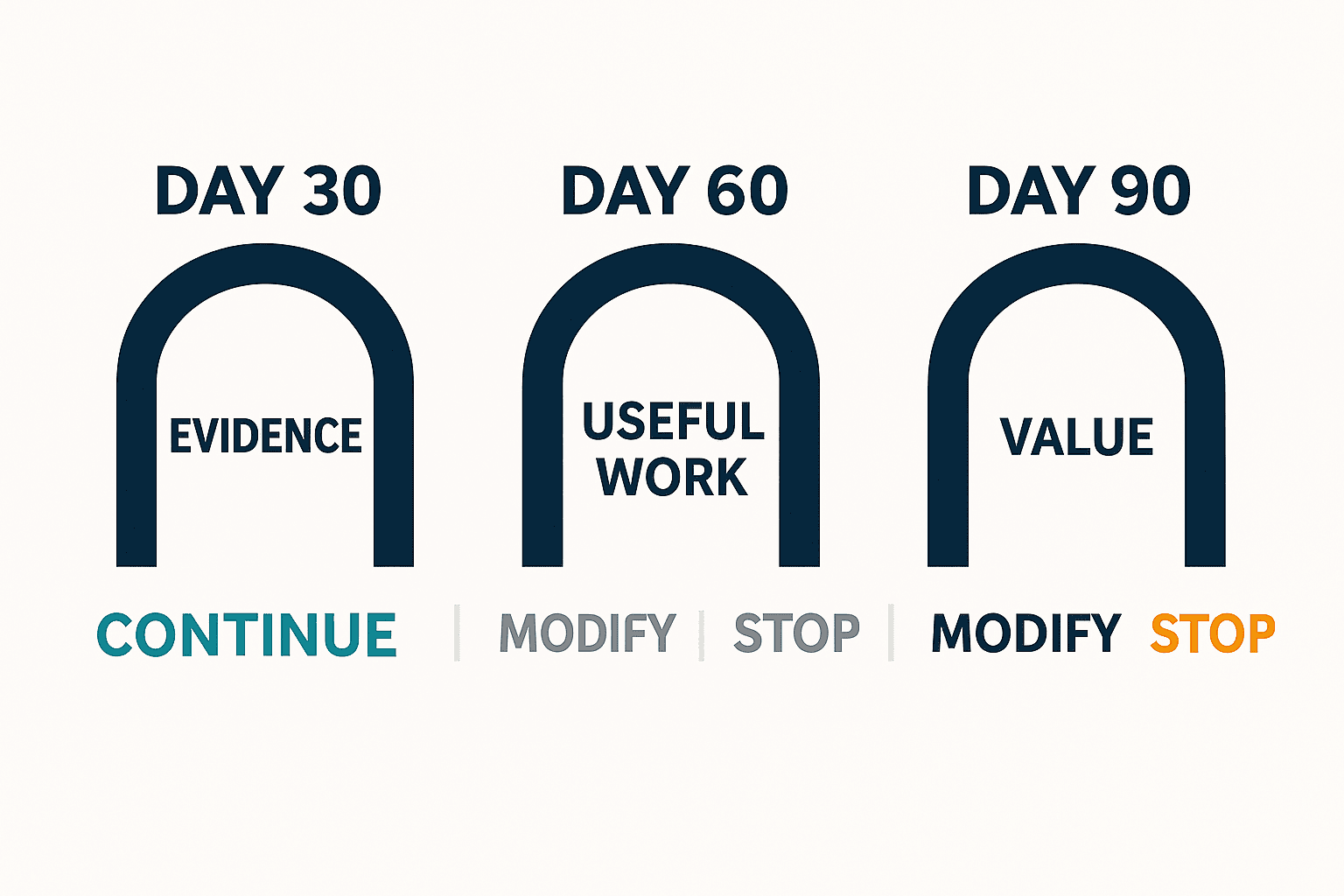
The dates are learning deadlines, not promises that ROI will appear. Each gate needs an owner, deliverables, decision choices, and a cap on the next investment.
Day 30: can we measure safely and reliably?
Confirm scope, population, case_id, baseline, quality floor, approved tools/data, human review, prohibited uses, log completeness, adoption bias, incident procedure, and recovery. Illustrative—not universal—thresholds might be ≥60% active adoption, ≥95% required-log completeness, ≥94% first-pass quality, and zero critical events. Missing evidence may trigger repair or narrower scope; a critical information, customer, or safety event triggers stop regardless of adoption.
Day 60: can we prove useful work and quality?
Examine useful completion, measured time, quality, and rework together. Example pre-committed thresholds could be at least 200 useful completions, at least 60 measured time samples, quality no lower than baseline, and an owner/action for every flagged event. Review difficulty and language segments and exclude concentrated failure areas from production.
The decision is continue, conditional continue, modify and remeasure, or stop. Stopping is correct when a critical risk appears, the value hypothesis disappears, evidence cannot be made reliable, or a simpler alternative wins.
Day 90: does incremental value exceed full cost?
Show the steady-state monthly run rate, treatment of initial cost, and sensitivity analysis—not only cumulative totals. A company might require recognized incremental value at least equal to full cost, quality/risk floors met, and credible unit economics at the next scale. In the worked example, −6.3% means no automatic expansion: modify and re-gate or stop.
The executive page should show evidence strength, unresolved risk, alternative explanations, next investment, and exit cost alongside the best number. Strong apparent effect with weak evidence merits a small next step, not immediate scale.
Improve through Specify → Measure → Improve
OpenAI’s “Evals drive the next chapter of AI” presents a Specify → Measure → Improve loop. Evals drive the next chapter of AI
- Specify successful, failed, and boundary cases; quality floors; prohibited behavior.
- Measure on a stable evaluation set and sampled live work, by version.
- Improve data, retrieval, tools, approvals, interface, and training—not prompts alone.
- Re-run the stable set and add newly discovered failures.
Where no single correct answer exists, use a rubric, multiple evaluators, and disagreement resolution. Validate automated graders against human review. Record model, retrieval index, prompt, tool, and permission versions.
For AI agents, evaluate tool choice, action order, permission scope, stop conditions, and approval before external change—not only the final text. Our guide to AI-agent business workflow governance connects that execution control with measurement.
Connect ISO/IEC 42001 and Thailand AI readiness to operations

ISO/IEC 42001:2023 specifies an AI management system for establishing, implementing, maintaining, and continually improving how an organization manages AI risks and opportunities. ISO/IEC 42001 A 30/60/90 gate is not certification, but it can connect policy, ownership, planning, operation, evaluation, and improvement in a PDCA-style rhythm.
Thailand’s ETDA AI Readiness Assessment frames readiness through five domains and twelve questions. ETDA AI Readiness Readiness is not ROI; it is a leading condition for running a measurable deployment. Strategy without a data owner cannot produce a baseline; technology without people and governance cannot scale safely.
| Management theme | Connection to impact measurement |
|---|---|
| policy and ownership | KPI owner, risk owner, finance approver |
| use-case selection | workflow scope, value hypothesis, prohibition |
| data and technology | baseline, case_id, version, log quality |
| people and adoption | barriers, training, review capability |
| evaluation and improvement | gates, incidents, change, re-evaluation |
Ten questions for an AI implementation consultation
Before asking a vendor “what can AI do?”, ask:
- Who decides what on Day 90?
- What starts and finishes the workflow, and what is its case mix?
- Where is evidence of current time, waiting, quality, rework, and cost?
- What non-AI improvement is happening at the same time?
- What counts as useful completion, and who accepts it?
- What is the quality floor and immediate stop condition?
- Which ID joins work, AI use, approval, and correction?
- Who gathers implementation, control, evaluation, and operations cost?
- How will released time become an approved value mechanism?
- How will data, integration, contracts, and users exit if the pilot stops?
Challenge any promise based on “users × standard time saving × salary.” Ask how case mix, quality, realizability, and double counting were handled. If an existing program needs repair, see our AI project recovery guide for Thailand.
What AI adoption advisory support should deliver
Effective support leaves reusable artifacts, not only meetings and prompt tips:
- measurement charter, KPI dictionary, population, exclusions;
- use-case cards, value hypotheses, rubrics, stop conditions;
- baseline, lineage, and case_id join design;
- evaluation set, results, failure taxonomy, version history;
- adoption funnel, barriers, training, communication;
- full-cost ledger, value-recognition rule, double-count check;
- gate packs, decision log, conditions, owner, due date;
- operational, access, incident, exit, and migration procedures.
A good partner does not make every pilot look successful. It makes hypotheses falsifiable, discovers weak results early, and enables correction or stop at limited cost.
Arrange the dashboard in decision order
An executive dashboard should follow the path of the decision so that adoption does not dominate the conversation:
- The decision required now, its deadline, accountable owner, and requested next investment.
- Eligible population, in-scope cases, exclusions, and evidence completeness.
- Active adoption, case coverage, and sustained use by approved use case.
- Useful completed work, touch time, elapsed lead time, and throughput.
- Quality floor, rework, critical risks, and unresolved corrective actions.
- Full cost, approved incremental value, net value, and sensitivity analysis.
- Evidence strength, plausible alternative explanations, and the next test.
Use department rankings with care. Teams differ in case difficulty, data quality, language mix, manager support, and access readiness. Ranking people or departments by utilization can reward unnecessary prompts and risky usage. The objective is not maximum activity; it is the largest amount of safe, useful completed work that the organization can defend with evidence.
Common failures and corrections
Calling seats or logins ROI
Seats are supply and login is contact. Join them to useful completion and quality by case_id.
Adding self-reported weekly time savings
Use survey estimates to find hypotheses, then calibrate with samples, workflow logs, and throughput. Disclose non-response bias.
Extrapolating the best example to the company
State the population, use case, and difficulty. Recalculate review capacity, enablement, and unit cost at scale.
Treating satisfaction as quality
Use a business rubric, first-pass quality, returns, rework, and severity-specific error measures.
Turning all time saved into profit
Separate capacity, cash, throughput, and speed; recognize only demonstrated conversion.
Never ending a pilot
Stopping is portfolio discipline. Agree exit conditions, export, contracts, and fallback before launch.
Practical checklist
- Is the decision date and continue/modify/stop choice explicit?
- Are workflow boundaries, population, and exclusions fixed?
- Is there pre-AI volume, time, quality, rework, cost, and risk evidence?
- Are eligible people and eligible cases the correct denominators?
- Is useful completion defined with an accountable acceptor?
- Are model and business metrics separate and versioned?
- Can no financial benefit offset a critical quality/risk breach?
- Can case_id join work, AI, approval, correction, and cost?
- Does full cost include enablement, evaluation, controls, integration, and operations?
- Is released time separated from cash and checked for double counting?
- Do all three gates have owners, deliverables, thresholds, and investment caps?
- Are minority-language, difficult, and high-risk segments visible?
- Is there an executable plan for scale, modification, and stop?
Conclusion: decide AI investment by evidence strength
AI adoption impact measurement connects baseline, adoption, useful completed work, quality/risk, full cost, and incremental value for the same scope and period. Generative AI ROI becomes meaningful only when that chain is intact. Day 30 tests measurement and safety, Day 60 tests useful work and quality, and Day 90 compares recognized incremental value with full cost. Continue, modify, and stop are all legitimate outcomes.
TOMAS TECH can help Thailand and regional teams design baselines, use-case evaluations, AI-agent controls, 30/60/90 gates, full-cost ledgers, and value-recognition rules. You can contact us while products and budgets are still open and the immediate need is simply to choose a measurable workflow.
Frequently asked questions about AI adoption impact measurement
Where should AI adoption impact measurement start?
Start with a one-page charter defining the Day-90 decision, workflow boundaries, population, baseline, quality floor, evidence owner, and stop conditions—before configuring tool analytics.
How should generative AI ROI be calculated?
Use (approved incremental value − full cost) ÷ full cost. Do not automatically turn time saved into profit; require evidence that capacity became reduced overtime, avoided outsourcing, or additional useful work.
Does high adoption mean implementation success?
No. Use must reach accepted completion, meet quality/risk floors, and justify full cost before it supports a value claim.
What is useful completed work?
It is a business unit that satisfies a defined accepted end state after required human review, not the number of AI outputs. Preserve case_id, version, approval, and quality evidence.
Will ROI always appear within 30, 60, or 90 days?
No. The dates are decision deadlines. They test measurability, useful work and quality, then economics; the right answer may be modification or stop.
What data is needed for an AI implementation consultation?
Useful inputs include eligible volume, touch and waiting time, first-pass quality, rework, exceptions, outsourcing/overtime, and user/case populations. Missing data is acceptable if gaps and a collection plan are explicit.
What should AI adoption advisory support produce?
It should produce a charter, KPI dictionary, baseline, evaluation set, rubric, cost ledger, value rule, gate packs, decision log, and operating/exit plan.
Should quality and risk reduction be monetized?
Only when probability, impact, and avoided cost are defensible. Otherwise keep them as separate mandatory gates or strategic indicators rather than padding ROI.
What needs special attention for a Thailand operation?
Segment Thai, English, and Japanese work; clarify local versus headquarters ownership; and examine data handling, approval, training, shifts, and minority high-risk cases rather than hiding them in a global average.
References
- OECD Compendium of Productivity Indicators 2026
- NIST AI RMF Playbook — Core
- NIST AI Risk Management Framework
- ISO/IEC 42001:2023
- ETDA AI Readiness Assessment
- OpenAI Academy — Measuring impact and ROI
- OpenAI — Evals drive the next chapter of AI
- OpenAI Academy — Gather appropriate evidence of value
- OpenAI — A scorecard for the AI age
- Google — Set up your ML project for success


