


When a company deploys a LINE chatbot for business in Thailand, the first decision is not which AI model to buy. It is where a simple LINE Official Account (LINE OA) FAQ should end and where Messaging API, CRM/ERP, retrieval-augmented generation (RAG), and human service must begin. This guide turns channel ownership, webhook verification, event idempotency, identity linking, PDPA operations, prohibited answers, human handoff, audit evidence, message counting, recovery, and exit migration into an RFP and a 90-day proof of concept (PoC).
Start by separating standard LINE OA functions from custom integration
LINE OA provides 1:1 chat, chat tags, quick replies, auto-response, AI response, and OA Call. The LINE for Business Thailand page says businesses can reach 47 million users; this article does not reinterpret that statement as a verified domestic monthly-active-user figure. A company should validate whether LINE is the channel used by its actual customers, dealers, job candidates, and employees.
Standard functions may be enough when answers are fixed, change infrequently, do not depend on a customer contract, do not query stock or maintenance records, do not request sensitive data, and can be handed to staff during business hours. Messaging API and a governed backend are usually needed in the following cases.
| Business process | Likely integration | Acceptance evidence |
|---|---|---|
| Dealer stock and delivery inquiry | ERP, product master, authentication | Role-based response, fail-closed behavior, query log |
| Equipment service intake | CRM, installed-base register, ticketing | Serial match, urgency classification, handoff timestamp |
| Recruitment inquiry | Job database, scheduling, consent | Purpose notice, deletion path, no automated hiring decision |
| Employee help desk | RAG, SSO, HR/IT desks | Document authorization, citation, prohibited-answer routing |
| Complaint and quality intake | QMS, CRM, escalation | Original record, integrity control, owner approval |
The acceptance question is not merely whether AI can answer. It is whether the system stops under prohibited conditions and transfers the case, with context, to the accountable person.
Define the boundary among LINE OA, Messaging API, and company systems

A practical architecture receives LINE OA events at a WEBHOOK, then a ROUTER directs them to FAQ, RAG, CRM, or HUMAN DESK. A simple diagram does not define responsibility; the RFP must.
Keep ownership with the buying company
Require the LINE OA and Messaging API channel to be created for and controlled by the customer company. Company administrators should retain ownership while a vendor receives time-limited, least-privilege access. Channel secrets, access tokens, and encryption keys must not be copied to personal computers or messaging threads. The contract should cover access removal after staff changes, vendor replacement, or incidents.
Handover scope should include source code, prompts, FAQ content, API specifications, monitoring configuration, runbooks, and current asset and access registers. A PoC channel created under an individual vendor account can become impossible to transfer. Build a recoverable ownership model from day one.
A working webhook is not yet an acceptable webhook
Messaging API delivers events by HTTPS POST to a webhook URL. The webhook URL is one endpoint. The receiving service must verify the signature before business processing, using the raw request body; normalizing or reconstructing JSON first can cause verification failure. The June 18, 2026 official LINE explanation gives implementation guidance for this control.
Do not replace signature verification with an IP allowlist. LINE does not publish a stable source IP range for this purpose, and addresses may change. Combine TLS, signature verification, secure secret storage, rate controls, and monitoring.
The same event may arrive again. The service therefore needs idempotency: store an event identifier or equivalent unique key, and never create a second CRM record, ticket, or response for a processed event. Track states such as received, integrating, answered, handed off, and failed. This distinguishes partial success—for example, a CRM ticket was created but the reply timed out—from a completely failed transaction.
Standardize the seven-stage processing flow
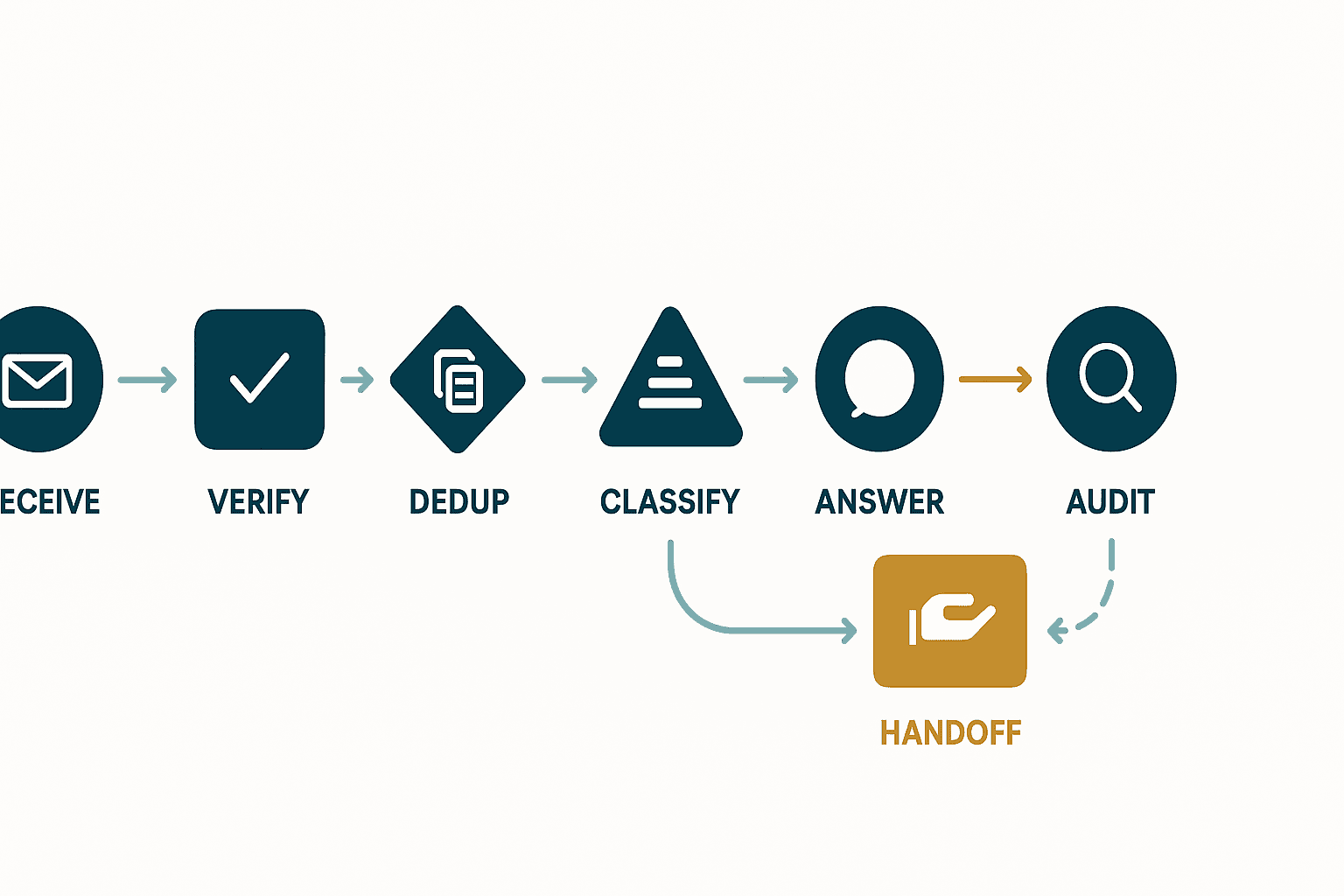
RECEIVE: retain only what the purpose requires
Record receipt time, event identity, channel, user identifier, and message type. Do not interpret this as permission to retain all content forever. Define purpose, retention period, and authorized roles. Treat images and files as possible malware, confidential information, and storage liabilities.
VERIFY: authenticate before parsing into business actions
Reject signature mismatch, missing signature, or a damaged body without creating business data. Avoid returning internal detail to the sender; alert internal monitoring. A channel-secret rotation needs a controlled cutover and rollback method.
DEDUP: perform each business action once
Use a durable key and state machine. Retrying after timeout must not repeat an action that already succeeded. Test repeated delivery both sequentially and concurrently, not only with one clean request.
CLASSIFY: identify both intent and control category
Classify FAQ, inventory, service, recruitment, employee, or complaint work. Separately flag personal data, emergency, safety, legal, price commitment, abuse, or low confidence. If the confidence is insufficient, offer controlled options or route to a human rather than guessing.
ANSWER: use only authorized sources and tools
Return approved text for fixed FAQs. RAG should search only documents the user is authorized to access and should expose a source name, revision, or update date. CRM and ERP values must come from structured APIs, not from an LLM’s estimate. If a request is prohibited, do not answer it.
HANDOFF: transfer context, not just a notification
The human desk needs the original message, classification, identity status, retrieved sources or structured data, proposed response, and urgency. Give the user a case number, service hours, and next contact method. “We will check” is not a complete workflow if the conversation then disappears.
AUDIT: make the decision reproducible
Link the model and prompt version, knowledge version, routing rule, API response, filter result, approver, and final answer. Retention must still be limited by business purpose and risk. More data is not automatically better evidence.
Prevent false account linking
Linking a LINE user identifier to a CRM customer ID enables personalized service but creates a serious wrong-person risk. LINE documentation describes an account-link token as one-time and valid for 10 minutes; check the current specification before implementation because it may change.
Authenticate the customer in the member site or CRM-controlled flow, issue a short-lived one-time token, and confirm the relationship server to server. Do not link on a name or phone-number match alone. Users must be able to see the linked state and unlink at any time. After unlink, personalized answers must stop. Provide flows for terminated contracts, staff departures, lost devices, administrative forced unlink, and audited re-linking. A new link must not silently inherit old authorization or sessions.
LINE user-consent functions may support the journey, but they do not by themselves resolve every compliance requirement. Confirm purpose, data categories, recipients, retention, and rights handling through the company’s contracts and privacy operations.
Define what RAG and generative AI must never answer
OWASP Top 10 for LLM Applications 2025 addresses prompt injection: instructions embedded in user input or retrieved material can attempt to override system controls. RAG does not automatically make an application safe.
| Information or action | Automated-answer policy | Safe alternative |
|---|---|---|
| Approved public FAQ | Answer from controlled content | Show source and revision |
| Customer-specific price or delivery | Only after authentication and structured API lookup | Transfer to sales |
| Equipment shutdown or safety incident | No autonomous diagnosis or commitment | Show emergency channel and approved stop procedure |
| Legal, tax, or labor issue | Do not generate legal advice | Transfer to responsible department |
| Hiring or individual evaluation | Do not let AI make the decision alone | Human review |
| Unreleased drawing or contract | Enforce document authorization | Deny and log |
| Password or secret key | Never request or retain | Official reset route |
NIST AI 600-1, the Generative AI Profile, provides a framework for governing generative-AI risks. ETDA’s Generative AI Governance Guideline is also a useful Thai reference for management responsibility, data, risk, and communication. Do not use these publications as a vague “certified” badge; convert them into a risk register, control owner, tests, monitoring, and incident process.
Acceptance tests should attempt “ignore previous instructions,” place a malicious command in an FAQ document, include instructions in linked pages, mix Thai, Japanese, and English, and hide commands in long text or OCR. Passing means the system does not obtain unauthorized data, does not invoke a dangerous tool, stops the answer, routes safely, and records the event—not merely that it labels a message suspicious.
Put PDPA operations into the RFP
This article is not legal advice. Applicability and legal interpretation should be confirmed with qualified advisers. A system RFP can nevertheless require operational evidence.
| Topic | RFP question | Acceptance evidence |
|---|---|---|
| Purpose | Why is each conversation field used? | Purpose-specific data flow |
| Minimization | Is every field necessary? | Input inventory and reduction record |
| Retention | When is data deleted or anonymized? | Retention schedule and deletion test |
| Access | Who can view originals and summaries? | Role matrix and access log |
| Vendors | Which clouds, AI services, and subcontractors receive data? | Supplier list and contract controls |
| Rights | How are access, correction, or deletion requests handled? | End-to-end exercise |
| Incident | Who receives a suspected breach escalation? | Contact tree and tabletop record |
Avoid using every conversation under a broad “AI improvement” purpose. Separate operating, quality-review, and model-improvement uses. State whether model training occurs, what is anonymized, how long it is kept, and where it is sent. Prefer synthetic data in a PoC and tightly limit production data.
Count LINE messages by official message type and recipients
Do not publish a fixed official price in an RFP that will outlive a plan change. Verify current Thailand plans with LINE for Business Thailand and the official Pricing documentation immediately before estimating.
The May 28, 2026 official explanation says reply messages are excluded from the message count. Push, multicast, broadcast, and narrowcast are counted, based on the number of recipients. One broadcast sent to 1,000 recipients is therefore managed as 1,000 messages rather than one campaign action. Verify the latest official conditions because plans and rules can change.
The monthly report should separate these message types, recipient and exclusion counts, process/campaign/language, retries, failures, deduplicated events, progress against plan limits, forecast, and an approved stopping threshold for abnormal growth.
Use an explicit illustrative assumption for the business case
The following is an illustrative assumption, not an industry average and not a performance guarantee. The same scenario is used in all language versions.
| Variable | Illustrative assumption |
|---|---|
| Monthly inquiries | 5,000 |
| Suitable for FAQ | 55% |
| Automated completion within suitable inquiries | 35% |
| Average human handling time | 6 minutes |
| Fully loaded labor cost | 220 THB/hour |
The calculation is:
- FAQ-suitable inquiries = 5,000 × 55% = 2,750.
- Automated completions = 2,750 × 35% = 962.5.
- Candidate hours saved = 962.5 × 6 ÷ 60 = 96.25 hours.
- Candidate labor value = 96.25 × 220 = 21,175 THB per month.
For operational reporting, round to approximately 963 cases and 96.3 hours. Do not call 21,175 THB “profit.” Deduct knowledge maintenance, monitoring, human escalation, APIs, cloud, messaging, incident response, and quality review. Saved time may improve response speed, after-hours intake, or record quality rather than reduce headcount.
During the PoC, replace each variable with measured values. Segment FAQ suitability, automated completion, incorrect answers, repeated contacts, human handling time, and operating effort by process and language so that a convenient average does not hide a failure.
Build acceptance evidence through a 90-day PoC
Days 0–30: ownership, scope, and fail conditions
Create the OA and channel under the company, choose two or three processes, document data flows and suppliers, approve prohibited answers and handoff rules, appoint owners for FAQ/RAG/CRM data, measure baseline volume and handling, and define stopping criteria. The primary outputs are an ownership matrix, data inventory, process flow, risk register, and test plan—not a polished screen.
Days 31–60: measure normal and abnormal behavior
Run with limited dealers, customers, or departments. Test signature failure, duplicate and concurrent events, timeouts, CRM outage, wrong identity link, multilingual ambiguity, prompt injection, and a closed human desk. Grade answers by correct source, prohibited-answer behavior, handoff, and reproducibility rather than fluency alone.
Days 61–90: exercise operations, recovery, and exit
Have company staff update an FAQ, replace an administrator, inspect monitoring, rotate secrets, restore a backup, switch to a degraded mode when AI or CRM is unavailable, unlink an account, delete data, and hand the system to another supplier or environment.

Seven acceptance gates for the RFP
| Gate | RFP requirement | Passing evidence |
|---|---|---|
| OWNERSHIP | Owners of OA, channel, code, and data | Admin screen, asset register, access removal |
| SECURITY | Signature, secrets, least privilege, idempotency | Tamper, replay, duplicate, and key-rotation tests |
| QUALITY | Correct source, prohibited answers, languages | Approved test-set results |
| PRIVACY | Purpose, minimization, retention, rights | Data flow, deletion and request exercise |
| COST | Visibility of messages and external APIs | Monthly detail and limit alert |
| RECOVERY | Outage, degraded mode, backup, restore | Timestamped recovery exercise |
| EXIT | Source, settings, documents, migration help | Rebuild or handover in another environment |
Make every condition observable. Replace “apply security controls” with “reject a modified webhook, create no business data, and produce a monitoring alert.”
Practical B2B uses in Thailand
For a dealer desk, return public product information immediately but authenticate before contract price, credit, or committed delivery data. Read those values through a structured ERP API or transfer to sales; do not let the model estimate them.
For equipment maintenance, collect machine serial, factory, symptom, time, and approved attachments. If the text indicates an emergency or safety issue, stop AI troubleshooting and show the formal emergency route. Return a ticket number and keep one history for the plant and service company.
For recruitment, provide public job, location, and interview-slot information. Do not collect unnecessary health, family, or religion data, and do not let the chatbot make a hiring decision. Make the purpose and contact route visible.
For an employee help desk, RAG may search policy and IT procedures, but document authorization must follow department, position, and employment type. Route payroll, appraisal, discipline, and individual contracts to HR. Show the document revision and update date.
For deeper planning, see our guides to multilingual AI chatbot implementation in Thailand, chatbot cost in Thailand, and customer-service chatbot design.
Questions to ask a chatbot development vendor
Ask who owns the OA and channel; how raw-body signature verification is tested; what happens when one event is delivered three times; how expired links, false linking, and unlink are tested; where RAG authorization is enforced; what prevents prompt injection from invoking tools; who owns Thai, Japanese, and English quality; what happens outside human-desk hours; who retains and deletes evidence; how reply and proactive message counts are separated; how the system degrades during AI or CRM failure; and what is delivered on termination. Require designs, test results, monitoring, runbooks, and drill records—not “supported” as a verbal answer.
FAQ
Can a business start an FAQ with only LINE OA chatbot functions?
Yes, if the content is fixed, does not depend on customer data, and carries low risk. Start with the top 20–50 approved inquiries and a clear human route. Add Messaging API and authentication when contract, stock, delivery, or service history is involved.
What is the difference between a LINE OA chatbot and Messaging API?
LINE OA standard tools can be configured quickly in an admin interface. Messaging API connects a webhook and company backend for CRM/ERP, RAG, authentication, and custom routing. It also creates responsibility for signature verification, idempotency, privacy, monitoring, and maintenance.
Which customer-service chatbot process should be automated first?
Choose high-volume questions with approved answers, low harm if misunderstood, and an easy human fallback—for example public hours, locations, catalogs, or ticket status. Safety, legal, price commitment, and complaint judgment are poor first targets.
How should chatbot development cost be estimated?
Separate implementation, LINE messaging, model use, cloud, CRM/ERP APIs, monitoring, knowledge work, multilingual review, human desk, incidents, and exit migration. Use current official plans. The 21,175 THB per month above is an illustrative candidate labor value, not a market price or guarantee.
What PDPA evidence should a Thailand AI vendor provide?
Request a data flow, purpose and minimization record, retention schedule, role/access matrix, supplier list, rights-handling process, incident contacts, and deletion-test result. Obtain legal advice separately; ask the vendor for implementation and operating evidence.
Are LINE reply messages included in the message count?
LINE’s May 28, 2026 official explanation says reply messages are excluded. Push, multicast, broadcast, and narrowcast are counted by recipients. Confirm the latest Thailand plan and official Pricing terms when estimating.
Does an IP allowlist remove the need for webhook signature verification?
No. The source IP is not a published stable substitute and may change. Verify the signature with the raw body and channel secret. Treat any network filter as an additional layer, not an identity control replacement.
What should pass a 90-day PoC?
Evaluate rejected invalid signatures, duplicate suppression, answer accuracy, prohibited answers, handoff time, source evidence, deletion, recovery, usage count, and supplier handover. Passing means company staff can reproduce the operation and evidence, not that the final demo happens to work.
Summary
A business LINE chatbot should begin with controlled standard FAQs and connect only processes requiring personalized or internal data to Messaging API, CRM/ERP, and RAG. The RFP and 90-day PoC must make channel ownership, raw-body signature verification, idempotent events, safe account linking and unlink, PDPA operations, prohibited answers, human handoff, audit evidence, message counting, recovery, and exit migration testable.
If your Thailand operation is still deciding which dealer, maintenance, recruitment, or employee inquiries belong in standard LINE OA and which require custom integration, you can discuss that boundary and a practical PoC with TOMAS TECH before committing to a full rollout.
References
- LINE OA Features
- Messaging API documentation
- Build a bot
- Verify webhook signature, June 18, 2026
- Messaging API pricing
- How to count messages, May 28, 2026
- Linking accounts
- User ID linking, April 9, 2026
- User consent
- ETDA Generative AI Governance Guideline
- NIST AI 600-1 Generative AI Profile
- OWASP Top 10 for LLM Applications 2025