


The purpose of a serial number management system in a Thailand factory is not to print labels. It is to preserve evidence that answers which individual item passed through which material, machine, operator and inspection; where it is now; and what must be contained when a problem occurs. An identifier policy, barcode or RFID media, event data, MES, ERP and QMS integration, reissue control, rework, FAT, SAT and operating ownership must form one chain before the plant has a usable manufacturing history.
This implementation guide is for plant managers, quality leaders, production engineers, IT/OT owners and procurement teams preparing an RFP for item-level traceability. It refers to GS1 General Specifications Release 26.0, EPCIS 2.0.1, ISO/IEC 15459-4:2008, the EU ESPR, U.S. FDA food-traceability material and a 2026 GS1 Thailand guide. It does not determine conformity. Product scope, export market, customer specifications, Thai requirements and contractual obligations must be checked for each project.
Separate item, lot and logistic-unit identifiers first
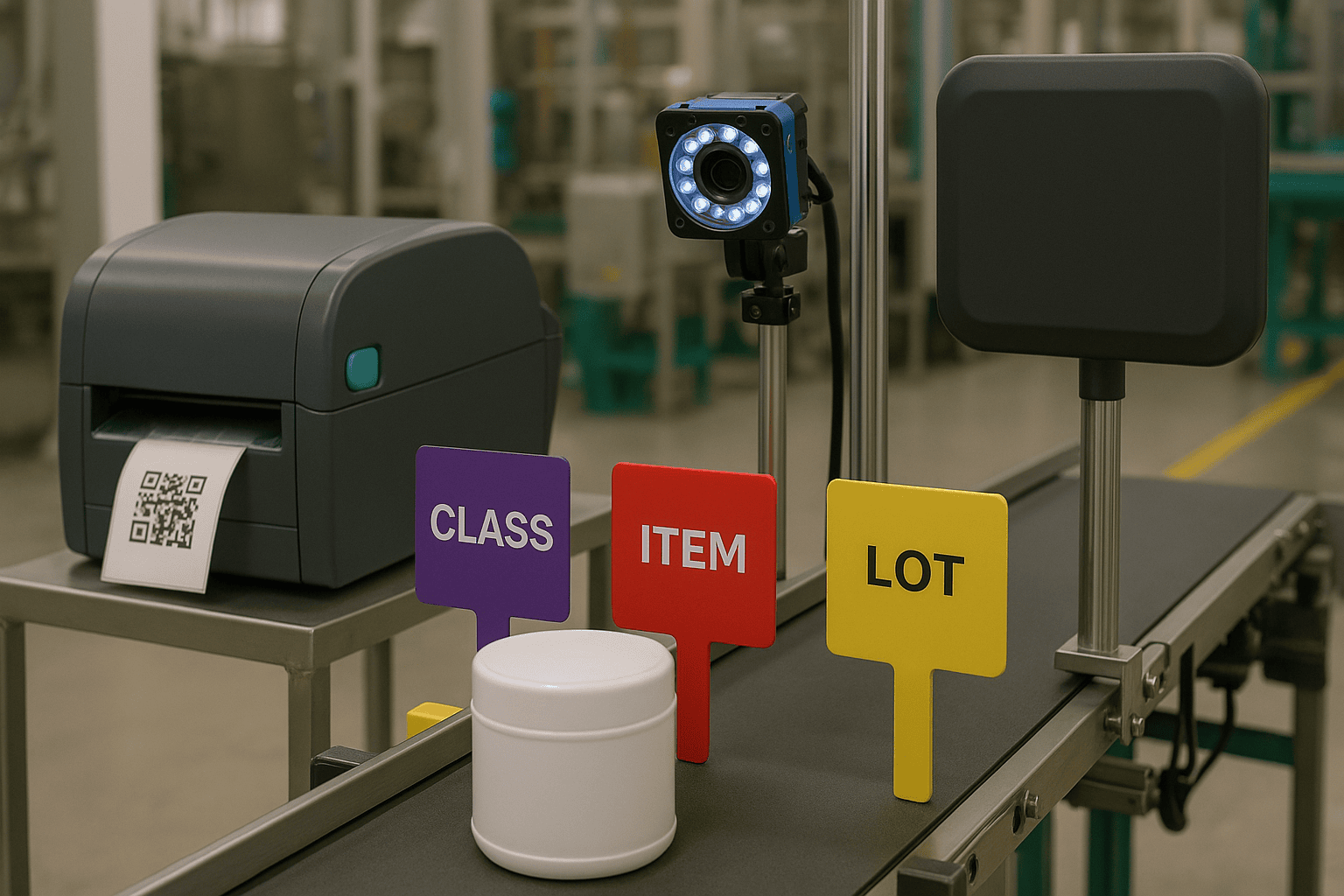
A project becomes inconsistent when the team uses “serial,” “lot” and “pallet number” as if they were one ID. They answer different questions. A product class says what type of trade item it is. An item identifier points to one physical unit. A lot identifies a production group. A logistic-unit ID identifies a case, tote or pallet used to move a changing set of contents.
| Identification layer | Question answered | Typical identifier | Control point |
|---|---|---|---|
| Product class | What type of product is it? | GTIN or internal item code | It does not identify one physical unit |
| Individual item | Which physical unit is it? | GTIN plus serial, or governed enterprise item ID | Uniqueness needs issuer and product context |
| Batch or lot | Which production group did it belong to? | Lot or batch ID | A lot alone cannot show differences between units |
| Logistic unit | Which case, tote or pallet was used? | SSCC or internal logistic-unit ID | Contents can change after repacking |
| Event | What happened, where and when? | Event ID plus object IDs | A current status is not a complete history |
One item can belong to a manufacturing lot and later move between trays and pallets. The data model should therefore store item, lot and logistic-unit IDs separately and record their time-dependent relationships as events. A pallet scan reveals all contained units only when packing, removal, addition and repacking events are complete.
Using a short serial field as the only database key is risky. The same text can appear across plants, brands, suppliers and product classes. Consider a logical key that includes an issuer or namespace, product class and serial, with an internal UUID for efficient lookup. Define uniqueness in an approved identifier policy instead of relying on the statement that duplicates have never happened.
ISO/IEC 15459-4:2008 concerns identifiers for individual products and product packages. The relevant design lesson is to govern issuance and uniqueness. A public abstract does not support reconstructing the paid standard’s detailed requirements or claiming that a proposed database schema is certified. If the standard is placed in a contract, obtain the official text and have qualified personnel confirm issuer, object scope, data syntax and relationships with the other parts of ISO/IEC 15459.
Combine GTIN and serial number with explicit rules
In GS1 General Specifications Release 26.0, Application Identifier AI 01 represents a GTIN and AI 21 represents a serial number. The AI 21 data field can contain up to 20 alphanumeric characters. Parentheses such as (01) and (21) are used in human-readable presentation; they are generally not encoded as literal data characters. The selected GS1 data carrier, FNC1 handling and variable-length separation must follow the official specification and validation tools.
The important design point is to interpret a serial with its product class. GTIN plus serial can say which trade item and which individual unit are involved. AI 10 is used for a batch or lot, while AI 17 is an expiration date example. GS1 Thailand’s 2026 healthcare implementation guide illustrates AI 01, 10, 17 and 21. This is a useful Thailand-published implementation example, not a universal requirement for every manufacturing sector.
Identifier requirements for the RFP
| Requirement | Decision to document | Failure if left vague |
|---|---|---|
| Issuing party | Headquarters, each plant, supplier or contract manufacturer | Two sites issue the same identity |
| Uniqueness scope | Product, legal entity, group or customer namespace | Duplicates appear after integration |
| Character set and length | Numeric or alphanumeric, case, forbidden characters, leading zeros | Devices or ERP truncate and transform data |
| Reuse | Never reuse, or controlled conditions | Old history becomes attached to a new item |
| Issuance point | Order release, input, completion, inspection or packing | Unused IDs and retroactive labeling increase |
| External IDs | Relationship to GTIN and customer or supplier IDs | Each label becomes a competing source of truth |
| Void and cancellation | Reservation cancel, print failure and scrap states | Gaps are mistaken for fraud, or void IDs are reused |
| Audit evidence | Who, when, on which terminal and why | Reissue and correction cannot be explained |
Encoding plant, date, line and product into the serial may look convenient, but equipment transfer and item-code change can make those meanings false. It also consumes digits and distributes generation logic. Compare that approach with an opaque unique serial whose changing attributes live in master and event data. If meaningful serials are required, test date boundaries, time zones, restart behavior, future capacity and rule changes.
Select traceability barcode or RFID by process conditions
Barcode versus RFID is not a contest between old and new technology. It is a decision about the read environment. A 1D or 2D code is often suitable when each label can be presented within line of sight and an operator should be able to verify human-readable data. RFID becomes a candidate when multiple tags must be read without line of sight, items move through an automated portal or a durable tag needs memory. Metal, liquid, tag orientation, reflection, read zones, adjacent lines, local radio requirements and tag loss still require physical tests.
| Factor | 1D barcode | 2D code | RFID |
|---|---|---|---|
| Line of sight | Required | Required | Usually not required, but RF conditions govern |
| Data capacity | Relatively small | Larger | Depends on tag type |
| Multiple reads | Normally one at a time | Normally one at a time | Possible, with over-read and missed-read controls |
| Human verification | Human-readable print is easy to add | Human-readable print is easy to add | Print the relevant identity for manual recovery |
| Plant risks | Dirt, damage, curve, light and focus | Small cells, print quality, glare and distortion | Metal, liquid, orientation, interference and dead zones |
| Validation | Symbol quality, real scanner and real process | Same | Zone, antenna, power, position and unintended reads |
Avoid claims that RFID reads everything or that a 2D code cannot fail. Define the required read outcome together with its recovery path, then run a PoC using real products, worst orientation, contamination, speed, adjacent stock and a full load. Decide whether a missed read stops the line, diverts the item to a manual station or can be reconciled later. Test consecutive misses, wrong-object reads and duplicate scans, not only the average.
Label material is part of the system. Check surface energy, temperature, oil, water, chemicals, abrasion, outdoor exposure, washing, painting, heat treatment, product life and recycling. A label that scans after printing but falls off before customer receipt does not provide traceability. Compare direct part marking, laser marking, durable labels, removable labels and embedded tags across the complete lifecycle.
Build an item management system with event data
Overwriting an item record from “in process” to “complete” and then “shipped” does not preserve manufacturing history. Capture events that can reconstruct what was true at the time. The model should answer:
- What: which item, lot or logistic unit was involved;
- When: device time, system receipt time and time zone;
- Where: plant, line, operation, machine and storage location;
- Why: production, inspection, rework, packing or shipping step;
- Who and how: operator, machine, terminal and application;
- Result: status, measurement, quantity, reason and related order.
GS1 EPCIS 2.0.1 is a standard for expressing and sharing visibility event data. Concepts including ObjectEvent, AggregationEvent, TransformationEvent and AssociationEvent can represent observations, packing relationships, material-to-product transformations and persistent associations. EPCIS is not a serial generator and does not automatically make ERP master data, MES execution or QMS decisions correct. The project must still decide which system issues each approved event and which identifier it uses.
Minimum event set for a production flow
| Event | Object | Data to require | Failure handling |
|---|---|---|---|
| ID reservation | Product class plus serial | Issuer, order, timestamp and state | Retry without issuing a duplicate |
| Label issuance | Label and target item | Template version, printer and print count | Distinguish un-applied and applied media |
| Apply and verify | Physical item plus scanned ID | Read value, operation and match result | Quarantine mismatches with a reason |
| Operation complete | Item | Machine, recipe version and timestamp | Make duplicate messages idempotent |
| Inspection | Item or lot | Characteristic, value, unit, specification and decision | Preserve prior results after retest |
| Rework | Item | Defect, action, operator and reinspection | Link the original failure and disposition |
| Packing | Item to logistic unit | Parent-child relationship, quantity and location | Record removal and addition as events |
| Shipping | Logistic unit and contained items | Destination, document, timestamp and release state | Block quarantined or unapproved stock |
Give every event a unique ID so device or PLC retries do not create duplicate production. Buffer safely during an outage and define sequence and conflict handling after recovery. Save both source and receipt timestamps; synchronize clocks and document the time zone. If a paper fallback is required, specify who enters it, how duplicate capture is prevented and where the original record is retained.
Divide manufacturing history across MES, ERP and QMS
Do not force every function into one application. Assign a system of record for each data object and decision, then build controlled interfaces.
| System | Candidate source of truth | Inputs | Outputs |
|---|---|---|---|
| ERP | Item master, BOM, order, customer, inventory and shipment | Completion, consumption and scrap | Orders, items, lots and shipment conditions |
| MES | Item progress, production, machine and operator history | Orders, quality decisions and equipment data | Completion, consumption, item history and downtime reason |
| QMS | Inspection plan, nonconformance, disposition and approval | Item, lot and measurements | Hold, release, rework and deviation approval |
| WMS | Location, handling unit, receipt and issue | Shipping condition and production completion | Packing, repacking and shipping events |
| Label management | Templates, versions, printers and issuance evidence | Item, customer and identity data | Issue, reissue and verification result |
| Event platform or EPCIS | Shared visibility events | Approved events from systems of record | Standardized query and exchange |
An interface specification needs more than field mapping. Document ownership, creation and update conditions, rejection, retry, ordering, timeout, alert, manual correction and audit. If QMS sends a hold just after MES reports completion, can ERP book available stock? Can an old “pass” message overwrite a newer “fail” after an outage? Test conflict and delay through state transitions.
An item-history screen should show the source and retrieval time of its data. Users must be able to navigate from an item to material lots, machine, recipe, operator, inspection, deviation, rework, packing and shipment, and in reverse from a suspect material lot to affected items and customers.
For budgeting, see our Thailand traceability system cost guide. For staged implementation patterns, review the Thailand manufacturing traceability case studies.
Control reissue as more than a print-button permission
Reissue is one of the highest-audit-risk operations. Reprinting the same label for the same item, replacing an applied label and assigning a replacement identity have different meanings.
Reissue states require separate controls
- Cancel before print: the ID was reserved but no medium was produced. Save the reason and reuse rule.
- Print failure: a physical medium may exist. Record count, printer response and recovery of waste.
- Reprint before application: print the same content, void and destroy the earlier medium, then reconcile quantities.
- Replace after application: connect old code, new code, physical item and approver.
- Replace the item identity: allow only under an approved exception, preserving the old-to-new relationship.
The workflow should capture reason code, comment, role, dual approval where appropriate, rescan of the physical item, recovery of old media, print count, terminal and time. Avoid direct database updates. Even emergency correction needs a ticket and retrospective approval. Monitor reissue rates by user, time, printer and reason to identify media problems, poor training or abuse.
Preserve lot tracking through split, merge and repacking
When one raw-material lot splits into work-in-process lots, lots mix, or finished items aggregate into cases and pallets, do not overwrite parent-child relationships. Record split as an event that reduces the source quantity and creates child lots. Record merge or transformation with all inputs and outputs. Do not change an item’s serial merely because its package changes.
Reconcile input, good output, work in process, sample, scrap and remaining quantities. For weight, liquid, evaporation and yield processes, define unit, conversion, tolerance, scale and rounding instead of demanding false integer precision.
For removal after packing, add an event that disassociates the item from its logistic unit. Use the same pattern for addition, transfer and repacking. This preserves what the pallet contained at shipment time and what it contains now. With an RFID portal, do not promote every observed tag directly into a packing record. Reconcile the expected set, read zone, duplicates and exceptions first.
Keep rework, repair and replacement in one evidence chain
Rework is not a reason to hide a defect behind a new serial. Normally, retain the physical item’s identity and add nonconformance, instruction, work performed, replacement component, reinspection and approval events. When a component is replaced, time-stamp the relationship among the parent, removed component and installed component.
If destruction, remanufacture or a regulated recertification truly creates a new item, issue a successor identity under an approved rule and link it to the retired identity. Do not delete the old history. For warranty repair, distinguish the configuration at shipment, return and release after repair.
Multiple rework loops need sequence-aware history. Control maximum attempts, special approval, required reinspection and scrap conditions. Test the MES interlock that prevents progression before QMS release, including communication failure and emergency operation.

Do not overstate the ESPR digital product passport
Regulation (EU) 2024/1781, the ESPR, creates a framework for ecodesign requirements and the digital product passport. Articles 9 and 10 address product passports and applicable requirements. It is inaccurate to claim that every product already needs an item-level serial DPP. Product-specific delegated acts determine scope, data, access, carrier and whether the relevant identifier level is model, batch or item.
Build adaptable foundations now: separate product class, item, lot, economic operator, facility and event; retain external-identifier mappings; and govern source, owner, validity and access for each field. A 2D code or URL alone does not establish DPP compliance. When an applicable delegated act is adopted, perform a formal gap assessment for data, granularity, carrier, registry, access, update and retention.
Read the FDA example as a food lot-level readiness exercise
The U.S. FDA Food Traceability Rule applies to certain persons handling foods on the Food Traceability List. It requires specified Key Data Elements associated with Critical Tracking Events. FDA states that it does not intend to enforce the rule before July 20, 2028. This is not a general deadline for automotive, electronics or machinery factories.
FDA’s 2026 tabletop-exercise report and updated FAQs discuss readiness to provide requested information in an electronic sortable spreadsheet within 24 hours in the rule context. The transferable lesson is to test whether lot events spread across teams and trading partners can be extracted accurately under pressure. It is not a universal 24-hour SLA.
Food businesses that may be in scope should design CTE, KDE, traceability lot code, retention and submission against the FDA text and qualified advice. A general manufacturer can voluntarily run a 24-hour impact-and-customer trace exercise, but it should label that as an internal target, not an FDA obligation.
Put executable requirements in the RFP
“Trace products with barcodes” is not a comparable RFP requirement. Give every bidder the same plant boundary, data, exception and acceptance scenarios, then require compliant, partially compliant, noncompliant or clarification responses by requirement ID.
RFP requirement pack
| Requirement group | RFP content | Acceptance evidence |
|---|---|---|
| Scope | Plants, lines, products, operations, partners and existing systems | Boundary map, included and excluded lists |
| Identity | Issuer, uniqueness, GTIN, serial, lot, SSCC and reuse | Generation, collision and migration tests |
| Media | 1D, 2D or RFID, material, position, durability and zone | Real-product environmental tests |
| Events | Operation, state, time, location, reason, aggregation and transformation | Scenario-based event records |
| Exceptions | Reissue, split, merge, rework, scrap and offline operation | Fault injection, recovery and audit evidence |
| Integration | ERP, MES, QMS, WMS and PLC ownership, API and retry | Interface tests and reconciliation |
| Performance | Concurrent devices, peak, search, retention and availability | Measurements under agreed load |
| Security | Role, least privilege, audit, encryption and remote support | Permission tests and response policy |
| Operations | Master data, versioning, training, support and backup | SOP, competency assessment and restore test |
| Handover | Configuration, source, licenses and documents | Document register, backup and admin ownership |
Measure the plant peak before setting performance values: shift-start login, packing-station concurrency, month-end shipping, history export and queue volume during upstream downtime. Determine retention by product life, warranty, contract, law, legal hold and storage economics rather than copying one number into every data class.
Separate operator, supervisor, quality, maintenance, IT and vendor roles. Do not combine production deletion, disposition change, reissue, time correction, master release and user administration. Remote vendor access needs approval, expiration, multifactor authentication, session logs and a kill switch. Prove that application, database, templates and device settings can be restored together.
Use a 30-day PoC to test technology and operations
Thirty days is a planning pattern, not an industry benchmark or a promise to finish production deployment. Select assumptions that would change the design if they fail. Include worst-case media, orientation, speed, network and exceptions instead of showing only one ideal product.
| Period | Activity | Gate |
|---|---|---|
| Days 1–5 | Observe work; define IDs, events, ownership and baseline | PoC requirements, test data and pass criteria |
| Days 6–10 | Trial labels or tags, printers, readers and simple interface | Media and read-zone feasibility |
| Days 11–17 | Normal flow, item history, parent-child relation and search | End-to-end evidence chain |
| Days 18–23 | Reissue, duplicate, split, merge, rework and outage | Exception and audit feasibility |
| Days 24–27 | Peak, permissions, backup and restore | Performance, control and recoverability |
| Days 28–30 | Findings, open risks, TCO and rollout design | Recorded Go or No-Go and next-stage RFP |
Record product, label batch, tag location, distance, speed, antenna power, software version, network condition, expected result, actual result, logs and deviation. RFID tests should cover full and empty loads, metal and liquid, neighboring zones, tag populations and missing tags. A 2D test should cover contrast, curvature, dirt, light, angle, motion, minimum cell and both verifier and production scanner.
Any read-rate number needs a denominator, number of trials, retry treatment, manual recovery and false-read definition. This article does not invent a benchmark. Set targets from product, safety, quality and downtime risk together with recovery-station capacity.
Close specifications and abnormal cases in FAT
FAT is not a screen demonstration. Verify RFP and URS IDs, data model, media, equipment, integration, roles, exceptions and backup in an approved configuration with representative products, production media, real printers and readers, and PLC or enterprise-system simulation.
Representative FAT tests
- Generate, read and search GTIN plus serial, lot and logistic-unit IDs without mixing them.
- Preserve leading zeros, maximum length, alphanumeric data and variable-length parsing.
- Prevent duplicate or missing production after retry, timeout, reverse ordering and restart.
- Distinguish label jam, print failure, pre-application reprint and post-application replacement.
- Preserve quantity and relationships through split, merge, packing, removal and repacking.
- Control fail, hold, rework, retest and scrap through approved workflows.
- Reject unauthorized reissue, disposition change, master release and log deletion.
- Restore an approved configuration and resume search, print and integration.
The FAT record should include environment, version, test data, expected and actual result, log or screenshot, performer, witness, time, deviation, corrective action and retest. Classify open points by severity, shipment impact, SAT dependency, owner, due date and payment milestone. Do not defer a critical identity collision or missing audit trail without a controlled gate.
Validate real Thailand plant conditions in SAT
SAT repeats critical verification under the actual floor, lighting, temperature, humidity, dust, oil, power, network, work flow, language, shift and upstream or downstream equipment. A code that scanned at FAT may fail under reflection, vibration, angle and line speed. An RFID zone can change when machinery or inventory layout changes.
Test normal production plus network loss, server restart, printer replacement, scanner failure, power recovery, wrong-product input, duplicate label, unlabeled item and an attempt to ship held stock. Operators should execute Thai-language procedures; supervisors should approve exceptions; quality should search evidence; and IT should restore and administer accounts.
FAT/SAT traceability matrix
| Requirement ID | Purpose | FAT | SAT | Operating evidence | Approver |
|---|---|---|---|---|---|
| ID-01 | Collision-free generation | Concurrency and retry | Repeat on plant network | Duplicate alert and reconciliation | IT and quality |
| MED-02 | Read real products reliably | Worst fixture conditions | Real line speed and environment | Inspection and recovery history | Engineering |
| EVT-03 | Preserve sequence and history | Reverse order and restart | Live system interfaces | Queue and missing-event monitoring | MES owner |
| QMS-04 | Block held stock | Decision and permission | Live shipment block | Release approval log | Quality |
| REC-05 | Recover service | Restore in validation | Plant backup exercise | Periodic restore record | IT owner |
Protect serial-number control after handover
Changes to identifiers, label templates, items, devices and APIs can break continuity between past and future history. Change control should define purpose, before and after states, affected data, migration, backward compatibility, security, training, rollback and regression testing.
The handover package should include:
- identifier policy, data dictionary, entity relationship model, event definition, state transition and API specification;
- approved barcode or RFID specification, templates, printer and reader settings, and mounting drawings;
- ERP, MES, QMS, WMS and PLC ownership, retry, queues, monitoring and manual-correction procedures;
- source, build data, configuration, licenses, admin accounts and certificate-renewal process;
- FAT and SAT results, known constraints, punch list, migration and reconciliation records;
- Thai-language procedures for operation, reissue, split, merge, rework, incident, backup and restore;
- role-based training, practical assessment, support conditions, spares and maintenance plan.
Monitor unused IDs, rejected duplicates, reissue, read failure, manual correction, event backlog, clock drift, master mismatch, search response and restore results. Investigate media, fixture, process capability, interface design, training and maintenance before blaming the operator. A culture that punishes exception reporting drives work outside the traceability system.
Keep Thailand investment context separate from project returns
Thailand Board of Investment reported 132 Smart and Sustainable Industry promotion applications worth approximately THB 17.2 billion in the first half of 2026. This provides context that production-modernization investment remains active. It is not the number of serial-management deployments, an average price, a subsidy promise or an ROI. Confirm BOI eligibility, timing and qualifying expenditure directly for the project.
Build the business case from measured trace time, containment scope, mis-shipment, relabeling, WIP, audit effort, recall exercises and warranty analysis. Evaluate containment precision, decision time, evidence quality, customer requirements and continuity as well as labor. Include licenses, devices, media, support, cloud, network, training, master-data operation, change, retention and retirement in TCO.
FAQ about serial number management systems
What is the difference between an item management system and a lot tracking system?
Item management tracks each physical unit. Lot tracking follows a shared production or material group. Keep both and record which items belonged to which lots. Logistic units also need separate IDs linked by packing and repacking events.
Is a serial unique within each item code sufficient?
It may work inside one limited plant, but collisions appear after integrating products, factories, suppliers and customers. Define scope, issuer, reuse and external-ID composition. Consider a key with namespace and product class rather than serial alone.
Should traceability use 1D or 2D barcodes?
Decide from data volume, print space, distance, speed, dirt, curvature and customer requirements. A 2D code stores more in a small area but still needs print-quality and real-process validation. Include human-readable recovery data.
Is traceability RFID more reliable than barcode?
Not universally. RFID supports non-line-of-sight and population reads, but metal, liquid, orientation and adjacent zones cause misses and over-reads. Test real products and reconcile observations against expected contents.
Do GS1 AI 01 and AI 21 guarantee international customer acceptance?
They are a strong standardized method for GTIN and serial, but they do not automatically satisfy every customer or market. Confirm the carrier, label layout, AIs, validation and master-data exchange against official GS1 and customer specifications.
Does EPCIS 2.0.1 replace MES?
No. EPCIS supports visibility-event expression and exchange. It does not replace generation, work instructions, machine control, quality release or inventory accounting. Publish approved events from the responsible systems.
Can the same serial be printed again?
It depends on state. A pre-application print failure differs from replacement after the item was labeled. Record old-media recovery, reason, approval, count, physical-item rescan and the old-to-new relationship.
Does a 30-day PoC complete the production rollout?
No. It is a focused validation pattern. Use it to test media, reads, events, interfaces, exceptions, permissions and restore, then complete the rollout RFP, migration, FAT, SAT and training plan.
Is July 20, 2028 an FDA deadline for general Thailand factories?
No. The FDA context concerns certain foods on the Food Traceability List and covered persons. Other manufacturers may borrow the exercise pattern but should not label it as an FDA obligation.
Does every digital product passport require an item serial?
No universal rule can be stated. Applicable ESPR delegated acts determine product scope, data, carrier, access and whether identification is at model, batch or item level. Perform a formal gap assessment when the relevant measure exists.
Conclusion: procure an evidence chain, not a numbering screen
A serial number management system succeeds when it separates product class, item, lot and logistic unit; governs collision-free issuance; selects barcode, 2D or RFID against plant conditions; and records production, inspection, rework, packing and shipping as events. It assigns sources of truth across MES, ERP, QMS and WMS, treats reissue, split, merge and outage as designed scenarios, and closes evidence through PoC, FAT, SAT and restore exercises.
You can consult TOMAS TECH while defining the identifier policy, RFP, 30-day PoC or MES, ERP and QMS integration for a Thailand plant. We help convert plant reads, manufacturing history and operational acceptance into one testable requirement set, with qualified review for applicable standards, laws and customer obligations. Contact us.
Primary references
- GS1, GS1 General Specifications Release 26.0
- GS1, EPCIS and CBV Standard 2.0.1
- ISO, ISO/IEC 15459-4:2008 — Individual products and product packages
- European Union, Regulation (EU) 2024/1781 — ESPR
- U.S. FDA, Food Traceability Rule
- U.S. FDA, 2026 traceability-readiness tabletop report and updated FAQs
- GS1 Thailand, 5 Steps to GS1 Standards Implementation in Healthcare
- Thailand Board of Investment, 2026 H1 investment application release
*Facts checked on September 1, 2026. Recheck official standards, legislation and customer specifications immediately before a decision.*


