



Changeover time reduction analysis should not begin with an expensive sensor or a slogan telling operators to move faster. Begin with one shared boundary—from the last good piece of the outgoing product to the first good piece of the incoming product—and record waiting, travel, replacement, adjustment, verification and first-piece quality on the same timeline. This guide explains how a Thailand factory can turn that evidence into a safe 30-day proof of concept (PoC), an RFP and acceptance tests.
1. Define the boundary before competing on speed
Production planning may count scheduled downtime, maintenance may count machine stop to restart, quality may count until first-piece approval, and an operator may count only hands-on fixture work. All can produce different “changeover times” for the same event.
NIST’s lean-manufacturing guidance uses a practical boundary: last good piece to first good piece. This includes material waits, tool searches, cleaning, fixture replacement, parameter entry, trial runs, measurement, readjustment and first-piece defects. Production, engineering, quality and EHS should agree on the following before improvement begins.
| Definition item | Agreement required | Evidence |
|---|---|---|
| Start | Time the last good outgoing piece is confirmed | Production record, quality result, PLC event |
| Finish | Time the first good incoming piece is confirmed | First-piece approval, inspection, production record |
| Exclusions | Treatment of breaks, failures and material shortages | Reason codes and approval rule |
| Quality | Conditions for “good,” not merely machine restart | Measurements, limits and approver |
| Safety | Hazardous-energy control, guarding and checks | Approved procedure and execution record |
Split the total into preparation, safe shutdown, removal, cleaning, installation, setting, trial, measurement, adjustment and approval events. Eliminate waste and delay; never claim savings by omitting hazardous-energy control, a machine guard or a required safety check.
Use distributions, not only averages. Track the median, 90th percentile and longest result by product pair, together with first-pass approval, readjustments and late starts.
| KPI | Calculation | Purpose |
|---|---|---|
| Total changeover | First-good time minus last-good time | Common headline measure |
| P50 / P90 | Distribution by product pair | Normal performance and adverse variation |
| First-pass approval | Approved without readjustment ÷ all changeovers | Balance speed and quality |
| Externalisation rate | Work moved outside downtime ÷ eligible work | SMED progress |
| Waiting ratio | Waiting time ÷ total changeover | Supply, approval and information losses |
| Safety deviation | Procedure deviations and near misses | Independent zero-tolerance constraint |
2. Collect a baseline before changing the work
For one to two weeks, observe representative high-frequency, long or highly variable product pairs without changing the current method. Capture machine, outgoing and incoming product, lot, start and finish, event timestamps, crew size, reason, first-piece result, readjustment and interruption reason.
PLC and MES signals can provide stops, modes, recipes, cycles, alarms and inspection results. A tablet, barcode, button or observation sheet must explain events such as “tool missing” or “waiting for approval.” If video is considered, first establish purpose, retention, access, employee communication, local requirements and company policy. Use it as process evidence, not employee surveillance.
As in our guide to cycle time measurement, synchronise PLC, inspection, tablet and MES clocks. Otherwise waits can appear negative and cause can appear after effect. Start with a small reason-code list: material, tool, person, instruction/approval, cleaning, replacement, travel, setting, trial, measurement, readjustment, equipment fault and safety measure. Expand only codes that recur.
Do not rank individuals. Product mix, fixture condition, supply timing and machine state affect the result. Treat the event and its system conditions as the unit of improvement.
3. Separate internal and external setup
Lean Enterprise Institute’s SMED definition describes a drive toward a single-digit number of minutes—under ten—and emphasises separating internal from external setup. The name is not a promise that every process can or should be below ten minutes. Equipment, product, safety, quality and regulatory constraints determine an appropriate target condition.
Internal setup requires the equipment to be stopped. External setup can be performed safely before or after downtime. Ask of every current internal task: must this truly wait for the stop?
| Current event | Current class | Possible future method | Control needed |
|---|---|---|---|
| Search for next tools | Internal | Pre-kitted tool cart | Confirm completeness before stop |
| Material and labels | Internal | Verified set delivered nearby | Prevent mix-up; meet storage conditions |
| Recipe entry | Internal | Preload an approved recipe | Access, revision and product verification |
| Fixture preheat | Internal | Preheat using dedicated equipment | Burn, fire and quality risk assessment |
| Hazardous-energy isolation | Internal | Do not target for removal | Execute the approved procedure fully |
| First-piece inspection | Internal | Externalise preparation, retain inspection | Calibration and approval authority |
Externalisation is not merely doing work earlier. It requires identity control, approved revisions, defined storage and a readiness gate. Before the planned stop, confirm material, tools, fixture, recipe, measuring equipment and people.

4. Apply ECRS, parallel work and presetting in sequence
Use ECRS: Eliminate, Combine, Rearrange and Simplify. First remove duplicate entry, redundant approval, unnecessary movement and tool search. Then externalise and resequence. Simplify only the work that remains.
Adding a second person does not automatically halve time. Parallelise only non-interfering work—such as safe left/right replacement or preparation while another approved task continues. Keep work sequential where people share a crane, occupy the same hazard zone or could blur responsibility for energy isolation. Document roles, signals, completion checks and stop authority.
Preset positions, pressure, temperature, tool length, guide width or recipes outside downtime where safe and feasible. Stops, scales, keyed connectors, carts and mistake-proofing can improve repeatability, but each physical or software change requires risk and quality verification. The goal is not to relax first-piece quality; it is to reproduce the right condition on the first attempt.
Standard work is a repeatable safe method, not a recording of the fastest person. It includes sequence, roles, materials, expected time, quality, safety conditions, abnormal response and recording, plus revision control and training.
Toyota’s official TPS overview describes just-in-time, jidoka, kaizen and thorough waste reduction. Applied to changeover, this means preparing what is needed when needed and exposing abnormalities rather than masking them with inventory.
5. Design event data before the dashboard
Define who records what, which system is authoritative and how corrections are audited. A practical model has five groups.
| Data group | Key fields | Design point |
|---|---|---|
| Changeover header | ID, machine, from/to product, start/end, shift | Unique event; support midnight crossing |
| Event detail | Type, start/end, internal/external, person/role | Allow overlap for parallel work |
| Quality result | Measurement, pass/fail, piece, approver | Link to the first “good” piece |
| Reason master | Code, class, validity, language | Preserve historical meaning after change |
| Improvement action | Hypothesis, owner, due date, before/after | Trace decisions to evidence |
Define data acceptance criteria: missing mandatory events, clock drift, duplicate changeovers, unclassified time, join rate to first-piece results and manual correction rate. If the dashboard total disagrees with observation, repair measurement before optimising the process.
Connect changeover loss to OEE improvement without chasing OEE alone. A faster changeover that creates more first-piece scrap or micro-stops is not improvement. A production progress monitor can show ready, changing, awaiting first-piece approval and recovered states alongside plan-versus-actual.
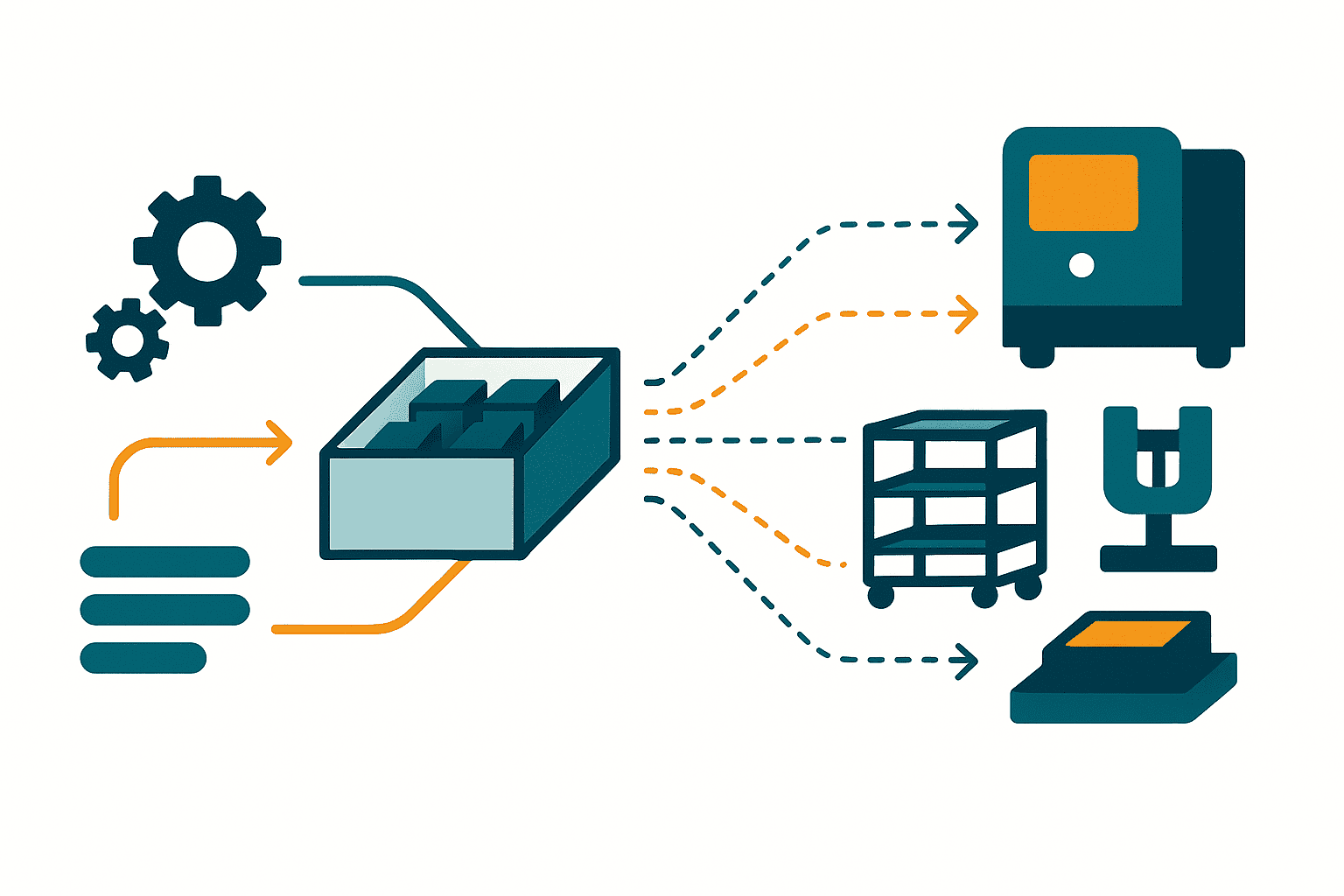
6. Run a 30-day PoC on one small scope
The PoC tests which loss is material and which countermeasure is repeatable. Limit scope to one machine or product family and involve the line leader, industrial engineering, quality, maintenance, IT/OT and EHS.
| Days | Work | Deliverable / decision |
|---|---|---|
| 1–5 | Agree definitions, synchronise clocks, observe | Data dictionary, current method, safety boundary |
| 6–12 | Baseline and event Pareto | P50/P90, first-pass rate, top losses |
| 13–18 | Test externalisation, kitting, presets | Countermeasures, risk review, revised standard |
| 19–25 | Repeat across shifts using Kata/PDCA | Variation, deviations and learning log |
| 26–30 | Evaluate effect, data and scale conditions | PoC report, RFP requirements, go/no-go |
NIST’s Toyota Kata case illustrates using a concrete target condition and repeated PDCA experiments. An example is: “Reduce P90 for A-to-B from 45 to 30 minutes, keep first-pass approval at or above 95%, and maintain zero safety deviations.” Validate over several shifts and repetitions, not one best run.
Each weekly review records five questions: what was expected, what actually happened, what was learned from the gap, what the next experiment is and when it will be checked. Before committing to automation, test low-cost hypotheses such as moving a tool cart, adding a readiness checklist or changing approval timing.
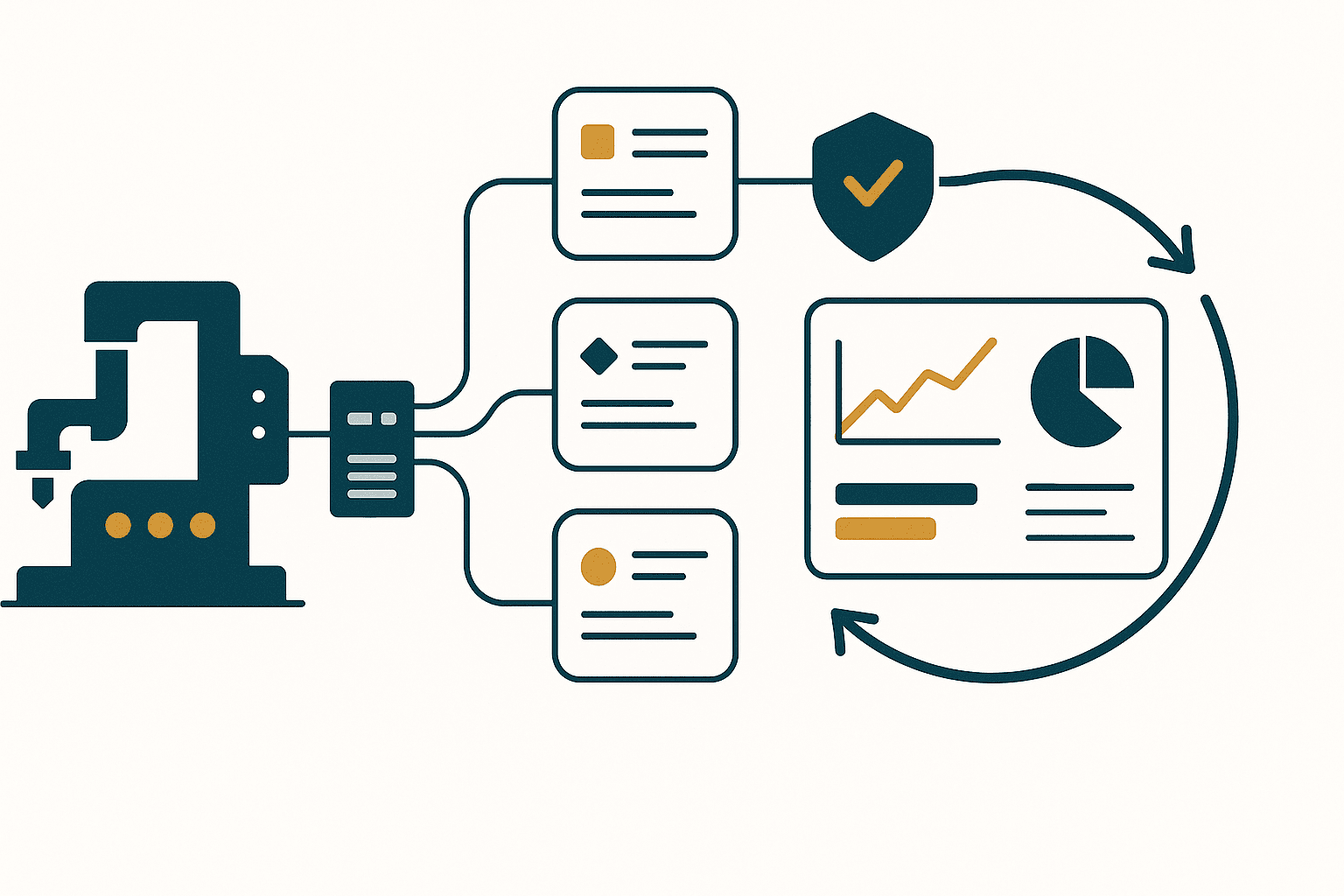
7. Convert PoC learning into an RFP and acceptance tests
“Visualise changeover” is not enough for comparable bids. Specify machines, PLC signals, manual inputs, connection interval, retention, clock synchronisation, product master, permissions, languages, MES/ERP interfaces, cybersecurity, maintenance boundary, source/configuration handover and training.
| RFP area | Requirement example | Acceptance example |
|---|---|---|
| Event detection | Last good, stop, recipe, first good | Reconcile a controlled test lot |
| Manual input | Reason, correction, note, offline operation | Test missing data, resend and conflict |
| Time | Common time source | Measure allowed device-to-device drift |
| Analytics | P50/P90, product pair, Pareto | Recalculate with a known data set |
| Quality join | Link first-piece result to event ID | Trace fail, retest and approval |
| Audit | Role-based view/edit/approve history | Test every role and correction trail |
| Availability | Buffer and recover during outage | Disconnect and verify no loss |
| Handover | Tags, diagrams, settings, backup, training | Restore and reconcile documents |
Test raw events, aggregates, quality results, screens and exports end-to-end. Include communication loss, clock drift, cancelled change, failed first piece, midnight crossing, parallel events and manual corrections.
8. Build the investment case without double counting
Saved changeover minutes are not automatically revenue. Demand, the true bottleneck, staffing, material and downstream capacity must align. Separate overtime avoided, expedite or outsourcing cost, incremental throughput, inventory reduction, delivery stability and first-piece scrap. Do not claim the same recovered hour in several categories.
Calculate annual recovered hours from saving per changeover × annual frequency, then apply a realistic utilisation factor. Value incremental output using contribution margin rather than gross sales. Total investment includes engineering, connectivity, cybersecurity, training, standard-work revision, maintenance, licences and data governance.
A NIST case about Brighton NC Machine Corporation in Brighton, Michigan reports 70% lower changeover, 98% less travel, USD 460,000 in new sales and USD 125,000 in cost savings. These are results from one company under its specific conditions—not a general guarantee or a TOMAS TECH performance promise.
As macro context only, NESDC’s Q1 2026 report reports Thailand manufacturing growth of 0.9% year on year and average capacity utilisation of 61.26%, versus 57.50% in the prior quarter and 61.61% a year earlier. National statistics do not establish an individual plant’s constraint or business case.
The Thailand BOI’s official H1 2026 announcement provides current investment context. This article does not determine incentive eligibility. Confirm the latest scheme, eligible activity, timing and evidence with BOI and qualified advisers for each project.
| Layer | Examples | Common error |
|---|---|---|
| Technical | Minutes, P90, first-pass rate, travel | Using one best run |
| Operational | Recovered hours, overtime, adherence, inventory | Counting one hour several times |
| Financial | Contribution, avoided cost, total ownership cost | Treating sales as profit |
9. Treat safety and change control as independent constraints
Changeover can expose electrical, pneumatic, hydraulic, gravitational, thermal, rotational, chemical and stored-energy hazards. Hazardous-energy control, guarding and safety checks are not waste to be deleted. Competent, authorised people must define controls from the equipment risk assessment, manufacturer instructions, company EHS, customer requirements, local law and applicable standards.
OSHA’s minor servicing exception guidance describes an exception only where servicing during production is routine, repetitive and integral to production—all conditions—and effective alternative protection is used. One condition alone does not justify bypassing lockout/tagout. OSHA is a US framework; it must not be presented as a uniform legal duty or exception for every Thailand facility. Check Thai law, manufacturer instructions, customer requirements, internal EHS and applicable standards for the specific project.
Quick clamps, connectors, guides, carts and automated recipe loading can introduce mix-up, pinch, drop, unexpected-start or access risks. Review changes with engineering, quality, maintenance and EHS; update drawings, risk assessment, standard work, spares and training. Assign an owner and expiry date to temporary controls.
This article is not legal advice, a safety procedure or an equipment-specific risk assessment. Isolation, testing, modification and return to service must follow approved procedures and correct equipment information under authorised, competent personnel.
10. Frequently asked questions
Where should changeover time start and finish?
Use the last good piece of the outgoing product to the first good piece of the incoming product. Document quality conditions and exclusions; machine restart alone hides trial, adjustment and defects.
Does SMED guarantee every changeover below ten minutes?
No. SMED seeks single-digit-minute changeovers by separating internal and external setup, but it is neither a universal guarantee nor a requirement to apply the same target to every process.
Is reducing changeover enough for OEE improvement?
No. Monitor first-piece quality, micro-stops, speed, P90 variation, schedule adherence and safety alongside OEE.
Is cycle time measurement the same as changeover measurement?
No. Cycle time covers one normal production cycle; changeover spans the product transition. They can share PLC events, clock synchronisation and quality integration.
Does production line visualisation always require new sensors?
No. Existing PLC, inspection and MES data plus simple operator input may be enough for a PoC. Add sensors only where a decision-critical gap is demonstrated.
What defines a successful 30-day PoC?
Success combines data completeness, P50/P90, first-pass quality, zero safety deviations, repeatability across shifts and requirements clear enough for an RFP—not merely the highest percentage reduction.
Is adding more people an effective way to improve changeover?
It can be effective only where tasks can proceed in parallel without interfering with each other. Adding people does not solve waiting, missing tools, unclear approval or repeated adjustment, and it can create congestion or safety risk. Remove and externalise avoidable work first, then define roles, shared resources and safe completion signals for any parallel work.
Conclusion: improve changeover as a chain of events
Sustainable changeover reduction does not come from one stopwatch study or extra labour. Define last-good to first-good, classify internal/external setup, waiting, travel, adjustment and first-piece quality, then test ECRS, externalisation, safe parallel work and presetting. Use a 30-day PoC to validate variation and repeatability before procuring a larger system. Hazardous-energy control, guarding and safety checks remain independent constraints, never reduction targets.
To scope changeover data collection, PLC/MES integration, a PoC dashboard or an evidence-based RFP for your Thailand factory, contact TOMAS TECH. We can begin by identifying a small test scope and measurable acceptance criteria.
References
- Lean Enterprise Institute: Single-Minute Exchange of Die
- NIST: Improvement Effort Reduces Changeover Time
- NIST: Toyota Kata — A Lean Strategy for Keeping Pace With Change
- NIST: Lean Manufacturing — Don’t Leave Home Without It
- OSHA: Minor Servicing Exception
- Toyota Motor Corporation: Toyota Production System
- Thailand BOI: Investment Applications in H1 2026
- NESDC: Thai Economic Performance in Q1 2026


