



Control panel design outsourcing for a Thailand factory is not merely an order for drawings and a metal enclosure. Circuit integrity, short-circuit ratings, internal temperature, machine interfaces, safety-related controls, FAT acceptance criteria, as-built drawings and program handover belong in one procurement specification. When they are connected, quotation comparison and acceptance use the same evidence. This guide explains how a buyer can procure design, fabrication and testing while using international standards as project references rather than unsupported legal claims.
Control panel design buys a verifiable function, not a box
A control panel distributes power, switches and protects loads, operates machinery through PLC and safety-related controls, displays status, and moves the system to a defined state when a fault occurs. The deliverable is therefore more than sheet metal, breakers, PLCs and terminals. It should establish a reproducible design baseline: requirements, single-line diagram, schematics, bill of materials, layout, terminal and I/O schedules, thermal-design evidence, short-circuit rating evidence, safety-function specifications and validation records, FAT records, settings, source files, backups and as-built documents.
The buyer should first define the machine, supply system, installation environment, operation and maintenance model, destination market, customer specification and assessment route. Naming one standard does not replace these decisions. IEC 61439-1:2020 covers general rules for low-voltage switchgear and controlgear assemblies; its official IEC page states that the 2021 and 2023 corrigenda are included. IEC 60204-1:2016+A1:2021 CSV addresses electrical equipment of machines. Referring to either document does not prove that one standard, edition or certification is a uniform statutory requirement for every Thailand project. Confirm the applicable standards and editions for the destination market, equipment type, contract, customer requirements, authorities and certification strategy.
Divide the supply into five layers
| Layer | Buyer defines | Supplier provides as evidence |
|---|---|---|
| Function | modes, loads, interlocks, stopping and recovery | functional specification, cause-and-effect matrix, test records |
| Electrical | incoming supply, earthing, fault-current data, power quality | single-line diagram, protection evidence, rating schedule |
| Physical | location, ambient conditions, size, cable entry | layout, thermal assessment, IP strategy, installation drawing |
| Safety | hazards, safety functions, reset, maintenance access | safety requirements, circuits, verification records |
| Lifecycle | FAT, installation, changes, spares, handover | FAT report, as-built set, restore test, training records |
With these layers in the RFQ, a control panel fabrication supplier can identify missing inputs and the buyer can compare assumptions and exclusions. Phrases such as “same as existing,” “supplier standard” and “complete set” leave design gaps that often emerge after fabrication as site modifications and variation orders.
Build the requirements specification before drawing circuits
The first outsourced engineering deliverable should be the design input, not the schematic. In addition to a load list, define what each operating state permits, what stops on a fault, how power restoration is handled, and what information is exchanged with higher-level systems. For brownfield work, record the survey date, inaccessible areas, discrepancies between drawings and the installed condition, and available shutdown windows.
Design-input checklist for the RFQ
| Subject | Minimum input | If unresolved |
|---|---|---|
| Supply | voltage, phases, frequency, earthing, point of supply | assign measurement or electrical-owner confirmation |
| System | available fault current or data needed to calculate it | state the assumption and confirmation deadline |
| Loads | ratings, starts, duty, simultaneity, future expansion | separate base scope and options |
| Environment | ambient temperature, humidity, dust, water, corrosion, vibration, indoor/outdoor | distinguish normal and worst credible conditions |
| Operation | Auto/Manual, Local/Remote, recovery, authorisation | review with a state-transition model |
| Safety | hazards, required safety functions, equipment boundaries | assign the risk-assessment owner and due date |
| Communications | PLC/HMI, host, protocol, time, failure behaviour | manage boundaries in an ICD |
| Maintenance | access, isolation, spares, diagnostics, remote support | make maintenance approval a gate |
| Documents | languages, formats, revisions, source, licences | accept through a handover register |
Give each value a source. If the panel ambient is stated as 40°C, identify whether this is a plant rule, site measurement, HVAC design condition or temporary assumption. Control panel thermal design and component selection depend on the credibility of the inputs. Uncertainty should remain visible with an owner, decision date, impact and provisional condition.
Even a panel-only replacement requires boundary checks at field wiring, motors, sensors, emergency stops and host communications. Do not assume that legacy drawings describe the installed equipment. Critical power and signals need site verification. This article is not an instruction for live electrical work. Any survey or work involving exposed electrical hazards must be planned and performed by authorised, competent personnel under site rules and applicable requirements.
Do not reduce short-circuit current ratings to breaker interrupting capacity
For a short circuit, establish the available current at the panel incomer from the upstream system and verify that the assembly design—including busbars, branches, protective devices, terminals, conductors and enclosure—is suitable for the stated conditions. A high interrupting rating on one breaker does not automatically prove the short-circuit capability of the whole panel or the acceptability of every component combination.
The necessary inputs vary by project and may include transformer size and impedance, upstream protection, conductor length and characteristics, earthing arrangement, parallel sources, generators, UPS equipment and future system changes. If the buyer cannot yet provide the final value, retain the supplier’s assumption, calculation boundary, upstream conditions, confirmation date and re-evaluation trigger in the design file.
North American destinations and customer specifications may introduce UL 508A and SCCR terminology. UL’s official UL 508A Supplement SA resource identifies the October 2025 supplement dealing with specific component requirements. A general article cannot establish the SCCR of a particular panel or declare a UL Listing. Confirm the destination-market requirement and scope with the customer and, where needed, a qualified or authorised supplier and evaluator.
Short-circuit review questions
- Who established the available fault current at the point of connection, and from which system data or calculation?
- Does the design distinguish an assembly rating from the interrupting rating of each protective device?
- If current limitation or a combination rating is used, are all conditions of use recorded?
- Does the assessment boundary include internal wiring, busbars, terminals, branches and control power?
- Are re-evaluation triggers stated for transformer replacement, capacity increase or parallel operation?
- Do nameplate, drawings, calculation record, BOM and FAT record show consistent ratings?
These are procurement and review questions, not a field-measurement or fault-calculation procedure. Competent electrical engineers must use correct system data, design methods and applicable requirements to make the actual determination.
Control panel thermal design covers total loss and local hot spots
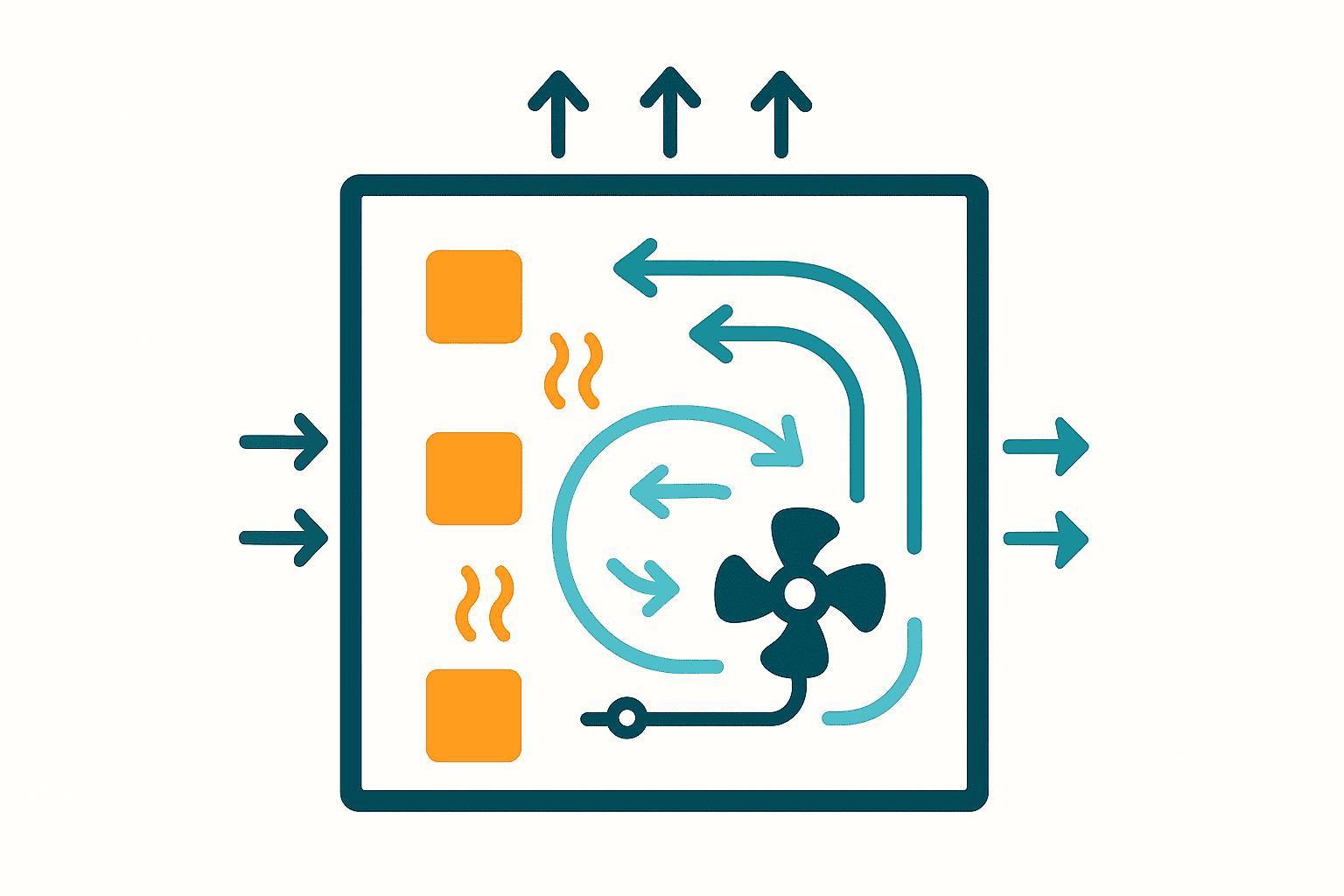
Panel temperature should be designed from the balance of environment and heat losses, not from a default decision to install a fan or air conditioner. Inputs include ambient temperature, solar gain, mounting method, enclosure material and size, component losses, duty and simultaneity, airflow, filter loading, altitude, pollution and the required ingress-protection strategy. Around drives and power supplies, check local component temperature and manufacturer derating conditions as well as the average enclosure temperature.
IEC TR 60890:2022 specifies a method for calculating air temperature rise inside enclosures for low-voltage switchgear and controlgear assemblies or similar products. It is primarily applicable to enclosed assemblies or partitioned sections without forced ventilation, so its conditions, inputs and limits must be checked. Do not apply one simplified formula to every panel; state whether the verification plan uses calculation, comparison with a verified design, testing, or an appropriate combination.
| Thermal-design input | Engineering question | FAT and handover evidence |
|---|---|---|
| Ambient | normal/maximum, location, solar gain, loss of HVAC | input source, panel-in/panel-out test conditions |
| Device loss | losses by operating state, simultaneity, future allowance | loss schedule, source data sheets |
| Layout | heat sources, airflow, sensitive devices, wiring density | layout, spacing rationale, photographs |
| Cooling | natural flow, fan, heat exchanger, air conditioner | capacity basis, failure alarm, maintenance condition |
| Enclosure | dust/water strategy versus heat rejection | IP strategy, gasket and opening inspection |
| Verification | applicability of calculation, comparison or test | calculation, measurement points, load condition, result |
Where cooling equipment is selected, specify condensation and drainage, filter replacement, alarms, spares, discharge of heat outside the panel and the safe response to cooling failure. High sealing and high ventilation can conflict, so heat rejection and ingress protection must be designed together.
IEC 60529 covers degrees of protection provided by enclosures—the IP Code. An IP designation is not a universal guarantee for ambient temperature, corrosion, condensation, chemicals and outdoor weathering. Define the needed protection and maintain it in the completed assembly, including glands, doors, vents, coolers and site-cut openings.
Integrate power, control, safety and communication boundaries
A useful schematic allows reviewers to trace source, protection, potential, terminals, cables, tags, cross-references, normal state and fault state. Where several supplies exist, clearly identify supplies that remain after the main isolator is opened and voltages returned from external systems. Draw distinguishable boundaries between internal and field wiring, supplier and buyer scope, machine and building, and standard versus safety-related control.
Projects referring to IEC 60204-1:2016+A1:2021 CSV should review the applicable requirements for the electrical equipment of machinery, including protection, control circuits, operator interfaces and documentation. For machinery destined for North America, NFPA 79:2024 may form part of the market or contractual requirements. It should not be imposed automatically on every domestic Thailand panel or treated as clause-by-clause identical to an IEC document. Determine the destination and customer specification first.
Keep interfaces inside the electrical design outsourcing scope
If electrical design outsourcing is defined as “prepare drawings only,” PLC requirements, machine risk, panel heat, field cabling and FAT can fall between parties. Use a RACI or interface control document to name the provider, designer, reviewer, approver and tester for every deliverable.
| Interface | Buyer | Design/fabrication supplier | Agreement gate |
|---|---|---|---|
| Supply and fault data | provides system data and planned changes | incorporates conditions and raises gaps | before basic design |
| Machine I/O | provides behaviour and hazard information | designs I/O, interlocks and terminals | I/O freeze |
| Safety | approves risk assessment and required functions | prepares safety circuit and verification plan | before detailed design |
| Thermal/environment | provides site conditions | assesses loss, layout, cooling and IP | before fabrication |
| Software | provides standards, access and handover terms | implements and versions PLC/HMI | pre-FAT freeze |
| Site works | coordinates shutdown, installation and inspection | supplies terminal, cable and installation data | before shipment |
A buyer’s drawing approval does not automatically transfer the designer’s responsibility to the buyer. Define whether approval confirms inputs and interfaces, releases the next stage, or accepts a specific deviation. Allocate design responsibility, fabrication quality and compliance duties separately in the contract.
Safety-related control is more than fitting an emergency-stop device
Safety-related control starts with the equipment-specific risk assessment and the safety functions derived from it. Door-open stopping, prevention of unexpected restart, emergency stopping and restricted motion in maintenance mode each need defined inputs, logic, outputs, response, fault behaviour, reset and validation method.
ISO 13849-1:2023 provides a methodology for the design and integration of safety-related parts of control systems. It does not prescribe one safety function or one required performance level for every machine. Required functions and PLr are determined from the risk assessment and applicable requirements; circuit, components, software, diagnostics, common-cause considerations and validation must remain consistent. The standard alone also does not provide cybersecurity measures.
For an outsourced design, include the safety requirements specification, input data, calculation or assessment files, component versions, circuit drawings, software versions, test procedures, results and corrective-action history in the handover. Naming a safety relay or safety PLC is not evidence that the required safety function has been achieved.
Connect control panel fabrication to the approved design baseline
Control panel fabrication must control substitutions, terminations, wire identification, machining, earthing, door-mounted devices, segregation, clearances, cooling paths and software versions—not only reproduce an approved drawing. A substitute component requires review of electrical ratings, short-circuit conditions, heat loss, environmental ratings, approvals, communications, maintainability and effects on safety functions, not merely its mounting dimensions.
Inspection points during fabrication preserve evidence for details hidden after completion, such as protective bonding, busbar supports, duct wiring, gaskets and sheet-metal work. Do not leave drawing changes as red marks. Flow them into schematics, BOM, layout, terminal schedule, PLC/HMI, labels and test procedures, then issue the as-built set after FAT.
For Thailand sourcing, language is also an engineering interface. Decide which language controls labels, warnings, HMI, operation and maintenance manuals and FAT records. Where English, Thai and Japanese versions coexist, maintain a terminology list and assign a reviewer so safety messages and operating modes retain the same meaning.
For a broader sourcing workflow, see Control Panel Manufacturing in Thailand. For alarm philosophy, permissions and screen requirements, refer to HMI Screen Development for Thailand Factories. Program continuity and restoration are covered in Mitsubishi PLC Program Handover.
A control panel FAT proves requirements, not merely energisation
A control panel FAT is the last major gate at which defects can be corrected before shipment. It should prove, against an approved procedure and acceptance criteria, the circuits, functions, displays, interlocks, fault responses, documentation and backups that can be assessed at the supplier’s facility. Before starting, confirm the readiness of design inputs, drawings, components, software, open issues, test equipment, simulated signals and safe test conditions.

| FAT section | Example checks | Record |
|---|---|---|
| Document reconciliation | drawings, BOM, labels, terminals and settings | revision, discrepancy, correction, approver |
| Construction | dimensions, machining, identification, bonding, wiring, ventilation | photographs, checklist, outstanding items |
| Electrical tests | agreed continuity, insulation and functional tests | method, condition, instrument, readings, result |
| I/O | all points or agreed scope with simulated inputs/outputs | tag, expected result, actual result, exception |
| Functions | modes, sequences, interlocks and recovery | precondition, action, outcome, log |
| Faults | sensor loss, communication loss, power restoration | safe state, alarm, recovery, retest |
| Safety | agreed verification of safety functions | function, response, reset, evidence |
| Thermal | assessment at agreed load and ambient condition | points, load, stabilisation condition, result |
| Handover | sources, backup, restore and document register | files, versions, hashes, restore result |
Do not copy test voltages, numerical limits or acceptance values from a general article. Competent personnel must prepare the procedure from the applicable standards, component information, design, contract and available test equipment. Record instrument identification and calibration status, conditions, actual measurements, deviations, correction and retest—not just pass/fail.
Even when the contract allows FAT without customer attendance, the supplier’s inspection record remains necessary. For remote witnessing, agree the drawing revision, I/O simulation, log sharing and method of record approval in addition to the camera view. If a conditional pass allows shipment, define the open items, owner, deadline, site retest and any payment retention.
FAT and SAT are not interchangeable
FAT covers what can be reproduced at the supplier’s premises. Actual incoming supply, field cables, machine loads, plant network, adjacent equipment, safety zones and operator movement need site acceptance. FAT approval does not automatically establish post-installation compliance or the safety of the complete machine. Link FAT and SAT tests to the requirements traceability matrix and assign where each requirement is proven.
Compare quotations at one deliverable and evidence boundary
The comparison table should cover design-input confirmation, survey, short-circuit and thermal assessment, standards scope, safety design, PLC/HMI, FAT, travel, installation, SAT, training, as-builts, source files, warranty and spares—not only enclosure size and main devices. Replace vague “included” and “excluded” statements with the document, quantity, language and acceptance condition.
Clarification list for a panel supplier
- Which standards, editions, destination market and customer specifications apply, and which assessments are excluded?
- From which input will available fault current be established, and where will the panel rating be recorded?
- What are the thermal inputs, verification method, cooling-failure response and maintenance conditions?
- Who supplies and approves the risk assessment and safety requirements, and who validates them?
- How are substitutions and drawing changes approved and propagated to deliverables?
- What are the FAT scope, conditions, witness arrangements, deviation process, retest and shipment gate?
- Are PLC/HMI source, licences, passwords, backups and a restore test included?
- What are the boundaries for site works, SAT, legacy modification, shutdowns, travel, tax and freight?
- When does warranty begin, and what response, remote access, spares and obsolescence support are offered?
- Can as-built and training completion be linked to final payment?
If the response is merely “supplier standard” or “no problem,” ask for the document name and revision, calculation or test method, and exclusions. A proposal that exposes unresolved inputs and assigns evidence ownership is easier to compare for total project risk than a low price with a broad hidden boundary.
Thailand BOI incentives require project-specific confirmation
The current official Thailand Board of Investment Smart and Sustainable Industry page states that the minimum eligible investment is THB 1 million, excluding land and working capital, and that machinery import duty may be exempt. The three-year corporate income tax exemption is capped at 50% of the efficiency-improvement investment, excluding land and working capital. The cap rises to 100% when machinery or equipment linked to Thailand’s domestic automation industry accounts for at least 30% of total eligible investment in machinery, automation systems and robotics. These are conditions shown on the current official page at the time of writing. They do not mean every panel renewal automatically qualifies or will receive the same incentive. Eligibility and calculation must be confirmed with BOI for the project.
The applicant should confirm the activity, eligible investment, application timing, relationship to an existing operation, calculation of local automation linkage, supporting evidence and whether orders may be placed before approval with BOI and appropriate advisers. BOI’s official 2026 first-half release provides current investment-promotion context; it does not guarantee an individual approval.
At quotation stage, separate potentially eligible equipment, engineering, installation, software and training, and retain supplier, origin, value, contract, payment, installation and acceptance evidence. This article does not make a tax or legal determination.
Protect the engineering asset through handover and change control
The handover register should cover as-built schematics, BOM, layout, terminal and I/O schedules, cable data, settings, PLC/HMI source, edit and compile environments, firmware, licences, password-management method, FAT/SAT records, thermal, short-circuit and safety evidence, operation and maintenance documents, spare-parts list and revision history.
Receiving files is not the same as being able to recover. Include a restoration to a spare PLC or agreed test environment, opening of the HMI project, library confirmation, communication-setting restoration and revision comparison in acceptance. Separate copyright, right to use, right to modify, third-party maintenance, confidential information and the supplier’s reusable libraries in the contract.

For every change, record the requirement ID, reason, affected drawings, components, software, safety functions and tests, approver, implementation date and retest result. Adding one component may affect heat, power capacity, short-circuit conditions, wiring, EMC, software, safety and spares—not merely consume spare DIN rail. Returning even small modifications to the controlled design baseline makes the next fault response and upgrade faster.
Conclusion: connect inputs, engineering evidence, testing and handover
Control panel design quality is not measured by a neat schematic alone. Establish the installation and operating requirements as design inputs; treat short-circuit current rating as an assembly condition; verify thermal design from losses and ambient conditions; connect safety-related control to risk assessment; propagate fabrication changes into documents; and use the control panel FAT to prove requirements. Determine standards for each project from destination market, equipment, customer specification, contract and authority requirements. Confirm BOI eligibility through official channels before acting.
TOMAS TECH can assist while you are still defining the RFP for a new panel, brownfield replacement or outsourced electrical design in Thailand. If you want to structure the survey, design/fabrication boundary, thermal, short-circuit and safety reviews, FAT/SAT and handover package, contact TOMAS TECH.
FAQ
Should control panel fabrication and design go to the same supplier?
Not necessarily. If they are split, define responsibility for design inputs, substitutions, shop drawings, inspection, changes and as-builts. Under a single contract, retain separate design-review and fabrication-inspection gates.
What should be provided for electrical design outsourcing?
Provide supply and system data, load list, operating description, I/O, environment, space limits, customer standards, destination market, safety requirements, communications, document languages, FAT/SAT and handover terms. Identify assumptions and confirmation dates for missing information.
What should a control panel FAT include?
The scope depends on the equipment and contract. Consider document reconciliation, construction, applicable electrical tests, I/O, functions, faults, interlocks, safety functions and backup/restore. Allocate items requiring real plant conditions to SAT. Set methods and values from the approved design and applicable requirements.
Does a panel air conditioner remove the need for thermal design?
No. Ambient conditions, component losses, arrangement, sealing, cooling capacity, failure behaviour, condensation and maintenance still need evaluation. Include cooler shutdown and filter loading in the operating case.
Is short-circuit current rating the same as main-breaker interrupting rating?
Not necessarily. The breaker rating matters, but the assembly, busbars, branches, component combinations and upstream conditions also require assessment. A competent engineer determines the project value from correct system information and the applicable assessment method.


