


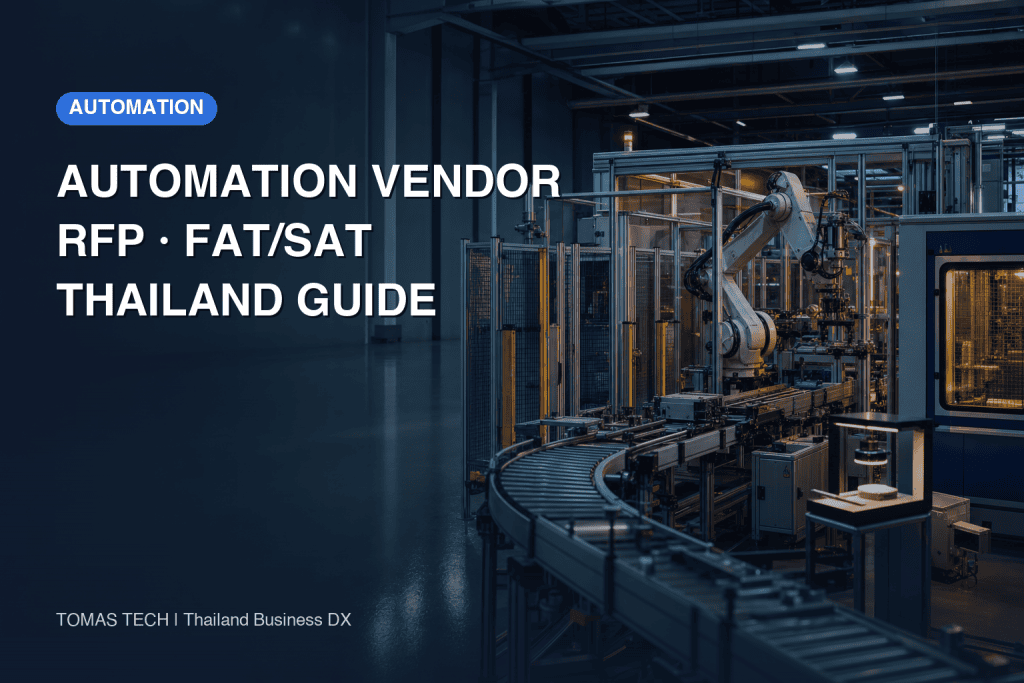
When a factory searches for an automation equipment manufacturer in Thailand that project team members can rely on, or for a system integrator, comparing quotation totals first can make the cheapest-looking offer become the most expensive to complete. A fair comparison must cover the requirement boundary, safety ownership, acceptance evidence, editable source and backups, local maintenance, and controlled changes—not only the machine price.
This guide gives manufacturing, engineering, maintenance, EHS, IT/OT, quality and procurement teams one practical process from vendor research and RFP through FAT, SAT, handover and support. It does not recommend a particular vendor, invent a price range or saving percentage, or provide a legal conformity decision.
What an automation equipment manufacturer and SIer each do
An equipment manufacturer commonly supplies a standard or engineered machine and coordinates mechanical, electrical and control work. A system integrator commonly combines robots, PLCs, sensors, vision, motion and higher-level systems from several makers into one process. In practice, the boundary varies: a machine builder may include integration; an SIer may manage fabricators; a Thailand entity and overseas headquarters may share delivery.
The buyer should therefore evaluate ownership rather than labels:
- translating process capability and quality needs into equipment requirements;
- integrating mechanical, electrical, PLC/HMI, robot and vision work;
- risk assessment, safeguards, safety functions and validation;
- interfaces with existing lines, MES/ERP and utilities;
- FAT, shipment, installation, SAT and production ramp-up;
- delivery of editable sources, configurations, backups, licenses and training;
- Thai-language first response, escalation and spare-parts support.
Even a strong vendor cannot close an unowned interface. If there is one prime contractor, disclose subcontractors, deliverables, warranty channels and change-approval routes.
Reading Thailand’s automation investment data correctly
Thailand’s Board of Investment reported 1,299 investment-promotion applications worth about THB 1.47 trillion in the first half of 2026. Within that release, machinery, automation and robotics accounted for 82 applications worth about THB 13.1 billion, while Smart and Sustainable Industry measures accounted for 132 applications worth about THB 17.2 billion. These are applications, not approvals, expenditure, completed installations or proven returns.
The figures do not prove that automation automatically succeeds. They show why factories should secure engineering capacity, parts lead times and test windows early, while separating promotional claims from evidence.
BOI’s automation page describes a current automotive-industry measure with a THB 1 million minimum investment and references machinery, control or production-support software, AI, machine learning and data analytics. Do not extend an automotive measure to every manufacturer. Confirm eligible activity, cost, deadline, incentive and procedure for the specific project with BOI or a qualified adviser before including any benefit in the business case.
Define the manufacturing-line automation boundary before selecting technology
A useful RFP does not start with a robot model. It starts with the current process, desired future state and operating boundary.
Record variation, not only an average
The bidder data pack should include product variants, sequence, observed cycles, downtime reasons, rework, changeovers, material variation, available space and environmental conditions. An average such as “ten parts per minute” does not explain upstream starvation, downstream blockage, product change or re-entry.
Record how each value was measured. A short peak, a good-parts-only count and a shift result including replenishment describe different conditions. Separate nominal, worst-case and design-margin conditions. Mark missing evidence as “not measured” instead of presenting an estimate as a binding fact.
Separate success criteria from constraints
Success criteria describe what the system must accomplish. Constraints describe boundaries such as floor loading, height, access route, power, air, network, allowable shutdown, prohibited materials, plant component standards and data retention.
| Area | What the RFP should state | Acceptance evidence |
|---|---|---|
| Product | Variants, dimensions, weight, tolerance, surface | Approved samples and drawings |
| Process result | Pass/fail definition for handling, assembly, inspection or packing | Test method and result record |
| Capability | Nominal and worst-case operating conditions | Time study and run log |
| Quality | Defect definition, disposition and traceability | Master samples and inspection log |
| Interfaces | Upstream/downstream, MES/ERP and utilities | I/O list and interface test |
| Environment | Heat, dust, cleaning, lighting, floor and noise | Site survey and layout |
| Operation | Shifts, changeover, cleaning and maintenance | Standard work and training |
| Exclusions | Building, primary power, network or other work | Responsibility matrix |
Issue the same controlled data pack to every bidder. Share clarification answers fairly and record assumptions. This exposes scope differences before price comparison.
Build an RFP that makes industrial automation equipment vendors comparable
An RFP should connect requirements, roles and evidence with stable IDs. A practical structure is:
- purpose and process boundary;
- current process, product/material data and constraints;
- functional, capability and quality acceptance criteria;
- safety requirements and responsibility split;
- mechanical, electrical, control, robot and IT/OT standards;
- existing-line, higher-level system and utility interfaces;
- FAT, SAT, run-off, training and handover;
- source, backup, license and documentation rights;
- Thailand support, warranty and spare parts;
- schedule, reviews and change control;
- price breakdown, assumptions, exclusions and options;
- mandatory response format and evaluation method.

Trace requirements into tests and changes
Give every requirement a unique ID. Ask bidders to answer “complies,” “conditional,” “does not comply,” or “alternative,” with supporting evidence. Carry the same IDs into design records, FAT/SAT procedures, defect reports and change requests.
“Can comply” is not evidence. The proposal should explain conditions, configuration and proof. Alternatives may be valuable, but the difference from the original requirement, benefit, limitation, price impact and schedule impact must be explicit.
Use pass/fail gates before weighted scoring
A single total score may allow a serious exception—such as unclear safety ownership or refusal to hand over source—to be offset by unrelated points. Apply mandatory gates first, then score the qualified proposals.
Typical mandatory gates
- evidence that the bidder understands the process and capability;
- a defined safety scope and validation responsibility;
- acceptance of FAT/SAT procedures, criteria and evidence;
- clear terms for editable sources, settings and backups;
- a credible Thailand installation and first-line support model;
- controlled approval for significant changes;
- disclosure of IP, third-party licenses, credentials and remote access.
Evidence-based scoring matrix
| Evaluation area | What to examine | Useful evidence |
|---|---|---|
| Requirement understanding | Exceptions, constraints and process logic | Compliance matrix and assumptions |
| Architecture | Maintainability, standardization and capacity | Architecture, BOM and calculations |
| Safety | Risk-reduction process and responsibility | Risk file, safety requirements, test plan |
| Acceptance | Measurement and decision criteria | FAT/SAT draft and instruments |
| Handover | Sources, backup, documents and training | Deliverables register and restore plan |
| Local support | Skills, response, spares and escalation | Team matrix and service process |
| Change control | Baselines, approval and rollback | Change form and version method |
| Commercial | Breakdown, exclusions, warranty and milestones | Price and conditions schedule |
Define examples for zero, full and intermediate scores before evaluation. Link comments to submitted evidence. Procurement should evaluate with production engineering, operations, maintenance, EHS, IT/OT and quality.
Normalize quotations onto one scope
Split each price into equipment, engineering, software, tooling, inspection, installation, freight, tax/customs treatment, training, spares, licenses, support, options and exclusions. Align quantity, currency, validity, payment terms and the event that starts lead time.
If a low bid excludes primary work, network, existing-machine modification, safety validation, sample testing, night work, repeat FAT or source handover, the totals are not comparable. Classify differences as technical, scope or commercial before negotiation.
Do not outsource all safety responsibility to the vendor
Machinery safety is an iterative process: define limits, identify hazards, estimate and evaluate risk, then reduce risk through inherently safe design, protective measures and information for use. ISO 12100:2010 provides general principles for risk assessment and risk reduction. The referenced edition remains current, but revision is underway; confirm the contractual edition and cutoff date.
ISO 13849-1:2023 provides a methodology for safety-related parts of control systems. It does not assign the required PLr to a specific safety function. Procurement should not guess a PLr; competent engineering must determine and validate it from the project risk assessment.
IEC 60204-1 addresses electrical, electronic and programmable electronic equipment of machines, from the point where the supply connects to the electrical equipment, including topics such as EMC, overcurrent protection, protective bonding and documentation. ISO 13855:2024 addresses positioning and dimensioning of safeguards, detection zones, two-hand controls and interlocking arrangements, but its limits include running, jumping and falling. No single checklist closes every risk.
In Thailand, review the authoritative Thai text of the Ministry of Labour’s 2021 machinery safety regulation and other project-specific duties. This guide is not legal advice. Applicability and action should be confirmed by the factory’s Thai occupational-safety responsible person and qualified local professionals. EU Machinery Regulation (EU) 2023/1230 may be an additional input when equipment is supplied for the EU market; do not assume it automatically applies to a machine installed only in Thailand.
Assign safety deliverables and approvals
| Deliverable | Factory role | Vendor/SIer role | Evidence |
|---|---|---|---|
| Intended use and limits | Supply and approve operating conditions | Reflect limits in design | Approved limits |
| Hazard and risk file | Provide site information | Analyze design hazards | Risk register and residual risk |
| Safety requirements | Approve required operation | Design functions and architecture | Requirements and calculations |
| Guards and stopping | Confirm access patterns | Detail, build and test | Drawings, distances and tests |
| Validation | Witness and confirm operation | Prepare and execute procedure | Function-level signed records |
| Residual risk and training | Deploy to users | Supply documents and training | Manuals and attendance |
Adapt responsibility to the project. The essential point is to replace “the supplier handles safety” with named outputs, reviewers and gates.
Evaluate factory automation case studies by boundary and evidence
A headline about labor or productivity does not establish transferability. Credible factory automation case studies explain the previous process, product range, system boundary, exceptions, measurement method, stabilization period, remaining manual work and maintenance model.
Ask shortlisted vendors, within confidentiality limits:
- Which product variation, process and environment resemble this project?
- What work remained manual, and why?
- Which commissioning issue consumed the most effort?
- What appeared at SAT that FAT did not reveal?
- Who controls software changes and spares after handover?
- What baseline period and treatment of downtime and defects support a claimed result?
Even without disclosed percentages, concrete design decisions, acceptance evidence and maintenance practice are useful. Never transfer an unsupported saving or payback number into your own plan. Measure your own baseline and use the same definition after implementation.
Make FAT a contractual test, not a demonstration
Factory Acceptance Test verifies requirements that can be tested before shipment or site installation. It should link requirement ID, conditions, procedure, expected result, decision, evidence and open item.
Prepare approved drawings and software versions, representative samples, normal/boundary/fault/recovery procedures, calibrated instruments, witnesses and decision authority, evidence rules, and severity/retest/shipment criteria.
Mechanical motion, I/O, interlocks, HMI, recipes, fault handling, basic capability, changeover, guards, safety functions, power restart and backup can often be tested when suitable simulation is available. Real upstream/downstream behavior, production network, utilities, full product variation and long-term stability may remain for SAT.
Do not define FAT pass as “no issue of any size.” Classify findings into shipment blockers, site-fix items and monitored items. Safety, equipment-damage, quality-escape and core-capability findings must not be deferred only to protect the schedule.
Use SAT to close site-specific interfaces
Site Acceptance Test verifies the installed system under actual factory conditions: post-shipment condition, alignment, power and air, production network, adjacent machines, MES/ERP, real products, operators and maintenance procedures.

Define the FAT/SAT split in the RFP. When a function appears in both, explain that FAT uses controlled or simulated conditions and SAT uses the actual site. Too many first-time tests at SAT invite redesign during a production shutdown.
| Test area | FAT purpose | SAT purpose |
|---|---|---|
| Machine and control | Verify the designed behavior | Reproduce it after shipment and installation |
| Capability and quality | Test representative samples | Test real products and supply variation |
| Safety | Validate designed functions and devices | Include site access and adjacent equipment |
| Interfaces | Test signals using simulators | Test real machines and production network |
| Recovery | Exercise power, communication and backup | Recover using plant roles and procedures |
| Operation | Review screens, manuals and training | Have actual users execute standard work |
Every result should record requirement ID, test ID, date, equipment/software version, product lot, instrument, measured and expected value, result, evidence file, witness and deviation number. A video alone or signature alone is not reproducible evidence.
Conditional acceptance must name the open item, containment, permanent action, owner, deadline and retest. If “operational control” is temporary, approve workload, safety/quality effect, training and exit condition.
Contract for editable source, backups and licenses
A running machine is not maintainable when the factory lacks editable source, settings, credentials, licenses and restoration instructions. “Backup included” may mean only an executable, a copy held on the vendor laptop, or an outdated version.
Handover should include:
- editable PLC, HMI, robot, vision, motion and industrial-PC sources;
- parameters, settings and recipe defaults matching the installed baseline;
- build/download instructions and compatible tool versions;
- secure transfer of users, roles and initial credentials;
- license owner, term, renewal, rehosting and hardware-key conditions;
- network, I/O, tag, address and device registers;
- electrical/mechanical drawings, BOM, spares and maintenance instructions;
- known limitations, residual risks, open items and warranty contacts.

Acceptance should require a clean restore on an approved maintenance environment, version comparison and connectivity proof—not only receipt of files. If writing to production is inappropriate, use a spare controller, simulator or read-only verification. Where a third-party component cannot be assigned, define rights to use, reinstall and access it during failure before contract award.
Evaluate Thailand local support beyond “we have an office”
A local office does not guarantee an engineer with the right PLC, robot, vision and mechanical skills. Distinguish sales office, parts warehouse, help desk, field engineer and overseas escalation.
| Support area | Question | Required output |
|---|---|---|
| Intake | Language, hours, holidays and channel? | Contact and priority matrix |
| Initial action | Remote diagnosis and dispatch rules? | Response targets and factory inputs |
| Skills | Who can diagnose each subsystem? | Skill and backup-person matrix |
| Parts | Stock location, obsolescence and alternatives? | Spares and lifecycle plan |
| Remote access | Approval, duration, logging and cutoff? | OT access procedure |
| Recovery | Who restores which backup? | Restore procedure and periodic test |
| Escalation | What happens when local support cannot solve it? | Named overseas route and ownership |
| Modification | Boundary between service and project work? | Change request and retest process |
Replace “24-hour support” with definitions for acknowledgement, remote start, site arrival, workaround and permanent restoration by severity. Also define logs, access and spares the factory must provide.
Control changes during commissioning
Commissioning creates many apparently small requests. Accumulated verbal changes make requirements, software, drawings and tests inconsistent. Use a lightweight change record containing reason, before/after state, affected IDs, mechanical/electrical/software/safety/quality/cyber/schedule/cost effects, implementer, reviewer, test and rollback.
Even an emergency change needs provisional approval, a backup, a log and retrospective review. Establish baselines at RFP issue, design approval, design freeze, FAT, shipment, SAT and final handover. Confirm that BOM, drawings, software, risk documents and tests refer to the same version.
Keep HMI, PLC and higher-level system integration inside the procurement scope
For production line automation, performance depends on HMI, PLC, recipes, history, quality data and MES/ERP—not machinery alone. For screen and tag-boundary detail, see our HMI development guide for Thailand factories. For a process-boundary example, see the bagging automation guide for Thailand.
Define data owner, update rate, time synchronization, quality flags, communication-loss behavior, retry, duplicate handling, units, master data and authorization. “MES-ready” does not show whether only a protocol connects or a business transaction is guaranteed. For each interface, name producer, consumer, test data, error behavior, rerun and log.
For remote support PCs and industrial PCs, align accounts, session approval, recording, patching, malware controls, USB, time and backup with plant IT/OT policy.
Convert labor-saving automation examples into a factory-specific work transition
Automation does not simply replace a person. Work moves to replenishment, exceptions, quality decisions, changeover, cleaning, maintenance, recovery and data review. Map normal, stopped and changed states.
| Work | Current owner | Automated state | Exception owner | New skill or authority |
|---|---|---|---|---|
| Material supply | Operator | Auto-feed or timed replenishment | Line operator | Stop and replenish procedure |
| Process | Operator | Standard machine cycle | Operator/maintenance | HMI and quality decision |
| Inspection | Visual/measuring operator | Sensor or vision decision | Quality reviewer | Master management |
| Changeover | Skilled operator | Recipe plus tooling | Authorized technician | Approval and version control |
| Cleaning | Operator | Partly remains manual | Trained operator | Safe isolation and restart |
| Maintenance | Maintenance team | Preventive/corrective work | Vendor escalation | Diagnosis and backup |
This avoids treating headcount difference as the only benefit. Set benefits from your measured baseline and do not reward a short peak that sacrifices quality or safety.
A 30/60/90-day vendor-selection and delivery sequence
First 30 days: requirements and shortlist
Observe the process; record products, tasks, stops, exceptions and quality; separate outcomes, constraints, exclusions and unknowns; involve EHS, IT/OT, quality and maintenance; screen vendors for technical boundary and Thailand capability; conduct controlled site surveys.
Next 30 days: RFP and contract
Issue the ID-based RFP; equalize clarifications; identify assumptions and exclusions; apply gates before scoring; normalize scope and price; review fault, recovery, service and change scenarios; tie FAT/SAT, source handover, warranty and support to contractual milestones.
Following phase: evidence-led design and acceptance
Approve compliance, responsibility and risk files at basic design; close changes at each detailed review; draft FAT during design; track findings with owner, date and retest; prepare site, utilities, interfaces, products and users for SAT; complete the handover register and clean restore; maintain change, defect, spares and training records during warranty.
FAQ about automation equipment vendor selection
How many automation equipment manufacturers should a factory compare?
There is no universal number. Prequalify companies that understand the process, disclose responsibility and can answer the same RFP with evidence. Too many candidates weaken technical review; too few limit alternatives.
When can an automation equipment budget be fixed?
Confidence improves as product variation, capability, quality, safety, interfaces, installation, tests, handover and support are defined. Keep early estimates separate from a firm quotation and require assumptions and exclusions. Obtain itemized offers against your own scope instead of relying on an unsupported market price.
Can a factory use a published automation saving percentage?
Not directly. Process boundary, product, shift, downtime, defects and measurement period differ. Use cases to identify design issues and risk, then assess outcomes against your own pre-installation baseline.
Are both FAT and SAT necessary for manufacturing-line automation?
They prove different conditions. FAT reduces design risk before shipment; SAT proves installation and real-site interfaces. Define which requirement is proven where so that nothing remains untested.
Does citing ISO standards make equipment compliant?
No. Scope, edition, risk assessment, safety requirements, design, verification and documentation must align and be reviewed by competent people. A standard name alone is not a conformity conclusion.
Is a BOI automation incentive available to every Thailand factory?
No universal eligibility should be assumed. Industry, activity, cost and timing matter. Confirm the specific project with BOI or a qualified adviser.
Can a labor-saving automation project also reduce maintenance staffing?
Not as a general rule. Routine production work may decrease, but the factory still needs skills for PLCs, robots, vision, networks, spare parts, backup restoration and controlled changes. Map normal operation, exceptions, cleaning, changeover, recovery and preventive maintenance first; then determine staffing and competencies from the site-specific workload and support model.
Conclusion: buy a system that is comparable, provable and maintainable
Before selecting the lowest automation quotation, make process boundaries, requirement IDs, safety ownership, FAT/SAT evidence, source and backup, Thailand support and change control comparable. A consistent baseline from RFP through handover lets the factory explain what is included, what was tested and who can restore the line. That is the foundation for operating and improving automation after the project team leaves.
Even if the target process is not final, you can begin with the requirement data pack, response matrix, FAT/SAT division and handover register. For a practical comparison covering equipment, controls and higher-level system interfaces in Thailand, contact TOMAS TECH.
References
- Thailand BOI: investment applications in the first half of 2026
- Thailand BOI: automation measures
- ISO 12100:2010
- ISO 13849-1:2023
- IEC 60204-1
- ISO 13855:2024
- Thai Ministry of Labour: 2021 machinery safety regulation (Thai PDF)
- EUR-Lex: Regulation (EU) 2023/1230 on machinery
*This article provides general procurement and project-management information, not legal advice, conformity certification or a BOI eligibility decision. Confirm applicable law, standards, safety requirements and incentives for the specific project with qualified parties.*


