


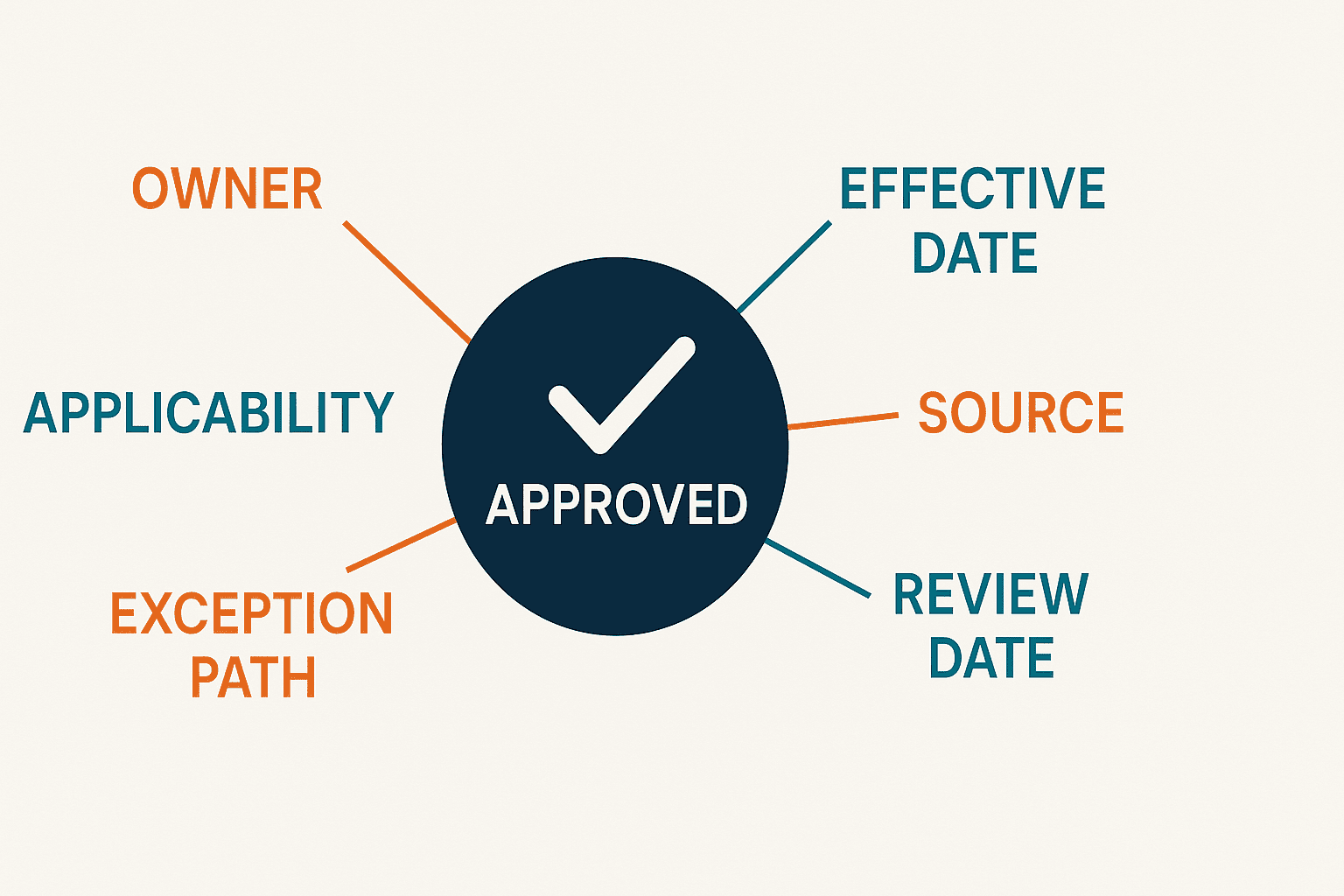
General Affairs inquiry reduction is often treated as a chatbot procurement exercise. The safer unit of control is an approved answer object: an answer with an owner, applicable employee/site/language, effective date, cited source, exception path, and review date. This guide shows how a Japanese company in Thailand can use that unit to design a multilingual 30-day PoC, acceptance tests, governance, security controls, an RFP, and a site-measured business case.
Establish the workload baseline before automating back-office inquiries
“General Affairs is overloaded” is not enough to define scope or approve an investment. Consolidate a representative sample from email, chat, telephone, walk-up requests, and forms. The log is an operating-design input, not an employee-performance scorecard.
| Field | What it reveals | Design use |
|---|---|---|
| Category and question summary | Distribution across access, facilities, transport, canteen, housing, travel, safety, and supplies | Select repetitive, low-risk PoC categories |
| Input and answer language | Japanese, Thai, English, Vietnamese, or mixed input | Build separate language test sets |
| Channel | Email, chat, phone, counter, or form | Choose the entry channel and recording method |
| Active handling time | Time spent reading, finding, checking, and answering | Create a site baseline |
| Waiting time | Time to the first useful response | Measure employee experience |
| Repeat questions | Why one response did not resolve the request | Improve completeness and navigation |
| Reassignment | Transfers among GA, HR, IT, Safety/EHS, Legal, Finance, or site administration | Define ownership and handoff queues |
| Source availability | Policy, procedure, form, notice, or only staff memory | Decide whether an answer can be automated |
| Applicable population | Site, employment group, working arrangement, visitor status | Prevent use of the wrong rule |
Separate inquiry volume from unique intents. Twenty repeats of one approved question can justify one maintained answer object; twenty personal cases may call for better intake and routing instead. If oral traffic cannot be captured completely, collect a time-bounded sample and document the unobserved channels.
Do not rely on averages alone. Segment volume, active handling time, waiting time, reassignment, and repeat contacts by category, language, and channel. Distinguish “a source exists but cannot be found,” “sources conflict,” and “only one employee knows.” Those conditions require search improvement, content governance, and process standardization respectively.
The target is avoidable search, repeated typing, wrong-queue transfers, and status-chasing—not legitimate questions. A target that discourages safety reports, grievances, or requests for help is harmful. Track supported resolution, correct handoff, repeat-contact rate, unresolved rate, and source freshness alongside any automation rate.
Make the approved answer object the core of an internal FAQ chatbot
Pointing an AI system at a document folder does not create an accountable General Affairs service. Define the smallest controlled unit as an approved answer object: representative questions, an approved response, its source, scope, and exception path in one operational record.
| Required attribute | Purpose | Example |
|---|---|---|
| Answer ID | Stable traceability across revisions | GA-ACCESS-014 |
| Intent and examples | Real phrasings and variants | “Can I enter the plant on a holiday?” |
| Approved answer | Concise, actionable response | Form, deadline, required details |
| Owner and approver | Department that edits and person who approves | GA manager; Safety manager |
| Applicability | Site, employee type, language, work arrangement | Rayong directly employed staff |
| Effective date/version | Establishes current validity | 2026-09-01, v3 |
| Source citation | Policy name, section, URL, or document ID | Site Access Procedure 4.2 |
| Exception/handoff | Conditions the bot must not decide | Emergency to the Safety queue |
| Review/expiry | Prevents silent staleness | Quarterly or on process change |
| Data classification | Audience and personal-data status | All employees; no personal data |
This object makes answers testable, lets teams trace the impact of a change, and allows expired answers to be stopped. An item without an owner, applicability, effective date, or approved source should remain in a remediation queue rather than be completed by the model.
Define a source-of-truth hierarchy
A practical hierarchy is: (1) approved policy, (2) approved procedure, (3) current form and workflow, (4) official notice within its effective period, and (5) approved FAQ. Staff notes, old email, and meeting chat may identify candidate content, but they are not automatically authoritative.
- A policy states principles, rights, or obligations. Cite the applicable section and route contested interpretations to the owner.
- A procedure states what to do, where, and by when. Update it with system and form changes.
- A form needs a canonical link and submission conditions; do not redistribute an old attachment.
- A notice needs start and end dates. After expiry, fall back to the governing policy or procedure.
- Personal-case data stays outside the general FAQ corpus and belongs in an authenticated, purpose-limited workflow.
Microsoft documents an implementation pattern in which SharePoint-grounded answers use an authenticated user’s existing access. It also notes that a broad SharePoint path can include subpaths. Neither fact is a guarantee against leakage. Scope sites, libraries, folders, and documents deliberately, then negative-test with users holding different permissions. Test retrieval authorization, citation behavior, and transcript exposure as separate controls.
For wider implementation-pattern context, see our chatbot implementation case comparison and, if Teams is the likely entry point, our Teams chatbot and agent design guide. The governance and acceptance requirements in this article remain platform-neutral.
Use a routing matrix for inquiry-response efficiency
Maximizing answer rate is less important than separating paths by consequence. Convert this matrix into operating procedures, system behavior, and acceptance tests.
| Route | Suitable cases | AI role | Mandatory condition |
|---|---|---|---|
| Automatic answer | Common facilities use, current forms, general procedure | Present the approved answer and citation | Applicable population matches; source is current; no personal judgment |
| Guided form/workflow | Standard access, supply, travel, or vehicle requests | Explain required fields and open the canonical workflow | Approval remains in the approved system; retain no unnecessary input |
| Human handoff | Exceptions, approvals, conflicting sources, unclear application | Send a concise summary and consulted sources to a named queue | Owner, service hours, response target, and reassignment rule exist |
| Never answer automatically | Salary, discipline, medical details, grievances, investigations, immigration/visa status, emergencies, or contested interpretation | Give only safe routing information | Do not solicit sensitive detail; keep emergency routes visible |
A bare refusal sends the employee to another channel. A useful handoff explains why a person is needed, the correct destination, what non-sensitive information to prepare, and when a response can be expected. For grievances, reports, and investigations, do not ask users to restate the case in general chat; link directly to the controlled channel.
Allocate ownership across back-office functions
General Affairs may be the broad front door at a Thailand site, but it should not own every decision. Facilities, visitors, and supplies may belong to GA; employment conditions and leave to HR; accounts to IT; accidents, chemicals, and evacuation to Safety/EHS; contractual interpretation to Legal; expense rules to Finance; and local exceptions to site administration. Split multi-domain questions into owner-approved objects, then present the sequence of actions without merging accountability.
Design a JA/TH/EN/VI work-rules chatbot by applicability, not translation alone
A multilingual chatbot is not finished when one paragraph has four translations. Linguistic equivalence does not guarantee policy equivalence. Keep language and applicability as separate fields so that Japan-headquarters guidance, Thai entity work rules, plant safety procedures, and expatriate rules do not blur together.
A Japanese question from a locally employed Thai-entity employee should still retrieve the source applicable to that person and site. A Thai-speaking contractor must not receive benefits guidance intended for directly employed staff. Detected language is never a substitute for identity, role, or access.
Microsoft’s language-support material lists Japanese, Thai, English, and Vietnamese for relevant generative-answer or user-language capabilities, while support stages and feature coverage can vary. Verify the exact channel, authentication pattern, source connection, and feature at procurement and again before production. Presence on a language list does not guarantee equivalent quality.
Build native test sets for every language
Translated copies of one test set miss language-specific failure modes. Each language set should include local abbreviations, polite and colloquial phrasing, spelling variation, Thai-English switching, omitted subjects in Japanese, and Vietnamese input without expected diacritics.
Include at least:
- A routine question directly supported by a current source.
- An ambiguous question missing site or employee classification.
- An old program or form name.
- A compound question spanning GA, HR, and IT.
- A personal case containing sensitive information.
- A prompt attempting to obtain unauthorized content.
- A question with no supported answer.
- Paraphrases and near-boundary meanings.
- Mixed-language, typo, colloquial, and abbreviated input.
- Urgency or emergency language.
Judge language quality by grammatical clarity, terminology, politeness, actionability, and consistency with real form names. Business owners—not translators alone—must approve meaning where an error changes obligations or next steps.
Separate permission, personal data, transcripts, retention, and access reviews
In back-office inquiry automation, personal data can enter through a user’s question even if the source corpus contains none. Microsoft notes that conversation transcripts can include questions and source-search results. Treat source documents, user input, generated output, citations, search results, evaluation records, and support tickets as distinct governed data sets.
| Control object | Decision required | Negative-test example |
|---|---|---|
| Source access | Who can search which site, folder, and document | A general employee cannot cite manager-only content |
| Answer object | Applicability, classification, expiry | The bot does not assert another site’s local procedure |
| User input | Purpose, minimization, masking | The bot does not request extra salary or medical details |
| Transcript | Whether saved, viewers, retention, deletion | Operators cannot browse unnecessary personal-case text |
| Evaluation data | De-identification and reuse boundary | Production logs are not moved to an external test space without approval |
| Administration | Grant, review, and removal | A transferred or departed administrator loses access |
Permission-aligned retrieval must be configured and negative-tested; do not claim that a platform inherently prevents permission leakage. Exercise privileged, ordinary, contractor, other-site, and unauthenticated roles. Inspect retrieval, citations, final responses, and logs.
This article does not determine a lawful basis or give legal advice on Thailand’s personal-data rules, notices, retention, employee monitoring, or cross-border processing. Give the actual data flow and contractual terms to your PDPA owner, Legal, Information Security, and appropriate external advisers. ETDA’s generative-AI and executive-governance publications can inform voluntary organizational governance; they are not themselves mandatory law.
Acceptance criteria for an internal FAQ chatbot
Generative output is nondeterministic and can be wrong. Microsoft guidance on generative answers and agent evaluation calls for expected and adversarial questions, repeatable test cases, and language-specific evaluation. A successful demo is not acceptance evidence. Record the test set, scoring rubric, model/configuration, retrieval settings, time, and artifacts.
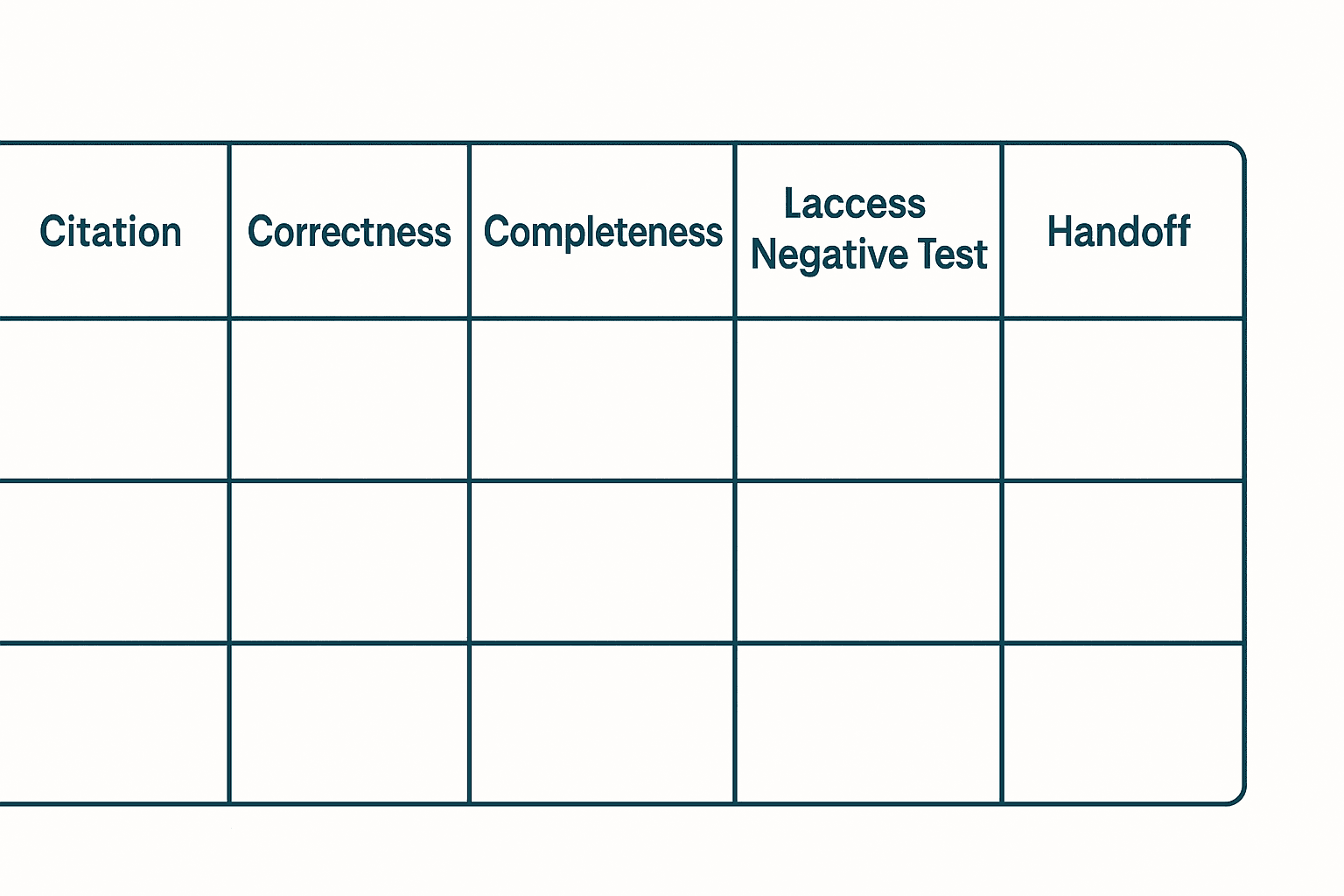
| Dimension | Passing principle | Evidence |
|---|---|---|
| Citation | Identifies the approved source and correct section/link | Response, citation, retrieved document ID |
| Grounded support | Every material claim is supported by the cited source | Claim-by-claim review |
| Correctness | Owner confirms there is no wrong scope or interpretation | Owner decision |
| Completeness | Includes channel, deadline, exception, and next action where required | Checklist |
| Language quality | Terms, meaning, tone, and action are appropriate per language | Native-speaker review |
| Access control | Does not retrieve, cite, or infer unauthorized information | Role-based negative tests |
| Refusal/handoff | Stops safely and reaches the correct queue | Boundary-case transcript |
| Freshness | Prefers the current effective version | Before/after update test |
| Repeatability | Multiple runs do not produce a material change in outcome | Repeated-run record |
Do not collapse all defects into one accuracy score. A correct form with a missing deadline may create another inquiry; a correctly quoted rule for the wrong site is dangerous. Separate cosmetic variance, material omission, major misinformation, and access-control failure. A critical failure must not be averaged away by easy cases.
Run important cases more than once. There is no universal run count; choose it based on variability and business risk. Re-run the affected regression set after changing the model, prompt, retrieval scope, connector, approved content, channel, authentication, or language handling. OpenAI’s Evals API is one concrete example of defining criteria and data schemas so tests can be rerun across configurations.
NIST AI RMF and the Generative AI Profile support a lifecycle approach: define the use context, assign oversight, test under deployment-like conditions, document evidence, and monitor production. Include GA, HR, Safety, IT, and native language users; use independent or domain review for high-consequence boundaries.
A 30-day PoC for General Affairs inquiry reduction
The PoC should not promise enterprise rollout or a universal reduction percentage. It should prove whether the team can maintain answer objects, enforce permissions and handoffs, and collect enough site evidence for a stop/go decision.
Suggested scope:
- One site and a limited employee cohort.
- Two or three low-risk, repetitive categories.
- Separate tests for all required languages among JA/TH/EN/VI.
- Approved answer objects as the only knowledge source.
- No personal-case decision, approval, or emergency reporting.
- Links to canonical workflows rather than autonomous business updates.
The days and quantities below are illustrative planning assumptions, not a standard, price, or promised result. Replace them with your readiness and risk.
| Period | Work | Exit condition |
|---|---|---|
| Days 1–5 | Classify logs; approve categories, owners, and exclusions | Scope and out-of-scope are signed off |
| Days 6–10 | Build answer objects, hierarchy, and permission matrix | Source, applicability, and review dates are complete |
| Days 11–15 | Configure retrieval, citation, routing, and logging | Positive and negative paths execute |
| Days 16–21 | Run language and role tests repeatedly; fix defects | No unresolved critical defect |
| Days 22–26 | Limited user trial; measure time and repeat contacts | Site logs and feedback are captured |
| Days 27–30 | Re-evaluate risk, operating effort, and cost | Go, conditional go, or stop is documented |
Name a business owner, content steward, technical owner, security/privacy reviewer, evaluator for each language, support queue, and final go authority. One person may fill multiple roles, but approval accountability must remain explicit.
Stop conditions may include unauthorized disclosure, wrong emergency routing, a decisive response to an excluded personal case, selection of an expired source over the current one, missing audit evidence, or an unbounded critical defect. Stopping is useful PoC evidence. Record cause, affected scope, remediation, and added regression tests before resuming.
Put evidence requirements into the RFP, FAT, SAT, and operations plan
An RFP should ask for operational evidence rather than a generic “AI-enabled” feature list.
- Sources: scope, subpaths, versioning, expiry, synchronization delay, and citations.
- Identity and permission: SSO, groups, service accounts, retrieval-time access, administrator review.
- Languages: JA/TH/EN/VI and mixed input, channel differences, glossary, per-language evaluation.
- Safety boundaries: refusal and handoff for personal, urgent, disputed, and unsupported cases.
- Data and logs: locations, viewers, retention, deletion, and exports for input, retrieval, output, citation, transcript, and evaluation.
- Evaluation: test schema, rubric, repeated runs, regression, and change-triggered re-evaluation.
- Operations: monitoring, alerting, incidents, content SLA, change approval, rollback.
- Portability: export answer objects, test sets, logs, configuration, and operating records.
- Cost: measurement units for setup, connectors, environments, usage, storage, support, translation/evaluation, training, and exit.
- Evidence: demonstrate the buyer’s cases and provide settings, logs, results, and known limitations.
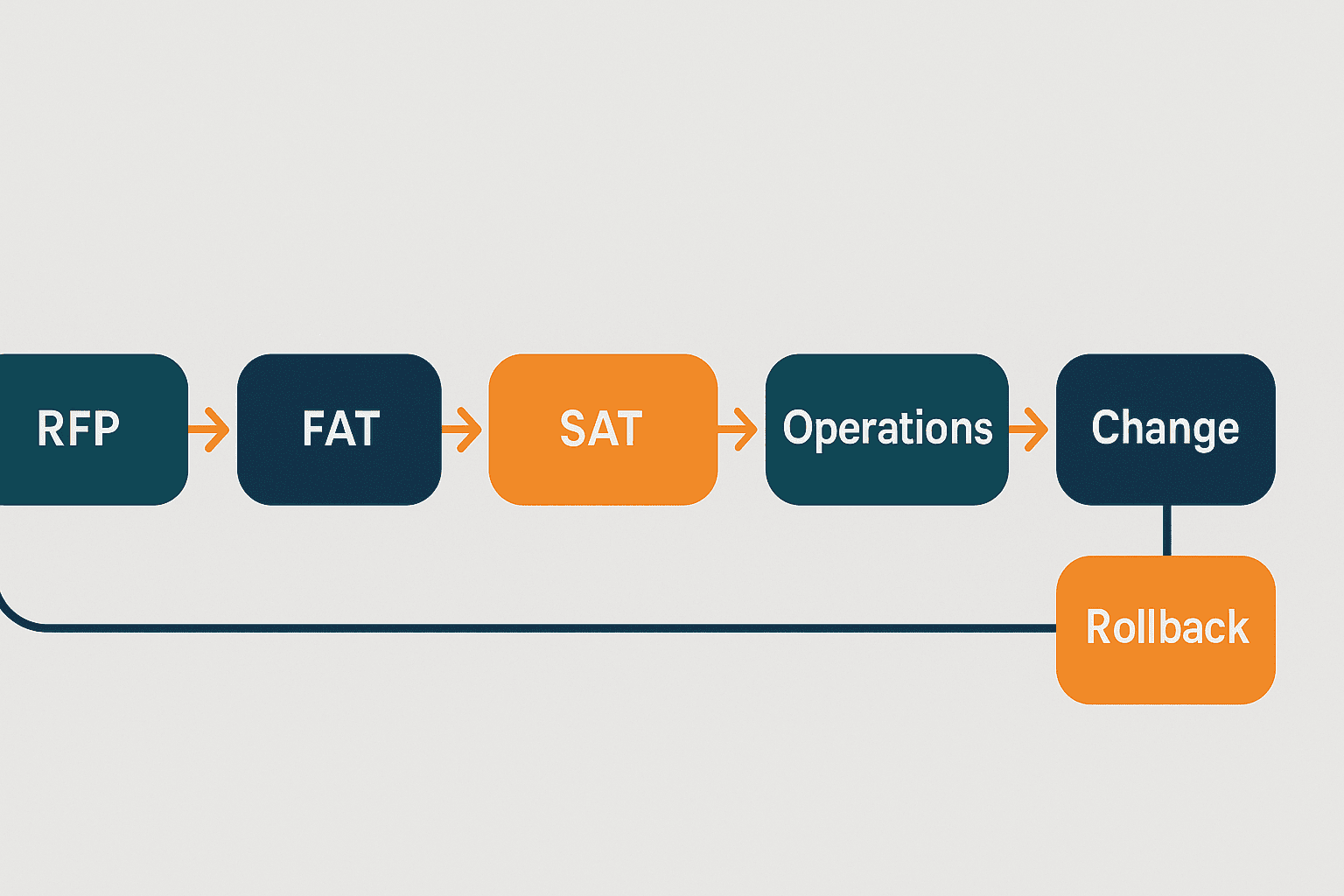
FAT checks object ingestion, citations, routing, permission configuration, logging, export, and failure behavior in the supplier or build environment. SAT repeats the relevant cases with the site’s identities, network, channels, document permissions, and native speakers. FAT approval does not imply SAT approval.
Each acceptance case needs preconditions, role, input, expected source, expected action, prohibited outcome, result, and artifact location. Replace “answers naturally” with observable language such as “does not reveal the restricted document title or content and hands off to the approved queue.”
Production procedures should cover user reporting, severity, containment, disabling an answer object, impact search, owner notification, approved correction, regression, and restart. For suspected permission exposure, inspect the retrieval path and log viewers, not just the displayed answer.
Change records should preserve reason, old and new versions, approver, effective date, and impact tests. Rollback should cover the prompt, retrieval scope, connector, answer object, model/configuration, and channel. Nominate delegates who can suspend expired content when the primary owner is unavailable.
Build the business case from site measurements only
Avoid market-average deflection or vendor-price assumptions. Use the inquiry log, measured effort, actual quotations, and observed consumption. Every number below is an illustrative assumption solely to demonstrate the formula, not a benchmark or guarantee.
Assume 800 monthly inquiries in scope, six minutes of baseline active handling time, 25% supported completion after the PoC, one minute of monitoring and content-maintenance allocation per supported completion, and a 0.5-minute search improvement for remaining cases.
- Baseline effort = 800 × 6 = 4,800 minutes/month.
- Gross time difference for supported completion = 800 × 25% × 6 = 1,200 minutes/month.
- Monitoring/maintenance allocation = 800 × 25% × 1 = 200 minutes/month.
- Search improvement for remaining cases = 800 × 75% × 0.5 = 300 minutes/month.
- Illustrative net time difference = 1,200 − 200 + 300 = 1,300 minutes/month.
The 25%, one-minute, and 0.5-minute inputs are hypothetical. In a real decision, count only cases completed with a valid source and no repeat contact as supported completion. A handoff or later manual correction is not a saved case.
An illustrative monthly benefit is net hours × internal loaded hourly value, but freed time is not automatically cash. Distinguish overtime avoided, vacancy absorption, faster response, and rework avoided. Total cost is initial build + integration + content preparation + four-language evaluation + security/legal review + training + recurring usage + monitoring + content change + incident response + exit/migration. Align quotations by users, messages, model consumption, storage, environments, and support hours.
Simple payback months = initial cost ÷ (measured monthly benefit − monthly recurring cost). If the denominator is zero or negative, do not report payback; reduce scope, improve operations, or stop. Use downside, base, and upside cases based on site evidence rather than fixing a preferred automation rate.
Keep the operating burden from returning to General Affairs
Quality decays when forms, policies, and organizations change. Our guide to preventing version drift in an internal helpdesk AI provides related controls. For GA, connect change events directly to answer-object review:
- Register policy, form, site, organization, holiday, and emergency-procedure changes.
- Notify the owner before review dates; suspend or hand off an unapproved expired answer.
- Classify low ratings as source, wording, retrieval, or ownership defects rather than treating the user as the answer key.
- Review frequent unresolved questions, repeat contacts, bad routing, expired content, and permission negative tests.
- Run a fixed regression set before and after model or connector changes.
- Review source and administrator access at an organization-defined interval.
Keep HR-specific accountability separate; our HR inquiry AI three-layer design explains that boundary. Sustainable inquiry-response efficiency comes from stopping stale content, exposing missing owners, and routing exceptions—not from accumulating FAQs indefinitely.
FAQ: internal FAQ chatbots and back-office inquiry automation
Where should General Affairs inquiry reduction start?
Classify a representative inquiry log by category, language, channel, active handling time, repeat contact, reassignment, and source availability. Select low-risk repetitive questions with approved sources. Keep emergencies and personal cases out of the first scope.
Can an internal FAQ chatbot search every internal document?
That is unsafe as a default. Scope authoritative sources, subfolders, applicable sites, versions, and expiry. Use accounts with different roles to negative-test retrieval, citations, responses, and logs.
Is automation rate enough to measure inquiry-response efficiency?
No. Measure source-supported completion, repeat contact, waiting time, correct handoff, unresolved cases, critical misinformation, freshness, and content-maintenance effort. A higher answer rate with more wrong answers is not improvement.
Can a work-rules chatbot use one translated test set for four languages?
Shared intents are useful, but translated duplicates are insufficient. Build native JA/TH/EN/VI cases with local wording, abbreviations, mixed input, and ambiguity. Translation equality does not establish equal policy applicability.
Can back-office inquiry automation process personal data?
If personal data may enter, separate general FAQ retrieval from personal-case workflows. Define authentication, access, purpose, retention, deletion, transcript viewers, and cross-border review. Salary, medical, disciplinary, grievance, investigation, and similar cases require a controlled human path. Ask the site’s PDPA and legal owners for a decision.
Does a 30-day PoC guarantee savings?
No. It supplies evidence about content readiness, permissions, evaluation, operating effort, and measured site behavior. Calculate any benefit from actual PoC and production logs, then continue measuring after scope expands.
What should suppliers provide with an RFP response?
Ask for case-level responses, citations, role-based negative tests, logs, change regression, failure handoffs, data exports, and limitations—not only a feature checklist. Define FAT/SAT evidence, critical defects, change management, and rollback before contracting.
Conclusion: control what may be answered and what must be handed off
Safe General Affairs inquiry reduction depends on approved answer objects with owners, applicability, dates, sources, exception paths, and reviews. Measure workload, separate automatic answers from workflows and human queues, and test each language and permission role. A 30-day PoC is valuable when it produces evidence for a stop/go decision—not when it promises an arbitrary reduction percentage.
If you are considering a General Affairs FAQ, source cleanup, multilingual acceptance design, or an RFP for a Thailand site, you can contact TOMAS TECH while the project is still at the planning stage. We can help define the controllable scope and the decisions that should remain with people.
Primary and official references
- Microsoft Learn, Use SharePoint content for generative answers
- Microsoft Learn, FAQ for generative answers
- Microsoft Learn, About agent evaluation
- Microsoft Learn, Language support
- Microsoft Learn, Add a generative answers node
- NIST, Artificial Intelligence Risk Management Framework: Generative Artificial Intelligence Profile
- NIST AIRC, AI RMF Core
- ETDA, Generative AI Governance Guideline for Organizations v2
- ETDA, Official overview of AI governance in Thailand
- OpenAI, Create an eval


