


Production Management System Comparison: RFP Guide for Thai Factories
A search for “production management system comparison” produces plenty of feature grids and vendor rankings. A factory in Thailand needs something more useful: a way to test whether each option fits its operations, ERP, equipment, forms, lot rules and support reality under the same conditions. This guide connects the comparison matrix, request for proposal (RFP), proof of concept (PoC) and acceptance test into one defensible selection process.
Decide the comparison scope before looking at products
Start with the outcome and scope, not the product list. If the team watches demos before agreeing on the problem, visual polish and presenter skill can dominate the decision. One option may be strong in planning, another in shop-floor capture and a third in traceability, yet their strengths cannot be compared fairly when each vendor demonstrates a different story.
Map the current flow as plan, dispatch, execute, record and analyze. For each stage, identify who enters what, which master data is referenced, which output is produced and who decides when an exception occurs. Do not label every spreadsheet as waste. A sheet used for genuinely flexible scheduling has a different replacement priority from a sheet that merely repeats data already held in ERP.
Select about three success conditions. Examples are eliminating re-entry between production orders and confirmed results, reducing the time required to trace raw-material lots to shipment lots, or seeing shift KPIs before the shift ends. If a numerical goal is used, define the current measurement method at the same time. “Reduce work by 30%” cannot guide a proposal or acceptance decision without a baseline and measurement rule.
Put the system boundary on one page
The opening pages of the RFP should state:
- sites, lines, processes, product families, user counts and languages;
- in-scope and out-of-scope processes;
- ERP, WMS, quality, maintenance, machine, scale and label-printer interfaces;
- cloud, on-premises or hybrid constraints;
- master and historical data to be migrated;
- desired go-live period and blackout periods when operations cannot stop; and
- customer, audit and cybersecurity requirements.
This boundary does not eliminate future expansion. It separates what is included now, what must be priced as an option, and what is only a future direction. Making everything mandatory inflates cost; leaving everything vague creates change orders later.
How to choose a production management system: nine evaluation dimensions
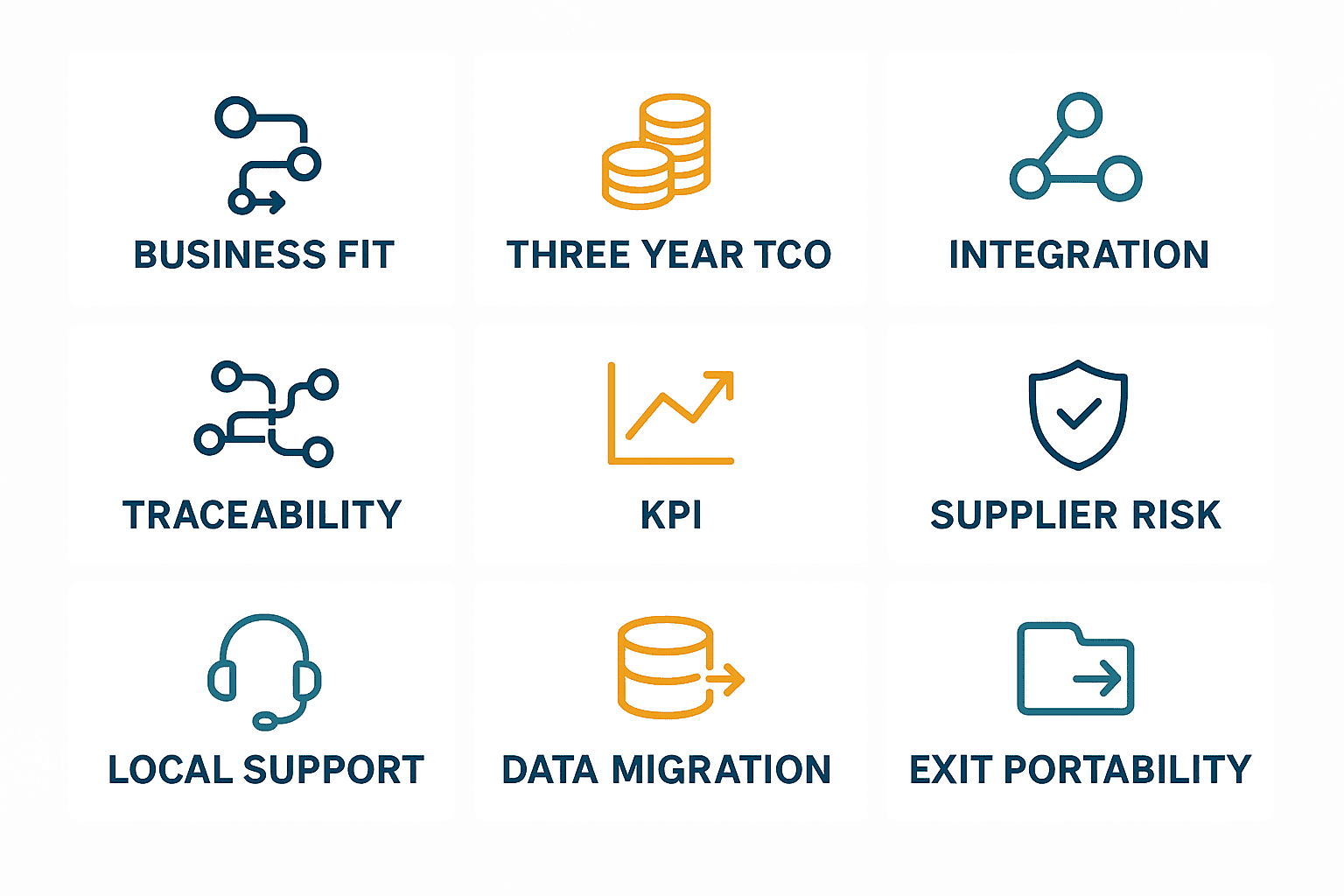
Define the dimensions and required evidence before placing product names in columns. The following nine dimensions are frequently relevant to factories in Thailand. Their weights should change with industry, scale and customer obligations.
| Dimension | What to compare | Evidence to request |
|---|---|---|
| Business fit | Can critical scenarios be completed mainly with standard functions? | Scenario demo using buyer data |
| Three-year TCO | Implementation, subscription, integration, migration, support and internal effort | Assumption-based cost breakdown and change rates |
| ERP, machine and document integration | Transport, retries, monitoring and recovery | API specifications, interface list, failure demonstration |
| Lot and traceability | Split, merge, rework, substitution and reverse lookup | Forward and backward trace of a representative lot |
| KPI | Definition, formula, time grain and closing behavior | KPI dictionary and reconciliation to source data |
| Security and supplier risk | Access, logs, vulnerability response and subcontractors | Security response, contract clauses and assurance evidence |
| Local support | Thai language, coverage hours, site visits and triage | Proposed SLA, team map and escalation exercise |
| Data migration | Cleansing, reconciliation, history and rerun | Trial-migration results and reconciliation report |
| Exit portability | Export, documentation and end-of-contract assistance | Export sample, data dictionary and exit clause |
1. Measure business fit through scenarios, not feature counts
On a checklist, nearly every supplier can mark “supported.” The useful question is whether daily and exception flows work end to end. Build scenarios around order changes, shortages, machine downtime, schedule replacement, partial completion, defects, rework, substitute material, lot splitting, lot merging and night-shift failures. Choose events that are frequent or costly in your own factory.
Ask suppliers to configure a small set of your items, bills of material, routings, shifts, units and lot rules. Observe how many steps each role performs, how exceptions are documented and whether approvals remain auditable. Record “possible with customization” separately from standard capability, together with cost, lead time and upgrade consequences.
2. Compare production management system costs on a three-year TCO basis
An implementation quote alone hides subscriptions, extra environments, backups, interface monitoring, upgrades, support and internal effort. A single oversized contingency also hides differences. Normalize the same three-year period, users, sites and currency date across all candidates.
Our separate guide to production management system costs in Thailand provides more detail. At minimum, separate licensing or subscription, configuration, extensions, migration, interfaces, infrastructure, training, testing, go-live support, maintenance, internal labor and contingency. State taxes, travel, after-hours support, exchange assumptions and renewal-price rules.
3. Test ERP, equipment and document integration through recovery
“We have an API” says little about operational quality. For an ERP order interface, ask about timing, deltas, keys, cancellation, change handling, duplicate prevention, timeout, retry, reconciliation, monitoring, manual recovery and ownership. For machines, look beyond reading a PLC value. Test local buffering during an outage, clock synchronization, abnormal values, tag changes and the effort needed to add equipment.
Document output in Thailand raises practical questions about Thai, English and Japanese characters, date formats, units, decimals, barcodes and label reprint authority. For more detail on capture methods, see production actual-data collection systems for Thai factories.
4. Evaluate lot traceability with messy flows
Most systems can demonstrate a clean receipt-to-finished-lot relationship. Differences emerge with split material, mixed work in process, rework, retest, consumables, packaging, substitutions, scrap and release from hold. Test both forward and backward trace with quantity reconciliation and time.
Where event data must be exchanged among companies, GS1 EPCIS is an interoperability option. It models the what, when, where, why and how of visibility events. EPCIS 2.0 includes support for sensor data, certification details, JSON/JSON-LD and REST APIs. It is not mandatory for every factory; first establish whether customers, suppliers or logistics partners need standardized exchange.
5. Normalize KPI definitions, formulas and time behavior
Two products can both claim OEE or productivity dashboards while treating planned time, downtime, good units, rework and setup differently. ISO 22400-1 provides an industry-neutral KPI framework for manufacturing operations management across batch, continuous and discrete industries. ISO states that the 2014 edition was reviewed and confirmed in 2025. ISO 22400-2 describes selected KPIs through formulas and elements, time behavior and units or dimensions. Its ISO page also indicates an upcoming replacement, so procurement teams should check the current edition at contract time.
The RFP should request the KPI name, purpose, formula, source, missing-data rule, time grain, post-close correction and owner—not merely a yes/no response. During the PoC, calculate the metric from a common source dataset and require an explanation of every difference from the current report.
6. Integrate cybersecurity and technology-supplier risk
A production system contains product, process and possibly cost-sensitive data while connecting to ERP and equipment. Compare more than initial passwords. Include access changes, administrative logs, vulnerability notification, backup restoration, incident communication, subprocessors and product end-of-support.
NIST SP 1305 explains how the CSF 2.0 GV.SC category can support a cybersecurity supply-chain risk management capability and the definition and communication of supplier requirements. Adapt this idea to the RFP by asking about development, hosting, dependencies, vulnerability handling, contracting and exit. NIST CSF 2.0 is a risk-based outcome framework intended for organizations regardless of size, sector or maturity; it does not prescribe a particular technology. Ask for evidence against your risks rather than a vendor’s unsupported claim of “compliance.”
7. Judge local support by recovery ability, not language alone
A Thai-language contact helps, but the team must also triage applications, networks, terminals and interfaces during factory hours. Confirm on-site terms, escalation to product engineering and the final accountable party when headquarters, the Thai office, a regional partner and a software manufacturer are all involved.
Run a tabletop exercise during selection: “The ERP order feed stops on night shift. Should production continue?” Ask the supplier to explain intake, diagnosis, temporary operation, recovery, replay, reconciliation and reporting.
8. Treat data migration as an early workstream
Migration may include items, BOMs, routings, equipment, partners, inventory, WIP, open orders, lots, quality status, users, permissions and selected history. Not everything must move. Decide the retention needed for law, customers, analytics and shop-floor lookup, and compare the option of keeping the legacy system read-only.
Request methods for extraction, transformation, cleansing, load, reconciliation, exception handling and rerun. Plan at least a trial migration and a delta method instead of betting on one final load. Review units, field lengths, codes, revisions, duplicates and character encoding—not only row counts.
9. Contract for exit portability before implementation
Long-term use is the plan, but a business reorganization, product retirement, price change or service decline may force replacement. Confirm export of master, transaction, production, audit and attachment data in practical formats, together with data dictionaries, interface documentation, fees, timing, deletion evidence and transition help.
Exit portability does not mean replacement will be effortless. It means the buyer is not locked out of its own information and can plan the next migration. Heavy bespoke extensions make source, specifications, tests and knowledge-transfer terms more important.
Build a production management system comparison matrix that preserves evidence
Avoid a simple yes/maybe/no grid. Connect requirement, priority, response, evidence, limitation, cost and owner. Standardize response codes so every supplier uses the same meaning.
| Code | Meaning | Evaluation treatment |
|---|---|---|
| S | Supported by the current standard product | Verify configuration and demo evidence |
| C | Supported through configuration or a minor extension | Confirm scope, price and upgrade impact |
| D | Requires custom development | Confirm specification, estimate, maintenance and regression testing |
| P | Provided by a partner product | Confirm contracts, incident ownership and data flow |
| N | Not supported | Assess workaround and operational impact |
| F | Future roadmap | Score as unavailable today unless contractually guaranteed |
An S is not automatically a high score if the standard workflow conflicts with your controls. A D can be acceptable for a genuinely differentiating process when ownership and maintenance are clear. Consistency of meaning matters more than the letter.
Example evaluation weights
The following is an editorial example, not a market standard or a fixed TOMAS TECH method. Management, production, quality, IT and finance should agree their own weights.
| Dimension | Example weight | Example of a five-point result |
|---|---|---|
| Business fit | 22% | Critical scenarios completed mainly as standard, with evidence |
| Three-year TCO | 15% | Assumptions, change rates and renewal terms are transparent |
| Integration | 15% | Failure, retry and monitoring are demonstrated |
| Lot and traceability | 12% | Forward and backward traces work with exceptions |
| KPI | 8% | Definitions reconcile to source data |
| Security and supplier risk | 10% | Requirements, evidence, contract and monitoring are concrete |
| Local support | 8% | Recovery coverage matches factory hours |
| Data migration | 5% | Trial and reconciliation methods are credible |
| Exit portability | 5% | Complete export and end support are confirmed |
With a zero-to-five scale, weighted points can be calculated as score divided by five times weight. Do not let the total make the decision automatically. A material compliance gap, unmet customer mandate, untestable restoration or prohibited data export can be a pass/fail gate. Large differences among evaluators also deserve discussion; do not hide disagreement inside an average.
What a production management system RFP should contain
An RFP is not an enormous feature dictionary. It lets candidates design, price and disclose risk under common assumptions. Combine it with a realistic implementation model such as that discussed in packaged software implementation support in Thailand.
- Company, factory, products and production methods
- Current problems and measured baseline
- Scope, exclusions and future scope
- Prioritized business scenarios
- Data, master, lot and document requirements
- ERP, machine and external-system interfaces
- KPI and report definitions
- Non-functional and cybersecurity requirements
- Migration, training, testing, cutover and stabilization
- Support hours, SLA and responsibility matrix
- Price-response format and three-year TCO
- Contract, intellectual property, data and exit terms
- Schedule, questions and evaluation process
Replace “Can you?” with “Show us”
Instead of asking whether lot traceability is supported, ask the supplier to split a material lot into two WIP lots, rework one, merge it into another finished lot, then trace finished product to raw material and raw material to shipment while showing quantity differences and the audit trail.
For interfaces, demonstrate duplicate prevention when ERP resends an order, message ordering after network recovery, and quarantine/reprocessing for master mismatch. For security, request a sample role matrix, administrator audit log, restoration record and vulnerability-notification workflow. RFP evidence is more useful than marketing language.
Three-year TCO example for production management system costs
This is a fictional teaching example—not a real project price, TOMAS TECH rate card or market average. Currency is THB and the period is assumed to be three years.
| Cost layer | Assumed amount | Example inclusions |
|---|---|---|
| Initial implementation | 3,200,000 | Configuration, interfaces, migration, training, test, go-live |
| Three-year recurring cost | 1,080,000 | Subscription, maintenance, infrastructure, monitoring |
| Internal effort | 720,000 | Process definition, data preparation, test and training |
| Contingency | 500,000 | Explicit allowance for identified uncertainty |
| Three-year TCO | 5,500,000 | Total of the above |
Use identical rows for each candidate. A missing item should be marked “additional” or “not quoted,” not zero. A quote with many unpriced lines is uncertain, not necessarily cheap. For fees driven by user count, transactions, machine count, retention or API calls, price both a baseline and growth case.
Split benefits into revenue, inventory, downtime, defects, re-entry, tracing and close activities, but avoid double counting. Reduced downtime and increased output can represent the same benefit. Assign an owner, data source, start month and realization probability, then compare optimistic, base and conservative cases.
Do not pre-book BOI incentives as a discount
Thailand BOI’s Smart and Sustainable Industry page states a minimum efficiency-improvement investment of THB 1 million excluding land and working capital. It describes import-duty exemption on qualifying machinery/equipment and a three-year corporate income tax exemption capped at 50% of qualifying investment, or 100% under the stated condition involving at least 30% linkage/support for Thailand’s automation machinery industry.
A production management system is not automatically eligible. Confirm the promoted activity, timing, expenditure scope and treatment of software, machinery and services for each project with BOI or an appropriate adviser. Until confirmed, show the incentive as a separate eligible-case scenario rather than subtracting it from base TCO.
Use a PoC to test failure conditions, not to repeat a product presentation
A PoC should reduce the uncertainties that can change the decision, not implement every feature on a small scale. One representative line, two product families, two shifts and four to six weeks can be a planning example, but it is not a universal rule.
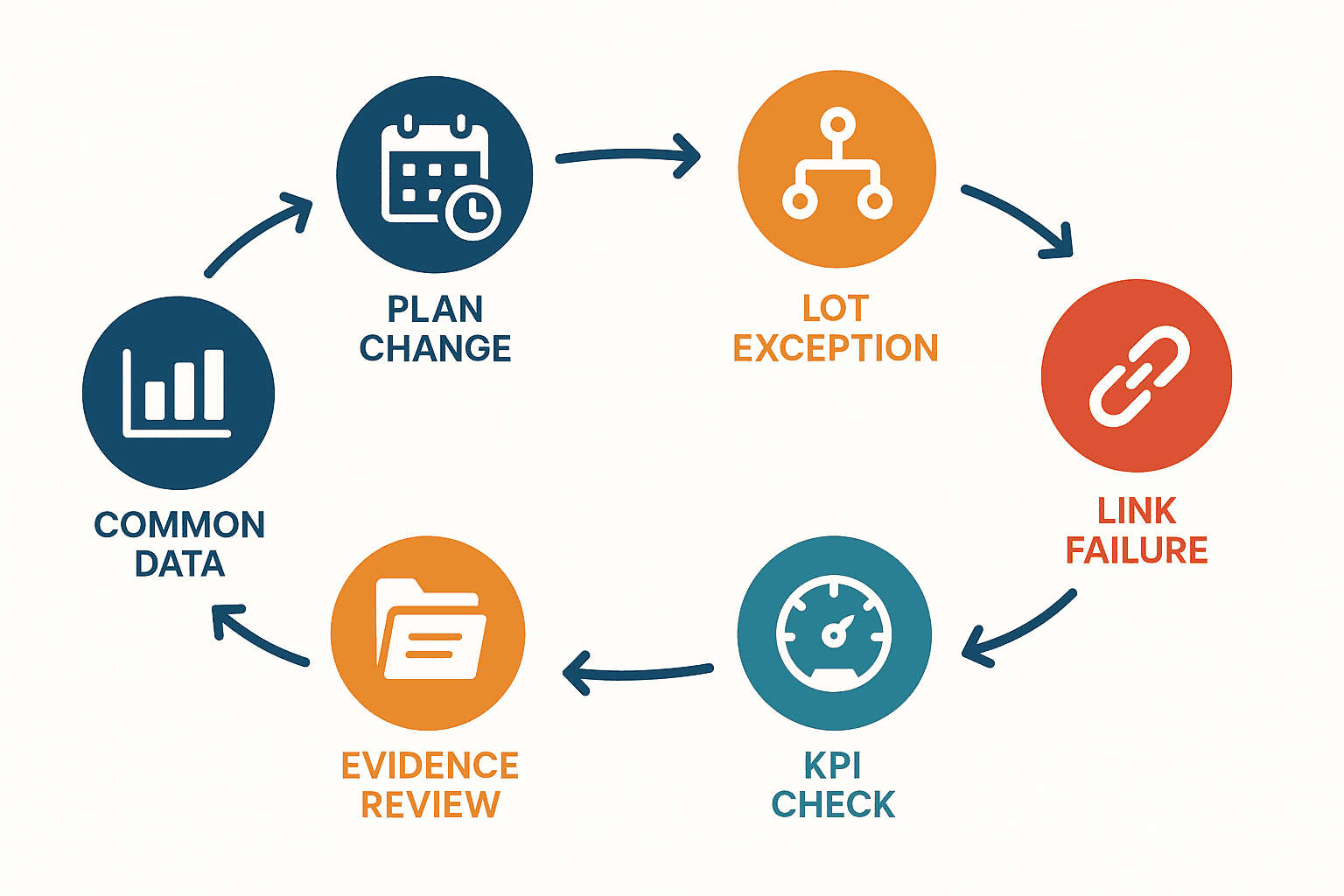
Agree on hypothesis, input, owner, duration, success and failure conditions, deliverables and production reuse. All candidates need the same scenarios and dataset.
| PoC theme | Activity | Evidence for decision |
|---|---|---|
| Schedule change | Introduce shortage and downtime, then replan | Time, constraint display and approval history |
| Actual capture | Collect results from terminal and machine | Missing, duplicate, delay and manual-edit logs |
| Trace | Process split, rework and merge | Forward/backward trace, quantity and search time |
| Interface failure | Stop and restore ERP/API | Buffering, replay, duplicate prevention and reconciliation |
| KPI | Calculate from common source data | Definition match, difference explanation and recalculation |
| Access | Change role and attempt prohibited operation | Denial, approval and administrator log |
A successful PoC does not guarantee production scale, all-site rollout or long-term support. A failure can reveal a weak requirement or poor buyer data as well as a product constraint. Record which cause applies.
Design acceptance tests before the contract is signed
Acceptance testing is not an end-of-project tour of screens. It converts important RFP scenarios into contractual completion evidence. Each requirement needs a test ID, precondition, input, steps, expected result, evidence, owner and severity.
Divide testing into four layers
- Functional: orders, results, stock, quality and lots behave as required.
- Integration: ERP, equipment, reports, identity and external services work together.
- Business acceptance: real roles and shifts can resolve exceptions.
- Operational acceptance: monitoring, backup, restoration, support and workaround function.
Performance and recovery thresholds should come from the factory’s operating conditions. Define concurrency, volume, network, time window and measurement point. If go-live proceeds with open issues, document the list, workaround, due date, owner and any payment retention.
Make reconciliation central to acceptance
A good-looking screen cannot compensate for mismatched ERP balances, WIP, lots or KPIs. Reconcile pre/post migration counts, quantities, values and status breakdowns. For an interface, sent, received, rejected, held, retried and duplicated totals must explain one another.
Roadmap from comparison to stabilized operation
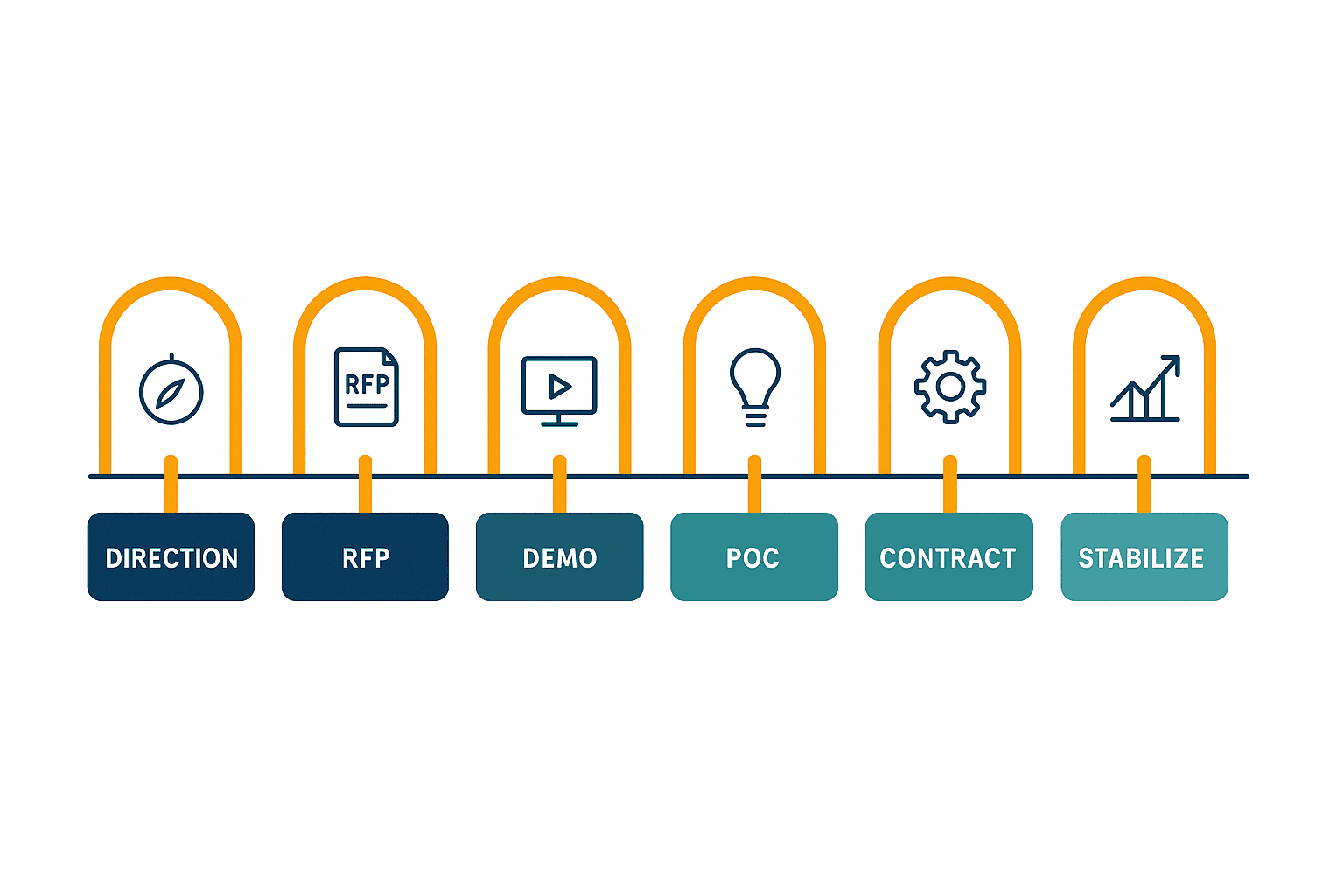
Treat selection and implementation as one gated process.
| Gate | Main deliverables | Condition to proceed |
|---|---|---|
| 0. Direction | Scope, issue, baseline and governance | Management and operations agree on purpose |
| 1. RFP | Requirements, scenarios, price form and scoring | Candidates can answer common assumptions |
| 2. Demo/evaluation | Evidence, scores, risks and Q&A | Shortlist passes mandatory gates |
| 3. PoC | Hypothesis, results, differences and decision | Material uncertainty falls to an acceptable level |
| 4. Contract | Scope, ownership, acceptance, SLA and exit | Open points are controlled |
| 5. Implementation | Design, configuration, migration, training and tests | Acceptance and cutover conditions pass |
| 6. Stabilization | Incidents, KPIs, backlog and handover | Normal operations can own the system |
Include production, planning, quality, logistics, maintenance, IT, finance and an executive sponsor. Not everyone attends every meeting, but requirement owners and acceptance owners must be named. A vendor cannot discover every informal exception or departmental responsibility alone.
Common comparison mistakes and countermeasures
Treating a public ranking as your factory’s ranking
Rankings can help build a longlist but cannot substitute for your workflow, Thai support, ERP, migration and contract. Make the final order from your scenarios and evidence.
Marking every requirement mandatory
Too many mandatory items recreate the legacy system and force customization. Classify Must, Should, Could and Out, and state the impact behind each Must.
Letting evaluators see a demo without a scorecard
Free-form impressions are influenced by speaking style, color and recency. Circulate scenario and scoring rules first, collect independent scores, then discuss differences.
Confusing the lowest quote with the lowest TCO
Integration, migration, environments, support and internal effort may be excluded. Normalize assumptions and expose unpriced lines.
Treating go-live as the finish line
Data differences, user questions and exceptions peak after cutover. Define stabilization, daily review, incident priority and exit criteria through handover to normal support.
Conclusion: make the comparison matrix a decision record
A strong production management system comparison is not about seeing the most products. Define critical scenarios, gather evidence across nine dimensions, and connect three-year TCO, RFP, PoC and acceptance testing. Separate standard, configuration, development, partner and roadmap claims, and keep severe risks as gates outside the weighted score. The result can be explained to management, operations, IT and audit while reducing ambiguous cost and ownership during implementation.
You can seek input before a shortlist exists. If you want to turn current operations and interfaces into a common comparison matrix or a practical RFP for a factory in Thailand, contact TOMAS TECH for a scoped discussion.
FAQ
What should be checked first when choosing a production management system?
Define sites, processes, outcomes, baseline, exclusions, interfaces and success conditions before reviewing products. Then create common daily and exception scenarios for evidence-based demos.
How should production management system costs be compared?
Use the same-period TCO, including license, configuration, development, integration, migration, infrastructure, training, testing, go-live, support, internal effort and contingency. Never treat “additional” or “not quoted” as zero.
What belongs in a production management system RFP?
Include the factory context, measured problem, scope, prioritized scenarios, data and lot rules, interfaces, KPIs, non-functional and security needs, migration, training, tests, SLA, pricing format, contract and exit terms. Request evidence, not a yes/no answer.
What is the difference between a demo and a PoC?
A demo compares capability under common scripted scenarios. A PoC tests decision-critical uncertainty using conditions and data close to the buyer’s environment. Agree success conditions and what can be reused in production beforehand.
Should a Thai factory choose cloud or on-premises?
There is no universal answer. Compare operations during network failure, machine integration, data location, updates, backup, restoration, multisite rollout and internal operating capability. Include hybrid and test post-outage reconciliation.
What should be checked for local vendor support?
Check language, coverage, initial response, on-site terms, scope, product-engineering escalation, incident reports and SLA. Use a concrete night-shift incident exercise to expose recovery capability.
Can BOI incentives be deducted from production management system costs?
Not before eligibility is confirmed. The Smart and Sustainable Industry measure has investment, scope and procedural conditions. Ask BOI or an appropriate adviser for a project-specific view and show it as a separate scenario in TCO.
What should be contracted for a future system exit?
Specify export of master, transaction, production, audit and attachment data, practical formats, dictionaries, interface documents, fees, timing, deletion evidence and transition support.
References
- Thailand BOI, Smart and Sustainable Industry: https://www.boi.go.th/th/smart_sustainable
- Thailand BOI, investment applications press release (1H 2026): https://www.boi.go.th/index.php?_module=news&from_page=press_releases2&language=en&page=press_releases_detail&topic_id=139075
- NIST SP 1305, Cybersecurity Supply Chain Risk Management: https://csrc.nist.gov/pubs/sp/1305/final
- GS1 EPCIS: https://www.gs1.org/standards/epcis
- ISO 22400-1: https://www.iso.org/cms/%20render/live/en/sites/isoorg/contents/data/standard/05/68/56847.html
- ISO 22400-2: https://www.iso.org/standard/54497.html
- NIST Cybersecurity Framework 2.0: https://csrc.nist.gov/pubs/cswp/29/the-nist-cybersecurity-framework-csf-20/final
Note: schemes, standards and product specifications change. Confirm BOI eligibility, the current ISO edition and contractual, tax or legal treatment from primary sources and qualified advisers at decision time. All weights, costs and PoC durations in this article are teaching assumptions, not statistics or price lists.


