


Across Thailand, Japanese manufacturers are refreshing their production management and back-office systems all at once. The moment that decision is made, the same question surfaces in every plant. Who should actually build it? Teams that start looking for a Japanese IT vendor in Thailand are usually not shopping on price alone. They have already sensed that something else decides whether the project lands. This article lays out what published data says about Thailand’s IT investment climate right now, then walks through the criteria that matter during vendor selection, in the order they come up in real projects.
Why Japanese manufacturers in Thailand are investing in systems right now
It helps to start with the numbers. A vendor decision argued on gut feeling will stall the moment it reaches an internal approval round or a briefing with head office in Japan.
According to JETRO’s survey of Japanese corporate presence in Thailand for fiscal 2024, published in February 2025, there are 6,083 Japanese companies based in the country. That is the largest single concentration anywhere in ASEAN. Decades of accumulation cut both ways: it also means that equipment and systems commissioned twenty or thirty years ago are all reaching their replacement window at the same time.
The investment momentum has not faded either. In 2025, Japan ranked first among sources of inbound foreign direct investment into Thailand, accounting for roughly 20% of the total, concentrated in automotive and electronics. On top of that, Japanese companies filed 1,380 BOI investment promotion applications worth THB 396 billion cumulatively from 2021 through the first half of 2026. Commentary about Japanese firms pulling out of Thailand is easy to find, but on a planned-investment basis the money is still flowing in, and that fact makes system investment decisions easier to defend internally. One caveat is worth keeping in mind. BOI figures represent applications for investment promotion, not capital that has already been deployed.
Equipment renewal and digital transformation have arrived together
Look at what companies actually plan to spend on and the priorities become clear. In a survey of 504 Japanese companies operating in Thailand, 59% said they were planning to replace existing equipment, 31% were planning improvements to production efficiency, and 22% were planning DX investment.
The order of those three figures carries a practical message. Equipment renewal is by far the largest category, and companies budgeting for digital transformation as a standalone line item are still a minority. In other words, real projects launch as hybrid initiatives. “Since we are replacing this ageing machine anyway, let us make sure it can produce data.” “While we are rebalancing the line, let us digitise how production results get collected.” These are not pure IT projects. They pull in facilities, manufacturing, quality, and finance at the same time.
That structure changes what a vendor has to be good at. Coding ability is not the whole requirement. Can they pick up signals from the equipment side? Can their software talk to the existing core system? Do they understand how head office in Japan handles accounting and cost allocation? The presence or absence of that surrounding knowledge is usually what decides whether the project succeeds.

Investment into the digital sector itself is accelerating
More recently, investment aimed at the digital industry has climbed sharply. In the first quarter of 2026, the value of investment applications for the digital sector reached 2.4x the same quarter a year earlier, driven by data centre and cloud-related projects.
For Japanese manufacturers this cuts two ways. First, running cloud infrastructure inside Thailand has become a far more realistic option than it used to be. Second, the market for IT talent is going to get even tighter. Strong engineers get absorbed by data centre operators and cloud providers, which makes the pool available for contract development work aimed at factories relatively scarce. From the buyer’s side, the safe assumption is simple: “the good vendors will be fully booked by next year.”
The role of the Thai site itself has changed
There is one more shift worth understanding before making an investment decision. For a long time, a Thai site was primarily a production base that built designs created in Japan, cheaply and at volume. As labour costs have risen and the simple cost advantage over neighbouring countries has narrowed, what companies expect from the site has changed.
What most Japanese manufacturers now want from their Thai operation is not just volume output. They want a supply hub serving the wider ASEAN region, and the capability to handle design changes locally. The continued flow of Japanese investment into automotive and electronics is arguably driven less by low cost than by the parts supply network and the engineering workforce that have built up here over decades.
That change in role changes the systems the site needs. If the job is producing a fixed set of part numbers by a fixed procedure, paper forms and Excel will carry you. Once the product mix widens, specifications diverge by destination market, and customers start demanding traceability, a system that captures data becomes the baseline. The wave of equipment renewal and the pressure to digitise are arriving together precisely because of this structural shift. Put the other way round, a system installed today cannot simply be a mirror image of today’s production. It has to survive what production looks like several years from now. Whether a vendor thinks this way tends to show up in how they write the assumptions section of their proposal.
System projects in Thailand fail on translation, not on technical skill
Stories about a Thai IT vendor project going badly are not hard to find. But concluding that Thai engineers lack technical skill is almost always a misdiagnosis. Break down what actually went wrong and most of it traces back to misalignment during requirements definition and specification understanding.
What the Japanese side treats as obvious never reaches the specification
Japanese manufacturing runs on an enormous body of unwritten assumptions. When the monthly books close. How physical item tags are handled. What happens to defective units. How rework inside a process gets counted. The format of the form a line leader reads out at the morning meeting. A Japanese vendor serving the same industry would understand all of it without being told, so none of it gets written down.
With a local vendor, none of those assumptions are shared. Since they are not written down, the vendor fills the gaps with its own common sense. The Japanese side looks at the result and says “that is not what we meant,” and the project absorbs extra cost and schedule slip. That is the classic failure pattern. No bad faith, no negligence, just a different set of assumptions, and a schedule that can slide a long way to the right.
Adding a translator does not remove the language barrier
The language problem has exactly the same shape. On a site where Japanese, English, and Thai all appear, it is tempting to assume that assigning one interpreter solves it. In practice it does not. Production management specifications are dense with domain vocabulary. Work in process, yield, changeover, first in first out. Unless someone can carry both the word and the business meaning behind it, they are not a bridge.
One published analysis of offshore development failures makes the same point. Having a staff member who speaks Japanese is not enough. What separates success from failure is whether someone with both Japanese language ability and IT skill is present during requirements definition. The need is not for a translator but for an interpreter who understands both the operation and the technology.
Built exactly as specified becomes a valid defence
There is a second, more awkward problem. Nobody flags the issue. From a contractor’s point of view, building what the client specified is the contract being performed. Even if the specification contains a contradiction, even if the design would never work in practice, there is no absolute obligation to point that out. And when business customs differ, the specification tends to get the benefit of the doubt. “It looked strange, but that must be how they do it in Japan.”
This is exactly where Japanese buyers hold an unspoken expectation. “If it looks wrong, surely they will tell us.” “Surely they will read between the lines.” When that expectation goes into a contract unwritten, the gap only becomes visible at acceptance testing. The real question during vendor selection is not a list of the technologies they work with. It is whether a mechanism for filling in those unwritten lines is built into how they work.
Three failure patterns you will actually see
To make this concrete, here are three ways projects commonly stumble. None of them involve technically difficult work. They all happen in the everyday details of the operation.
The first is degradation through two-stage translation, where Japanese requirements are rendered into English and then implemented in Thai. A phrase meaning “register production results” is rendered in English as a word for a data entry action, then shifts again in Thai toward the sense of simply saving a record, and the resulting screen has no approval step at all. Nobody made an error at any single step, yet only the final deliverable misses the requirement.
The second is missing exception handling. On a Japanese production floor, how you handle departures from standard work is the whole point of building a system. Receiving a quantity that does not match, a skipped process step, reintroducing a unit after rework. These exceptions are so obvious to the Japanese owner that they never make it into the specification, and to the vendor they are territory they cannot even imagine exists. The result is a system where only the happy path works.
The third is the language barrier after go-live. There was a Japanese-speaking contact during development, and then the project enters maintenance and support suddenly runs in English only. Thai team leaders on the floor cannot raise questions in English, the Japanese expatriate staff are too busy to keep up, and everyone quietly reverts to a parallel Excel file. When a freshly installed system stops being used, this operational disconnect is often the reason.
None of these can be caught by quality control during the development phase. They are structural questions. Is someone who understands both the operation and the languages present during requirements definition, and does the same language environment survive into the maintenance phase?
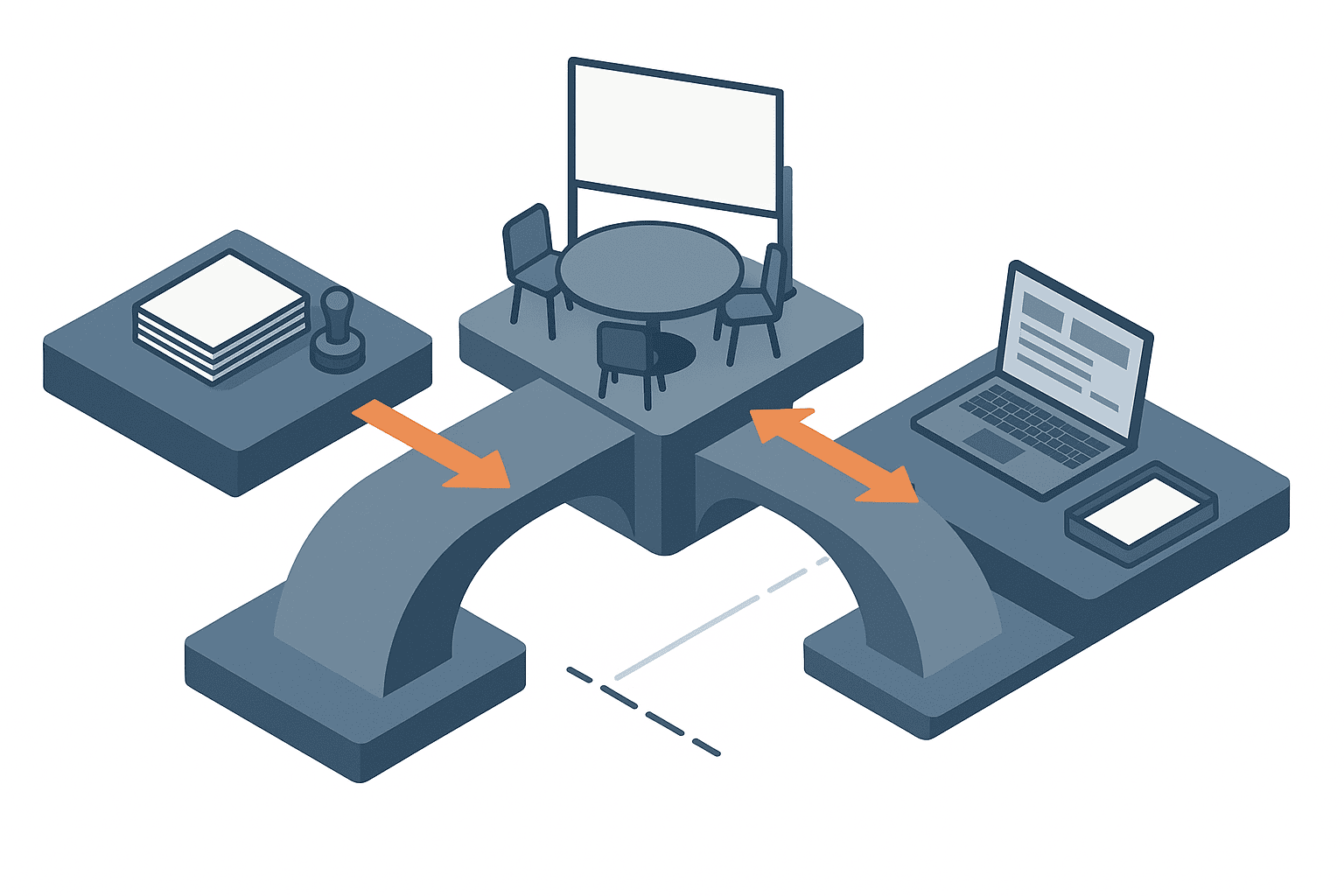
A level-headed comparison of Japanese IT vendors and Thai local vendors
Read this far and it might look like a Japanese vendor is the only rational choice, but the picture is not that simple. Local vendors are genuinely price competitive, and for a system used entirely by Thai staff they can be the better fit. The useful question is not which type is superior. It is which arena your particular project belongs in.
| Comparison point | Japan-affiliated IT vendor | Thai local vendor |
|---|---|---|
| Language of requirements definition | Japanese, directly | English or Thai as standard |
| Understanding of Japanese business practice | Shared as a baseline | Explained case by case |
| Unit rates | Relatively high | Relatively low |
| Reporting material for head office | Easy to produce in Japanese | Separate translation effort |
| Maintenance contact point | Enquiries possible in Japanese | Runs in English or Thai |
| Support for local Thai staff | Varies by vendor | Core strength |
The point worth noticing here is that on unit rates alone, local vendors clearly win. Compare on total cost and the view changes. Rework caused by misunderstood requirements, translating documents into Japanese, preparing material to brief head office, and handling enquiries after go-live. None of that appears on a quotation, but all of it lands on your own payroll.
Compare total cost, not the quoted figure
Comparing on total cost does not require complicated maths. Take the quoted figure and add the effort your own organisation will spend.
Suppose a Japanese expatriate manager attends requirements workshops for half a day every week over four months. That alone consumes close to nine person-days from your side. The same applies to translating specifications back into Japanese, building the monthly report for head office, and preparing test data. On top of that, when a misalignment surfaces, the rework does not only come back as a change order from the vendor. It also costs you another round of interviews on the floor.
The factor that dominates all of this is that an expatriate manager’s time is your scarcest resource. If the plant manager or the IT lead has to stop doing their real job to act as project interpreter for months, the opportunity cost easily exceeds the difference in development fees. When comparing vendors, write out for each candidate who in your organisation will spend how many hours if you award the work to them. Differences that a rate card never revealed will show up as numbers.
The reverse case is equally valid. If you already have IT people in-house who work comfortably in both Japanese and Thai, and they can be dedicated to requirements definition, choosing a local vendor is entirely reasonable. The dividing line is a design decision. Do you hold the bridging role inside your own company, or do you buy it from the vendor?
Calling yourself Japan-affiliated proves nothing on its own
One further caution. Vendors that describe themselves as Japan-affiliated vary enormously in substance. Some display a Japanese corporate name while the actual development is left entirely to a local team, with a single salesperson as the only Japanese-speaking contact. Others are Thai-owned but keep Japanese engineers permanently involved in requirements definition.
What matters is not the shareholding structure. It is whether someone who can run requirements definition in Japanese actually sits inside the team doing the work. That lens is also useful if you want to run the whole comparison more systematically. For the design of the selection process as a whole, see Software Development Company Thailand: 2026 Selection Guide.
Seven criteria for choosing an IT vendor as a Japanese company in Thailand
With that groundwork in place, here are the items to verify during actual selection. They are written at a level of detail you can drop straight into an RFP evaluation sheet.
1. Measure the depth of Japanese language capability
A single line saying “Japanese language support available” tells you nothing. What you need to know is where in the organisation the Japanese speakers sit. Sales only? Project managers too? The engineers who run requirements definition? Those three levels are worlds apart in practice.
The fastest check is to ask that the requirements lead attend the first meeting, then throw domain vocabulary at them in Japanese. Say “we also want changeover time counted” and watch what happens. A question coming back tells you one thing. A vague nod tells you another.
2. Do they understand local business practice and regulation?
Running a system in Thailand means dealing with country-specific rules whether you like it or not. A plant under BOI privileges has raw material management obligations. There is electronic tax invoicing to support, and personal data protection law to respect. This is exactly where a Japanese package dropped in unchanged fails to run.
The reliable way to check is to name the privileges you hold and the regimes that apply to you, then ask for a track record of handling them. A vendor whose answers become concrete the moment you name a regime and a vendor who says they will look into it and come back will move at completely different speeds from that point on. Regulations get revised, so it is also worth confirming that they are keeping up with current practice.
3. Does the setup reach both expatriates and local staff?
Japanese expatriates are not the only people who use the system. The people touching the screens every day are Thai operators, and if they cannot work the system, the investment never pays back. A Japanese-only manual, or training delivered in English only, does not stick on the floor.
What to verify is Thai language support in the interface, operator training delivered in Thai, and whether post-go-live enquiries can be handled in Thai. Japanese capability and Thai capability are not alternatives. You need both.
4. Can one partner cover requirements definition through maintenance?
Splitting the work across vendors by phase carries unusually high risk in Thailand. A structure where a Japanese consultancy writes the requirements, a local vendor builds it, and a third company handles maintenance leaves accountability undefined the moment something breaks. With distance and language layered on top, the coordination cost rises far above what the same structure would cost in Japan.
If one company covers requirements definition through maintenance, you at least stop wasting time working out who to call. On how to draw the boundaries of an outsourced scope and what to pin down contractually, System Development Outsourcing: Thailand Factory RFP Guide covers the contract side in detail.

5. Do they have industry knowledge and comparable delivery experience?
Production management systems differ enormously in design from one industry to another. A site making automotive parts, with long process chains and strict lot traceability requirements, needs a fundamentally different data model from a food plant where shelf-life management is the central concern.
When asking about past work, do not settle for a client count or a contract value. Ask them to describe a specific project in your industry and at your scale. Even inside the limits of confidentiality, they should be able to explain what problem they faced and how they solved it. A vendor who cannot is safely assumed to be thin on experience in that area.
6. Will the documents satisfy head office in Japan?
Even for a project owned by the Thai site, approval almost always routes through head office in Japan. If the progress reports and design documents exist only in English, your local staff end up absorbing the translation work themselves. Whether a vendor can produce documentation in Japanese has a large effect on costs that never appear in a quotation.
7. Will they still be a viable partner in a few years?
A system is not finished when it goes live. Whether the vendor can respond to change matters too, whether that means adding sites as volume grows five years from now or shifting production to another country. A vendor whose staff turn over annually, forcing you to explain everything from scratch at each handover, will not sustain your operation. Asking frankly about attrition rates and how long the proposed project manager has been with the company is not rude. It is a reasonable check.
What to sort out before commissioning system development in Bangkok
Even with a good vendor, a project will get messy if the buying side is unprepared. Here are the preparations that have made the biggest difference in factory system implementation in Thailand, in the order they matter.
Write down the current state in Japanese
Start by putting into words, in Japanese, what is actually causing pain today. Write it as an operational problem, not a system problem. It is completely acceptable to work at the level of “it takes three days every month to consolidate the daily reports” or “we trace defect causes by going back through paper records.”
Approach a vendor without that inventory and the conversation jumps straight to a feature list, leaving the problem you originally wanted to solve behind.
Once you have the list, add one line to each item saying who is suffering and what happens if it is left alone. Those two columns alone settle the priority order almost by themselves. Trying to systemise everything at once, watching the budget balloon, failing to clear internal approval, and losing a year is the most common form of stalling on Thai site projects.
Decide your own project structure first
Before you start approaching vendors, settle your internal structure. Specifically, four roles. The decision maker, the business-side contact, the IT-side contact, and a key person from the shop floor.
The business-side contact is the critical one. The requirements for a production management system are owned by the manufacturing department, and the IT team alone cannot answer them. Yet manufacturing managers are often tied to line operations, and if a different person attends each meeting, what was agreed last time gets overturned the following week. Even if it takes some effort, whether you can fix the business-side contact as a single named person determines the pace of the whole project.
Bringing Thai team leaders in early as the shop-floor key person makes everything downstream easier. They are the ones touching the screens daily after go-live, and the people who contributed opinions during requirements definition are the ones who help the system take root afterwards. Decide the specification among Japanese staff only and hand it down to the floor, and you will hear a chorus of complaints about usability as soon as it goes live, along with the modification costs that follow.
Settle the scope of head office involvement in advance too. Approval only, compliance with a standard template, or a say in the system architecture? Leave that vague and head office will push the project back just as requirements firm up, sending months of discussion back to the start.
Your RFP does not need to be perfect
A common pattern is a company trying to write a flawless RFP before contacting anyone, and losing six months to it. In practice, a list of problems, the current process flow, the target sites, a rough budget range, and a desired timeframe are enough to start a useful discussion. Refining the requirements together with the vendor is both faster and more accurate.
Agree how you will read the quotations
When collecting quotations from several companies, lining up the totals side by side is not a comparison. Person-months by phase, the role of each assigned person, how many person-days of Japanese-language support are included. A vendor who cannot produce that breakdown is likely to come back with change orders later.
| Check item | What to look for in the quotation |
|---|---|
| Requirements definition effort | A sufficient ratio against development effort |
| Japanese support person-days | Named people and stated day counts |
| Testing and acceptance support | The buyer’s own scope of work defined |
| Maintenance fee | Annual amount, service hours, and support languages |
Once you can read a quotation breakdown, the quality of the conversation with vendors changes. Instead of haggling over price, you can discuss design, specifically where the effort should be concentrated.
Lock the acceptance criteria before signing
Most acceptance disputes trace back to entering a contract without defining what done means. Test data, expected volumes, response time requirements, and the length of parallel running. Document those before signing and you will see far less trouble immediately before go-live.
Confirm who guarantees Japanese in the org chart
Finally, always check the organisation chart in the proposal. Which person is the Japanese language role attached to, and is that person involved in both requirements definition and maintenance? Sign with that box empty and support turns English-only after go-live, and the floor stops using the system. In system development in Bangkok, the stumble usually surfaces after go-live rather than during development.
Frequently asked questions
How should we choose an IT vendor in Thailand?
Start from who will run requirements definition and in which language, rather than from price. Whether the assumptions behind the operation are shared matters more to the outcome than any gap in technical skill. Specifically, check three things first. Is there someone on the development team who can exchange domain vocabulary in Japanese? Do they have a track record with local regulation and business practice? And can a single company cover requirements definition through maintenance?
What is the difference between a Japanese system development company and a Thai local vendor?
The biggest difference is whether the unspoken assumptions of Japanese manufacturing can be shared without being explained. On unit rates a local vendor has the advantage, but once you add the invisible costs of rework from misalignment, translation effort, and preparing material for head office, the totals can reverse. Conversely, for a small system used only by Thai staff, a local vendor may well be the better fit.
How long does a factory system implementation in Thailand take?
It depends on scale and scope, but for an implementation centred on collecting production results, six months or so from requirements definition to go-live is a common expectation. Once integration with a core system or a rollout across multiple sites is involved, it can exceed a year. On projects running alongside equipment renewal, the construction schedule on the equipment side sets the pace, so it is safer to start the IT discussion as soon as the equipment plan is fixed.
Can we roll out our Japanese head office system in Thailand as is?
Cases where it works unchanged are limited. Accounting and tax requirements, language support, network conditions, and the working practices on the floor are all different. In practice, the workable approach is to take the head office standard as the base and create local deltas on top. Agreeing in advance with head office on how far those deltas are permitted is what prevents disputes in the later half of the project.
What should we prepare for an initial consultation?
A memo written in Japanese listing the current problems, plus any material showing the existing process flow, is enough. System diagrams and detailed requirements are more efficiently settled through discussion with the vendor. Even before the budget is fixed, sharing a sense of the investment scale improves the quality of the proposal you get back.
Summary
Thailand hosts a concentration of 6,083 Japanese companies, and Japan ranked first in inbound direct investment in 2025. In the survey of 504 Japanese companies operating in Thailand, 59% plan equipment renewal and 22% plan DX investment, which points to a wave of system investment that is only now getting properly underway. At the same time, with digital sector investment applications reaching 2.4x the level of the same quarter a year earlier, IT talent able to take on manufacturing projects will only become scarcer.
The way to avoid getting the choice of a Japanese IT vendor in Thailand wrong is to stop comparing technical skill and to look instead for whether someone in the requirements definition room can translate Japanese operational assumptions. Depth of Japanese capability, understanding of local business practice and regulation, support for both expatriates and Thai staff, single-partner coverage from requirements definition to maintenance, industry knowledge, documentation for head office, and continuity over several years. Put those seven into an evaluation sheet and you escape a comparison driven purely by price.
TOMAS TECH is based in Bangkok and develops and implements business systems for Japanese manufacturers, including the PEGASUS production management system. We work in Japanese, English, and Thai across the full span from requirements definition to maintenance, and we have delivered the kind of hybrid projects that run alongside equipment renewal. It is perfectly fine if you are still at the concept stage with no budget approved. We are happy to start by helping you organise the problems you have today, so please Contact us.
References
- JETRO survey of Japanese corporate presence in Thailand, FY2024 – 6,083 Japanese companies in Thailand – jetro.go.jp
- The Nation Thailand – Japan ranked first in Thailand inbound FDI in 2025 at roughly 20% of the total – nationthailand.com
- Pattaya Mail – Survey of 504 Japanese companies in Thailand, 59% equipment renewal, 31% production efficiency, 22% DX investment – pattayamail.com
- TCIJ Thai – Related coverage of the survey of 504 Japanese companies in Thailand – tcijthai.com
- Bangkok Shuho – BOI investment promotion applications by Japanese companies, 1,380 applications worth THB 396 billion cumulatively from 2021 to the first half of 2026 – bangkokshuho.com
- THAIBIZ – Digital sector investment applications in Q1 2026 reached 2.4x the same quarter a year earlier – th-biz.com
- NS Solutions Thailand – Requirements definition and language challenges in system implementation in Thailand – global.nssol.nipponsteel.com
- Timedoor – Avoiding the language barrier in offshore development with Japanese clients – jp.timedoor.net


