



A PLC replacement in a Thai factory is not merely a purchase of a newer CPU. The deliverable is a production system that can resume safely after the legacy program, I/O, communications, safety circuits, HMI, drives and maintenance procedures have all moved to a supportable platform. This guide turns that objective into an RFP, backup package, migration design, FAT/SAT plan, rollback procedure and local maintenance model.
Why PLC replacement is difficult to postpone in 2026
“It is still running” does not prove that a machine is recoverable. A legacy PLC can run normally for years while the real risks remain hidden: the engineering laptop fails, a battery-backed memory is lost, a communication module breaks, the last licensed software installation disappears, or nobody can prove that the stored project matches the running CPU. The relevant question is not only how often the controller fails. It is whether the plant has everything required to restore production after a failure.
As a current example, Mitsubishi Electric’s official discontinued/alternative-model database lists specific Universal model QCPU units, including models such as Q03UDCPU, Q04UDHCPU and Q06UDHCPU, with an order-acceptance deadline of 30 September 2026, production discontinuation on 30 October 2026 and repair support through 31 October 2033. These dates must not be generalized to every MELSEC-Q product. Check the exact CPU, base, power supply, I/O, network and special-function module before procurement.
Siemens states that SIMATIC S7-300 and ET 200M reached type cancellation on 1 October 2025. From that date, the components are in a spare-parts phase and may be supplied as spare parts, repaired or, where necessary, exchanged against a defective item. In 2026, this is no longer a distant phase-out announcement; it is a changed sourcing condition that belongs in the plant risk register.
Thailand BOI’s Private Investment Index and Components reports provisional June 2026 values of 149.6 for the Private Machinery and Equipment Investment Index, THB 177,377.1 million for machinery and equipment imports, and THB 294,931.5 million for domestic machinery and equipment sales. These are single-month June 2026 figures. They do not measure PLC demand or prove a return from retrofit. They do, however, provide context for an investment environment in which old controls increasingly have to interface with new lines, data platforms and plant standards.
Start before the formal end-of-life date when recovery is uncertain
An assessment is justified when one or more of the following conditions applies:
- The archived PLC project cannot be proven identical to the online program.
- Engineering software, licenses, cables or a compatible operating system are no longer controlled.
- There is no verified local spare for the CPU or a critical special module.
- HMI, drive, servo, vision, instrument or MES interfaces are undocumented.
- Safety drawings differ from the physical wiring.
- The OEM is unavailable or will not provide source files.
- Maximum tolerable downtime and the person authorized to restart production are undefined.
This does not force immediate hardware purchase. An asset register, verified backup, difference list and risk ranking are valuable even when the physical cutover is deferred.
Choosing between PLC modification, staged migration and full replacement
A PLC modification may retain the existing hardware and change only logic. A staged migration may replace the CPU while retaining selected I/O or terminal wiring. A full retrofit can renew the panel, I/O, network, safety and related drives. The correct scope depends on production risk, recoverability, drawing quality, peripheral compatibility, available outage windows and the plant’s future modification roadmap.
| Option | Conditions that favor it | Main advantage | Main caution |
|---|---|---|---|
| Logic modification only | Hardware is supported and tools/spares are controlled | Small physical work scope | Obsolescence remains |
| CPU-focused staged update | I/O and terminals can be reused with bounded differences | Lower installation volume | Mixed-generation support becomes complex |
| Remote-I/O transition | Field wiring should remain while control is renewed | Supports phased modernization | Network-failure behavior must be designed |
| Full replacement | Panel, wiring, safety and communications need a common lifecycle | Better standardization and maintainability | Larger FAT, site work and outage coordination |
| Parallel cutover | The outage window is short and rollback is critical | More verification before final switch | Temporary panels and duplicate design are required |
Mitsubishi Electric’s Q-to-iQ-R bulletin provides alternative-model tables and a process for converting GX Works2 projects for GX Works3, but not every module or function is a one-to-one replacement. Siemens’ S7-300/S7-400-to-S7-1500 guide similarly notes that technological functions may require a solution-based combination of hardware and software rather than direct component substitution. A conversion tool finishing without an error is not proof that the machine behaves equivalently or safely.
Additional scope for a machine-tool retrofit
A machine-tool retrofit connects the PLC to a CNC, motion system, spindle, servo, encoder, probing system, hydraulics, lubrication, tool changer and guarding. A mechanically sound machine may still depend on an obsolete function module or fieldbus.
Record, by machine:
- The CNC/PLC responsibility boundary, shared memory and handshake.
- Axis count, control cycle, homing sequence and positioning acceptance method.
- Drive and servo models, parameter sets and tuning values.
- Storage locations for tool data, offsets, recipes and part programs.
- Emergency stop, door, safe torque off and other safety functions.
- Sensor resolution, filtering and sampling that affect quality decisions.
- Restart behavior after a power dip, power loss or communication interruption.
The acceptance objective is not “a new panel.” It is the ability to make conforming product under defined conditions and to reach an equal or safer state when a fault occurs.
Build an as-is asset package before detailed design
Migration quality often depends more on as-is evidence than on the chosen new CPU. Prepare templates before the survey and consolidate the findings into a controlled asset package.
A backup is not verified merely because a file exists
Include at least:
- PLC projects, libraries, user-defined blocks, comments and symbols.
- CPU, I/O, network, PID, motion and safety parameters.
- HMI screens, alarms, recipes, users and communication settings.
- Drive, servo, robot, vision and instrument settings.
- An online upload from the running CPU, with date and source recorded.
- Engineering software product, version, license and supported operating system.
- Panel drawings, I/O lists, terminal schedules, network diagrams and layouts.
- Change history, known defects, temporary modifications and handwritten site notes.
Then test restoration on a separate computer. Confirm that libraries resolve, the project opens, compilation is repeatable and online comparison is possible. A file called “final” is not evidence. Record its hash, origin, owner and collection time, and reconcile it with the running system.
Maintain an I/O, communication and safety difference register

I/O comparison must include electrical behavior, not only point count. Two 24 VDC input modules may differ in source/sink arrangement, common wiring, response, interrupt behavior and terminal pinout. For analog channels, verify signal type, range, resolution, scaling, broken-wire behavior and filtering. For counters and positioning, check latch and home-input behavior as well as maximum frequency.
For every communication path, record the peer, protocol, node/IP, port, cycle, data area, byte order, timeout, reconnection, watchdog and fallback behavior. A value appearing on an HMI is not sufficient acceptance. Test cable loss, peer restart, duplicate messages and clock changes.
Manage safety separately from standard control. Reconcile the physical emergency stops, guards, light curtains, contactors, safety relays or safety PLC and STO circuits with the drawings and approved risk assessment. Qualified personnel must validate the safety functions under applicable Thai requirements and company standards. Never assume that safety logic can simply be recreated in a standard PLC.
| Difference area | As-is evidence | New-design check | FAT/SAT evidence |
|---|---|---|---|
| Digital I/O | Model, terminal, voltage, common | Electrical compatibility and response | Full agreed loop check |
| Analog I/O | Range, scale and filter | Resolution, conversion, broken-wire behavior | Calibration and limit tests |
| Communication | Topology, address and cycle | Protocol and reconnection differences | Disconnect, recovery and load tests |
| Motion | Axis, cycle, home and limits | Instruction, unit and safety differences | Low speed, no load, then real load |
| Safety | Drawings, risk basis and physical circuit | Match to safety requirement specification | Validation of safety functions |
| Higher-level interface | Tags, quality, time and errors | Data type, clock and retry behavior | End-to-end HMI/MES test |
Write an equipment-control retrofit RFP around deliverables
Supplier quotations become incomparable when each bidder assumes a different boundary. A low CPU price does not show whether site survey, source analysis, panel work, night work, interpretation, training, spares and standby support are included. The RFP should define who delivers what evidence, not just which product brand to install.
Recommended RFP structure
- Machines, products, criticality and outage constraints.
- Existing architecture, documents supplied and known unknowns.
- Included and excluded scope, including other-vendor boundaries.
- Functional, performance, safety and quality requirements.
- PLC, I/O, HMI, network and drive design principles.
- Software standard, naming, comment languages and version control.
- Cybersecurity and remote-maintenance conditions.
- FAT, SAT, production ramp-up and acceptance criteria.
- Cutover method, rollback triggers and decision authority.
- Training, source files, licenses, documents and spares at handover.
- Warranty, response model, onsite/remote support and escalation.
- Price breakdown, assumptions, variable charges, taxes, currency and payment.
It is often practical to request a budget estimate before the site survey and a firm offer after survey findings are closed. Forcing unknown conditions into a fixed price either adds contingency or moves the issue into later change orders. An agreed unknowns register makes the bids easier to compare.
Compare cost through a calculation model, not a headline number
One useful illustrative formula is:
Estimated project cost = hardware and panel materials + design hours × rate + software hours × rate + FAT hours × rate + site/SAT hours × rate + travel/logistics + risk allowance − approved reuse credit
This is a quotation structure, not a market price. Ask each bidder to use the same work breakdown and show quantity, unit rate, assumption and exclusion. Link every contingency to a named uncertainty such as unverified I/O, source mismatch, night work or a module without a direct replacement.
Downtime impact can be modeled separately:
Illustrative outage impact = outage hours × approved contribution-margin impact per hour + scrap/reinspection + emergency logistics + recovery labor
All inputs are plant-specific and conditional. Finance and production must approve them. Do not claim a payback from generic article values. The case for parallel cutover should compare its additional engineering cost with outage exposure under the same assumptions.
Migration design: prove equivalence rather than trusting conversion
After project conversion, review instructions, tasks, interrupts, device areas, retentive memory, startup, arithmetic precision, timers, scan behavior and communication buffers. The conversion report is the beginning of the engineering issue list, not the completion record.
Prioritize differences by consequence
- Behavior that can injure people or damage equipment.
- Stop, restart, mode selection and manual operation.
- Interlocks, alarms and fault recovery.
- Motion, PID, synchronization and high-speed I/O.
- Communication, recipes, traceability and higher-level systems.
- Displays, diagnostics, logs and maintainability.
Every difference should carry old behavior, new behavior, reason, verification method and approver. If the old system has a defect, do not copy it silently; process the correction through change control. At the same time, avoid combining an uncontrolled improvement program with an obsolescence replacement. Separating lifecycle renewal from later optimization can make root-cause analysis much easier.
Use simulation and shadow evaluation where practical
A new controller can receive simulated or mirrored input while its outputs remain disconnected, allowing engineers to compare decisions with the legacy PLC. Not every machine can run a true online parallel controller, but I/O simulation, a sequence model, a digital twin or replay of recorded signals can reduce what must be discovered during the outage.
Document the limits. Wiring noise, sensor edges, valve response, inertia, operator behavior and network congestion may not be represented. FAT success therefore never eliminates the need for SAT.
Use FAT and SAT to reduce outage risk
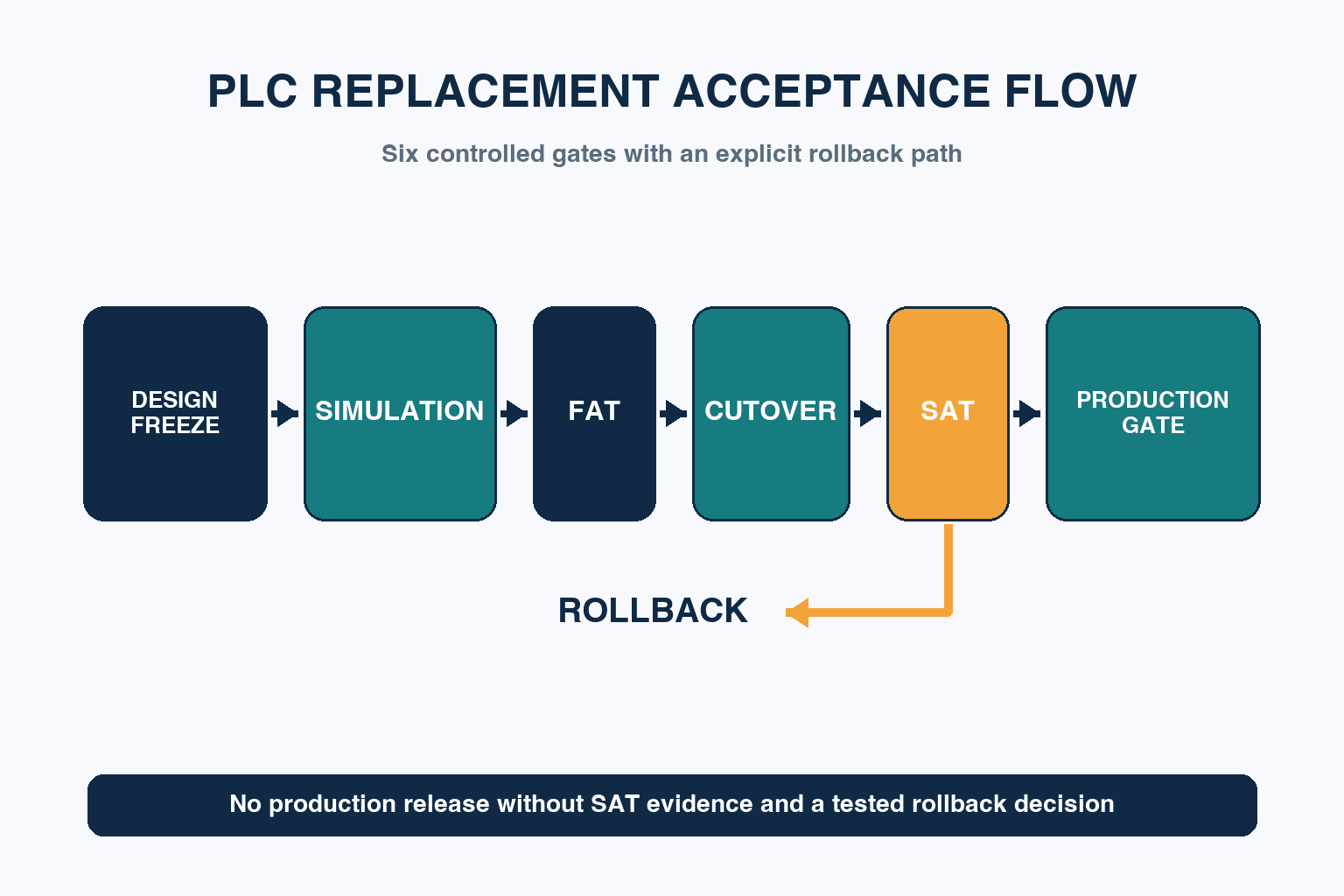
FAT is not a supplier demonstration. It is the acceptance stage that removes defects before site work. SAT is not simply proof that the new PLC powers up. It proves requirements using the actual machine, wiring, product, operators and interfaces.
FAT scope
- Approved hardware and bill-of-material conformity.
- Software version, checksum, warnings and open conversion issues.
- All I/O or the contractually agreed representative set.
- Auto, manual, setup, maintenance and fault-recovery sequences.
- Communication loss, peer shutdown, timeout and reconnection.
- Power loss, CPU restart, retentive data and initialization.
- Alarm number, cause, recovery guidance and history.
- Users, remote access, logging and backup.
- Rehearsal of the SAT and rollback procedures.
Classify open FAT items by severity and approve any site carryover with an owner and deadline. “Check onsite” without these controls is only an unresolved defect.
Stage SAT and production ramp-up through gates
| Gate | Main evidence | Condition to proceed |
|---|---|---|
| Electrical | Power, earth, short circuit, terminals, rotation | No unresolved anomaly and records complete |
| I/O and safety | Sensors, actuators, emergency stops | Agreed points and safety results approved |
| No-load | Manual, automatic and interlock behavior | No unexpected motion or state |
| Low-speed/single-piece | Timing, quality and safety | Agreed quality criteria achieved |
| Continuous production | Cycle, stops, communication, traceability | Stable run for the agreed product mix |
| Handover | Documents, training, spares and backup | Punch list and closure dates accepted |
The duration and quantities in each gate must be set per project. There is no universally sufficient eight-hour or one-shift test. Include relevant recipes, materials, shifts and abnormal states.
Rollback requires more than reinstalling the old CPU
Rollback protects the production window only when the decision is made early enough. Define the decision time, authorized person and retreat triggers before isolation begins.
The plan must cover:
- How long the old PLC, panel, cables, terminals and software remain reusable.
- Identification, photographs and checksheets for old and new wiring.
- A restoration-tested legacy program and parameters.
- I/O, safety and communication checks after restoration.
- Work-in-process, recipes, counters and traceability records.
- The person authorized to release production.
- Preservation of new-system logs for later diagnosis.
Build the outage from activities:
Illustrative cutover duration = safe isolation + removal + installation/wiring + continuity/I/O checks + software load + no-load test + production confirmation + decision reserve
Estimate each term using rehearsal, terminal quantity, crew plan and plant history. Values are conditional, not promised generic hours. Review workface interference and safety-supervision capacity before assuming tasks can run in parallel. Report the likely case and credible worst case, not only the shortest duration.
Include OT cybersecurity in the replacement specification
Ethernet connectivity and remote support improve maintainability but change the attack surface. IEC 62443-3-3 organizes control-system requirements around seven foundational requirements: identification and authentication control, use control, system integrity, data confidentiality, restricted data flow, timely response to events and resource availability. Use these as a completeness lens for the RFP; this article does not claim that a design is certified or compliant.

Translate the lens into practical requirements:
- Named user accounts, role-based rights and offboarding.
- Controlled source projects, approved changes, checksums and audit evidence.
- Network zones and conduits that permit only required communication.
- Approved remote sessions with time limits, strong authentication and recording where appropriate.
- Managed engineering workstations and removable-media procedures.
- Offline backup plus restoration tests.
- Resource and communication design that preserves essential control during external faults.
- Incident contacts, log collection, isolation and manual-operation procedures.
Where a PLC cannot provide a function, use compensating controls such as a firewall, jump host, VPN, identity service or operating procedure. Start with protected assets, threats and essential operation—not a product name.
Organize the Thai plant team and multilingual handover
The cutover decision involves Thai production, maintenance, quality, EHS, IT/OT, procurement, the integrator and often the OEM. Critical steps, anomaly criteria, rollback triggers and contacts must be usable in the language of the people performing the work.
An illustrative RACI is shown below; adapt authority to company rules.
| Activity | Plant equipment owner | Production | EHS/safety | IT/OT | SI | OEM |
|---|---|---|---|---|---|---|
| Approve outage | A | R/C | C | I | I | I |
| Capture as-is backup | C | I | I | C | R | C |
| Validate safety | C | I | A/R | I | R | C |
| Execute FAT | A | C | C | C | R | C |
| Cutover and SAT | A | C | C | C | R | C |
| Decide rollback | A | R | C | C | R | C |
| Train and hand over | A | C | C | C | R | C |
Test the support model before handover
A support contract should distinguish a 24-hour call desk from technical response and onsite arrival. Define covered assets, initial response, dispatch, spares, remote-access approval, service language, holidays, escalation and source ownership.
Before acceptance, inject a simulated fault. Ask local maintenance to open diagnostics, collect logs, restore a backup and give the support desk the correct evidence. Training should teach safe diagnosis and recovery, not only normal operation.
For decisions about local engineering scope and source-file ownership, see our PLC program development and outsourcing guide for Thailand. If the job includes a new or modified panel, combine it with the control panel manufacturing guide for Thailand to clarify inspection, documentation and material-control boundaries.
A phase-gated implementation roadmap
Project days depend on machine count, documentation, outage windows, parts lead time and approvals. Manage exit evidence rather than claiming a universal schedule.
Phase 1: survey and risk classification
Collect the asset register, verified backups, models, drawings, failure history, spares and outage constraints. Exit when recoverability and unknowns are approved for every critical machine.
Phase 2: basic design and RFP
Define migration method, boundaries, safety, cybersecurity, FAT/SAT and rollback. Exit when comparable bids and a technical-deviation register are available.
Phase 3: detailed design, build and conversion
Complete hardware, software, panel, I/O, communications and test design. Control versions and keep open differences visible. Exit when design maturity and traceability support FAT.
Phase 4: FAT and cutover rehearsal
Test normal function, faults and recovery; rehearse site procedures and measure tasks. Exit when critical defects are closed and carryover is approved.
Phase 5: cutover, SAT and production proof
Move through electrical, I/O, safety, no-load, real-load and continuous-production gates. Exit when approved criteria are met and rollback is no longer required.
Phase 6: stabilization and closure
Monitor early-life issues and transfer drawings, source, backups, spares, training records and punch-list ownership. Exit when the Thai plant can perform first-line diagnosis and the support path works in practice.
Conclusion: PLC replacement buys recoverability
The purpose of a PLC replacement is not to install a newer CPU. It is to control the source of truth, design the I/O/communication/safety differences, prove behavior in FAT and SAT, retain a workable rollback path and establish local support. Product lifecycle notices trigger the discussion, but priority should follow the consequence of downtime and today’s recovery capability. A practical first step is to select one critical machine and verify five facts: exact model, source project, drawings, spares and tolerable outage.
TOMAS TECH can help at the early planning stage, even before the migration method or outage window is fixed, with Thai-site surveys, PLC modifications, panel scope, FAT/SAT and cutover/rollback planning. Discuss a PLC replacement for your Thai factory
PLC replacement FAQ
When should a PLC replacement project begin?
Begin the assessment when a verified backup, engineering environment, critical spare, current drawing or capable support person is missing—not only at formal discontinuation. Survey first; schedule the physical cutover around approved production and budget constraints.
Can a PLC modification extend machine life?
It may when hardware supply, spares and engineering tools remain controlled and the change is bounded. If the power supply, base, network, special module or safety hardware is the real bottleneck, logic modification alone leaves recovery risk.
How should equipment-control retrofit quotations be compared?
Use a common work breakdown for hardware, design, software, FAT, site work, SAT, travel, spares and support. Separate assumptions, exclusions, variable charges and outage impact. Distinguish a pre-survey budget from a post-survey firm quotation.
Can a machine-tool retrofit replace only the PLC?
Often not. CNC, motion, servo, encoder, tool change, hydraulics and safety are interdependent. Survey interfaces and make machining quality plus safety behavior part of acceptance.
Does a successful FAT guarantee a short shutdown?
FAT removes many defects before site work, but actual wiring, noise, mechanics, materials and operator behavior require SAT. Combine FAT with rehearsal, plug-compatible terminals or temporary panels and stage gates.
When can the legacy PLC be scrapped?
Retain rollback capability until the new system passes acceptance, the agreed stabilization period is complete, and backups, documentation and spares are transferred. Follow plant rules for memory sanitization, batteries and electronic waste.
Reference information
- Mitsubishi Electric, MELSEC-Q discontinued/alternative model search: https://www.mitsubishielectric.com/fa/products/dbdbsearch/SearchServlet.page?category=discon&kisyu=/plcq
- Mitsubishi Electric, “Alternative model lists and project conversion procedure for the replacement of MELSEC-Q series models with MELSEC iQ-R series models,” FA-A-0239: https://www.mitsubishielectric.com/fa/document/technews/plc/fa-a-0239/faa0239.pdf
- Siemens, “Say goodbye” — SIMATIC S7-300/ET 200M phase-out: https://blog.siemens.com/en/2023/08/say-goodbye/
- Siemens, “Guide for Migrating SIMATIC S7-300/S7-400 to SIMATIC S7-1500”: https://support.industry.siemens.com/cs/attachments/109478811/109478811_GuideForMigration_S7-300_S7-1500_en.pdf
- IEC, IEC 62443-3-3 preview, system security requirements and security levels: https://webstore.iec.ch/en/iec_catalog/product/preview/?id=L3B1Yi9wZGYvcHJldmlldy9pbmZvX2llYzYyNDQzLTMtM3tlZDEuMH1iLnBkZg%3D%3D
- Thailand Board of Investment, Private Investment Index and Components: https://www.boi.go.th/index.php?language=en&newpage=true&page=private_investment_indicators
Product availability, repair dates, software support, standards and BOI statistics above were checked on 27 August 2026. Reconfirm the exact model and sales region with official sources immediately before design, order or compliance decisions.


