


Chemical Production Management System 2026: RFP Requirements for Formulas, Quality and Lots
Selecting a chemical production management system requires a different evaluation from buying a generic planning or inventory package. In chemical manufacturing, a formula revision, weighing tolerance, process condition, raw-material status, intermediate lot, finished-goods lot, quality decision, shelf-life rule and safety record form one connected chain. This guide gives chemical plants in Thailand a practical specification for an RFP, vendor demonstration, FAT, SAT and a 90-day operational acceptance period in 2026.
Executive answer: the system must prove what was made, from which approved formula and lots, on which equipment, under whose authority
The minimum requirement is not a large function list. For every production order, the plant must be able to reconstruct the approved formula revision used, the actual raw-material lots and quantities charged, the operator and timestamps, the equipment and process conditions, the samples and test results, any deviation or rework, and the final product lots. Material on quality hold must not become available for normal issue or shipment. An unapproved formula must not reach the shop floor. Splits, merges and rework must not break genealogy.
Make these five items mandatory gates in the procurement decision:
- Controlled lifecycle for formula and recipe revisions, approval, effective date and withdrawal.
- Bidirectional genealogy across raw materials, intermediates, bulk products, packed products, by-products and rework.
- Direct linkage between quality status and the transactions permitted in planning, warehousing, production and shipping.
- An explicit responsibility boundary among ERP, MES, LIMS or quality functions, and PLC/DCS/SCADA.
- Audit trails and role-based access proven with the Thai, Japanese and English working practices of the actual plant.
Why chemical production management differs from generic manufacturing software
Discrete assembly can often be modelled around a bill of materials, routing, work order and completed quantity. Chemical production adds formulation knowledge and physical transformation. Two batches under the same product code can differ because of formula revision, raw-material potency or concentration, sequence of addition, mixing time, temperature, pressure, pH, viscosity, reaction hold time, equipment condition or cleaning state. Weight-based additions may coexist with volume and density conversions. Batch, continuous and filling operations may all exist in one plant.
An RFP therefore needs executable business scenarios, not headings such as “planning”, “inventory” and “reporting”. A useful requirement reads: “Assign approved formula revision 3 to an order; propose only released, unexpired raw-material lots using FEFO; block a scan or weighing outside the tolerance; capture actual process conditions; and make the product lot shippable only after authorised quality release.” Ask every bidder to identify whether each step is standard, configurable, custom-developed or dependent on another product.
For the broader foundation, see the production management system basics guide. The sections below focus on requirements specific to chemical plants.
Applying ISA-88 to recipe, equipment and batch records
The ISA-88 series provides terminology and models for batch control, recipes, procedures and records. It is not a vendor product specification or a substitute for risk assessment. Its value in an RFP is to give the plant, MES supplier and automation supplier a shared language. Avoid a single checkbox labelled “ISA-88 compliant”; state which concepts and interfaces are required.
Equipment model: separate what to make from where it can run
An ISA-88-oriented equipment hierarchy may include enterprise, site, area, process cell, unit, equipment module and control module. A chemical plant can map reactors, blending vessels, storage tanks, filters, dryers, filling lines, scales, valves and instruments at the level needed for scheduling, execution and evidence.
The RFP should test whether the proposed solution can:
- qualify units by capacity, construction material, approved product family, hazardous-area characteristics and other plant-defined constraints;
- assign a common procedure safely to units of different sizes while controlling parameter limits and scaling rules;
- reflect running, cleaning, maintenance, calibration-expired and prohibited equipment states in detailed scheduling and execution;
- include equipment IDs, instrument IDs and calibration status in the batch record;
- prevent execution where an equipment constraint or required qualification is not satisfied.
Recipe model: control the relationship between product knowledge and a specific batch
ISA-88 distinguishes general, site, master and control recipes. Product terminology differs, but a system must separate the standard manufacturing knowledge, the site- and equipment-approved master, and the instructions and actual values for one batch. A PDF attachment alone cannot enforce this distinction.
A chemical formula-management function may need to control ingredients and standard quantities, sequence of addition, tolerances, agitation, temperature, pressure, time, sampling points, equipment constraints, wait periods, cleaning requirements, qualifications and electronic signatures as one revision. If substitutions or concentration adjustments are permitted, the system must control who may apply them, under what rule, and how the calculated and actual quantities are recorded.
Batch record: reconstruct the event, not merely print a report
The record should connect order, recipe revision, material lots, planned and actual weights, operator, timestamp, equipment, process values, alarms, manual entries, samples, results, deviations and approvals in sequence. Structured, searchable records are more useful for genealogy and investigation than a daily report generated after the fact.
During the vendor demonstration, require exception cases: over-weighing, material substitution, unit change, pause and resume, quality hold, communication loss and rework. Check that the old and new values, reason and authority remain in the audit trail and that an export remains intelligible outside the user interface.

Defining the ERP–MES boundary with ISA-95
ISA-95 addresses integration between enterprise and manufacturing operations. A common failure is to maintain formulas, inventory balances, orders and quality statuses independently in both ERP and MES. The RFP must identify the system of record for each object, the transaction owner and the update direction.
| Information or function | Likely system of record | Boundary decision required |
|---|---|---|
| Customer demand, purchasing, finance and product costing | ERP | Order granularity and timing sent to MES |
| Item, unit and business-partner masters | ERP or shared MDM | Code, revision, retirement and synchronisation ownership |
| Formula and manufacturing procedure | PLM, ERP or MES | Approval source, execution transformation and effectivity |
| Detailed schedule and equipment assignment | MES | Frozen horizon and response to ERP |
| Material issue, charge and production actuals | MES | Posting time, reversal and correction in ERP |
| Process values, alarms and control | PLC/DCS/SCADA | Sampling, timestamps, command authority and missing data |
| Specifications, tests and dispositions | LIMS/QMS or MES | Sample identity, decision authority and hold linkage |
| Finished inventory and shipment permission | ERP/WMS plus quality state | Release, quarantine and reclassification behaviour |
An interface specification must go beyond field mapping. Define create, change, cancel, retry, duplicate, out-of-order and outage behaviour. What happens when ERP cancels an order after pre-weighing has started? How is an ERP inventory status reversed when a quality result is corrected? What happens when a material master reaches MES after the order that references it? “API available” is not an acceptance criterion.
The MES comparison guide for factories in Thailand provides additional comparison dimensions for MES product selection.
Formula revision and approval requirements
A formula revision is an execution object, not merely a document. Require a controlled lifecycle:
- Draft the ingredients, quantities, process conditions, tests and packing instructions.
- Route relevant sections to R&D, production engineering, quality and EHS reviewers.
- Obtain approval using plant segregation-of-duties rules.
- Make the revision effective only for the permitted date, site, unit, capacity, customer or product condition.
- Create a new revision without deleting the previous approved record, and retain the reason and comparison.
- Withdraw a revision from new orders while assessing orders already released.
Ask the supplier to demonstrate that a creator cannot also perform final approval when the policy prohibits it. Test delegated approval, expiring delegation, rejection, comments, emergency change and re-authentication for an electronic signature. An approved revision must not be directly editable; a copied revision must preserve its relationship to the source.
Plants in Thailand frequently combine Japanese master instructions, Thai operating text and English supplier names. Separate translated files become unsynchronised. Use shared non-language keys for materials, operations, hazards and states, with language-specific display fields governed inside the same revision. Decide whether technical approval and translation approval are separate gates.
Chemical lot genealogy from receipt to shipment
Chemical lot control is more than storing a supplier lot number. Backward tracing must identify every input used in a product lot. Forward tracing must identify the intermediates, products and shipments affected by a material lot. The GS1 Global Traceability Standard provides an industry-neutral framework based on Critical Tracking Events and Key Data Elements; a plant can use those concepts to define its event map without treating them as a ready-made application design.
Include at least these events:
- receipt, sampling, hold, release and rejection of raw materials;
- decanting, repacking, pre-weighing and mixing of multiple source lots;
- creation of intermediates through reaction, blending, filtration, drying, milling or ageing;
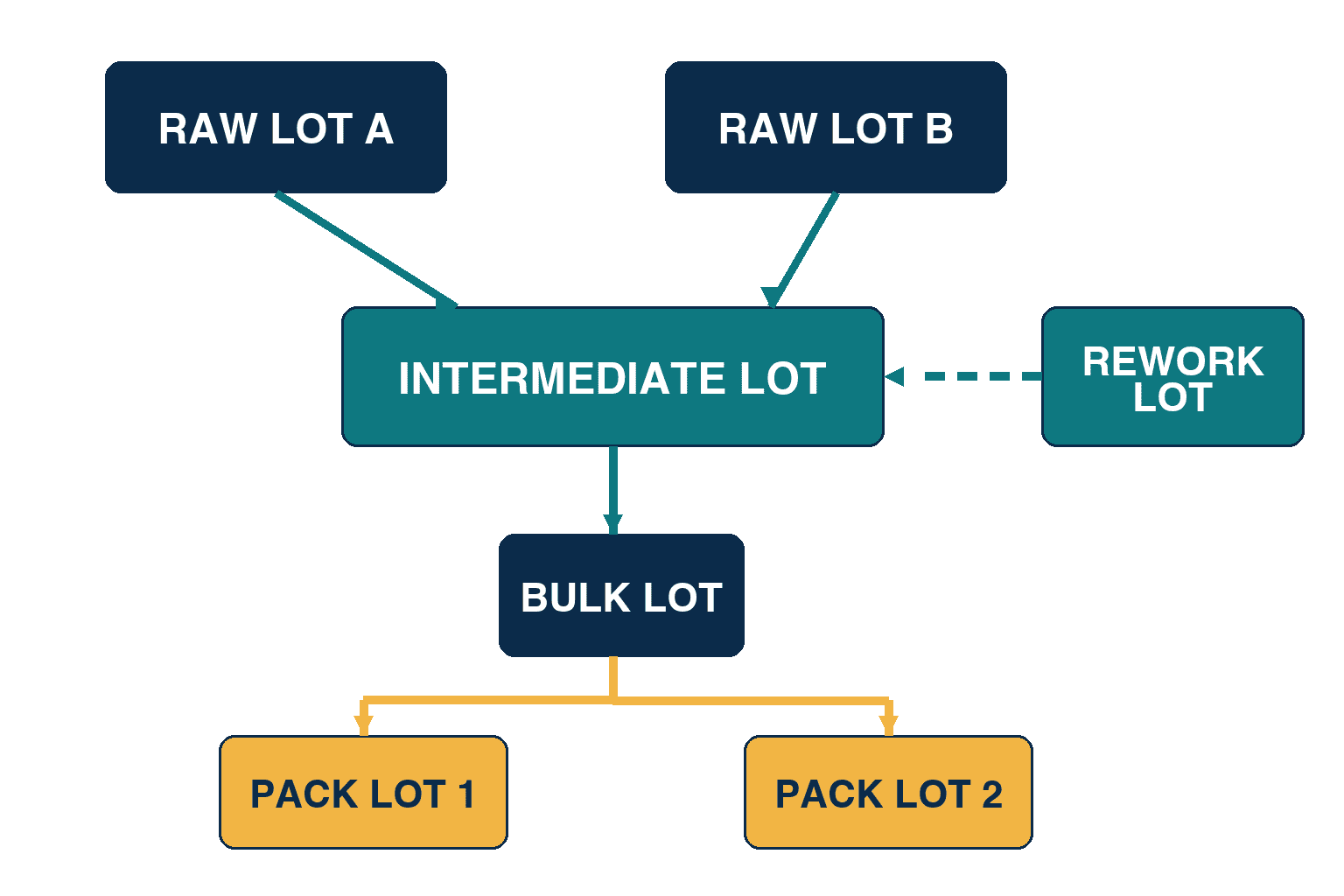
- splitting bulk batches into filling or packing lots, and merging where permitted;
- return material, rework, waste, by-product and sample removal;
- warehouse transfer, subcontract processing, shipment and customer return.
The difficult cases are many-to-many. Several raw lots can feed one batch, one bulk batch can become many packed lots, several intermediates can be blended, and part of a failed lot can return as a rework input. The solution must retain quantity, unit, conversion and loss reasons across each relationship, not just draw a line between lot IDs.
See the detailed chemical lot management guide for further genealogy design considerations.
Make quality hold and release control actual inventory availability
Quality status cannot remain an informational field visible only to the laboratory. It affects allocation, issue, transfer, production, shipment, costing and rework. Define the minimum set of states required by the plant—such as unsampled, sampled, testing, hold, conditionally approved, released, rejected, rework pending and disposal—then specify a transition matrix. For every state, state who can change it, what transactions are permitted and which next states are valid.
Typical mandatory rules include:
- held lots are excluded from normal allocation, issue and shipment proposals;
- conditional use requires product scope, quantity, expiry, reason and named approval;
- correction of a test result retains old value, new value, reason, editor and approver;
- rework creates a controlled order and preserves the genealogy from the failed material;
- subsequent release does not erase the earlier rejection or deviation;
- MES, ERP, WMS and LIMS status codes are mapped, with fail-safe behaviour during delay or outage.
If MES provides laboratory functions, review specification revision, method, unit, rounding, detection limits, retest, sample location and Certificate of Analysis responsibilities. If LIMS remains, decide whether MES receives only the disposition or also individual measurements. The decision affects investigation, reporting and data retention.
Define actual yield, material balance and weighing variance before configuration
Departments often use “yield” with different numerators and denominators. The ratio of actual bulk to theoretical bulk, finished packed quantity to filling input, and good output to total input are different measures. Evaporation, reaction, sampling, equipment heel, filter residue and moisture changes can make a simple input-equals-output rule inappropriate.
The RFP should therefore state:
- the process point at which theoretical and actual quantities are compared;
- where potency, concentration, density and moisture corrections are maintained and approved;
- whether tolerance is absolute, percentage-based, material-specific or step-specific;
- whether an out-of-tolerance event warns, blocks, or permits continuation after authorised approval;
- which system owns unit conversion and rounding precision;
- which deviation workflow receives an abnormal yield or balance.
If a demonstration uses “standard 100.00 kg with a tolerance of ±0.20 kg”, label it as an illustrative assumption, not an operating recommendation. Replace it in acceptance testing with the plant’s approved formula, scale specification and quality-risk criteria. This article intentionally does not invent a standard efficiency gain or improvement percentage; the plant should baseline and compare data under the same definitions.
Link SDS, GHS and hazardous-material masters to execution
Chemical information management requires more than attaching an SDS to an item. Consider material or substance identity, supplier, SDS revision and issue date, language, GHS classification, pictogram code, signal word, hazard and precautionary statements, storage constraints, incompatibility, and plant-controlled transport or disposal information. Decide how a revised SDS affects existing stock, work in progress, labels and instructions.
Thailand’s requirements for hazardous substances, licensing, possession, labelling, storage and reporting can depend on substance, use, quantity, business activity and location. Thailand’s Department of Industrial Works (DIW) publishes hazardous-substance information, but an application vendor’s statement of “Thai legal compliance” is not legal advice. Confirm the current duties for the plant’s actual scope with DIW and any other competent authority, qualified specialists and legal counsel. The UN GHS provides a global framework; local implementation and transition requirements must still be checked in official sources.
Useful system requirements include:
- operators and warehouse personnel can reach the approved SDS revision applicable to the lot in use;
- expired or unapproved SDS revisions cannot be selected for new labels or work instructions;
- a hazard classification change identifies affected items, stock, work in progress, products and customer documents;
- Thai, English and Japanese phrases link to controlled non-language codes;
- emergency information remains available through a process aligned with the plant’s EHS and access-control policy.
FEFO and expiry control: one material can have several relevant dates
Chemical materials may have a manufacturing date, retest date, expiry date, opened-container life and quality-approval date. FEFO means prioritising the earliest applicable expiry, but it cannot ignore release status, customer specification, storage condition, container integrity or incompatibility.
Define each date, its start event, whether retesting may extend it, who approves an extension, what appears on labels, and which application owns the field. When a container is opened or split, decide whether a new container ID and date are generated while retaining source genealogy. Acceptance testing must verify that an expired lot is blocked at scanning or charging, not merely omitted from a planning report.
Audit trails, electronic signatures and Thai–Japanese access design
An audit trail needs more than user and timestamp. It should make the affected object, old value, new value, reason, device, related order or lot and approval searchable, while preventing ordinary users from alteration or deletion. Time synchronisation across servers, terminals, scales, PLC/DCS and laboratory equipment matters because a sequence of charge and approval cannot be defended if timestamps conflict.
Design permissions around duties, qualification, department, equipment and delegation period—not nationality. A Thai-speaking operator might weigh and charge materials, a Thai supervisor review an initial exception, a Japanese production manager approve a formula change, and an independent quality role release the lot. Translate that real separation into roles.
Test during demo and FAT that:
- an operator cannot edit an approved formula;
- a formula author cannot perform prohibited self-approval;
- transfers, resignations and expired delegation remove access;
- offline actions retain correct user and time after synchronisation;
- administrator changes to masters are also audited;
- Thai, Japanese and English screens refer to the same code, unit and state.
Mandatory RFP sections for a batch management system
Require bidders to classify every response as mandatory, important or optional, and as standard, configured, custom or third-party. At minimum, cover the following areas.
Master data and formulas
- Items, approved substitutes, units, conversions, concentration, potency, density, containers and storage constraints.
- Formula revision, applicable site, equipment and capacity, addition sequence, tolerance and process conditions.
- Approval, effectivity, withdrawal, revision comparison, translation and electronic signature.
Planning and order control
- Production orders from demand and sales, batch-size split and merge rules.
- Equipment capacity, cleaning, changeover, maintenance, material availability and quality status.
- Frozen horizon, urgent insertion, rescheduling and feedback to ERP.
Warehouse, weighing and charging
- Barcode or RFID verification of material, lot and container.
- FEFO proposal and blocking of held, expired or incompatible material.
- Scale integration, tare, calibration status, tolerance and second-person verification.
- Child container identity, balance, return, disposal and cleaning.
Batch execution and automation integration
- Procedures, phases, parameters and states using ISA-88 concepts where appropriate.
- Values from PLC/DCS/SCADA, command authority and differentiation of manual entries.
- Alarm, deviation, pause, resume, equipment change and sample instruction.
Quality and release
- Specification revision, sample, test, retest, calculation and disposition.
- Hold, conditional use, release, rejection, rework and disposal.
- LIMS integration, CoA and inventory-status integration with ERP/WMS.
Traceability and reporting
- Bidirectional genealogy from raw material to shipment and from shipment to inputs.
- Split, merge, decant, return, rework and by-product events.
- Batch record, material balance, actual yield, deviation and audit trail.
Non-functional and operational requirements
- Languages, time zone, units, concurrency, response, availability and offline policy.
- Backup, recovery, cybersecurity, patching and log monitoring.
- Data migration, training, support languages, SLA and controlled change.
- Data ownership, export, end-of-contract return and retention.
Use controlled chemical-plant scenarios in every vendor demonstration
A free-form demonstration lets suppliers show only their strongest screens. Give every bidder the same scenario, input conditions and scorecard. The figures below are illustrative assumptions, not operating limits.
Scenario A — normal batch: Assign an approved formula revision. Propose only released, unexpired material using FEFO. Verify containers and weigh through an integrated scale. Capture process values, sample results and final release. Score the consistency among revision, planned and actual values, lots and approvals—not merely the number of keystrokes.
Scenario B — weighing deviation: Assume, solely for the demonstration, a 10.00 kg target and ±0.05 kg tolerance, then read 10.08 kg. Verify the block, reason, authorised decision and correction. Check who can override the warning and what remains in the audit trail.
Scenario C — quality hold and rework: Hold an intermediate so it cannot move to the normal next operation. After quality authorises rework, create a separate rework order and trace the source lot, input quantity, resulting lot and retest.
Scenario D — raw-material recall investigation: From a selected supplier lot, trace every batch, intermediate, product, shipment and customer affected, including a path through rework. Check search filters, elapsed processing behaviour and export completeness without accepting an invented universal response-time target.
Scenario E — outage and recovery: Stop ERP, MES, scale or automation communication. Identify permitted and prohibited operations, queues, duplicate prevention, reconciliation and the treatment of out-of-order messages. “It synchronises later” is not a sufficient design explanation.
FAT, SAT and 90-day operational acceptance
The contract should define staged acceptance rather than treating software installation as completion.
FAT: prove the configured design before plant deployment
At Factory Acceptance Test, execute critical and exception scenarios using the approved design and configured environment. Include roles, simulated interfaces, reports and audit trails. Agree test data, expected result, evidence, defect severity and retest rules before execution. For a cloud service, the same principle applies to a configured pre-production acceptance gate.
SAT: prove the solution with the Thai plant’s devices and users
Site Acceptance Test must use the real scales, scanners, printers, PLC/DCS, network, terminals, languages, clocks, barcodes and ERP/LIMS connections. Check Thai combining characters and line wrapping, Japanese material names, unit symbols and label fonts. Include power, network, terminal replacement and restore cases appropriate to the site.
90-day acceptance: make stable operation an outcome
The 90-day period in this guide is a recommended illustrative contractual assumption, not a statutory or universal standard. Agree a duration that covers the plant’s production cycles, product mix and periodic processing. During the agreed window, verify that:
- critical defects and open issues remain within the contractual threshold;
- unsent, duplicate and inconsistent interface transactions are monitored and resolved;
- formula revisions, release decisions, genealogy and audit trails work on live batches;
- users can operate with approved Thai and Japanese procedures;
- backup, restore, month-end, master changes and leaver access removal are performed;
- KPIs are captured under stable definitions and remaining manual work has an owner and reason.
Link acceptance holds, workarounds, corrective dates and payment milestones so that “the screens are live” cannot close a project whose lot genealogy is incomplete.

Data preparation and migration scope
Data readiness often governs the schedule. Duplicate items, inconsistent conversions, obsolete formulas, supplier-name variations and missing dates will produce wrong decisions in a new system.
Assess migration of item, formula revision, operation, equipment, scale, storage location, quality specification, test method, SDS reference, user, role, open order, inventory lot, container, status and expiry data. Decide whether history is fully migrated or the legacy system remains read-only, based on customer, quality, contractual and applicable legal retention needs.
Reconciliation must test more than row counts:
- every active product has an approved effective formula;
- every formula component is valid and has approved unit conversion;
- inventory totals reconcile with ERP, warehouse records and physical stock;
- held stock has not been converted to released status;
- SDS revision relationships to item and supplier remain traceable;
- user rights match current employment and segregation of duties.
Scoring and contract questions
A scorecard based only on feature fit may favour a heavily customised proposal with weak operating support. Separate business fit, standard-function ratio, integration, migration, non-functional quality, cybersecurity, implementation team, local Thailand support, total cost and contract terms. Choose weights from plant risk rather than copying a generic template.
Thailand’s BOI describes its Smart and Sustainable Industry measure as supporting investment that improves the efficiency of manufacturing and service operations and upgrades them toward smart, sustainable industry. If the investment case relies on that measure, confirm current eligibility, scope, qualifying expenditure and evidence directly with BOI, separately from the system-fit assessment.
Contract review should include ownership and maintenance of custom work, API limits, data-export charges, regression testing after upgrades, responsibility for Thai localisation, local-time incident coverage, third-party licensing, cloud data location and end-of-contract data return. Compare prices under the same scope and period across licence, configuration, integration, migration, validation, training, operation, change, infrastructure and devices. This guide does not invent market prices; request itemised quotations under common assumptions.
Common selection failures
Relying on the phrase “chemical industry ready”
Batch reaction, continuous processing, filling, hazardous chemicals and specialty formulations differ. Require the plant’s own scenarios and a standard/configuration/custom classification.
Keeping the executable formula as a PDF
A document can be displayed but cannot enforce sequence, tolerance, version or equipment restrictions unless those elements are structured and controlled.
Correcting stock manually in both ERP and MES
Uncoordinated correction breaks the link between genealogy and financial quantity. Define the owner, correction transaction, retry and daily reconciliation.
Showing a quality hold only as a colour
A colour does not prevent automatic allocation or scanned charging. Status must drive allowed transactions.
Accepting only the happy path
Real failures occur during cancellation, substitution, outage, rework, expiry and delegated approval. Include exceptions before contract and in acceptance.
FAQ about chemical production management systems
Is a chemical production management system the same as a batch management system?
Not necessarily. Production management may include demand, planning, inventory and cost; batch management may focus on recipe, equipment procedure and execution record. Evaluate the required ERP, MES, DCS and LIMS responsibilities rather than the product label.
Can formula management remain entirely in ERP?
ERP may manage item and standard formulation data. Scale integration, charging sequence, equipment state, detailed process values and exception execution may be better handled in MES or the batch-control layer. The right boundary depends on the installed ERP, response needs and quality risk.
How far should chemical lot management trace?
Cover every event at which identity or quantity changes: receipt, decanting, blending, split, merge, intermediate production, return, rework, waste, subcontracting and shipment. Confirm product- and market-specific duties separately.
Should ISA-88 and ISA-95 compliance be mandatory?
A single compliance checkbox is weak. Specify the models, vocabulary, interfaces and records needed, then ask suppliers to explain which parts follow the standards and which are product-specific.
What percentage improvement should be promised?
No universal percentage is credible. Baseline weighing corrections, investigation time, inventory variance, manual entries, deviations and stoppage under stable definitions, then set targets for the actual automation scope.
Is a system advertised as compliant with Thai hazardous-material law sufficient?
No. Duties can vary with substance, quantity, use, operation and location. Confirm current requirements with DIW, other competent authorities and specialists, then express them as specific masters, workflows, controls, reports and evidence. Software does not replace the legal determination.
Conclusion: define the manufacturing facts you must prove before comparing products
A chemical production management system connects an approved formula, eligible material, equipment and procedure, actual charge, process condition, quality decision and finished lot as one evidence chain. ISA-88 helps structure recipe, equipment and batch execution. ISA-95 helps make the ERP–MES boundary explicit. GS1 traceability concepts help define events and critical data.
Put weighing variance, hold, rework, split, merge, expiry, outage and formula revision into the RFP—not only the normal batch. Carry the same scenarios into FAT, the Thai plant’s SAT and the agreed operational acceptance window. The outcome is then not “software has been installed”, but “the plant can control and reconstruct its production facts”.
For help translating formula, quality and genealogy risks into an RFP, contact TOMAS TECH. The discussion can start with requirements and integration boundaries, including a phased MES deployment that retains current ERP and equipment.
Primary references
- International Society of Automation, ISA-88 Series of Standards
- International Society of Automation, ISA-95 Standard
- International Society of Automation, Update to ISA-95 Standard Addresses Integration of Enterprise and Manufacturing Control Systems
- GS1, GS1 Global Traceability Standard
- Department of Industrial Works, Thailand, Hazardous Substance Information
- Thailand Board of Investment, Smart and Sustainable Industry
- United Nations Economic Commission for Europe, Globally Harmonized System of Classification and Labelling of Chemicals
Primary sources were checked on 27 August 2026. Confirm the current application of standards and all Thai permit, hazardous-substance, labelling and storage requirements for the actual substance, product, process, quantity and location with the competent authorities and qualified advisers.


