


Thailand Robot System Integrator Selection 2026: RFP, Safety, FAT/SAT and TCO Guide
When selecting a Thailand robot system integrator, the first comparison should not be robot price or the speed of a demonstration video. A defensible comparison begins with the process boundary, safety requirements, acceptance criteria, change control, maintenance responsibility and five-year total cost of ownership. This guide does not rank vendors. It shows Thailand factories how to prepare an RFI or RFP and evaluate proposals on the same evidence-based basis.
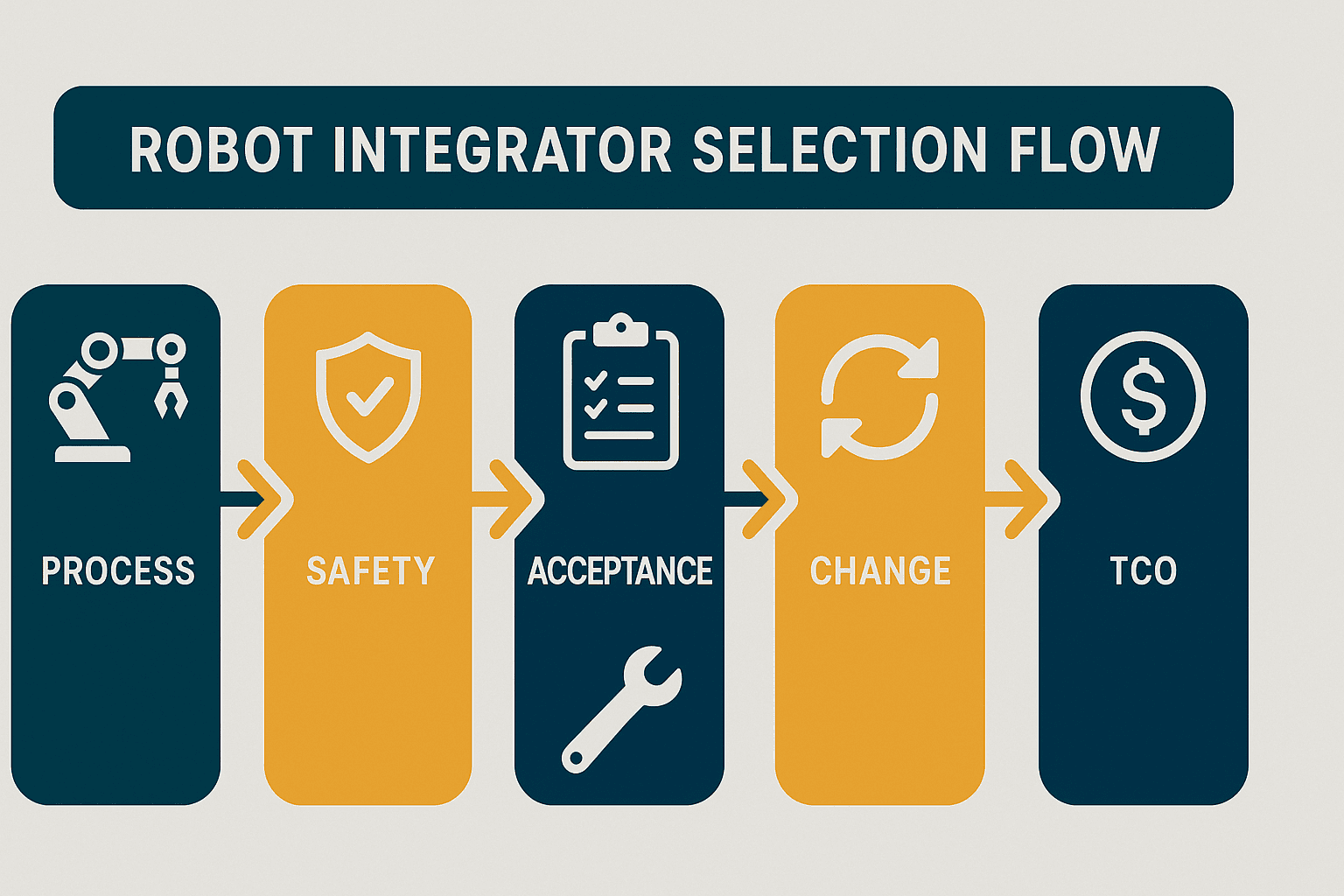
Thailand robot system integrator selection: the six-gate answer
Integrator proposals often use different robot brands, configurations, cycle-time assumptions, warranty scopes and exclusions. A grand total therefore does not provide a like-for-like comparison. Divide the decision into six gates.
| Gate | Decision | Minimum evidence |
|---|---|---|
| 1. Process fit | Can the system handle the work and its variation? | Workpiece list, process map, capacity calculation, assumptions |
| 2. Safety | Can risk be reduced across the whole cell? | Draft risk assessment, safety-function list, validation plan |
| 3. Acceptance | Can FAT and SAT produce a clear pass or fail? | Tests, measurement method, sample rules, acceptance owner |
| 4. Change | Can a change be traced into cost, schedule and safety? | Baseline, change request, impact assessment, approval route |
| 5. Operations | Can the Thailand site recover and maintain the cell? | SLA, contacts, spares, training, backups |
| 6. Economics | Is the result rational over five years? | TCO including initial, running, downtime and renewal costs |
If any gate remains “to be decided later,” treat it as an identified risk, not as zero cost. An unanswered question does not automatically disqualify an integrator; the buyer’s requirement may also be incomplete. Record the owner and deadline for every open assumption.
What a robot system integrator actually integrates
A robot SIer does more than purchase and install a robot. It brings together the product, gripper, fixture, conveyance, sensors, vision, PLC, safety devices, upstream systems, utilities, operator movement and maintenance method into one production system.
Even a “palletizing” project changes substantially when carton size varies, multiple pallet patterns are needed, changeover must be automatic, operators replenish material while production continues, or label orientation must be checked. In variable-load applications such as those discussed in our robotic depalletizing guide for Thailand factories, the boundary must include detection failures, double picks, unstable loads and exception discharge—not only successful gripping.
Put the machine design and build boundary on one page
Before issuing an RFI, create a one-page “who supplies what” boundary drawing. Include at least:
- mechanical, electrical and signal interfaces to existing equipment;
- workpiece entry, finished-product handoff and reject or exception destinations;
- responsibility for robot, end effector, fixtures, conveyors, vision, guarding and panels;
- building work, foundation, power, air, network, fire and environmental conditions;
- responsibility for PLC, HMI, robot, vision and host-system software;
- ownership of production data, alarms, recipes, user permissions and backups; and
- installation, commissioning, training, ramp-up support and post-production service.
Use separate colors for the integrator, customer, third parties and undecided items. Number each interface and reference those numbers in proposal exclusions. This makes omissions visible across bidders.
Provide the range of variation, not only a representative part
A system designed around an average product may fail on the most difficult production variant. Provide ranges for dimensions, mass, center of gravity, surface, reflectivity, rigidity, tolerance, temperature, contamination, arrival pose, packaging and lot variation. Where drawings are insufficient, provide controlled physical samples for normal and boundary conditions.
Separate current scope from future products. Label items as “must handle now,” “design allowance required” or “subject to a future change order.” Mixing those categories creates both overengineering and later disputes.
Safety requirements for robot implementation support
Safety is not complete merely because the industrial robot has a safety declaration. Risk must be evaluated for the robot, safety control, end effector, payload, peripheral machinery, guard, door, work procedure and maintenance activities as one application.
ISO 10218-1:2025 addresses safety requirements for industrial robots themselves. ISO 10218-2:2025 addresses industrial robot applications and robot cells, including integration. Their scopes must not be collapsed. ISO 12100:2010 provides general principles for machinery risk assessment and risk reduction. The applicable standards, laws, customer requirements and third-party review need to be confirmed for each project and destination.
Do not confuse Thailand TIS with the 2025 ISO edition
The TISI page identifies TIS 3950 Part 1-2567 as equivalent to ISO 10218-1:2011 and gives an effective date of 8 February 2025. That does not make it identical to ISO 10218-1:2025. State the standard and edition in the RFP, then confirm legal applicability, the hierarchy of customer standards, and any required third-party review with qualified Thailand specialists.
Assess work scenarios, not only a hazard list
Describe normal production, changeover, jam clearing, cleaning, teaching, manual operation, maintenance, re-energization, part replacement and abnormal-product recovery. For each scenario, record who enters which space, what energy remains, what foreseeable misuse exists, what protective measure acts and how it will be verified.
Require evidence rather than a statement that “the cell is safe”:
- assumptions, hazards, initial risk, risk-reduction measures and residual risk;
- a list of safety-related functions and their required performance and validation method;
- layout of guards, doors, light curtains, scanners, emergency stops and resets;
- state transitions for automatic, manual, teach and maintenance modes;
- energy-isolation and lockout/tagout principles;
- validation records, instruments, results and open findings; and
- transfer of residual risks into procedures, signs and training.
Attach a safety responsibility matrix to the contract
Gaps arise when the robot maker, SIer, tooling supplier, building contractor, customer EHS and production engineering teams each assume another party owns cell-level validation. Prepare a RACI for design, approval, implementation, validation, record retention and reassessment after change. Use role names as well as named contacts so responsibility survives staff turnover.
Shortlist a Thailand robot system integrator by evidence
Robot counts, major customer logos and years in business provide context, but they do not prove fit for the current process. Ask how the proposed team controlled risks similar to those in your application.
Ten prequalification checks
- Thailand legal presence, service locations and working languages.
- Mechanical, electrical, control, robot, safety and vision engineering resources.
- Design logic and acceptance methods for comparable workpieces and processes.
- Design review, version control, code review and backup procedures.
- Competence for risk assessment and safety validation.
- FAT facility, measurement equipment, sample control and test records.
- Project, issue, change, schedule and subcontractor control.
- First response, on-site attendance and remote service after ramp-up.
- Spares, obsolescence, licenses, software and data ownership.
- Fit with the buyer’s financial, insurance, quality and information-security requirements.
A third-party credential such as A3’s Certified Robot Integrator Program can be one signal of business practice and technical capability. It is voluntary and should not be treated as sole proof of fitness for a particular Thailand project. Verify validity, the certified location, the actual project team and application-specific capability.
Ask references how problems were controlled
Do not limit a reference call to whether delivery was “on time.” Ask what failed during FAT, how specification changes were priced, what stopped production in the first month, whether backups restored correctly, and whether support continued after the original engineer changed. Subject to confidentiality, evidence of transparent problem control is often more useful than a perfect success story.
Make overseas robot implementation support RFPs comparable
In overseas projects, headquarters standards and Thailand site realities may diverge. A specified component may not be locally available; operating language may not suit technicians; holiday support windows may differ; imported spare lead time may be long. Bring those differences into the RFP.
Put measurable performance in the URS
Avoid words such as “fast” and “stable” without a test method.
| Topic | Weak wording | Comparable requirement example |
|---|---|---|
| Capacity | Process quickly | Cycle time under specified mix and upstream-feed conditions |
| Quality | Reduce mistakes | Defect definition, decision method, false-result handling and records |
| Availability | High uptime | Rules for planned stops, material starvation and upstream outages |
| Changeover | High-mix capable | Included products, time, tools, recipe rights and first-piece check |
| Recovery | Easy to repair | Diagnostics, recovery steps and permissions by fault scenario |
| Data | Keep history | Tags, units, timestamps, retention, format and owner |
Where a measure cannot yet be fixed, list it as an integrator proposal requiring customer approval at a named design gate. Do not turn a blank cell into an implied unlimited obligation.
Normalize the quotation breakdown
Separate robot, tooling, peripherals, safety, mechanical, electrical, controls, vision, host integration, engineering, assembly, FAT, packing, transport, import, installation, SAT, training, ramp-up, warranty, maintenance and spares. Mark customer-supplied items, third-party work, tax, foreign exchange, travel, holiday work and production samples as included or excluded.
Only after this normalization can a buyer see whether a price difference is a configuration difference, exclusion or risk allowance. The purpose is not to force the lowest number; it is to compare the same intended outcome.
Do not book BOI benefits as guaranteed savings
The current Thai BOI automation page describes an automotive-industry measure with an application period in B.E. 2569-2570, corresponding to 2026-2027. It shows a minimum investment of THB 1 million and a three-year corporate income tax exemption capped at 50% of qualifying investment, with the cap reaching 100% where links to the domestic automation industry are at least 30%. Eligibility, qualifying expense, linkage calculation, deadline, approval conditions and actual applicability must be confirmed for the individual project with BOI or a qualified adviser.
The English BOI Investment Promotion Guide 2025 is useful background, but do not present an older English 2025 deadline as the current scheme when the current Thai page describes 2026-2027. Use “no incentive” as the base TCO case, adding an incentive case only after the assumptions are substantiated.
Use FAT for design acceptance and SAT for site integration
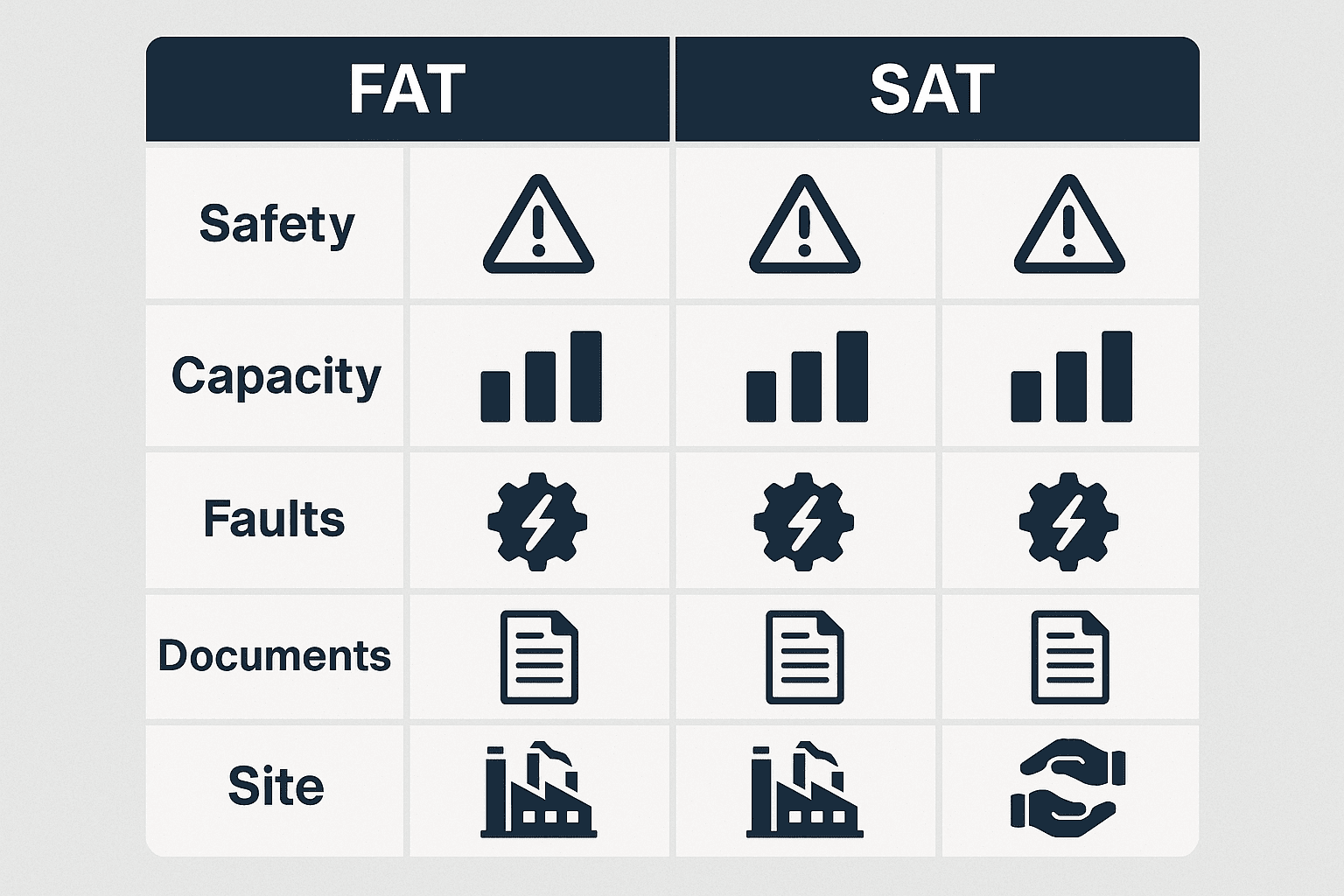
Factory Acceptance Testing is not a celebration that the machine moves. It is a contractual gate to confirm specification compliance and unresolved issues before shipment. Site Acceptance Testing is not merely a repeat. It confirms integration with the Thailand factory’s power, floor, network, upstream and downstream equipment, production materials, operators and maintenance organization.
Agree the FAT plan before design freeze
If FAT tests are written just before completion, the system may already be unable to demonstrate a requirement. Give each URS statement a test ID and decide at design review whether compliance will be shown by inspection, analysis, demonstration or document review.
The FAT should cover at least:
- purchased specification, BOM, drawing and software-version consistency;
- safety functions, doors, stops, restart and mode changes;
- normal capacity, endurance, changeover and boundary workpieces;
- jams, grip failure, sensor faults, communications loss and power recovery;
- isolation and traceability of rejects and exceptions;
- alarm cause, recovery guidance, history and time synchronization;
- backup creation, separate storage and restore testing; and
- operating and maintenance materials, drawings, parts lists and licenses.
Define cycle-time acceptance beyond one number
Cycle time varies with upstream feed, product mix, safety speed reduction, quality inspection and downstream readiness. Define start and stop points, sample count, warm-up, product mix, exclusion handling and statistic. Judge repeatable performance under agreed conditions, not the fastest isolated cycle.
Separate failed site prerequisites from equipment nonconformity
If power quality, networking, materials or upstream equipment do not meet an agreed prerequisite, do not mix that lost time with an integrator equipment defect. Jointly check site prerequisites before SAT and assign owners and deadlines to gaps. Manage integrator nonconformities with root cause, containment, permanent correction and retest evidence.
Start FAT/SAT change control at quotation
Automation projects rarely have zero changes. The problem is not the existence of change but a verbal change that never reaches the design, price, schedule, safety assessment and acceptance plan.
Maintain a four-part baseline
Freeze the requirements, responsibility boundary, normalized price and master schedule as one approved contract baseline. Minutes alone should not authorize design change; issue a unique change-request number.
Record the reason, requester, affected documents, technical impact, safety reassessment, software and hardware effects, price, schedule, FAT/SAT tests, training and spares. For an emergency change, set a deadline to complete the record afterward.
Define what “no charge” means
Defect correction, specification interpretation, customer convenience, regulatory response and changed site conditions have different commercial responsibility. Define classifications and decision authority, how quickly the SIer must assess impact, how quickly the customer must approve, and the limited situations where work can begin before approval.
Return any safety-relevant change to risk assessment and validation even when it appears small. A sensor position, speed, fixture, access door or recovery-sequence change can alter a protective measure.
Design the maintenance SLA beyond “hours to repair”
Separate acknowledgement, remote diagnosis start, site arrival, temporary recovery and permanent correction. Arrival does not restore a machine when a component is unavailable, and remote access is impossible without authorization. State the conditions needed to deliver the SLA.
Define severity and clock-stopping rules
| Level | Example condition | Operating rule |
|---|---|---|
| P1 | Safety concern, total stop, no workaround | Need for 24-hour intake, immediate escalation, management notice |
| P2 | Reduced capacity, controlled manual workaround | Same-day diagnosis, workaround and corrective plan |
| P3 | Minor defect or improvement request | Normal channel and planned-stop release |
“Response” should mean a qualified person accepts the case, not an automated email. Distinguish temporary restoration from permanent repair. If the clock pauses while logs, access, parts or a third party are unavailable, define the evidence and owner.
Make spares and backups contractual deliverables
For critical parts, request recommended stock, quantity, storage conditions, inspection interval, lead time, substitutes and obsolescence notices. Do not stock every expensive item blindly. Tier parts by production consequence and replacement time; determine project figures from supplier evidence and customer impact.
A backup is not useful simply because it exists. Define PLC, HMI, robot, vision, servo, safety, recipe and host-communication scope; the captured version; encryption; location; permissions and restoration procedure. Test a restore during FAT or SAT.
Put remote-maintenance cybersecurity in the RFP
Do not assume permanent connectivity, shared IDs or unlimited privileges. Define customer-approved session initiation, named identity, multi-factor authentication, least privilege, time limits, activity logging, possible recording, file transfer, emergency termination and offboarding. If the OT network policy conflicts with the proposed support method, design an alternative before commissioning.
Compare five-year robot implementation TCO in Thailand
Compare what it costs to maintain the same production result over five years, not only initial quotation totals. Adjust the period to company investment policy. The following is a buyer model, not a market price or performance guarantee.
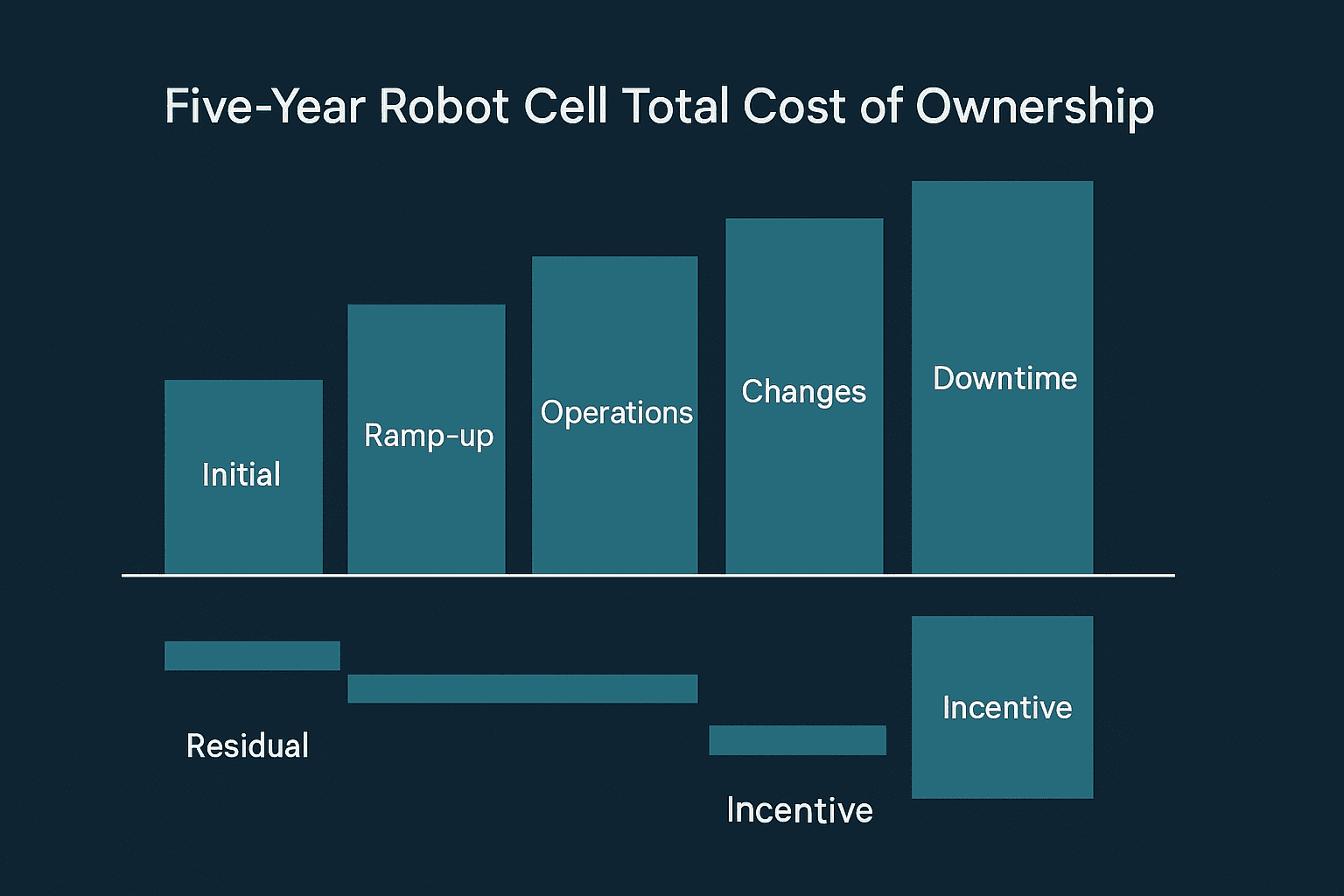
Five-year TCO = initial implementation + ramp-up + five-year run and maintenance + changes and renewal + expected downtime loss − substantiated residual value − confirmed incentive benefit
Include the complete initial cost
Add equipment, engineering, sample preparation, site survey, simulation, risk assessment, FAT attendance, packing, freight, insurance, import, installation, building work, SAT, training, initial spares and production ramp-up support. Record internal customer effort separately as a scarce decision resource.
Include ongoing operation and maintenance
Include electricity, compressed air, consumables, lubrication, tools, calibration, inspections, licenses, communications, remote support, preventive maintenance, spare replenishment, maintainer training and backup administration. Add future tooling and recipe work through explicit high-mix scenarios.
Do not hide downtime in a single unexplained average
Expected downtime loss = sum for each failure scenario of assumed frequency × assumed average duration × approved impact per hour
Where frequency and duration are not warranted, label them “customer model assumption” and create optimistic, base and downside cases. Use only impact components accepted internally, such as lost contribution, overtime, subcontracting, scrap, reinspection or expedited freight. Align definitions with finance to prevent double counting.
When using our Thailand robot implementation ROI framework, keep TCO on the cost side and capacity, quality and redeployment on the benefit side. Do not turn all saved time into cash unless capacity is actually redeployed or spending changes.
Contract deliverables for machine design and build
A cell may run while leaving the buyer dependent on the SIer for future recovery or change if source, drawings, passwords, licenses and training records are missing. Put deliverables, formats, submission dates, approvers and update obligations into the contract.
Final handover package
- as-built mechanical, electrical, pneumatic and layout drawings and BOM;
- PLC, HMI, robot, vision and safety backups with version index;
- commented source, controlled password handover, licenses and renewal conditions;
- risk assessment, validation, residual risk and conformity-related records;
- FAT/SAT results, nonconformity closure and calibration records;
- operation, changeover, cleaning, inspection, diagnostics and recovery procedures;
- recommended spares, consumables, obsolescence process and maker contacts;
- training material, attendance, competence check and refresher conditions; and
- warranty, SLA, escalation, remote access and contract-end procedure.
Separate intellectual property from required use rights
Pre-existing libraries, project-specific code, third-party software, robot programs, drawings, learning data, images and recipes may have different rights. State what the buyer may operate, back up, modify, maintain through a third party and reuse on another line. Demanding ownership of everything is not the only valid model, but missing operational rights is an avoidable lock-in.
Design the exit and SIer transition
Define account deactivation, confidential-data deletion, return of current source and documents, open issues, spares and transition assistance. Clear exit conditions can also make a long-term partnership with the incumbent SIer easier to approve.
A practical Thailand robot system integrator scorecard
Separate mandatory thresholds from scored preferences. The table is an adjustable buyer model, not a universally recommended weighting.
| Evaluation area | Example weight | Evidence |
|---|---|---|
| Process and technical fit | 25 | Capacity logic, tests, exception handling, comparable risk |
| Safety and quality | 20 | Standards, risk assessment, validation, document quality |
| Project and change | 15 | Team, schedule, version and change control |
| FAT/SAT and handover | 15 | Acceptance criteria, records, training and as-built package |
| Maintenance and local support | 15 | SLA, resources, spares and remote method |
| Normalized TCO | 10 | Five-year cost and sensitivity on common assumptions |
Do not let price points compensate for a failed mandatory safety condition. Require evaluator comments and reconcile large scoring differences. Base the decision on submitted documents and version-controlled answers to questions, not presentation impressions.
Frequently asked questions
How should a buyer find a Thailand robot system integrator?
First describe the process boundary, workpiece variation, safety needs, acceptance criteria and support window. Send an RFI to candidates that can show evidence for comparable technical risks. Associations, robot manufacturers, current suppliers, exhibitions and certifications help discover candidates; final selection should rest on project-specific evidence, team, FAT/SAT plan and TCO.
How many robot SIer quotations should be compared?
There is no universal number. More bidders also require more evaluation effort. Prequalify capability and commercial fit, then invite a manageable number able to answer the same RFP. Equal scope and normalized exclusions matter more than bid count.
Who decides safety standards in robot implementation support?
The buyer states corporate, legal and customer requirements; the SIer proposes an application-specific compliance route; and qualified specialists or third parties review where needed. Distinguish ISO 10218-1:2025 for the robot from ISO 10218-2:2025 for integration and cells, and state each edition in the contract.
What is the difference between FAT and SAT?
FAT confirms specification, capacity, safety functions, fault response and documents before shipment at the supplier. SAT confirms integration with the Thailand site’s utilities, network, existing equipment, production material and people. Define separate prerequisites, acceptance and punch-list treatment even where tests overlap.
What belongs in an overseas robot support SLA?
Separate intake, qualified response, remote diagnosis, site arrival, temporary recovery and permanent correction. Check language, holidays, spare stock, travel coverage, access controls, customer prerequisites, paused-clock rules, escalation and service reporting.
What belongs in machine design and build TCO?
Include engineering, equipment, installation, FAT/SAT, training, spares, utilities, consumables, maintenance, software renewal, product additions, downtime effect and eventual transfer or removal for the selected period. Keep BOI benefit out of the base case until project eligibility is confirmed.
Conclusion: define an acceptable system before selecting the SIer
Selecting a Thailand robot system integrator is not producing a ranking of company names. It is aligning the process boundary, safety, FAT/SAT, change, maintenance and TCO, then comparing the evidence each team provides. Distinguish the robot scope of ISO 10218-1:2025 from the integration and cell scope of ISO 10218-2:2025, avoid conflating Thailand TIS editions, and carry responsibility into the contract and tests.
TOMAS TECH can support process definition, SIer RFI/RFP preparation, user requirements, FAT/SAT acceptance and five-year TCO before a robot brand or vendor is fixed. If you want a comparison framework tailored to your Thailand factory and investment rules, contact us.
Primary references
- ISO 10218-1:2025: https://www.iso.org/standard/73933.html
- ISO 10218-2:2025: https://www.iso.org/standard/73934.html
- ISO 12100:2010: https://www.iso.org/standard/51528.html
- Thai Industrial Standards Institute, TIS 3950 Part 1-2567: https://a.tisi.go.th/t/?n=8106
- Thailand BOI, current Thai automation page: https://www.boi.go.th/th/automation
- Thailand BOI, A Guide to the Board of Investment 2025: https://osos.boi.go.th/download/BOI_PDF/BOI_A_Guide2025_EN.pdf
- Association for Advancing Automation, Certified Robot Integrator Program: https://www.automate.org/robotics/robotics-certifications/robotic-integrator-certification-program


