



Equipment Maintenance Outsourcing in Thailand: SLA, Cost and RFP Guide 2026
When a factory evaluates equipment maintenance outsourcing in Thailand, the real decision is not simply “in-house or outsourced.” The stronger question is which external capabilities should be integrated while the plant, as asset owner, retains accountability, approval rights, equipment knowledge and operational risk. This guide gives procurement leaders, plant managers and maintenance teams a common framework for scope, SLA design, cost comparison, RFPs, site safety, OT remote access, spare parts, knowledge transfer and FAT/SAT-equivalent acceptance. All monetary figures below are a hypothetical comparison model, not a market-rate claim.
Equipment maintenance outsourcing is capability integration, not abdication
An external provider may perform inspections, preventive work and breakdown response, but production accountability does not automatically transfer. Production planning, product quality, safety, change control, backups, cybersecurity and legal compliance remain interconnected. The plant therefore needs to continue making asset-owner decisions.
ISO 55001:2024 sets requirements for an asset management system. ISO/TC 251 guidance on outsourcing reinforces a practical principle: accountability remains with the organization even when activities are externally provided, so the outsourced process must be controlled. A maintenance contract should consequently cover more than completed work orders. It should connect business outcomes, decision rights, information ownership, risk and oversight.
Responsibilities the plant should retain
- Criticality classification and assessment of safety, quality and delivery impact
- Final approval of preventive intervals and PLC, robot or drive setting changes
- Work permits, energy isolation, restoration checks and permission to restart production
- Authorization of OT access, account creation, log review and emergency disconnection
- Ownership of master drawings, bills of material, backups and maintenance history
- Supplier performance review, corrective action, renewal and termination decisions
The provider contributes specialist skills, coverage, calibrated instruments, approved diagnostic tools, multi-vendor experience and execution capacity. A RACI matrix should connect these capabilities without blurring accountability.
Classify assets before choosing factory maintenance outsourcing
Putting every machine under one service level usually under-serves the bottleneck and over-services low-impact equipment. Before issuing an RFP, classify assets across business impact, scarcity of technical skill and availability of an operational alternative.
| Class | Typical assets | Main exposure | Suitable service model |
|---|---|---|---|
| A: Critical | Bottlenecks, safety-related systems, core PLCs and robots | Injury, quality escape, prolonged outage | Joint governance, planned PM, priority on-site response, strict change approval |
| B: Important | Equipment with a slower alternative route | Delivery delay, overtime, rework | Planned maintenance plus time-banded on-call support |
| C: General | Redundant assets with short-term workarounds | Local efficiency loss | Route-based inspection, fixed service visits, repair on demand |
Two identical machines can have different criticality if only one has a backup, makes a unique product or uses a component with a long lead time. Validate the rating with production, quality, EHS, IT/OT, maintenance and procurement rather than relying on the asset register alone.
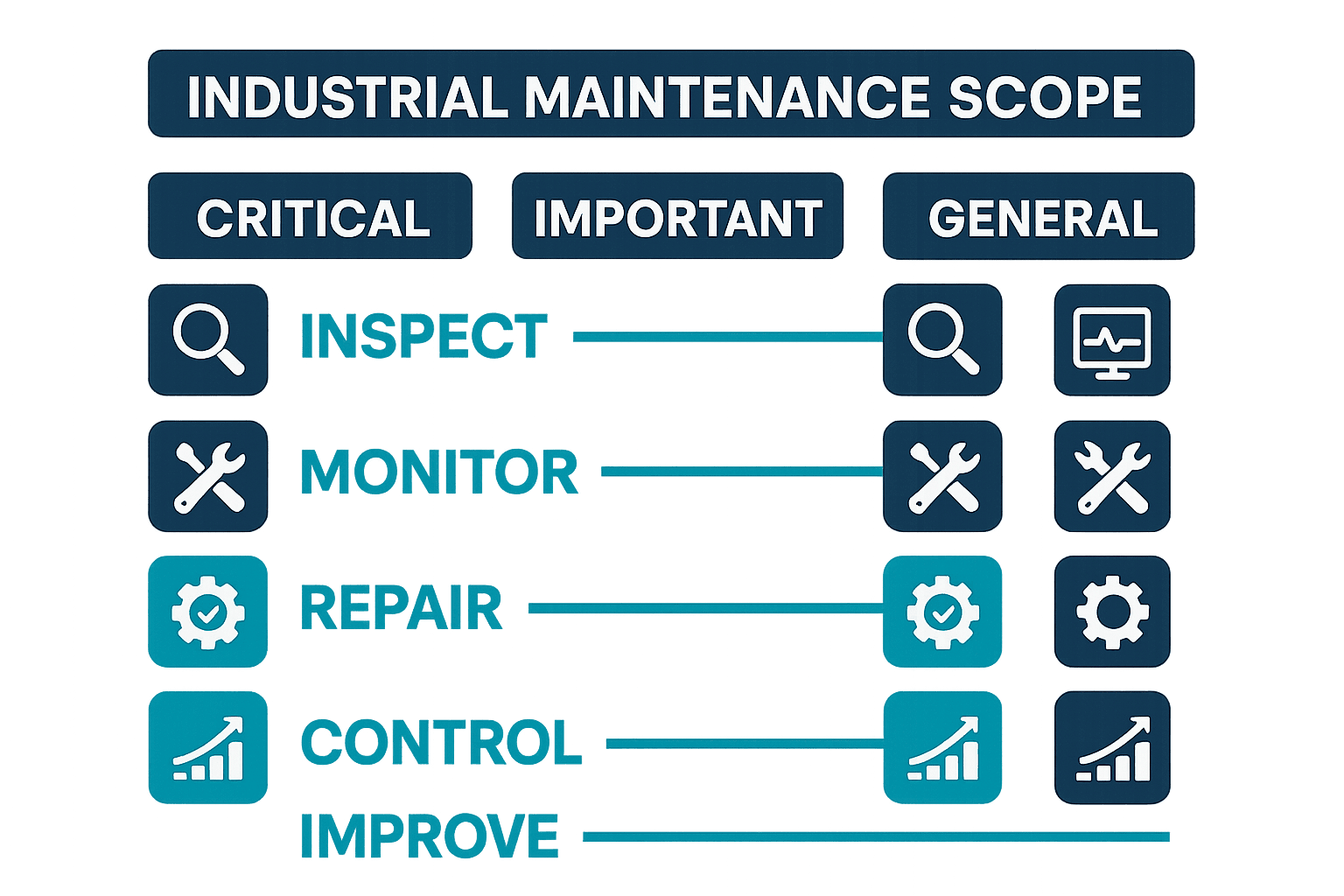
Break the scope into five layers
- Basic inspection, cleaning, lubrication and torque checks
- Condition monitoring and diagnosis using vibration, temperature or current
- Breakdown response, replacement and controlled recommissioning
- PLC, HMI, servo and robot software maintenance
- Reliability improvement, root cause analysis, spares optimization, training and lifecycle planning
The phrase “full maintenance service” invites inconsistent assumptions. Tie each asset to activities, exclusions, competence, standard tools, special tools, consumables, spare parts and out-of-hours coverage, then map every item to the commercial schedule.
Build the SLA around more than downtime
An SLA that only promises arrival within four hours says nothing about diagnostic quality or permanent correction. An availability target on its own can also be unfair if it includes material shortages, operator error, quality holds and utility failures outside the provider’s control. Separate controllable causes and combine leading with lagging measures.
| SLA or KPI | Example definition | Evidence | Design caution |
|---|---|---|---|
| Acknowledgement | P1 notice to accountable engineer acceptance | Ticket timestamps | Do not count an auto-reply as acceptance |
| Remote diagnosis start | Approved session to start of diagnosis | Access logs | Never reward unapproved access |
| On-site arrival | Dispatch approval to site entry | Gate record | Define traffic and access assumptions |
| Temporary recovery | Safe limited operation restored | Downtime record and approval | State the product-quality limits |
| Permanent action | Completion after approved RCA | Work report and change record | Define treatment of long-lead parts |
| PM compliance | Due work orders completed on time | CMMS data | Require approval for deferral |
| Recurrence rate | Repeat of the same failure mode within a period | Standard fault codes | Harmonize taxonomy first |
| Restore validation | Backups tested for recovery, not merely copied | Hash and restore record | Do not test on production without approval |
| Safety/security deviation | Unauthorized work, access, tools or procedure breach | Audit trail | Zero tolerance takes priority |
Define P1 to P4 as a shared operating language
For example, P1 may mean risk to life, environment, major quality or a full-line stop; P2 a major capacity loss; P3 a local stop; and P4 a planned improvement. Define who can declare a priority, how false alarms are handled, the night escalation chain and when the post-event report is due.
Put stop-work authority ahead of service credits
Commercial credits may deter poor performance, but they cannot stop unsafe work or an unauthorized connection. Plant operations, EHS and OT owners should be able to stop a task when isolation is doubtful, a tool is unapproved, an identity cannot be verified or a change lacks a valid backup. The contract must state that a justified safety or security stop is not an SLA breach.
An outsourced maintenance cost model versus in-house maintenance
Compare more than the monthly retainer. Include plant-side governance, overtime, travel, instruments, software, spares, training and downtime exposure. The following figures are a hypothetical model to demonstrate arithmetic. They are not indicative Thai market prices. All amounts are in THB; no currency conversion is used.
Model assumptions
- Assets: 20 Class A, 40 Class B and 60 Class C, 120 total
- Operation: 26 days per month, two shifts
- Comparison period: 12 months
- In-house option: four technicians plus 0.5 supervisor FTE
- Outsourced option: 420,000 THB monthly base service and 240 unplanned hours per year
- Unplanned rates: 1,500 THB/hour standard and 2,200 THB/hour out of hours; 120 hours each
- Spare parts common to both options are excluded; only differential costs are counted
Annual cost calculation
| Cost item | In-house option, assumed | Outsourced option, assumed |
|---|---|---|
| Labor or base service | 4 × 75,000 × 12 = 3,600,000 | 420,000 × 12 = 5,040,000 |
| Supervision/contract management | 0.5 × 110,000 × 12 = 660,000 | Plant 0.2 × 110,000 × 12 = 264,000 |
| Training and certification | 320,000 | 120,000 |
| Instruments and diagnostic software | 480,000 | 180,000 |
| Unplanned work | 360,000 | 120 × 1,500 + 120 × 2,200 = 444,000 |
| Travel and site access | 80,000 | 160,000 |
| Annual total | 5,500,000 | 6,208,000 |
The outsourced option is 708,000 THB higher in this model, or about 12.9% above the in-house total: 6,208,000 − 5,500,000 = 708,000 and 708,000 ÷ 5,500,000 ≈ 12.87%. That does not settle the decision. If limited specialist coverage in the in-house option creates one additional major outage, hypothetically valued at 1,200,000 THB, its risk-adjusted cost becomes 6,700,000 THB, which is 492,000 THB above the outsourced option. Conversely, if outsourcing does not reduce failure probability or recovery time, that benefit must not be booked.
Commonly missed TCO items
- Minimum call-out, nights, weekends, travel distance, standby and cancellation
- Licenses and updates for manufacturer-specific engineering software
- Calibrated instruments, fixtures, lifting equipment and scaffolding
- Required insurance, training, immigration/work authorization and site onboarding
- Ownership, return, obsolescence, emergency freight and duty for spare parts
- CMMS entry, monthly reporting, RCA, training and drawing updates
- Data return, account deletion and knowledge transfer at exit
Procurement should add “included, excluded, unit price, cap and approver” to the comparison sheet. A low base price with many exclusions often becomes expensive at the first serious failure.
Ten requirements for a preventive maintenance outsourcing RFP
An RFP is an execution specification, not a collection of corporate brochures.
1. Plant and production conditions
State products, operating pattern, shutdown windows, cleanliness, temperature, hazardous areas, working languages and site rules. Disclose sensitive detail in stages and let the site survey confirm quantities.
2. Asset list and criticality
Provide maker, model, age, controls, networks, fault history, spares and backup status. Mark unknowns as survey scope rather than allowing bidders to guess.
3. Activities and exclusions
Allocate inspection, lubrication, calibration, diagnosis, repair, software changes, RCA, reports and training by asset. Make consumables, parts, cranes, scaffolds and OEM attendance explicit.
4. People and capability
Request a skills matrix for accountable leadership, mechanical, electrical, PLC, robot, safety and OT security. Assess backup staffing and retraining, not only the name of one expert.
5. SLA and escalation
Specify priority, acknowledgement, diagnosis, arrival, temporary recovery, permanent action and RCA deadlines. State plant dependencies such as access, parts and shutdown windows.
6. Site safety
Cover permits, lockout/tagout, electrical exposure, falls, lifting, hot work, chemicals, contractor induction and incident reporting. OSHA 29 CFR 1910.147 is United States regulation, not Thai law. However, its requirement for host and outside employers to inform each other of their hazardous-energy procedures is a useful RFP design reference. Applicable Thai law and plant rules must be checked separately.
7. OT cybersecurity
Define identity, MFA, connection path, managed endpoints, malware controls, logging, file transfer, backups, emergency cut-off and incident notification. Adapt controls to OT safety and availability rather than copying office IT rules unchanged.
8. Spare parts and tools
Set critical spares, minimum stock, reorder points, storage, cycle counts, repair pools and obsolescence notice. If the supplier holds parts, specify title, reservation priority, price and handover.
9. Data, deliverables and intellectual property
Specify formats and rights for reports, raw measurements, settings, source files, backups, drawings, photos, BOMs and training material. Add approved cloud location, retention period and evidence of deletion.
10. Transition and exit
Define the baseline survey at mobilization and return of knowledge, data, accounts and stock at termination. Exit criteria protect the plant from supplier lock-in.
Put site safety ahead of response time
Pressure to restore production can create the most serious maintenance hazard. Before work, identify electrical, pneumatic, hydraulic, thermal, gravitational, chemical, pressure and stored-energy sources. The plant asset owner and contractor supervisor should jointly verify isolation, zero-energy state, test boundary and restart condition.
ISO 45001 provides an occupational health and safety management framework, but certification alone does not demonstrate field competence. Review incidents and near misses, supervision ratios, hazard assessment, reassessment after scope change, subcontractor control and training records in languages workers understand.
| Stage | Plant responsibility | Provider responsibility | Joint authorization |
|---|---|---|---|
| Before work | Disclose condition, hazards and window | Submit method, team, tools and PPE | Permit to Work and LOTO |
| During work | Control adjacent production and access | Follow method and report anomalies | Scope change and added isolation |
| Testing | Control quality and restart rights | Verify guarding, I/O and interlocks | Test boundary and result |
| Closeout | Accept handover and register update | Remove tools/temporary items and report | Re-energization and closure |
At multilingual sites, do not rely on an interpreter alone. Use equipment photographs, isolation-point IDs, colors and teach-back. Ask the worker to explain the procedure in their own words rather than accepting a simple “understood.”
Translate OT remote-access controls into the maintenance contract
NIST SP 800-82 Rev.3 explains OT security while accounting for performance, reliability and safety. For outsourced maintenance, practical controls include maintenance tracking, approved tools, access control, logs, backups and recovery. NIST SP 1339, the OT Backup Quick Start Guide, is also a useful reference for translating backup planning into maintenance practice. Final NIST SP 1800-45 uses the water and wastewater sector as a secure remote-access implementation context. It is not a legal requirement for a Thai factory, but it provides relevant architectural patterns.

A controlled connection workflow
- A plant owner approves purpose, target, time and named engineer in a ticket.
- The provider uses an individual identity and MFA to enter a VPN or managed gateway.
- A jump host limits the path to the approved asset.
- Tools and files are checked against an allowlist, hash and malware scan.
- Screen activity, commands, transfers and session times are logged.
- The plant supervises changes and can disconnect immediately.
- Temporary rights are disabled; configuration differences and the report are stored.
Avoid shared accounts, permanent VPN tunnels, unmanaged personal laptops and direct PLC exposure to the internet. Emergency work still needs a delegated approval chain so that “document it later” does not become normal practice.
Judge backups by restorability
For PLCs, HMIs, robots, drives, industrial PCs, recipes and network devices, define:
- Master location, encryption, access and an offline or isolated copy
- Capture timing, version, hash and link to the equipment serial number
- Before/after differences, approval number and rollback procedure
- Restore-test frequency, environment and evidence of success
- Alternative access when ransomware or identity systems are unavailable
A restore test does not mean writing to a running production asset without permission. Use a spare, offline environment or vendor validation method under plant change control.
Make spare-parts responsibility explicit
“No part available” is a common SLA dispute. Fast arrival cannot restore an obsolete PLC or proprietary servo that is not in stock. For Class A assets, connect failure modes to the BOM, then assess lead time, substitution, shelf life and storage conditions.
| Location | Best suited parts | Benefit | Main risk |
|---|---|---|---|
| Plant stock | Proprietary, immediately required, preconfigured | Immediate access and clear title | Obsolescence and inventory burden |
| Provider stock | Standard parts reusable across customers | Pooling and after-hours logistics | Reservation priority may be unclear |
| OEM stock | High-value, low-failure exchange units | Authentic supply and repair loop | Lead time and import delay |
If the provider stocks a part, distinguish dedicated from shared inventory. Regularly validate firmware, options and licensing compatibility with the installed machine.
Prevent lock-in through continuous knowledge transfer
Outsourcing tends to concentrate failure history and tacit knowledge in supplier personnel. A stack of reports at termination cannot reproduce recovery judgment. Make knowledge transfer a monthly deliverable.
Maintain the asset register, criticality, BOM, drawings, network diagrams, failure modes, symptoms, diagnostics, raw measurements, root causes, PLC/HMI/robot masters, change history, work instructions, photographs, skill records, open risks and obsolescence notices. Report quality should be measured by reproducibility. “Adjusted a sensor” is inadequate; record the tag, before/after value, tolerance, instrument and calibration expiry, approver and test result.
The plant should retain safe first response, P1 classification, ability to locate backups, accurate symptom communication, change approval and restoration acceptance. The automation technician shortage guide explains why standard work and development matter alongside recruitment. Where asset aging is the main problem, use the PLC replacement and retrofit decision guide to separate maintenance scope from capital renewal.
Use FAT/SAT-equivalent acceptance for maintenance work
“Machine restored” is too vague. Borrow the discipline of FAT and SAT: define test item, acceptance value, evidence and approver before work. Routine maintenance cannot repeat a complete factory test, so scale the acceptance to risk.
| Work | Acceptance item | Example criterion | Evidence |
|---|---|---|---|
| Motor replacement | Direction, current, vibration, temperature, protection | Within maker and plant limits | Measurements and photos |
| Sensor replacement | Zero, span, alarm and PLC input | Within tolerance against reference | Calibration and I/O record |
| PLC change | I/O, sequence, faults, safety and restore | All approved test steps pass | Version diff and backup |
| Robot service | Datum, path, collision, quality and safety | Meets approved product and safety condition | Program version and sample |
| Industrial PC recovery | Boot, communication, recipe, logs and restore | Data intact within recovery objective | Image version and test result |
Use four gates: prerequisites; static inspection; staged dynamic testing from manual to normal; and production verification of quality, cycle time, alarms and stability. Technical acceptance may still precede quality first-piece approval, so passing a repair test does not automatically authorize mass production.

Score suppliers on execution, not presentation
| Evaluation area | Example weight | Verification method |
|---|---|---|
| Equipment competence | 20 | Skills evidence and practical case |
| Coverage and SLA | 15 | Location, roster and references |
| Safety management | 15 | Procedures, training and site audit |
| OT cybersecurity | 15 | Connection demonstration and logs |
| Maintenance planning and RCA | 10 | Sample report and analysis task |
| Knowledge and data | 10 | Deliverables, CMMS and exit plan |
| Commercial TCO | 10 | Rates, exclusions, caps and insurance |
| Local response and language | 5 | Thai, English and Japanese coverage |
These are model weights. A high-hazard plant can set a non-negotiable safety threshold. A mechanical scope with no OT connection may reduce cybersecurity weighting and increase diagnostic competence.
A 90-day implementation plan
Days 0–30: define and baseline
- Classify assets and review 12 months of failures, downtime and cost
- Draft scope, RACI, P1–P4 and SLA
- Audit safety, OT access, backups and critical spares
- Issue an RFI to three to five providers, conduct site surveys and resolve questions
Days 31–60: contract and limited pilot
- Pilot selected Class A and B assets
- Perform planned work, one fault drill, a remote session and a restore exercise
- Test reporting, CMMS, approvals and escalation
- Correct ambiguous cost and SLA definitions
Days 61–90: accept and decide expansion
- Review KPIs, recurrence, open risk and deviations
- Confirm plant staff can conduct first response, approval and acceptance
- Audit spares, backups and knowledge assets
- Decide go, conditional go or no-go jointly across plant, management and procurement
Ninety days is an implementation model, not a guaranteed universal duration. Adjust for asset count, contract, site access and OEM authorization.
FAQ about maintenance outsourcing in Thailand
What does outsourced equipment maintenance cost?
Asset count alone is insufficient. Criticality, shifts, location, out-of-hours response, technology, spares, licensed tools, SLA and reporting all affect price. Compare retainer, unit rates, deliverables, exclusions and annual caps on a like-for-like TCO basis. The figures in this article are hypothetical, not market rates.
How much preventive maintenance can be outsourced?
Inspection, measurement, diagnosis, planning and execution can be outsourced. Criticality, shutdown approval, interval changes, parameter changes and production restart should remain subject to plant approval. Keep raw data and reasoning in the plant’s master record.
Can the plant eliminate its maintenance team?
That is not advisable. The plant still needs an asset owner plus capabilities for safety, OT authorization, first response, change approval, restoration acceptance and contract governance. Outsourcing supplements capability; it does not erase accountability.
What should remote maintenance prohibit first?
Prohibit shared IDs, permanent connections, personal PCs, direct internet access to PLCs and unlogged file transfer. Require individual identity, MFA, time limits, a jump host, managed endpoint, logs and emergency cut-off.
What must be returned when changing providers?
Require the current register, drawings, BOM, history, open issues, raw measurements, PLC/HMI/robot masters, accounts, spares, training evidence and restore procedures. Disable access after handover and sample-test restoration and key work instructions.
Can robot maintenance be outsourced separately?
Yes, but the boundary must include the safety PLC, fixtures, peripheral I/O, network and product-quality conditions—not only the robot arm. The robot maintenance support guide helps structure OEM and local support responsibilities.
Conclusion: remain the asset owner while using external expertise
Effective equipment maintenance outsourcing is not the purchase of low-cost labor. Classify assets, fix accountability in a RACI, and broaden the SLA to safety, quality, response, permanent correction and knowledge. Compare costs through assumption-based TCO. Put site safety, OT access, backups, spares, data ownership and exit terms in the RFP. Agree acceptance before work. External expertise improves continuity only when the plant retains approval rights and the ability to judge restoration.
If your Thailand operation is defining maintenance scope, preparing an RFP, redesigning an SLA or securing OT remote support, contact TOMAS TECH. We can start with a limited-line assessment, a pilot design or a second review of an existing contract.
Research sources
- ISO 55001:2024
- ISO/TC 251 guidance for outsourcing
- NIST SP 800-82 Rev.3
- NIST OT security publications
- NIST SP 1339: OT Backup Quick Start Guide
- NIST SP 1800-45
- NIST NCCoE secure remote access overview
- Thailand BOI Investment Promotion Guide 2026
- OSHA 29 CFR 1910.147
- ISO 45001
The BOI guide is cited for institutional context only; current eligibility, application timing and incentives require confirmation with current BOI information. OSHA is cited as a safety-design reference and not represented as Thai law.