


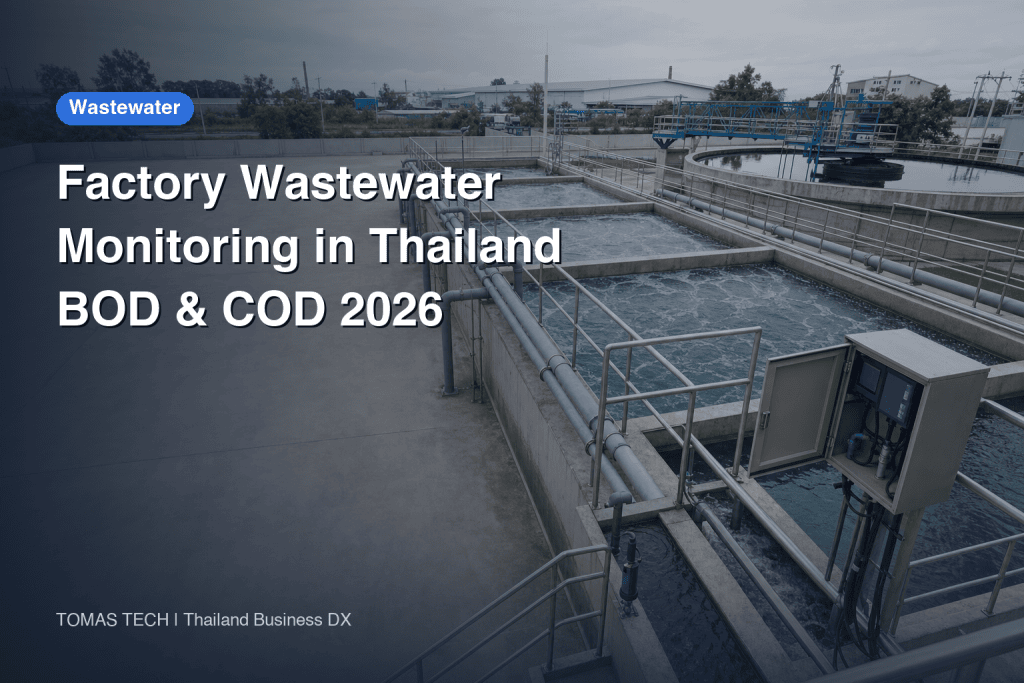
Energy monitoring in a factory usually starts with electricity and then extends to water consumption. But the two sides of water are not the same problem. Measuring intake means measuring volume upstream of the tap. Measuring discharge means measuring water quality at the outfall, and that requires different equipment and carries an entirely different legal exposure. Factory wastewater monitoring tends to be the last thing on the list, and the reason is structural rather than a matter of anyone neglecting it — the quantities that matter are analytical values such as BOD and COD. This article sets out the full picture of Thailand’s wastewater regulations, then works through measurement point design, sensor selection, cost structure and a practical rollout sequence for an IoT-based wastewater monitoring system.
Why wastewater monitoring is always the one that gets put off
The further a company has gone with shop floor visibility, the more likely it is that wastewater is the single area still untouched. Electricity is covered by smart meters and CT sensors. Water consumption is covered by flow meters. Wastewater, meanwhile, arrives as a laboratory report in PDF form once a month, and nobody looks at the day-to-day condition at all. Where does that asymmetry come from?
Intake measures volume, discharge measures quality
Monitoring on the intake side is fundamentally volumetric. Put one flow meter in the pipe and you get a number in cubic metres. The unit is unambiguous, and although the value moves with the season or the process running, the measurement principle never changes. That is precisely why intake monitoring could be treated as a natural extension of electricity monitoring.
On the discharge side, the question is water quality. Two identical volumes of 100 cubic metres of effluent can be treated completely differently in law depending on how much organic matter is dissolved in them, whether they are acidic or alkaline, and whether oil has found its way in. Volume has no concept of a pass mark. Water quality has a limit value for every parameter, and exceeding even one of them is a violation.
The more awkward point is that BOD (biochemical oxygen demand), the headline indicator of water quality, cannot be measured on the spot as a matter of principle. The standard method incubates the sample for five days and observes the decrease in dissolved oxygen, so the measurement takes five days. COD (chemical oxygen demand) is relatively faster because it uses a chemical oxidation reaction, but it is still laboratory work. In other words, wastewater monitoring starts from a completely different level of difficulty than intake monitoring, where fitting a single flow meter finishes the job.
That gap is what determines priorities on the ground. Electricity and intake could be tackled because attaching a sensor produces a number. Wastewater was left to outsourced analysis because attaching a sensor does not produce the legally recognised value. Proposing that wastewater should also be made visible with IoT, without first understanding this structure, gets the conversation nowhere.
The penalty is not a higher bill, it is a shutdown
The second asymmetry is the weight of the consequences when monitoring is neglected.
If you do not monitor electricity, what happens is essentially that your electricity bill rises. Contract demand reviews come late, peak-shaving opportunities are missed, equipment degradation goes unnoticed for longer. All of these hurt financially, but the factory keeps running.
Wastewater is different. Discharging water that exceeds effluent standards puts not only fines on the table but improvement orders, temporary suspension of operations, and in the worst case revocation of the factory licence. In Thailand, Section 70 of the Enhancement and Conservation of National Environmental Quality Act B.E. 2535 (1992) explicitly requires the owner or operator of a pollution source to install and operate a wastewater treatment system. This is a legal obligation rather than a recommendation, and a state of non-compliance that comes to light becomes a target for administrative intervention.
For a Japanese-affiliated plant, the serious part is that such administrative action spills over into relationships with the surrounding community and into how head office assesses compliance. Wastewater problems are visible from outside the fence, in the colour or smell of a canal, so it is not unusual for a case to begin with a complaint from residents. Nobody reports a factory for using too much electricity. They do report abnormal effluent. The purpose of monitoring here is not cost reduction but securing the ability to keep operating, and that is what defines the character of wastewater monitoring.
The full picture of Thailand’s wastewater regulations
Running a factory in Thailand means that the rules governing wastewater do not sit in a single statute. The Enhancement and Conservation of National Environmental Quality Act under the environment ministry, the Factory Act and the notifications of the Department of Industrial Works (DIW) under the industry ministry, and — for plants located in an industrial estate — the notifications of the Industrial Estate Authority of Thailand (IEAT) all overlap. Considering capital investment without first working out which of these actually applies to you leads directly to measuring the wrong parameters.

The treatment obligation under Section 70 of the Act B.E. 2535
The foundation of wastewater regulation is the Enhancement and Conservation of National Environmental Quality Act, enacted in 1992. Section 70 of that Act requires the owner or operator of a pollution source to install a wastewater treatment system or waste disposal facility and to treat the water leaving the pollution source.
What is worth grasping here is that the provision demands the possession of treatment facilities, while whether those facilities actually produce compliant water is secured separately through limit values and inspections. It is a two-tier arrangement. Reading it as “having a treatment plant is enough” leads to the most frequently cited condition of all — the facility exists, but its capacity is insufficient and the discharge exceeds the limits. The role of monitoring is precisely to fill that gap between having equipment and knowing whether it is working.
IEAT industrial estate discharge standards, revised May 2024
Most Japanese-affiliated manufacturers in Thailand are located in industrial estates such as Amata, WHA or Rojana. A factory inside an estate normally sends its treated water to the estate’s central wastewater treatment system rather than discharging it directly to public waters. In that case, the applicable limits are the ones set by IEAT.
On 27 May 2024, IEAT published in the Royal Gazette its notification on general effluent standards for discharge into the central wastewater treatment system of an industrial estate (Notification of the Industrial Estate Authority of Thailand No. 029/2567), which took effect the following day, 28 May. It replaces the previous Notification No. 76/2560. The notification updates the definition of scope — all used water arising from business activities within the industrial estate is covered, while, for example, water used to clean solar panels without detergents or chemicals is excluded.
In practice, the most important point is that the severity of the limits differs enormously depending on where the water goes.
| Parameter | Discharge to estate central treatment plant | Direct discharge to public waters |
|---|---|---|
| pH | 5.5 to 9.0 | 5.5 to 9.0 |
| BOD | 500 mg/L or less | 20 mg/L or less |
| COD | 750 mg/L or less | 120 mg/L or less |
| Suspended solids (SS) | 200 mg/L or less | 50 mg/L or less |
| Total dissolved solids (TDS) | 3,000 mg/L or less | 3,000 mg/L or less |
| Oil and grease | 10 mg/L or less | 5 mg/L or less |
| Total Kjeldahl nitrogen (TKN) | 100 mg/L or less | 100 mg/L or less |
Looking at BOD, the 500 mg/L allowed for discharge inside an estate against 20 mg/L for direct discharge to public waters is a 25-fold difference. The gap exists because the estate’s central plant is assumed to carry out secondary treatment.
Two practical implications follow. First, the level a factory inside an industrial estate should target with its own equipment is the estate’s acceptance standard, not the public waters standard. There is no need to install over-specified treatment capacity. Second, and conversely, a factory located outside an estate, or one where water might reach a stormwater drain, has to face limits that are an order of magnitude or more tighter. The starting point is to confirm, from your contract and your factory licence, which set of standards you sit under.
Continuous monitoring for factories discharging more than 500 m³ per day
No discussion of wastewater monitoring in Thailand can avoid the DIW online monitoring mandate. On 3 October 2022, DIW published in the Royal Gazette its notification on criteria requiring factories with wastewater treatment systems to install special equipment (No. 2, B.E. 2565), which took effect the following day, 4 October. Operators were given a grace period of 120 days.
The notification applies to factories discharging more than 500 m³ of wastewater per day. Those factories must install continuous monitoring equipment to report the condition of their effluent online and transmit the data to DIW’s computer network system. Factories that do not discharge wastewater, and factories that send their wastewater to a central wastewater treatment plant, are excluded.
What is easily overlooked is the deviation management that the same notification requires. Covered factories must calculate the deviation between the values from their BOD or COD measuring instruments and the results of laboratory analysis, and report the outcome to DIW at least twice a year. Related information, facts, documents and records must be retained for at least one year.
This clause fundamentally shapes how a wastewater monitoring system should be designed. Online measured values do not stand on their own as legally recognised figures. Laboratory analysis remains the reference standard, and the online instrument is positioned as something that must continuously demonstrate how well it tracks that reference. Building a wastewater monitoring system therefore means designing not only the collection of sensor readings but also a mechanism that keeps pairing online values with laboratory results from samples taken at the same date, time and location, and recording them. Leave that out of the initial design and every semi-annual report turns into an excavation of historical data.
Even if your own discharge does not reach 500 m³ per day, the thinking behind the notification is still useful. If future production increases could push you past the threshold, building the measurement chain so it can be extended as-is will cost less than rebuilding it later.
The Win Process case and the Draft Industrial Waste Management Act
Separately from effluent limits themselves, it is worth noting that environmental regulation in Thailand as a whole is tightening. The emblematic case is Win Process in Rayong province.
The case involved the discovery of illegal dumping and disposal of hazardous waste, with contamination damage to surrounding waterways and farmland. In 2022, the Rayong provincial court ordered the company to pay compensation to 15 local residents who had brought claims over the environmental impact. At the same time, criticism was directed at whether DIW’s supervision had been adequate.
Prompted by this case, in 2025 the Department of Industrial Works under Thailand’s Ministry of Industry published the Draft Industrial Waste Management Act (DIWMA) and invited public comment until 1 April 2025. The draft adopts the principle of extended producer responsibility (EPR), under which operators bear responsibility for the industrial waste they generate until it has been completely treated or disposed of. Arranging collection and transport, and entrusting disposal only to operators licensed by DIW, also fall within that responsibility. Enforcement is strengthened with measures including licence revocation, substitute performance by DIW with cost recovery, and additional fines.
Why does a waste bill matter in a discussion about wastewater? Because the sludge produced by wastewater treatment is industrial waste. Running a treatment plant inevitably generates sludge, and that sludge has to be entrusted to a licensed contractor for disposal. Managing effluent quality and recording where the resulting sludge goes are, in operational terms, one continuous task. Under an EPR principle, the idea that responsibility ends the moment material is handed to a contractor no longer holds.
Stronger site inspections by accredited private inspectors
Enforcement capacity is changing as well. DIW has been strengthening its inspection regime through the use of accredited private inspectors, and inspectors hold powers including entry to factories, demands for documents, and corrective orders. Government staffing alone placed a ceiling on inspection frequency; bringing private inspection bodies into the system structurally raises the probability that an inspection will actually arrive.
This is where records start to matter. A site inspection does not only ask about water quality at that instant. It asks whether you can show that operation stayed within limits over time, and whether there is a record of what you did when something went wrong. A factory holding nothing but one analysis certificate per month has nothing to say about the other 29 days. With continuous monitoring records, even a day with an exceedance supports an account along the lines of “we detected it, we responded like this, and we recovered at this time.” A substantial share of the value of a monitoring system lies in that explainability.
How an IoT wastewater monitoring system is built
With the regulatory picture in view, we can move to how you actually build one. Thinking about a wastewater monitoring system in three layers — measurement point design, sensor selection, and data recording — makes the investment decision considerably easier.
Three measurement points as the baseline — pre-treatment, post-treatment and outfall
It is tempting to think that wastewater monitoring means measuring the outfall, but that leaves you unable to do anything when something goes wrong. By the time you can see that outfall values have deteriorated, non-compliant water has already left the site.
The practical minimum configuration is three points — pre-treatment (raw influent), post-treatment, and the outfall.
The pre-treatment point captures the load coming in. Watching pH, flow and, where possible, the trend in COD at this point tells you when a high-load stream from a particular process has entered the system. Events such as a chemical bath change on a coating line, a cleaning tank replacement, or a CIP wash swing raw influent quality sharply for a period. Without a measurement point on the influent side, the first sign of trouble is deterioration after treatment, and identifying the responsible process takes time.
The post-treatment point shows the health of the treatment plant itself. Problems in the treatment train — insufficient aeration, deteriorating sludge condition, dosing faults — degrade post-treatment values even when the influent is normal. Comparing pre- and post-treatment values tells you whether the plant is achieving its designed removal rate.
The outfall point is the regulatory evidence itself. This is the location whose values are questioned in DIW reporting and in site inspections, so continuity and retention of the data here take top priority.
The advantage of this three-point configuration is that it lets you isolate a problem immediately. If the influent is bad, it is a process-side problem. If the influent is normal but post-treatment is bad, it is an equipment-side problem. If post-treatment is normal but the outfall is bad, it is a piping or stormwater ingress problem. All three judgements can be made from numbers alone. With only one measurement point, that same isolation has to be done by people walking the site.
Note also that some factories combine multiple streams — production effluent and sanitary effluent, or separate lines. Measuring only a single point downstream of the confluence means you will never know which stream is responsible. Whether a measurement point can be placed upstream of the confluence is a question that must be examined during initial design.
Selecting sensors for BOD, COD, pH and flow
Next comes sensor selection. The first thing to understand is that whether a parameter can be measured continuously varies enormously from one parameter to the next.
pH and flow are straightforward to measure continuously. pH uses an electrode, flow uses an electromagnetic or ultrasonic flow meter, and both yield data on a per-second basis. Conductivity and turbidity are equally amenable to continuous measurement, and both are effective for early detection of abnormalities.
BOD and COD are the problem. As noted above, BOD is an indicator premised on five days of incubation and cannot in principle be measured in real time. What an online instrument reports is a value estimated from a different measurement — ultraviolet absorbance (UV254) or TOC (total organic carbon) — using a correlation equation derived from your own effluent. COD is similar. Online instruments mostly rely on ultraviolet absorbance or electrochemical techniques, and their measurement principle differs from the statutory dichromate or permanganate methods.
This fact bears directly on the investment decision. Installing online instruments does not remove the need for statutory analysis. As the DIW notification’s requirement for deviation calculation and reporting at least twice a year makes clear, the correct positioning is that laboratory analysis continues and online instruments are used as trend monitoring that fills the gaps between analyses.
| Comparison axis | Periodic sampling and laboratory analysis | Online continuous monitoring |
|---|---|---|
| Measurement frequency | Roughly monthly to weekly | Every few minutes to a few tens of minutes |
| Handling of BOD | Measurable by standard method and valid as the statutory figure | Direct measurement not possible. Correlation estimate from UV absorbance or TOC |
| Handling of COD | Measurable by standard method and valid as the statutory figure | Estimated value. Deviation management against laboratory values is assumed |
| Handling of pH and flow | Only the value at the moment of sampling is known | Continuous data available. Most effective for abnormality detection |
| Timing of abnormality detection | Days to weeks until analysis results return | Threshold exceedance detectable the same day |
| Regulatory positioning | The reference standard. Source of the certificate | Mandatory installation for factories discharging more than 500 m³ per day |
| Nature of the cost | Ongoing outsourced analysis fees | Large initial cost, with ongoing calibration and consumables |
| Main weakness | Represents only the instant the sample was taken | Values lose credibility if calibration is neglected |
The realistic selection policy is clear. Start by securing pH and flow with continuous monitoring, then pick one surrogate indicator suited to the character of your effluent — UV absorbance, TOC, conductivity or turbidity — and make it the pillar of trend monitoring. Keep the statutory BOD and COD values coming from laboratory analysis, and develop the correlation equation against online values using operating data. Follow that order and you gain responsive abnormality detection while keeping initial investment down.
Aiming to take every parameter online at once causes investment to jump and pushes the calibration workload beyond what the site can absorb. Online analysers are not install-and-forget equipment. Periodic calibration with standard solutions and replacement of electrodes and reagents are part of the deal, and that has to be built into the cost picture at the selection stage.
Recording data and connecting to the DIW reporting format
How the data from your sensors is retained is the single most important question from a compliance point of view.
The required capabilities come down to three. First, long-term retention of time-series data. The DIW notification requires related records to be retained for at least one year, and in practice keeping several years is the safer choice. Second, alerts on threshold exceedance. Without a mechanism that sets an internal control value with headroom against the legal limit and notifies the responsible person the moment it is crossed, continuous monitoring data becomes nothing more than a record to look back on. Third, output in reporting format. Being able to place online values and laboratory values side by side for the same date and time and produce a table with the deviation calculated turns the semi-annual reporting exercise into a few hours of work.
The most commonly overlooked element is the record of response actions. On the day a threshold was crossed, who checked what, which valve was throttled, and when was normal operation restored? Having that record tied to the same timeline as the numerical data is what determines your explainability during a site inspection. When choosing a monitoring system, checking whether comments and response records can be stored with timestamps delivers more practical value than the elegance of the graphs.
How this differs from electricity and water intake monitoring
Wastewater monitoring is sometimes explained as an extension of energy monitoring you have already deployed, but the design premises are genuinely different. Requesting a quotation framed as adding wastewater to an existing monitoring system is a reliable way to be surprised by installation costs later.

| Aspect | Electricity monitoring | Water intake (consumption) monitoring | Wastewater (quality) monitoring |
|---|---|---|---|
| What is measured | Energy consumption and demand | Flow rate and cumulative volume | Water quality parameters and flow |
| Sensor installation environment | Indoors inside distribution panels | Indoor and outdoor piping | Outdoor tanks and channels, with corrosion and fouling |
| Need for calibration | Essentially none | Periodic inspection only | Periodic calibration with standard solutions is mandatory |
| Risk of doing nothing | Higher electricity bills | Higher water bills, supply restrictions in drought | Improvement orders, suspension of operations, licence revocation |
| Use of the data | Cost reduction, energy reporting | Cost reduction, water resource management | Statutory reporting, evidence for site inspections |
| Basis for judgement | Headroom against contract demand | Variance against budget or unit consumption | Compliance or non-compliance against statutory limits |
The decisive difference is in the last row. For electricity and water consumption data, whether a number is good or bad depends on your own targets. Wastewater quality data has a pass mark imposed from outside, and crossing it is a violation. That difference in character governs everything else — the accuracy required, the calibration frequency, and the number of years the data must be retained.
Comparing this with emissions monitoring on the air side makes the position of wastewater monitoring easier to understand. For stack gas, a framework for continuous measurement and reporting to DIW was established earlier. We cover that subject in detail in our article on CEMS exhaust gas monitoring and the DIW reporting obligation for factories in Thailand. Exhaust gas and wastewater share the same structure — install continuous monitoring equipment and report online to the authorities — and the internal departments responsible often overlap, so planning both together when you deploy one lets you share the communications and data platform.
On the inlet side of water, our article on water usage monitoring and measurement point design for factories in Thailand deals with the design of measurement points. Intake and discharge are physically one continuous system, and looking at the difference between intake volume and discharge volume reveals the unaccounted-for water lost to evaporation, carried away in product, or leaking. If measurement points already exist on the intake side, adding a flow meter on the discharge side is enough to close a water balance, which makes the return on investment far easier to explain.
Implementation cost and how to proceed
The cost of a wastewater monitoring system varies enormously with the number of parameters and the installation environment. Quoting a single market rate would be misleading, but understanding how cost breaks down into line items lets you compare quotations from several suppliers.
| Cost item | What it covers | Nature of the cost |
|---|---|---|
| Sensors and analysers | pH meters, electromagnetic flow meters, UV absorbance analysers, turbidity meters | Initial cost. Proportional to the number of parameters and points |
| Installation work | Measurement chambers, sampling pumps, piping, power supply, weatherproof enclosures | Initial cost. Outdoor installation raises the construction share |
| Communications and data collection | Data loggers, gateways, communication lines | Initial cost plus a monthly charge |
| Monitoring software | Monitoring screens, threshold alerts, report output, history retention | Initial cost or monthly. Varies with retention period |
| Calibration and consumables | Standard solutions, electrode replacement, reagents, filters, cleaning | Annual recurring cost. Frequently missing from quotations |
| Laboratory analysis | Reference analysis for deviation calculation and statutory reporting | Annual recurring cost. Still required after going online |
The two bottom rows are what matter when comparing quotations. Comparing only sensor hardware and installation work makes a proposal with a weak calibration and consumables plan look cheaper. Electrodes are consumables and reagents have expiry dates. The reliable approach is to state up front, as a condition of the request for quotation, that comparison will be on a total cost basis including annual maintenance.

Stage one — establish your current position and take stock of measurement points
The first task is not equipment selection but confirming the conditions you are operating under.
The items to confirm are concrete. Does your effluent go to an industrial estate central treatment plant, or directly to public waters? How many cubic metres per day do you discharge, and where does that sit relative to the 500 m³ threshold? Which parameters and limit values are written into your factory licence and your contract with the estate? What is your current analysis frequency, and were there parameters that came close to the limits over the past year?
Alongside that, trace the effluent route on a drawing. Which processes feed which pipes, where do they combine, which tanks do they pass through, and where does the water leave the site? It is not unusual to find factories where this drawing does not exist. Only once it does can you judge where measurement points need to sit for isolation to be possible.
The deliverables of this stage are an effluent system diagram, a list of the limit values that legally apply to you, and your recent analysis history. With those in hand you can request quotations from several vendors on identical terms. Without them, each vendor builds a quotation on different assumptions and comparison becomes impossible.
Stage two — start small with pH and flow
There is no need to aim for online monitoring of every parameter from the outset. Stage two begins with pH and flow, the parameters that are easy to measure continuously and offer the best cost-effectiveness.
Even those two parameters alone deliver a great deal. A sudden pH shift is an early indication of a chemical dosing error or a process abnormality, and a flow anomaly points to a leak or unexpected effluent ingress. In addition, flow data pins down your actual daily discharge volume by measurement, so you know exactly where you stand relative to the 500 m³ threshold.
What should run in parallel at this stage is the reconciliation of laboratory values against online values. Record the sampling date and time, the online value at that moment, and the analysis result returned from the laboratory in the same table. The more data points accumulate, the more accurate the correlation equation for your own effluent becomes. That accumulation becomes the evidence for deciding whether to install a COD-equivalent online analyser at the next stage, and the foundation for deviation reporting once you have.
Site-level operating procedures should also be settled at this stage. When a threshold is crossed, who is notified, who checks the site, and where is the record kept? Adding more parameters before that routine works produces a situation where alarms sound and nobody moves.
Stage three — add water quality parameters and connect to reporting
In stage three, you use the accumulated data to add online monitoring of water quality parameters and to join everything up through to reporting.
Which parameters to add is determined by the risks that became visible in stage two. A factory with large swings in organic load points toward UV absorbance or TOC. A factory where inorganic suspended matter is the issue points toward turbidity or an SS meter. Prioritising the parameters that actually came close to your limits is far more cost-effective than assembling a full set.
At the same time, build out the reporting output — a deviation table placing online and laboratory values side by side, monthly averages and maxima, and the response history for threshold exceedances. With those generated automatically, both the semi-annual deviation report and the presentation of records during a site inspection become a few hours of work.
After go-live, whether the investment sticks depends on establishing a forum that looks at the data. Review effluent trends monthly, and where a parameter has moved toward its limit, chase the cause back into the process. Without that forum, data accumulates and nobody reads it. The return on wastewater monitoring is realised in the moments when an abnormality was stopped early and when a regulatory interaction ended quickly, and neither happens in an organisation that is not looking at the data routinely.
Realities specific to Japanese-affiliated plants managing wastewater in Thailand and ASEAN
Everything so far has been technology and regulation. Japanese-affiliated plants operating in Thailand and across ASEAN carry an additional layer on top.
First, there are multiple regulatory sources, and news of amendments is hard to obtain in Japanese. DIW notifications under the Ministry of Industry, standards under the environment ministry, IEAT notifications, and provincial ordinances all overlap. As with the May 2024 IEAT notification, some take effect the day after publication in the Royal Gazette, so a rule can already be in force before the in-house legal or environmental team is aware of it. You need either a clearly designated person responsible for checking the sources on a regular cadence, or a working relationship with a local specialist.
Second, there is the management of sludge disposal contractors. Sludge from wastewater treatment must be disposed of as industrial waste, and under the extended producer responsibility (EPR) concept adopted by DIWMA, the generator’s responsibility continues after the material has been handed to a licensed contractor. The validity of the contractor’s licence, the actual disposal destination, and how records are kept through to completion of disposal are all questions to be designed alongside wastewater monitoring. We cover that record design in detail in our article on industrial waste traceability in Thailand and tracking through to completion of disposal. Effluent quality data scattered across one set of files while sludge manifests sit in another is the arrangement that causes the most difficulty explaining yourself during a site inspection.
Third, there is staff turnover. In Thai factories, it is not unusual for the personnel operating wastewater treatment equipment to change every few years. Operation that depends on a veteran’s experience — deciding to increase chemical dosing when a particular smell appears, for instance — is severed the moment that person leaves. With continuous monitoring data and threshold rules, the decision criteria can be held in the equipment instead. Presenting the reduction of person-dependent operation as an objective alongside regulatory compliance tends to win far more acceptance on the floor.
Fourth, there is operation in Thai. The people who actually touch the wastewater treatment plant are Thai staff, and if alert messages and operating screens exist only in Japanese or English, every response is delayed by the detour through a manager. If you want the initial response to an abnormality to be fast, notifications and screens should be designed to work entirely in Thai. This is true of shop floor systems generally, but with wastewater a slow initial response translates directly into an exceedance, so the impact is larger.
Fifth, there is the relationship with neighbouring residents. Because effluent is visible from outside the factory, changes in the colour, foam or smell of a waterway lead to complaints. With continuous monitoring data, you can immediately show what the measured values were during that period. Without data, you remain under suspicion for the entire duration of the investigation. For a Japanese-affiliated plant, the relationship with the local community is a precondition for continued operation, and monitoring data is one of the materials that protects it.
Frequently asked questions
Is factory wastewater monitoring mandatory?
Installing wastewater treatment facilities is an obligation imposed on the owner or operator of a pollution source by Section 70 of the Enhancement and Conservation of National Environmental Quality Act B.E. 2535. On top of that, for online continuous monitoring, the 2022 DIW notification imposes installation and reporting obligations on factories discharging more than 500 m³ of wastewater per day. Factories that do not discharge wastewater and factories that send their wastewater to a central treatment plant are excluded. Even if you are excluded, the discharge standards themselves continue to apply, so you still need records demonstrating that you are within the limits. Judge whether you fall within the obligation on two points — your measured discharge volume and your discharge destination.
How frequently do BOD and COD need to be measured?
Statutory measurement frequency varies with factory type, discharge volume and discharge destination, so the first step is to confirm the conditions written into your factory licence and your contract with the estate. Beyond that, the practical approach is a two-layer arrangement — maintain statutory analysis as the reference standard, and cover day-to-day trends with online surrogate indicators. The fact that the DIW notification requires deviation between BOD or COD instruments and laboratory values to be reported at least twice a year shows that online monitoring complements laboratory analysis rather than replacing it. A factory operating on monthly analysis alone should recognise that it has nothing to say about the remaining days.
What does a wastewater monitoring system cost?
Cost varies so much with the number of parameters, the number of measurement points and outdoor installation conditions that quoting a uniform market rate would be misleading. What matters in comparison is looking at total cost including annual maintenance, not just the initial outlay. Standard solutions for calibration, consumables such as electrodes and reagents, and the laboratory analysis costs needed for deviation calculation are the items most likely to be missing from a quotation. Attaching a condition at the request-for-quotation stage that suppliers present a five-year total cost of ownership is what makes comparison between products meaningful. If you want to hold cost down, a staged rollout starting with pH and flow and adding water quality parameters later works well.
How is this different from electricity and water consumption monitoring?
It differs in three ways. The first is what is measured. Energy consumption and intake volume are single physical quantities — a volume or a cumulative total — whereas wastewater is a set of multiple analytical parameters that together describe water quality. The second is the basis for judgement. Electricity and intake are judged good or bad against your own targets, whereas wastewater has statutory limit values, a pass mark imposed from outside. The third is the risk of inaction. For electricity and intake the consequence is higher cost, whereas exceeding a wastewater limit leads directly to improvement orders or suspension of operations. Because of these differences, wastewater monitoring alone carries far heavier calibration and data retention requirements. Do not assume it can simply be added to an existing energy monitoring system — treat it as an area that needs its own design.
Conclusion
Factory wastewater monitoring lags behind electricity and water intake for a structural reason — what is measured is water quality rather than volume, and BOD and COD cannot in principle be measured in real time. In Thailand, Section 70 of the Enhancement and Conservation of National Environmental Quality Act mandates the installation of wastewater treatment facilities, IEAT revised the discharge standards for industrial estates in May 2024, and DIW requires factories discharging more than 500 m³ per day to carry out online continuous monitoring and report the deviation against laboratory values. On top of that, the Draft Industrial Waste Management Act prompted by the Win Process case adopts extended producer responsibility, and site inspections through accredited private inspectors have been strengthened. When building a monitoring system, take three measurement points — pre-treatment, post-treatment and outfall — as the baseline, start with pH and flow, and add water quality parameters in stages. Sharing the position that online measurement does not replace laboratory analysis but fills the gaps between analyses and secures explainability keeps both the investment decision and the day-to-day operation on a steady footing.
TOMAS TECH supports Japanese-affiliated manufacturers operating in Thailand and across ASEAN with factory data, wastewater included, from measurement point design through visualisation to the connection into reporting work. It is entirely fine if you are still at the early exploratory stage of checking whether you fall within the obligation at all, or undecided about how much of your existing outsourced analysis should move online. We are happy to start from your effluent system diagram and work through it together, so please get in touch with our team whenever it suits you.
References
- In review, environmental protection regulations in Thailand (Lexology)
- Industrial Estate Authority of Thailand updates industrial effluent standards (Enviliance ASIA)
- Thailand strengthens BOD-COD online monitoring of industrial effluent (Enviliance ASIA)
- Thailand, The Draft Industrial Waste Management Act – A new waste management regime (Global Compliance News)
- Thailand, Draft Industrial Waste Management Act (Enviliance ASIA)
- Factory Act in Thailand, Compliance, Penalties and Enforcement (LEX Bangkok)
- Wastewater Environmental Standards in Thailand (U.I. Masters)
- Nong Phawa villagers sue Win Process company demanding environmental restoration and compensation (Arnika)
- Thailand environment and energy standards, certification, regulations and rules (JETRO)


