



Before commissioning an AI PoC, the most important question is not which model to use. It is: what evidence would justify the next investment? A polished demo, a strong average accuracy score, or enthusiastic user comments can all be encouraging. None of them, on its own, proves that the system will create value safely and economically in production.
This guide is written for manufacturers and regional businesses evaluating outsourced or custom AI development in Thailand and Southeast Asia. It explains how to read an AI PoC quotation, define success before development starts, and make a defensible Go, Conditional Go, Pivot, or No-Go decision. It deliberately avoids a universal market-price claim. The effort changes materially with data readiness, workflow risk, integration, security, languages, and the evidence required. A useful estimate therefore exposes its assumptions instead of hiding them behind “PoC package” pricing.
An AI PoC is a decision instrument, not a small production system
A Proof of Concept should reduce the uncertainties that could overturn an investment decision. A good PoC answers five questions:
- Is there a measurable operational problem worth solving?
- Can the available data support the required behavior under realistic conditions?
- Can people detect and handle errors within the organization’s risk tolerance?
- Does the complete human-and-AI workflow improve time, quality, loss, or service?
- Is there a credible production architecture, operating owner, and unit-cost path?
NIST’s AI Risk Management Framework organizes work into Govern, Map, Measure, and Manage. Its Map function emphasizes context, intended use, benefits, costs, human oversight, and risk tolerance; its Measure function calls for documented test sets, metrics, uncertainty, and evaluation in conditions similar to deployment. This is a useful structure for an AI PoC: map the decision context first, measure evidence second, then decide how residual risk will be managed.
The opening statement in a PoC charter should therefore not be “build a predictive model.” A stronger statement is: “determine whether the current inspection workflow’s delay can be reduced, within defined quality and safety limits, at an acceptable production cost.” That wording keeps the model subordinate to the business decision.
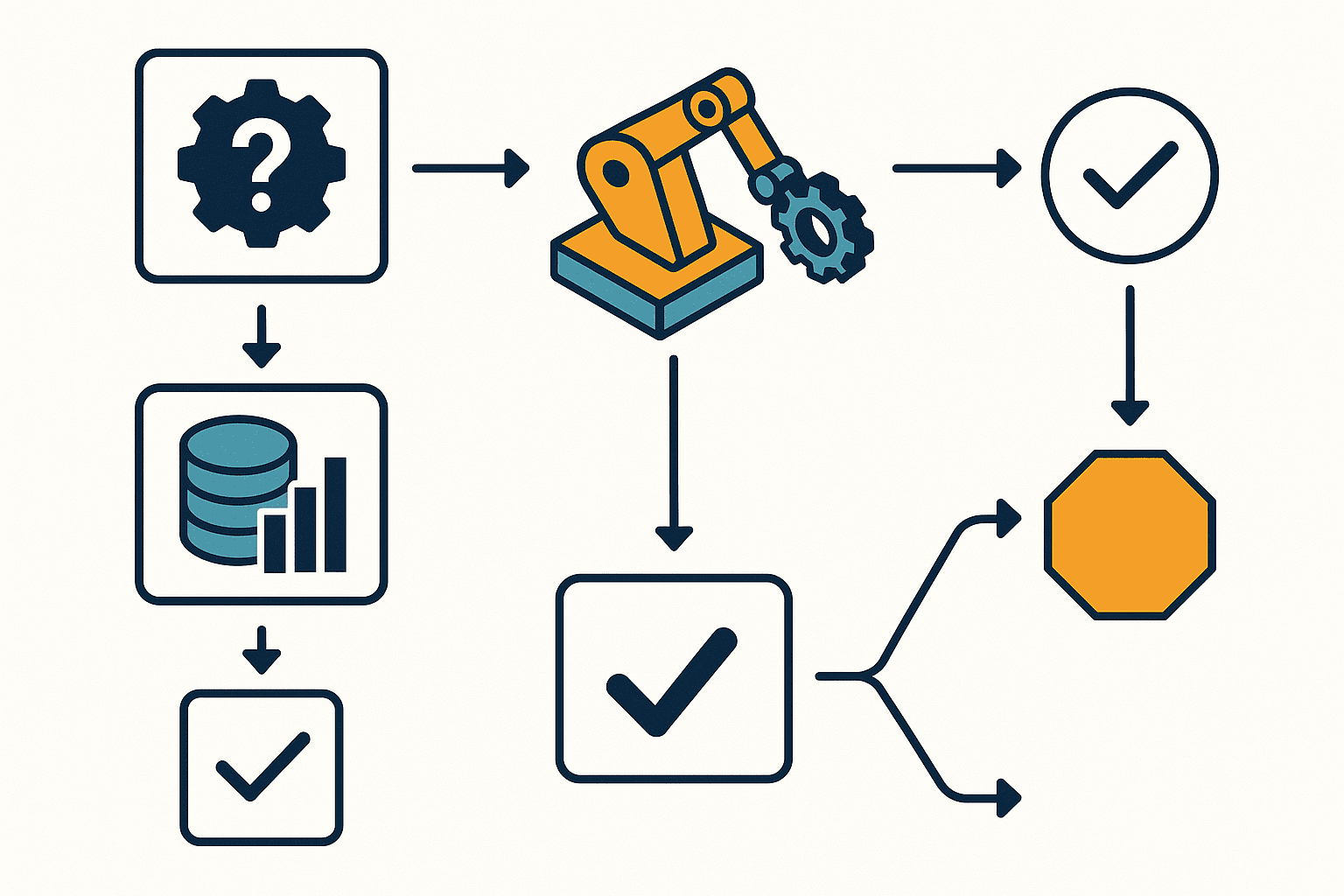
Separate discovery, PoC, pilot, and production
The four stages answer different questions and should not be priced as if they were interchangeable.
| Stage | Primary question | Typical scope | Decision evidence |
|---|---|---|---|
| Discovery | What uncertainty should be tested? | Process, baseline, data, risk, value | Use-case definition, data diagnosis, PoC charter |
| AI PoC | Is the concept technically and economically plausible? | Limited data and evaluation environment | Prototype, fixed evaluation, error analysis, production assumptions |
| Pilot | Does the human-AI workflow work in real operations? | One line, site, team, or controlled user group | Adoption, exception handling, incidents, operating measurements |
| Production | Can it run reliably, safely, and economically at scale? | Approved users, sites, integrations, and service levels | Production platform, monitoring, support, change and re-evaluation controls |
Demanding production-grade availability and every enterprise integration during a PoC can consume the budget before the central hypothesis is tested. At the other extreme, a local demo with hand-prepared CSV files does not validate identity, access, data freshness, ERP or MES errors, monitoring, or ongoing model cost. The scope should state both what the PoC includes and what remains untested. Untested items belong in the production risk and backlog, not in a footnote that disappears after the demonstration.
Read AI PoC cost through eight work packages
Two proposals with the same total can contain very different evidence. Ask each supplier to separate at least these components.
| Cost component | Work included | Assumptions to expose |
|---|---|---|
| 1. Process and requirements | Current workflow, loss, users, success gates, exclusions | Site visits, stakeholder groups, languages, documentation depth |
| 2. Data investigation | Extraction, profiling, cleaning, annotation, privacy treatment | Sources, access, label ownership, missing data, new collection |
| 3. Model or prompt work | Baseline, candidate comparison, training, retrieval or prompt iteration | Models, external APIs, versions, experiment count, reproducibility |
| 4. Evaluation | Test set, metrics, human review, error taxonomy, retest | Acceptance gates, evaluators, segments, independence, deliverables |
| 5. Application and UX | Input, result, approval, correction, history | Demo versus usable workflow, devices, languages, accessibility |
| 6. Integration and platform | ERP/MES/QMS, documents, identity, network, cloud | Real or simulated interfaces, environment, API constraints, reviews |
| 7. Governance and security | Permissions, logs, privacy, IP, misuse and failure testing | Risk coverage, third-party terms, legal review, residual risk |
| 8. Delivery and transfer | Project management, workshops, documents, training, handover | Meeting cadence, source rights, build steps, production planning |
The goal is not to maximize every work package. It is to spend on the evidence most likely to change the decision. If the key uncertainty is whether operators can distinguish an incorrect recommendation, invest in evaluation and exception workflow before polishing the dashboard. If historical sensor data is unreliable, diagnose timestamps, maintenance changes, and failure labels before tuning a model.
Separate one-time PoC cost from production economics
A quotation should show these categories independently:
- Initial work: discovery, data diagnosis, evaluation design, development, integration, security review, training, and migration.
- Usage-based cost: model tokens, inference calls, images or audio, GPU time, storage, and network traffic.
- Fixed operating cost: platform, licenses, monitoring, backup, support, and service management.
- Change cost: new product types, equipment, languages, model migration, prompt or knowledge updates, and re-evaluation.
- Internal cost: domain experts, annotation, IT, quality, legal, user testing, process change, and training time.
Google Cloud’s AI/ML cost-optimization guidance emphasizes resource choices aligned to business requirements, cost visibility, and ongoing optimization. This is especially relevant to generative AI, where input context, output length, model tier, retries, caching, and traffic shape unit cost. Use scenario formulas based on the intended workflow:
Monthly variable cost = cost per processing attempt × monthly attempts + data/storage/network usage
Cost per successful case = (fixed operations + variable cost + allocated change cost) ÷ successfully completed cases
The denominator should not be raw API calls. Separate retries, rejected responses, and cases that still require full manual work. Test a baseline, expected, peak-load, and unfavorable scenario. The purpose is not to predict a vendor’s future price precisely. It is to identify which assumption could make the business case fail.
Four omissions that make a low quote expensive later
Low price is not itself a warning, but these exclusions deserve attention:
- Ground truth: no one is assigned to decide what a correct result is or resolve expert disagreement.
- Reproducible evaluation: only selected demo examples are shown; test cases, versions, and run conditions are not transferred.
- Production gap: hand-carried files work, while actual permissions, latency, master data, and transaction errors remain untested.
- Exit and ownership: source, prompts, retrieval configuration, test data, dependency terms, and deletion obligations are unclear.
Put deliverables, assumptions, exclusions, customer tasks, and change triggers in one comparison sheet. A proposal can then be compared fairly even when suppliers choose different technical approaches.
Define AI PoC success on four axes
Success criteria belong in the statement of work before the supplier sees the final result. OpenAI’s evaluation guidance recommends defining the objective, collecting a dataset, setting metrics, running comparisons, and continuing evaluation. For non-deterministic output, combine task-specific automated checks, human judgment, rule-based controls, and carefully validated model-based grading where appropriate.
1. Technical quality: measure the errors that matter
Choose metrics that reflect the operational cost of mistakes. A classifier might need precision, recall, F1, and a confusion matrix. An anomaly system needs separate missed-event and false-alarm analysis. Forecasting requires an error distribution rather than one average. A generative workflow may need factual correctness, grounding, instruction adherence, format validity, safety, and refusal behavior.
Report performance by critical segment—product family, machine, language, shift, document type, or risk class. An acceptable average can hide an unusable minority group. Separate the final evaluation set from development data, check for leakage and duplicates, and version the dataset, model, prompt, retrieval index, and grading logic. NIST AI RMF Measure explicitly supports documenting test sets and metrics and assessing behavior in deployment-like conditions.
2. Business value: time the complete workflow
Do not report only “the model answered in two seconds.” Include preparation, review, correction, approval, exception handling, and downstream rework.
| Value hypothesis | Baseline | PoC measurement | Common mistake |
|---|---|---|---|
| Faster record creation | Median and distribution of current total time | Total time with AI, including correction | Counting only inference time |
| More consistent inspection | Inter-rater agreement, misses, false positives | Human-plus-AI result and reinspection | Comparing AI alone to an undefined process |
| Faster service response | First-response and completion time | Grounded completion and repeat-contact rate | Ignoring the impact of wrong answers |
| Less equipment downtime | Downtime and detection-to-action lead time | Lead-time change and avoidable events | Attributing seasonal or volume effects to AI |
Where feasible, compare similar cases using the current method and the AI-assisted method. Record user experience, case difficulty, and exclusions. For a small sample, show distributions and failures rather than a headline percentage with no denominator.
3. Risk: include hard stop conditions
A success scorecard must say what the system must not do. Examples include sending confidential data to an unapproved environment, revealing documents outside user permissions, taking a high-impact action without defined human approval, or continuing unsafely when a model service is unavailable. Test logging, access control, prompt or input attacks, misuse, source attribution, fail-safe behavior, and incident escalation in proportion to the use case.
ASEAN’s Expanded Guide on AI Governance and Ethics for Generative AI addresses accountability, data, security, content provenance, testing, and incident reporting. For a regional deployment, evaluate each operational language and location, not only an English or translated master dataset. Document legal and policy questions that the PoC cannot close, assign an owner, and make closure a production condition.
4. Operational readiness: name the people who will own it
An accurate model is not production-ready if these fields are blank:
- business owner and technical service owner;
- error reporting, triage, correction, and user communication;
- quality, cost, drift, and incident monitoring thresholds;
- approval for model, prompt, knowledge, and data-schema changes;
- fallback workflow and recovery objective when a dependency fails;
- re-evaluation when products, equipment, sites, languages, or policies change;
- user training and interface controls against automation bias.
AWS Prescriptive Guidance describes advancement from a generative AI PoC to preproduction as a formal, evidence-based decision, tied to predefined KPIs and expressed in the language of business value. Involve operations, IT, security, quality, finance, and legal or compliance as needed from the start—not as a final approval queue after the prototype is complete.
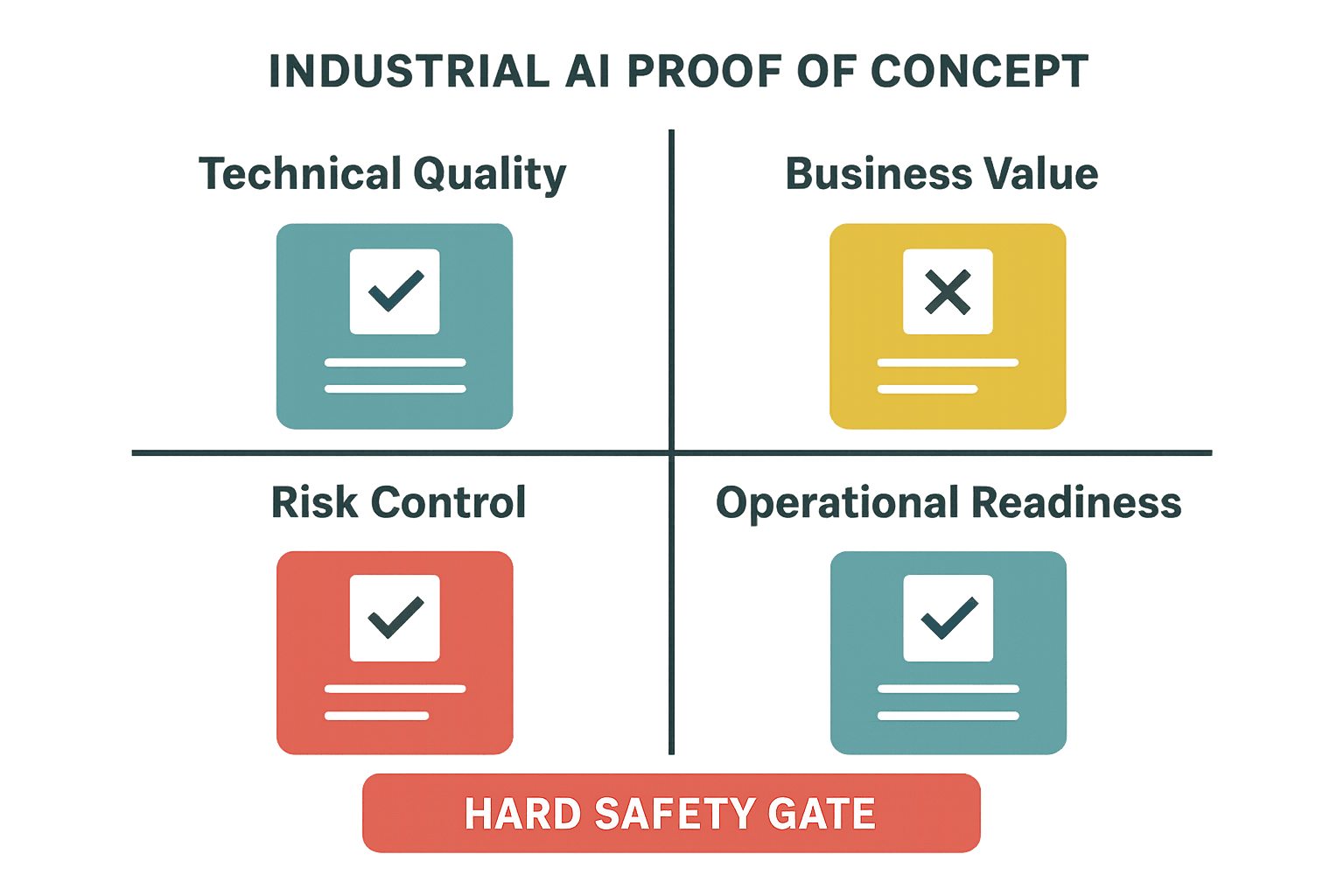
Put the acceptance logic on one scorecard
The numbers below are intentionally not prescribed. Each organization should fill its baseline, target, measurement method, criticality, and decision owner before execution.
| Decision domain | Example evidence | Gate logic |
|---|---|---|
| Business value | End-to-end time, loss, lead time, quality outcome | At least one core KPI must meet the pre-agreed requirement |
| Technical quality | Frozen test set, segment results, error analysis | A good average cannot cancel failure in a critical segment |
| Safety and compliance | Risk register, tests, approvals, residual risk | An untreated critical risk is a hard stop |
| Workflow fit | Observed task completion, exceptions, correction logs | Measure completion and error, not popularity alone |
| Data sustainability | Rights, quality, refresh, ground-truth owner | One-off manual preparation is not a production data plan |
| Economics | Unit-cost and benefit scenarios | Include high-volume and adverse assumptions |
| Operations | Monitoring, incident, change, and re-evaluation RACI | No accountable owner means no unconditional Go |
| Implementation path | Architecture, integration tests, production backlog | Untested work must have scope, cost, owner, and gate |
Keep hard gates separate from weighted scores. Otherwise, a severe data exposure could be mathematically offset by high user satisfaction. Critical safety, rights, or compliance failures should drive No-Go or redesign. A solvable UX issue or limited segment gap may support Conditional Go only when the corrective action, owner, cost, deadline, and re-test are explicit.
What to put in an outsourced or custom AI development brief
Custom AI development gives a company control over its workflow and differentiating data, but the customer still owns decisions about what “correct” means. Include the following in an RFP or statement of work.
Business and operating context
- current process, users, frequency, volumes, peaks, sites, and languages;
- loss to address and baseline, or a discovery task to establish the baseline;
- what AI may recommend, what a human must approve, and what may be automated;
- excluded functions, prohibited use, and capabilities that will not be productionized in the PoC.
Data and evaluation
- sources, owner, period, approximate volume, formats, and sensitivity;
- ground-truth definition, annotators, and adjudication of disagreement;
- development, validation, and final-evaluation split and leakage controls;
- mandatory metrics, supporting metrics, segments, gates, and decision owners;
- transfer of test cases, error analysis, results, and reproduction instructions.
Technology and security
- approved cloud, on-premises, models, and third-party API constraints;
- identity, permissions, encryption, logs, retention, deletion, and backup;
- ERP, MES, QMS, PLM, or document interfaces and which ones are simulated;
- whether response time, concurrency, and availability are PoC tests or production requirements;
- third-party training use, data location, terms, and exit or migration requirements.
Rights, transfer, and termination
- ownership and reuse rights for source, configuration, prompts, workflows, and evaluation data;
- open-source, pretrained model, API, and content licenses;
- build instructions, architecture, dependency list, and vendor-transfer package;
- deliverables retained after No-Go and evidence of data return or deletion;
- assumptions for a new production estimate, warranty boundary, and support options.
For a broader procurement checklist, see How to Choose an AI Development Company in 2026. The stage-gate structure is covered in the AI Implementation Roadmap 2026, while AI ROI Measurement Framework 2026 connects benefits, total cost, and risk to management metrics.
Compare validation plans, not model brand names
Ask each AI development company:
- What is the first uncertainty you would test, and why?
- Will you compare against a rule, search, existing product, or current-process baseline?
- How will failure cases be collected, classified with domain experts, and retested?
- Which artifacts let another team reproduce the result?
- What architecture, review, operating work, and cost appear only after PoC?
- What organizational asset remains if the answer is No-Go?
A credible proposal does not promise success before examining the data. It describes how the customer will know whether to proceed.
An illustrative eight-week AI PoC cadence
The duration is an example, not a universal schedule.
| Week | Main activity | Customer participation | Gate or artifact |
|---|---|---|---|
| 1 | Agree value hypothesis, constraints, users, and decision roles | Business owner, IT, risk stakeholders | Charter and RACI |
| 2 | Diagnose access, quality, rights, and bias in data | Data owner and domain experts | Data report and continue/stop gate |
| 3 | Freeze baseline, test set, metrics, and critical cases | Evaluators confirm ground truth | Evaluation specification |
| 4 | Build minimum prototype and baseline comparison | Weekly error review | First result and critical blockers |
| 5 | Improve and perform risk/failure tests | Users test exceptions and misuse | Versioned evaluation and risk register |
| 6 | Limited workflow trial | Users review, correct, and approve | End-to-end time and operational evidence |
| 7 | Design production architecture, operations, and cost | IT, finance, and service owner | TCO sensitivity and production backlog |
| 8 | Independent review and decision meeting | Named decision group | Final report and signed decision record |
Intermediate gates prevent a team from spending the full budget after discovering unusable data. Even a stopped PoC can leave reusable assets: a data dictionary, baseline, frozen test set, error taxonomy, and risk register. No-Go can be a successful risk-reduction result.
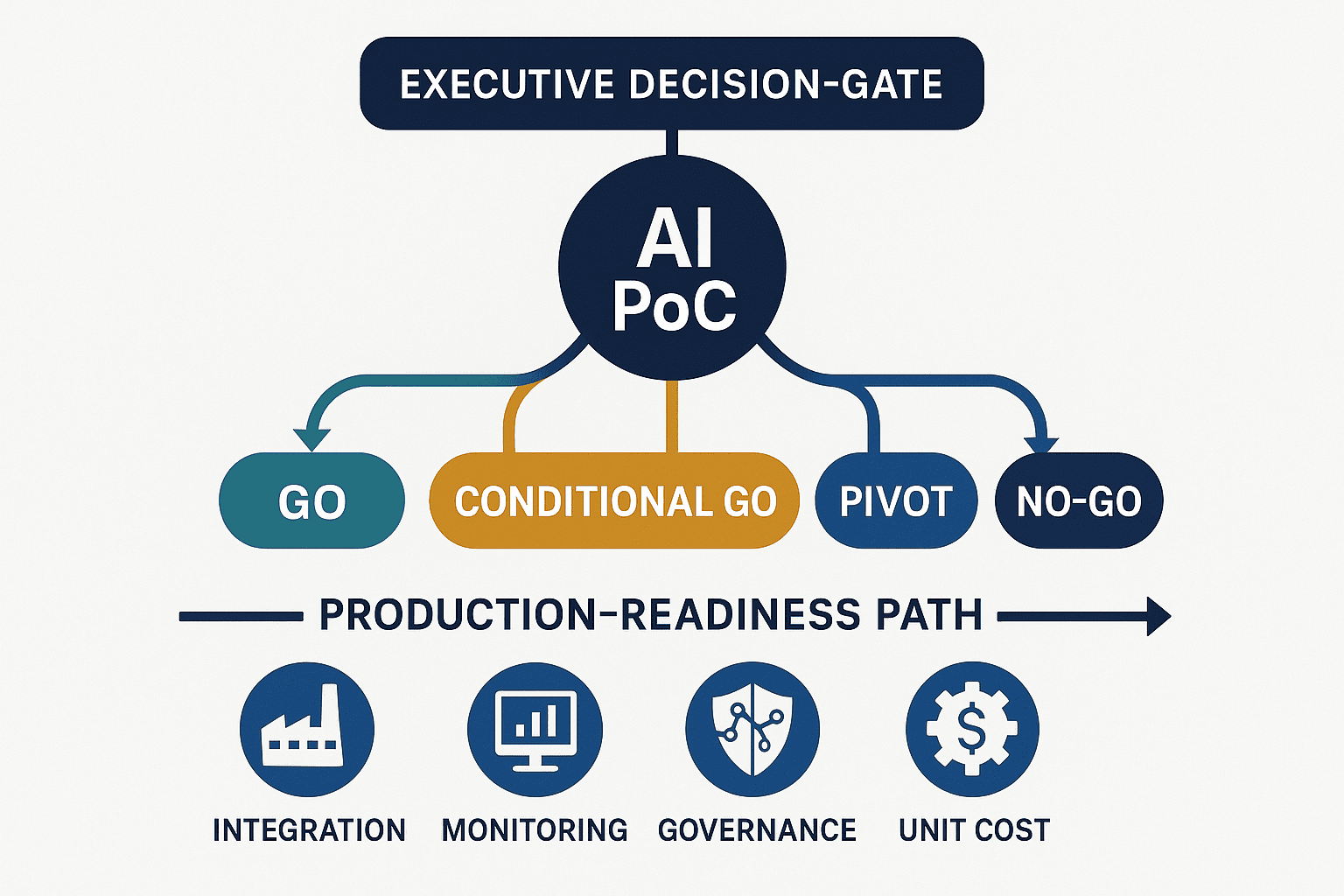
Make an explicit Go, Conditional Go, Pivot, or No-Go decision
Go
All hard gates pass, at least one core business outcome shows meaningful evidence, and the remaining production work has scope, owner, budget, and a further gate. Go authorizes the next controlled investment; it does not mean immediate enterprise-wide rollout.
Conditional Go
The value hypothesis is supported, but bounded issues remain—such as more data for one product family, permission integration, monitoring design, or policy approval. Every condition needs an owner, deadline, test, and stop rule. “We will improve it later” is not a condition.
Pivot
The problem is worth solving, but the selected approach is not. Change from generation to retrieval, custom training to a product, full automation to decision support, or a broad process to one high-frequency task. Reuse the same frozen evaluation where possible.
No-Go
Choose No-Go when data rights are unavailable, core KPIs do not improve, critical risk cannot be reduced, production economics are unacceptable, or no organization will own operations. Record the evidence, trigger for future reconsideration, artifact location, data disposition, and contract closeout.
Re-estimate seven production gaps
Do not multiply the PoC quote by the number of users. Re-estimate:
- transaction volume, peak periods, retries, and latency;
- sites, shifts, devices, users, permissions, and languages;
- real ERP/MES master and transaction interfaces, logging, and reconciliation;
- availability, backup, recovery, and dependency fallback;
- quality, cost, drift, feedback, and incident monitoring;
- model retirement, price changes, schema changes, new products, and policy updates;
- service desk, training, approval, change backlog, and budget ownership.
Model the business case as a range. Include internal review and exception handling in cost. Attribute only the benefit the AI-enabled workflow actually caused, separating simultaneous standardization or training initiatives.
Why this matters for manufacturers in Thailand
Thailand’s Board of Investment reported that investment-promotion applications in the first half of 2026 reached approximately THB 1.47 trillion across 1,299 projects, up 37% year on year, with the digital sector accounting for approximately THB 1.12 trillion. These figures do not prove that any individual AI PoC will succeed. They do show a rapidly moving investment environment in digital infrastructure and AI-related activity. The practical response is not to “AI everything,” but to select factory, quality, maintenance, engineering, document, or customer workflows where a controlled experiment can produce decision evidence.
For a Thailand operation, align headquarters requirements with shop-floor reality. If Japanese management documents, English specifications, and Thai operator inputs coexist, evaluate each language directly. Include shift patterns, temporary staff, supplier data, paper steps, and network constraints. A translated Japanese test set is not sufficient evidence for a Thai workflow.
Frequently asked questions about AI PoC procurement
How much should an AI PoC cost?
There is no responsible universal figure. A clean classification dataset and a multi-system, multilingual factory workflow are not comparable. Break the quote into process, data, model, evaluation, UX, integration, governance, and transfer. Compare the same assumptions and request a separate production-cost model.
What is the most important AI PoC success factor?
Agree what evidence changes the investment decision before development begins: baseline, frozen test set, critical errors, business KPI, risk gates, production-cost assumptions, and decision owners. Control any later change to acceptance criteria.
Must all data be clean before outsourcing AI development?
No. But identify ownership, access, period, format, sensitivity, and the experts who can judge correctness. If quality is unknown, make data diagnosis the first paid gate instead of assuming it inside a fixed model-build price.
What deliverables should an AI development company provide?
Request the charter, data dictionary, fixed evaluation set, versioned results, error analysis, risk register, reproducibility instructions, production architecture, cost assumptions, and unresolved backlog—not only a UI and source code.
Is custom AI development better than an off-the-shelf product?
Not automatically. A product may deliver evidence faster for a standard workflow. Custom AI can be appropriate where proprietary data, equipment integration, decision rules, or differentiation matter. Compare rules, products, existing APIs, and custom work against the same workflow outcome and total cost.
Does missing the target accuracy mean No-Go?
Not always. A gap isolated to a solvable segment may support Conditional Go or Pivot. A severe unresolved risk, weak business value, or an improvement plan with no evidence supports No-Go. Decide this logic before seeing results.
What work tends to expand most in production?
Production integration, identity and permissions, monitoring, exception handling, training, incident response, data refresh, and change management usually expand beyond the model work shown in a PoC. Do not estimate production from the prototype alone. Use a pilot with real users and the complete workflow, including the fallback procedure when AI is unavailable, before widening deployment.
Summary: the output of an AI PoC is a better investment decision
An AI PoC should produce more than a convincing demonstration. Decompose cost, preserve a current-process baseline and frozen evaluation set, and judge technical quality, business value, risk, and operational readiness through pre-agreed gates. Treat Go, Conditional Go, Pivot, and No-Go as valid outcomes. That approach avoids premature production spending while leaving reusable data, evaluation, and process knowledge behind.
You can speak with TOMAS TECH while your team is still framing the PoC brief, evaluation set, or production-cost assumptions. We help connect management, factory operations, and IT conditions in Thailand so the experiment supports a real deployment decision. Contact TOMAS TECH.
References
- NIST AI Risk Management Framework Core
- AWS Prescriptive Guidance: Advancing a generative AI PoC to preproduction
- Google Cloud Architecture Framework: AI and ML cost optimization
- OpenAI API Documentation: Evaluation best practices
- Thailand BOI: First-half 2026 investment applications
- ASEAN: Expanded Guide on AI Governance and Ethics – Generative AI


