


Once a Japanese-affiliated factory in Thailand finishes its first round of automation investment, the same question always comes up next: who is going to keep this running? A robot, a control panel, a PLC — the moment any of it goes live, the equipment maker’s or system integrator’s engineers are the ones who commission it. But the month after they leave, someone inside the plant has to redo the teaching every time the product mix changes, do the first-pass triage when an alarm fires, and place the order for the handful of program changes that come up each year. The automation technician shortage is partly a hiring problem — job postings that don’t get filled — but it is just as much an operating-design problem: who is actually responsible for keeping the uptime you paid for. This article revisits the whole framing of “in-house or outsourced” as a binary choice, lays out how to split the work by the nature of each task, and turns that judgment into a break-even model you can run with numbers.
The Automation Technician Shortage Shows Up After the Equipment Is Already Running
During the investment-evaluation stage, almost all of the discussion centers on the equipment itself: which robot maker to choose, whether payload and reach are sufficient, how many years the payback period will take. In our experience, “how will we secure maintenance staff” rarely makes it onto the agenda at this point. For a while after start-up there’s a warranty period, and the equipment maker handles early-life defects, so everything runs smoothly on the surface even with no technician on staff.
The problem becomes visible once the warranty expires and production items start to diverge from the original assumptions. A new model launch requires teaching corrections. A change in production volume means the conveyor’s transfer timing needs adjusting. One sensor fails and swapping in a replacement means touching the PLC’s address settings. None of these is serious enough to shut the line down for good, but if nobody in-house can touch the equipment, the only option is to call an outside contractor — and the lead time between placing that call and someone actually starting work becomes, in effect, a hard constraint on the line.
From the labor-market side, the competition for this kind of talent shows up in several indicators. In ManpowerGroup’s 2026 Global Talent Shortage survey, conducted October 1–31, 2025 across 41 countries and 39,063 companies, 72% of employers said they were struggling to find people with the skills they need. For the first time, that survey put AI-related skills at the very top of the “hardest skills to find” list, ahead of engineering and traditional IT skills, which had previously held the top spots. It’s worth being precise about what this does and doesn’t tell us: it’s a global aggregate across 41 countries, not a Thailand-specific figure, and not a figure limited to manufacturing automation technicians. What the survey actually shows is a structural shift — technical talent is getting harder to hire worldwide, and within that competition, AI-related skills have pushed past traditional engineering roles to become the scarcest of all — not a specific “Thailand is short by X automation technicians” number.
Looking specifically at Thailand, job-listing volume offers indirect evidence of hiring demand. As of July 2026, Glassdoor listed 933 “automation”-related job openings in Thailand. That’s not a shortage statistic — it simply signals that demand from the hiring side is strong. But it lines up with what practitioners already feel: when you try to hire someone experienced, there’s a lot of competition for that person.
On the wage side, Thailand’s skill-level wage standards are a useful reference point. The rate set for an Industrial Robot Controller Level 1 position is 605 THB per day, about 1.51 times Bangkok’s general minimum wage of 400 THB per day. That’s the rate for an entry-level, certified skill category — an engineer capable of handling robot teaching and PLC program revisions single-handedly sits well above this band. In other words, the decision to build an in-house automation technician role doesn’t pencil out if you’re thinking about it in the same labor-cost terms as general factory staff.
In-House or Outsourced Isn’t a Binary — It Splits by the Nature of the Task
When we’re asked about securing automation technicians, most people we talk to are wrestling with a binary: build the capability internally, or hand everything to the SI or equipment maker. In practice, though, these two aren’t mutually exclusive. Within the same factory, some tasks are clearly better handled in-house, and others are cheaper and more reliable outsourced. The real decision isn’t “which one” — it’s “which task goes to which side.”
The Two Axes Are Frequency and Required Expertise
There are two axes for making this split: how often a given task occurs, and how much expertise it demands.
Outsource a high-frequency task and each individual call-out may be cheap, but the call-outs pile up and the annual bill grows accordingly. Worse, the time spent waiting for the outside technician to arrive becomes downtime for the equipment. Go the other way — try to build an in-house capability for a low-frequency task — and the person you trained only gets to use that skill a few times a year; their proficiency never really builds up while the knowledge they learned quietly goes stale.
On the expertise axis, the more a task involves advanced diagnostics or design changes, the more time and money it takes to train someone into it. Learning to adjust a robot’s taught points is a very different order of training from learning to isolate a servo amplifier fault and decide whether a board needs replacing — the gap is roughly an order of magnitude.
Laying automation-related tasks out along these two axes gives you something like this:
| Task | Frequency | Expertise required | Impact on downtime | Where it should sit |
|---|---|---|---|---|
| Robot teaching corrections | High (every product changeover) | Medium | Direct hit | In-house |
| Fine-tuning production parameters | High | Low–medium | Direct hit | In-house |
| Daily preventive maintenance, cleaning, minor recovery | Very high (daily) | Low–medium | Direct hit | In-house |
| PLC program revisions | Low (a few times a year) | High | Easily absorbed by planned downtime | Outsourced |
| Fault diagnosis, board replacement, advanced repair | Low | Very high | Direct hit, but infrequent | Outsourced (guarantee response time by contract) |
| Control panel modification / expansion | Low (at equipment renewal) | High | Easily absorbed by planned downtime | Outsourced |
What the right-hand column of this table shows is that the line between in-house and outsourced isn’t drawn by “how difficult is this,” but by “how often does it happen” and “does the line actually stop when it happens.” If you draw the line by difficulty alone, you end up outsourcing tasks that are easy but happen every day — and the contract bill balloons.
In-House Robot Teaching Pays Off Through Downtime, Not Skill
On a high-mix, low-volume line, robot teaching corrections come up weekly, sometimes daily. Factories that depend on an outside contractor for this end up either calling in an SI engineer every time the product mix changes or blocking off a visit date in advance — and the production schedule ends up hostage to the teaching schedule.
Bringing teaching in-house effectively eliminates that waiting time, and that’s its biggest payoff. We’ve laid out the work involved and the skill range required in Robot Teaching and Programming in Practice; the short version is that adjusting existing points in an already-written program is well within reach of a manufacturer’s training course plus repetition on the shop floor. Designing a trajectory from scratch and fine-tuning existing taught points call for very different amounts of training.
That said, bringing this in-house isn’t free up front. There’s the training-course fee, the opportunity cost of the trainee being off the floor during that training, and the time equipment sits idle for practice. These costs are usually not accounted for in the equipment’s purchase price and tend to get treated as an afterthought that shows up only once the investment decision is already made. If your plan is to bring teaching in-house, the training budget should be built into the same capital-approval request as the equipment itself.
PLC Program Revisions Usually Favor Outsourcing
PLC program revisions are the mirror image of teaching in almost every respect. They happen rarely — a few times a year, usually driven by equipment spec changes or new production items — but the expertise they demand is high: you need to read the structure of an existing program, assess the impact on other processes, and make the change without breaking anything. If the change touches a safety circuit, the bar for demonstrated experience goes up even further.
Training someone in-house to write PLC programs, and keeping that skill sharp, for a task that only comes up a few times a year is an inefficient use of resources. If six months pass between training and the next time that person actually touches a program, most of what they learned won’t still be usable at a working level. This is a domain better handed to a specialist outside firm, both for quality and for cost stability. We cover how to scope requirements and read quotes in Outsourcing PLC Program Development.
That doesn’t mean zero in-house knowledge is acceptable, though. At minimum, someone internal needs to know which PLC controls which device, where program version history is tracked, and needs to own the job of keeping a change log in-house. Skip this and keep outsourcing indefinitely, and a few years down the line you’ll have equipment whose program nobody inside the company can explain.
Equipment Maintenance Splits by Layer, Not as One Block
Debates over whether to bring equipment maintenance in-house or outsource it often go nowhere because they treat “maintenance” as a single undifferentiated block. In reality, maintenance work splits into layers, and the answer differs by layer.
Daily preventive maintenance — cleaning, lubrication, tightening, filling in inspection logs — along with first-pass alarm triage and simple recovery, happens every day and has to be handled on the spot or the downtime becomes a direct loss. This is in-house, full stop. Unless an outside technician is physically stationed at your plant, there’s no way to structure daily maintenance as an outsourced function in the first place.
On the other hand, diagnostics that require measurement — vibration analysis, insulation testing — servo motor and amplifier replacement, and tracking down intermittent faults with no obvious cause all require dedicated instruments and experience, and they come up infrequently. This is the layer worth outsourcing, with response time guaranteed by contract. We go into the benefits of outsourcing maintenance and how to structure the contract in Outsourcing Equipment Maintenance.
The same structure holds when you narrow it to robots specifically. A common line: daily inspection, battery replacement, and homing operations stay in-house; gearbox replacement and controller-board diagnostics go to the manufacturer or a maintenance provider. As How to Choose Robot Maintenance Support discusses, the cost of a maintenance contract swings heavily on the combination of annual visit count and response time, so it pays to decide how much you’re absorbing in-house before you negotiate contract terms — that produces a leaner contract with less waste.
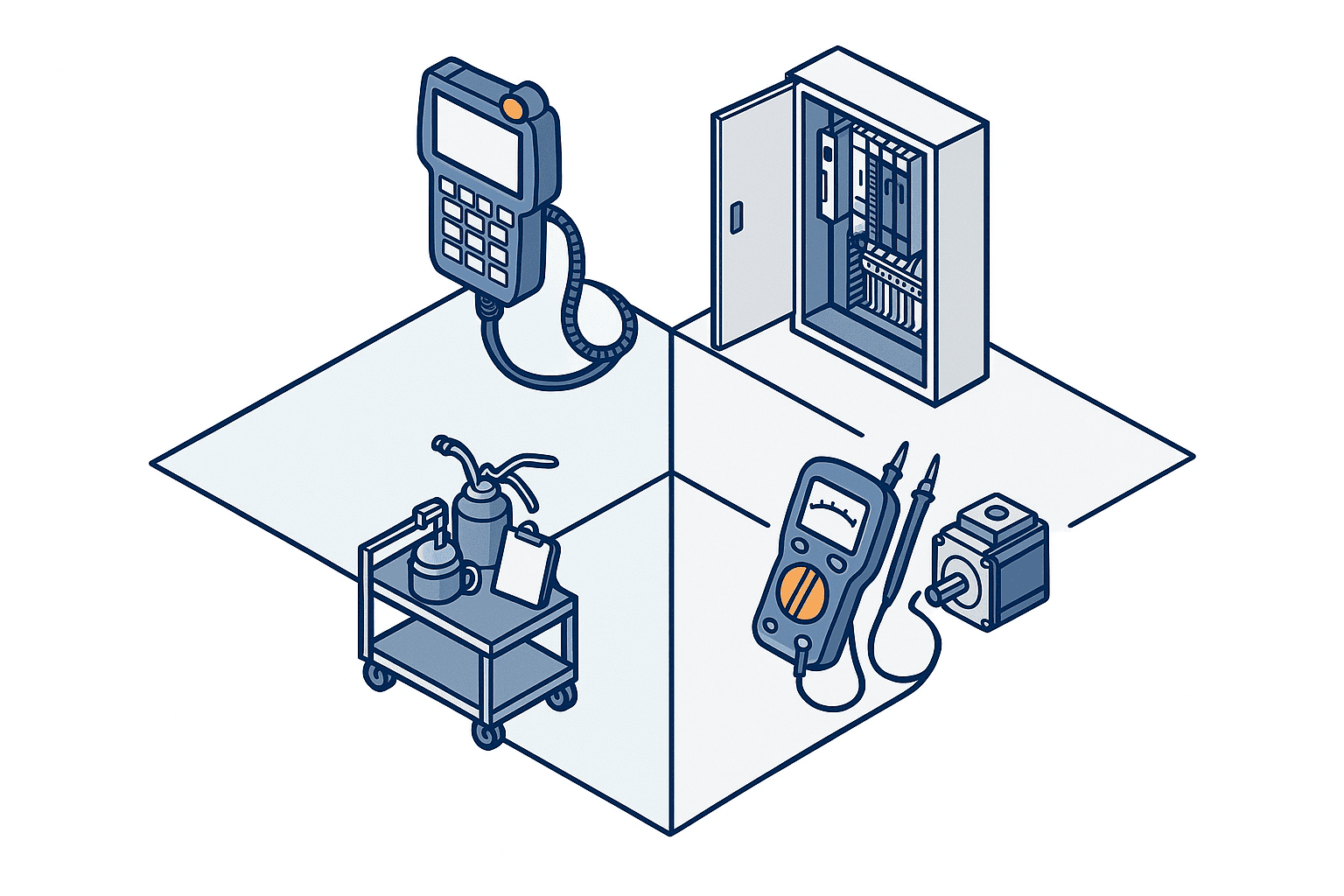
The Break-Even Point Between One In-House Technician and an Outsourced Maintenance Contract
With that framework in place, we can turn the decision into a simple model. The goal isn’t a precise figure — it’s to get a sense of the order of magnitude: roughly how many times a year you need a technician’s hands before it makes sense to bring the role in-house. Every number below is an assumption for the sake of the exercise; real conditions will move these significantly. Swap in your own actuals when you use this.
In-House Assumptions
We’ll build up the three-year cost of keeping one engineer on staff who can handle automation equipment. The assumptions:
- Monthly salary of 40,000 THB, with bonuses bringing the annual total to 13 months’ pay — 520,000 THB
- Statutory welfare costs (social security, etc.) and allowances assumed at 10% of salary, bringing total annual labor cost to 572,000 THB
- Recruiting fees and job-ad costs of 80,000 THB, first year only
- Training cost of 150,000 THB in year one — covering the manufacturer’s course fee plus the opportunity cost of the trainee being off the floor during training
- Ongoing training cost of 50,000 THB per year from year two onward
- An expected cost for turnover risk: assuming a 25% annual turnover rate, and a cost of 80,000 THB in recruiting plus 150,000 THB in retraining (230,000 THB total) per departure, the expected annual cost booked is 57,500 THB
Building this up over three years:
| Cost item | Year 1 | Year 2 | Year 3 |
|---|---|---|---|
| Labor cost (incl. statutory welfare) | 572,000 | 572,000 | 572,000 |
| Recruiting cost | 80,000 | 0 | 0 |
| Training cost | 150,000 | 50,000 | 50,000 |
| Expected turnover-risk cost | 57,500 | 57,500 | 57,500 |
| Annual total | 859,500 | 679,500 | 679,500 |
The three-year total comes to 2,218,500 THB, or an average of 739,500 THB per year. All figures in the table are in THB.
Outsourcing Assumptions
As the comparison case, we’ll model a maintenance contract you call on as needed:
- An annual base maintenance contract fee of 200,000 THB, including four scheduled visits
- Each visit beyond the four included in the contract costs an additional 25,000 THB
- If N is the number of call-outs in a year, annual outsourcing cost equals 200,000 THB plus 25,000 THB times (N minus 4)
The Break-Even Point Without Downtime
First, comparing pure monetary cost: setting the in-house annual average of 739,500 THB equal to the outsourcing cost, the excess over the four included visits works out to 539,500 THB. Dividing that by 25,000 THB per visit gives roughly 21.6 additional visits; adding back the four included visits puts the break-even point at roughly 26 call-outs per year. For a factory calling in an outside technician a little over twice a month, keeping one engineer in-house works out cheaper.
Twenty-six times a year should feel intuitively like a lot. Looking only at this number, the natural conclusion is “we’re nowhere near that volume, so outsourcing is fine as-is.”
Factor In Downtime, and the Break-Even Point Drops to a Fifth
But this comparison is missing something decisive: the fact that the equipment sits idle from the moment you call an outside technician until they arrive.
Let’s set another assumption here. For outsourcing, we’ll put the average time from call-out to a technician arriving on-site and starting work at 8 hours — essentially, response is on the following business day. For an in-house technician, we’ll put that at 1 hour. The difference is 7 hours per incident. Assuming a lost-profit cost of 15,000 THB for every hour the line is down, that 7-hour gap is worth 105,000 THB per incident.
Add that downtime difference into the outsourcing side and recalculate the break-even point, and it drops to roughly 5 times a year — from 26 down to 5, a fifth of the original figure. Even a factory calling an outside technician less than once a month — something more like once a quarter — tips in favor of in-house the moment you convert downtime into money.
What actually decides between in-house and outsourced isn’t the size of the labor cost most people assume it is. What really moves the break-even point is the price tag on the hours the line sits idle waiting for a technician to show up. This is the core conclusion of this article: refining your labor-cost estimate down to the nearest 10,000 THB matters far less to the decision than first figuring out what one hour of downtime on your own line is actually worth.
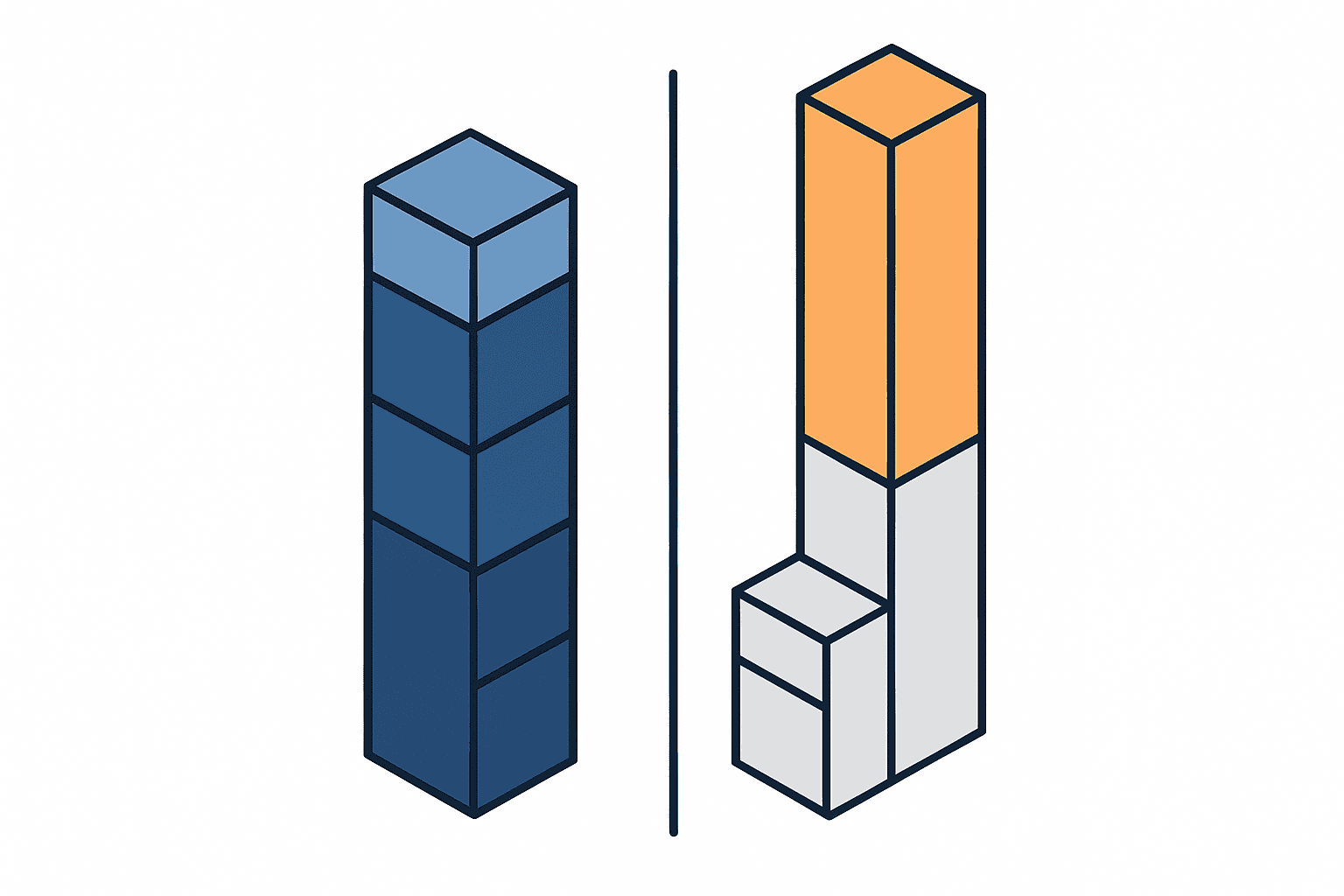
Checking Sensitivity
Let’s check how much the conclusion above depends on the assumptions. First, moving the lost-profit-per-hour-of-downtime figure: changing this doesn’t touch the contract fee, the excess-visit fee, or the labor-cost line items — only the size of the downtime-difference figure changes.
| Lost profit per hour of downtime (assumed) | Value of the per-incident time difference | Break-even annual call-out count |
|---|---|---|
| 0 THB (a process where downtime doesn’t affect production) | 0 THB | ~26 |
| 5,000 THB | 35,000 THB | ~11 |
| 15,000 THB | 105,000 THB | ~5 |
| 30,000 THB | 210,000 THB | ~3 |
Where downtime cost is zero — meaning a backup line or inventory buffer fully absorbs the outage — the break-even point returns to 26. Conversely, for a bottleneck process where downtime is expensive, even 3 call-outs a year can justify going in-house. The reason the answer differs by piece of equipment, even within the same factory, is that this single line item behaves completely differently depending on the equipment in question.
Next, let’s look at moving the in-house turnover rate. Only the expected turnover-risk cost changes here — it doesn’t touch the 105,000 THB downtime difference or the contract fee. We’ll hold the 15,000 THB-per-hour downtime assumption fixed.
| Assumed annual turnover rate | Annual expected turnover-risk cost | In-house average annual cost | Break-even annual call-out count |
|---|---|---|---|
| 0% | 0 THB | 682,000 THB | ~4.5 |
| 25% | 57,500 THB | 739,500 THB | ~4.9 |
| 50% | 115,000 THB | 797,000 THB | ~5.4 |
The notable thing here is that swinging the turnover rate all the way from 0% to 50% moves the break-even point only from 4.5 to 5.4 — a change of less than one call-out. Compared with the 26-to-3 swing produced by moving the downtime-cost assumption, the effect is an order of magnitude smaller.
That doesn’t mean turnover risk can be ignored. As we’ll get to below, the impact of turnover shows up in a form other than money. What this check confirms is that within the break-even comparison itself — the dollar-for-dollar comparison between in-house and outsourced — refining your turnover-rate assumption barely changes the answer.
The Limits of This Model
This model compares two pure forms — fully in-house and fully outsourced — to find a boundary between them. In practice, most operations end up as a hybrid: an in-house technician handling routine work, with only the hardest cases sent out. In that case, the break-even point above is best read as a guide for which way to lean the balance of that hybrid. For equipment groups whose annual call-out count runs above the break-even point, widen the in-house scope; for those below it, lean more on outsourcing.
This estimate also leaves out several hard-to-quantify benefits on the in-house side: having someone on staff who can catch early warning signs of trouble, being able to sanity-check an outside quote, and building up an in-house record of equipment change history. These are deliberately excluded because they’re difficult to put a number on, but all of them tilt in favor of in-house — so the break-even figures above should be read as somewhat conservative in that direction.
The Real Bottleneck for Going In-House Is Turnover Risk
As the sensitivity check showed, the turnover-rate assumption barely moves the break-even point. And yet turnover is exactly what factories in Thailand struggle with most when they try to build in-house capability. That looks like a contradiction, but it isn’t — turnover risk shows up not as a cost, but as an availability problem.
Consider a factory that has trained exactly one automation technician. Booking an expected cost of 57,500 THB a year balances the books, but the moment that one person quits, the number of people who can touch the factory’s automation equipment drops to zero. Hiring and training a replacement up to the same level takes months to recruit and another six months to a year to train. During that gap, the line’s constraints revert to how they were before you went in-house — except the equipment has gotten more complex since then. That discontinuity, which no expected-value number can capture, is the real bottleneck of going in-house.
This risk runs especially high in Thailand’s labor market. Engineers who’ve built up a skill set can command a pay raise by switching jobs relatively easily, and there’s a strong pull toward growth industries that are actively hiring automation talent. A technician you trained at your own expense taking that qualification and experience to a competitor can happen on a much shorter cycle here than it typically does in Japan.
There are three realistic ways to deal with this, used in combination:
- Don’t concentrate everything in one person. Split responsibilities across two or more people with narrower individual scopes — separate the teaching role from the daily-maintenance role — so training cost per person drops and the hole left by any one departure is smaller
- Design record-keeping into the training program from the start, to prevent knowledge from living only in one person’s head: a change log for taught points, alarm-response procedures, and inspection standards, kept as documents and data. What a technician can walk out the door with is experience — records stay with the factory
- Keep the highest-difficulty work outsourced from the outset, and deliberately keep the in-house scope to “a range where losing this person isn’t fatal”
That third point may look like the cautious option, but as the break-even math showed, most of the value of going in-house comes from cutting downtime. Cutting downtime doesn’t require advanced diagnostic ability — it requires having someone on the floor who can act immediately. Redefine the goal of going in-house not as “train someone who can do anything” but as “widen the range of things we don’t need to call someone else for,” and the training investment gets a much sharper target.
Training Infrastructure Available in Thailand, and Where BOI Incentives Fit In
Choosing to go in-house doesn’t mean shouldering all the training yourself. Thailand has built dedicated infrastructure for developing automation and robotics talent.
Within the Eastern Economic Corridor (EEC) innovation zone sits the Sustainable Manufacturing Center (SMC), launched in 2020 by NECTEC — under Thailand’s National Science and Technology Development Agency (NSTDA) — and now operating within EECi. Alongside talent development in automation and robotics, it offers a testbed function using real equipment, giving you a place to run technology validation and training without taking your own line down.
There’s also the EEC Automation Park, located on the campus of Burapha University and dedicated to training and workforce development in automation and robotics. Mitsubishi Electric has installed an e-F@ctory model line there, giving visitors a hands-on Industry 4.0 environment aimed at raising the overall level of Thailand’s manufacturing technology base. For Japanese-affiliated companies, the involvement of a Japanese manufacturer gives this a practical edge — the training content tends to line up closely with the equipment configurations you already have.
The benefit of using outside facilities like these goes beyond just cheaper training — it removes the burden of preparing training materials and instructors in-house. In the estimate earlier in this article, we put first-year training cost at 150,000 THB, and most of that figure isn’t course fees — it’s the opportunity cost of the trainee being off the floor during training. Using an outside facility where you can choose the timing and duration of the course also lets you schedule that opportunity cost around a slow production period.
On the investment-incentive side, Thailand’s Board of Investment (BOI) issued an investment-promotion policy for the automation and robotics industry dated November 18, 2021. It provides a corporate income tax exemption of up to 50% of the investment amount, for three years, for investment in automation machinery and robots — and if the proportion of domestically manufactured automation machinery or systems procured reaches 30% or more, that cap extends to 100%.
It’s worth flagging that the scope of this incentive is defined fairly narrowly. It applies to projects that introduce automation at the level of a production line, a full service operation, or a specific process unit such as an automated production cell — a single standalone machine purchase doesn’t qualify. Excluded sectors include, in manufacturing, general vehicles, motorcycles, and hybrid electric vehicles (HEVs); and in services, e-commerce, natural gas stations, coworking spaces, International Business Centers (IBC), and Trade and Investment Support Offices (TISO), among others. Businesses already receiving a corporate income tax exemption must also have that existing exemption period expire before they can use this measure. Whether your own project qualifies depends on these specific conditions, so confirm eligibility directly with the BOI or an application agent.
One more point worth understanding clearly: what this incentive actually subsidizes. The exemption applies to capital investment in automation machinery and robots — it does not directly cover the recruiting, salary, or training costs for technicians that this article’s estimate has been modeling. The accurate way to think about BOI incentives, then, is not as “a program that lowers the cost of going in-house,” but as “a program that lowers the burden on the equipment-investment side, freeing up budget room you can redirect toward people.” When you put together the capital-approval request for the equipment itself, it’s worth folding in some of what the tax exemption frees up as first-year training budget in that same request — that saves you the trouble of filing a separate request for training funds later.
What to Write Down Before You Decide on a Structure
Before deciding how to split work between in-house and outsourced, it’s worth having your organization surface and document the following items. Move ahead with hiring or contract negotiations while these stay vague, and the basis for the decision ends up resting on one person’s gut feeling.
- For each piece of automation equipment, how many times an outside technician was called in over the past year — counted per machine
- Of those call-outs, how many were for work that could realistically be brought in-house — teaching corrections, parameter changes, daily maintenance
- How long it actually took from call-out to a technician starting work — actual figures, not the contracted response time
- The lost-profit value of one hour of downtime, per piece of equipment — a rough gross-margin estimate, set lower for equipment a backup line or inventory buffer can absorb
- The number of visits included in the current maintenance contract, and the per-visit rate for anything beyond that
- The scope you’d bring in-house — up to teaching only, up to first-pass triage, or including parts replacement
- The current skill level of the person you’d train, and the courses and time needed to reach the target scope
- Whether you’re willing to run with just one person in that role, or want a minimum of two
- Who logs the taught-point change history and alarm-response procedures, and where
- If any equipment is covered by BOI incentives, the conditions and the period those incentives apply for
The item most often overlooked is the fourth one — downtime cost per piece of equipment. We frequently see factories take a single per-hour figure from overall plant revenue and apply it uniformly to every machine, but that doesn’t match reality. A machine with buffer inventory upstream and a machine running a single-piece flow of made-to-order product lose completely different amounts when they stop for an hour. Given how heavily this single item swings the break-even point, it’s worth the effort to work it out equipment by equipment.
Frequently Asked Questions
How long does it take to train a PLC technician?
It depends heavily on the scope you’re aiming for. If the goal is reading an existing program, locating the source of an alarm, and adjusting parameters or timer values, a manufacturer’s basic course plus repetition on the shop floor gets you there in a few months to about half a year. Writing a new equipment’s program from scratch, including safety-circuit design, requires years of experience. Following this article’s framework, the former is a reasonable candidate for in-house, the latter for outsourcing. When you build a training plan, decide up front which level you’re aiming for — able to read it, able to fix it, or able to write it.
When bringing robot maintenance in-house, how far should the in-house scope go?
A reasonable in-house baseline covers daily inspection, replacing consumables and batteries, recovery from an emergency stop, homing operations, and resetting or triaging simple alarms. Gearbox and servo-motor replacement, controller-board diagnostics, and recalibration when accuracy drifts generally belong on the outsourced side, since they require dedicated jigs and experience. Settling this line before you negotiate a maintenance contract lets you trim the contracted visit count down to match reality.
What are the benefits of outsourcing equipment maintenance?
Three things. First, you don’t need to own dedicated measurement and diagnostic equipment yourself. Second, you can borrow the experience of a technician who services multiple companies’ equipment — someone who has a feel for failure modes your own plant might see once a decade. Third, you move personnel-turnover risk outside the company; the skill discontinuity that turnover causes in an in-house setup simply doesn’t happen. The trade-off is response lead time — as this article’s estimate showed, that wait time is what moves the break-even point the most. Getting the benefit of outsourcing depends on locking in response time clearly in the contract.
Do you need a dedicated person to bring robot teaching in-house?
Not necessarily. If product changeovers happen a few times a week, a production-engineering or maintenance staffer can handle it as part of a broader role. If it’s a shared role, though, plan for that person’s other work to fall behind during changeover-heavy periods. On a line where changeovers happen daily, the workload is effectively full-time anyway, so it makes more sense to budget for a dedicated headcount from the start.
When combining in-house and outsourced work, how should responsibility be divided?
We’d recommend drawing the line by task type rather than by piece of equipment. Splitting by equipment tends to create a “this machine is ours” mentality, which means when a serious fault hits that machine, it gets absorbed in-house by default even when it shouldn’t be. Splitting by task — for example, “within this list of alarm codes, this range gets handled internally and this range means an immediate call to the maintenance company” — lets staff on the floor make the call without hesitation. Sharing that list as an attachment to the maintenance contract also speeds up the actual call-out conversation when it happens.
Is the automation talent shortage specific to Thailand?
No, it’s a global trend. The 2026 ManpowerGroup survey referenced in this article covered 41 countries and 39,063 companies, with 72% of employers reporting difficulty securing talent. That survey put AI-related skills at the top of the hardest-to-find list for the first time, ahead of engineering and traditional IT skills that had previously led. That said, this is a global aggregate, not a figure specific to Thai manufacturing. Factors specific to Thailand include high labor mobility and talent flowing toward growth industries, both of which make it harder to retain the technicians you’ve trained.
Summary
The technician shortage that hits a factory after it invests in automation is a hiring problem, but it’s just as much a design problem — deciding which tasks stay in-house and which go outside. Framed as a binary of in-house versus outsourced, there’s no clean answer. But laid out along the two axes of frequency and required expertise, the line draws itself naturally: robot teaching and daily maintenance in-house, PLC program revisions and advanced fault diagnosis outsourced.
What this article set out to show, beyond that, is that labor cost isn’t what decides the break-even point between in-house and outsourced. Comparing the cost of keeping one technician for three years against a maintenance contract puts the break-even point at 26 call-outs a year — but the moment you convert the downtime spent waiting for an outside technician to arrive into money, that break-even point drops to 5 a year. Swing the turnover rate all the way from 0% to 50% and the break-even point only moves from 4.5 to 5.4; change the downtime-cost assumption and it moves from 26 all the way to 3. The first thing to check when weighing whether to go in-house isn’t hiring-market rates or a training-cost quote — it’s the number of THB you lose for every hour that specific piece of equipment sits idle.
And turnover risk, while a minor line item in the dollar-for-dollar comparison, is a different kind of risk entirely — one that can collapse an in-house structure outright. Don’t concentrate the role in one person. Keep records on the factory’s side, not the technician’s. Keep the in-house scope deliberately narrow. Building these three principles into the design from the start is what it takes to sustain an in-house capability in Thailand over the long run.
If you haven’t yet decided how much of your equipment fleet should move in-house, we’re happy to talk it through at whatever stage you’re at. If you have a year’s worth of call-out counts and response-time records, we can work through this article’s model together and map out the break-even point equipment by equipment. Even if your thinking is still at an early stage, feel free to reach out through our contact page.
References
- ManpowerGroup 2026 Global Talent Shortage survey release — Global Talent Shortage Reaches Turning Point as AI Skills Claim Top Spot
- JETRO — Overview of the Eastern Economic Corridor (EEC) policy
- Mediator — 135th anniversary of Japan-Thailand friendship: business collaboration connected by the EEC
- Thai-Biz — Mitsubishi Electric partners with Thai and Japanese companies to advance “Thailand 4.0”
- EECi Sustainable Manufacturing Center (SMC) official page
- BOI Thailand — Investment Promotion Policy for Automation and Robotics Industries (Japanese-language PDF)
- Glassdoor — Automation-related job listings in Thailand


