


There is no shortage of articles about robot implementation, but most of them treat “the factory” as a single category. Once you actually start evaluating a project, though, you find that a site with several thousand employees and a small or mid-sized manufacturer running a few dozen to a few hundred people in Thailand get stuck in completely different places. It is not only a funding constraint. There is nobody to spare for the evaluation, there is no internal precedent, and there is no second move available if the first one fails. When those three overlap, the plan stalls the moment you trace the “correct process” written for large enterprises. This article isolates only the parts where the premises change for a small or mid-sized manufacturer, and works through how to read the cost, how to calculate the return, what the Thailand BOI incentives offer, and the concrete sequence for starting small and expanding.
Why SME robot implementation does not work with the large-enterprise process
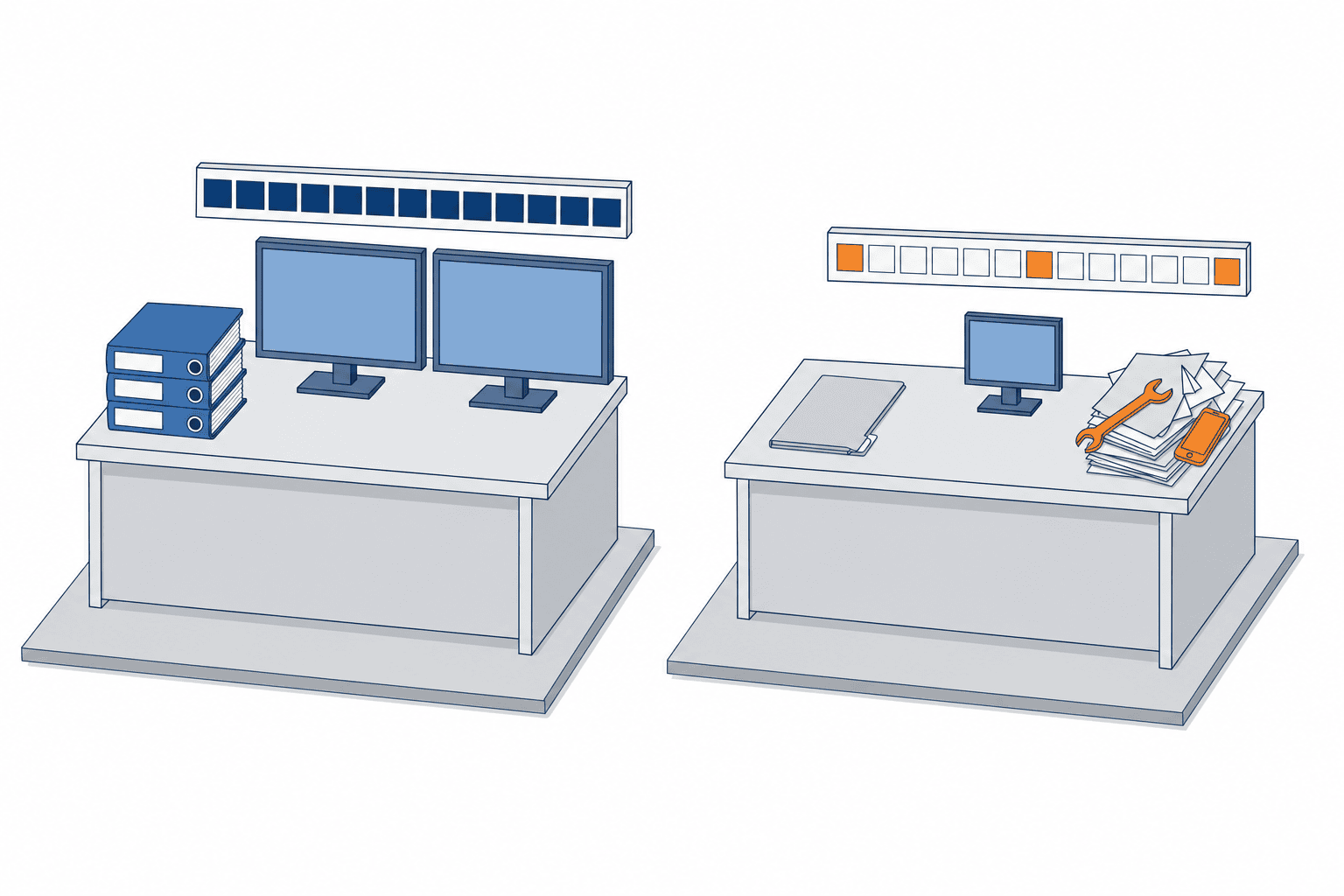
The evaluation gets 0.2 of a person, on top of another job
In a large enterprise capital investment, the production engineering department has a dedicated owner. That person writes the specification, collects quotations from several vendors, coordinates with the internal safety function, and pushes the approval through. Because the evaluation itself is defined as a job, it can take six months to a year to settle.
At a small or mid-sized manufacturer, that role falls to the plant manager or a production engineering staff member who is already doing another full-time job. The hours realistically available amount to perhaps one day a week, or roughly 0.2 of a person on an annual basis. This gap is not the kind you close by trying harder. It means that the evaluation process itself has to be redesigned around the hours you can actually put in.
In practice that requires deliberate trade-offs. Narrow the number of candidates you compare. Do not try to freeze all requirements at once, but confirm them in stages. Where you cannot make a judgment internally, outsource not just the work but the preparation of the material the judgment is based on. The textbook approach of collecting five competitive quotations and lining them up side by side burns several weeks just to build the comparison table, so it stalls halfway through under a 0.2-person structure.
A single failure hits the whole business
The other decisive difference is the loss impact when something fails. The ratio of capital investment to annual revenue is structurally larger at a small or mid-sized company. A project that a large enterprise can write off as “one pilot that did not pan out” can consume several years of a smaller company’s entire capital investment budget.
That asymmetry has a clear implication for how you proceed. Designing so that the amount at risk is small matters more than working to lower the probability of failure. A large enterprise can afford a thick evaluation to reduce failure probability. A smaller manufacturer does not have those hours. If that is the case, the only remaining lever is to shrink the amount you stake at any one time. The phased rollout described later in this article is the conclusion that follows from this structure.
The information gap shows up most in SIer selection
In industrial robot implementation, the capability of the system integrator, the SIer who builds the robot into your process, drives the outcome more than the robot manufacturer does. Yet a smaller manufacturer has almost no accumulated criteria for evaluating an SIer, because there is no population to compare against. How many integrators have you worked with, and what went wrong on which process? The data simply is not there.
Materials published by the Japanese Ministry of Economy, Trade and Industry and by the industry association for FA and robot system integrators repeatedly list the same barriers for SME robot implementation. The size of the initial investment, the shortage of people who can lead implementation and design, and the difficulty of choosing the right SIer. The first two tend to be recognized readily as money and people problems. The third one is the awkward one, because companies often place the order without ever recognizing it as an issue. The specific criteria for selection are laid out in how to choose a robot SIer in 2026, and it is worth reading once before you request quotations.
Where “collaborative robots make it easy” belongs
The spread of collaborative robots in recent years has made configurations without safety fencing, installed close to people, a realistic option. It is genuinely true that the barrier to entry has come down. But choosing a collaborative robot does not make the work disappear, namely carving out the process, designing the jigs, sourcing peripheral equipment, and teaching and commissioning the cell.
The cost structure and the process specific to collaborative robots are covered in detail in the cost and process of collaborative robot implementation. What this article covers sits upstream of model selection, namely the question of what order and what size of increments to use under the specific conditions of a smaller manufacturer.
The three walls that stop SME robot implementation
Breaking down what each wall actually is
The three barriers listed above are different in nature. The funding wall is a question of amount, the people wall is a question of hours and knowledge, and the SIer selection wall is a question of information asymmetry. Naturally, the countermeasures differ too.
| Wall | What it consists of | Why it differs from a large enterprise | Direction for an SME |
|---|---|---|---|
| Size of the initial investment | Peripheral equipment, SIer fees and installation work stack on top of the robot itself | The investment is large relative to revenue and there is little capacity to recover from failure | Break the amount staked at one time into smaller increments and use public support to compress the own-funded portion |
| Shortage of people | Nobody in-house can write the specification, teach the robot or maintain it | There is no dedicated production engineering function, so evaluation is done on top of another job | Decide before ordering who will touch the cell after commissioning, and include training in the contract |
| Difficulty of choosing an SIer | Neither evaluation criteria nor a comparison population exists internally | Little track record of past transactions, so the validity of a quotation cannot be judged | Screen on whether they came to look at the process and whether they can answer on the support structure, not on price |
Of the three, the one most often deferred in practice is the people wall. It is hard to see as an issue until the equipment arrives, and it surfaces after commissioning in the form of “there is nobody who can operate this.”
The funding wall bites through the depth of the trough, not the total
The reason the size of the initial investment becomes a problem is less the total amount than the time lag between spending and benefit. Payment for the equipment is concentrated at implementation, while the benefit accumulates gradually after start-up. In between, cash on hand keeps falling.
A large enterprise can absorb that trough with company-wide funds. For a smaller manufacturer, a deep trough directly affects other investment decisions and working capital. So the figure to look at for an investment decision is not just the payback period but how short you will be at the point where cash is lowest. How to build the funding plan for capital investment as a whole is covered in capital investment planning support.
Make the people wall visible by asking who touches it after commissioning
“Labor shortage” is an abstract phrase, but in practice it breaks down into three roles. Writing down on paper who takes which one, before you place the order, makes the gaps you cannot fill internally obvious.
- Defining the specification. Putting into words which process, at what cycle time, and to what accuracy will be automated
- Commissioning and teaching. Correcting the program and adjusting positions when the product variant changes
- Day-to-day maintenance. Performing first-level triage when something goes wrong, and managing parts replacement and backups
The first of these you can build together with the SIer. The problem is the second and the third. If those are left blank when you order, the operation after start-up becomes “call the SIer every time the variant changes,” and annual running costs exceed what you budgeted. How to structure the support arrangement is covered in detail in robot maintenance and support in 2026.
Read industrial robot implementation cost in five layers
What the five layers contain
You cannot compare robot implementation costs by looking only at the bottom line of a quotation. The same total with a different internal allocation produces a different amount of cost added later. In practice, breaking the cost into the following five layers makes both the validity of the quotation and the future add-on costs visible.
| Layer | Contents | Approximate share of the total |
|---|---|---|
| Layer 1, the robot itself | Arm, controller, teach pendant | 30-50% |
| Layer 2, peripheral equipment | Grippers, jigs, frames, safety devices, conveying and feeding equipment | 10-30% |
| Layer 3, SIer fees | Process design, system design, programming, commissioning | 20-40% |
| Layer 4, installation work | Delivery, mounting, power and air piping, floor work | Varies by project |
| Layer 5, annual running cost | Maintenance contract, consumables, parts, re-teaching, electricity | Recurs every year, separate from the initial cost |
Note that the shares in the table show, independently for each layer, the range seen in practice. Not all layers hit their upper bound at once. Layer 3, the SIer fee, can be equivalent to anywhere from 50% to 150% of the robot hardware cost depending on the project. The more complex the process and the more variants involved, the more this layer swells. That is why comparing hardware price lists alone tells you nothing about the total.
SMEs most often miss Layer 2 and Layer 5
Of the five layers, the one most likely to be missing at the point you request a quotation is Layer 2, peripheral equipment. A robot only starts moving once you have settled what it will grip. If the workpiece geometry differs by variant, you need that many more grippers and jigs. Ask for a rough estimate without stating the number of variants and the figure comes back based on a thinner version of this layer than reality.
Layer 5, the annual running cost, is the same. Because it does not appear in the initial cost quotation, it tends to drop off the investment decision sheet. But the maintenance contract, consumables, spare parts stock and the re-teaching required each time a variant is added all recur every year for as long as the cell is running. For a smaller manufacturer, if this layer is not in the budget plan, year two onward feels like “unplanned spending just to keep it running,” and the next investment decision turns conservative.
For a concrete example of how price is composed on a specific process, the price of a palletizing robot is a useful reference. You should be able to see that even with the same robot, the thickness of Layer 2 changes with the packaging format handled and the number of variants.
How to calculate the return on robot implementation
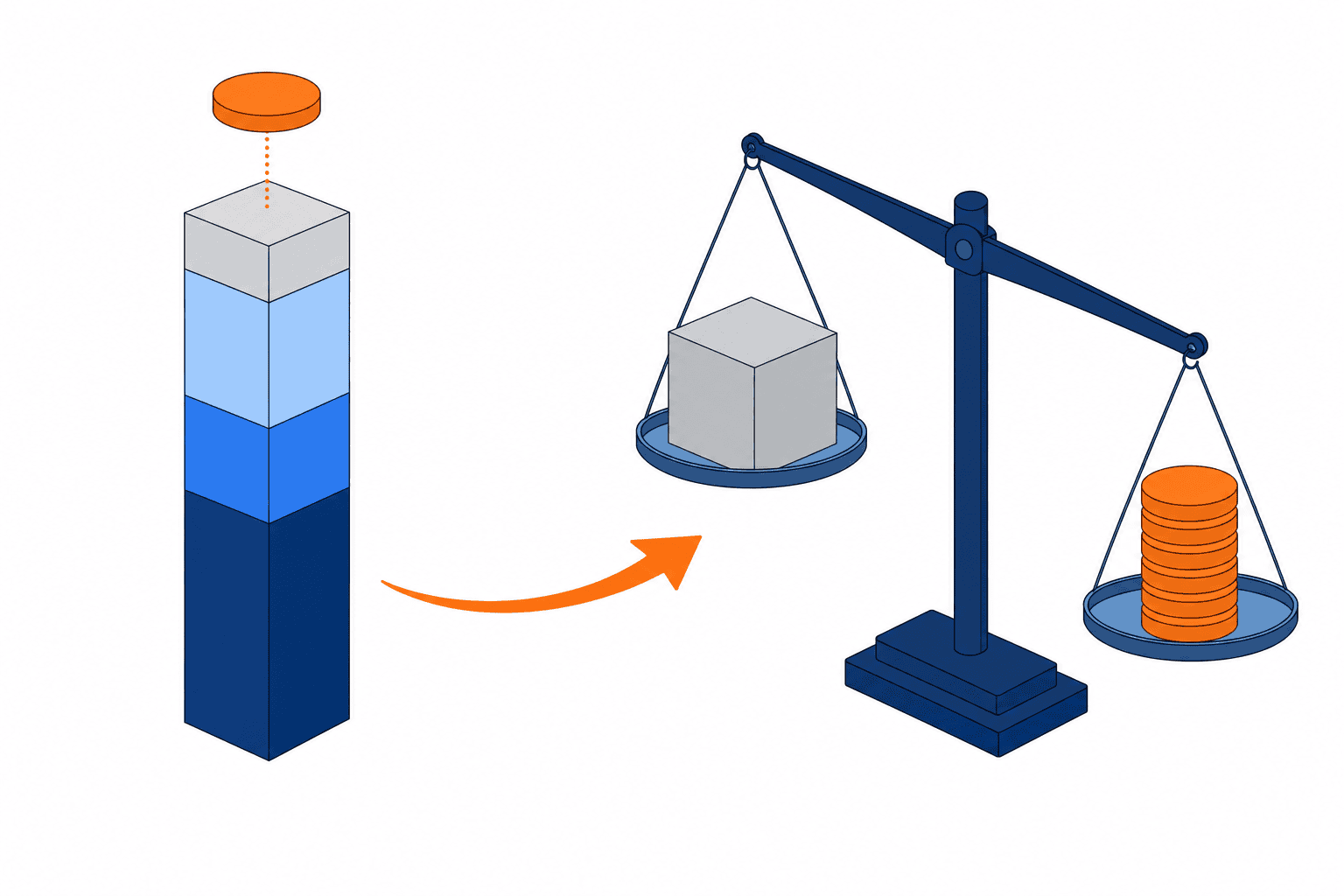
Build the calculation pattern with a model
The following is a model to demonstrate the calculation procedure, not an actual quotation. Read it as a skeleton to be used with your own numbers substituted in.
Set the total initial cost for Layers 1 through 4 at 3,000,000 baht. Allocate the initial cost as 40% for the robot itself at 1,200,000 baht, 20% for peripheral equipment at 600,000 baht, 30% for SIer fees at 900,000 baht, and 10% for installation work at 300,000 baht. The SIer fee corresponds to 75% of the hardware cost, which sits inside the 50% to 150% range noted above. Set the Layer 5 annual running cost at 150,000 baht.
Build up the annual benefit as three items of different nature.
| Type of benefit | Annual amount (model) | What it is proportional to |
|---|---|---|
| Labor cost equivalent reduction | 600,000 baht | Robot operating hours |
| Reduction in defects and rework | 180,000 baht | Quality variation on the automated process |
| Reduction in overtime | 120,000 baht | Robot operating hours |
The three together come to 900,000 baht a year. Subtract the 150,000 baht annual running cost and the net benefit is 750,000 baht. Divide the 3,000,000 baht initial cost by the net benefit and the simple payback period is 4.0 years.
Do not apply the sensitivity factor to every benefit
An investment decision also looks at the numbers if things do not run as assumed. The mistake that shows up constantly here is multiplying the total benefit of 900,000 baht by a flat 0.8 when utilization only reaches 80% of the assumption.
The correct approach is to judge, benefit by benefit, what the factor actually acts on. A drop in utilization affects the benefits that are proportional to the hours the robot runs, which are the labor cost equivalent reduction and the overtime reduction. The reduction in defects and rework, by contrast, comes from eliminating the variation caused by manual work on the automated process, and the benefit per piece does not change even when operating hours are shorter. What is assumed here is the case where production volume on the target process is unchanged and the cycle simply runs longer than expected, so the efficiency of operating hours falls. If the premise is that production volume itself drops, then the reduction in defects and rework has to be revised in proportion to volume as well. The essential point is the order of operations, namely decide what variation the factor represents before you apply it.
Calculated along those lines, the labor cost equivalent becomes 480,000 baht, the overtime reduction becomes 96,000 baht, and the reduction in defects and rework stays at 180,000 baht, for a total of 756,000 baht. Subtract the 150,000 baht annual running cost and the net benefit is 606,000 baht, giving a payback period of about 5.0 years. That is shorter than the roughly 5.3 years you get by applying a flat 0.8.
The difference looks like about 0.3 years, but on the boundary where the decision could go either way, that difference reverses the conclusion. Applying the factor uniformly produces a number more pessimistic than reality and kills an investment that should have gone through. Simply writing out what each benefit is proportional to avoids the distortion.
Look at the cash trough before the payback period
The payback period is widely used as an investment decision metric, but for a smaller manufacturer it is not enough on its own. Even at the same 4.0 years, paying the initial cost in a lump sum and paying it in installments put entirely different pressure on cash on hand.
What you should look at is the amount at the point where cash on hand is lowest when spending and benefit are laid out month by month. If that amount exceeds your available funds, the project cannot be executed no matter what the payback period says. Conversely, if you can make that trough shallower, a slightly longer payback still leaves a workable plan. The BOI incentives and subsidies discussed below work precisely as tools for making that trough shallower.
Do not measure the benefit on labor cost alone
The other thing to watch is building the benefit estimate purely from labor cost reduction. Labor cost levels on the Thai shop floor are lower than in Japan, so putting only labor cost on the benefit side stretches the payback period and leaves almost no project able to clear the investment hurdle.
What matters in practice is the benefit beyond labor cost. Reduced defects and rework from less quality variation, the production capacity gained from running at night and on holidays, the reduction in overtime and temporary support staff during peak periods, and stable output that does not swing with staff turnover. Whether or not these appear on the benefit sheet changes the evaluation of the very same equipment substantially. Since putting them on the sheet requires measured evidence, measuring your current defect rate and rework hours before implementation is itself the preparation for the investment decision.
Build the Thailand BOI incentives into the investment plan
Investment in automation and robotics qualifies
In Thailand, the Board of Investment (BOI) offers preferential treatment for investment in automation and robotics. Under the recent framework it is positioned within “Smart and Sustainable Industry,” and capital investment in automation and robotics is reported to qualify for a three-year corporate income tax (CIT) exemption.
The exemption mechanism is not a simple zeroing of the tax bill. It takes the form of a cap set against the qualifying investment amount. The base exemption rate is stated as an amount equivalent to 50% of the investment. In other words, corporate income tax is exempted up to a range equivalent to 50% of the qualifying investment.
The condition that raises the rate to 100%
There is a condition that lifts this exemption rate. Where 30% or more of the value of the automation and robotics equipment being installed links to, or supports, machinery manufactured in Thailand, the exemption rate is reported to rise to 100% of the investment.
This condition directly affects equipment selection. If you check the scheme only after the specification and the vendor are locked in, reselecting to fit the condition is effectively impossible. How much Thai-manufactured machinery you can build in is a point that belongs on the agenda at the early stage when you first consult the SIer.
There is a minimum investment requirement
Qualifying investment is reported to carry a minimum investment requirement, excluding land cost and working capital. A small one-off implementation may not reach that floor.
On the other hand, the fit with the phased rollout described below is not necessarily bad. It may be possible to structure the project by filing a consolidated investment plan and splitting the execution into stages. That said, treatment on this point varies with the content of the project and the application category, so it should be confirmed individually rather than judged from general principles.
Treat the scheme as something that gets revised
BOI measures get revised in every dimension, including the target industries, the content of the incentives and the conditions. What is described in this article is an organization of information published at the time of writing, and it does not guarantee agreement with the scheme in force when you apply.
As a practical matter, we recommend approaching the BOI or a local specialist once while you are still at the concept stage. There are four things to confirm. Whether your investment falls into a qualifying category, whether it meets the minimum investment requirement, whether there is room to target the 100% exemption condition, and whether there are constraints on the order of application and equipment ordering. The last one in particular cannot be undone if you consult after placing the order.
| Item to confirm | When to confirm it | What happens if you are late |
|---|---|---|
| Whether it falls into a qualifying category | Concept stage | An investment plan built on the incentive no longer holds |
| The minimum investment requirement | When the rough estimate arrives | The amount falls short of the floor and you cannot apply |
| The 100% exemption condition | Before equipment selection | Equipment already ordered cannot satisfy the condition |
| Order of application and ordering | Before requesting quotations | Getting the order wrong disqualifies you from the incentive |
Because the details of the scheme are revised, always confirm the latest official information and take advice from a local specialist when you apply.
Subsidies on the Japanese head office side as an option
A separate set of schemes is available to the head office
For a Japanese-owned SME manufacturer with a site in Thailand, support schemes are not limited to the Thai side. Japan also operates several subsidies aimed at robot implementation by smaller companies. The representative one is the Monozukuri (Manufacturing), Commerce and Service Productivity Improvement Subsidy, commonly known as the manufacturing subsidy.
Some schemes include a frame where meeting wage-increase requirements substantially raises the subsidy ceiling, and cases have been presented with a ceiling on the order of 40 million yen. However, both the scheme names and the amounts change from year to year. It is not unusual for the framework to be reorganized between application rounds, so rather than building a plan on an amount, check the latest application guidelines at the point you consider applying.
Eligibility is determined by where the investment sits
The practical caveat is that most subsidies inside Japan target capital investment and business activity inside Japan. Capital investment at a Thai site does not automatically qualify.
So when you consider a head office scheme, you have to start from the design question of where the investing entity sits and where the equipment will be installed. There are cases where the sequence is easier to reconcile if you commission the same equipment at a domestic plant first and then deploy the knowledge and settings gained there to the Thai site. This too cannot be judged from general principles, so confirming with the scheme’s administering office is the reliable path.
| Support framework | Main target | How it works for an SME |
|---|---|---|
| Thailand BOI measures | Automation and robotics investment within Thailand | Corporate income tax exemption lightens the tax burden after start-up |
| Subsidies within Japan | Mainly capital investment within Japan | Part of the initial cost is subsidized, making the spending trough shallower |
The two schemes work differently. The BOI incentive acts mainly on the tax burden after start-up, while a Japanese subsidy acts on the initial spend. If your aim is to make the cash trough described earlier shallower, it is reasonable to look first at the scheme that acts on the initial cost.
How to start small and expand
Do not do everything at once
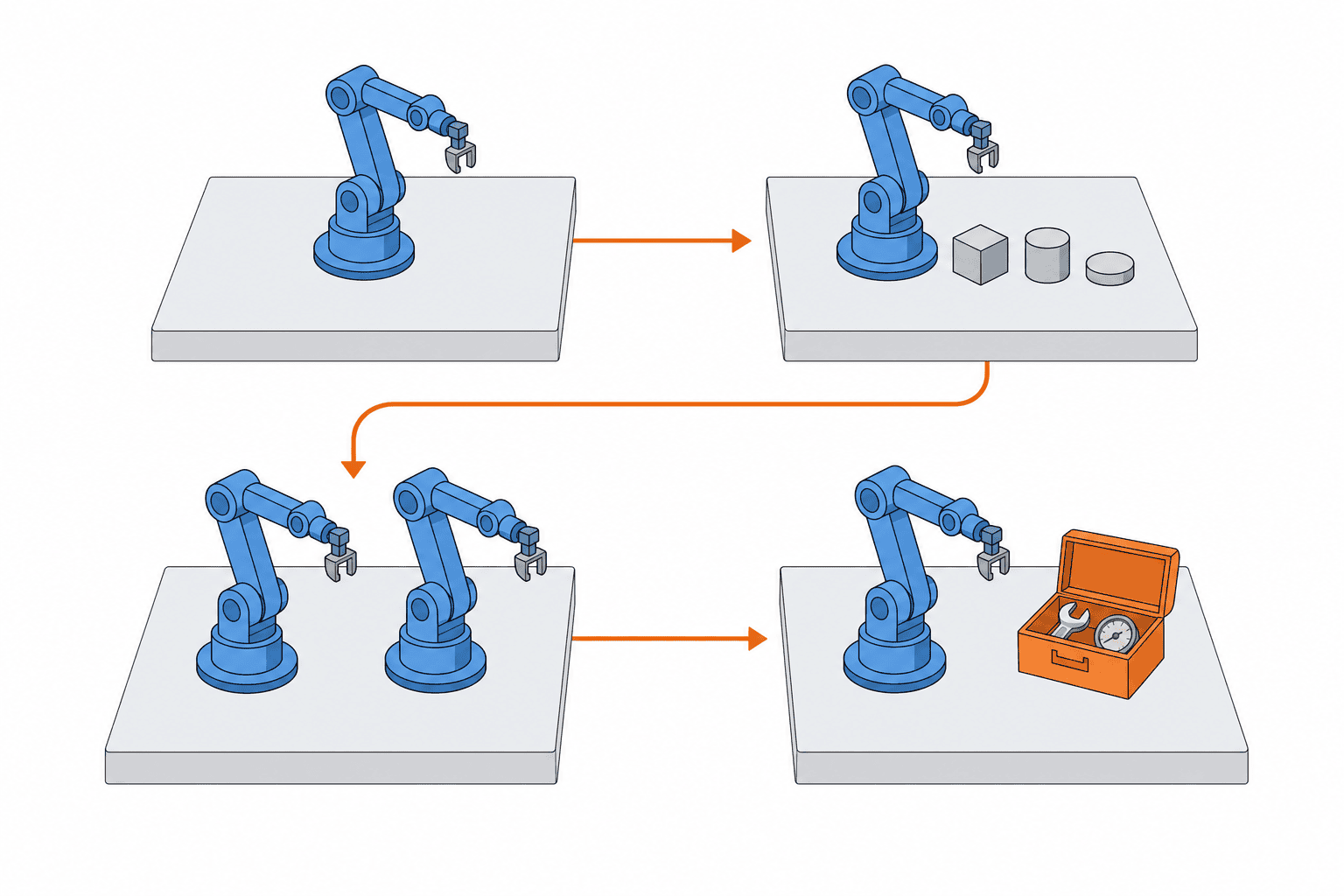
What the SME cases that produce results from robot implementation have in common is that they did not try to automate the whole factory from the start. Begin with one process and one task, then decide the next step based on the real data obtained there. This order is the most reliable way to accumulate internal know-how while keeping the amount at risk small.
The stages can be organized as follows.
| Stage | What you do | What you gain at this stage | Criterion for moving to the next stage |
|---|---|---|---|
| Stage 1 | Implement on one task in one process | Measured cycle time and utilization | Whether the assumed benefit is confirmed in real data |
| Stage 2 | Add product variants on the same equipment | Changeover time and the teaching workload | Whether internal staff can handle the teaching |
| Stage 3 | Extend to adjacent or similar processes | Actual implementation cost for the second unit onward | Whether operation of the first unit is stable |
| Stage 4 | Build the capability to handle maintenance and teaching in-house | Reduced external dependency and lower annual running cost | Whether first-level triage can be completed in-house |
The important column in this table is the right-hand one. Define the condition for advancing to the next stage in real data, not by feel. Without it, you order the second unit while the first one is still unstable and end up doubling the same problem.
What the Stage 1 process should look like
Which process you pick first largely determines the speed of everything that follows. Processes that deliver benefit readily and where failure stays contained share several characteristics.
- The work content is identical every time and involves no judgment or visual inspection
- The workpiece geometry and placement are fixed, or there is room to fix them
- There is slack in the timing with the upstream and downstream processes, so a stoppage does not immediately halt everything
- Someone is currently tied to that work, so the time can be measured
- The changeover frequency between variants is not too high
Conversely, if you pick the process that looks like it would deliver the biggest benefit for Stage 1, for example a core line process that every variant passes through, the impact of a stoppage is large and you become so cautious that commissioning never progresses. Core processes are commissioned faster once operational experience has accumulated internally.
What you only find out when you add variants at Stage 2
While you are running a single variant, robot implementation looks like a success. Real operational capability is tested when you add a second and a third variant. That is when problems surface, such as the gripper not being versatile enough, jig changes taking too long, or re-teaching requiring an external call.
So it pays to tell the SIer at the time of the Stage 1 order how far you intend to load variants onto this equipment in the future. If you do not, the SIer will design an optimum for the single variant in front of them. That is not wrong, but the cost of adding a second variant jumps.
Internal know-how starts paying off from Stage 3
Implementation from the second unit onward can usually be done faster and cheaper than the first. How to carve out a process, how to write a specification, and the key points of working with an SIer all remain inside the company. Put the other way round, if you run the first unit in a way that leaves none of that behind, the second unit repeats the same struggle from zero.
The minimum to do in order to retain that know-how is to keep the specifications and quotations, record the problems that arose during commissioning along with how they were handled, and back up the programs and settings. Backups matter most of all, because losing configuration data through a transfer or resignation comes back as considerable cost and time spent on re-teaching.
What an SME should check when selecting an SIer
Price comparison alone cannot decide it
Quoted amounts are not comparable unless the premises are aligned. If, for the same process, company A quotes on the assumption of reusing an existing frame while company B includes a new frame, the price difference is not a difference in capability.
If a smaller manufacturer has to decide with limited hours, screening on the following points is more reliable than screening on price.
- Did they actually come to look at the process before quoting? A company that produces a figure from drawings and a verbal description alone is filling in the premises itself
- Can they explain, before the contract, how costs are handled when something unanticipated happens?
- Are they prepared to hand over post-commissioning teaching in a form your own staff can learn?
- Can they answer on the parts procurement and repair arrangement with concrete lead times?
- Can they describe track record in the same industry and the same process concretely, even if under conditions?
What a cheap quotation is telling you
When one company in a competitive bid is clearly cheaper, always confirm where the difference comes from. In most cases it is one of three things. The scope of peripheral equipment is narrower, post-commissioning support is not included, or adding variants is charged separately.
In terms of the five layers above, it is almost always Layer 2 or Layer 3 that has been quoted thin. Both are parts that will unavoidably be needed after start-up, so cutting them at the ordering stage does not make the spending disappear. It reappears later as add-on cost. The danger for a smaller manufacturer is that this addition occurs outside the frame of the investment decision.
Put industrial robot safety standards into the order conditions
ISO 10218-1 and 10218-2 are the core standards
The core international standards setting safety requirements for industrial robots are ISO 10218-1 and ISO 10218-2. Revised editions of both were published on January 31, 2025. 10218-1 covers requirements for the robot itself, while 10218-2 covers robot systems and their integration, meaning the requirements for the whole system the SIer builds.
What matters most in practice about this revision is that requirements for collaborative applications, previously handled in the technical specification ISO/TS 15066, were integrated into the two standards. Even for a configuration using a collaborative robot, the standards to reference are no longer split out separately.
Why writing the standard into the order matters more for an SME
Safety standards tend to be received as a large-enterprise topic, but in reality it is the smaller manufacturer with no in-house safety assessment specialist that gains more from stating the standard explicitly as an order condition. The logic is that precisely because you cannot assess it internally, you delegate the assessment criteria to an external standard.
Putting a single line into the request for quotation, stating that the scope includes conducting a risk assessment based on ISO 10218-2 and submitting the resulting documentation, levels the quality of the proposals. An SIer that cannot comply drops out of the candidate list at that point. That documentation also becomes your basis when you are asked to justify the installation during a head office safety audit, an insurer’s risk assessment, or a customer audit.
Risk assessment cannot be skipped even with a collaborative robot
A configuration without safety fencing does not mean a configuration without a risk assessment. If people can approach it, that means speed and force have to be assessed on the premise that contact is possible. The measures required change with the workpiece geometry, the weight being gripped, and the layout of surrounding equipment.
Implementing on the understanding that “it is a collaborative robot, therefore it is safe” means adding countermeasures later in response to findings from the head office safety function or a customer audit, which means doing the work with the cell stopped. Putting the standard into the order conditions up front ends up cheaper.
How to read the Thailand and ASEAN market trend
The market is forecast to grow at around 16.7% a year
Private research firms forecast that the Southeast Asian industrial and service robot market will grow at an average of around 16.7% a year from 2026 to 2035. That is fast growth by capital-equipment investment standards.
That said, this is a forecast for the market as a whole, and it does not indicate when an individual plant should implement. What you should read from the figure is that robot implementation is still an area partway through adoption. It is neither the case that everyone around you has finished implementing, nor that nobody is using them.
The practical implication for an SME
An expanding market has two practical effects for a smaller manufacturer. One is that as the number of implementation cases grows, SIers accumulate experience, so design rework decreases for processes of the same type. The other is that local parts stock and support bases become easier to establish, which shortens downtime when something breaks.
At the same time, the fact that the market is growing is not by itself a reason for your company to implement now. The basis for the decision remains the work content of your own process, the measured work time, the changeover frequency between variants, and the funds you have available.
Pre-order checklist
Here are the items worth settling before you request a quotation. Request quotations with these blank and the figures that come back are built on different premises, so they cannot be compared.
| Item | What to settle |
|---|---|
| Target process | Which work on which process, how many hours a day and how many days a year, will be automated |
| Workpiece conditions | Geometry, weight, number of variants, variants planned for future addition |
| Cycle time | The current measured value and the target required after automation |
| Current measurements | Work time, defect rate, rework hours, overtime hours |
| Breakdown of benefits | What the labor cost equivalent, defect reduction and overtime reduction are each proportional to |
| Funding plan | Payment terms and the amount at the point where cash on hand is lowest |
| Support schemes | BOI qualifying category, minimum investment, the 100% exemption condition, order of application and ordering |
| Safety requirements | Whether a risk assessment based on ISO 10218-2 and document submission are required |
| Operating structure | Who handles teaching, who handles first-level triage, who manages backups |
| Next stage | The variants to add at Stage 2 and the criterion for advancing to it |
Of these, only “current measurements” cannot be outsourced. Neither work time nor defect rate can be measured anywhere but on your own shop floor. Put the other way round, once you have those as numbers, the remaining items can be filled in using the SIer and outside support.
Frequently asked questions
Is robot implementation realistic for a smaller manufacturer
It depends on how you choose the process and how you size the increments. Aiming to automate the whole factory at once does not work on either funding or hours. Narrow it to one process where the work content is identical every time and the time can be measured, and you can confirm the benefit while keeping the investment contained. What matters is building the order of operations into the plan from the start, namely making the next decision based on the real data from the first unit.
How should the return on robot implementation be calculated
Grasp the initial cost in five layers and build the benefit up by type. Building the benefit purely from labor cost reduction stretches the payback period at Thai labor cost levels and leaves most projects unworkable. To add reduced defects and rework, reduced overtime and extended operating hours to the benefit side, you need to measure your current defect rate and rework hours before implementation. In sensitivity analysis, do not apply a factor uniformly to the benefit total. Judge, benefit by benefit, what that factor is proportional to.
What support schemes are available for implementing robots in Thailand
Thailand offers a BOI measure reported to provide a three-year corporate income tax exemption for investment in automation and robotics. The base exemption rate is reported to be 50% of the investment, rising to 100% where 30% or more of the equipment value links to or supports machinery manufactured in Thailand. There is also a minimum investment requirement excluding land cost and working capital. Because the scheme gets revised, confirm with the BOI or a local specialist at the concept stage.
How should an SIer be selected
Price comparison alone cannot decide it. Did they actually come to look at the process before quoting? Can they explain, before the contract, how costs are handled when something unanticipated happens? Are they prepared to hand over post-commissioning teaching in a form your own staff can learn? Can they answer concretely on parts procurement and repair lead times? Screening on those four points makes a decision possible even with limited hours. If one quotation comes back extremely cheap, always check whether the scope of peripheral equipment or post-commissioning support is missing.
Should I choose a collaborative robot or an industrial robot
It comes down to whether the robot needs to work in the same space as people, and what cycle time and payload you require. A collaborative robot makes a configuration without safety fencing easier to achieve, but it is constrained on speed and payload. Whichever you choose, though, the work of carving out the process, designing the jigs, and teaching and commissioning does not change. Settling the target process and the workpiece conditions before you get into model comparison moves things faster in the end.
I am worried about whether we can operate it in-house after implementation
Split the worry into teaching and maintenance. Teaching arises every time a variant changes, so if you cannot handle it internally the annual running cost exceeds your budget. For maintenance, a realistic dividing line is handling first-level triage in-house and leaving anything beyond that to an external party. For both, deciding on the responsible person before you order and including commissioning-stage training in the contract scope puts a solution within sight.
Summary
SME robot implementation does not run on the large-enterprise process for reasons beyond funding constraints. The hours available for evaluation amount to only 0.2 of a person alongside another job, a failure hits the entire business, and there are no internal criteria for evaluating an SIer. Because those three overlap, you have to design in the direction of shrinking the amount staked at one time, rather than in the direction of lowering the probability of failure.
Grasp the cost in five layers, with the robot itself at 30-50%, peripheral equipment at 10-30% and SIer fees at 20-40%, plus installation work and the annual running cost. SIer fees can reach 50% to 150% of the hardware cost, so a hardware price list alone tells you nothing about the total. What SMEs miss most often is the peripheral equipment that swells in proportion to the number of variants, and the annual running cost that never appears in the initial quotation.
In calculating the return, the key points are not building the benefit from labor cost reduction alone, and not applying a sensitivity factor uniformly to the benefit total. A drop in utilization acts on the benefits proportional to operating hours, but is not proportional to the benefit from eliminating quality variation. Whether or not you separate those in the calculation reverses the conclusion on borderline projects. As for the decision metric, look not only at the payback period but also at the amount at the point where cash on hand is lowest.
On support schemes, Thailand BOI offers a three-year corporate income tax exemption for automation and robotics investment, with a base exemption rate reported to be 50% of the investment, rising to 100% where 30% or more of the equipment value links to or supports machinery manufactured in Thailand. There is a minimum investment requirement excluding land cost and working capital, and because conditions get revised, individual confirmation is necessary. Subsidies on the Japanese head office side act on the initial spend, while the BOI incentive acts on the tax burden after start-up.
The way to proceed is four stages, starting from one task in one process and taking real data, adding variants, extending horizontally, and finally moving maintenance and teaching in-house. Defining the criterion for advancing at each stage in real data is the brake that stops you doubling the problems of the first unit. On safety, we recommend stating the 2025 editions of ISO 10218-1 and ISO 10218-2 explicitly in the order conditions, and including submission of risk assessment documentation in the contract.
It is perfectly fine if neither the model nor the process is decided yet, or if you cannot even tell whether robot implementation makes sense at your scale. Even at the concept stage, feel free to reach out through our contact page, and we are happy to start simply by hearing about your current line configuration and the work people are currently tied to.
References
- Thailand BOI Manufacturing Incentives – Pertama Partners
- Thailand’s BOI in 2026 – From Investment Incentives to Accelerated Project Delivery – Mahanakorn Partners Group
- Checklist for Selecting a Robot System Integrator – FA and Robot System Integrator Association
- Subsidies Available for Robot Implementation – Subsidy and Grant Guide
- Robot Implementation Demonstration Project – Robot System Packages – Kanto Bureau of Economy, Trade and Industry
- ISO 10218-1 Robotics – Safety requirements – Part 1 Industrial robots – ISO
- Southeast Asia Industrial and Service Robot Market – MarkWide Research