


Search for an automation company in Bangkok and you will find that most company profiles list a Bangkok address. Your own plant, meanwhile, is in Rayong or Chonburi. What that combination means in practice is something you cannot work out by comparing websites, however many you look at. The address on a company profile is the address of the sales office, and that is a different question from where engineers are actually stationed, where spare parts are held, and who can reach your line at night. This article uses published statistics and the base structures of major FA manufacturers to set out the criteria a buyer should be checking, then puts numbers on them with a model factory to show how much difference base structure makes over a year. Every figure in the estimate is an assumption for the model factory, not a measured result.
The Location Illusion That Appears When You Search for an Automation Company in Bangkok
Searching for “automation company Bangkok” is a perfectly reasonable thing to do. Head-office functions of Japanese-affiliated companies in Thailand are concentrated in Bangkok, and meetings and commercial discussions usually happen there. The problem is that the “Bangkok” in those search results is not necessarily the same “Bangkok” your plant actually needs.
51.7% of Japanese-Affiliated Head Offices Are Concentrated in Bangkok
The Survey on Japanese-Affiliated Companies in Thailand FY2024, published by the JETRO Bangkok office in February 2025, covered 9,146 Japanese-affiliated companies registered with the Department of Business Development of Thailand’s Ministry of Commerce, and reported results for the 6,083 companies whose business activity was confirmed during the survey period from August 1 to December 27, 2024. According to that survey, the top ten provinces account for 95% of head-office locations, with Bangkok the largest at 51.7% (3,146 companies).
| Province | Companies | Share |
|---|---|---|
| Bangkok | 3,146 | 51.7% |
| Chonburi | 794 | 13.1% |
| Samut Prakan | 673 | 11.1% |
| Rayong | 305 | 5.0% |
| Pathum Thani | 300 | 4.9% |
| Ayutthaya | 252 | 4.1% |
All figures come from the same survey. By sector, manufacturing accounts for 39.6% of the total (2,411 companies).
But the Plants Themselves Are Spread Across the Surrounding Provinces
Look at the table again. The five provinces ranked below Bangkok add up to 2,324 companies, or 38.2% of the total. That sum is calculated for this article from the survey’s published figures and is not a number JETRO publishes directly.
The point to watch is that these statistics describe head-office locations. Bangkok’s 51.7% almost certainly includes a substantial number of companies whose office functions sit in Bangkok while their production equipment sits in another province. The survey tabulates head-office location only and gives no breakdown of where the plants are. By the same token, Chonburi’s 13.1%, Samut Prakan’s 11.1% and Rayong’s 5.0% describe the share of companies headquartered in those provinces, not the number of plants operating there. It is reasonable to assume that actual production sites are spread even more widely than the head-office statistics suggest, from the outskirts of Bangkok across the EEC, the Eastern Economic Corridor covering the three provinces of Chonburi, Rayong and Chachoengsao.
There is corroborating evidence of that clustering toward the EEC. According to a Thai industrial-estate information site (Thai-Koujyo.com), 250 companies have set up in the Amata City Rayong industrial estate, of which roughly 40% are Japanese-affiliated. Company counts change over time, so check each estate’s own published information for the current position.
What the Address Field on a Company Profile Actually Points To
Put all of this together and the situation facing a buyer searching for an automation company in Bangkok looks like this.
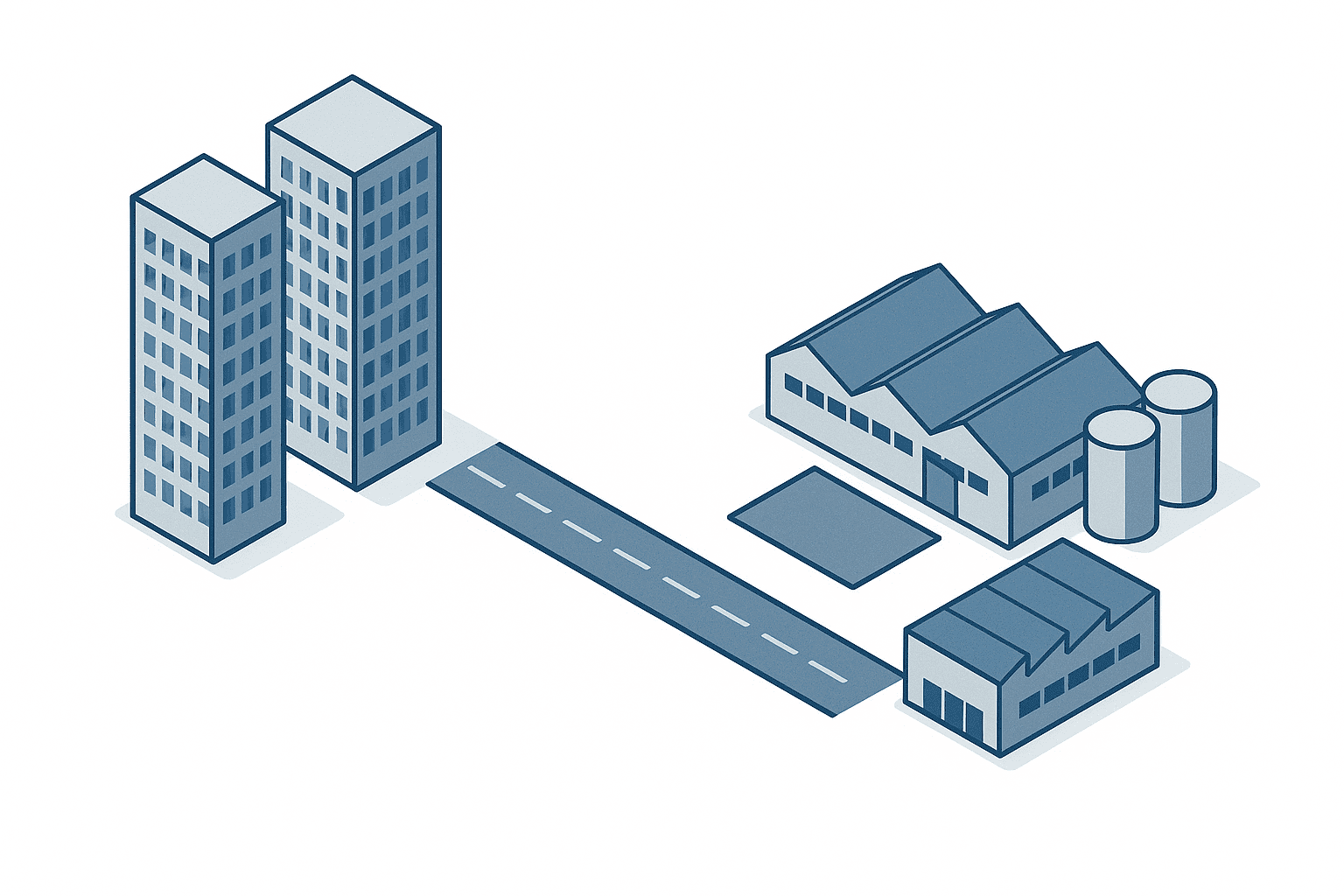
On the buyer’s side, head-office functions are in Bangkok and the plant is in Chonburi or Rayong. On the supplier’s side, the automation company either keeps sales and design in Bangkok while stationing installation and maintenance staff out in the EEC, or it consolidates everything in Bangkok. And the address field on a company profile draws no distinction whatsoever between the two. Companies of either structure write the same thing in that field, which is Bangkok.
In other words, the category “automation company in Bangkok” barely functions as a criterion for narrowing down suppliers. The criteria that actually work are these questions. Where are engineers permanently stationed? Where are spare parts held? When an emergency call comes in, who responds and from where? None of those three appear in an address field.
Major FA Manufacturers Separate Head-Office Functions from Regional Service Bases
The view that a head-office address and an operating base are two different things is not something buyers have invented. The major FA manufacturers with long track records in Thailand design their own networks that way.
How Mitsubishi Electric FA Structures Its Bases in Thailand
Mitsubishi Electric FA maintains a head FA center in Bangkok with Japanese engineers stationed there. On top of that, it operates separate regional branches at Bowin (Sriracha, Chonburi province), Lamphun and Korat, and the company states that this network handles more than 1,400 repairs a year.
What matters here is not the repair count itself but the way the network is divided. The head function sits in Bangkok, and yet the company has gone to the trouble of setting up branches in Sriracha, Lamphun and Korat. If Bangkok could cover the whole country, those regional bases would be unnecessary. The company does not publish its reasons for splitting the network, but the most natural reading is that repair work is an activity heavily constrained by travel time.
OMRON’s Support Tiers
In Thailand, OMRON offers a tiered structure consisting of free support and a paid premium support option. Premium support is an annual contract that bundles scheduled inspection with fault recovery.
What this suggests is that maintenance coverage is not a matter of “available or not available” but of “which contract tier includes it”. The question to ask before placing an order is therefore not “do you provide maintenance?” but “what is covered within the free scope, what is added when we take a paid contract, and how is the target response time defined?”
The Checks You Can Draw from How Manufacturers Design Their Own Networks
From how these two large manufacturers organize themselves, a buyer’s checks come down to two things. The first is to ask about the head-office address and the operating bases separately. The second is to ask about maintenance in terms of contract tiers. Neither can be answered by comparing company websites. They only surface if you ask.
So how much of a difference do these two axes actually make in money terms? The following model-factory estimate puts numbers on it.
A Model-Factory Estimate — How Annual Downtime Loss Changes Across Three Base Structures
Everything below is an assumed value for a model factory, not a measured result. It is not the track record of any real company either. Read it not for the absolute size of the numbers but for the relative sizes of the components and for where the differences between them come from.
Assumptions
| Item | Setting |
|---|---|
| Location | An industrial estate in Rayong province |
| Sector | Japanese-affiliated manufacturing (Thai subsidiary) |
| Equipment in scope | One FA line already installed, in its fifth year of operation |
| Faults requiring an emergency call-out | 6 per year (assumed) |
| Loss per hour of downtime | 45,000 THB (assumed) |
The 45,000 THB per hour of downtime is an assumed figure combining lost production opportunity, idle labor cost and the work of dealing with delivery delays. It varies enormously by sector and by customer, so substitute your own value as you read. How to judge the return on an automation investment is covered in the break-even point between labor cost and automation in Thailand.
Breaking Recovery Time into Four Components
To convert differences in base structure into money, recovery time has to be broken into components and built back up. This estimate uses the following four.
| Component | What it covers |
|---|---|
| Intake and triage time | From the call being made until the responsible engineer is assigned and dispatched |
| Travel time | One way, from the base to the plant |
| On-site first response time | From arrival, spent diagnosing and carrying out the fix |
| Escalation add-on time | Added only when the first response cannot resolve the fault |
The travel assumptions are as follows. From central Bangkok to an industrial estate in Rayong province is roughly 180km, assumed at 3.0 hours one way by road. From a regional base inside the EEC (around Sriracha) to the same estate is roughly 40km, assumed at 0.8 hours one way. Both are assumptions, and the real figures move with traffic, time of day and the exact position of the estate.
On-site first response time is fixed at the same 2.5 hours in all three patterns. The work itself does not change with base structure, so this component produces no difference. The differences come from the other three.
Pattern A — The Supplier Has Bases Only in Bangkok
A structure where both the sales contact and the engineers are consolidated in Bangkok. Every fault is answered by a dispatch from Bangkok.
We assume intake and triage takes 1.5 hours, because assigning an engineer from the head-office desk and getting them on the road requires juggling other projects. With 3.0 hours of travel one way and 2.5 hours on site, the base time per incident comes to 7.0 hours. Across 6 incidents a year that is 42.0 hours.
We assume a first-time fix rate of 5 out of 6 incidents (83.3%). The rate is set high because the specialist engineers are concentrated in Bangkok. The remaining 1.0 incident requires a return to Bangkok to collect parts or instruments and a second dispatch, which we assume adds 6.0 hours.
Annual downtime is 42.0 hours plus 6.0 hours, or 48.0 hours, and the loss is 48.0 hours × 45,000 THB, or 2,160,000 THB.
Pattern B — A Bangkok Head Office Plus an Engineer-Staffed Base in the EEC
A structure where sales and design sit in Bangkok while maintenance staff and spare parts sit at a regional base in the EEC. Faults are taken first by the EEC base.
Because the regional base takes the call directly, intake and triage is 1.0 hour, travel is 0.8 hours one way and on-site response is 2.5 hours, giving 4.3 hours per incident and 25.8 hours across 6 incidents a year.
We assume the same first-time fix rate as Pattern A, 5 out of 6 incidents (83.3%), on the basis that the regional base also holds spare parts and experienced engineers. For the remaining 1.0 incident, we assume the fault can be handled with remote support from the specialist engineers at the Bangkok head office plus same-day delivery of parts, adding only 3.0 hours.
Annual downtime is 25.8 hours plus 3.0 hours, or 28.8 hours, and the loss is 28.8 hours × 45,000 THB, or 1,296,000 THB.

Pattern C — A Local EEC Contractor with No Bangkok Base
A structure with a base close to the plant, so travel is fast. However, we assume the pool of specialist engineers is thin, and that anything they cannot resolve requires a query to the equipment manufacturer or to an overseas head office.
Intake and triage is 1.0 hour, travel 0.8 hours and on-site response 2.5 hours, giving 4.3 hours per incident. Up to this point Pattern C is identical to Pattern B, and the 25.8 hours a year across 6 incidents is identical too.
What differs is the first-time fix rate. We assume that faults involving control systems or integration with higher-level systems cannot be resolved on the first response, giving 3 out of 6 incidents (50.0%). The remaining 3.0 incidents require queries to the manufacturer or an overseas head office, waiting for answers and arranging parts, which we assume adds 10.0 hours per incident, or 30.0 hours in total.
Annual downtime is 25.8 hours plus 30.0 hours, or 55.8 hours, and the loss is 55.8 hours × 45,000 THB, or 2,511,000 THB.
The Three Patterns Side by Side
| Item | Pattern A (Bangkok only) | Pattern B (Bangkok + EEC staffed) | Pattern C (EEC local only) |
|---|---|---|---|
| Intake and triage (hours per incident) | 1.5 | 1.0 | 1.0 |
| Travel (hours per incident, one way) | 3.0 | 0.8 | 0.8 |
| On-site first response (hours per incident) | 2.5 | 2.5 | 2.5 |
| Base time, annual total | 42.0 hours | 25.8 hours | 25.8 hours |
| First-time fix rate | 5 of 6 (83.3%) | 5 of 6 (83.3%) | 3 of 6 (50.0%) |
| Escalated incidents | 1.0 | 1.0 | 3.0 |
| Add-on time per escalated incident | 6.0 hours | 3.0 hours | 10.0 hours |
| Escalation, annual total | 6.0 hours | 3.0 hours | 30.0 hours |
| Annual downtime | 48.0 hours | 28.8 hours | 55.8 hours |
| Annual downtime loss (THB) | 2,160,000 | 1,296,000 | 2,511,000 |
The smallest loss belongs to Pattern B at 1,296,000 THB. That much is probably what you expected.
The surprise is the relationship between Pattern A and Pattern C. Pattern C, which can be on site after 0.8 hours of travel, ends up with an annual loss 351,000 THB larger than Pattern A, which needs 3.0 hours one way. On distance alone Pattern C looks overwhelmingly better, and yet the annual totals reverse the order.
Against Pattern B as the baseline, Pattern A costs 864,000 THB more per year and Pattern C costs 1,215,000 THB more per year, which means Pattern C costs 351,000 THB more per year than Pattern A.
Where the Difference Comes From

To see why the order reverses, break the gaps down by component, again taking Pattern B as the baseline.
| Component of the gap | Pattern A vs B | Pattern C vs B |
|---|---|---|
| Intake and triage | 3.0 hours / 135,000 THB | 0 hours / 0 THB |
| Travel | 13.2 hours / 594,000 THB | 0 hours / 0 THB |
| On-site first response | 0 hours / 0 THB | 0 hours / 0 THB |
| Escalation | 3.0 hours / 135,000 THB | 27.0 hours / 1,215,000 THB |
| Total | 19.2 hours / 864,000 THB | 27.0 hours / 1,215,000 THB |
For Pattern A against B, the intake gap is (1.5 – 1.0) × 6 incidents, or 3.0 hours; the travel gap is (3.0 – 0.8) × 6 incidents, or 13.2 hours; and the escalation gap is 6.0 hours minus 3.0 hours, or 3.0 hours. That totals 19.2 hours, or 864,000 THB.
For Pattern C against B the breakdown is simpler. Intake, travel and on-site work run on identical assumptions to Pattern B, so the entire gap comes from escalation. The number of escalated incidents rises from 1.0 to 3.0 and the add-on time per escalated incident stretches from 3.0 hours to 10.0 hours, giving 30.0 hours minus 3.0 hours, or 27.0 hours a year, a gap of 1,215,000 THB.
It is worth stating the resulting relationship in plain numbers.
The difference in travel time (3.0 hours one way against 0.8 hours) produces an annual loss gap of 594,000 THB. The difference in escalation path produces an annual loss gap of 1,215,000 THB, about 2.0 times the former.
The difference in escalation path here does not mean the difference in first-time fix rate (83.3% against 50.0%) on its own. It combines two things — the rise in unresolved incidents from 1.0 to 3.0, and the stretch in add-on time per incident from 3.0 hours to 10.0 hours. These are separate assumptions, and neither on its own produces 1,215,000 THB. Indeed, in Case 2 of the sensitivity analysis below, aligning the first-time fix rate with Pattern B at 83.3% still leaves a gap of 315,000 THB as long as the add-on time stays at 10.0 hours.
So in this model factory, what matters more to annual loss than the distance to the base is whether the engineer who arrives can fix the fault on the spot, and if not, how quickly the problem reaches someone who can. Travel time is easy to understand, and it is the first metric buyers look at when comparing suppliers. But travel time can only ever create a gap of a few hours per incident, whereas an unresolved first response inserts a query to a head office or an overseas team, and that waiting time tends to be an order of magnitude larger.
None of this makes Pattern A “bad”. Pattern A’s annual loss of 2,160,000 THB is smaller than Pattern C’s 2,511,000 THB. Even a company with bases only in Bangkok comes out ahead of Pattern C if its first-time fix rate is high. What you need to verify is not whether the base is in Bangkok, but how the escalation path is designed for emergencies.
Sensitivity Analysis — Does the Conclusion Change If the Assumptions Break
The whole estimate rests on assumptions. It is worth checking whether changing them changes the direction of the conclusion.
One structural property first. The model is linear in the annual number of incidents and in the hourly rate. Changing either of those two assumptions therefore leaves the ranking of the three patterns unchanged and simply scales the gaps up or down proportionally. The only thing that can move the ranking is the way time accumulates, which means travel time and escalation, the latter covering both the number of unresolved incidents and the add-on time when they occur.
| Case | Assumption changed | Pattern A | Pattern B | Pattern C |
|---|---|---|---|---|
| Baseline | As assumed | 2,160,000 THB | 1,296,000 THB | 2,511,000 THB |
| Case 1 | 3 incidents a year instead of 6 | 1,080,000 THB | 648,000 THB | 1,255,500 THB |
| Case 2 | Pattern C’s first-time fix rate is 83.3% | 2,160,000 THB | 1,296,000 THB | 1,611,000 THB |
| Case 3 | The plant is close to Bangkok (travel 1.5 hours) | 1,755,000 THB | 1,296,000 THB | 2,511,000 THB |
Case 1 — Half as Many Emergency Call-Outs
Here the annual number of emergency call-outs is 3 rather than 6. Pattern A becomes 3 incidents × 7.0 hours plus 0.5 incidents × 6.0 hours, or 24.0 hours, giving 1,080,000 THB. Pattern B becomes 3 incidents × 4.3 hours plus 0.5 incidents × 3.0 hours, or 14.4 hours, giving 648,000 THB. Pattern C becomes 3 incidents × 4.3 hours plus 1.5 incidents × 10.0 hours, or 27.9 hours, giving 1,255,500 THB.
The gaps are 432,000 THB for A against B, 607,500 THB for C against B and 175,500 THB for C against A, each exactly half of the baseline case. The ranking does not change. In other words, how accurately you estimate the number of incidents does not change the direction of the conclusion.
Case 2 — The Local Contractor’s First-Time Fix Rate Is Actually High
Here Pattern C’s local contractor achieves 83.3% rather than 50.0%, the same level as Patterns A and B. Escalated incidents fall from 3.0 to 1.0, so annual downtime becomes 25.8 hours plus 10.0 hours, or 35.8 hours, and the loss becomes 1,611,000 THB.
That flips the order of Patterns A and C, leaving Pattern C 549,000 THB better off than Pattern A. What this reversal shows is that the disadvantage comes not from being a local contractor but from a low first-time fix rate.
Pattern C still does not reach Pattern B, however. The gap is 315,000 THB, because even at an identical first-time fix rate, the one incident that cannot be resolved still carries 10.0 hours of escalation add-on time. Proximity and a high first-time fix rate together are not enough if the escalation path is long.
Case 3 — The Plant Sits Close to Bangkok
Here the plant is not in Rayong province but at a location 1.5 hours one way from Bangkok. Pattern A’s base time per incident becomes 5.5 hours, so the annual total is 6 incidents × 5.5 hours plus 1.0 incident × 6.0 hours, or 39.0 hours, giving a loss of 1,755,000 THB.
Pattern A’s disadvantage narrows from 864,000 THB to 459,000 THB. Its lead over Pattern C widens too, putting Pattern A 756,000 THB ahead of Pattern C. A supplier with bases only in Bangkok is at a disadvantage when the plant is far away; the Bangkok base is not itself the problem.
Note that this case is a one-factor sensitivity that moves only Pattern A’s travel time. If the plant moved closer to Bangkok, it would in reality sit further from a regional base around Sriracha, but travel time for Patterns B and C is held at 0.8 hours here.
What This Estimate Supports
Across the three cases, the only one that reordered the patterns was Case 2, the one that moved the first-time fix rate. Halving the number of incidents did not move the ranking, and halving travel time did not move it either. In Case 3, the gap between Patterns A and B narrowed from 864,000 THB to 459,000 THB, but Pattern B remained the strongest.
The practical guidance this model supports is therefore as follows. When you compare suppliers, spend more time verifying first-time fix rates and escalation paths than estimating travel time. Travel time you can read off a map; first-time fix rates and escalation paths only emerge if you ask. And the latter has the larger effect on the outcome.
To repeat, all of this is an estimate built on assumed values for a model factory. Substitute your own hourly downtime loss and your own annual fault count and the amounts will change. Because the model is linear, though, the ranking will not.
Base Checks for Choosing a Robot System Integrator or Japanese-Affiliated Integrator in Thailand
The next step is to turn the estimate into concrete checks to run before you place an order. What follows is information that does not appear on websites or in company profiles and only surfaces if you ask.
Seven Questions That Reveal the Real Base Structure
| # | Question | What it verifies |
|---|---|---|
| 1 | At which bases do you have engineers permanently stationed? | Whether the address field points to a sales office |
| 2 | Which of your operating bases is closest to our plant? | The real starting point for travel time |
| 3 | How many engineers are assigned to that base? | The depth of the pool available for call-outs |
| 4 | At which base do you hold spare parts? | How often a second dispatch becomes necessary |
| 5 | If the first response cannot resolve the fault, where does it go next? | The design of the escalation path |
| 6 | How long does that escalation typically take? | The component with the largest effect in the estimate |
| 7 | Which tier of the maintenance contract covers all of this? | The boundary between free scope and paid contract |
Questions 5 and 6 correspond to the component that mattered most in this article’s estimate. Both are hard questions for a supplier to answer, so whether they can answer clearly is itself a signal. If all you get is “it depends on the case”, the path may not have been designed yet.
On question 7, OMRON is one example of a company that publishes its free support and paid premium support as explicit tiers. Asking about maintenance in terms of “which contract tier includes what” rather than “will you cover it” tends to produce answers you can actually compare.
Scope of Responsibility Is a Separate Axis
Checking base structure is a separate exercise from checking the scope of responsibility in a quotation. Working out where the supplier’s responsibility ends and yours begins is an issue independent of where the bases are, and no amount of checking bases lets you place an order until that has been settled. The split of responsibility is set out across five boundaries in how to choose a robot system integrator, which pairs well with the base checks here.
If you are still upstream of that, at the stage of working out how much automation your operation actually needs, the concept has to be sorted out before you pick the team that will execute it. How to approach that stage is covered in how to choose a factory automation consultant. This article deals with what comes after the concept is settled, namely judging the company that will execute it by the reality of its bases.
Check BOI Requirements While You Are Still Choosing a Supplier
Automation investment in Thailand may qualify for the BOI’s Smart and Sustainable Industry measure. It covers automation, robotics and digital investment, and offers reduction or exemption of import duty on machinery plus a three-year corporate income tax (CIT) exemption. The exemption is capped at 50% of the eligible investment as a rule, rising to 100% only where machinery manufactured in Thailand accounts for 30% or more of the investment. The minimum investment is 1 million baht excluding land and working capital, and the investment must be completed within three years.
The details of the scheme are not the subject of this article. The point worth carrying forward is that because of the local-machinery ratio requirement, you need to confirm at the supplier-selection stage whether a procurement mix that meets it can be assembled. Discovering the requirement after the design is frozen means reworking the equipment selection. Adding this item to your list of base questions is a cheap safeguard. The wider picture of factory automation in Thailand is set out in factory automation in Thailand.
Meeting Base Staff at a Trade Show
You can ask about base structure by phone or email, but talking directly to the people who actually go out to sites gives you sharper answers. Industry trade shows are one opportunity for that. Automation Thailand 2026 is scheduled for March 11 to 13, 2026 at the Bangkok International Trade and Exhibition Centre.
The same seven questions work at a trade show. Aiming for the hours when technical staff rather than sales staff are on the stand tends to produce concrete answers to practical questions like escalation paths.
Summary
Here is what this article concludes.
When you go looking for an automation company in Bangkok, the address field on a company profile is close to useless as a decision input. The JETRO survey puts 51.7% (3,146 companies) of Japanese-affiliated head offices in Bangkok, while production sites are spread from the surrounding provinces across the EEC, with Chonburi at 13.1%, Samut Prakan at 11.1% and Rayong at 5.0%. That address field points to the sales office, which is a different thing from the base where engineers are stationed and spare parts are held.
This separation is a structure the major FA manufacturers design into their own networks. Mitsubishi Electric FA keeps a head FA center in Bangkok while operating separate regional bases at Sriracha, Lamphun and Korat. Splitting head-office functions from regional service bases in this way suggests that repair work is an activity heavily constrained by travel time.
In the model-factory estimate, annual downtime loss across three base structures came out at 1,296,000 THB for Pattern B (Bangkok head office plus EEC staffing), the lowest, 2,160,000 THB for Pattern A (Bangkok only) and 2,511,000 THB for Pattern C (EEC local only). Pattern C, able to arrive after 0.8 hours of travel, loses 351,000 THB more per year than Pattern A, which needs 3.0 hours.
Decomposing the gap, the difference in travel time produces an annual loss gap of 594,000 THB, while the difference in escalation path, covering both the number of unresolved incidents and the add-on time when they occur, produces 1,215,000 THB, about 2.0 times as much. The only sensitivity case that reordered the patterns was the one that moved the first-time fix rate.
So what to verify before placing an order is not whether the base is in Bangkok, but these two things. First, how much can be fixed on the first response. Second, where the problem goes when it cannot be, and how many hours that takes. Neither appears in an address field or a company profile, so the only way to find out is to ask. As a final note, every figure in this estimate is an assumed value for a model factory and not a measured result.
Talking It Through Before You Decide
Which base structure suits your plant, and where automation should start given the equipment you already run, are questions a specification document alone cannot settle. They need your plant’s location and its history of fault response looked at together. TOMAS TECH supports Japanese-affiliated manufacturers in Thailand with FA automation and production management system implementation, and we are happy to talk at the stage before a supplier has been chosen. Even something as simple as running your own downtime loss and fault count through the tables in this article is a fine place to start. Feel free to get in touch through our contact page.
Frequently Asked Questions
Should we avoid companies with no base in Bangkok?
Not necessarily. In the model-factory estimate, Pattern C, a local EEC contractor with no Bangkok base, had the largest annual loss at 2,511,000 THB, but the cause was a 50.0% first-time fix rate and 10.0 hours of escalation add-on time, not travel distance. When the sensitivity analysis raises the first-time fix rate to 83.3%, Pattern C comes out at 1,611,000 THB, which is 549,000 THB better than Pattern A’s 2,160,000 THB with bases only in Bangkok. What to judge is not whether there is a base in Bangkok, but how much can be fixed on the first response and where the problem goes when it cannot be. Again, all of these figures are assumed values for a model factory and not measured results.
Besides bases, what should we check when comparing robot system integrators in Thailand?
The scope of responsibility in the quotation. If you place an order while the boundary between the supplier’s responsibility and your own is still vague, response stalls the moment something goes wrong. This is independent of where the bases are, and checking bases alone does not get you to a purchase order. The split of responsibility is set out across five boundaries in how to choose a robot system integrator. In addition, if you plan to use the BOI’s Smart and Sustainable Industry measure, it is worth confirming at the supplier-selection stage whether a procurement mix can be assembled that meets the requirement for machinery manufactured in Thailand to account for 30% or more of the investment.
Which is better suited to automating a plant in Thailand, a Japanese-affiliated integrator or a Thai local contractor?
In practice it is more useful to look at organizational structure than nationality. The smallest annual loss in this article’s model-factory estimate belonged to Pattern B (1,296,000 THB), which keeps head-office functions in Bangkok while stationing engineers in the EEC. That structure is independent of whether the company is Japanese-affiliated or local. A local contractor with a high first-time fix rate and a short escalation path for what it cannot resolve shows a small loss in the estimate. Conversely, a Japanese-affiliated supplier with engineers consolidated in Bangkok and a distant plant carries an annual loss gap of 594,000 THB from travel time alone. What to verify is not the company’s attributes but three things — staffed bases, spare parts locations and the escalation path.
For robot deployment support overseas, how should emergency response times be written into the contract?
If you write only a target arrival time, the component that mattered most in this article’s estimate drops out of the contract. In the estimate, the difference in travel time produced an annual loss gap of 594,000 THB while the difference in escalation path, covering both the number of unresolved incidents and the add-on time when they occur, produced 1,215,000 THB, about 2.0 times as much. What belongs in the contract is therefore the target time to arrive on site, plus the contact point and target response time when the first response cannot resolve the fault, plus the route and lead time for parts. Just as OMRON separates free support and paid premium support into tiers in Thailand, confirming in writing which response falls into which contract tier prevents later disputes over how the scope was interpreted.
If our plant is near Bangkok, do we still need to care about EEC bases?
The closer the plant is to Bangkok, the smaller the penalty from a distant base. In Case 3 of the sensitivity analysis, with the plant 1.5 hours one way from Bangkok, Pattern A’s annual loss with bases only in Bangkok fell from 2,160,000 THB to 1,755,000 THB, and its gap against Pattern B narrowed from 864,000 THB to 459,000 THB. The gap does not disappear, however. Checking the escalation path is still necessary in this case. Even with short travel times, a fault that the first response cannot resolve inserts a query to an overseas team, and that wait can run longer than the journey itself would have taken.
References
- Survey on Japanese-Affiliated Companies in Thailand FY2024, Figures 1-7 and 1-8 (companies by province of head office and by sector, published February 2025, PDF, in Japanese) JETRO Bangkok Office verified as of August 2026
- Report landing page for the same survey JETRO Research Reports verified as of August 2026
- Service and support structure of Mitsubishi Electric FA in Thailand, covering the head FA center and regional bases (in Japanese) Mitsubishi Electric FA verified as of August 2026
- OMRON support tiers in Thailand, free support and paid premium support (in Japanese) OMRON FA Support verified as of August 2026
- Number of companies and Japanese-affiliated share at the Amata City Rayong industrial estate (in Japanese) Thai-Koujyo.com verified as of August 2026
- Overview of Thailand BOI investment incentives in 2026, including Smart and Sustainable Industry Mahanakorn Partners Group verified as of August 2026
- Requirements of the BOI Smart and Sustainable Industry measure, primary document, PDF Thailand Board of Investment verified as of August 2026
- Event details for Automation Thailand 2026, March 11 to 13, 2026 at the Bangkok International Trade and Exhibition Centre Automation Thailand verified as of August 2026


