


There is one sentence we hear more often than any other on sites that are evaluating a picking system. “We installed the lights, but we still need the same number of people.” The racks are lined with lamps. Quantities appear on digital displays. Operators no longer carry a paper list. And yet the shift still ends at almost exactly the same time it did before. The “major reduction in working hours” that went into the capital request has quietly disappeared.
The reason is simple. The single largest consumer of picking time is walking, and no instruction device removes even one second of walking. Swapping paper for a handheld, or a handheld for a light display, does not change the distance an operator covers from bin to bin. What changes is only the time spent finding things, the time spent checking them, and the time spent recording them.
This article uses a model case based on a parts warehouse in Chonburi Province, Thailand. We break the time for a single picking line into five components, show what each method actually removes, show which conditions move the cost, and then show how a payback case can honestly be assembled. It is written for plant managers, production control leads, and head-office IT staff who want to know what their own company has to decide before quotes start arriving.
Why headcount does not fall after a picking system goes in
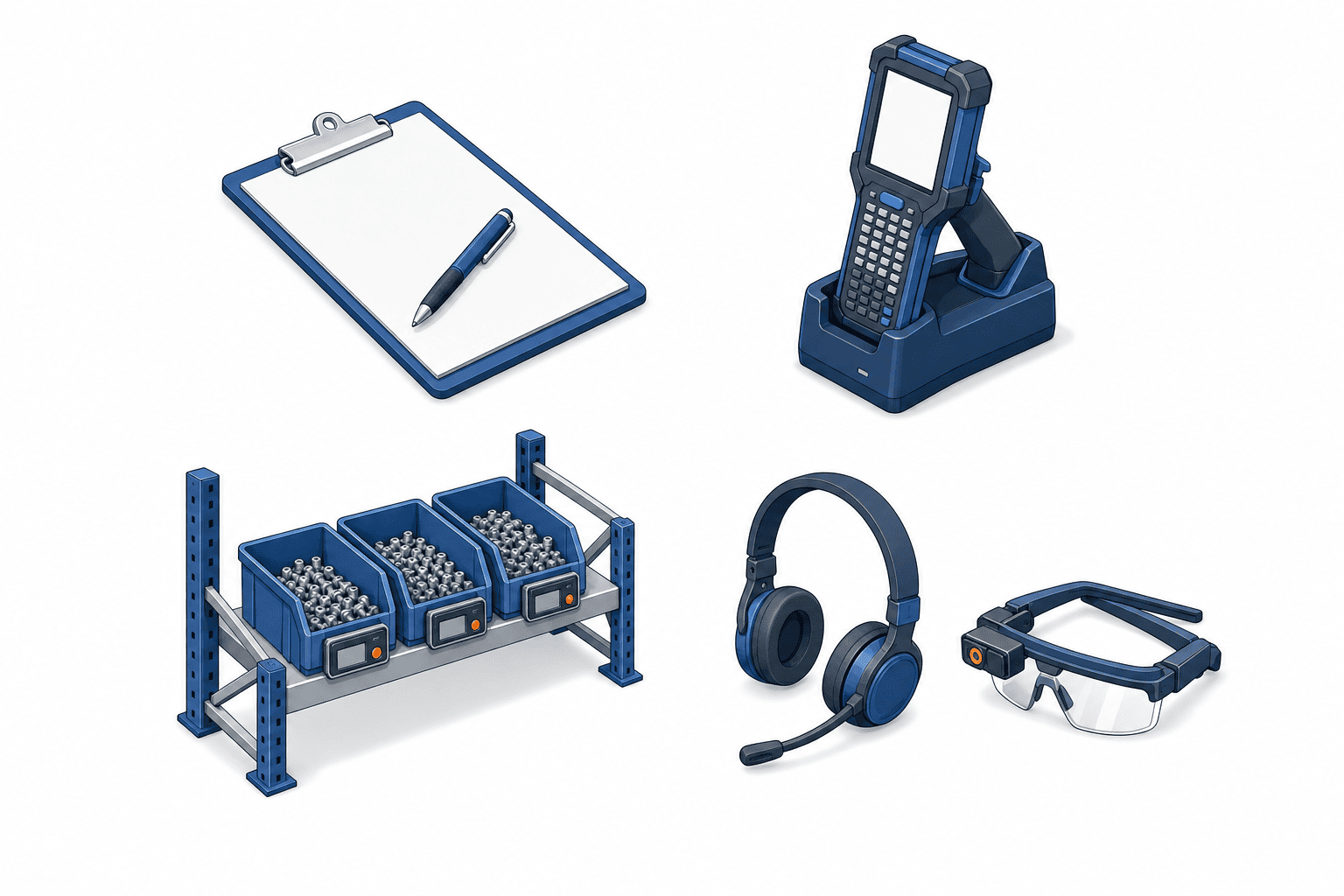
In warehouse improvement proposals, a picking system is almost always presented as a swap of instruction method. Replace the paper pick list with a handheld terminal. Replace the handheld with a digital display. Replace the display with voice or AR. Vendor material lines up a comparison table by method, with benefits such as fewer mis-picks and faster onboarding for new staff.
Nothing written in those tables is false. The problem is what is not written. A comparison of instruction methods says nothing at all about the time an operator spends walking between racks.
When picking work is actually measured with a stopwatch, it is not unusual to find that the time spent moving between racks, or between the racks and the shipping area, is longer than the time spent standing at a bin and reaching for the item. In the model case below, 21 of the 42 seconds in a paper-list operation are walking. That is exactly 50.0 percent.
If you replace the instruction method without understanding this structure, here is what happens. The capital request says that 42 seconds per line will become 30 seconds. And it does. But those 12 seconds come out of search, verify, and record, so the number of people standing on the floor does not change. Each person’s day gets a little easier, overtime drops a little, and the clean, legible change of “8 people become 7” never arrives. When the author of the capital request struggles to explain the results a year later, this is almost always the pattern.
The practical conclusion follows in one line. Do not begin a picking system evaluation by comparing devices. Begin by breaking down where your own per-line time actually goes. Once you have that breakdown, you can separate what a device can reduce from what only layout and sequence can reduce, before you look at a single quote.
Breaking one picking line into five blocks of time
The time required for one picking line can be broken into the following five components. This split holds up in warehouses across almost any industry.
- Walk — moving from the previous bin to the next one, or out to the shipping area
- Search — reading the bin address and locating the target bin and item by eye
- Pick — reaching, taking the item, and placing it in the container
- Verify — confirming that the part number and quantity match the instruction
- Record — ticking the paper, or confirming on a terminal, that the line is done
Of these, an instruction device can shorten only search, verify, and record. Picking is physical work, so no device changes it. And walking does not change however clever the device becomes, as long as the operator’s feet cover the same distance.
Model case assumptions
From here on we use a single shared model case. A parts warehouse in Chonburi Province, Thailand, handling 1,200 picking lines per day, with 8 operators, running 26 days per month, across 300 storage bins. For a Japanese-owned manufacturer’s Thai subsidiary, that is a very ordinary parts warehouse.
Time per line by method
| Method | Walk | Search | Pick | Verify | Record | Total |
|---|---|---|---|---|---|---|
| Paper list | 21 | 8 | 6 | 4 | 3 | 42 |
| Handheld verification | 21 | 7 | 6 | 2 | 0 | 36 |
| Digital display (DPS) | 21 | 2 | 6 | 1 | 0 | 30 |
| DPS plus relocation plus multi-order | 9 | 2 | 6 | 1 | 0 | 18 |
Units are seconds. The important thing to read in this table is that in the first three rows, the walk column stays at 21 seconds and never moves. Paper to handheld, handheld to display, walking is 21 seconds throughout. The only columns that move are search from 8 seconds to 2, verify from 4 seconds to 1, and record from 3 seconds to 0.
As reduction rates, handheld verification delivers 14.3 percent and the digital display 28.6 percent. That is the ceiling of what swapping the instruction method can buy you. Only in the fourth row, where the display is combined with location redesign and multi-order picking, does walking finally drop from 21 seconds to 9 seconds, and the reduction rate jumps to 57.1 percent.
Converted into total daily working hours, the gap becomes even clearer. The paper list takes 14.0 hours, the digital display 10.0 hours, and the version that also fixes the travel path 6.0 hours. The display on its own saves 4.0 hours, fixing the travel path adds another 4.0 hours, for a total of 8.0 hours. In other words, half of the saving comes from design, not from hardware.
From the point of view of getting a capital request approved, that table is your explanation of what you are paying for. The display quote covers reductions in search, verify, and record. It does not cover a reduction in walking. The location cleanup and the order-batching rule change that reduce walking have to be designed separately and budgeted separately.
Four instruction methods — paper, handheld, digital display, voice and AR
The instruction methods used in picking fall into four families. Each one differs in what it removes and where it gets stuck.
The paper pick list
Paper is still in active service on many sites. It costs almost nothing to start, it works during a power cut, and anyone can read it. Its weaknesses are that recording is handwritten, that verification depends on human attention, and that the list is frozen at the stock position of the moment it was printed. It cannot follow changes made just before shipment, so every change means reprinting the list or passing the change verbally. In the model case, verify takes 4 seconds and record takes 3 seconds. Against the digital display’s 1 second to verify and 0 to record, 6 of the 42 seconds per line, roughly 14 percent, is the extra cost of simply being on paper.
The handheld terminal with barcode verification
The operator carries a terminal and scans the rack label and the item barcode to verify the pick. Recording is automated, so record time falls to 0, and verify drops from 4 seconds to 2. Search barely moves, from 8 seconds to 7, because all the terminal does is display the bin address on a screen. There is also the physical constraint that one hand is occupied by the terminal.
On the other hand, the handheld’s greatest strength is that nothing is attached to the racks. Change the layout, add bins, and all you need is to re-label the bin addresses and update the master data. On sites where the item mix churns hard, or where the layout is touched several times a year, that flexibility shows up as real money.
The digital display (digital picking)
A small display is mounted on each bin. The lamp on the bin to be picked lights up, the quantity appears, and the operator presses a completion button. This is the method known as digital picking. When it is used for pick-to-order it is called DPS, and when it is used for sort-to-order it is called DAS.
The essence of the method is that search falls from 8 seconds to 2. The operator does not need to read a bin address at all, only to walk toward the light. Because the load of reading text disappears, there is no longer any need to make Thai-speaking operators read Japanese or English part numbers. On a local plant with a multinational workforce, this “nothing to read” property pays off in training cost even more than in cycle time.
The weakness is clear. The displays are physically tied to the racks. Change the bin allocation and the mapping between displays and locations has to be rebuilt. Move a rack and cabling work follows. On sites where bins are reshuffled frequently, this rework appears every year as an unbudgeted extra.
A variant that softens this weakness is projection picking. Instead of fitting a display to every bin, a projector mounted on the ceiling or a frame casts light and numbers onto the racks or the workbench to indicate the place to pick. Because no hardware sits on the rack side, a change in bin allocation can be followed by changing the projection settings, with no need to redo cabling every time the layout changes. On the other hand, obstacles in the projection path block the light, high ambient illumination reduces legibility, and nothing outside the projection area can be covered, so it is generally applied to bounded areas such as a sorting table. It is worth considering at the stage where you do not want to invest in a display on every bin but still want to cut search time.
Voice picking and AR picking
In voice picking, the operator wears a headset, receives the bin address and quantity by voice, and confirms completion by speaking back. The advantages are that both hands stay free and the eyes never leave the item, which makes it a good fit for heavy or bulky parts and for frozen or chilled warehouses where gloves make terminal operation awkward. The reported practical constraints are that recognition accuracy falls in noisy buildings, and that multilingual sites need a separate voice model and tuning per language.
AR picking overlays instructions inside the field of view through smart glasses and guides the operator visually to the rack and the item. Because a travel route can be drawn into the field of view, it is one of the few methods that could in principle also reduce walking, but headset weight, battery life, legibility in bright buildings, and unit price all remain barriers to practical rollout. As of 2026 the safe assumption is that activity is still concentrated in limited-area trials and partial application to specific tasks, and that full deployment across a 300-bin parts warehouse is not yet on the table.
How to line the four methods up
The axis of comparison is not only what each method removes. In practice you look at three things together. First, whether anything is attached to the racks. Methods that attach are weak against layout change; methods that do not are strong. Second, whether a hand is occupied. Third, whether operators are made to read. Methods that require reading stretch training time on multilingual sites.
If you settle where your own warehouse sits on those three axes before quotes arrive, the candidate methods naturally narrow to about two. Skip that step and competitive bidding produces three quotes that cannot be compared with each other.
DPS and DAS are opposite by design — decide on the ratio of destinations to SKUs
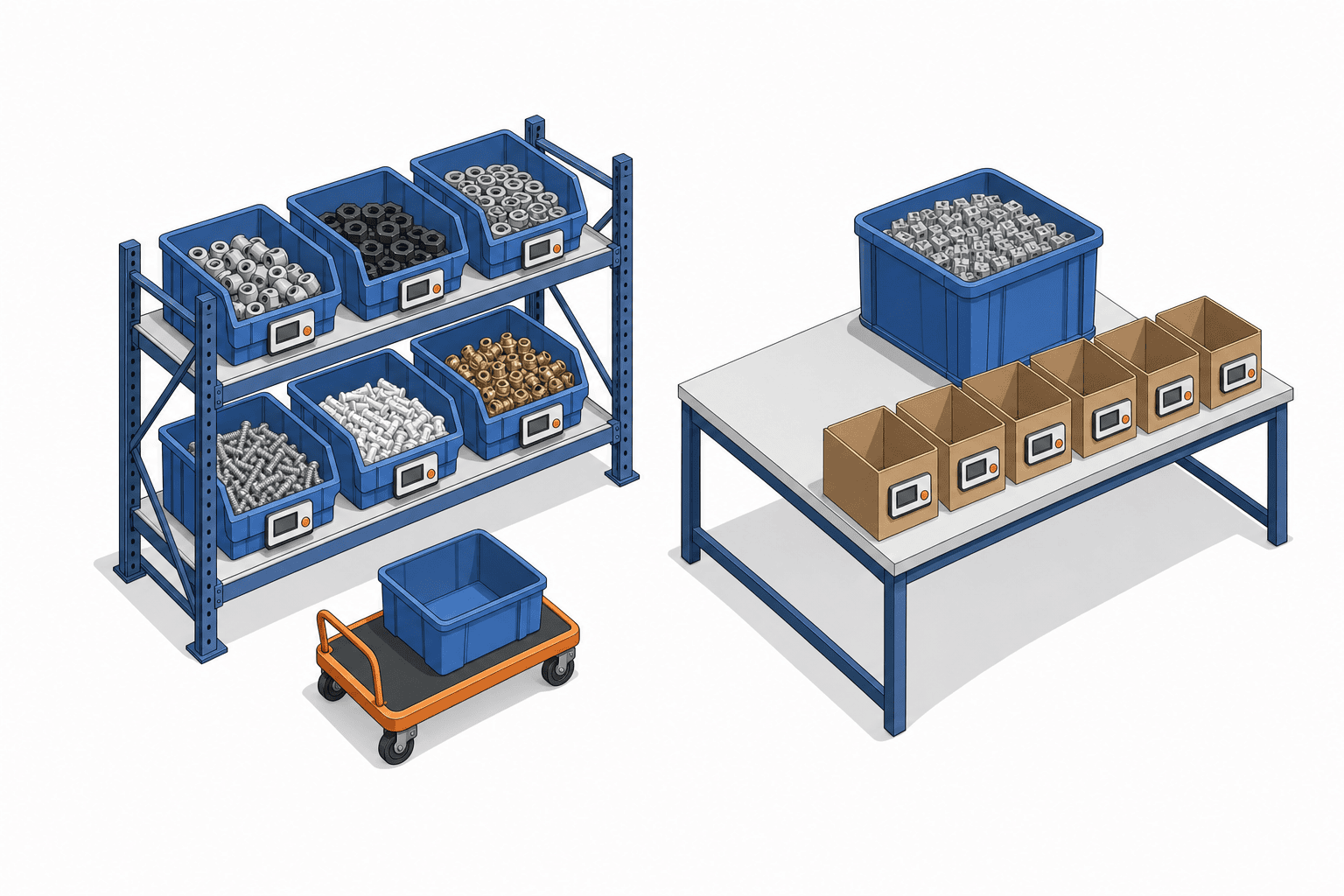
There are two forms of digital display operation, DPS and DAS. They use the same displays, they light up the same way, and they show quantities the same way. But what they are doing is the exact opposite.
DPS (pick-to-order) means carrying one order around the racks
DPS stands for Digital Picking System, and it is the pick-to-order approach. An operator holding one shipping order visits the bins for the items on that order in sequence, picking from whichever rack is lit. When the order is finished, the operator moves to the next one. The person moves and the goods wait on the shelf.
This works on sites where each order has few lines and the SKU count is high. With many items, storage cannot be consolidated, but each trip only involves a handful of bins. Parts warehouses and service-parts shipping tend to take this shape.
DAS (sort-to-order) means distributing one item across destinations
DAS stands for Digital Assort System, and it is the sort-to-order approach. You first bring one item from the rack in the total quantity required, stand in front of sorting bins divided by destination, and distribute the instructed quantity into whichever bin is lit. When that item is fully distributed, you move to the next item. The person stays in the sorting area and the goods do the moving.
This works on sites where the number of destinations is high and the same item is common to many of them. Line-side kitting between processes, parts supply to multiple lines, and simultaneous shipment to multiple stores or sites all take this shape.
The choice is set by a ratio, not by preference
The common failure on site is choosing DPS because “we have always done it that way”. The choice between DPS and DAS is not a question of operating habit. It is a question of one number, the ratio of destinations to SKUs.
| Decision axis | Favours DPS (pick-to-order) | Favours DAS (sort-to-order) |
|---|---|---|
| Number of destinations | Few | Many |
| Number of SKUs | Many | Relatively few |
| Lines per order | Few | Many |
| What moves | The person tours the racks | The goods come to the sorting bins |
| Where displays are fitted | Storage rack bins | Sorting rack bins |
| Floor area required | Storage area doubles as work area | A separate sorting area is needed |
In practice the two are not mutually exclusive. Distributing fast-moving common parts by DAS while picking slow-moving dedicated parts by DPS is often the most realistic answer. But running both means more displays and more host-system interfaces, so the cost adds up in the most literal way. Requesting a quote on the logic of “install both and we will be safe” produces a total nobody was expecting. Which method is the backbone and which is the supplement is a question to settle before you ask for a quote.
If you do choose DAS, floor area becomes a second factor. You need to set aside a separate sorting area, but better sorting accuracy compresses staging space and the queue waiting for inspection, so the occupied area can end up smaller. Multiplied by the Thai warehouse rents discussed later, that area effect is not a rounding error.
What actually cuts walking is location design and pick sequence
This is the heart of the article. The 21 seconds of walking inside a 42-second line will not be reduced by the instruction method. There are only two levers. Shorten the distance walked, which is location design, or complete several errands in one trip, which is pick sequence.
Location design — put fast movers close and on the path
The basis of location design is to place high-frequency items near the aisle entrance, at an easy height between the waist and the eye. It sounds obvious, but when we walk sites it is often not the case. The reason is simple. The bin addresses assigned on day one are still in use years later. The item mix changes every year, but if locations are frozen, items that now barely move occupy prime real estate while items picked several times a day sit at the far end of the aisle.
Redoing location design does not require a sophisticated algorithm. It requires the last 12 months of outbound history. Sort items by outbound line count in descending order and gather the top items near the aisle entrance and into the golden zone between waist and eye height. That alone shrinks both walking and search. The place to extract that history is the ERP or the warehouse management system, and as covered in WMS costs and how to choose one, whether the system can hold outbound history by location and by item has a large effect on how much improvement is available later.
Pick sequence — multi-order picking and zoning
The second lever is multi-order picking, where several orders are picked simultaneously in a single trip. Four orders are assigned to four containers on a cart, and one loop of the bins picks all four. The distance travelled stays roughly one loop, but the number of lines processed multiplies. That is the mechanism that lowers walking time divided by line count.
A further option is to split the warehouse into zones, assign operators to fixed zones, and relay orders between them. Each operator covers a smaller area, so walking falls, and each handles a fixed set of items, so search falls too. But if the handover design between zones is wrong, waiting time appears as a different kind of loss.
In the model case, walking drops from 21 seconds to 9 seconds because those two levers, relocation and multi-order, are used together. Against the display’s 12 seconds, the travel-path work delivers 12 seconds. Exactly the same size.
Do not get the order wrong
In practice the single most important thing is the order of work. Install displays before fixing locations and you freeze the wrong layout in hardware. Because the displays are tied to the racks, fixing locations afterwards means rebuilding the mapping and changing the cabling.
In other words, location design has to be finished before the displays go in. Following that one rule removes most of the rework cost that would otherwise appear later. The approach of “install the hardware first and fix things as we run” is, for digital displays specifically, the most expensive way to proceed.

Cost moves on three axes — unit count, floor area, and item count
If you only ever see picking system cost as “this much up front, this much per month”, you cannot tell which conditions move the number. Here we split the initial cost of the model case, 300 bins with DPS, into three axes: cost driven by unit count, cost driven by floor area, and cost driven by item count.
| Line item | Amount (baht) | Axis |
|---|---|---|
| Digital displays, 300 units at 2,800 baht each | 840,000 | Unit count |
| Controller, wireless access points, cabling work | 260,000 | Floor area |
| Location setup (bin labels, bin reassignment, opening stock count) | 180,000 | Floor area |
| WMS and host system integration (2 interfaces) | 350,000 | Item count |
| Commissioning, training, on-site attendance | 170,000 | Item count |
| Total | 1,800,000 | — |
Cost driven by unit count
This is the displays themselves. One per bin across 300 bins is 300 units. At 2,800 baht each, that is 840,000 baht. Out of a total of 1,800,000 baht, that single line accounts for roughly half.
Once you see that, the first thing worth investigating becomes obvious. Do all 300 bins really need a display? In most cases there is no need to light up bins holding low-frequency items. Fit displays only to the high-frequency top tier and pick low-frequency items with a handheld, and the unit count, and therefore the cost, comes straight down. Requesting a quote for every bin without first testing whether the unit count can be reduced is where the whole approach goes wrong from the start.
Cost driven by floor area
The controller, wireless access points, and cabling work sit here, along with the location setup. Together, 440,000 baht. These costs grow in proportion to the floor area and the way the racking is arranged. Racks further apart mean longer cable runs and more access points. High ceilings, many columns, and densely packed steel racking all degrade the radio environment and lead to additional access points.
This axis cannot be estimated accurately without a site survey. Quote from drawings alone and you get a change order after work starts, along the lines of “the signal does not reach, we are adding access points”. That is exactly why you should check whether a site survey is included at the competitive-quote stage.
Cost driven by item count
Host system integration and commissioning and training sit here. Together, 520,000 baht. These move less with the raw item count than with the complexity of the item master and the number of touchpoints with upstream systems.
Two interfaces means, for example, one to receive shipping instructions and one to return picking results. Add “synchronise stock allocation” and “hand over lot and serial data” and both the interface count and the verification effort grow. On sites with traceability requirements, it is not unusual for this cost to double against expectations. As set out in comparing factory inventory management systems, how much data the existing ERP already holds makes a large difference to this axis.
What changes when you look at three axes
Splitting the cost into three axes lets you predict how the quote moves when conditions change. Talk of expanding the warehouse moves the floor-area axis. A plan to consolidate items lowers the item-count axis. A phased rollout that starts with only 100 bins cuts the unit-count axis to a third. With a flat “1,800,000 baht all-in” figure, none of that simulation is possible.
Labor savings alone will not pay it back — errors and training make the case
This is the crux of the article. If you calculate the return on a picking system from labor savings alone, you will almost certainly produce a number that does not get approved. Let us run it on the model case.
First, labor savings only
Start with Thai wage assumptions. The Bangkok daily minimum wage is 400 baht, effective 1 July 2025 and held flat for 2026. We set the effective hourly cost, including social security, overtime premium, and benefits, at 75 baht.
As shown above, the hours saved are 4.0 hours per day with DPS alone and 8.0 hours per day with the travel-path work included.
| Scenario | Hours saved per day | Per month (baht) | Per year (baht) |
|---|---|---|---|
| DPS only | 4.0 hours | 7,800 | 93,600 |
| DPS plus flow redesign | 8.0 hours | 15,600 | 187,200 |
Divide the initial cost of 1,800,000 baht by the 187,200 baht per year that includes the flow redesign and you get 9.6 years. Set against any sensible equipment replacement cycle, a capital request carrying that number comes straight back.
And this is where many proposals reach for the footnote that “wages rise every year, so in reality it pays back faster”. In Thailand in 2026, that argument is not available. The minimum wage has held at the level set in the July 2025 revision, no further revision has been reported for 2026, and a payback scenario that banks on natural wage growth is unusually weak this year.
Add the cost of mis-picks
If labor savings are not enough, what else should be counted? The answer is mis-picks.
Monthly line volume in the model case is 31,200 lines, being 1,200 lines a day over 26 days. Put the mis-pick rate for a paper-list operation at 0.35 percent and that is 109 cases a month. Bring it down to 0.03 percent with a digital display and it is 9 cases a month. The difference is 100 cases a month.
The crux is how you value one case. Rework hours, the freight cost of reshipment, time spent handling the customer, and the loss of trust at the customer. Average those out at 900 baht per case and you get 100 cases multiplied by 900 baht, which is 90,000 baht a month, or 1,080,000 baht a year. More than five times the labor saving.
That 900 baht unit value is a number you should re-derive for your own operation. It goes up on sites that charter a truck for reshipment and down for internal line-side kitting. As also covered in preventing shipping errors in practice, a company that has never measured its own loss per case ends up unable to put the single largest benefit into the capital request at all.
Add training time
The second item is training time. Put the number of days for a new operator to reach standard speed at 15 days on paper or handheld and 4 days with a digital display. The difference exists because there is no longer any need to read bin addresses, memorise part numbers, or remember where things live.
With annual turnover of 12 people, that is 12 people multiplied by 11 days multiplied by 8 hours, or 1,056 hours. At an effective 75 baht per hour, 79,200 baht per year.
Operator turnover in Thai manufacturing and logistics is widely described as faster than at plants in Japan, so training cost recurs every single year. Almost no proposal includes this line, and the higher the turnover, the larger the number.
Add all three and the payback looks like this
| Benefit | Per year (baht) |
|---|---|
| Labor savings (with flow redesign) | 187,200 |
| Reduced mis-pick losses | 1,080,000 |
| Reduced training time | 79,200 |
| Total | 1,346,400 |
Initial cost of 1,800,000 baht divided by an annual benefit of 1,346,400 baht gives 1.3 years.
Those two figures, 9.6 years and 1.3 years, describe the same equipment, the same site, and the same hours saved. The only difference is what was counted. The main reason picking system capital requests fail is neither device performance nor price. It is benefits left uncounted.
Measure by where the error is found, not by the error rate
The previous section showed that the mis-pick figure is what carries the payback. If that is true, then post-go-live measurement should also be built around mis-picks. But what you should measure is not a rate.
The mis-pick rate has one fatal weakness. The denominator is vague and the numerator depends on what the floor reports. An error caught and quietly corrected mid-process never enters the numerator unless it is recorded. The result is that the better the team, the better the number looks, and the less you can see.
The metric to use instead is where the error was found. Split it three ways.
| Where found | Meaning | Real cost per case |
|---|---|---|
| In process (during picking or sorting) | The system stopped it on the spot | Smallest |
| Before shipment (inspection, packing) | Someone downstream caught it | Medium |
| At the customer (after delivery) | Nobody caught it | Largest |
The change that should occur when a picking system goes in is that the point of discovery moves from the customer to pre-shipment, and from pre-shipment to in-process. Even if the total case count is flat, the investment is working if customer-side discoveries have gone to zero. Conversely, if the total has fallen but customer-side discoveries remain, the system is not stopping the escapes.
Seen this way, the relationship with the inspection process also becomes clear. If more errors are stopped at the moment of picking, the number caught by a shipping and receiving inspection system should fall. If it does not, there is a loophole in how picking is being operated. Gaps such as being able to press the completion button without taking the item, or picking by feel without looking at the displayed quantity, only become visible once these figures are lined up.
As a measurement practice, a monthly table with the three counts, in process, pre-shipment, and at the customer, comparing three months before go-live against three months after, is entirely sufficient. No difficult analysis is required. The difficult part is having measured the three months before. Start measuring only after the project is approved and there is nothing to compare against.
Conditions that matter in Thailand in 2026 — flat wages, rising rents, continuing turnover
The same picking system stands or falls on market conditions. Thailand in 2026 has three conditions that shape the decision.
Wages are flat, so a labor-based payback is weak this year
The Bangkok daily minimum wage is 400 baht, still at the level that took effect on 1 July 2025. No further revision has been reported for 2026.
What that means is that the 9.6 years in the previous section will not improve on its own with the passage of time. Write a capital request on the premise that “wages go up every year, so the benefit will be larger next year” and you will not be able to explain the results at the following year’s review. If you are making an investment decision in 2026, the basis for payback has to sit outside labor cost.
Warehouse rents are rising, so reclaimed floor area is money
The second condition is warehouse rent. According to Cushman & Wakefield’s report for the second quarter of 2026, ready-built warehouses (RBW) in Thailand have total stock of 6.05 million square meters, occupancy of 85.28 percent, and an average rent of 160 baht per square meter per month. Ready-built factories (RBF) have total stock of 3.42 million square meters, occupancy of 89.55 percent, and average rent of 196 baht. New supply in the second quarter was zero, and rents are reported to be on an upward trend.
High, sustained occupancy with no new supply means that expansion is an expensive option. Turned around, it means the value of any measure that increases throughput within the current footprint has gone up.
Consider a DAS scenario in the model case. Compress the sorting area from 240 square meters to 150 square meters and 90 square meters are released. At an average rent of 160 baht, 90 multiplied by 160 multiplied by 12 gives 172,800 baht per year. That is almost exactly the same scale as the labor saving of 187,200 baht per year.
Even in an owned warehouse, that floor area pays off by avoiding the need to expand. Deferring an expansion request by a year saves that year of rent or that year of capital.
Turnover continues, so training time pays every year
The third condition is staff turnover. The training benefit calculated above, 79,200 baht per year, recurs for as long as turnover continues. Flat wages do not make turnover go away.
The training benefit also has the property of growing with the number of languages on the floor. An operation that requires bin addresses and part numbers to be read takes time to master. An operation where you walk to the light and take the number shown requires no such mastery. At Japanese-owned plants still using a Japanese part-numbering scheme, that gap is especially wide.
Line the three up and the shape of the argument for a picking system in Thailand in 2026 is set. Do not make labor cost the lead. Lead with errors and training, and use the floor-area effect as reinforcement. A capital request assembled in that order does not fall apart when wage trends change.
How to roll it out — reaching live operation in 90 days
Let us turn all of this into an actual plan. At the 300-bin scale, you can reach live operation in 90 days. The condition is that you keep the order.
First 30 days — measure and decide
Not a single device is bought in this period. There are three things to do.
- Measure your current picking line — with a stopwatch, split five ways into walk, search, pick, verify, and record, across at least 30 lines. Sample at least two operators and at least two times of day
- Count where mis-picks were found for the past three months — three categories, in process, pre-shipment, and at the customer. If no records exist, start recording today
- Produce the last 12 months of outbound history by item — a descending list by outbound line count. Check what percentage of all outbound lines the top 20 percent of items account for
With those three in hand, DPS or DAS, every bin or partial rollout, display or handheld, are all decided by numbers. Request quotes without them and you will be offered the vendor’s standard configuration.
Next 30 days — fix the locations
Locations come before hardware. Reassign bin addresses on the basis of the descending outbound list, replace the bin labels, and reconcile stock to actual counts with an opening physical count. At the end of this period, measure the time per line again. If walking has not fallen by this point, adding displays will only deliver half the total reduction.
Location change is also the step that meets the strongest resistance on the floor. The reaction of “my body knows where things are, I do not want it changed” is guaranteed to appear. That is precisely why this step must not be done at the same time as the hardware. Do them together and you can no longer tell whether the confusion is caused by the layout or by the device.
Final 30 days — install and run in parallel
Display installation, integration testing with the host system, training, and parallel running. During the parallel period, keep recording under the old method as well, because the tally of where mis-picks are found has to be comparable across the go-live boundary.
The criterion for cutting over is not “the displays light up”. It is “during the parallel period, mis-pick discovery has shifted toward the in-process end”. Cut over on the calendar without looking at that and you go live with customer-side discoveries still in place.
Seven things to decide before you request quotes
There are things to settle internally before competitive quotes go out. Without them, you get quotes that cannot be compared.
- Pick-to-order, sort-to-order, or both — decide from the ratio of destinations to SKUs and the lines per order. Decide with numbers, not with operating habit
- How many bins get a display — every bin, or only high-frequency items. Unit count is about half the cost, so this decides the total
- How often locations change — how many times a year bin allocations are reshuffled. If it is frequent, a handheld comes out cheaper than displays on total cost
- How many host interfaces, and in which direction — of receiving shipping instructions, returning results, synchronising stock allocation, and handing over lot and serial data, which do you actually need
- The loss per mis-pick — build it from your own history of rework hours, reshipment cost, and customer handling time. Without this number the payback calculation is labor cost only
- Whether a site survey happens before the quote — radio environment, ceiling height, rack material, aisle width. Quotes from drawings alone tend to generate change orders after work starts
- The measurement metrics and the date you start collecting baseline data — the three-way split of where mis-picks are found, and the five-way split of time per line. Always capture three months before go-live
Write the answers to those seven on a single sheet and hand it to vendors, and the quality of the quotes you get back changes. Without that sheet, each vendor builds a configuration on different assumptions, and you cannot tell whether a price difference reflects scope or unit rates.
Frequently asked questions (FAQ)
How much does a picking system cost
It varies widely with configuration, but the model case, 300 bins with digital displays and 2 host interfaces, came to 1,800,000 baht up front. The breakdown is 840,000 baht for 300 displays, 260,000 baht for the controller and cabling work, 180,000 baht for location setup, 350,000 baht for host integration, and 170,000 baht for commissioning and training.
What matters more than the total is that cost moves on three axes, unit count, floor area, and item count. Reduce the number of bins and the unit-count axis falls, a larger warehouse raises the floor-area axis, and more interfaces raise the item-count axis. Get the quote broken out on those three axes and you can run your own simulations when conditions change.
Should we choose DPS or DAS
Decide on the ratio of destinations to SKUs. Few destinations, many SKUs, and few lines per order points to DPS, the pick-to-order method. Many destinations, with the same item going to many of them, points to DAS, the sort-to-order method.
If the call is not obvious, pull two figures from the last three months of shipping data, the average number of lines per order and the number of destinations a single item goes to. A small first figure leans DPS, a large second figure leans DAS. In practice a combination is often the best answer, but note that running both makes the cost add up in the most literal way.
Are voice picking and AR picking ready for real use
Voice picking is in real use where both hands are occupied and where gloves are worn. That said, recognition accuracy falls in noisy buildings, and multilingual sites are reported to need tuning per language.
AR picking is one of the few methods that could also reduce walking, because instructions are overlaid inside the field of view, but headset weight, battery life, legibility in bright buildings, and unit price all remain open issues. As of 2026 activity is concentrated in limited-area trials and partial application, and it is safest to assume full deployment across a 300-bin warehouse is not yet on the table. We recommend taking the realistic step first, from paper to a digital display or to a handheld.
How far can picking be improved without installing a system
Quite a long way. In the model case, walking fell from 21 seconds to 9 seconds through operational measures alone, namely location relocation and multi-order picking. In per-line terms that is 12 seconds. Exactly the same size as the reduction delivered by the digital display, 12 seconds across search, verify, and record.
In other words, there are real situations where the benefit available without buying a single display matches the benefit of an 840,000 baht investment in displays. Location setup itself is not free, 180,000 baht in the model case, but that is around a fifth of the 840,000 baht for displays. Reviewing locations on the basis of outbound history and changing how orders are batched first, then filling the remaining gap with hardware, gives the strongest return.
We installed a system but mis-picks have not fallen. What should we look at
Count where mis-picks were found in three categories rather than tracking a rate. In process, pre-shipment, and at the customer. Even if the total is flat, the system is working if customer-side discoveries have disappeared and moved to in-process discoveries.
If customer-side discoveries remain, there is a loophole in the operation. Common ones are pressing the completion button before taking the item, picking by feel without looking at the displayed quantity, and processing several bins together and confirming them in one go. These are working-rule problems rather than device settings, so the only way to find them is by observing the floor.
Can we install a picking system without an existing inventory management system
You can, but the benefit will be limited. A picking system runs on instructions telling it what to take, from where, and how many, so something upstream has to create those instructions. If upstream is still spreadsheets and paper, creating the instructions remains a manual bottleneck.
The item-level outbound history that location design needs also does not accumulate without a host system. The natural order is to put in place a system that holds stock and shipping instruction data first, and then replace the execution layer of picking with hardware. For how this relates to existing systems, see also how to choose an inventory management system.
Summary
Here are the points to hold on to when evaluating a picking system.
The largest share of working time is walking. In the model case it was 21 of 42 seconds per line, 50.0 percent. And changing the method from paper to handheld to digital display does not move those 21 seconds. Instruction devices reduce only search, verify, and record. Only two things reduce walking, location design and pick sequence.
That is why half the benefit comes from design. In the model case, the digital display saved 4.0 hours a day, location relocation and multi-order picking together saved another 4.0 hours, for a total of 8.0 hours. In terms of the size of the benefit, hardware and design matter equally.
And the investment does not pay back on labor savings alone. A figure of 9.6 years does not get approved. Only when the reduction in mis-picks, 1,080,000 baht a year, and the reduction in training time, 79,200 baht a year, are added does it become 1.3 years. Because Thailand in 2026 has flat wages and rising rents, placing the basis for payback outside labor cost matters more than ever.
Finally, measure the benefit by where errors are found rather than by a mis-pick rate, and start collecting that data before the project is approved. Hold those two points and you will be able to explain the numbers at the one-year review.
It is not unusual to be unable to tell at this stage whether your warehouse suits pick-to-order or sort-to-order, or whether you need displays at all rather than an operational review. TOMAS TECH works on production control and inventory management systems on the floor at Japanese-owned manufacturers in Thailand, and we are happy to start simply by measuring your current picking line together. You are welcome to get in touch even before a method has been chosen, through our contact page.


