


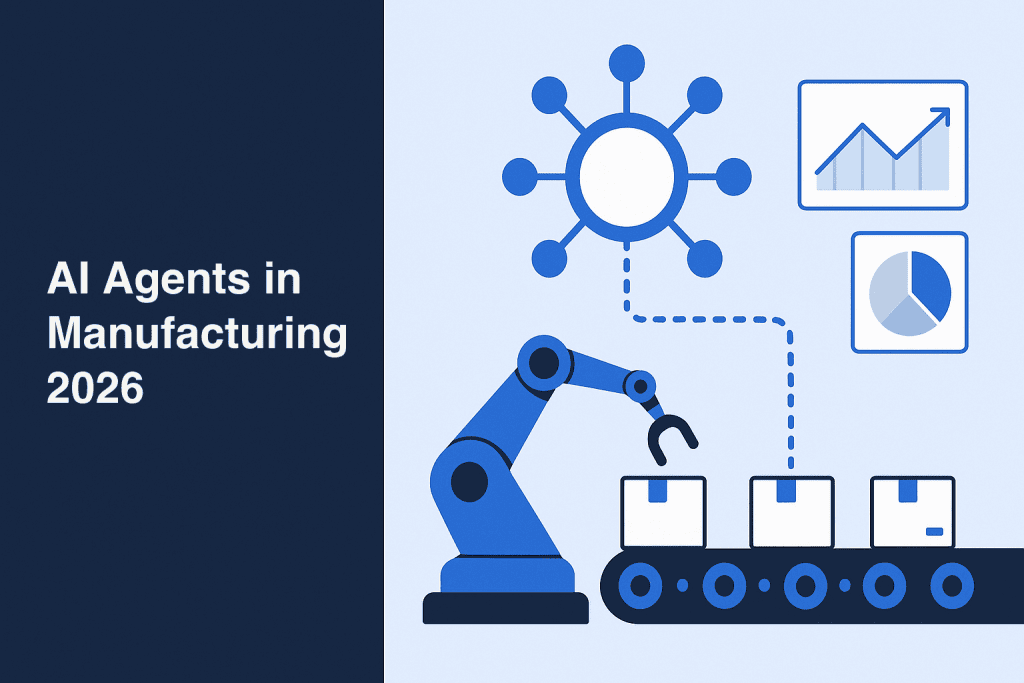
“We tried AI, but it never got past the PoC.” Talking with executives and plant managers at manufacturers in Thailand through 2024 and 2025, we heard some version of that sentence again and again. Someone pushed shop-floor questions into a chatbot. Someone trialled image recognition for visual inspection. Nothing made it onto the production line. The reason was almost always the same: the AI only *returned an answer*. Everything after that — keying data into the production management system, notifying the right person, raising the paperwork, issuing instructions to equipment — still had to be done by hand.
In 2026, that equation has visibly started to change. The keyword is agentic AI. Not an AI that answers, but an AI that, given an objective, plans its own steps, executes them across multiple systems, verifies the result, and reports back. In the first half of 2026, Anthropic and OpenAI both shipped releases that decisively pushed the industry in this direction. And in manufacturing, adoption has stopped being an experiment and started showing up as numbers on the operations side of the business.
This article lays out how AI agents evolved in H1 2026, what that means concretely for manufacturing and logistics operations, and what manufacturers in Thailand and Vietnam — including Japanese-owned plants — should be doing right now. The perspective is that of TOMAS TECH, a Bangkok-based factory IT integrator that has spent years on the floor of real plants doing real deployments.
2026: AI Agents Move from “Trying” to “Using”
Adoption is forecast to roughly quadruple in a single year
Start with the industry temperature, in numbers. According to Manufacturing Dive, Deloitte forecasts that agentic AI adoption in manufacturing will rise from 6% to 24% in 2026 — roughly a fourfold increase. Even allowing for the small base, a 4x change rate in twelve months is not something to wave away. It marks the shift from “a handful of leading-edge companies are experimenting” to “one in four of your competitors is actually running this.”
There is a second indicator that sits much closer to the shop floor. Industry forecasts hold that more than 40% of manufacturers that own a production scheduling system will upgrade to AI-driven capabilities by 2026. Production scheduling is arguably the most Genba-adjacent and the most person-dependent domain in all of manufacturing IT. The fact that AI is entering *there* tells you the target of AI has moved from back-office efficiency into the operation of production itself.
For management at manufacturers in Thailand, the important implication is that this is no longer a “someday” topic. It belongs in this fiscal year’s budget cycle. When a competitor halves the time it takes to build a production plan and automates 80% of its order processing, the gap shows up as lead time and quotation response speed — the two things customers feel directly.
Why 2026 is the inflection point
The concept of agentic AI has been discussed since roughly 2024. So why did implementation accelerate so sharply in 2026? The technical reasons come down to three.
First, models became genuinely capable of long-running task execution. Earlier generative AI was excellent at single question-and-answer exchanges but broke down over sequences of 20 or 30 steps. The 2026 model generation has improved substantially in this kind of endurance.
Second, standard patterns emerged for connecting AI to external systems. Common mechanisms for wiring AI into existing assets — ERP, production management systems, MES, equipment PLCs — have become widespread, which lowered the custom development burden dramatically.
Third, agents arrived that non-engineers can actually use. Agentic AI had been running ahead in the software development context; 2026 is the year that tools matured enough for staff in accounting, purchasing, and production control to hand work directly to an agent. We look at that in detail in the next section.
What Anthropic and OpenAI Shipped in H1 2026
Anthropic: Claude Cowork opened up agents for non-engineers
The most symbolic release of H1 2026 was arguably Claude Cowork, which Anthropic announced on 12 January 2026. As reported by NBC News, it is a general-purpose AI agent aimed at non-engineers, designed so that ordinary business work outside software development can be delegated to AI.
By July 2026, Claude Cowork had expanded to web, mobile, and cloud execution, and tasks can now continue even when the user’s device is offline. That “keeps running while you’re offline” property carries more practical weight for manufacturing readers than it might first appear. Plant managers spend most of the day away from a desk — on the line, in meeting rooms, at suppliers. A tool that stops the moment you close the laptop and a tool that keeps working in the cloud so results are waiting when you get back are two completely different propositions in terms of how easily they embed into daily operations.
Anthropic also introduced the Claude 5 family, a new model tier. It is designed on the assumption that you select a model according to the task and the accuracy you need, which makes it far easier to optimise the cost-performance balance per workflow. On top of that, the Claude Agent SDK is making it commonplace to build agents tailored to your own business processes. That represents a shift from “use the AI features your vendor gives you” to “assemble agents around your own operations” — and for companies with in-house IT capability, it widens the room for genuine differentiation.
The July 2026 Claude Code update reveals the management-side view
Claude Code, the developer-facing product, received a notable update in July 2026 as well. One change: /code-review now runs as a background sub-agent. Review work is split off to a separate agent and runs behind the scenes, so a human never has to wait. It is a clear signal that “run several agents in parallel” is becoming the default mental model.
The other change was two new tabs added to the admin console, covering usage and value. The number of active developers in the organisation, session counts, and top commands are now updated daily. For management, this matters. AI tooling has historically been an investment whose effect was hard to measure; the direction of travel is now toward visibility into who is using it, how much, and for what. The logic is the same as in plant IT: you cannot improve a machine whose utilisation you cannot see. Visible usage is a precondition for adoption sticking.
OpenAI: GPT-5.6 Sol and multi-agent operation by voice
On the OpenAI side, GPT-5.6 Sol reached GA (general availability) as the default model in Codex on 9 July 2026. Published benchmark scores include 88.8% on Terminal-Bench 2.1 and 64.6% on SWE-Bench Pro. These measure software engineering task execution — in other words, whether the model can take a problem and finish it end to end on its own. More telling than the numbers themselves is the fact that real-task benchmarks have become the headline metric at all. It is evidence that the industry’s attention has moved from “clever responses” to “getting the job done.”
Operationally, the more interesting addition is support for multi-agent operation by voice: issuing spoken instructions to several agents and having them work in parallel. It is designed for situations where your hands are occupied or you cannot look at a screen. Many manufacturing readers will immediately see the affinity. Standing beside a line with gloves on, or walking a plant round, issuing voice instructions and finding the report waiting when you return — that is now technically within sight.
TechCrunch reported on 15 July 2026 that OpenAI released Codex Micro, a $230 dedicated keyboard for Codex. The very existence of purpose-built hardware for driving AI agents is corroborating evidence that agents are becoming a tool people touch for hours every day rather than something used occasionally. Dedicated interfaces appear for a tool only after that tool has settled into daily work.
Meanwhile in Southeast Asia: Thailand’s AI adoption is above the regional average
Alongside the global picture, the domestic situation in Thailand deserves attention. According to the UOB Business Outlook Study 2026, more than 70% of Thai SMEs have already adopted AI — a level above the regional average. If your mental model is still “Thailand is a few years behind,” it may be worth updating. In practice, it is entirely plausible for your suppliers and logistics partners to be running AI while your own operation remains manual.
Looking further out, TDRI (Thailand Development Research Institute) forecasts that Thailand’s AI industry will grow at a CAGR of 42.4% from 2020 to 2030. Under the Thailand 4.0 policy, there is continued policy support for upgrading manufacturing and developing digital talent. And at the Nikkei Asia Forum, executives from ASEAN manufacturers have been debating AI’s potential to transform the sector — a sign that “how do we convert AI into industrial competitiveness” has moved to the centre of the regional management agenda.
How Agentic AI Works, and What Makes It Fundamentally Different
From “AI that answers” to “AI that finishes the job”
Let us be precise about what agentic AI actually is. Conventional generative AI — chat-style AI — is fundamentally a device that returns an output for an input. A human asks; the AI answers. What happens next with that answer is entirely the human’s job.
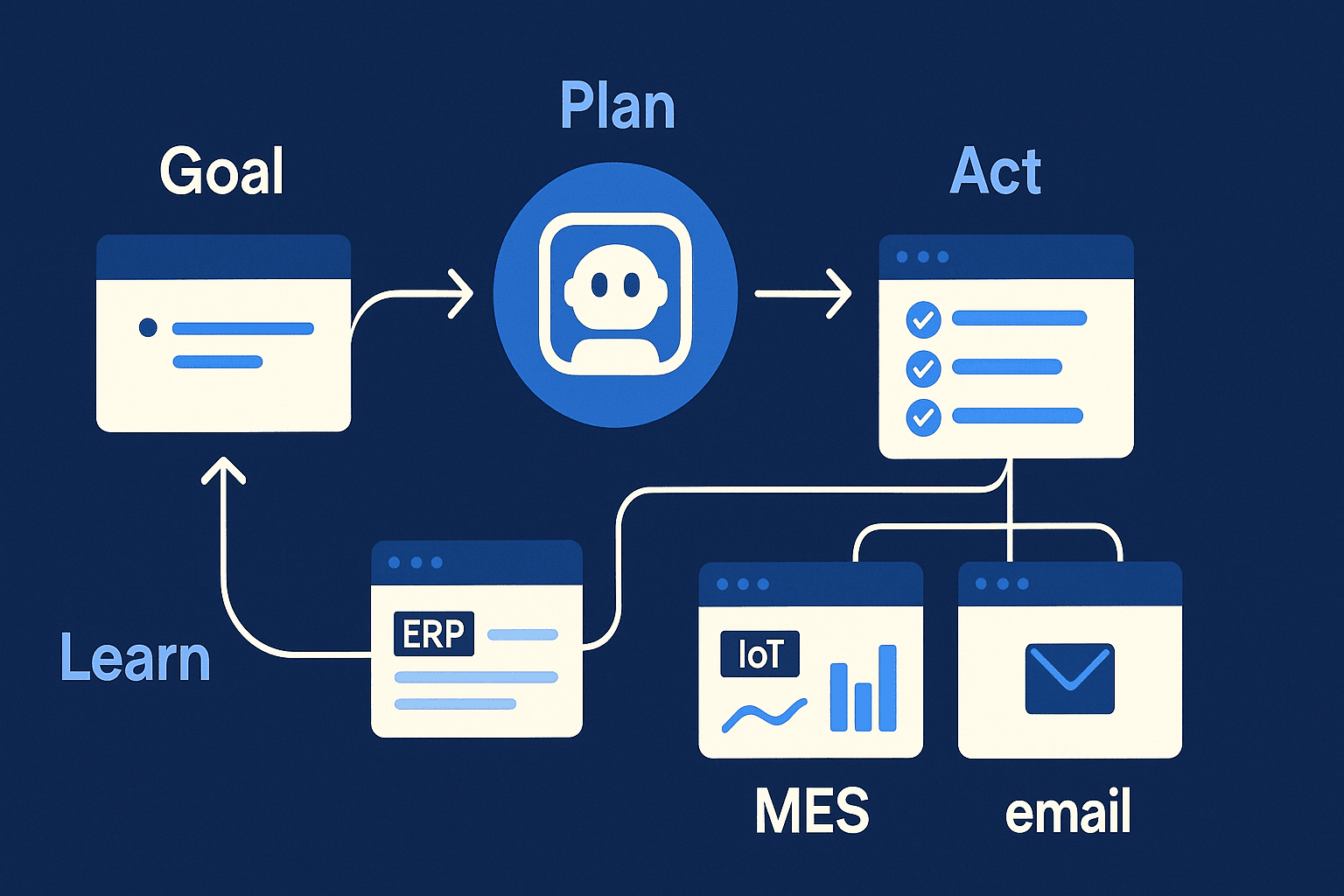
Agentic AI adds a loop of planning, action, and verification on top of that structure. Given an objective, it decomposes the steps itself, goes and fetches the information it needs, operates external systems, checks the result, and retries when something fails. What the human specifies is *what should be achieved*, not *how to do it*.
Translated into manufacturing language: if conventional AI is the veteran who will tell you the answer when you ask, agentic AI is the staff member who takes the job and handles it from setup to cleanup. The difference is decisive because the shape of the benefit changes. The former shortens the time people spend thinking; the latter removes the man-hours of the work itself.
The four components that make an agent viable
At the implementation level, an agent that works in production is generally built from four components.
1. Planner. The part that decomposes an objective into sub-tasks and decides execution order. An instruction like “rebuild this month’s production plan” gets broken down into “retrieve order data,” “check inventory,” “reference the equipment availability calendar,” “allocate under constraints,” and “generate an explanation of the variances.”
2. Tool connectivity (cross-system integration). The interfaces for operating external systems: ERP, production management systems, MES, WMS, equipment data platforms, email and chat. Most of an agent’s real-world capability is actually determined here. However smart the model is, if it cannot touch core system data it is merely well-read.
3. Memory (context retention). The mechanism for holding past exchanges, business rules, and the reasoning behind previous decisions. Whether you can accumulate tacit rules — “rush orders for this customer require sales director approval” — makes an enormous difference to practical usefulness.
4. Verification and guardrails. The mechanism that checks results and blocks out-of-scope operations. This is especially critical in manufacturing: without a tiered design such as “reads are automatic, writes require human approval,” the shop floor will never be comfortable delegating.
In manufacturing, designing the human approval points matters most
In our experience, what separates a successful agentic AI deployment from a failed one is not model selection but where you place the human-in-the-loop approval points.
For a production plan rebuild, let the agent handle data gathering and alternative-scenario generation, and have the production controller approve the final version. For equipment anomaly detection, automate the correlation analysis and the shortlist of probable causes, and let the maintenance manager decide whether to issue a work order. For order processing, auto-handle cases that meet standard conditions and escalate only those with price deviations or credit concerns.
You do not need to draw these lines perfectly on day one. What matters far more is designing so that the scope of automation can be widened progressively during operation. Start with humans reviewing every case. After three months of operation, move the areas where the agent’s judgement has consistently matched the human’s over to auto-approval first. Run it this way and psychological resistance on the floor stays low — and you have a defensible story for audit.
What Actually Changes on the Shop Floor and in Logistics — Concrete Use Cases
Published results show the scale of the effect
Abstractions do not support decisions, so let us look at results that have already been published. The Infor cases covered by Manufacturing Dive report the following outcomes:
- Suzano (pulp and paper): 95% reduction in materials data lookup time
- Danfoss (industrial equipment): 80% of transactional decisions in order processing automated
- Elanco (animal health): up to USD 1.3 million in productivity loss avoided per site through document management automation
What deserves attention is that none of these are glamorous technology domains. Materials data lookups, order processing, document management — every plant has them, they are unglamorous, high in volume, and prone to becoming one person’s private knowledge. That is exactly where agentic AI delivers first.
There is also useful data on return on investment. Survey findings report an average ROI of 192% for agentic AI deployments at US companies, with payback in 12 to 18 months. Compared with a multi-year core-system replacement, this is an investment you can evaluate on a dramatically shorter cycle.
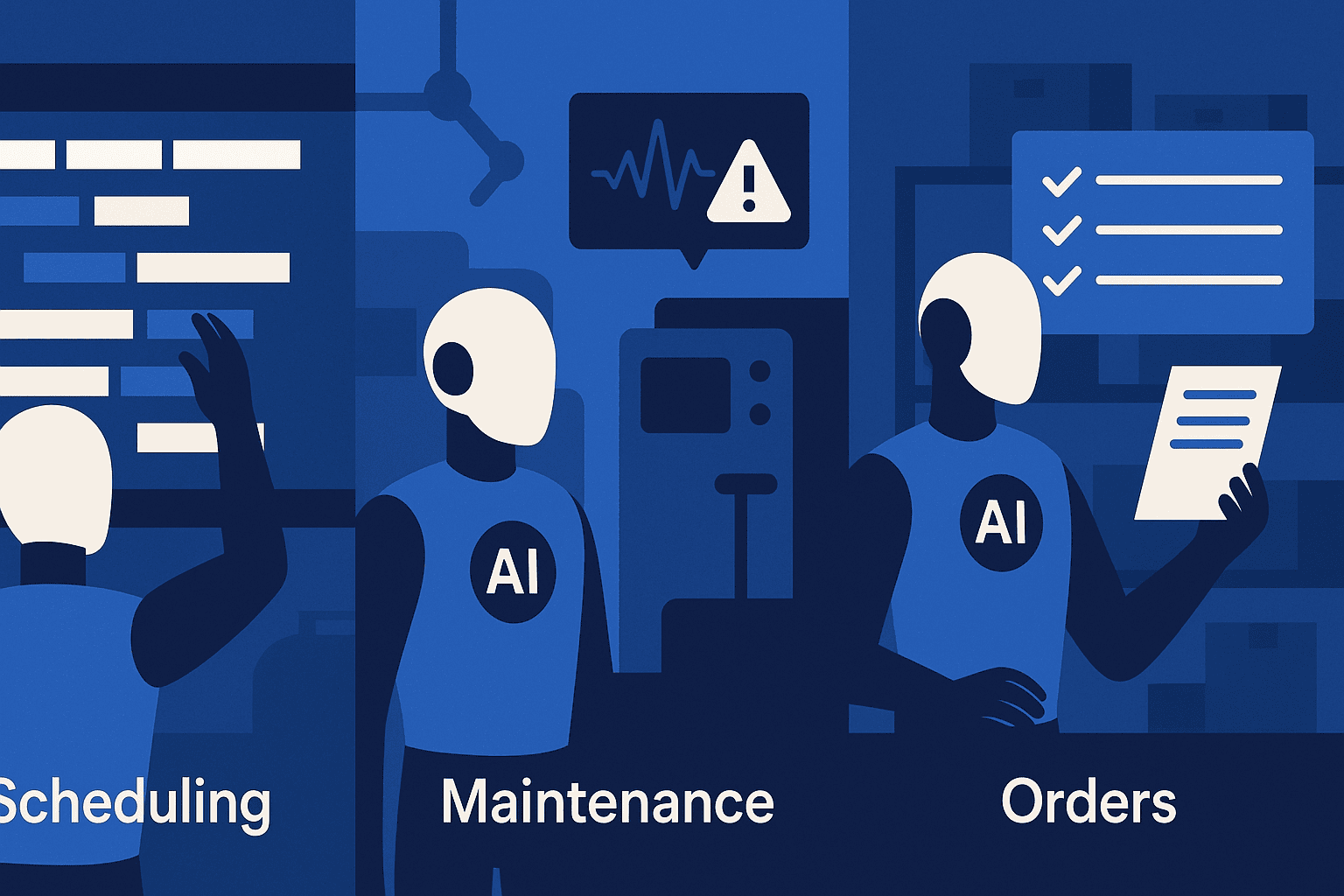
Use case 1: Production planning and scheduling
At manufacturing plants in Thailand, production planning is typically the single most person-dependent function. A veteran production controller combines order status, incoming material schedules, equipment condition, operator skills, and customer priorities in their head and produces a plan. What happens on the day that person takes leave — or resigns — is something most plant managers have experienced first-hand.
Agentic AI works in two modes here. The first is automatic plan generation: give it the constraints and it produces multiple alternatives in a short time, explaining the trade-offs of each (on-time delivery rate versus number of changeovers, for example). The second is change response: when a rush order, a material delay, or an equipment breakdown lands, it immediately maps the affected scope and proposes a revised plan. As noted above, the forecast that more than 40% of manufacturers with a production scheduling system will upgrade to AI-driven capabilities by 2026 reflects exactly how strong this demand is.
Use case 2: Equipment maintenance and downtime reduction
The number of plants collecting equipment data via IoT has grown, but just as common is the plant where collection is where it ended. The data exists; nobody has time to look at it. Threshold alarms fire, become the boy who cried wolf, and everyone stops reading them.
This is where agentic AI takes over monitoring and first-line diagnosis. It looks across multiple indicators — vibration, current, temperature, cycle time — and when it detects a sign of abnormality, it automatically cross-references similar past events, recent maintenance history, and part replacement cycles, then presents the maintenance team with probable causes and recommended actions. The technician starts from an organised hypothesis rather than from raw data.
Use case 3: Back-office automation for order processing and quotations
As the Danfoss case shows, order processing is a domain where automation pays off readily. For Japanese-owned companies specifically, the norm is a multilingual, multi-format environment: Japanese PDFs and Excel files coming from the parent company or trading house, English and Thai documents going to and from Thai suppliers. Reading and re-keying all of this consumes a substantial share of indirect-department man-hours.
Combining AI-OCR with an agent lets you run the whole chain end to end: read the purchase order, match it against the item master, verify price and delivery-date validity, register it in the production management system, and escalate only the exceptions. The key point is that OCR alone stops at “here is your extracted data in Excel.” Only when system registration and judgement are included does the man-hour saving reach a scale people actually feel.
Use case 4: Logistics, inventory, and traceability
On the logistics side, the targets are shipment planning and truck arrangement, customs documentation preparation, and inventory placement optimisation. In Thailand, import and export procedures generate a heavy volume of paperwork — precisely the “document management automation” territory in which the Elanco case delivered its results.
In traceability, the classic case is the backward investigation triggered by a quality issue. Starting from a lot number and pulling together the materials used, the production equipment, the operators, the inspection records, and the shipment destinations used to take days. When the data is in place, an agent does the same work in minutes and drafts the report on top of it. Speed of first response to the customer is a decisive factor in restoring trust after a quality incident.
Use case 5: Knowledge transfer and multilingual communication on the floor
Japanese-owned plants in Thailand and Vietnam face a specific challenge: the language and knowledge gap between Japanese managers and local staff. Work standards, defect reports, morning meeting instructions — making these multilingual and keeping accumulated knowledge searchable has been a problem for years.
Agentic AI answers questions across internal documents, outputs in whichever language is needed, and goes further by making connections such as “there was a similar defect three years ago.” AI underwrites the work of converting a veteran’s tacit knowledge into explicit knowledge.
What TOMAS TECH Has Learned in the Field: Without Genba Data, No Agent Will Run
What we see on actual deployments
TOMAS TECH is based in Bangkok and provides manufacturers in Thailand with the PEGASUS production management system and energy management system, IoT equipment data collection, AI-OCR-based back-office automation, and FA and robot control solutions. Across a long track record of deployments in production planning, results collection, traceability, and equipment utilisation monitoring, we have consistently worked from a Genba-first philosophy.
From that position, we have one thing to say above all: the real capability of an agentic AI system is determined not by model performance but by the quality of the data and systems it is connected to.
Deploy the most capable agent in the world, and if production results exist only on paper daily reports, the AI can see nothing. If equipment status lives only in one technician’s memory, predictive maintenance simply does not work. Conversely, at plants where a production management system and an IoT data platform are already in place, agentic AI produces results in a startlingly short time. That gap is widening year on year.
PEGASUS production management system: the foundation an agent reads from and writes to
For an agent to participate in production planning, orders, material inventory, process progress, equipment calendars, and actual results all need to exist in structured form. The PEGASUS production management system is exactly the platform that holds this structured operational data.
What we tell our customers is a matter of sequence: do not *create new data for the AI* — make the data already sitting in your production management system *accessible to the AI*. At most plants, 70% of the data required is already inside the systems. What is missing is the pathway to extract it across silos in a form usable for decisions. Building that pathway should be positioned as a pre-AI investment — and even if you never deploy AI, it reliably generates value in visualisation and analysis.
IoT equipment data collection: the precondition for predictive maintenance and energy management
Equipment data collection is a domain whose value has gone up another notch in the agentic AI era. Traditionally, IoT data was used mainly to be *looked at on a dashboard*. Agentic AI interprets the data before a human looks at it, isolates the anomaly, and presents a remediation proposal. The efficiency with which the data gets used is on a completely different level.
The same applies to energy management. In Thai manufacturing, electricity cost puts direct pressure on the P&L, and peak-demand suppression and per-machine energy intensity management are ongoing concerns. Agentic AI can analyse the relationship between the production plan and energy consumption and feed concrete proposals — “reorder the changeover sequence this way and you cut the peak” — directly into the planning process.
AI-OCR: back-office automation is only completed by making it agentic
From our experience delivering AI-OCR, the cases where OCR alone produces high satisfaction are limited. Even at 99% recognition accuracy, you are still left with verifying the remaining 1% and with the work of entering the extracted data into a system.
Combining it with an agent closes that last step, because you can design reading, matching, judgement, system registration, and exception escalation as a single continuous flow. The Elanco result — up to USD 1.3 million in productivity loss avoided per site — should be read the same way: the gain came not from reading documents but from automating the entire business process surrounding those documents.
Connecting to FA and robot control: safety and the responsibility boundary come first
Finally, let us be explicit about where agentic AI sits in the FA and robot control domain. At this point in time, we do not recommend letting AI agents directly control equipment.
The reasons are safety and the responsibility boundary. PLC-based control must be deterministic, and inserting a probabilistically behaving model into a safety-related control loop is not realistic — neither from a risk assessment standpoint nor from a certification standpoint.
That said, there is enormous room *around* the control layer. Recommending changeover parameter values, proposing optimised production conditions, managing and searching robot teaching data, analysing anomalies in operating logs, automatically collecting traceability information — every one of these is somewhere AI can contribute without compromising control safety. Holding the responsibility boundary of “AI proposes, humans decide, the PLC executes” is, in our view, the condition for using AI in a production environment over the long term.
Implementation Roadmap: A Realistic Path to Results in Six Months
Step 1: Inventory your processes and identify candidate areas (month 1)
Start by *not* thinking about AI. Take an inventory of indirect and shop-floor processes and identify the work that meets four conditions: high volume, standardised procedure, spanning multiple systems, and dependent on a specific individual. The reason the published cases delivered results in unglamorous areas like materials lookups, order processing, and document management is that those areas satisfy exactly these conditions.
Step 2: Diagnose data and system connectivity (months 1-2)
For each candidate area, confirm where the required data lives and in what format. Inside the production management system? In Excel? On paper? If you find an area where only paper exists, you need a digitisation design before any AI deployment. Skip this diagnosis and go straight to PoC, and you will almost certainly stall on data preparation.
Step 3: Run exactly one small, tightly scoped PoC (months 2-3)
Limit yourself to a single target process. Run several in parallel and you will not be able to isolate the cause when something fails. At this stage it is perfectly acceptable to assume that a human reviews every agent output. What you should measure is not the AI’s accuracy rate but whether the work finished faster than before, review time included.
Step 4: Design guardrails and approval flows (months 3-4)
Based on the PoC results, draw the line between what gets automated and what a human approves. Split read-only operations, write operations, and decisions that affect money or delivery dates into tiers, and set permissions and logging for each. Design the audit trail at this stage too. For Japanese-owned companies, checking alignment with the parent company’s internal control requirements early avoids painful rework.
Step 5: Production rollout and effect measurement (months 4-6)
In production rollout, deciding your measurement metrics *in advance* is decisive. Processing time, volume processed, error rate, overtime hours for the responsible staff — unless you hold the thing you wanted to improve as a number, you cannot make the next investment decision. Just as Claude Code’s admin console added tabs visualising usage and value, the whole industry is moving toward making “is it being used” and “is it delivering value” visible. Bring the same mindset to your own deployment.
Step 6: Horizontal expansion and building in-house capability (month 6 onward)
Once the first process is running, expand horizontally into adjacent processes. At this point, having people in-house who can *design agents* transforms your expansion speed. Tools such as the Claude Agent SDK have lowered the barrier to building agents, and a structure that does not depend entirely on external vendors has become a realistic option. The reported average ROI of 192% and payback of 12 to 18 months are well within reach if you assume this kind of staged expansion.

Frequently Asked Questions
Q. Is deploying AI agents realistic for a small or mid-sized plant?
Yes. In fact, small and mid-sized plants — where decisions move quickly and process changes are easier to push through — tend to reach results faster. The UOB Business Outlook Study 2026 finding that more than 70% of Thai SMEs have already adopted AI, above the regional average, is itself evidence that scale is not a decisive barrier.
The important thing is not to aim for a company-wide simultaneous rollout. Start with a single process — order processing, materials lookups, document handling — and measure the effect in monthly transaction volume and hours saved. Get the first one running with limited upfront investment, then use that result as the justification for the next one. That is the realistic path.
Q. Do we need to replace our existing production management system or ERP?
In most cases, no. Agentic AI should be designed as a layer that sits *on top of* existing systems. It references the data your production management system or ERP already holds and writes back where required.
There are two prerequisites, however. First, the system needs a pathway for external data access — an API, database access, or an integration file export. Second, master data needs to be in order. If inconsistencies in item codes or customer codes have been left unaddressed, the agent cannot match records correctly. That clean-up is worth doing whether or not you deploy AI. At TOMAS TECH, our support starts with a connectivity diagnosis of your existing environment, including the PEGASUS production management system.
Q. We are worried about pushback from operators and floor staff. How should we approach it?
We recommend being explicit from the outset that the purpose is not to cut headcount but to cut the time spent searching, waiting, and re-keying. Notably, the published cases with the biggest effects — Suzano’s 95% reduction in materials data lookup time, for example — targeted precisely the work the staff themselves found most painful. Start with processes where the people doing them feel the benefit directly, and in our experience you are more likely to be welcomed than resisted.
The second technique is not to let agent decisions auto-finalise from day one. Keep a human review step in the flow for several months, and only widen the scope of automation once the floor has accumulated the confidence that “the AI’s judgement matches ours.” Respect that sequence and your adoption rate changes dramatically.
Q. How should we think about security and confidential information?
In manufacturing, the data in scope includes drawings, costs, customer information, and process conditions — all highly confidential — so this has to be worked out at the design stage. In practice, cover four points at minimum.
First, define the data handling scope: decide, process by process, which data goes to the AI and which does not. Second, permission design: give the agent the minimum necessary system permissions, and be especially restrictive with write operations. Third, logging and audit trails: make it possible to trace what the agent referenced and what it executed. Fourth, contract and data processing terms: check the data handling policy of the AI service you use against your parent company’s information security regulations.
It is worth noting that governance capabilities on the agent platform side are advancing too. Claude Code’s admin console adding tabs that visualise usage with daily updates is one example of the broader move toward organisational governance.
Conclusion: What to Start Now Is Not “Deploying AI” but “Building a Plant Where AI Can Work”
Pull the H1 2026 developments together and the direction is unambiguous. Anthropic announced Claude Cowork on 12 January 2026, opening general-purpose agents to non-engineers; as of July 2026 it supports web, mobile, and cloud execution, and tasks continue even offline. The Claude 5 family and the Claude Agent SDK have made it commonplace to build agents around your own operations. OpenAI made GPT-5.6 Sol GA as the default Codex model on 9 July 2026, demonstrating task execution performance of 88.8% on Terminal-Bench 2.1 and 64.6% on SWE-Bench Pro. Multi-agent operation by voice, and the $230 Codex Micro keyboard reported by TechCrunch on 15 July, are both signs that agents have become everyday working tools.
And in manufacturing, adoption has genuinely begun — as shown by Deloitte’s forecast reported by Manufacturing Dive that agentic AI adoption will rise roughly fourfold, from 6% to 24%, in 2026. The forecast that more than 40% of companies with production scheduling systems will upgrade to AI-driven capabilities by 2026; Suzano’s 95% reduction in materials data lookup time; Danfoss automating 80% of order processing decisions; Elanco avoiding up to USD 1.3 million in productivity loss per site; and survey findings of an average 192% ROI with payback in 12 to 18 months. All of it corroborates that this technology has moved past the experimental stage.
Turn to Thailand and more than 70% of SMEs have already adopted AI, while TDRI forecasts the Thai AI industry growing at a CAGR of 42.4% from 2020 to 2030. With the Thailand 4.0 policy behind it, and with ASEAN manufacturing executives debating AI-driven transformation at the Nikkei Asia Forum, the environment around you is unmistakably moving.
Against that backdrop, what we most want to say to manufacturers in Thailand and Vietnam is this: what you should start now is not “deploying AI” itself but building a plant where AI can work. Production results structured, equipment data collected continuously, forms digitised, master data maintained — with that foundation in place, agentic AI produces results quickly. Without it, no amount of model performance on your contract will translate into effect. And fortunately, building that foundation is an investment that returns value reliably in the form of visibility and improvement, regardless of which AI happens to be fashionable.
TOMAS TECH is a Bangkok-based factory IT integrator serving manufacturers in Thailand and Vietnam, delivering the PEGASUS production management system, energy management systems, IoT equipment data collection, AI-OCR back-office automation, and FA and robot control solutions — always from a Genba-first standpoint. “Is our data in a state where AI can actually use it?” “Which process should we start with to see payback?” We would be glad to work through questions like these with you, starting from an honest assessment of where you stand today. Tell us about your current system landscape and operational pain points, and we will propose a feasible, sequenced plan fitted to your situation. Please feel free to get in touch.
References
- Anthropic News: https://www.anthropic.com/news
- Claude Code update log: https://releasebot.io/updates/anthropic/claude-code
- NBC News, “Anthropic will make Claude Cowork available to users”: https://www.nbcnews.com/tech/tech-news/anthropic-will-make-claude-cowork-available-users-cloud-rcna353218
- Manufacturing Dive, “Agentic AI potential to rattle manufacturing status quo (Deloitte)”: https://www.manufacturingdive.com/news/agentic-ai-potential-rattle-manufacturing-status-quo-deloitte/816325/
- Dataiku, “Manufacturing AI Trends 2026”: https://www.dataiku.com/blog/manufacturing-ai-trends-2026
- Infor, “Agentic AI transforms industrial manufacturing 2026”: https://www.infor.com/blog/agentic-ai-transforms-industrial-manufacturing-2026
- TechCrunch, “OpenAI releases a $230 keyboard for Codex”: https://techcrunch.com/2026/07/15/amid-hardware-legal-battle-openai-releases-a-230-keyboard-for-codex/
- Nikkei Asia Forum, “AI could transform ASEAN manufacturing, executives say”: https://asia.nikkei.com/spotlight/nikkei-asia-forum/nikkei-asia-forum-apac-2026/ai-could-transform-asean-manufacturing-executives-say
- ThaiPR: https://www.thaipr.net/en/business_en/3735803
- Help Net Security: https://www.helpnetsecurity.com/2026/07/13/claude-code-weekly-limits-promotion-extended/


