


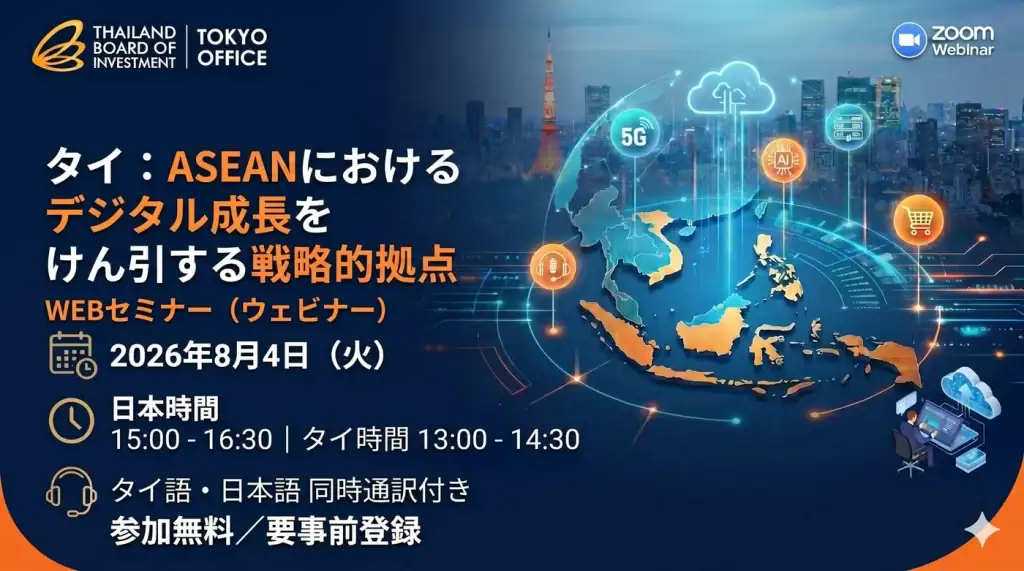
TOMAS TECH President & CEO Ryo Nozaki to Speak at BOI Tokyo Office Webinar “Thailand: A Strategic Hub Driving Digital Growth in ASEAN” (August 4, 2026)
TOMAS TECH CO., LTD. (headquartered in Bangkok, Thailand), a system integrator dedicated to helping Japanese manufacturing and logistics companies succeed in Thailand and across ASEAN, is pleased to announce that its President & CEO, Ryo Nozaki, will speak at the online webinar “Thailand: A Strategic Hub Driving Digital Growth in ASEAN,” hosted by the Thailand Board of Investment (BOI) Tokyo Office. The webinar will be held on Tuesday, August 4, 2026, and Mr. Nozaki will present a session titled “Case Studies: The Reality of Doing Business in Thailand” from 15:50 to 16:10 Japan Standard Time.
This webinar brings together the Thailand Board of Investment, the Digital Economy Promotion Agency (depa), and TOMAS TECH to give Japanese companies a clear, practical picture of why Thailand has become the strategic gateway for digital growth in Southeast Asia — and how to translate that opportunity into concrete business results. Drawing on TOMAS TECH’s direct, hands-on experience delivering digital transformation (DX), AI, and automation projects on the factory floor and in logistics operations across Thailand, Mr. Nozaki’s session is designed to move beyond high-level narrative and share what actually happens when a Japanese company builds and runs digital operations on the ground.
Participation is free of charge, with simultaneous Thai–Japanese interpretation provided throughout. Advance registration is required, and applications are handled by the BOI Tokyo Office. In this article, we introduce the background and purpose of the webinar, the full program, what to expect from Mr. Nozaki’s session, why Thailand deserves the attention of Japanese companies right now, and how TOMAS TECH supports companies entering and expanding in the Thai market.
About the Webinar: Thailand as ASEAN’s Emerging Digital Hub
For decades, Thailand has served as a reliable and trusted investment destination for Japanese companies. It has been the manufacturing heartland of Southeast Asia — the place where automotive, electronics, machinery, food, and chemical companies built factories, developed supply chains, and cultivated local talent. That legacy of trust remains intact. What is changing, and changing rapidly, is the nature of the opportunity. Thailand is no longer only a place to manufacture and sell; it is evolving into the regional hub for ASEAN’s digital infrastructure and next-generation technologies.
Demand for artificial intelligence, data centers, cloud services, fintech, and smart manufacturing is accelerating across the region, and Thailand sits at the center of that acceleration. The country is positioning itself not merely as a point of market access, but as a strategic gateway through which companies can implement digital solutions, scale innovation, and pursue cross-border business expansion. This is a meaningful shift in how Japanese companies should think about Thailand. The question is no longer simply “Should we build a factory there?” but “How can we make Thailand the base from which we drive digital transformation across all of ASEAN?”
The webinar is built around this shift. It is designed to help Japanese companies understand the concrete elements that make Thailand a genuine platform for digital growth: stable power supply and connectivity, hyperscale-ready data center development, expanding 5G networks, and a rapidly growing pool of digital talent. Combined with strong government support, attractive tax incentives, and a business-friendly regulatory environment, these elements make Thailand a true platform for leading digital transformation in ASEAN. The webinar will explain both the “why” — the strategic case for Thailand — and the “how” — the support systems, investment incentives, and real-world experiences that turn strategy into execution.
Crucially, the program balances policy and practice. Government and public-sector speakers will lay out the national digital transformation agenda and the specific investment incentives available to companies in the digital sector. Then TOMAS TECH will bring the perspective from the ground — what it is actually like to plan, build, and operate digital and automation projects in Thailand, including the practical realities that rarely appear in official presentations. This combination of top-down policy vision and bottom-up operational reality is what makes the session especially valuable for companies that are seriously evaluating Thailand or ASEAN as their next stage of growth.
It is worth pausing on why this framing represents such a meaningful evolution. For much of the past forty years, the case for Thailand rested primarily on cost, location, and a mature supplier ecosystem. Those advantages have not disappeared — but on their own they no longer capture the full opportunity. What the webinar sets out to communicate is that Thailand has added an entirely new dimension to its value proposition. The country is investing, at national scale, in becoming the place where digital capability is concentrated and from which it radiates across ASEAN. Companies that continue to view Thailand only through the lens of traditional manufacturing risk underestimating what is now possible there. The purpose of this event is to correct that outdated picture and to replace it with a more accurate, more ambitious one.
Equally important is the emphasis on cross-border thinking. The webinar does not present Thailand as an isolated destination but as a strategic gateway — a base from which digital initiatives can be extended to neighboring markets throughout Southeast Asia. This regional framing reflects how leading companies are increasingly organizing their operations: not country by country in isolation, but around hubs that concentrate infrastructure, talent, and capability and then serve a broader footprint. Understanding Thailand’s role as such a hub is central to the strategic message of the event, and it is a lens that runs through every session on the program.
Event Overview
- Event name: Web Seminar (Webinar) “Thailand: A Strategic Hub Driving Digital Growth in ASEAN”
- Host: Royal Thai Embassy, Office of Economic and Investment Affairs (BOI Tokyo Office)
- Date & time: Tuesday, August 4, 2026 — 15:00–16:30 Japan Standard Time (JST) / 13:00–14:30 Thailand time
- Format: Zoom webinar, with simultaneous Thai–Japanese interpretation
- Languages: Thai and Japanese (simultaneous interpretation provided)
- Participation fee: Free of charge (advance registration required)
- Registration deadline: Thursday, July 30, 2026
- How to register / inquiries: BOI Tokyo Office — Tel: (03) 3582-1806 / Email: [email protected] (advance registration via the official registration page)
- TOMAS TECH speaker: Ryo Nozaki, President & CEO, TOMAS TECH CO., LTD.
- TOMAS TECH session: 15:50–16:10 (JST) “Case Studies: The Reality of Doing Business in Thailand”
Because seating for this webinar is managed through advance registration, and because the registration deadline of July 30, 2026 arrives before the event itself, we strongly encourage anyone interested to complete their registration early through the BOI Tokyo Office. All registration is handled exclusively by the BOI Tokyo Office; please direct your application and any questions to the contact details listed above.
Program (Agenda)
The webinar runs for 90 minutes and is structured to move from context, to policy, to investment incentives, to real-world case studies, and finally to open dialogue. The full program (subject to change without notice) is as follows:
- 15:00–15:05 — Introduction (BOI Tokyo Office)
- 15:05–15:10 — Welcome Address (Royal Thai Embassy, Office of Economic and Investment Affairs / BOI Tokyo Office — Ms. Rachanee Wattanawisitporn, Minister-Counsellor [Economic and Investment])
- 15:10–15:30 — Lecture: “Thailand’s Digital Transformation (DX) and Its Support Framework” (Digital Economy Promotion Agency [depa], Digital Investment and Industry Promotion Department — Mr. Sakkawet Yoseng, Deputy Director-General)
- 15:30–15:50 — Lecture: “BOI Investment Incentives for the Digital Industry and Business Opportunities” (Thailand Board of Investment [BOI], Investment Promotion Division 4 — Ms. Thinapa Apaiwong, Director)
- 15:50–16:10 — Lecture: “Case Studies: The Reality of Doing Business in Thailand” (TOMAS TECH CO., LTD., President & CEO — Ryo Nozaki) — our session
- 16:10–16:30 — Q&A Session
This flow is deliberate. The opening sessions establish the national strategy and the institutional support behind Thailand’s digital ambitions — first the vision and support framework from depa, then the concrete investment incentives from the BOI. By the time Mr. Nozaki takes the floor, attendees will have a solid understanding of the policy landscape. His role is to connect that landscape to lived reality: to show, through actual case studies, what it takes to execute digital and automation projects in Thailand and to succeed there over the long term. The webinar then closes with a Q&A session, giving participants the chance to raise the specific questions most relevant to their own plans.
The speaker lineup itself signals the seriousness of Thailand’s digital agenda. The welcome address is delivered by Ms. Rachanee Wattanawisitporn, Minister-Counsellor (Economic and Investment) at the Royal Thai Embassy’s Office of Economic and Investment Affairs. The depa lecture is given by Mr. Sakkawet Yoseng, Deputy Director-General of the Digital Investment and Industry Promotion Department, who speaks to Thailand’s national DX strategy and the framework of support behind it. The BOI lecture is presented by Ms. Thinapa Apaiwong, Director of Investment Promotion Division 4, who addresses the specific investment incentives available to companies in the digital industry and the business opportunities they unlock. Together, these speakers represent the institutions actively shaping Thailand’s digital future — and TOMAS TECH is honored to share the program alongside them, contributing the practitioner’s view from the field.
Broad Institutional Backing
The significance of this webinar is reflected in the breadth of organizations that support it. The event is backed by a wide range of industry associations, public institutions, and financial organizations, including:
- Japan Embedded Systems Technology Association (JASA)
- Japan Information Technology Services Industry Association (JISA)
- Software Association of Japan (SAJ)
- Digital Content Association of Japan (DCAJ)
- ASEAN-Japan Centre
- Japan External Trade Organization (JETRO)
- Organization for Small & Medium Enterprises and Regional Innovation, Japan (SME Support, JAPAN)
- The Association for Overseas Technical Cooperation and Sustainable Partnerships (AOTS)
- Sumitomo Mitsui Banking Corporation (SMBC)
- MUFG Bank
- Mizuho Bank
- Shoko Chukin Bank
- Japan-Thailand Business Forum (JTBF)
The involvement of these industry associations, trade-promotion bodies, small- and medium-enterprise support organizations, and major financial institutions underscores just how much attention Thailand’s digital transformation is attracting among Japanese business stakeholders. It also reflects a shared recognition that the opportunity in Thailand spans companies of every size — from large enterprises to small and medium-sized businesses — and that access to the right information, incentives, and partners can make the difference for all of them.
Our Session: “Case Studies: The Reality of Doing Business in Thailand” (Ryo Nozaki, 15:50–16:10 JST)
The centerpiece of TOMAS TECH’s participation is the 20-minute session led by President & CEO Ryo Nozaki. While the policy and incentive sessions that precede it explain what Thailand offers on paper, Mr. Nozaki’s session is about what it feels like in practice — the reality of doing business in Thailand, told through concrete case studies rather than abstractions.
TOMAS TECH operates every day at the intersection of Japanese business expectations and the Thai operating environment. As a Bangkok-based system integrator serving Japanese manufacturing and logistics companies, the company has been on the front line of countless DX, AI, and automation initiatives — from production management system rollouts on the factory floor, to paperless digitization of on-site reporting, to the introduction of automated guided vehicles for material handling. That accumulated, hands-on experience is exactly what Mr. Nozaki will draw upon.
What to Expect
Attendees can expect a candid, practitioner’s view of what actually happens when a Japanese company sets out to build and operate digital systems in Thailand. Rather than a polished success story stripped of its rough edges, the session is intended to convey the real texture of on-the-ground project work: the expectations companies bring with them, the gaps that emerge between plan and reality, and the practical steps that make the difference between a project that stalls and one that delivers lasting value. The goal is to give the audience a mental model they can apply to their own situation — a sense of what to prepare for, what to prioritize, and where the true levers of success lie.
Key Takeaways
- The reality behind the headlines: how the strategic promise of Thailand — AI, cloud, smart manufacturing, Industry 4.0 — translates into concrete, day-to-day project work at real Japanese companies.
- Bridging Japanese expectations and the local environment: how to align the standards, precision, and quality expectations of a Japanese head office with the realities of on-site operations in Thailand.
- Common pitfalls and how to avoid them: practical lessons drawn from real projects, so that companies entering or expanding in Thailand can sidestep the mistakes others have already made.
- The importance of local, trilingual, hands-on support: why “genba”-level (on-site) presence and support in Japanese, Thai, and English is often the decisive factor in whether a DX or automation project succeeds.
- A realistic path forward: how to think about first steps, phasing, and partner selection when planning a digital or automation initiative in the Thai market.
For any company weighing a move into Thailand — or looking to deepen and modernize an existing Thai operation — this session is intended to be the practical counterpart to the strategic and policy content that comes before it. It is the part of the program where the big picture meets the shop floor.
There is a reason this kind of ground-level perspective is so hard to come by, and so valuable when it is available. Policy documents and incentive brochures describe a destination as it is designed to be. They are accurate and important, but they cannot capture the moment when a project team arrives on-site and begins the real work of turning intentions into a functioning system. That is where the details live — the coordination between a Japanese head office and a Thai operating team, the handoffs between planning and execution, the adjustments that every project requires once it meets reality. Companies that have already been through this understand how much depends on those details. Companies that have not yet begun often underestimate them. Mr. Nozaki’s session is designed to close that gap: to give first-time entrants a realistic preview, and to give experienced operators a point of comparison against their own experience.
The session also speaks directly to a question that sits at the heart of every cross-border project: how do you preserve the standards and quality culture of a Japanese organization while adapting to a different operating environment? This is not a matter of choosing one over the other. The best outcomes come from genuine alignment — where head-office expectations are clearly understood on-site, and where on-site realities are clearly understood back at head office. Achieving that alignment is difficult, and it rarely happens by accident. It is one of the recurring themes TOMAS TECH encounters in its work, and it is a thread that runs through the case studies Mr. Nozaki will share.
Why Thailand, and Why Now
The timing of this webinar is not incidental. Several forces are converging to make Thailand a uniquely compelling base for digital growth in ASEAN, and Japanese companies that understand these forces early will be best positioned to benefit. Below, we examine the key drivers in depth.
Accelerating Demand for AI, Data Centers, and Cloud
Across Southeast Asia, demand for artificial intelligence, data centers, cloud services, fintech, and smart manufacturing is rising sharply. This is not a distant, speculative trend; it is a present-day surge that is reshaping where and how companies deploy technology. Thailand has moved to meet this demand head-on, developing the physical and digital infrastructure needed to host and run advanced workloads. For companies that depend on AI and cloud-based systems — whether for analytics, quality control, predictive maintenance, or customer-facing services — the presence of robust local infrastructure changes the calculus entirely. It means the data and the compute can live close to the operation, reducing latency, improving reliability, and enabling new classes of application that were previously impractical.
Hyperscale-Ready Data Centers and Stable Connectivity
One of Thailand’s most significant advantages is its stable power supply and connectivity, combined with the development of hyperscale-ready data centers. For AI and cloud workloads, two things matter above almost all else: reliable electricity and dependable network connectivity. Thailand’s steady power infrastructure and its investment in large-scale data center capacity mean that companies can localize their cloud and data operations with confidence. This is the foundation for building regional data hubs — places where data from operations across ASEAN can be aggregated, processed, and put to work. For Japanese companies that have historically kept critical systems in Japan, the ability to establish a trusted, well-connected data presence in Thailand opens up new architectures for serving the entire region.
Expanding 5G Networks
The rollout of 5G networks is another critical enabler. High-speed, low-latency wireless connectivity is the backbone of modern smart manufacturing and IoT deployments. It allows factories to connect large numbers of sensors and devices, to move data in real time, and to support applications such as automated material handling, real-time production monitoring, and remote equipment management. As 5G coverage expands, the practical ceiling on what companies can automate and connect on the factory floor rises with it. For manufacturers pursuing Industry 4.0, this connectivity is not a luxury — it is the precondition for the entire model.
Smart Manufacturing and Industry 4.0
Thailand’s manufacturing base — long a strength — is now being upgraded through smart manufacturing and Industry 4.0 implementation. With the right infrastructure and support in place, companies can move quickly and confidently to introduce AI solutions, localize their cloud, build regional data hubs, and implement Industry 4.0 across ASEAN. For Japanese manufacturers, this represents a chance to bring the discipline and quality culture they are known for into a fully digitized, data-driven production environment. The combination of Thailand’s established manufacturing ecosystem and its new digital infrastructure creates fertile ground for exactly the kind of shop-floor transformation that turns efficiency gains into competitive advantage.
Strong Government Support and BOI Investment Incentives
Underpinning all of this is a strong framework of government support, attractive tax incentives, and a business-friendly regulatory environment. The Thailand Board of Investment plays a central role here, offering investment incentives specifically aimed at the digital industry. These incentives, along with a regulatory environment designed to make it easier to do business, materially lower the barriers to entry and expansion. This is precisely why the webinar dedicates a full session to BOI incentives for the digital sector: understanding what support is available, and how to access it, can significantly change the economics of a project. When strong policy backing is combined with world-class infrastructure, Thailand becomes not just an attractive option but a genuine platform for leading digital transformation across the region.
A Rapidly Growing Pool of Digital Talent
Finally, none of this infrastructure or incentive framework would matter without people to build and run the systems. Thailand’s rapidly expanding pool of digital talent is one of its most important assets. A growing base of skilled engineers, developers, and technical specialists means that companies can staff and sustain their digital operations locally, rather than relying entirely on expatriate teams or remote support from Japan. This local talent, combined with partners who can bridge language and cultural gaps, makes it realistic to build durable, self-sustaining digital operations in Thailand. It is the human foundation that turns the country’s strategic promise into something companies can actually operationalize.
Taken together — accelerating demand, hyperscale-ready data centers, stable power and connectivity, expanding 5G, smart manufacturing momentum, strong BOI-led incentives, and a deepening talent pool — these factors explain why Thailand is emerging as ASEAN’s strategic gateway for digital growth, and why now is the moment for Japanese companies to act. The window of opportunity is open, and the companies that move deliberately and well-informed will be the ones that capture the most value.
TOMAS TECH’s Thailand Business and Strengths
TOMAS TECH CO., LTD. is a Bangkok-based system integrator that provides DX, AI, and automation solutions to Japanese manufacturing and logistics companies. The company exists to help these companies unlock the full potential of the Thai market — not by handing over technology and walking away, but by working alongside them on-site, in their language, until real results are achieved. This is why TOMAS TECH is an especially fitting voice for this webinar: the company lives at the exact point where Thailand’s strategic promise meets the practical demands of the factory floor and the warehouse.
Six Business Domains
TOMAS TECH delivers end-to-end support across six core business domains, covering the full lifecycle of a digital initiative from initial consulting through long-term operation and improvement:
- AI & System Consulting: helping companies define the right problems to solve, evaluate options, and build a realistic roadmap for digital transformation.
- AI & System Design and Development: designing and building the systems and applications that turn a plan into a working solution.
- Operation, Maintenance, and Improvement: keeping systems running reliably and continuously improving them over time — the phase where lasting value is realized.
- FA, Automation, and Equipment Integration: connecting factory automation equipment and integrating it with digital systems to create a unified, controllable operation.
- IoT and Data Visualization: collecting data from equipment and processes and turning it into clear, actionable visibility for decision-makers on the floor and in management.
- Manufacturing and Logistics DX: driving digital transformation across production and logistics operations, from the shop floor to the warehouse.
This breadth matters. Digital transformation rarely fails because of a single missing technology; it fails at the seams — where consulting hands off to development, where systems meet physical equipment, where a go-live turns into daily operation. By covering all six domains, TOMAS TECH can own those seams and ensure that a project holds together from concept to sustained result. A company does not have to assemble and coordinate a patchwork of separate vendors, each responsible for one slice of the problem and none accountable for the whole. Instead, it can work with a single partner that understands how the pieces fit together and takes responsibility for the end-to-end outcome. For Japanese companies operating far from home, in a different language and business culture, that single point of accountability is often worth as much as any individual technology.
Solutions and Packages
TOMAS TECH brings a portfolio of proven solutions and packages to bear on its clients’ challenges:
- PEGASUS production management system: a production management solution that gives manufacturers real visibility and control over their production operations.
- i-Reporter and package implementation support: supporting the introduction of tools such as i-Reporter to digitize on-site reporting and eliminate paper-based processes on the factory floor.
- AGV / AMR transport automation (HIKROBOT): introducing automated guided vehicles and autonomous mobile robots to automate material handling and internal transport.
- Generative AI adoption: helping companies put generative AI to practical use, including AI adoption training, AI-OCR, and chatbots, so that teams can capture the benefits of AI in their everyday work.
These solutions are not isolated products; they are building blocks that TOMAS TECH combines according to each client’s needs. A production management rollout with PEGASUS can be paired with IoT-based data visualization to turn shop-floor data into real-time insight. Paperless on-site reporting through tools such as i-Reporter removes the friction and error of manual, paper-based processes and feeds cleaner data into the systems that depend on it. AGV and AMR transport automation, using proven HIKROBOT hardware, takes on the repetitive movement of materials so that people can focus on higher-value work. And generative AI — through practical applications such as AI adoption training, AI-OCR for extracting information from documents, and chatbots — helps teams work faster and smarter in their everyday tasks. Because TOMAS TECH understands both the technology and the manufacturing and logistics context in which it is deployed, it can assemble these elements into a coherent whole rather than a collection of disconnected tools.
Trilingual, Hands-On Support
Perhaps TOMAS TECH’s most distinctive strength is the way it supports its clients. The company provides support in Japanese, Thai, and English, with local staff who accompany clients throughout the project — a genuine hands-on, side-by-side model of engagement. In a cross-border setting, language and cultural alignment are not peripheral conveniences; they are frequently the deciding factor in whether a project succeeds. A Japanese head office needs to be understood in Japanese. A Thai operating team needs to be engaged in Thai. And global standards and documentation often live in English. TOMAS TECH bridges all three, which is why the company can align a Japanese head office’s expectations with the realities of the Thai operating environment — one of the recurring themes in Mr. Nozaki’s webinar session.
Mission: Maximizing “Genba” Productivity
Everything TOMAS TECH does is guided by a single mission: to maximize the productivity of the “Genba” — the front line, the shop floor, the place where real work happens — through the power of technology. This mission keeps the company grounded. Technology is never the goal in itself; it is a means to make the people who do the actual work more productive, more effective, and more empowered. This philosophy is exactly why TOMAS TECH’s perspective is so valuable to companies considering Thailand: the company measures success not by how impressive a system looks, but by how much it improves what happens on the ground, every day.
This “Genba”-first orientation shapes every stage of an engagement. It means that consulting begins with listening to the people who do the work, not with prescribing a predetermined solution. It means that systems are designed to fit the way a factory or warehouse actually operates, rather than forcing the operation to bend around the system. And it means that success is judged over time, in daily use, by whether the people on the front line find their work genuinely easier and more productive. This is the standard TOMAS TECH holds itself to, and it is the lens through which the company’s case studies should be understood. When Mr. Nozaki speaks about the reality of doing business in Thailand, he speaks from a company whose entire reason for existing is to make that reality work — for the people on the ground, and for the businesses that depend on them.
Who Should Attend
This webinar is designed for decision-makers and practitioners who are thinking seriously about Thailand and ASEAN as a stage for growth and digital transformation. In particular, it will be valuable for:
- Japanese companies considering entry into Thailand: those evaluating whether and how to establish operations in Thailand, who want a realistic understanding of both the opportunity and the practical realities before committing.
- Companies pursuing DX across ASEAN: organizations that see Thailand as a potential hub from which to drive digital transformation across the wider region, and want to understand the infrastructure, incentives, and support available.
- Manufacturers and logistics companies pursuing on-site DX and automation: those looking to modernize the factory floor and warehouse through production management, IoT and data visualization, factory automation, AGV/AMR transport automation, and generative AI.
- Companies already operating in Thailand that want to modernize: existing Thai operations that are ready to take the next step in digitization, automation, and AI adoption, and want to learn from real-world case studies.
- Anyone seeking the practical reality, not just the strategy: professionals who value candid, experience-based insight into what it actually takes to succeed with digital projects in Thailand.
Because the program pairs high-level policy and incentive content with grounded, practitioner-level case studies, it serves both those who are early in their thinking and those who are already deep into planning or execution. Whether you are asking “Is Thailand right for us?” or “How do we make our existing Thai operation smarter and more productive?”, the webinar is built to help you answer that question with confidence.
It will also be valuable for professionals in supporting roles — corporate planning, overseas business development, IT and DX leadership, and manufacturing engineering — who are responsible for evaluating regional strategy and building the business case for investment. For these stakeholders, the webinar offers a concise, authoritative briefing on the policy environment, the available incentives, and the operational realities, all in a single 90-minute session with Japanese interpretation. That combination is difficult to assemble from separate sources, which is part of what makes this event worth attending live.
How to Join
Joining the webinar is straightforward, but advance registration is required and the deadline arrives before the event, so we encourage you to act early.
- Cost: Free of charge.
- Registration: Advance registration is required. Please register through the BOI Tokyo Office’s official registration process.
- Deadline: Thursday, July 30, 2026.
- Register / inquire via the BOI Tokyo Office: Email [email protected] or call (03) 3582-1806.
- Interpretation: Simultaneous Thai–Japanese interpretation is provided, so you can participate comfortably in Japanese.
Please note that all registration and access arrangements are handled by the BOI Tokyo Office. To register, contact the BOI Tokyo Office directly using the email address or telephone number above and follow their official registration process. We recommend completing your registration well before the July 30, 2026 deadline to secure your place.
Contact TOMAS TECH
If Mr. Nozaki’s session sparks questions about your own situation — whether you are considering entering the Thai market, planning DX across ASEAN, or looking to modernize an existing operation with production management, IoT, factory automation, AGV/AMR, or generative AI — the TOMAS TECH team would be glad to talk. As a Bangkok-based system integrator with trilingual, on-site support in Japanese, Thai, and English, we help Japanese manufacturing and logistics companies turn the strategic promise of Thailand into concrete, measurable results on the ground.
We invite you to attend the webinar on August 4, 2026, hear real case studies from Thailand, and then reach out to continue the conversation. To learn more about how TOMAS TECH can support your digital transformation, AI adoption, and automation initiatives in Thailand and across ASEAN, please contact us via our website: https://tomastc.com/contact/.
Thailand’s transformation into ASEAN’s strategic hub for digital growth is not a distant prospect; it is happening now, and the companies that engage with it early and thoughtfully will be the ones best positioned to lead. This webinar is a rare opportunity to hear directly from the institutions shaping that transformation — the BOI and depa — and from a practitioner who works within it every day. Whether your interest is strategic or immediately practical, we believe the 90 minutes on August 4, 2026 will be time well spent. Register early through the BOI Tokyo Office, join us for the session, and let us help you turn Thailand’s opportunity into results you can measure.
We look forward to seeing you at the webinar — and to helping you maximize the productivity of your “Genba” through the power of technology.


