


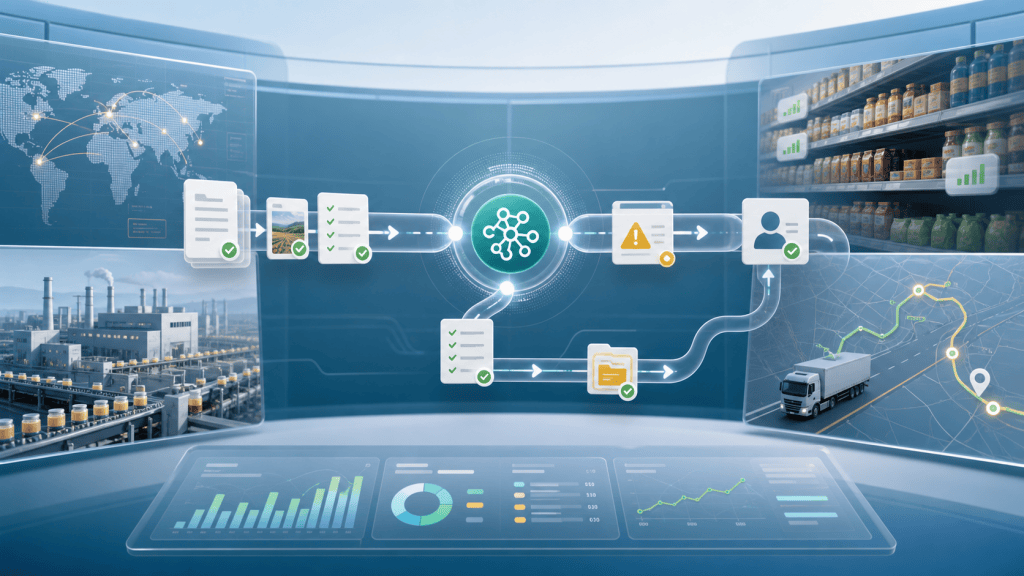
AI Agents Need an Operations Evidence Layer: A July 19, 2026 Business Memo
As of July 19, 2026, the center of gravity in AI has moved again. The important shift is no longer better chat output. It is the expansion of supervised AI agents that can push work forward for 30 minutes, one hour, or several hours at a time.
OpenAI reported on June 2, 2026 that Codex was becoming a productivity tool for knowledge work beyond software development. Then, on June 25, 2026, OpenAI published stronger evidence: longer-horizon usage was rising, non-developer adoption was accelerating, and agentic work was spreading across departments. Anthropic’s June 16, 2026 research on Claude Code added a second operational signal: domain expertise matters more than raw coding skill when people are trying to succeed with agentic systems. Stanford HAI’s 2026 AI Index added the third signal: AI capability and adoption are moving faster than the frameworks used to evaluate, govern, and understand these systems.
Put together, these signals point to one practical conclusion. The real question is no longer whether an AI system sounds impressive. The real question is what an AI agent saw, what evidence it used, which constraints it respected, and when it handed the task back to a human.
Why an operations evidence layer matters now
An operations evidence layer is the structure around the agent, not just the output from the agent. It records:
- what the task was supposed to finish
- which documents, logs, or datasets were used
- which rules or constraints were enforced
- which exception conditions were detected
- what was handed to a human reviewer and why
Many AI pilots stall for a simple reason: the team tries to scale output before it can inspect process. In a live operating environment, business leaders do not only need answers. They need re-checkable reasoning, traceable inputs, controllable escalation, and usable handoff packets.
That requirement gets stronger as tasks get longer. OpenAI’s June 25 report showed that by May 2026, many Codex users were already assigning work estimated to take more than one hour, and a meaningful share were assigning work beyond eight hours. Anthropic’s Claude Code research showed that the most successful users were not necessarily the best programmers; they were often the people who understood the problem domain well enough to direct and review the agent effectively. That is exactly why an evidence layer matters: it turns domain knowledge into operating leverage.
What Codex and Claude Code signal to business operators
It is a mistake to read Codex and Claude Code only as developer tools. Their broader value is that they reveal a new operating pattern:
- accept a meaningful goal
- gather context across files or systems
- act within explicit constraints
- verify progress and return the task cleanly
That pattern transfers well into manufacturing, logistics, food, and retail. The best near-term use cases are rarely free-form content generation. They are usually exception-heavy workflows, cross-document checking, decision preparation, and brittle handoffs between teams.
In practice, four fields stabilize deployment:
- `goal`: what must be completed
- `evidence`: what source material must support the work
- `constraints`: what the agent may and may not do
- `handoff`: when the task returns to a person, and with what next step
Industry implications
Manufacturing
The June 12, 2026 FactoryLLM paper is useful because it frames an industrial problem correctly. Smart factories do not merely need a chatbot. They need systems that can reason across many machine manuals and maintenance documents without leaking sensitive data, and they need evaluation methods that show whether the reasoning is grounded.
That points to a realistic first use case: not autonomous plant control, but evidence-backed abnormality triage and maintenance investigation support. An agent can read shift notes, equipment alerts, SOPs, and prior stoppage records, then prepare an escalation packet for a supervisor. In this workflow, traceability matters more than fluency.
Logistics
Supply chain disruption monitoring research suggests that agentic systems are useful not only because they can detect disruption signals from external sources, but because they can map those signals into multi-tier networks, identify affected nodes, and propose response paths. That is a strong fit for logistics, where visibility gaps often create late and expensive decisions.
The 2026 OptiRepair work extends the same lesson into optimization workflows. Even where AI is not making the final decision, it can help diagnose infeasible models, surface rule conflicts, and prepare repair options. The business value is not blind automation. It is faster, more inspectable exception resolution.
Food
The July 10, 2026 food formulation paper is a timely reminder that AI becomes more valuable when constraints are explicit. Food formulation is never just about ideation. It has to balance nutrition, cost, sustainability, allergen risk, ingredient availability, and regulatory requirements.
That makes food a strong candidate for constrained agents. A practical agent does not replace product developers. It assembles candidate formulations, highlights missing information, organizes tradeoffs, and shows which inputs drove each recommendation. In food, evidence is not overhead. It is part of product safety and speed.
Retail
The April 7, 2026 Flowr paper describes an agentic architecture for supermarket supply chain operations in which specialized agents work under human supervision. That is important because retail operations involve high-frequency coordination across forecasting, procurement, replenishment, and supplier communication. The same period also produced stronger field evidence that generative AI can improve sales and conversion in online retail.
Still, the highest-value retail use cases are not “automate everything.” They are workflows such as inventory exceptions, promotion readiness, store-to-HQ escalation, and supplier-facing decision packets. Retail wins when AI reduces coordination drag before the manager makes the call.
A 90-day operating playbook
If this is the current trend, the next 90 days should focus less on model shopping and more on workflow design.
1. In the first 30 days, select three recurring tasks that usually take more than 30 minutes and involve repeated exception handling. 2. In the next 30 days, define `goal`, `evidence`, `constraints`, and `handoff` for each workflow. 3. In the final 30 days, measure decision-preparation time, rework reduction, and handoff quality, not just output volume.
This sequence turns AI pilots into operating experiments instead of demo theater.
Summary
The key AI trend on July 19, 2026 is not simply that agents are getting stronger. It is that business value is shifting toward agents that can move work forward with inspectable evidence and controlled escalation. OpenAI’s Codex reports, Anthropic’s Claude Code usage research, and Stanford HAI’s evaluation warning all support the same conclusion.
For manufacturers, logistics operators, food businesses, and retailers, the next competitive edge is not full autonomy on day one. It is the ability to build an operations evidence layer that lets AI agents accelerate decision preparation without weakening accountability.
FAQ
What is the difference between an AI agent and a normal generative AI tool?
A normal generative AI tool often stops at one answer. An AI agent works toward a goal through multiple steps, including context gathering, action, verification, and handoff.
Why is an operations evidence layer important now?
Because tasks are getting longer and more cross-functional. Once AI starts doing multi-step work, teams need to know what sources were used, which rules were applied, and why a recommendation was made.
What is a safe first manufacturing use case?
Start with abnormality triage, maintenance draft support, or audit-ready investigation packets. These are evidence-rich workflows where a human can keep the final decision.
Which KPIs matter most in logistics and retail?
Look beyond response speed. Track earlier exception detection, lower rework, shorter decision-preparation time, and better handoff quality.
What is the key caution for food businesses?
Do not let an agent operate without explicit allergen, regulatory, sourcing, and quality constraints. In food, constraint-first design is safer than free-form generation.
References
- OpenAI, “Codex is becoming a productivity tool for everyone,” June 2, 2026
- OpenAI, “How agents are transforming work,” June 25, 2026
- Anthropic, “How Claude Code is used in practice,” June 16, 2026
- Stanford HAI, “2026 AI Index Report”
- Pulse et al., “FactoryLLM: A Safe and Open-Source AI Playground for Evaluating LLMs in Smart Factories,” June 12, 2026
- AlMahri et al., “Automating Supply Chain Disruption Monitoring Via an Agentic AI Approach,” January 14, 2026
- Ao et al., “OptiRepair: Closed-Loop Diagnosis and Repair of Supply Chain Optimization Models with LLM Agents,” February 22, 2026
- Tac and Kuhl, “Artificial Intelligence and the Generative Science of Food Formulation,” July 10, 2026
- Bandara et al., “Flowr — Scaling Up Retail Supply Chain Operations Through Agentic AI in Large Scale Supermarket Chains,” April 7, 2026
- Fang et al., “Generative AI and Firm Productivity: Field Experiments in Online Retail,” 2025 working paper page accessed July 19, 2026


