


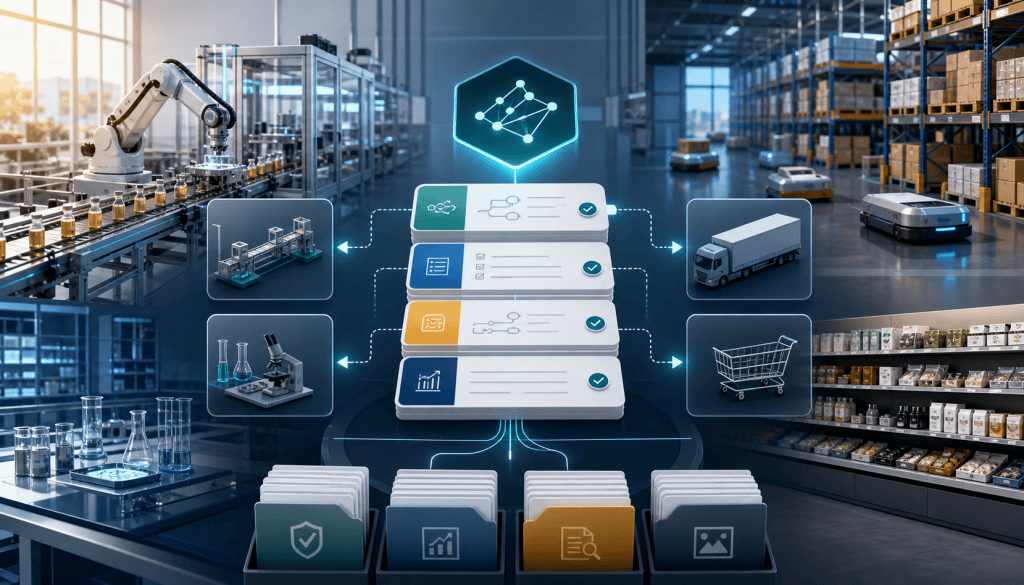
AI Agents Are Moving to Long-Horizon Work: A July 18, 2026 Operations Memo
As of July 18, 2026, the most important AI trend is no longer faster chat answers. The real shift is that companies are starting to delegate 30-minute to multi-hour business tasks to supervised AI agents. OpenAI’s June 25, 2026 Codex study showed that longer agentic workflows can compress task time substantially, but only when goals, review points, and constraints are explicit. Anthropic’s Claude Code documentation points in the same direction with its gather-context, take-action, and verify loop.
That changes the business question. The question is not whether AI sounds smart. The question is which work package can be delegated, under which constraints, with what evidence, and when a human must step back in. That is especially relevant for manufacturing, logistics, food, and retail, where operating discipline matters more than demo quality.
How to read the 2026 AI signal
The Stanford HAI 2026 AI Index shows a familiar pattern: adoption keeps rising, but operational readiness is uneven. Many firms now use AI somewhere in the business, yet fewer have clear exception handling, audit trails, or escalation design. This is where agent-style systems such as Codex and Claude Code matter.
The practical trend is that generative AI value is moving from content generation to work progression. A common mistake is to stop at summarization, FAQ drafting, or generic assistants. Those use cases are easy to demo, but they rarely change business throughput. The higher-value targets are usually:
- cross-system checking work
- exception-heavy workflows with known rules
- evidence gathering before a human decision
- daily operations that fail when handoffs are weak
These are long-horizon tasks. AI agents do not need to replace humans. They need to move the work forward in a structured way.
What Codex and Claude Code signal to operators
Codex is not just a code generator. Its operating model accepts a large task, forms a plan, gathers context, performs actions, and carries state until there is a usable outcome. That pattern transfers well beyond software engineering into business analysis, documentation, operations coordination, and internal reporting.
Claude Code signals the same thing from a different product angle. The important lesson is not the tool name. The lesson is that delegated work is becoming an operating unit, not just a prompt.
For business deployment, four fields matter most:
- `goal`: what must be finished
- `constraints`: what the agent may and may not touch
- `evidence`: which source material or logs must support the output
- `handoff`: when the task must return to a human and with what next step
When those four items are weak, teams often blame model quality for what is really a workflow design failure.
What this means by industry
Manufacturing
Recent smart manufacturing research argues that AI works best when it is tied to process knowledge, equipment constraints, and operational data instead of being treated as a free-form assistant. In manufacturing, the best first step is usually not autonomous control. It is exception sorting, maintenance draft planning, and audit-ready documentation support.
A strong long-horizon workflow is this: read daily production notes, detect abnormal signals, pull the relevant maintenance instructions, compare against prior stoppage records, and return an escalation packet for a supervisor. Accuracy matters, but evidence-backed escalation matters more.
Logistics
The January 14, 2026 supply chain monitoring paper shows why agentic AI matters in logistics. The value is not just detecting disruption news. The value is estimating which customers, nodes, routes, or SKUs are likely to be affected first.
Logistics work often spans customs, transport, warehousing, and customer communication. Humans become the integration layer by default. AI agents can reduce that burden by reading across those signals, assembling a situation brief, listing alternatives, and surfacing only the decisions that require a manager.
Food
The July 10, 2026 food formulation paper is useful because it is optimistic and cautious at the same time. Generative AI can accelerate knowledge search and concept generation, but safety, regulation, allergen logic, and sensory validation remain non-negotiable.
That makes food a strong use case for constrained agent workflows. A realistic pattern is to lock cost, allergen, ingredient availability, nutrition targets, and market rules first, then let an AI agent generate candidate directions and identify missing information. The long-horizon value is not writing copy. It is navigating many constraints quickly.
Retail
Retail evidence in 2026, including Flowr and online retail productivity research, suggests that AI value is broader than customer support. Important use cases sit inside promotion preparation, stock exception management, store-to-HQ coordination, and recurring decision support.
One high-value pattern is to ingest store exceptions, compare them against inventory, campaign timing, and prior actions, then prepare a decision packet for managers. Retail benefits when AI improves decision readiness, not when it pretends to make every decision itself.
A 90-day adoption runbook
If this is the current trend, the first 90 days should focus more on runbook design than on model comparison.
- In the first 30 days, identify three recurring tasks that normally take more than 30 minutes.
- In the next 30 days, standardize `goal`, `constraints`, `evidence`, and `handoff` for each workflow.
- In the final 30 days, measure exception visibility, rework reduction, and handoff quality instead of raw output volume.
This sequence makes pilots harder to dismiss as demos. The opposite pattern, trying to scale immediately or automate end-to-end from day one, usually creates distrust faster than value.
Summary
On July 18, 2026, the center of gravity in AI is shifting from fast answers to delegated long-horizon work. Codex and Claude Code both point there. For manufacturers, logistics operators, food businesses, and retailers, the winning move is not to treat AI as a magic decision engine. It is to use AI agents as constrained operators with clear evidence and escalation paths.
From a Tomas Tech point of view, the next winners will not be the firms that chase every new model release. They will be the firms that can convert long business tasks into runbooks that AI agents and humans can share.
FAQ
What is the difference between an AI agent and a normal generative AI tool?
A normal generative AI tool often stops at a single answer. An AI agent works toward a goal through multiple steps, including context gathering, action, and verification. That difference matters in operations.
Why are Codex and Claude Code relevant outside software teams?
Because they demonstrate a practical operating pattern for delegated work: define the goal, gather context, act within constraints, and verify before handoff. That pattern also fits quality, supply chain, and commercial workflows.
What is a safe first manufacturing use case?
Start with abnormality triage, maintenance recommendation drafts, or audit record preparation. These are evidence-rich workflows where a human can still make the final decision.
What is the key caution for food businesses?
Do not let AI operate without explicit safety, allergen, regulatory, and sourcing constraints. Food workflows benefit from faster option generation, but they still require disciplined guardrails.
Which KPIs make sense in logistics and retail?
Look beyond response speed. Measure earlier exception detection, less rework, shorter decision-preparation time, and better handoff quality.
References
- OpenAI, “Introducing Codex,” May 16, 2025
- Anthropic, “Overview – Claude Code Docs”
- Stanford HAI, “2026 AI Index Report”
- Johnston et al., “The Shift to Agentic AI: Evidence from Codex,” Jun 25, 2026
- Lee et al., “2026 Roadmap on Artificial Intelligence and Machine Learning for Smart Manufacturing,” Apr 5, 2026
- AlMahri et al., “Automating Supply Chain Disruption Monitoring via an Agentic AI Approach,” Jan 14, 2026
- Tac and Kuhl, “Artificial Intelligence and the Generative Science of Food Formulation,” Jul 10, 2026
- Bandara et al., “Flowr — Scaling Up Retail Supply Chain Operations Through Agentic AI in Large Scale Supermarket Chains,” Apr 7, 2026
- Fang et al., “Generative AI and Sales Productivity: Field Experiments in Online Retail,” revised Jun 29, 2026


